Kingfisher: building value

Welcome to the latest in our new series of short-format Stock Pitches. Graham recently looked at microfinance firm ASA International – today I’m going to look at a quite different business, FTSE 100 home improvement retailer Kingfisher (LON:KGF).
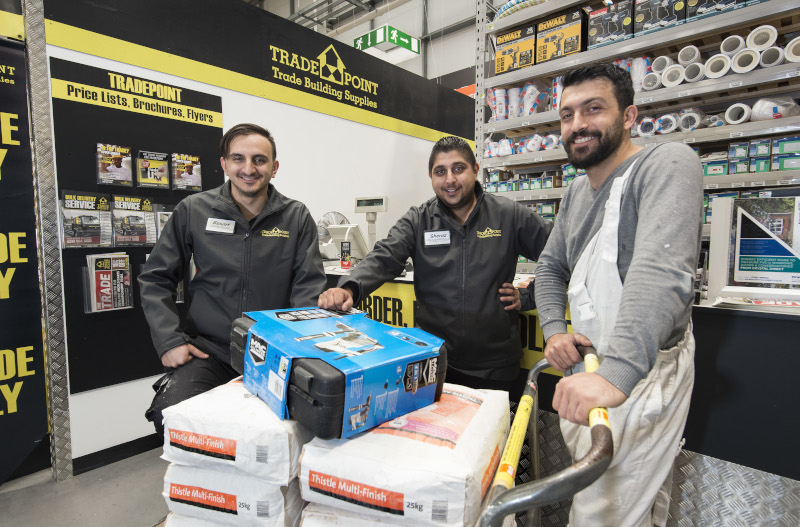
Image: Kingfisher plc
The Pitch
Kingfisher owns UK retailers B&Q and Screwfix, plus similar businesses in France and Poland operating under the Brico Dépôt and Castorama brands.
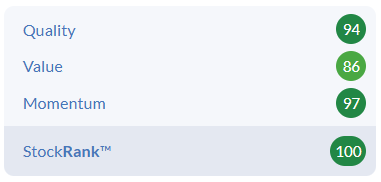
This mature and unglamorous business currently boasts a rare StockRank of 100. Kingfisher has also outperformed the FTSE 100 over the last year and is a member of Ed’s 2026 NAPS portfolio.
Recent trading has been ahead of expectations in difficult markets. Broker forecasts have edged higher since the summer. Changes made by CEO Thierry Garnier appear to be delivering much-needed operational improvements and positioning the group for longer-term growth.
The Big Picture
Kingfisher is associated in many investors’ minds with B&Q DIY stores and similar retail businesses in France. These are rightly seen as mature, slow-growing businesses. However, CEO Garnier is using the company’s scale, store networks and brand strength to expand market reach and grow profits ahead of sales:
Trade: Screwfix is popular with trade customers and has long been one of the group’s fastest-growing brands. B&Q’s own Tradepoint offering is also growing fast. Total trade sales rose by 12% in H1 and now represent 28% of group sales. Garnier says that trade customers “visit 3x more often and spend 3x more per visit”. This trade strategy is being applied across all Kingfisher’s geographic markets.
Online: ecommerce revenue rose by 11% in H1 and now accounts for 20% of group sales. Kingfisher stores carry large product ranges which have been expanded further through the addition of a third-party marketplace. Selling online attracts buyers who would not visit stores, while the stores themselves can be used for order fulfilment.
Advertising: online sales provides a treasure-trove of customer data. This is being used to develop a “retail media” advertising business for suppliers and vendors. Kingfisher’s medium-term target is for ad revenue to reach “up to 3% of ecommerce sales” – potentially c.£85m based on current sales. Garnier describes this as a “highly profitable income stream”.
Efficiency: Kingfisher’s large scale and portfolio of own brands provide opportunities for cost savings and efficiency gains that should boost profit margins.
Going Deeper
Kingfisher’s appeal as an investment is enhanced by robust financials and a longstanding policy of providing attractive shareholder returns:
Free cash flow: customers pay for the purchase of faster-moving stock items before Kingfisher needs to pay its suppliers. This helps to limit working capital requirements and supports strong cash generation. Free cash flow is reinvested in the business and used to fund shareholder returns.
Balance sheet: Kingfisher has £2.2bn of lease liabilities, but the group maintains a net cash position excluding leases. This policy provides the flexibility to support long-term planning, while interest income helps to limit finance costs. Over time, I believe this should benefit shareholders.
Shareholder returns: Kingfisher has a good track record of dividend payments and offers a forward yield of 3.9%. The group is also buying back its own shares. With the stock trading below book value, I believe this is likely to create value for shareholders. Buybacks added 4% to H1 earnings during the current financial year.
Valuation: a forward P/E of c.13 is broadly in line with the long-term average for this stock. A combination of rising profits and buyback-driven EPS growth could support a higher share price, without the valuation becoming too stretched.
What The Brokers Say
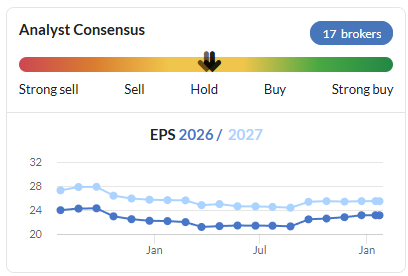
As a FTSE 100 business, Kingfisher benefits from broad broker coverage. The StockReport shows 17 brokers covering the shares.
Upgrades: earnings forecasts for the FY26 and FY27 have both been upgraded by nearly 10% since August. Our research has found that positive earnings momentum often leads to further upgrades as analysts follow the upward curve of management guidance.
Neutral view: despite upgrading estimates, brokers have a Hold rating and average share price target of 309p for Kingfisher – slightly below current levels. Again, this may hint at the potential for upgrades.
The Bear Case
Kingfisher lacks the defensive characteristics of larger retailers such as supermarkets. It’s unavoidably cyclical, with exposure to both consumer spending and housing market conditions.
Cautious outlook: Kingfisher’s 2025 survey data shows that the number of consumers planning to carry out home improvement projects has fallen over the last year, amid growing caution about personal finances. In trade, activity levels are good and confidence in future workloads is high, albeit slightly lower than one year ago.
No long-term growth: this business operates in mature markets where growth depends at least in part on taking market share from rivals. Kingfisher’s sales growth has averaged just 2% over the last 10 years, while FY25 operating profit was lower than in 2016. At the time of writing, Kingfisher’s share price is the same as it was 10 years ago.
Declining profitability? This is a low-margin retailer with a fairly large cost base. While Mr Garnier may be able to rebuild margins to pre-Covid levels of c.6%, this improvement may come partly through one-time efficiency gains. I am not sure this business will ever deserve to trade on a high earnings multiple.
The Bottom Line
While Kingfisher’s cyclical exposure may mean it’s better suited for trading than as a long-term hold, I believe the group’s recovery has further to go and may offer an opportunity for continued gains.
A return to a c.6% operating margin could imply a 40%+ rise in operating profit from 2025 levels. Strong cash generation should also continue to support attractive dividends and buybacks.
When combined, I believe these factors could lift the shares to new highs without stretching the valuation of this market-leading retailer.
Disclaimer
This is not financial advice. Our content is intended to be used and must be used for information and education purposes only. Please read our disclaimer and terms and conditions to understand our obligations.

11 comments
Thanks, I guess you are right
Why does Stockopedia quote the Kingfisher (LON:KGF) PE ratio as 14.1 wheras both my stockbrokers say it is 34?
There's a big difference between reported and adjusted numbers for both 2025 and TTM EPS. I guess that your stockbrokers are going off the reported numbers.
I bought kingfisher January 2025 (Using Stockopedia metrics) and still hold (Using Stockopedia metrics!) Return to date is 40%. I don’t worry about the story or reasons for the ratings I just take them at face value and it has served me well.
I am still holding too, sitting on a nice profit but I have a tight alert in case of a reversal
We've recently moved house . My other half has a long list of improvements for me to implement, and looking briefly at the list, I think I'll single highhandedly be responsible for a significant increase in turnover at Screwfix. Time to buy/add now?
(disclosure: I hold)
Screwfix is the main business here and it's no longer just a trade outlet. Most customers are DIY. B&Q stores are tired and badly need work on them. They've benefitted in the last year as Homebase went bust meaning both Kingfisher and Wickes picked up their business which no doubt was not in the original forecasts.
Round my way at least there are plenty of Screwfix branches, but more Toolstation's (owned by Travis Perkins) have opened up in the last couple of years. It looks like Screwfix have double the number of branches as Toolstation currently, but the possibility of Toolstation opening up more and taking trade away must be a real possibility.
Meanwhile, in the reatil space I find B&Q a throughly dismal experience. The only advantage it has over Wickes (in my area at least) is the breadth of products.
Held these for quite a while.
Funny story - in the late 90's I worked for a competitor to B&Q and proposed to the board that we should look at this little up and coming business called "Screwfix Direct", I suggested that it was a potential bolt on to the stores business and would be a steal at anywhere from 50 - 90 million. They told me I was wrong and it would never amount to anything.
Six months later Kingfisher bought Screwfix Direct for £60m, today it has a net worth of circa £500m and sales in excess of £2.7b. The original family that owned Screwfix went on to start another business called Toolstation.
The business I worked for no longer exists!
I'm not entirely sure why this has a stock rank of 100 - or even anywhere near that. It's not especially cheap on a PE of 13, momentum looks fairly average with earning forecast largely flat, while quality metrics such as ROCE and margins don't look anything special either. Would be interested to know exactly what's driving this perfect stock rank as I fail to see it myself!
Me too. It would be interesting to see the rational for this stock ranking.