New Year NAPS - Top Stocks for 2026 and Why Value Investing Still Matters

It's been quite an eventful year in markets. Most of the market-moving headlines came from across the pond with the Trump tariff tumble in April this year and the huge AI investment theme that's turned heads - bubble or not.
Against that backdrop, many investors have given up on UK shares. We continue to see a drip drip of delistings, either to relist in the USA or to takeover bids. And there’s very little IPO activity to refill the hopper. It all feeds the same narrative - that the UK is shrinking, unloved, and best avoided.
Nonetheless, this sort of environment is manna from heaven for a value investor. And it's in this climate that my own systematic UK Model Portfolio, the NAPS, has had another remarkable year with a 37% capital return. This return has dominated the UK indices and the S&P 500 once again.
So in this piece, now something of an annual tradition, I want to share three things.
- First, we’ll dig into what’s driven the excellent results over the past year.
- Next, we’ll step back and revisit the core investing principles.
- Then, we’ll lay out the 2026 portfolio rules and the current candidate stocks.
I can’t predict what will happen in 2026, but I do think we all need a reminder that having the courage to apply sound Value Investing principles pays off - wherever you invest in the world.
If you prefer to watch rather than read, I will be running a deep-dive NAPS educational webinar on the 22nd January. The NAPS is a great “starting system” - but the real value comes if you understand why it’s worked, where it breaks, and how you might sensibly adapt it to your own needs. Please do join then. I will run over the 11-year history, all the principles, and the new portfolio. You can sign up here at this link.
The headline: NAPS returned 37% in 2025
The 2025 NAPS portfolio delivered 36.8% capital appreciation, with approximately 3.5% of dividends on top. That puts it firmly into the “standout year” category. The FTSE 100 rose 20% with the All Share close behind, while the FTSE Small Cap rose 6.5% and the AIM All Share 6%. It's worth noting that the S&P 500 was up 16%.
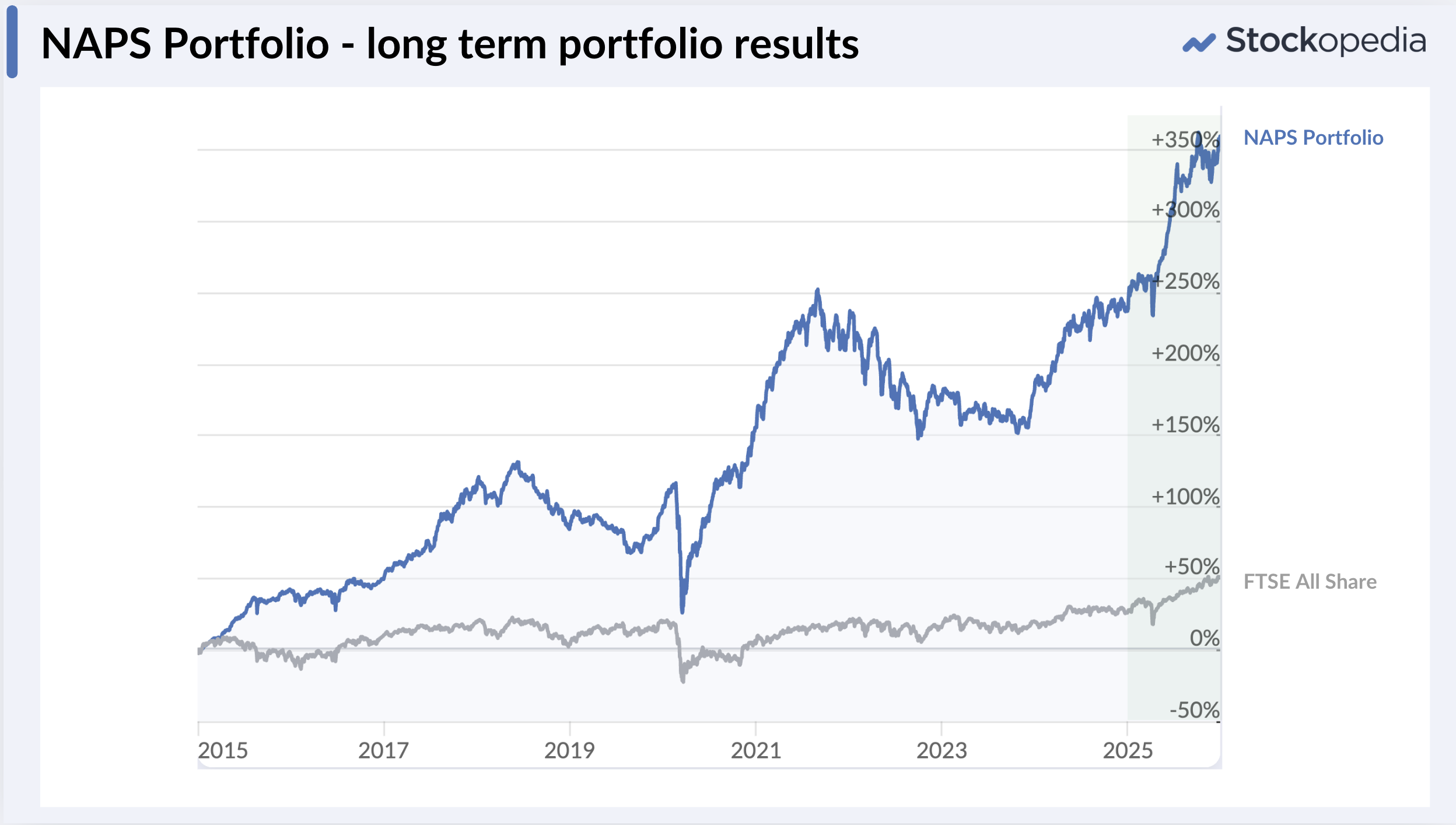
What’s striking is how this sits in the longer history (do review last year’s 10 year review here):
- This would rank as the third best year in the NAPS 11-year track record.
- Six of those years have returned more than 20%.
- The worst calendar year drawdown was -16%.
- The annualised performance is now 15%.
The 363% capital return over this period is such a good reminder of how powerful compounding can be over the long term. A strategy that works doesn’t work every year. It works over time.
Many subscribers commented in last week's 2025 review of winners and losers across the StockRank spectrum that they have had an outstanding year with some stating returns of 40% or more. Though as we’ll see performance was often sector specific - so don’t be disheartened if your returns were more moderate. We need to also remember that markets don't go straight up and every two or three years there is often a nasty drawdown. I am though quite optimistic for the year ahead in UK shares - which I hope is not a warning sign.
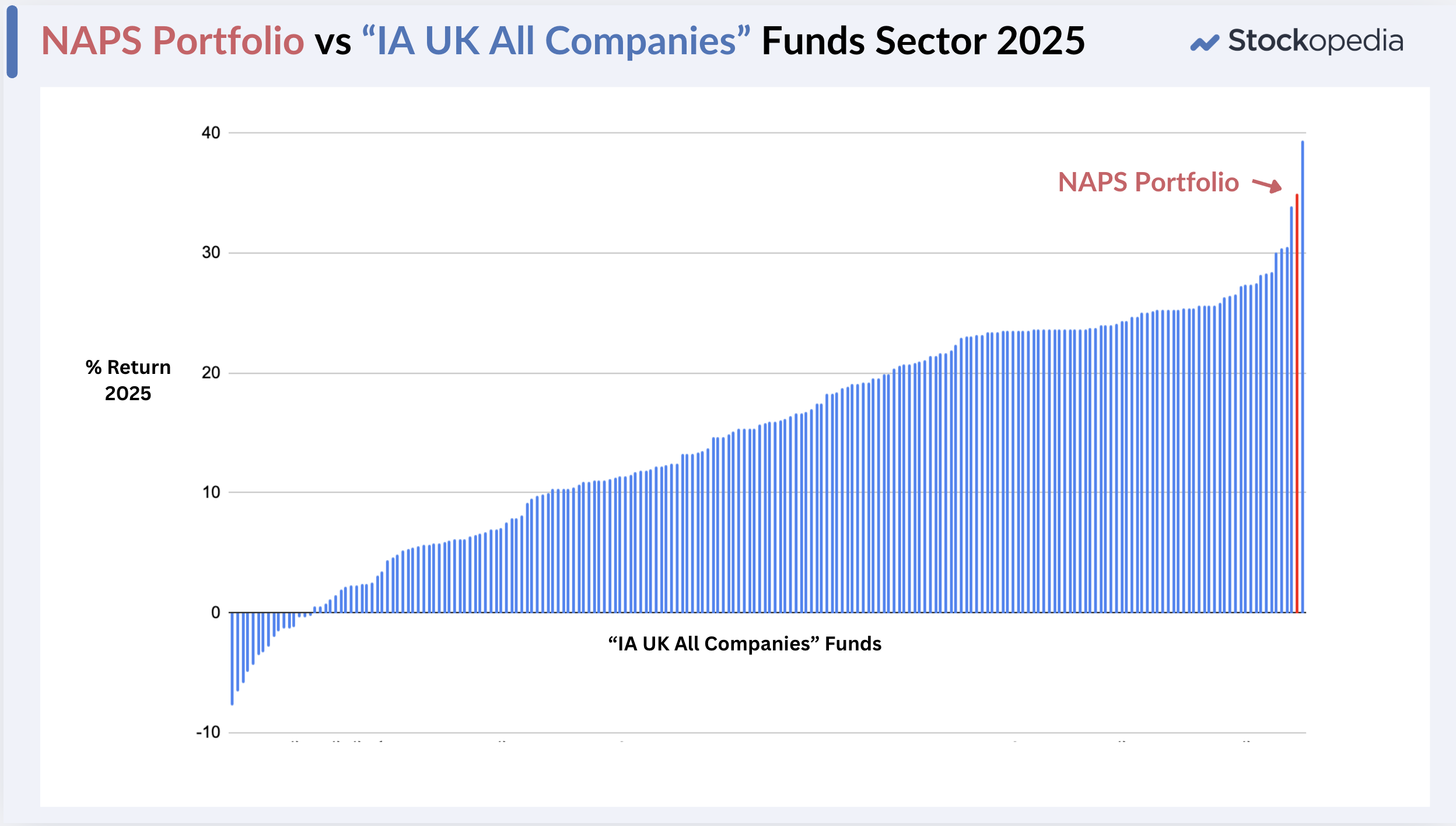
I know this isn't a fair, nor like-for-like comparison, but last year, we found that the NAPS had outperformed all UK fund managers over the first 10 years. For 2025 alone, it would be sitting in second place. What I found interesting when reviewing this was that the two funds either side are both constructed from systematic processes. The top fund being the Artemis SmartGarp UK (based on their proprietary method), and the one just behind being the systematic Dimensional UK Value Fund. *There really are merits in rules based approaches.*
What drove the returns in 2025?
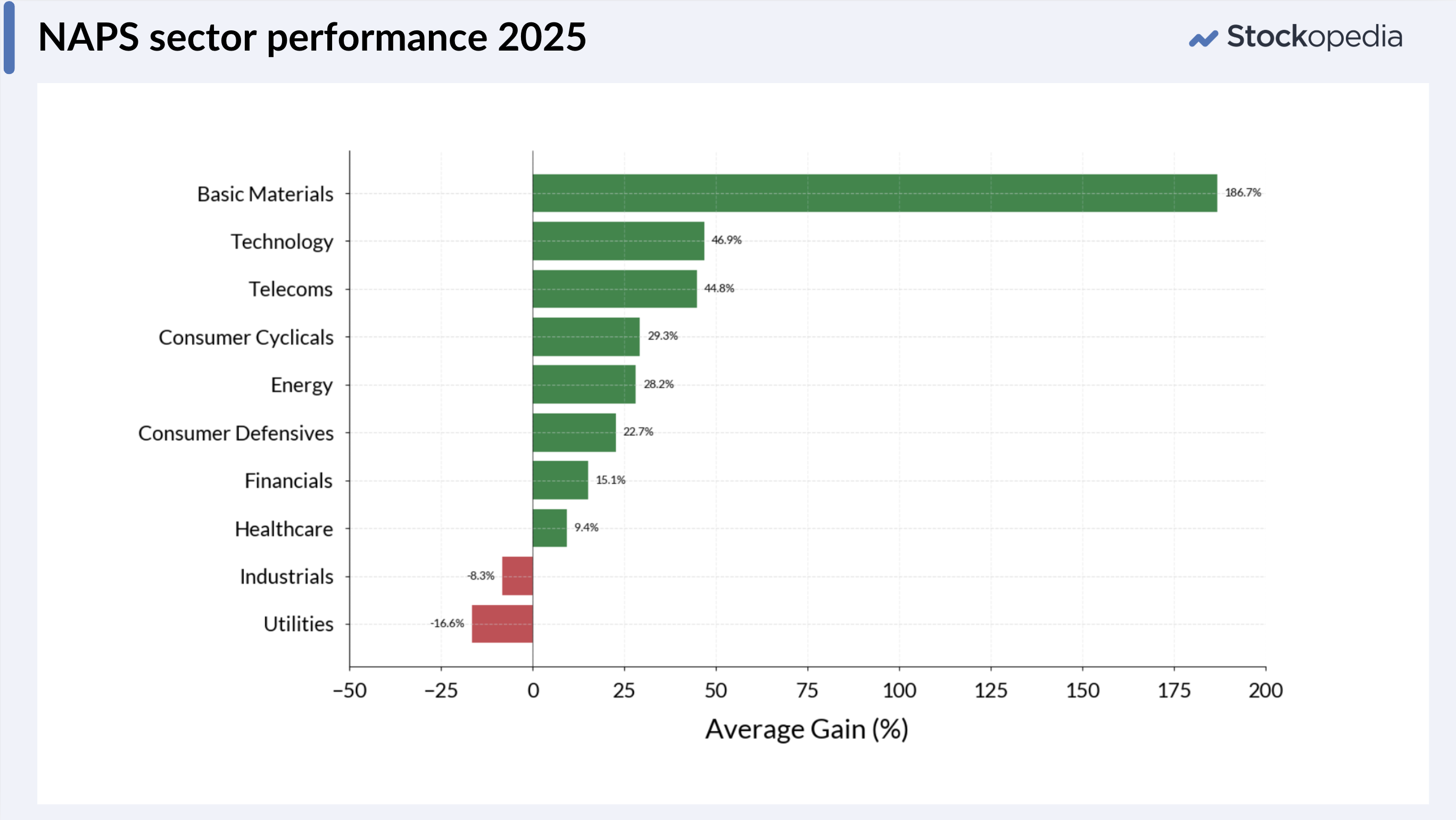
While the average gain across the portfolio was 37%, the distribution mattered. The chart below shows the really exceptional returns to the two junior gold miners selected in the portfolio, Metals Exploration and Serabi Gold, both returning more than 180% through the year. Right behind was Journeo which started to become recognised as an acquisitive small-cap compounder.
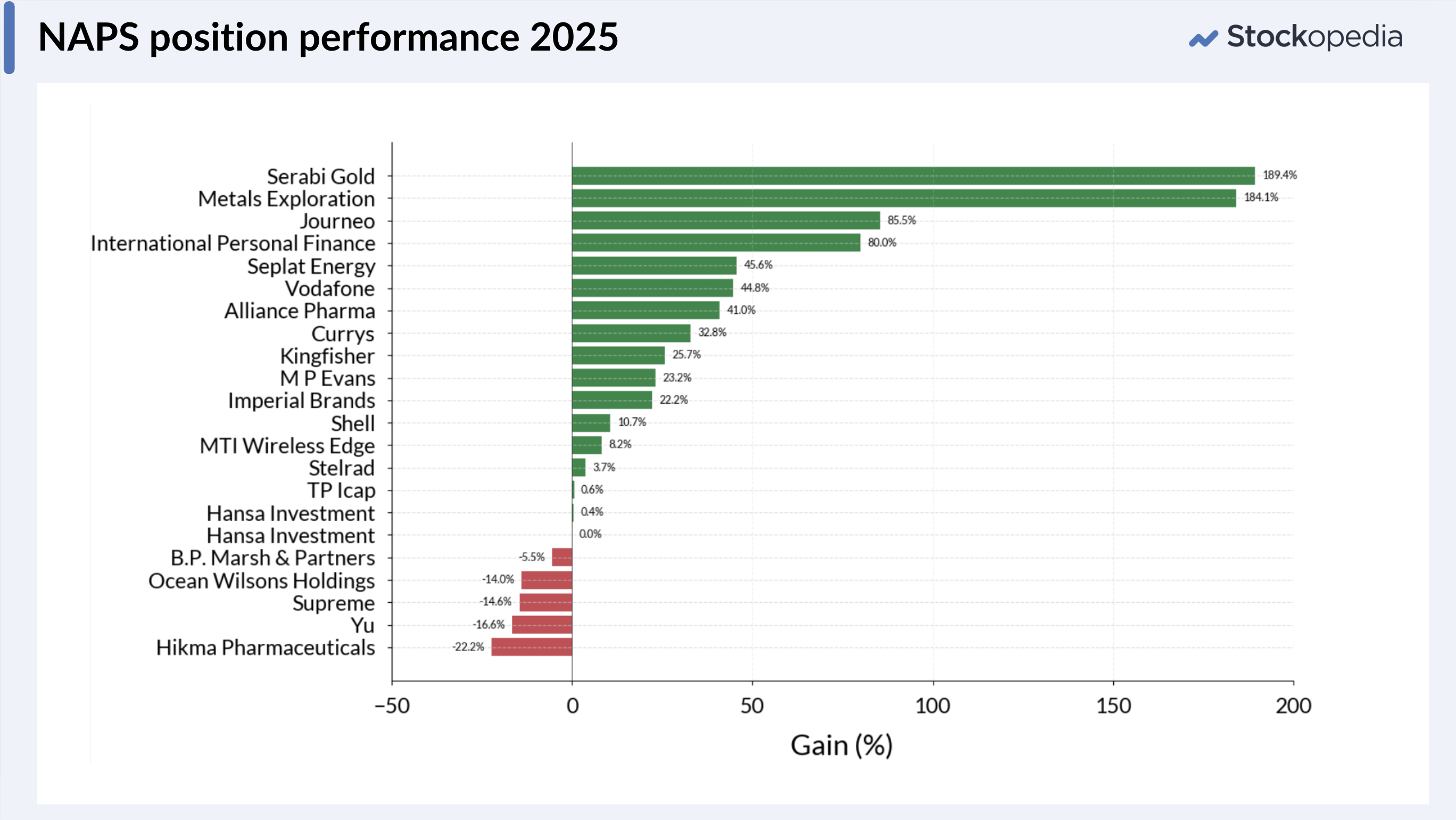
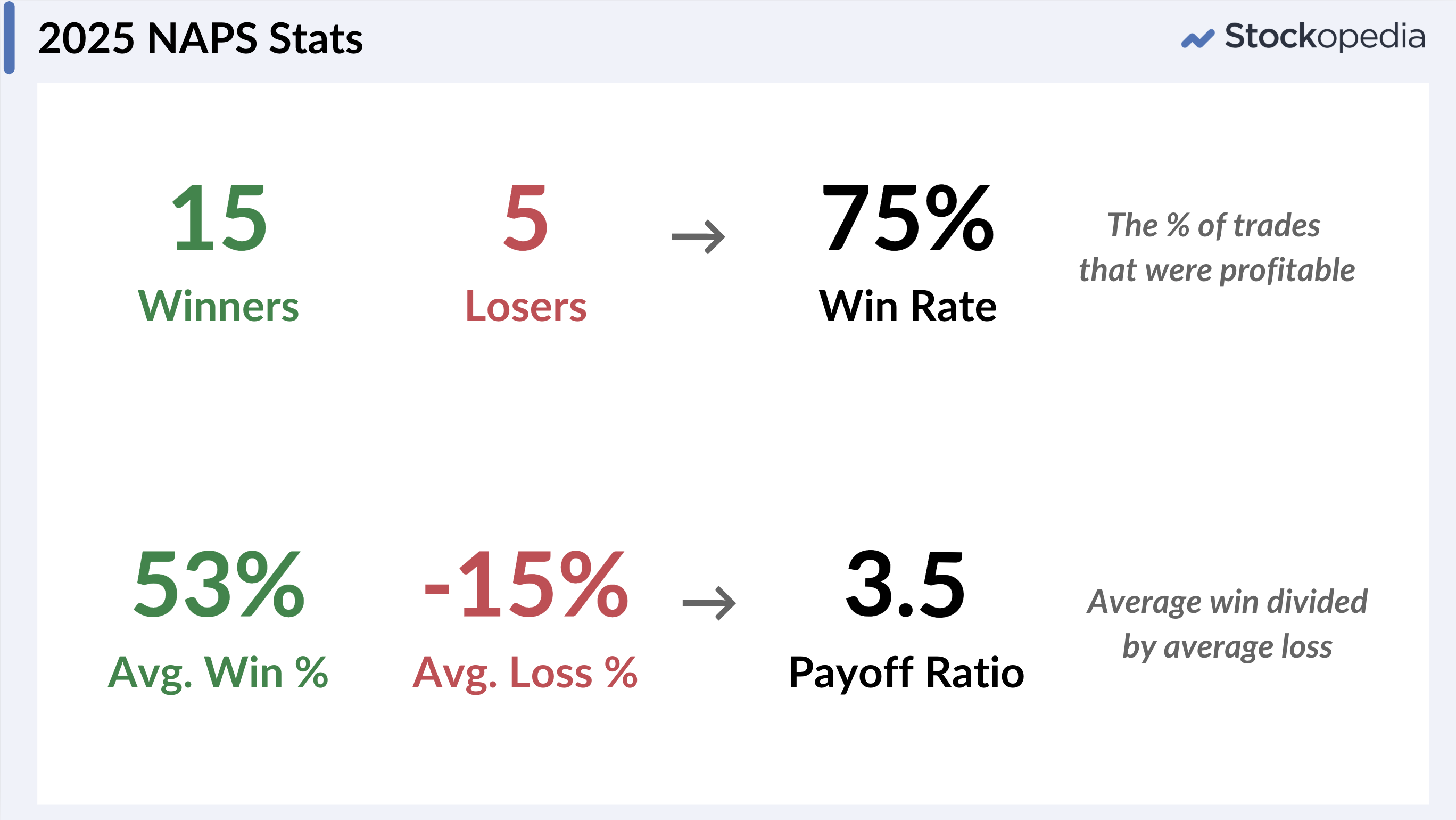
Even if we strip out those two gold positions, the “average” return across the rest of the portfolio was still something like 19.5%. That's an extremely solid showing, given small caps on average have not had nearly as strong a year. 15 winners and 5losers is a 75% win rate with a 53% average gain for the winners. Not bad at all.
Side note on the QVM Portfolio
One quirk of the headline NAPS rules is that I don’t “fiddle” with the holdings. When Alliance Pharma was acquired early in the year, the portfolio ended up sitting on a meaningful chunk of cash for the remainder of the year. That created a drag - and it’s one of those moments where you really feel the tension between “no admin” and “common sense”.
As an experiment, I ran a parallel “QVM Portfolio” which added an extra rule: to sell on an agreed takeover bid. It switched into SDI, the next highest ranked healthcare stock - which boosted the returns even further. Although when Ocean Wilson's was merged into Hansa Investment Trust, it broke my “No collective investments” rule - so it was sold and switched into Virgin Wines. That's led to a loss. Nonetheless, the QVM portfolio is a couple of percent higher for the year at 39.5%, which may be luck, but certainly illustrates the potential in adapting NAPS rules to ones own preference. We'll chat about this in the webinar. ⠀
Why value investing (and diversification) still matter
I don't blame anyone for throwing in the towel on UK shares. It's all felt terribly negative here since 2016, with a few intermittent eye-catching bull runs. But the absolutely stunning and eye-catching tech sector returns in America have turned heads. Who doesn't want to be in on the great growth stories of the day? Such as in cloud computing, data centres and AI.
Nonetheless, we need to remind ourselves that great returns in the stock market do not just come from EPS growth - they also come from PE multiple expansion and dividends. The UK market remains significantly cheaper than international comparables and has been greatly avoided for the last 10 years. There is real scope for that valuation discount to close, and the higher dividend yields on offer here remain a real attractor.
Why I back the “value” return driver
I've analysed the 11-year history of the NAPS portfolio holdings and looked at the P/E ratio at the start of each year to the P/E ratio by the end of the year. What I found was eye-catching.
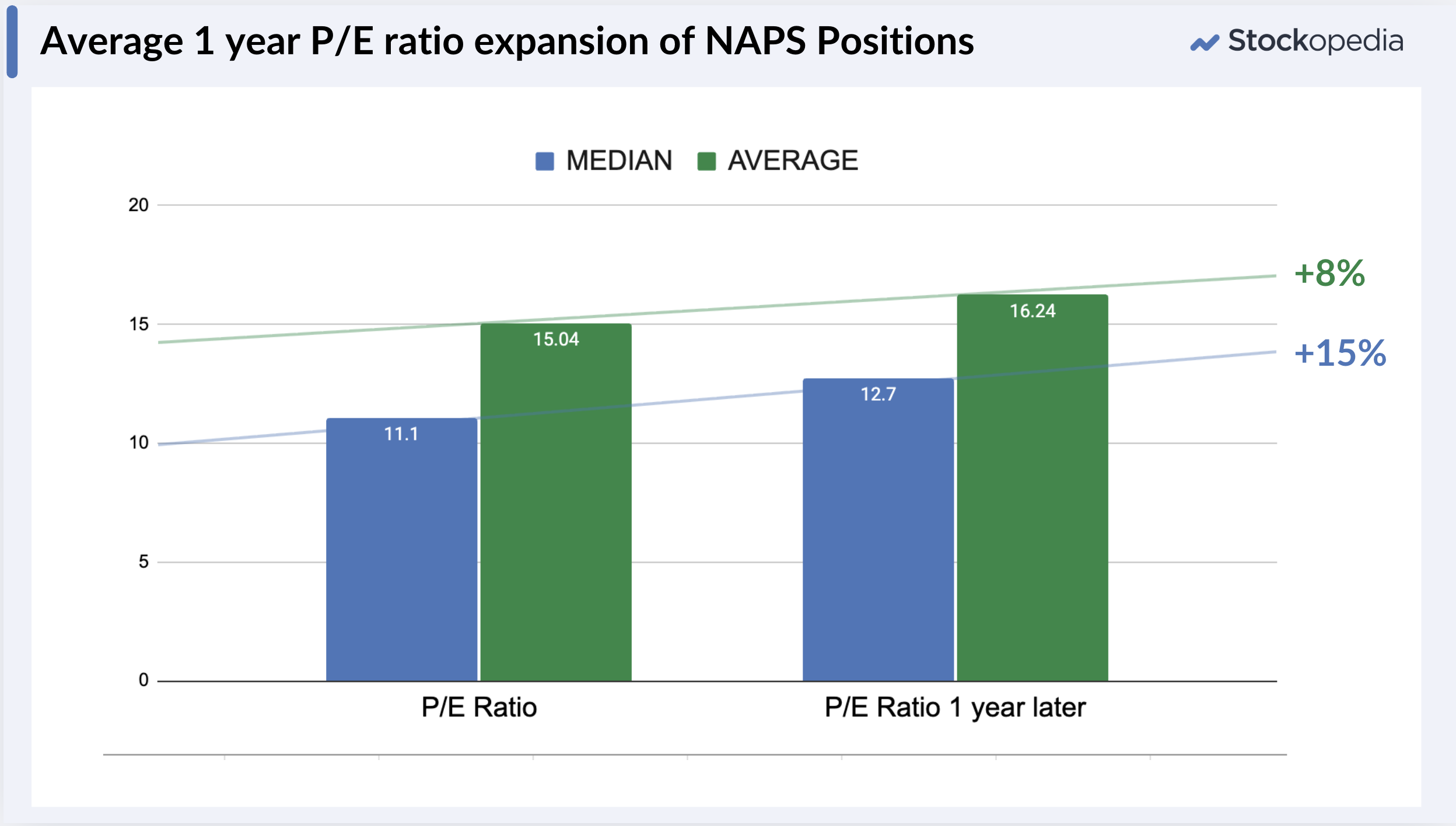
Depending on how you calculate the averages, there has been an 8% to 15% increase in the P/E ratio of the average holding each year.
That is Ben Graham's Mr. Market doing his work. There are hundreds of thousands of investors seeking value - and the starting positions in the NAPS portfolio tend to be at a discount to the market.
The above chart shows that the valuation gap tends to narrow through the year. And this constant force, undervaluation as a return "driver," powerfully compounds over time.
Why I love diversification, and you should too
The NAPS does a form of Noah’s Ark diversification: picking shares two-by-two across ten sectors. This turns many people off - many of the best investors I know seek far higher concentration - holding often as few as 5-8 shares
But one of the reasons to consider broad sector diversification is simple: you really don’t know what’s going to work next or when.
I couldn’t have predicted, twelve months ago, that two positions would return +180%+ - driven by the really stunning run in the gold price. I also couldn't have predicted that one of my top multibaggers in recent years, Yu Group, would fall by 18%.
That’s the point.
We really can be terrible forecasters. You may have found great undervaluation in the [*your favourite share or theme here*], and you may be right. But if you get your timing wrong - you can end up in value traps for years.
This is why I prefer to put the QVM return drivers in charge across sectors. This year, they rewarded the mining sector. In other years, they've rewarded Healthcare. I didn't predict the gold price would rocket, and I didn't predict Covid either. I'm just not that smart.
Warren Buffett once said, "Diversification is a hedge for ignorance" I think he meant it as an insult. I just think it's good advice.
Why value investors really need to sell
One of the most counterintuitive lessons from the last decade is that many of the biggest multibaggers revert brutally. Several of the “top ten” NAPS multibaggers subsequently fell 70–90% from their peaks after leaving the portfolio.
This is why annual rebalancing is so powerful. It forces one of two very powerful habits:
- It forces you to sell extreme momentum winners - which may have gone too far.
- It forces you to bank some gains if a candidate stock still qualifies.
Sure, you might lose out on some upside from a multi-year winner. But how many Games Workshops are there really in a value market like the UK? The lesson from ten years of NAPS analysis is that you really should bank gains after strong value stock runs.
As we will see below, Serabi Gold is coming back into the portfolio again - but the rebalance acts like a risk control. It's position size has ballooned to 11% but will be clipped back to 5%. If the gold price tumbles next year, the damage limitation will be minimised.
The 2026 selection rules
I see absolutely no reason to fiddle with the rules this year. I am going to use exactly the same rules as 2025.
This year’s rules are:
- Sort by StockRank descending.
- 20 stock portfolio.
- 2 from each sector, but just one from Telecoms and Utilities.
- Top up with the next highest-ranked stock from 2 of the other 8 sectors.
- Minimum market cap of £20m, and max bid-ask spread of 7.5% (750 basis points).
- No investment trusts or funds and no dual-listed stocks.
- Equal weight position size.
2026 portfolio overview
Last year, the portfolio had an average price-earnings ratio of about 8.7. This year, it's 12.5x - dragged up by Kromek, which has a high forecast P/E ratio. This is almost bang in line with the overall market at 12.3x - which may meant that the portfolio leans a little more towards relying on earnings momentum, rather than value, as key return driver. This also could be a risk factor.
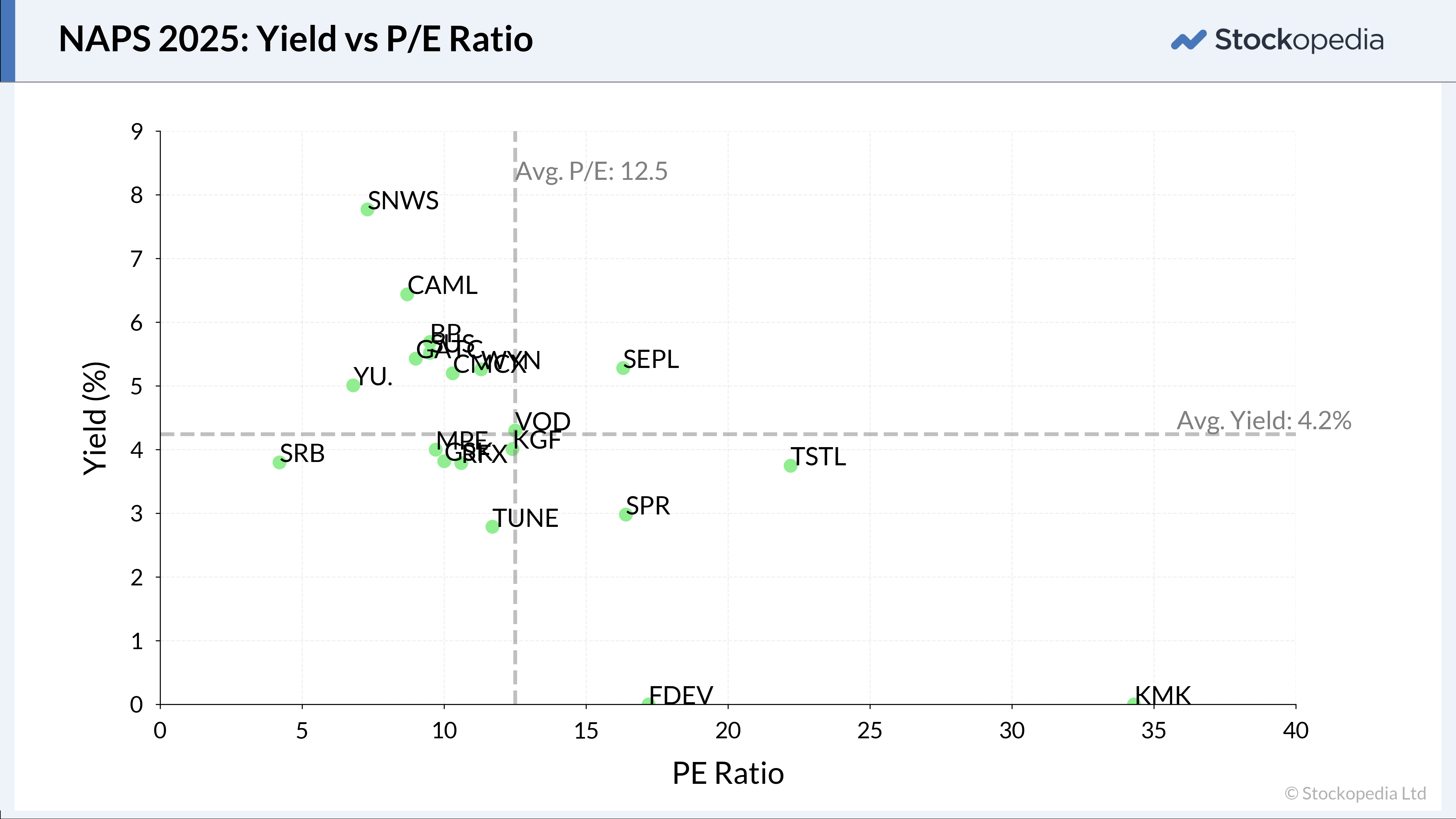
The average StockRank of the portfolio is 96, and some of the other stats are quite interesting. This set of shares has a median return of 38% in the last 12 months - these are rising shares. The median earnings growth is about 17% over the last 12 months. All are currently profitable with an average ROCE of 18%.
A cautionary note on liquidity and dealing in shares
This year, more than half of the stocks are small caps - the median market cap is £244m. Sometimes in the past, I have forced a constraint on the portfolio to only select a third in small caps. I ended up removing this a long time ago. Nonetheless, this is more small caps than I've seen in some time.
As a result, the bid-ask spread of this year’s portfolio is about 1.4% between the bid and ask price (last year it was less than 1%). That’s obviously quite high - but it's a real consideration if one is intending on dealing in these shares.
It’s worth reminding that this portfolio is neither a recommendation nor financial advice - we can’t offer any personal advice and personal circumstance matters. If one does have a larger portfolio, one should seek to deal carefully in smaller-cap shares, or better, remove them completely. If in any doubt, talk to a professional.
Nonetheless, the average yield is about 4% which more than covers the typical bid-ask spread. In these articles, I tend to focus on the capital return rather than the total return because I am not including transaction costs in performance tracking. I do believe this is a conservative assumption given the yield always more than covers the spread, stamp duty and commission costs from a broker. I've certainly have always found that in practice.
The 2026 portfolio: the stats (and a few themes)
And just to finish off, I'm following up with a table of the portfolio positions for 2026, and also an investment brief for each. Hopefully, it's useful for you to get to know some of these shares.
A few comments on the holdings for 2026.
- Only one gold miner remains (Serabi), and we’re now seeing a base metals name (Central Asia Metals) come through - a subtle rotation reducing gold exposure. Though Ramsden's Holdings does have gold exposure through its retail gold operation.
- Recruiters are showing up (Gattaca, though Staffline just missed out) - deeply cyclical companies, unloved, and suddenly starting to screen well.
- One palm oil name - MP Evans - while REA Holdings and AEP Plantations just missed the cut - it was almost 2 names from this sector. This certainly will not suit everyone given sustainability concerns.
- Technology remains thin on the LSE, but we get two familiar “bowl-ish” candidates: Frontier Developments and Focusrite. I nearly bought a Focusrite product recently, and it's nice to see them make the list. Journeo falls away.
| Name | Mkt Cap £m | P/E | StockRank | Sector |
|---|---|---|---|---|
| Seplat Energy (LON:SEPL) | 1703 | 16.3 | 95.8 | Energy |
| BP (LON:BP.) | 67636 | 9.5 | 94.6 | Energy |
| Serabi Gold (LON:SRB) | 236 | 4.2 | 99.6 | Basic Materials |
| Central Asia Metals (LON:CAML) | 337 | 8.7 | 98.5 | Basic Materials |
| Gattaca (LON:GATC) | 28 | 9.0 | 98.9 | Industrials |
| Kromek (LON:KMK) | 58 | 34.3 | 97.7 | Industrials |
| Kingfisher (LON:KGF) | 5356 | 12.4 | 100.0 | Consumer Cyclical |
| Springfield Properties (LON:SPR) | 153 | 16.4 | 99.5 | Consumer Cyclical |
| Smiths News (LON:SNWS) | 187 | 7.3 | 99.4 | Consumer Cyclical |
| M P Evans (LON:MPE) | 640 | 9.7 | 98.4 | Consumer Defensive |
| Wynnstay (LON:WYN) | 78 | 11.3 | 97.5 | Consumer Defensive |
| CMC Markets (LON:CMCX) | 836 | 10.3 | 99.1 | Financials |
| Ramsdens Holdings (LON:RFX) | 121 | 10.6 | 98.3 | Financials |
| S&U (LON:SUS) | 252 | 9.5 | 98.1 | Financials |
| GSK (LON:GSK) | 74356 | 10.0 | 91.8 | Healthcare |
| Tristel (LON:TSTL) | 199 | 22.2 | 77.8 | Healthcare |
| Frontier Developments (LON:FDEV) | 163 | 17.2 | 97.5 | Technology |
| Focusrite (LON:TUNE) | 134 | 11.7 | 92.3 | Technology |
| Vodafone (LON:VOD) | 23262 | 12.5 | 92.8 | Telecoms |
| Yu (LON:YU.) | 253 | 6.8 | 93.8 | Utilities |
Energy
A heavyweight value pairing of Africa-focused Seplat and global supermajor BP.
Seplat Energy (LON:SEPL)
StockRank: 95.8, Market Cap: £1703m, P/E: 16.3x, Yield: 5.28% Seplat is trading well after a transformative offshore acquisition and a strong Q3. The Nigeria-focused oil and gas producer trebled revenues and doubled profits in 2025, helped by a 185% production increase. Net debt fell sharply to $386m, while a refreshed dividend policy is attractive. The group is now Nigeria’s top processed gas supplier, with the ANOH project launched. Risks remain around Nigerian political exposure and operations, but with a 6% yield and sub-10x earnings, Seplat looks undervalued with growing free cash flow.
BP (LON:BP.)
StockRank: 94.6, Market Cap: £67636m, P/E: 9.5x, Yield: 5.69% BP is reshaping under new leadership after losing its way. The oil major still earns most of its cash from upstream production and refining but has scaled back its energy transition ambitions in favour of capital discipline and shareholder returns. New incoming CEO Meg O’Neill is expected to deepen this shift. Recent catalysts include steady buybacks, a $10 bn Castrol stake sale to cut debt, and a refocus on core hydrocarbon projects. Risks are oil-price swings and policy pressure on fossil fuels. But with a near 6% yield, BP’s back-to-basics stance is winning investors back.
Basic Materials
Two miners with exceptional momentum and quality scores, offering exposure to precious and base metals.
Serabi Gold (LON:SRB)
StockRank: 99.6, Market Cap: £236m, P/E: 4.2x, Yield: 3.8% Serabi Gold has tenbagged since 2023, but still looks attractively priced. It operates two high-grade mines in Brazil’s Tapajós region, with production up 19% this year and grades hitting nearly 7g/t. Cash flow is strong, exploration is extending the 1Moz resource base, and brokers see more upside, with targets at 386–400p vs the current 290p. Risks remain - short mine life, permitting at Coringa, and cost pressures — but with free cash flow of $72m forecast in FY26, and a possible dividend, Serabi is executing well into a strong gold price environment. Read a full brief here. (I hold)
Central Asia Metals (LON:CAML)
StockRank: 98.5, Market Cap: £337m, P/E: 8.7x, Yield: 6.44% Central Asia Metals is a copper and zinc miner running low-cost sites in Kazakhstan and North Macedonia. Profits dipped due to lower grades at its Sasa mine, but its flagship Kounrad site is still performing well. Some copper produced but not yet sold could boost near-term revenue. With strong cash reserves and a cheaper share count, CAML may be better value than the headlines suggest. The company has reset shareholder return approach recently - cutting its dividend in half and starting a $10m share buyback. If copper stays high, the mix of income and buybacks could look attractive again.
Industrials
A staffing specialist and radiation detection technology company, both small caps.
Gattaca (LON:GATC)
StockRank: 98.9, Market Cap: £28m, P/E: 9.0x, Yield: 5.43% Gattaca is quietly outperforming in a tough UK recruitment market. The specialist STEM recruiter delivered profits at the top end of guidance, thanks to cost control and better consultant productivity. Contract and permanent role volumes have been down slightly, but the Energy segment performed well with 17% growth. Its Infosec acquisition is integrating smoothly, and more bolt-on deals may follow. Net cash is strong at £15.7m, and the dividend is growing. Risks remain - permanent role demand is still slow - but Gattaca’s self-help story looks credible heading into 2026.
Kromek (LON:KMK)
StockRank: 97.7, Market Cap: £58m, P/E: 34.3x, Yield: 0.0% Kromek Group is turning a corner after years of investment and loss-making. The AIM-listed detection tech firm, which supplies advanced radiation and biosecurity systems, reported profits “significantly ahead” with a sharp swing in revenues. This was boosted by a new deal with Siemens. Underlying sales grew 70% to £6.3m, with total revenues hitting £14.5m - and positive PBT expected. Profitability is forecast to normalise, but the shift towards profitability is material. Revenue remains lumpy and Siemens-linked - but Kromek is on a more solid footing. Cavendish have a price target of 26p (vs 7.3p now). (I hold)
Consumer Cyclical
A diverse trio spanning a DIY retail giant, Scottish housebuilder, and newspaper distributor.
Kingfisher (LON:KGF)
StockRank: 100.0, Market Cap: £5356m, P/E: 12.4x, Yield: 4.01% Kingfisher returns to the NAPS for 2026. The home improvement giant, which owns B&Q and Screwfix, is rebuilding momentum after soft markets dented growth in France and Poland. It's been delivering strong UK outperformance thanks to investments in e-commerce and trade sales, with good like-for-likes and marketplace growth. Management has now upgraded 2026 profit guidance to £540–£570m. There are risks in Europe, but cost savings and brand strength are providing resilience. A surprising 25% gainer in 2025, but the valuation still looks moderate, and if momentum holds, it could continue rerating.
Springfield Properties (LON:SPR)
StockRank: 99.5, Market Cap: £153m, P/E: 16.4x, Yield: 2.98% Springfield Properties is pivoting into infrastructure-led housing demand in northern Scotland. The AIM-listed housebuilder has secured a landmark 293-home deal with SSEN Transmission, marking a new revenue stream with phased leases. These homes will house workers for SSE’s £33bn grid upgrade and are expected to generate reliable rental income over time. H1 trading was in line, with net debt dropping. Risks remain with execution and slow private housing demand, but Springfield’s strategic landbank gives it leverage as these energy projects scale. Fair value seen at 159–160p by brokers.
Smiths News (LON:SNWS)
StockRank: 99.4, Market Cap: £187m, P/E: 7.3x, Yield: 7.77% Smiths News is a resilient print media distributor that serves 22,000 UK retailers. Despite a declining newspaper market, it continues to generate strong profits, with results beating expectations. The company now holds net cash and has lifted its total dividend which is well covered by EPS. CEO Jon Bunting is avoiding past M&A mishaps, and instead investing cautiously in new areas like recycling and book delivery. Long-term decline remains a risk, but brokers now see only modest revenue erosion, suggesting Smiths could remain cash-generative and rewarding for longer than expected. Read Graham's note here.
Consumer Defensive
A palm oil producer and an agricultural supplies group - defensive quality plays at modest valuations.
M P Evans (LON:MPE)
StockRank: 98.4, Market Cap: £640m, P/E: 9.7x, Yield: 4.0% MP Evans is a long-established Indonesian palm oil producer with a vertically integrated, low-cost model. Benefiting from stronger palm oil prices in 2025, it delivered a 50% increase in H1 operating profit and has upgraded earnings forecasts. The company has a long dividend record and a net cash balance forecast to exceed $140m next year. Risks include falling palm oil prices and political instability in Indonesia. Still, with a P/E of 10x for 2027 and a progressive payout policy, MPE offers steady cash generation and agricultural diversification that’s rare among UK midcaps. Read Graham's note here.
Wynnstay (LON:WYN)
StockRank: 97.5, Market Cap: £78m, P/E: 11.3x, Yield: 5.26% Wynnstay is regaining momentum after a tough year in agriculture. The AIM-listed farm supplies business spans animal feed, arable inputs, grain trading and rural retail — with recent restructuring bearing fruit. FY25 profit is set to come in ahead of expectations, with margin growing across all divisions and strong cash generation. The new fertiliser plant and feed mill expansion are key growth levers, while Project Genesis continues to streamline operations. Risks include commodity price volatility and ongoing HSE scrutiny after a fatal accident. But with 5% yield and 45% discount to NAV, the rerating case is building.
Financials
A spread better, pawnbroker, and motor finance specialist - all with good yields.
CMC Markets (LON:CMCX)
StockRank: 99.1, Market Cap: £836m, P/E: 10.3x, Yield: 5.2% CMC is steadying after a tough post-pandemic comedown in retail trading volumes. The FTSE 250 firm runs a global platform offering spread betting, CFDs, and share trading, with a growing push into investment platforms and tech partnerships. Interim results in late 2025 showed better revenue and outlook, with new deals like Westpac in Australia supporting growth. But competition is fierce, and activity can be cyclical as we all know. Still, with a healthy balance sheet, 5% yield, and signs of momentum, CMC’s blend of steady income and upside potential is worth a look. Read Mark's comment on CMC's interims here.
Ramsdens Holdings (LON:RFX)
StockRank: 98.3, Market Cap: £121m, P/E: 10.6x, Yield: 3.79% Ramsdens is benefiting from strong gold prices and operational tailwinds across its retail network. The group earns from pawnbroking, jewellery retail, FX, and gold buying with gross profit up across all but FX, and profits for 2025 set to come in slightly ahead of upgraded expectations at £15.7m. Jewellery profit rose 15%, the pledge book grew 8%, and card customer numbers jumped 60% to 40k. With a gold price well above forecast, and new store openings accelerating, the shares look undemanding with moderate P/E and good 4% yield.
S&U (LON:SUS)
StockRank: 98.1, Market Cap: £252m, P/E: 9.5x, Yield: 5.52% S&U is quietly returning to confidence after a tough stretch in consumer finance. The group provides non-prime motor finance and bridging loans, with both arms seeing improved collections and profitability in recent results. Pre-tax profits jumped 22% as impairments fell and leverage pared back to 75%. Dividends are rising again, but revenue remains below last year, and the motor finance sector still faces regulatory headwinds. Still, S&U’s operational recovery and capital discipline are worth a look for investors seeking small-cap value with a yield kicker.
Healthcare
A pharma giant paired with an infection control specialist.
GSK (LON:GSK)
StockRank: 91.8, Market Cap: £74356m, P/E: 10.0x, Yield: 3.82% GSK (LON:GSK) has been regaining investor interest after a year of solid execution and product momentum. The FTSE 100 pharma group makes money through vaccines, HIV treatments, and specialty medicines - areas now driving growth. A recent UK approval for Exdensur, its new asthma biologic, has upgraded guidance and a stronger 2026 outlook. CEO Emma Walmsley will exit in January, handing over to Luke Miels after a transformative shift. Patent risks and leadership transition are question marks but the pipeline progress is clear.
Tristel (LON:TSTL)
StockRank: 77.8, Market Cap: £199m, P/E: 22.2x, Yield: 3.75% Tristel is a UK infection‑prevention specialist whose share price has lagged its fundamentals at times. The company sells high‑margin chlorine dioxide disinfectants to hospitals and clinics, with recurring revenue from consumables and strong cash generation. After peaking well above 600p, the stock fell significantly from those highs and is still below earlier levels. This reflects sluggish progress in US regulatory execution which frustrated investors before recent catalysts emerged. Tristel now has FDA clearance for Tristel OPH and global expansion potential, but execution and market adoption remain key risks. There are one or two higher ranked Healthcare stocks which are dual listed - worth a look for those willing to invest in dual lists.
Technology
Two tech stocks in recovery - a video game developer and an audio equipment maker.
Frontier Developments (LON:FDEV)
StockRank: 97.5, Market Cap: £163m, P/E: 17.2x, Yield: 0.0% Frontier Developments is bouncing back after a failed diversion into F1 / sports titles. The AIM-listed studio has refocused on its niche: high-margin, long-tail Creative Management Simulation titles like Planet Zoo and Jurassic World Evolution (JWE). The successful launch of JWE3 has prompted earnings upgrades, with Panmure and Zeus lifting forecasts and targets (565p and 620p). Risks include player retention on JWE3, and the recently announced CEO transition with long-tenured Jonny Watts stepping aside. But with a StockRank of 97 and a strong balance sheet, Frontier’s recovery story is gaining traction, especially if the Planet Zoo sequel hits in 2026. I am a holder.
Focusrite (LON:TUNE)
StockRank: 92.3, Market Cap: £134m, P/E: 11.7x, Yield: 2.79% Focusrite is turning the corner after a tough few years for audio tech. The AIM-listed group, best known for its Scarlett interfaces (I nearly bought one at Christmas) and studio hardware, has returned to top-line growth - with recent launches from Focusrite, ADAM and Sequential powering a rebound in Content Creation. Margins are recovering, cash flow is improving, and net debt has nearly halved. Costs remain sticky, and growth in China is still sluggish, but operational gearing is kicking in. With forecasts unchanged and shares up 19% in 3 months, Focusrite’s recovery story may be just starting.
Telecoms
Vodafone is our sole telecom with improving momentum after recent restructuring.
Vodafone (LON:VOD)
StockRank: 92.8, Market Cap: £23262m, P/E: 12.5x, Yield: 4.3% Vodafone is rebuilding investor confidence after years of underperformance, with shares up 45% in 2025. The telecoms giant generates most of its revenue from mobile and fixed-line services across Europe and Africa, and is now sharpening its focus on core markets and enterprise solutions. Strategic disposals, debt trimming, and dividend discipline have improved sentiment. Still, growth remains patchy, and consensus targets suggest limited near-term upside. But with a 4% yield and operational simplification underway, Vodafone’s turnaround could have legs if management keeps delivering.
Utilities
And finally a high-growth utility company.
Yu (LON:YU.)
StockRank: 93.8, Market Cap: £253m, P/E: 6.8x, Yield: 5.01% Yu Group has been a strong multibagger over recent years, but consolidated in 2025. It is carving out a high-margin niche as a fast-growing utility supplier to UK businesses. The AIM-listed company sells electricity, gas, and smart metering services to SMEs avoiding the domestic market. The company has strong cash generation and a growing smart meter base. A long-term hedging deal with Shell and credit controls help to stabilise margins despite energy market volatility. Risks remain around SME bad debts and pricing swings. But with net cash above £100m and a 6.8x P/E, the shares look undervalued.
To 2026 and beyond…
Please do share any thoughts on any of the names in this year's portfolio in the comments below. What's more, we'd love to hear about whether you've been using the principles of the NAPS in your own personal strategy. This really is a community site, and we're all in this together - warts and all.
I'm wishing you the best of luck for safe investing in 2026. Let's hope for another fruitful year in UK and international shares.
And once again - please do sign up to the webinar on the 22nd January.
Disclaimer
This is not financial advice. Our content is intended to be used and must be used for information and education purposes only. Please read our disclaimer and terms and conditions to understand our obligations.
193 comments
The Quality Ranking for S&U (LON:SUS) seems to have declined from 78 to 38 in the past 2 weeks. That's a significant downgrade. Seems to be driven by negative FCF and a lower Piotroski F-Score. Does anyone have any further insight / thoughts on this?
Yes the F score has fallen to 2 from 7. The results came out last week. The profits were higher than last year, but debt increased.
Of course, there have been problems, with motor finance but these seem to be behind them now.
I've just come across this article and would like to try the NAPS portfolio this year, but wondering if its too late to buy the stocks in the portfolio?
Also Im noticing that some of those in the NAPS portfolio are currently not the highest Stock Rank for their sector (at the time of writing), e,g SEPL is currently 3rd in UK energy sector by Stock Rank , with DRX and TGA topping - would it be wise to invest in those instead, as an example, or stick to stocks Ed has already selected?
Grateful for all comments on this. thank you
Just run the process yourself and buy at any stage oof the year. The whole point of NAPS is to show you the process rather than the stocks selected when Ed runs the process.
ah ok, thanks for clarifying
I am moving more towards a NAPS Portfolio but as I have missed 3months to date, perhaps I should wait for the 6m sell & commence 1st July?
It is not always sensible to sell shares at the end of the year, however much they have gained. I have held shares in Ferguson Enterprises (LON:FERG) (originally Wolseley) since 2005. I added to them through dividend reinvestment before they moved to NYSE. My overall costs are £20,050, my return including dividends 497%. Similarly, Next (LON:NXT) 640% and Rolls-Royce Holdings (LON:RR.) 835%. I think these companies have a lot more to give and I hope that I can hold on to them for the next 20 years. I noted that in previous NAPS, you held and then sold Jet2 (LON:JET2). I bought cheaply and and again intend to hold for the long term. There are some instances where loyalty pays dividends.
Whilst it's not always sensible to sell, NAPs gives us a structure to follow which takes the decision away. I think the vast majority of us dont possess the temperament to hold for the genuinely long term, as much as we would like to!
JS "NAPs gives us a structure to follow which takes the decision away." cant see in the above article any guides on when to sell?
NAPs gets rebalanced end of every year
It runs for 1 year. You should read the previous articles on it.
All explained and shown here! :
?si=8B-EFwQQ7YtiH685This is my first post even though I've been a member for just over a year now. After making the plunge, signing up and investing a proportion of my portfolio into the NAPS last year, I was delighted with the results. And as others have said, the performance so far this year has been terrific.
As well as investing the lump sum at the start of the year, I also contribute monthly into my T212 account where I have a ‘NAPS pie’, less Serabi Gold (LON:SRB) which I hold with another broker. I’m curious if others do the same, and if so, whether you spread funds equally between all 20 shares, or whether you adjust the percentages in the pie to buy more of the performing stocks?
And if you do that, how long do you typically leave it before you make a judgement call as to the perceived winners and losers? After only a month, several are down (Smiths News (LON:SNWS) down 10% for instance and I wonder whether I make the call now or be patient before doing any rebalancing of my pie.
Grateful for any advice.
Smiths News (LON:SNWS)
Bear in mind that ex dividend date was 8/1/26 (6.8p) when the share price fell quite dramatically and payment date is today, about 10% of the current value.
So good to have you making your first post here Aljames99 !
Am delighted you've had a good first 12 months. The 2021 to 2023 period was quite brutal in the UK markets so your timing is quite good. I wish every year could be like 2024.
Personally, I don't use T212 so I can't comment on how it works. I'm not sure if you saw the NAPS webinar that I did recently. I did do a bit of a study of the benefits of using stop losses. But it was a slightly naive study as it didn't have re-entry rules at any time in the middle of the year until the rebalancing date. All the stop-loss studies actually underperformed the fully invested NAPS. None the less, they also significantly reduced the downside.
Early in my investing life, I used to pyramid up my positions, so I would buy more of the shares that were winning, and cut losses fast.. A very Bill O'Neill or Mark Minervini approach. Generally, I do try to keep losses small. I hate seeing losers in my portfolio. But I don't tend to pyramid up.
I do think you raise a good question, though, because given the skew of returns to the big winners in a portfolio. Perhaps inverting the study I was doing on stop losses could be quite interesting. What happens if you do cut the losers but reinvest in the winners? And how would that impact the returns on a portfolio? I'm sure it would significantly increase the risk and in bad momentum reversal markets, it could be quite painful. But this could be quite an interesting study.
Food for thought, and possibly future research.
Some early losers do become the years big winners though, as in the year when there were 3 stocks that gained around 150%, all of those were down over 10%, l think 2 fell over 15% before recovering. This is the problem with stop losses, people only focus on the losers. Getting figures is difficult because most prices are at the close, of course shares can go down far more during the day. I have given up on auto stop losses. Of course early winners can soon fall, see Serabi Gold (LON:SRB) this year, was +15% but now is -18%.
Why not run the NAPS screen again, and reinvest in the share that comes top regardless of sector. This will take advantage of the rise in the sector that has performed best since the start of the holding period.
Why sell a stock if it still top in its sector and 2nd, over £20m mcap, on the list?
Serabi Gold (LON:SRB) was down 18% this morning, from inception, so it could have triggered your stop loss. It ended the day only down 7%.
Kingfisher (LON:KGF) is still top, but that is already in NAPS.
So you would buy Kingfisher (LON:KGF) again or a stock that is not already in NAPs?
2026 NAPS has shown dramatic performance in less than 4 weeks: : +7.75%. I'm actually up 12.5% on the portfolio since I'd bought GATC, RFX & SRB earlier.
I make it over 10% YTD.
It has missed out on Silver though, which is up over 50%, this year.
We should have heeded William Jennings Bryan. But sensing the winds of war I bought Saab, RR and other defence stocks over the past 18 months. The military-industrial complex is paying well.
I notice that the top QMs have outperformed the others over 6 months, 1 year and 2 years and was second to M over 3 years. VM is full of financials, some are funds.
I have dumped Tristek and GKN but the rest look very interesting. Trustel and GKN have been replaced by higher rated similar stocks one of which is MCK ...
MCK?
Interesting when you look at last 5 years or less for some , 1-2 years looks shocking and flat. If you extend out to all time ,its even worse.
Another benchmark surely would be to look at history and try to get a smooth 45 degree increase chart. Perhaps comparing the top 5. Basically tweaking it a bit that if a share is on a run it will continue so. Have put 18 of the 20 into a portfolio and will see. I have International Consolidated Airlines SA (LON:IAG) IAG (bought at 110) and LATAM Airlines SA (NYQ:LTM) bought at $28 (was $1000 before chapter 11 caused by covid) as incredible covid recovery drivers that have that can feed the naps with their profits
Just caught up on the webinar Ed!
Congrats to you and the team.
The information contained in the webinar is gold dust and can really help to build processes that deliver.
Best of luck for '26!
Thanks for checking in Phil - there were lots of great new insights and angles for further research. There's far too much to do... but it's so much fun to dig into. It's a privilege when work feels like play.
And best of luck to you too - just let us know please when you find the next Celestica (NYQ:CLS) ;-)
I might have found it already Ed, we just don't know it yet!
Evening Ed
Congratulations on yet another year of NAPS outperforming …I’m pretty much at the opposite end of the investment spectrum nowadays…I want to be deep into the details of the best companies I’ve encountered in my U.K. investment universe…& that makes me an outlier in portfolio allocation…and performance..so far so good
Best wishes for 2026
@rhomboid1 - I think I mentioned you twice in the webinar last night - out of deep respect - congratulations on such a fantastic 2025!
Started my NAPS portfolio 1/6/25 so coming up to 8 months ago. Just ticked over 25% gain excluding dividends. Today was the highest rise in the last 8 months. Lets see how the next 4 months go.
Isn't it interesting how few people actually just commit their cash to the NAPS wholeheartedly without tinkering? We all think we must be able to do a little better with some judicious nudges here and there. I suppose it shows how much we all enjoy the challenge as much as the end product!
Just looking through the selection critieria, one of the ones that caught my eye was the no dual listing rule. Does anyone know the rationale behind this one?
On this point, Seplat Energy seems to have a dual listing, London and Nigeria.
I believe the dual listing rule kicks in when London is the secondary listing. In the case of Seplat Energy London is the primary listing so that's okay.
Ed, great article, is there any reason we couldn't apply the same philosophy to a broader European stock selection? So for example the pickings are very slim if looking to select a high ranking UK technology stock (3 stocks with a SR >90) but a broad range of 45 stocks if I look at a European screen.
Is SR translatable across markets? (ie if a stock on the Nordic exchange has a higher rank than one on the LSE - is that a valid comparison, or is each exchange ranked separately?)
Thanks
Extremely helpful discussion. Has anyone views or experiences with a worldwide NAPS portfolio? including Europe / US/ and developed Asia? I have seen the results for Germany and Europe in the discussion and they seemed promising. What do people think should be the size of a world wide NAPS to get enough coverage for each region? 5 per sector? 10 per sector? Thanks for your thoughts.
I have a large portfolio that I have built over the last 4 years by maxing out my ISA, never sold anything, just kept adding/reinvesting.
Its a bit of a mess, over 40 (mostly) large cap stocks, a lot in the same sectors etc. Its has performed reasonably well I think for a beginner/novice. Overall 12.%% CAGR. Seems to have tracked slightly higher than the FTSE, got lucky I guess. As my brother did similar (not the same stocks) and tracked the FTSE pretty tight.
I already own some of the stocks in the NAPS and have been experimenting with the stock ranks, screens etc and looking to take the plunge on my version of the NAPS. Mainly about portfolio rules, as I have large positions in 3 banks and other financials. I also have lots of small positions too. Certainly not equal weighted (I think I may have just plucked a number based on how risky I thought they were).
But I am struggling mentally to take the step to sell what I have, especially when they are/have been been preforming well. Any advice?
Also any advice on rebalancing stocks I want to keep?
Hi Adam
Selling is much harder than buying.
Everybody will have their own take on this. The most important thing is to develop a strategy that works for you. This will in part depend on how much time you wish to spend investing and researching picks.
Personally I use a number of pointers as to when to sell. These include:
The list could go on but it gives an idea of the way I try to approach the issue of selling.
Yes run your winners but I would always watch very carefully if the PE rises significantly. When sentiment changes, which it will, the drawback (especially with small caps) can be significant.
I do sometimes sell when I become uncomfortable with the level of PE.
There is always and option of top slicing which brings us to your second query about diversity and balancing. Taking some profits off the table can be a good way to mitigate against a sudden fall.
The NAPS portfolio I religiously rebalance annually. It is a rule based portfolio and those are the rules with a proven 11 year record.
Alongside this I run a more concentrated portfolio of about 10 shares. This is not balanced or well diversified. I monitor this closely, follow the updates and look at the opinions of others on this and other sites. My reasons for selling are more subjective.
An excellent book it might be worth reading is ‘The Art of Execution’ by Lee-Freeman Shor.
Here are my notes from the book which I think are mostly understandable, though reading the whole thing would make it much clearer:
Key Points
Key Learning
Excellent Investing
Key points
Investment style
Probably a mix of value and quality – persevere through inevitable periods of under performance
Over confidence – consider diversification
Upper and lower portfolio limits (at cost or current market price)
Maximum limit at cost and selling at higher percentage
For loss aversion
Set lower limit 5-10% of upper limit and sell if position falls below this
Consider averaging down
Consider stop-loss
Consider probabilities especially with respect to base rates
Consider frauds, fads and failures
Weighting portfolio
Kelly formula bet proportion (or fixed fraction of this) of bankroll in proportion to edge versus odds
Risks
Sizing
Initial --- Reduce
UPSIDE
Low
Medium
High
DOWNSIDE
Low
10% --- 15%
15% --- 20%
Medium
5% --- 10%
10% --- 15%
High
2.5% --- 5%
Hope that helps.
Thankyou for the info. I have a large portfolio and am always reluctant to sell. I finally decided to ditch Fundsmith last year, but need to develop a more ruthless streak. I have saved your post in the hope that it will make me more disciplined.
Germany Naps and Euronext + Austria e Spagna
Thanks for posting those akka - most insightful. I'm very tempted to do something similar for other EU countries e.g. Spain, France, Poland, etc...
Apologies for the possible ignorance here, but what is "EU-SABFN" short for?
Spain Austria Belgium France Netherlands?
Corrected a name created with chatGPT
I have been following the NAPS strategy for many years with great satisfaction; I started with the English market and then with the EU and US. The USA in 2025 only +10%, but Europe did great.I apologize for my terrible English
Do you mind me asking what platform did you trade these shares and were all shares available to trade - I find many platforms only allow high caps international shares to be traded
Thanks Ed I will always be grateful to you for introducing me to this strategy
from Italy
I have been following the NAPS experiment for a number of years but it was only last year that I started to look at it more seriously.
In December 2024 I started running virtual NAPS portfolios beginning each one in the first week of each month.
I used the basic criteria to select each portfolio:
I felt this kept any subjective biases to a minimum. I did make a couple of ethical exclusions.
I monitored these portfolios monthly and if the SR fell below 75 or the share price fell by more than 20% I replaced it with the next highest SR in that sector not already held.
Interestingly there was a considerable variation in the portfolio returns depending on when it was started. This is not necessarily surprising in a volatile market over 12 months. I would expect that over many years this would to some extent even itself out.
Two portfolios have now matured:
Dec 2024- Dec 2025 which made a 26.4% gain. Rebalancing led to changing 10 positions.
Jan 2025 – Jan 2026 which made an astounding 79.5% return. Rebalancing led to changing 12 positions.
The difference between this and the official NAPS portfolio seemed odd. It appeared that this was partly due to slightly different picks chosen on a different day to Ed. For instant I had Altyngold in my portfolio which also included collective investments. And maybe from my decision to replace those shares that fell below certain criteria, which I did monthly – more of that later.
Just to show the current variation in performance in those portfolios started in different months they currently run as follows:
Back in May I had convinced myself that along with the 10 year history of NAPS performance and my virtual portfolios it was worth taking the plunge and on 22nd May started a small real NAPS portfolio.
This, after 7 months, is currently returning a 30.4% gain.
Being an actual portfolio this includes all costs.
Looking at this portfolio in more detail I was able to analyse the effect of share replacement on the portfolio gain.
To date my criteria have led to 6 transactions over 7 months. Looking at the 6 replacement shares these have gained 8% more, including costs, than if I had stuck with the original picks.
Now maybe I have chosen a particularly good year to start this experiment and certainly in terms of my replacement strategy one sunny day doesn’t make a summer.
However I have been impressed by the results so far which in 2025 gave a better return than the other investment approaches I employed.
I think what is most excellent is that almost everyone without exception who is slightly tweaking the timings and selection processes and posting their own results - seems to be coming up similarly good results - whether that be slightly better or worse than the core actual picks. I think this is great validation that its more than just a few lucky picks in the main NAPS portfolio.
Obviously thats an over simplistic statement - with the same selection process in might be anything from 50-90% plus identical stocks within minor differences - so the maths would probably say that would be highly likely.
The old saying is so true though that for many people who materially outperform the market - its a very small % of stocks that really deliver the bacon.
I think in this regard as its up against a benchmark each year that should almost be 50/50 as to whetehr its beaten (if benchmark is suitable) - i think after 10 years plus the proof seems very much there that the system works.
To me its not much more that common sense - imho in this game its tricky to predict the runaway winners - and often investing in stocks one thinks may be runaway winners might mean one is going more for the story rather than the actual numbers - ok the numbers may be more backward looking than forward - but the beauty anout the stocky stuff is that it does factor in forecasts earnings and thats enough imho to get the job done.
Overall i suspect the bit that NAPS does best is simply ensuring there are very few known shit companies in the final selections - they are all their on sensible merits - obviously any previously decently performing company can run into issues down the line - no one knows ten future. Bu the stuff thats being picked has kinda normally proved itself to be a decent company rather than a company with a good story.
And that is also the advantage of the ranking system, as I tell friends when asked if Stockopedia is good at telling you what to buy, my answer is that I use it to tell me what I shouldn't buy.
I'm paraphrasing a bit here as don't have the article in front of me but I had an email through from one of the very top UK fund managers of 2025 last week and he was saying with regards to the ftse 100 index 80% of the returns were from eight companies.
Could be, Fresnillo (LON:FRES) was up 533%. If you exclude commodity stocks, you probably would have not done that well.
Great work Pyrites - impressive discipline and judgement.
Well done on picking Altyngold (LON:ALTN) - it was in and out of the candidates in the few days before the portfolio was constructed last year, and it has been the top performer on the London Stock Exchange last year. My son owns it in his ISA, and he's had an absolutely stonking 2025.
Thanks, I was scratching my head on this. So will the NAPS 2026 be updated or will it stand as it I wonder?
This has been answered already, it won't be changing.
I don't understand how Drax was not picked for the Energy Sector based on the criteria?
This has been queried before, Ed's response: "My mistake - I had excluded it for another reason historically in the Python script I run to generate the portfolio. I failed to remove the exclusion."
Do you use TTM for both yield and P/E calcs?
Ed, why did you choose a stock like Tristel with a QVM of 77.8 for the NAPS portfolio?
Tristel (LON:TSTL) looks good, almost Hofferesque
EPS analysts upgrades are declining. #nodice
I know. That's the only 'fault' so to speak
Ed have you used NAPS rules for US and european stocks? will NAPS rules work in other markets? Thanks
See Can the NAPS beat various international markets? (July 2022): https://www.stockopedia.com/co...
I am currently experimenting with this in the Eurozone. A virtual portfolio set up last January and unchanged in the year returned 27% but one year (in a good market) proves nothing.
For my real portfolio I am adapting the NAPS rules. I buy (and sell) throughout the year. I do not limit selections by sector, and I have introduced momentum as a factor in buying and selling. My rules are:
This portfolio returned 20% but is distorted by the time needed to get it into place. I'll see how this works out over the next 12 months.
Happy to exchange further if anyone is interested.
I'm interested in reading the updates (especially if they are based on the Eurozone) - many thanks!
I'd be interested in a European naps post discussing the picks
thanks for posting. It is quite popular as by the time I had a look some esp less liquid ones went up by 15-20 %
Brilliant result, well done Ed.
As always a quibble......i really think a bid-ask spread of 7.5% is too high. This means incurring a definate loss in return for a possible profit.
An article on this in 2026 would be highly appreciated.
"I really think a bid-ask spread of 7.5% is too high. This means incurring a definite loss in return for a possible profit."
I actually don't think that the spread cost is the real issue. Normally, you can deal within the spread through most brokers, but in very illiquid stocks, it's the market impact cost that is higher. Everybody learns through experience that you can't just put a market order on an illiquid share.
I remember once trying to buy a Canadian gold miner back in the mid-2000s and I put a market order in for quite a sizeable trade and it ended up getting executed 30% above the quoted price. Limit orders, or managing large transactions as a set of smaller market order trades through time are the best way to build positions in these shares.
There is, though, quite a well-known factor in stocks which is called the illiquidity premium (finance researchers like Amihud and others have proven this). Illiquid stocks are often under-priced because they are so hard to trade, and people want to avoid them.
Most illiquid low-ranked stocks, are probably best avoided without genuinely valuable research insights. But high-ranked stocks that are illiquid, if you are willing to pay the consequences of being stuck in an illiquid stock should the market turn against you, they can be quite profitable as often they are discounted to genuine value.
I am new here. So trying to understand the approach. I understand this is a no admin portfolio, would it be sensible to put in a stop loss if there is a drawdown at all? If there is a stop loss to be put would it need to be adjusted on a periodic basis at all?
Stop losses can take you out of big winners, some were around 140-150%. Not only will miss the win but you will also suffer a loss. I found they did not improve the overall performance and one year had a significant negative effect, that is with a 12% and 15% stop loss.
Why is BP (LON:BP.) included? that is listed on more than one exchange.
BP's primary listing is LSE
Can you filter for that? Does the excluding dual listing rule, not exclude every dual listing?
Shell (LON:SHEL) is not primary LSE listing now?
We exclude dual lists from the screener by default. It does mean that some stocks which trade very heavily in London, like Shell, but which are actually dual-listed in London with their primary listing abroad, don't show up. But they are quite rare.
You can, "include dual lists," by clicking the checkbox.
Edward said it was a mistake. If you followed the rules, Drax would be in its place.
Many thanks again, to be honest I use it as a check list, and a nice New Year gift to oneself. I think you are brilliant.
SDI a bargain today, guess because everyone had that in their NAPs last year and it’s not in now so mass selling today. Am happy to take it off their hands! Word of warning, if your all doing the same thing on the same day, on mass, this may start to not work!!
This is a really good point @WTT. The principle behind NAPs looks really solid but strong argument for picking your own start date for each cycle.
Hi Paul,
I considered adding a moving average check and/or proximity to 52 wk high check when I was building the Light Touch screen but I felt it diluted the quality of the VM Rank scores. In the end I left them out. On review of the 20 selections generated 15 were above their 50 day moving average and I'd hope to ride that trend until rebalancing in 3 months time.
Apologies if this has been asked before but how do I exclude investment trusts or funds and dual listed stocks using the screener?
"If the gold price tumbles next year, the damage limitation will be minimised" Happy New Year Ed, now tell me will Serabi Gold (LON:SRB) be tumbling in 2027 or, this year? I ask, tongue in cheek, as Serabi is my largest holding in a sector which is 50% of my portfolios. Loathe as I amj, unless for CGT reasons, I wno't be getting rid of any of the dogs in my kennel hoping that they may get taken over this year but at least they are shrinking in size in comparison with the growing greater part.
Edit: Having had a close look at the 2026 NAPS I can see that Serabi Gold (LON:SRB) will likely continue it success story in 2026 and personally feel assured. (I think it will be paying a maiden dividend). During 2025 most of my investing was made on Momentum, again a thumbs-up to Ed.
"Ed, now tell me will Serabi Gold (LON:SRB) be tumbling in 2027 or, this year?"
I honestly never make predictions - I have no idea!
Like Silver Moon above, the falling dollar and speculative success of mining shares led to them forming 50% of my investment by the end of 2025, so I have been delighted with the list provided by Naps 2026 to equally rebalance with stronger companies made up entirely with superstocks. This will save me checking daily on the price of gold with a sense of foreboding. I can tell from the momentum shown in the selected shares that many fellow subscribers were actively engaged in providing demand just like myself. Happy 2026
Hi Silver Moon, Serabi Gold (LON:SRB) gave a 'Q4-2024 Production Results and Operational Highlights' update on the 15th January last year. So worth watching out for this year to see if production is still going up.
People seem to be missing the point ... it not about the stocks offered in today's snapshot of candidates. You can run the NAPS screen or any of the low admin approaches at any time of the year.
Think process, not story!
Hi Phil,
I was just thinking how often to run the process. If you were running NAPS how would you decide to switch a stock to another in the same sector?
An obvious one is profit warnings.
What about a drop below the cloud? Stockrank?
Interested to hear your thoughts.
Hi Revs8,
Each strategy has to make sense to you and what you are trying to do.
Ed has his own rules as to how he organises NAPS but he suggests that you can use it as a starting point. I believe Ed buys in January and hold for a year, but I'll let Ed clarify if there are any exceptions.
Fundamentally you have to decide what are you trying to do?
What is your process?
Am I buying and not looking for 3 months? for 6 months? for a year?
Or am I active?
For me I'm trying through my channel to promote confidence that time-poor investors don't have to hover over their portfolio. So for low maintenance portfolios I follow the rules. Sure some things will be missed with a "simple" approach, e.g. my screen selected a stock that is undergoing a merger.
Is it ideal? No!
Is it catastrophic? No!
If I could screen for that would I include it? Yes
Would I suggest that a time poor or novice investor go and check that out before purchase?
Maybe, maybe not! It complicates a clean and simple process with limited downside.
The StockRank TopRank Portfolio doesn't know about profit warnings, price action, takeovers, etc. So for me all of this stuff is potentially irrelevant for a time poor investor who is employing this passive approach.
I have just launched a VM based passive approach inspired by the VM Top Ranks Portfolio & Ed's NAPS approach. If I'm investing in momentum based approaches I personally would want a quarterly review. The downside is increased trading fees. I just bought a version of this portfolio myself using a portion of my funds. For this approach I will enter passive mode and not touch it until 3 months have passed, regardless of profit warnings, price action or stock rank changes. That's my plan but it might not be yours and that's fine.
I will still be investing using a more active approach but these two approaches are different and I behave differently for each.
Not sure if that helps?
Phil
If I were newish to Stocko I would gather up 20k in cash and invest it on April 6th in a new ISA, then look at the NAPS situation before building a portfolio out of it.
"If one does have a larger portfolio, one should seek to deal carefully in smaller-cap shares, or better, remove them completely. If in any doubt, talk to a professional."
Or alternatively, increase the number of positions. There's no reason to limit a quant portfolio (which NAPS is) to 20 positions. I run a stockranks based quant portfolio in one of my ISAs, and as it's grown I have increased the nominal starting size of a position, but I've also increased the number of positions held, since I don't want to give up the "small beats large (adjusted for quality to remove junk)" factor.
If you didn’t buy the NAPS early this morning it looks like you’ve missed a big boat
If you didn’t buy the NAPS early this morning it looks like you’ve missed a big boat
It's still the holiday season, most institutions and serious investors aren't trading so even small volume can move prices significantly, particularly with small caps.
Simon Thompson of the IC always warns when he produces his tips of the year that people should wait a couple of weeks for the initial excitement to die down. But basically today is a day for selling NAPS tips, you'll be able to pick up most of them cheaper in a few weeks.
timarr
Agree with timarr. Some of the small caps have jumped today. They may keep going but some of them are now at the top of a range and will fall back. When institutions return next week you'll get a better idea.
I think NAPS is a great idea and it's track record speaks for itself. I think the major difficulty, perhaps with any rules based system, is getting started especially if you're new to investing in individual stocks. Putting say 20k straight away into the system would take guts imo. I think having a diverse portfolio over different sectors is a major strength, you just dont know which sector will outperform in the coming year.
I've added a little bit of a trend aspect to my selections, above 100MA and AS>0, also spread<500 otherwise same selection process, doesnt really differ that much from Ed's NAPS in any case but gives me more confidence.
Hope everyone has a good year.
I selected AEP Plantations (LON:AEP) over M P Evans (LON:MPE) and Staffline (LON:STAF) over Gattaca (LON:GATC) Also watching Jupiter Fund Management (LON:JUP) as its trying to break out.
Hi Paul, what does AS stand for? thanks
Adjusted Slope. It smooths out the R^2 value, which is a measure of the smoothness of a trend, to take into account the volatility of a share price. Ed wrote an article on it if you need more info
Thnaks Paul , helpful
Thanks Paul.... but I wonder if you would regret the omission of Kromek.... I can't help thinking this is going to be one of the highest performers in 2026... M (I look forward to eating shattered glass in December!)
There are other stocks in a different sector with higher StockRank so I don't have to use my judgement. That's the point of NAPS, its not subjective
Absolutely, and I really appreciate and value the NAPS methodology.... And as much as Stockopedia eschews stories, I can't help thinking Kromek has a good one.... Time will tell, but even if it turns out to be a good investment, I don't think it will support or refute the basic NAPS hypothesis..... that's why stock picking is so much fun!
Is NAPS moving the market today? Certainly feels like it.
Yes, thanks Ed. Sold Ramsdens at the top of the channel today for 18% gain, having bought at the bottom at end of October. Will leave on my watch list to see if it goes back down again or tries to breakout.
Certainly an "Ed" bounce today, glad I bought last week, however only matched 13 of the official NAPS selections. My criteria is slightly tighter than Ed's. 4% spread and must be above 90 stock rank and positive stock style. Happy investing all.
Hi Ed,
What I find interesting is that the NAPS 2024 Portfolio returned 41% in 2025.
In otherwords, the NAPS 2024 Porfolio just pipped the NAPS 2025 Portfolio return of 37%.
David.
Wow!
2 more stocks that were excluded from this years NAPS.
Jupiter Fund management (JUP) and Science (SAG)
Both seem to qualify according to the rules. Jupiter was in the July SNAPS screen, but not in this years NAPS. Not sure why.
Think as Jupiter Fund Management falls into the rules criteria......
Just a thought on MP Evans M P Evans (LON:MPE) and sustainability. When we buy/sell shares in the secondary market in any company we are not giving money to the company itself nor taking it from them - we're giving money/taking money from another investor.
If I don't buy those shares in tobacco/gambling/defence/coal/palm oil stocks, somebody else will.
How I spend my profits is what's important - I can buy organic food, an electric car, or whatever else I believe is the sustainable way to live. I simply aim to maximise my profits...
Mass deforestation, loss of human life and the threatened extinction of the Sumatran Tiger. But hey I’ve just bought an electric car so all is good with the world.
Thankfully we can grow enormous amounts of equivalently efficient crops elsewhere in the world with absolutely no trade-offs, right? Including for the very poorest people in the world who rely on cheap palm oil?
Aswath Damodaran said something along the lines of
“You don’t change the world by investing. You change it by consuming.”
M P Evans (LON:MPE) and their like might contribute to those problems but whether you buy or sell their shares makes no difference.
Our consumption does make a difference, hence try to buy products from sustainable sources (or whatever you believe in).
If nobody buys their products then the company will have to evolve or shut down.
I think this ai malarkey might be overrated - Gemini thinks that today is tomorrow and has hallucinated a bunch of share prices!
It's currently 11:37 pm on 01 January and so the market has definitely not "just opened"!
It now thinks that it's already lunchtime and the FTSE 100 has topped 10,000
Duveteux - would you mind asking it for the lottery numbers for the next draw please?
Is there something wrong with the Threaded/Unthreaded selector at the top of the comments section of this post? It doesn't appear to be working.
Vodafone (LON:VOD) $71m fine - https://www.stockopedia.com/sh...
Hi Ed,
Thanks for excellent NAPS review.
I have a general tracker fund to get exposure to the larger caps etc. The fund has done OK over 5 years but nowhere near NAPS selecting so I’m going to switch it to NAPS this year.
It’s going to be difficult because some of my biggest mistakes have come from buying a stock purely on a recommendation, so buying all of these stocks on trust of the NAPS system goes against the grain for me (some I really like but some I’ve never considered). In the past I’ve bought a few of them but that’s not the idea.
I foresee the hardest part will be avoiding tampering with it when the charts look dire and I’ll find it hard to accept the inevitable drawdowns in some of them.
WRT timing of purchases and sales. You’ve shown previously that there are no “hold forever stocks”. So at some point we all have to trade. The NAPS takes away the decision but can buying and selling decisions be improved and profits improved? Obviously they can, because there are people who make a living purely out of trading.
Phil Hoffer’s excellent article and video showed how he combined rules and trading to time his exit and check if a stock is trending etc and CockneyRebell (and others in here) uses charts and fundamentals to look for potential bowls and “One Baggers in a Year” So charts and trading do matter.
Personally, I’m of the view that the charts are the sum of all knowledge and sentiment towards a stock. The hard part is deciphering them and projecting them forward.
Hopefully, as discussed, some of the NAPS will rerate this year but it’s when the price breaks out of a range or climbs the side of a bowl and surges above the moving averages, that we know this is happening, so knowing how to interpret charts can add greatly to an investors understanding.
The only regular features in Stockopedia regarding trading/charting, is the popular “Trading ideas”thread set up by Wolf and now kept alive by members.
It’s remarkable that (without moderation or control) the thread has evolved into a place of ideas and learning. I’ve learned from the other contributors and found a few stocks that have changed price significantly in a short time.
There clearly is a demand from members for this type of information. Are there any plans for Stockopedia to build on the popularity of this thread? Maybe take ownership of the thread and get contributions from an expert in charting?
The thread is currently “archived” but lives on due to its polarity. Could you provide it with a new home? If so maybe the start of a New Year is the time to do it?
Apologies that this comment on NAPS turned into a request for more on chart analysis.
Thanks again. Here is to another market beating year.
DKK, there was in the 2025 winners and losers thread, nothing to do with NAPS.
Hi Ed
Happy New Year to you and the team, and thank you for your continuing excellent work on the NAPS theme. I must admit I'm a convert, but I still find it hard to cold-bloodedly commit to a company with a sliding share price.
Your selection of Frontier Developments (LON:FDEV) is an example - share price now 20% lower than recent high, and you have recently mentioned some concern about the true success of their latest game release, following experiences of using Google Trends in your company research.
How do you get past those concerns, and the share price trend, and make it one of your picks?
"How do you get past those concerns, and the share price trend, and make it one of your picks?"
The NAPS aren't picks in the traditional sense. They are just the highest-ranked stocks according to the rules set out in the article. Frontier Developments is the highest-ranked Technology stock on the site, so that's why it's included.
There is a lot of evidence that we are all prone to the "narrative fallacy" - we believe in stories and narratives, and often they can get in the way of truly objective investing. The difference with rules-based investing is you try and keep all emotion and narrative-driven or thematic thoughts out of your mind and just stick to hard, objective rules.
An example is indeed FDEV - there is plenty to worry about - but there's always something to worry about in shares. The recent share price shake-out might just be technical or due to the CEO leaving. But then again, it might be an opportunity? I'm a shareholder in Frontier Developments, and I find myself spinning worries about it all the time. I do think they will have a good trading statement on the 14th of January as JWE3 is performing well, but how their new releases pan out through the rest of the year is anyone's guess.
The key is that in a diversified portfolio, stocks with high QVM rankings have had a tendency to, on average, outperform. Individual shares might not do as well. For example, FDEV might have a bad year. But it's the averages that matter. I have confidence in the portfolio process rather than any specific individual share.
I actually sold Frontier Developments (LON:FDEV) recently due to a break below the Ichimoku Kumo in a period where the FTSE was non-bearish. It doesn't mean it can't start performing again but I didn't like the price trend and the divergence with the index
I also sold Frontier Developments (LON:FDEV) recently for the same reason. But that's the beauty of NAPS. It removes cognitive bias and opts for the highest ranked stock in a sector. Put 20 of these together and you win. Fiddle around with it too much and you get a different result. It's certainly not easy to beat the NAPSDAQ index.
Frontier Developments (LON:FDEV) shares fell because the long standing CEO is leaving soon.
Nice hypothesis .. but that's all it is. During my psychotherapy training I was repeatedly invited to "be less certain".
Whilst the share price drop is of no interest to this NAPS approach in my other approach (active QM approach) the reason why the share price dropped below a drop dead level (in a positive wider market) is irrelevant. It's broken the threshold and any "story" is just a distraction hence my "Follow the process, not the story" mantra
I've been absolutely loving NAPS since 2021 and the 88% return according to my unitisation chart is well above the S&P 500 Index (SP:SPX) with-dividends figure. It also is well above Vanguard FTSE All-World UCITS ETF USD Dis (LON:VWRL)
I absolutely love this idea that the benighted LSE can produce stellar return by understanding what moves markets and applying it with rules that take 30 mins/year to implement.
I evangelise this process to everyone who cares to talk about stocks with me (surprisingly that is actually quite a few people). I just wish the powers that be could churn up enthusiasm for investing in UK stocks by offering a small tax-advantaged allowance each year (additional to ISA, similar to LISA but also for the over 40s) that would only be investable in UK companies, UK funds and ITs.
The US spends trillions propping up its stock market, offering tax advantage in a UK focused savings vehicle makes a lot of sense to me by comparison and would bring lovely liquidity to the market again. India also has such savings funds (though these I believe are used for infrastructure investments).
Offering £3000 + 25% uplift the Gov't only has to attract 1 million savers to put £4B into UK stocks whilst offering an almost unbeatable net-return to everyone who participates, it would only cost them £1B/yr as well! Chickenfeed. Personally I think it's a no brainer given the situation.
We fail to teach people about long term investing, put massive warnings all over investment advertising yet allow the gambling industry to look cool and sexy with nary a "you WILL lose money on average" warning in sight. Bizarre!
Personally I wouldn't trust the government as far as I could throw it and I go back further than Harold Wilson who told us we shouldn't worry about his devaluing the Pound Streling as yhe pound in our pockets would still be a pound. Then of course George Brown who sold our gold at bargain basement prices and top-sliced our company pension schemes, also George Osbourne who opened the gates for successive chancellors to reduce dividend tax allowances, These examples are only some of a litany of rip=offs.
I understand that it was Gordon Brown who sold off our gold holdings at giveaway prices. George Brown I understand was Harold Wilson's deputy did he do something similar?
He drank the proceeds
Don't forget about our experience of north sea oil vs Norway? Norway has a great example of a well designed sovereign wealth fund. It's not actually run by the government.
I think that it's fine to be cynical about the government, but at the point that prevents you seeing any benefit to trying something new or thinking that a particular initiative couldn't happen you have to wonder if you might have gone too far with it.
The country is suffering from decades of politicians with little vision or strategic thinking. You named some great examples. I don't hold much hope for the idea but the theory is sound and definitely in play elsewhere in the world.
We have an ageing population and a non-contributory minimum funds replacement benefit in the state pension. We have a dying capital market.
If we don't start thinking about how to fix this stuff then quite a large number of our peers who themselves have done little "wrong" are stuffed.
Hi Ed
Many thanks for the update and a happy New Year to you and the team.
I'm afraid I don't really understand your adversion to 'collective investments'.
I do understand that for specific ethical or moral grounds individuals will avoid certain investments. The moral or ethical reason is more important than the extra gains made by such an investment.
I can't see how collective investments fall into this category
My understanding of the NAPS model was that maximum gain was made by choosing the highest ranking stocks in each sector with one or two caveats to exclude possible problematic choices.
Is there a problematic reason why collective investments are excluded or is it simply a prejudice against such investments.
How does a prejudice, if this is the reason, against collective investments help maximise returns using this model?
I have been running a number of virtual NAPS portfolios and the one I set up in January 2025 contained the Jupiter Fund Management (JUP). On the day (Jan 2nd) I made the selections it made the cut. It gained 82.9% over the 12 months.
The NAPS selection was IPF, BMP and TPCap which all had a lower SR at the time and none did as well as JUP.
This year from this sector you have selected RFX and S&U over JUP and FEML (my choices) for the same apparent reason even though their SRs are lower.
If collective investments have a higher SR it seems logical to choose them according to the NAPS rules. I will be interested to see how they fair relative to the choices made.
I have also kept Jupiter Fund Management (LON:JUP) in my holdings. My take is that there has to be a very much superior stock rank and 1 just isn't enough IMO to boot something out!
Hi and thanks for putting the work in on the portfolio. 1st year invested into it and looking forward to having a shared adventure.
I am curious - i actually took a flyer on the portfolio and made my equally weighted investments yesterday.
My reasons for doing so was an assumption that the Market Makers probably have access to this type of platform and will mark the stocks up tomorrow when market opens?
Is this something that has been experienced by followers in the past - has there been any tracking of this.
My oppotunity cost was 3 companies that differred but i had expected this. I calculated Drax which you have comented on, ECO Animal Health & R.E.A. Holdings.
I'll keep them and add the 3 missing companies BP, Tristel, S&U.
Many thanks
Mark
I expect that all of these selections will jump markedly tomorrow, from previous experience.
ECO Animal Health just fell out due to 8% Spread today - but I think all spreads were wider yesterday - and I wasn't unhappy REA fell out as otherwise it would be 2 palm oil producers in the set. S&U sneaked in which might be a nice contrarian stock this year.
The NAPS portfolio doesn't have to be filtered and bought on the 1st Jan each year; the filter can be applied and bought at any time of year. The portfolio will be different to Ed's but over time the performance ought to be similar. This would help avoid the market makers bumping up prices in response to this.
I built my first NAPS portfolio in September 2025 and adjusted it in December by rerunning the filter, hence I hold 14 of the stocks listed here in my NAPS portfolio but have some divergence.
I started my NAPS portfolio on 29th December and so both ECO Animal Health and REA are in it. Over the year I ran a new virtual NAPS portfolio every month. All have gained but with some considerable variation. I guess that over many years they may converge towards a similar return but over 12 months the entry date seems to make quite a big difference.
I started a small real NAPS portfolio on May 22nd last year and it is currently up 25%.
The virtual portfolio successes and the small portfolio in May have encouraged me to take the plunge and build a bigger NAPS portfolio and that was what I started on 29th Dec.
Interestingly the virtual portfolio I stated in January last year has just 'matured' with a return of 75%. It was started on the 2nd and didn't quite match the official version. For example it contained both SRB and ALTN which gave it a considerable boost. I also reviewed it every month selling any stock that had dropped more than 20% or below a SR of 75 replacing it by the highest SR in that sector not already held. If I get a chance I will post more details but this resulted in an average of about one transaction a month.
Thanks Ed, I only subscribed to Stockepedia to get access to the DSMR commentary. However, your NAPS series has made me look at the QVM factors more. I was always a bit dismissive of quantamental factors, but I've started to apply them, especially momentum, in my investing process. As otherwise I tend to have a value investor's contrarian, lower price is always good, mindset.
And happy new year too!
Just wondering the reason for excluding Drax ?
GloucesterBob has already asked
My mistake - I had excluded it for another reason historically in the Python script I run to generate the portfolio. I failed to remove the exclusion.
In spite of this, the published portfolio stands.
I always say it's less about the individual company names and more about the exposure to the return drivers. Drax out BP in is fine by me - they have similar QVM profiles. Though some may prefer the renewable flavour of Drax.
Drax does look like it has a very nice, smooth trend over the last six months to a year, so I wouldn't be surprised to see it perform well.
Okay thanks for replying.
I left out Drax (LON:DRX) because I think that is a false flavour of sustainability and I am not sure they are really helping us become sustainably energy efficient.
Drax (LON:DRX) is the biggest CO2 producer in the UK, l won't invest in that.
Buying/selling their shares does not affect their CO2 emissions.
I never said it did. It should be closed down.
I agree with that comment. Drax is heavily dependent on government subsidy. The wood comes from North America, chopped over ther, transported by sea and rail before it gets to Doncaster. All this is excluded in the CO2 emissions impact. Without this subsidy it would not be viable.
Congrats Ed & Happy New Year to the stocko team and the community. Let's hope it's a good one!
And congratulations and thanks to you Phil for inspiring the whole community this year with your story. We should do it again some time in 2026!
A typo in the article in the writing for YO and Vod 2024 should be 2025?
Apologies - amended. I had based my Yu Group brief on something I wrote historically - but have amended it now.
Many thanks indeed for your timely reminder that an essential part of successful Naps investing is to bank some gains from extreme momentum winners. In my own case just a year on board, selling my overweight positions in gold and silver miners together with JNEO a personal favourite will break my heart having seen my portfolio grow by 42% this year, but these are extraordinary times likely to sharply change and your diversified selection of alternatives show an equally healthy past 12 month history, without risking half of my capital largely on the precarious perfomance of just four companies in two equity catagories.
Happy new year to yourself and team pointing us in the right direction
Wondering why Tristel (81) is in and not Integrated Diagnostics Holdings (91)? Also GSK has been range bound for 12 years and currently sits top of that range so a breakout would seem unlikely, not impossible. Thinking this year to just add the one Healthcare Integrated Diagnostics Holdings. Thanks for the great work Ed and good luck to all.
The fatality at Wynnstay (LON:WYN) is very concerning. As it's now been a year and they are still being investigated. My understanding is fines are based on revenue and Wynnstay has a lot of sales. The citation history on HandS website states that thier failings were responsible for the accident, so again not great. As a longer term holding it should be fine but as a one year NAPS holding I struggle to see how this will create momentum.
That's the 'story', not the formula.
I agree with you but it is quite simple to place into a rules based formula that fits my risk appetitite - No Shares under review from a government agency.
I've finished to build my NAPS pick for the year following my flexible screening rules
I can't trade SETx shares, so that limits a bit my ability to buy some companies, so my final NAPS 2026 is the following:
Pretty good add LATAM Airlines SA (NYQ:LTM) . Climbing from 26 covid recovery. Was $1000 before covid that caused chapter 11. Now 63. Lovely smooth 45 degree chart.
I did have a screen that looked for smooth 45 degree up charts that worker well
whsmith news is a shocker how that firm doesnt go bust I will never know. They had a monopoly but not anymore. I think only have the post office in branches saved them. The chart tells the picture as does the low 30s stock rank
I am very sceptical of these returns. Is there a way to do any back testing?
Use the print function on each share and see where they were a year ago. Repeat for previous years, though you will have to dig out the old lists.
Why are you sceptical? Many on here have been using NAPS and posting yearly returns, and have similar results.
Yes, indeed.
Wasn’t there a post a few days ago where the average return was 5% for private investors and many subscribers posting similar returns?
But, I guess, those investors weren't using a NAPS system!
Did this 5% include dividends?
I understand your skepticism DKK - it's all on record through the NAPS archive - and you can review the 10 year history article here.
If you were to take a diversified selection of small cap stocks would you have outperformed? Would NAPS work with a selection of FTSE100 stocks only, compared to the FTSE100 index? If not why not? Otherwise we are talking about market cap factor outperforming, not NAPS when your median stock is at 244m market cap. The FTSE all share is not the appropriate index.
One unbreakable rule I’ve learned in investing is that to outperform the index you must be contrarian on something. You can’t have readily available information for all and you outperform, the efficient market would ‘correct’ this anomaly.
In any case, I would find it extremely useful to have a full data set with historical values so that we can do some back testing and test different scenarios and portfolios… until then I will be cheering from the sidelines!
DKK - good challenges but a few comments:
First, the NAPS isn’t just a small-cap strategy - historically it’s been roughly one-third small, one-third mid and one-third large cap. The edge doesn’t come just from size, but from being selective on Quality, Value and Momentum - which does do even better among small caps - e.g. do read "Size matters if you control for Junk"
A naive diversified basket of small caps hasn't come close to the same outcome - e.g. even the rather concentrated and fairly good quality FTSE Smallcap Ex Its Index (FTSE:SMXX) is only up 51% before divis over the same 11 year period - AIM has gone sideways. Most small caps on AIM are junky jam tomorrow stocks - best excluded.
On contrarianism - I've written a lot about how QVM stocks are by their nature very contrarian as we're behaviourally biased against them. What persists is investors systematically overpaying for themes/stories and underweighting rather boring, cheap stocks companies with improving fundamentals. Eventually the market corrects this.
I do recommend reading the ebook on the StockRanks I put out last year - you can find it here - "Investing with the StockRanks".
And on efficient markets - the idea has been well sold by a lot of PR from indexing giants - but stock markets are "Efficiently Inefficient" as Lars Pedersen puts it. I don't pretend that the NAPS creates alpha - Quality, Value and Momentum premiums are really a form of recognised "beta" - what the NAPS has been quite good at is earning it.
"You can’t have readily available information for all and you outperform, the efficient market would ‘correct’ this anomaly."
Interesting comment and I'm sure I would have said the same ten years ago but, for you, as a newer subscriber, I can tell you that today is your lucky day!
You have stumbled on a thing of investing magic.
This is why I, as something of an economic illiterate, have been able to get a return of 40% this year and 70% over three years. I know it seems improbable but take a look and do all the backtesting. The anomaly is real and you can surf it!! Even now I still think I can do better than the model and continue to try (see my post below) We are naturally resistant to the method. Welcome to Stocko and Happy New Year. DD
As someone with an economics degree, I can also confirm that the efficient market hypothesis is wholly flawed. Behavioural traits have a strange impact on investing habits. Chasing hot stocks and ignoring boring stocks a case in point. I would be very supportive of a lot of the stocks listed above on a purely research angle. Aside from small companies, growth prospects, many of the stocks have good and safe yields.
These are the actual results. They go back 11 years. Search and you will find every year, start and at the end of each year. Not sure you understand how NAPs works.
Each year a new set of 20 stocks are selected.
The way I understand it is stocks can be selected at any point in the year. That’s how Ed presented it before
Yes they can be. But NAPs is at the start of the year. SNAPs is at beginning of July.
I did the naps last year and got a very similar performance
Now do 5X leverage and become a multimillionaire.
"Now do 5X leverage and become a multimillionaire."
Not recommended. The max portfolio drawdown was 47% mid-year in Covid. Leverage during that period would have busted the portfolio out.
At some point in the next few years - there will be another nasty drawdown. It's important to reiterate that past performance is not indicative of future returns!
I used to run 5x long-short leverage with the StockRanks in the past pre-Covid. That worked very well, but sadly the spread-betters have made it harder and harder to short sell shares. Most shares aren't offered for short selling. So have given up on that.
Couldn’t you do the same with CFDs? I’d be curious to understand how short sellers have killed this strategy. I still run arbitrage strategies with options and CFDs particularly around acquisitions.
NAPS rides again, still winning!! Amazing returns over ten years. I always look forward to the list, even though I’m sure I could work it out easily enough in advance if I weren’t too lazy.
On this year’s lot, pleased to see some I already have: Kromek (LON:KMK) Serabi Gold (LON:SRB) Seplat Energy (LON:SEPL) Vodafone (LON:VOD) and some I have been mulling: Central Asia Metals (LON:CAML) Focusrite (LON:TUNE) Springfield Properties (LON:SPR)
Because it’s fun I’m going to nominate M P Evans (LON:MPE) as this year’s turkey and S&U (LON:SUS) as this year’s triumph. How could S&U fail to succeed with the dullest of names and the dullest of businesses!
Good luck to all, there’s plenty of value left in these V&M winners!
DD
Amazing return Ed. Congratulations
thank you Ed. Today I will invest in my first NAPS portfolio
Brilliant
HNY and many happy returns in 2026!
Ed thanks for posting. With regards to Energy, isn't Drax (LON:DRX) top of the tree. I avoided it due to it being labelled red in one of the recent daily reports, but why did it miss your list?
There are quite a few like this. I also think SAG should be in Industrials instead of KMK, MHPC in Consumer Defensive instead of WYN, JUP instead of RFX in Financials, IDHC or SPEC in Healthcare instead of TSTL.
I guess Ed may have written this a couple of days ago and the narrow gap between the rankings is enough that many have switched in the interim.
The only exception really is Tristel (77 stockrank), which is beaten by both IDHC and SPEC (88 and 81) - too much of a margin for me to explain.
As Ed said, R E A Holdings (LON:RE.) was a close call over Wynnstay (LON:WYN) but Jupiter Fund Management (LON:JUP) missed the cut due to being an Investment Trust – as did Fidelity Emerging Markets (LON:FEML). I am glad Science (LON:SAG) was excluded as it's not listed on Trading 212, thus not so exposed.
I am surprised about Integrated Diagnostics Holdings (LON:IDHC) though, which has been ranking consistently high lately. I held it in my Magic Formula portfolio last year but sold recently and banked profit.
I do think Ed likes to spring a few surprises! Or perhaps it was just his script that also excluded Drax (LON:DRX), which he explains in these comments.
Jupiter Fund Management (LON:JUP) was in last year in SNAPs and has been before, l think. I would have Science (LON:SAG) as well, Kromek (LON:KMK) has a wide spread and was rated amber/red on the last update. Forecasts profits are reducing.
Integrated Diagnostics Holdings (LON:IDHC) have you seen where they operate? l think has been queried before, can't remember the reason now.
Jupiter Fund Management (LON:JUP) is a fund manager not a IT so can be included