New Year NAPS - Top Stocks for 2021 and some bold bets on 'big mo'

This is the seventh year that I've published my New Year NAPS Portfolio - seven is supposed to be a lucky number. I am though starting the year with some trepidation about the state of the markets. On the one hand, there's a wall of stimulus continuing to come through, both fiscal and monetary, which should continue to support equity momentum; but on the other hand, this liquidity is papering over the reality that much of the western world is deeply insolvent. I certainly don't have a macro crystal ball, but I'm aware enough to understand that there will be a reckoning at some point. But not... quite... yet. In the meantime, while the music plays, we dance.
If you are new to the Stockopedia service, the NAPS is my "no-admin-portfolio-system" - an illustration of how to use the StockRanks to construct a well diversified portfolio with a good probability of success. It's a process that can be run in less than an hour per year and has a strong track record of market beating returns - in fact it's returned 17% annualised over the last 6 years as you'll see below. That's not too shabby. If you are a discretionary stock picker the NAPS is a good benchmark to try to beat each year to see if your selections and trading add additional value.
The NAPS archives go into lots of detail about the annual portfolio selection process and the theory behind it and there are a few older videos on our Youtube channel which I really must update. For the first few years I kept a very simple selection process and the performance was fantastic. I should have realised "if it ain't broke don't fix it" but I started fiddling with the diversification rules and made the portfolio more and more constrained. Rather than just diversifying across sectors, I introduced diversification across size groups and risk ratings. This had the negative impact of driving down the average ranking of the shares held, and thus the performance suffered for a couple of years.
Nonetheless the 5 year performance was a 100% return. Not too shabby. At the start of 2020 I realised I needed to unshackle the portfolio and set it free. So that's what I did. I removed all the extra diversification rules and baked in more focus on momentum... it was a good decision.
2020 Performance Review
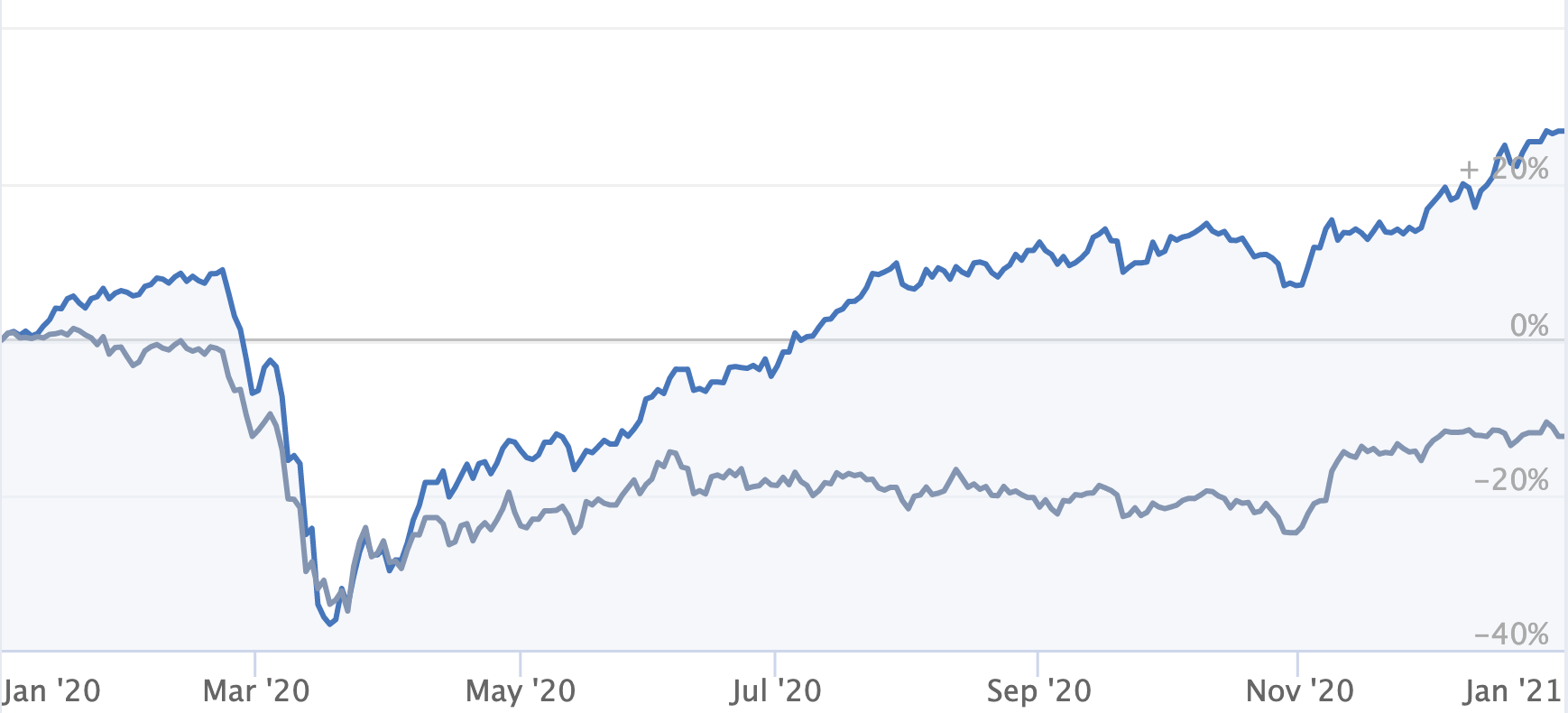
In a bumpy year the NAPS Portfolio has returned a handsome 27% gain before dividends. This compares favourably with the FTSE All Share (my benchmark) which lost 12.5% and the FTSE AIM All Share which rose 20%.
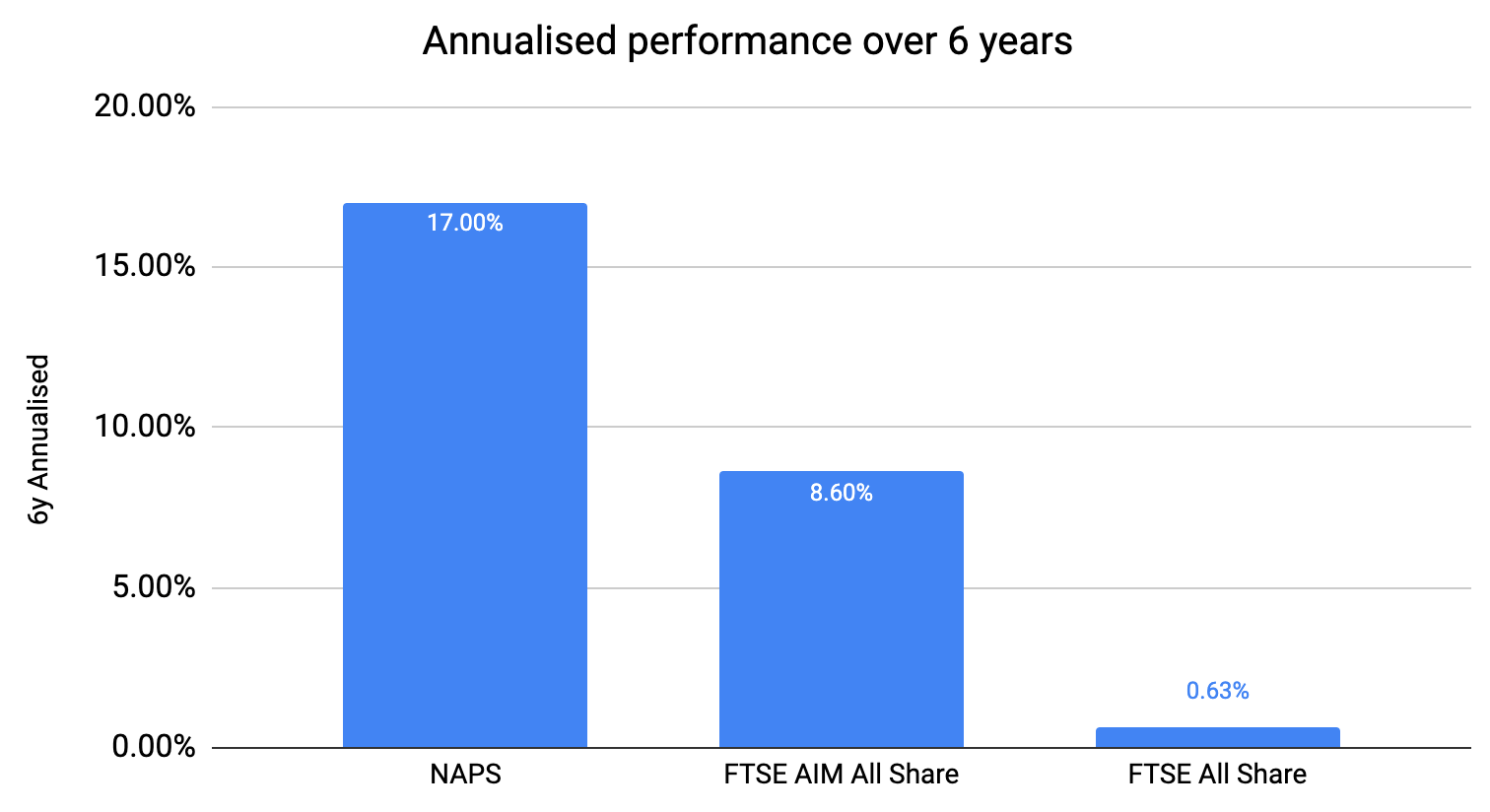
The NAPS Portfolio is now up 156% over 6 years which is an annualised 17% return before dividends and costs. If it can keep up the 17% annualised over the next 4 years the portfolio will have almost quadrupled in a decade - which ain't bad for an hour of work per year.
Holdings Performance
The portfolio got off to a great start with a 9% return in the first 7 weeks of the year - benefiting from the momentum with which it was designed, but March brought Coronavirus. There was a 42% decline from peak to trough between February 21st and March 18th. I have never seen a month like it in all my years of investing. These kind of drawdowns are normal in the stock market, but not in such a short space of time!
But the rally from the lows has been quite astonishing. The portfolio has now doubled in just over 9 months, benefiting from the huge rally in risk assets. The performance has been driven by four shares in particular. Ergomed (LON:ERGO) , Premier Foods (LON:PFD) , Petropavlovsk (LON:POG) and Frontier Developments (LON:FDEV) . Each of these four has returned over 150% in 12 months.
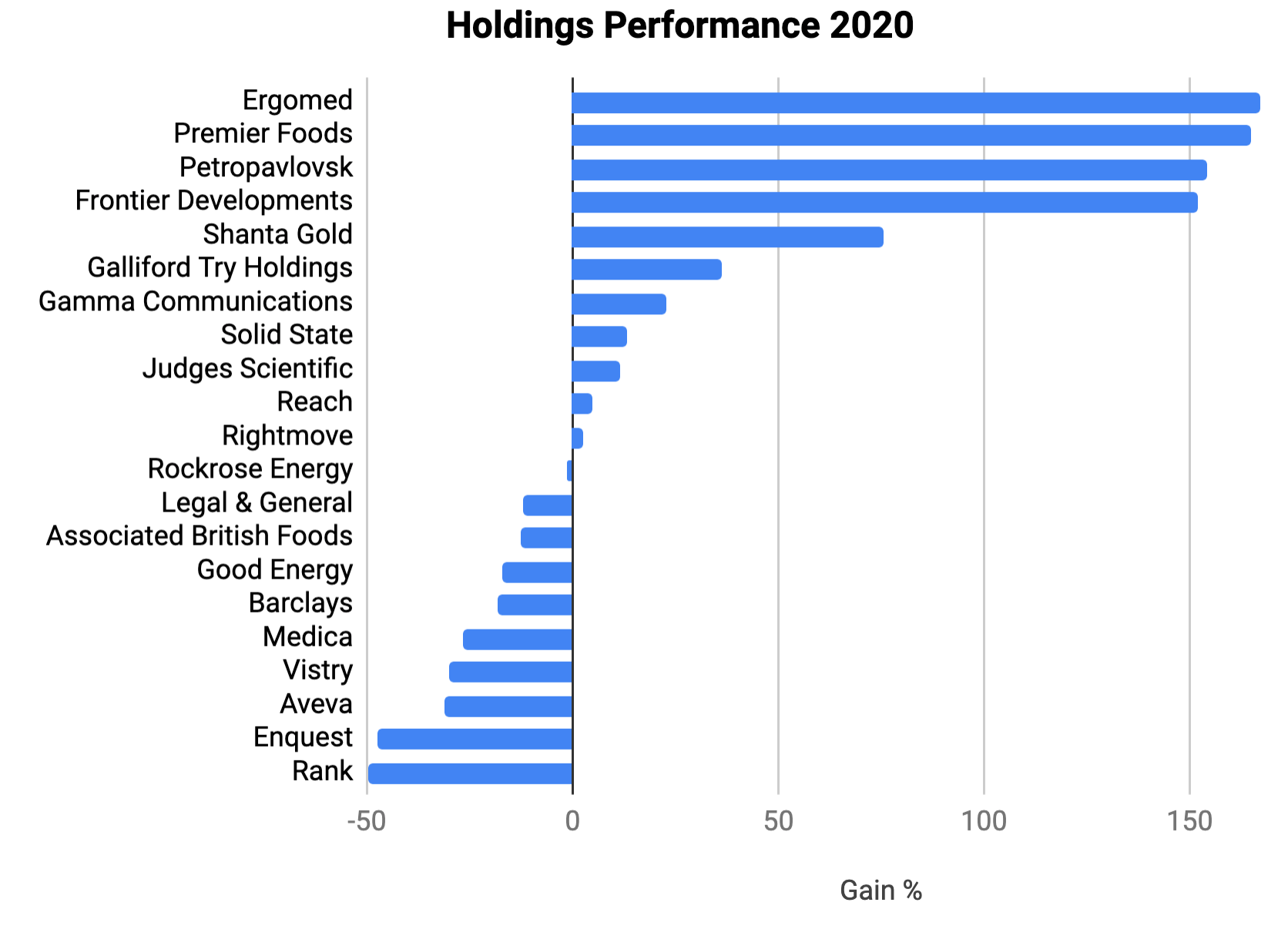
What's interesting is that these shares map to some of the key themes of 2020:
- Ergomed (LON:ERGO) → Healthcare - rapidly evaluating therapies & clinical trials seemed to be in vogue.
- Premier Foods (LON:PFD) → Food - you couldn't eat out so everyone filled the larder.
- Frontier Developments (LON:FDEV) → Gaming - what else can you do in lockdown?
- Petropavlovsk (LON:POG) → Gold - well fiat currencies are going down the drain...
Of course - there was no crystal ball. The NAPS process has absolutely no idea what's going to happen in the world year to year, but it aims for broad sector exposure in case of unexpected rotation.
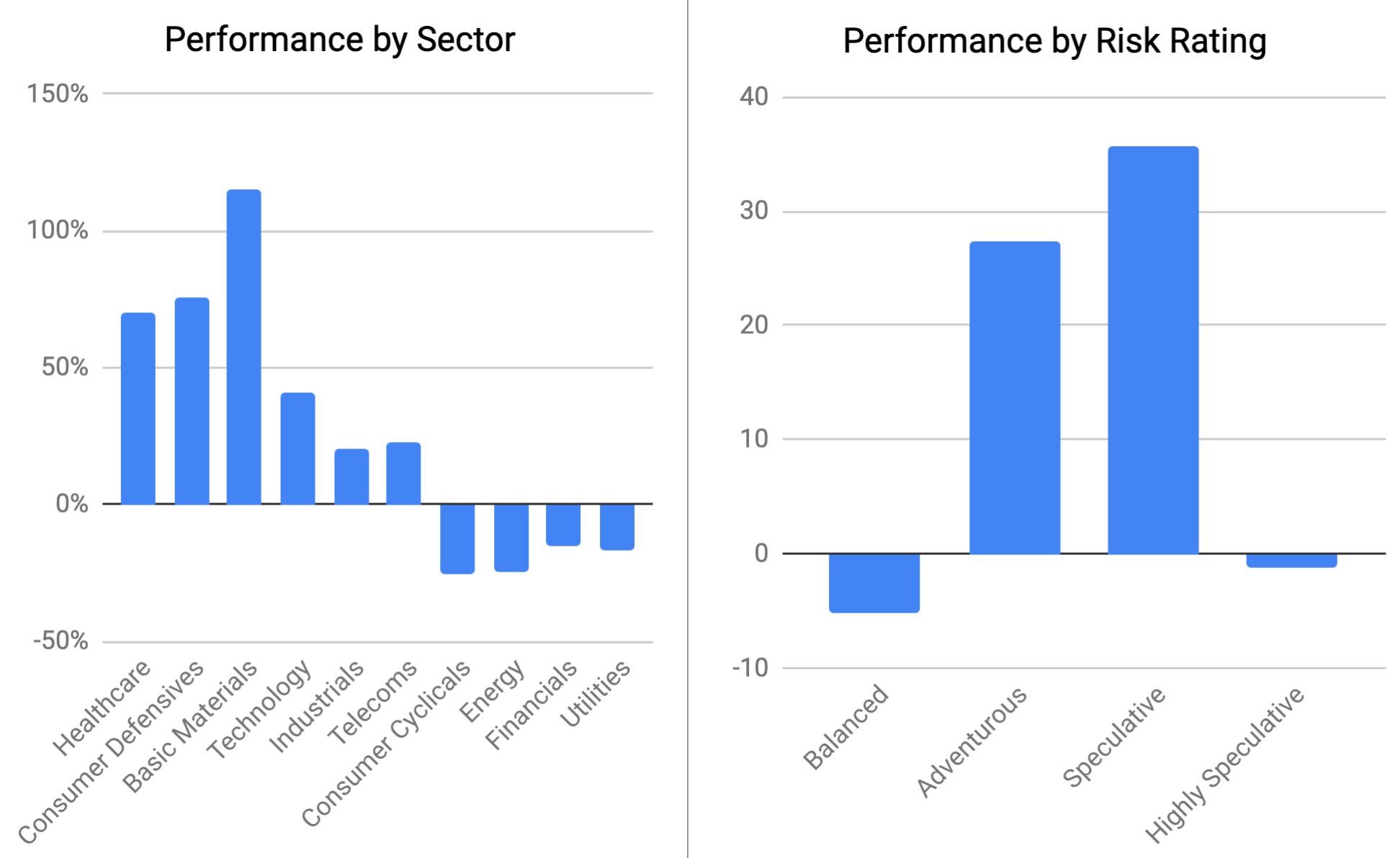
Looking at the sector performance below, we can see these themes play out. Yes other sectors like financials and energy brought a drag, but one of these days we're going to see enormous rallies in cyclical areas and the portfolio will benefit from its sector agnosticism.
How did the new rules work out?
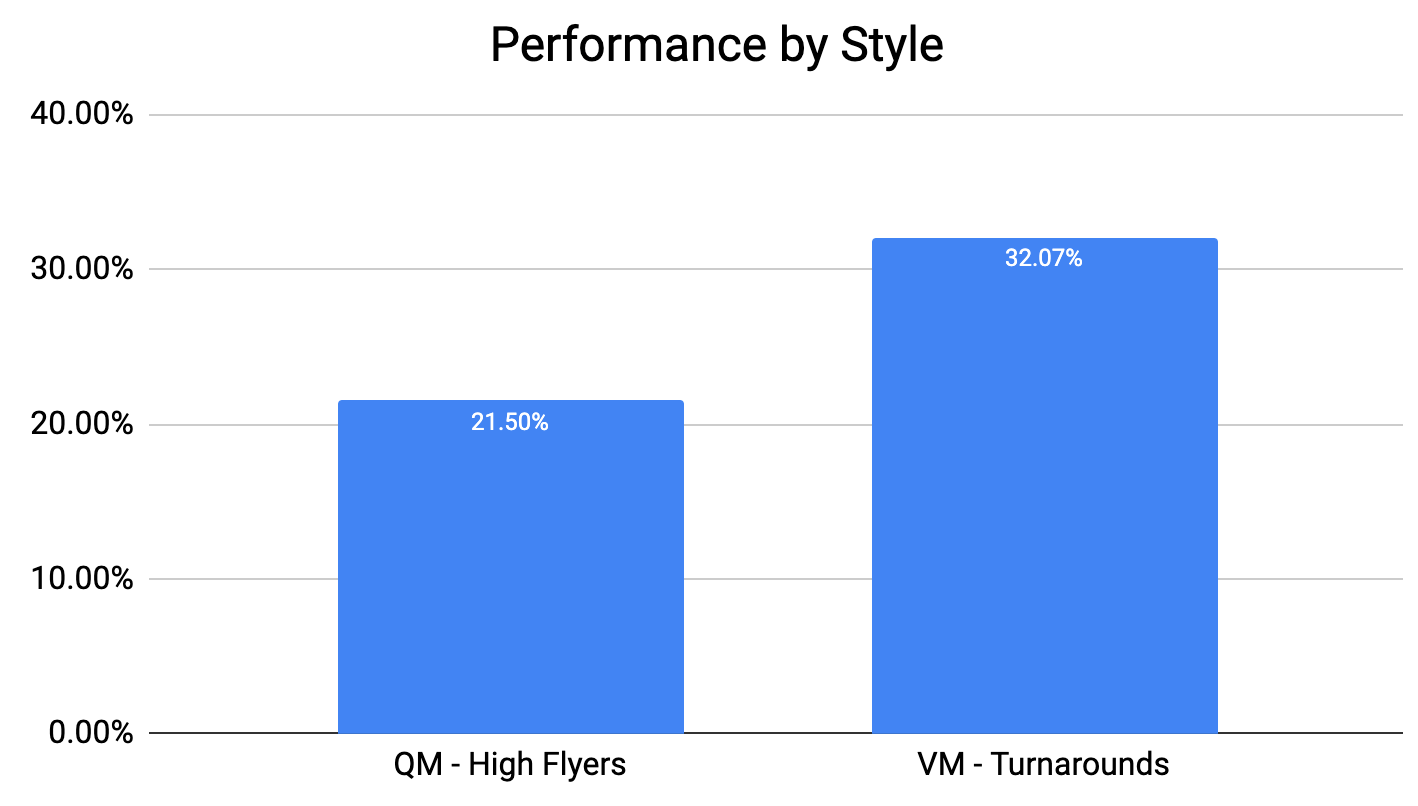
If you remember from this time last year, rather than just using highest ranked shares by their overall StockRank (Q+V+M) I decided to build half the portfolio with high QM Rank shares and half with high VM Rank shares. The idea being to build a list which benefited both from a stronger momentum loading, but also to fill the portfolio with names that were less cyclical in nature. High QM shares tend to be "high flyers" - the kind of high priced shares that are desired by growth investors, while high VM shares tend to be "turnarounds" - often just starting to be recognised by the market. These are my favourite strategies to pick from.
As you can see the "Turnaround" half of the portfolio returned over 32%, while the "High Flyer" half returned 21.5%. Both strategies complemented each other well in what was a very strange year.
Now I haven't checked what would have happened to the original NAPS rules, but I do know that the top 20 stocks by StockRank have only returned 4% over the last 12 months. So I think I made the right decision - fortunate perhaps, but one makes one's own luck.
2021 NAPS Portfolio
Back to the NAPS - once again for 2021, I will be betting on Big Mo with a fairly unchanged strategy. It's the top ranked QM and VM shares split across 10 sectors with a market cap cut off of £20m.
Normally quite a lot of people ask exactly how I constructed the portfolio. So here goes:
Create a couple of screens:
- Mkt Cap > £20m, sorted by VM Rank descending (you can duplicate this)
- Mkt Cap > £20m, sorted by QM Rank descending (you can duplicate this)
Then:
- Copy the top 20 or so from both lists into a spreadsheet but combine the VM and QM ranks from each list into a single column (VM or QM rank) depending on the screen it's come from.
- Sort by that combined rank column.
Then:
- Go down the list adding the highest two ranked shares from each of the 10 economic sectors.
- Make sure there are no more than 10 shares added from either of the original screens.
- Make sure there is a max of 2 in each sector, and only 1 from Telecoms & Utilities each.
That normally means there's 18 shares in the list... but before I add a couple more I do the following:
- Check for any industry bets I'm uncomfortable with. This year I removed Plus500 (LON:PLUS) from the list as ranked above it was Cmc Markets (LON:CMCX) and they are both in the same CFD/Spread betting sector. Similarly, I removed Jubilee Metals (LON:JLP) as it's another Platinum miner and Sylvania Platinum (LON:SLP) is ranked higher.
- Add the next highest ranked share in each of those sectors to replace the ones removed. That brought in Base Resources and Barclays.
Back to 18 shares... so go back to the list and add the next highest 2 ranked shares to any of the sectors. Take it up to 20.
You may get slightly different results running the process above. The data may have changed since I ran my process. The important thing is not to be pedantic about getting it exactly right... the point is the principles with which it is constructed: High ranking shares, diversified across sectors and factors ought to create a robust stock market portfolio.
After all of this, here are the 2021 New Year NAPS.
| Name | Mkt Cap £m | StockRank | Risk Rating | Sector |
|---|---|---|---|---|
| Base Resources (LON:BSE) | 188.2 | 98 | Adventurous | Basic Materials |
| Sylvania Platinum (LON:SLP) | 237.1 | 99 | Speculative | Basic Materials |
| Up Global Sourcing Holdings (LON:UPGS) | 99 | 99 | Speculative | Consumer Cyclicals |
| Halfords (LON:HFD) | 531.6 | 99 | Speculative | Consumer Cyclicals |
| Reach (LON:RCH) | 448.1 | 98 | Speculative | Consumer Cyclicals |
| Naked Wines (LON:WINE) | 489.3 | 95 | Adventurous | Consumer Defensives |
| Wynnstay (LON:WYN) | 67.5 | 99 | Adventurous | Consumer Defensives |
| Mcbride (LON:MCB) | 148.1 | 99 | Adventurous | Consumer Defensives |
| Yellow Cake (LON:YCA) | 209.3 | 88 | Balanced | Energy |
| John Wood (LON:WG.) | 2,135.20 | 97 | Speculative | Energy |
| Barclays (LON:BARC) | 25,457.30 | 83 | Adventurous | Financials |
| Cmc Markets (LON:CMCX) | 1,136.70 | 99 | Speculative | Financials |
| Sdi (LON:SDI) | 117.1 | 86 | Speculative | Healthcare |
| Ergomed (LON:ERGO) | 514 | 74 | Adventurous | Healthcare |
| Luceco (LON:LUCE) | 411.6 | 91 | Speculative | Industrials |
| Somero Enterprises Inc (LON:SOM) | 169.8 | 99 | Speculative | Industrials |
| Focusrite (LON:TUNE) | 630.6 | 83 | Adventurous | Technology |
| Computacenter (LON:CCC) | 2,794.20 | 96 | Adventurous | Technology |
| Vodafone (LON:VOD) | 32,453.10 | 92 | Balanced | Telecoms |
| Drax (LON:DRX) | 1,488.80 | 96 | Adventurous | Utilities |
I'm afraid this year due to time constraints and other projects, Ben and Jack haven't been able to write up the briefs about each share selection.
They have though put together a 44 page download about the new 2021 CyNAPS picks which you can find here - https://assets.stockopedia.com/topstocks2021.pdf. The CyNAPS is a NAPS-style portfolio that uses the top picks from the Stockopedia Challenge. It's a man+machine portfolio that has returned 31.5% over the last 12 months. There is a fair amount of overlap with some of the NAPS portfolio names. I do hope you enjoy the read.
Thanks...
2020 has been quite a year. Not only have markets been on an absolute tear up and down but we've all had to deal with the most enormous upheavals to our working and personal lives. We've been lucky enough to see good growth here at Stockopedia, but that brought all kinds of technical challenges while our entire staff were scattered and working from home. I have to admit that at times I found the whole thing rather intense, but here we are, welcoming in a New Year with at least some hope of a vaccine and a liberation from these awful lockdowns.
So to sign off, I just wanted to say thank you to the whole Stockopedia community. You've been patient with us while we worked on improving the site in 2020. We're about to complete a shift of our systems to the AWS cloud, after which we've a really terrific development roadmap for 2021. It's always an honour to service such a large group of brilliant private investors. I take my hats off to how resilient everyone has been in 2020. Here's to a strong 2021.
Disclaimer
This is not financial advice. Our content is intended to be used and must be used for information and education purposes only. Please read our disclaimer and terms and conditions to understand our obligations.
146 comments
Do you rebalance the NAPS portfolio throughout the year? if so, at what frequency and based on what parameters?
cheers
There is SNAPs, which is done after 6 months. But no it runs for 12 months, then is redone again for the next year. This is the latest SNAPs: https://www.stockopedia.com/co...
Thank you for your answer...
I´m wondering though... if we create the portfolio based on QM/VM, that means we place a higher importance on momentum... in times like we are in now, the volatility makes the momentum score vary quite a lot, and wonder if we wouldn´t be better off with a more frequent rebalancing.
It is a fair point. I have set NAPS every month this since April. I don’t think rebalancing more frequently would have gained anything until September. Since then the NAPS have not fallen back as much as the original NAPS but then you will have the costs of selling and re buying. Since 1st September NAPS is down around 15%. But that is doing it with hindsight. NAPS is still up around 22%, April NAPS is down over 3%. June NAPs is down nearly 7%, October is breakeven. I don’t have September NAPS figures to hand, I would have calculate them.
I wonder why you don´t include Real Estate amongst the sectors?
You do realise this is a UK site?
No separate sector for Real Estate, here are the sectors: https://www.stockopedia.com/se...
ok, I operate in the US market and wanted to replicate the NAPS there. I didn´t know UK didn´t consider Real Estate a sector. thanks!
Not sure about US as I don’t have that region on Stockopedia. Theres nothing to stop you doing a real estate sector there. There are some sub-sectors set up but they may not find everything you want. I consider some stocks to be in the wrong sectors anyway.
Depends what you mean by Real Estate. If it’s house builders they are under consumer cyclicals in a sub category called house builders and construction supplies.
I think they are more spread about than just under CC, some are under Financials subsector: Real Estate Operations such as Inland Homes (LON:INL), and some even in Industrials subsector: Construction and Engineering such as £GFRD.
Belvoir (LON:BLV) and Property Franchise (LON:TPFG) are under Financials but are probably what Americans would call Real Estate agents.
I often change the sector, to what I think is most appropriate, when doing NAPS.
In January and February, my son and I implemented 3 slightly different portfolios based on NAPS-style VM and QM filters, but with some added features. We have now closed out all those portfolios (though we have kept some of the shares just because we like them!). I thought I would share some thoughts on the three portfolios and some lessons we have learnt, to implement again in January 2022 (depending on the macro-environment – we are worried about a big drop in the near future).
For this post I will just be reviewing the first portfolio – which was closest to the NAPS portfolio implemented by Edward and contained 8 of the same stocks.
Portfolio 1. Implemented 5/1/2021 – performance YTD
NAPS-style high QM and VM, UK, France and Germany (France and Germany because we actually can easily and cheaply access those two markets). Equally weighted across 10 sectors with 1-3 shares in each sector (UK unless stated)
Basic Materials SLP +16% plus 8% dividends
Healthcare SDI +60%
Energy WG -33%
VBK (Dax) +100%
Telecoms VOD -17% plus 3% dividends
Financials CMCX -38% plus 5% dividends
Technology WAVE (Paris) +60% plus 0.5% dividends
CCC +9% plus 2% dividends
Industrial SOM +60% plus 8% dividends
Consumer Cyc. STO3 (Dax) +48% plus 3% dividends
Consumer Def. LNTA -15%
MCB -22%
WYN +50% plus 4% dividends
Utilities DRX +33% plus 4% dividends
Stars included WYN, SDI and SOM, which are well known from the NAPS portfolio. But less well-known are probably the Europeans WAVE, STO3 and VBK. STO3 and VBK remain in our holdings even after closing the portfolio. STO3 supplies building fittings and remains at 75 value rank despite the 50% increase. VBK is a leader in bio-fuels, and whilst it is no longer cheap it has a high ROC and is operating in a market that is expected to grow by 4000% by 2030! WAVE is a French IT Consultancy which has done well but is no longer as compelling from a value POV.
Lessons. Our actual return as per close out was over 30%. We sold out of some too early, some too late. We could have just sat on our hands, we would have done just as well! We probably bit off more than we could chew running three portfolios, 40-odd stocks and significant risk. However, we could have improved significantly if we had taken account of the macro-environment from late April onwards – as the reflation trade faded, our returns dried up and then reinvested – hindsight is 20:20.
The most important lesson we probably learnt is that there are really great stocks in Germany and France that are probably just not getting the scrutiny that UK stocks get. All 3 of our European stocks appeared in our top 6.
Finally, Edward, this exercise really taught us a lot about the power of Stockopedia.
I agree about European stocks, I do hold a few that have done very well this year, MIPS and EUZ are both up around 3x. I don't have the European section anymore, so I don't know how those 2 were ranked, I bought them some years ago.
However, if you are UK based it is always easy trading them and is usually more expensive. Information is scarce as well, I found on Stockopedia even some of the results were missing.
There used to be some coverage of European stocks a few years ago, but not seen anything recently.
Congratulations Alex - that's a terrific result! I'm on 23% but I've broken too many of my own rules through discretionary fiddling.
Are we going to see the 6 monthly review and new picks soon?
Can’t do the new picks until 30th June.
Will be early July.
Currently up 28% year to date.
Been running this for real, but stocks picked April 22, benchmarked against FTSEAS. I am up 10% on the month, compared to the All Share at breakeven.
I have to say that I have folded and put some stop loss orders on some of the better wins to take some profit on some of those holdings rather than run them for a year. But that's a real money thing - I have kept the original picks in a folio to see how they do.
Any profits taken by stop losses will be reinvested - perhaps even in the same equities if those companies still make the grade and fall lower. If not, some new additions will replace those sold out.
Let's see how this goes! Also, I am now trading all of this within a fixed fee ISA platform after I realised how much of my money my former providers were taking in platform fees...
Good results overall, well done!
I'd like to apply a Holdings Performance bar chart to a personal folder but don't know how, can someone help please.
Just having a look at the folio this morning and I notice that CMC Markets (LON:CMCX) is now in the Industrial Sector and not Financial Sector which does not seem right.
Actually I'm just trying to do a NAPS selection. What happens when 2 or shares have the same score in each sector? ie Naked Wines (LON:WINE) and McBride (LON:MCB) both score 98 in the CD sector, Treatt (LON:TET) has already been selected.
I notice there are no Technology shares in the VM list.
NAPS Portfolio is up 18% through Q1 vs FTSE All Share +5%.
Biggest winners year to date include:
18 winners, 2 losers. Good start to the year.
---
As a whole, the NAPS Portfolio has tripled over 6.25 years. That's a 19% annualised return (excluding dividends and transaction costs).
Great update. Your webinar was v useful, especially on the different rebalancing strategies, even if it was on the old website and old method.
Now that I’ve read the complete works on this blog, I’m looking forward to jumping on the NAPS train when my ISA-to-ISA cash transfer finally comes through.
As a whole, the NAPS Portfolio has tripled over 6.25 years. That's a 19% annualised return (excluding dividends and transaction costs).
What was the return at the bottom of the equity curve in March last year? Looking at the chart it looks like it was approx 40% after 5.25 years. I think NAPS is a great way to beat the U.K indexes for very little effort but anyone following it needs to have the mental and emotional strength to hold through occasional very large falls in value. Last years bear market was deep and short lived, at some point NAPS is going to have to deal with a multi year bear.
"I think NAPS is a great way to beat the U.K indexes for very little effort but anyone following it needs to have the mental and emotional strength to hold through occasional very large falls in value."
@unwise2 - to be honest, you can say exactly the same thing about any tracker fund.
The portfolio is structured in such a way that it offers pretty much market levels of risk, with the potential for significant outperformance. In my opinion it's far riskier to own a market cap weighted index tracker fund.
(Usual disclaimers of past performance not equaling future returns etc etc.)
Certainly NAPS has outperformed the top 20 QM shares which I set up for the last 2 years. QM top 20 this year is only up about 10% at 31/3/21. I also did a top QVM shares, this has performed better at 18.7% at end of March.
Do you a split between the QM and the VM shares in NAPs?
Yeah - @herbie47 - I explain the process in the article above. It's half VM half QM and I ensure there are 10 of each. There will rarely be any Tech or Healthcare with high VM - they tend to be found in QM. While there have recently been more miners and energy stocks in the VM camp. If there's an equal rank, well you have to make a decision!
Thanks Ed, but some are only in VM such as Energy, Telecom and Ultilities so that's 5 in VM. 3 shares are in both QM and VM top 10s, Gattaca (LON:GATC), Ferrexpo (LON:FXPO) and Sylvania Platinum (LON:SLP). My selection has 10 VM and 7 QM.
I will swap Marshall Motor Holdings (LON:MMH) for UP Global Sourcing Holdings (LON:UPGS) so that will make it 9VM and 8 QM.
I note that the VM are mostly Superstocks rather than Turnarounds at the momemet and QM are fairly evenly split between High Flyers and Superstocks.
Thanks very much for the replies - all done, now lets see if I can leave it alone for a year!
You could switch to iweb- £5 per share. There are also free brokers, but the bid-ask spread and small cap coverage may not be the best.
Diversification is also a function of turnover. If you are rebalancing on a more regular basis then you are getting exposure to more stocks over the year. Remember that this NAPS approach does not trade over the year, so there is no diversification from turning over the portfolio.
Hello - fairly new to the site - I have been a long term investor largely in ITs which have served me very well - however recently decided to have a go at a more active approach which I am well aware will probably underperform these but approaching it more as a hobby and very interested in adopting a NAPS approach after a brief spell in the "casino" microcap aim stocks - which hasn't been a disaster - but is no good for my coronary arteries and I suspect in the long-term will lead to heavy losses.
I cashed in most of my ISA for a house purchase and am left with a pretty modest sum of just over 25k. I am really uncertain whether this is enough to do the fully fledged "20 stocks" approach that NAPS recommends as it will incur proportionately fairly heavy costs (I am charged £10 per transaction with current broker Fidelity). However - with fewer than 20 I'm worried that I will lack diversification.
Would value others thoughts?
Richard
I have a similar sum of money and I find £1000-£2000 per company perfectly workable - particularly using a NAPS type approach as the number of transactions is limited
£25k should be enough to buy 20 shares, that's £1,250 each share. Some selections you may not be able to buy or may have reasons for not buying, such as spread is too wide or debt is too high etc.
There are cheaper platforms as well to consider.
If funds are less it's worth thinking about a limited number of high conviction purchases. I reviewed my own share picks recently, and my top 10 ranked picks outperformed the next 20 by some margin.
BSV
I'd be interested in the groups thoughts on my dilemma.....
I've successfully run a UK NAPS-style portfolio for a number of years now, and have bought into the Stock Rank concept with the Q/V/M aspects to it, but in the last few months I've been looking at the Stock Rank performance history charts (from the "Today" page). If you look at these for "All time", they show what we would all like or 'expect' to see. Generally the higher the ranking the better the performance. If you look at them from a 3m, 6m, 1yr or even 2yr perspective this seems to be reversed. The LOWER the ranked groupings generally have done BETTER than the higher ranked groupings!!!! Is this a data issue, a genuine "trend", the result of a rather messed up last 12 months or have I missed something...... I'm currently feeling a bit challenged on what I trust!!!
It’s perfectly normal to see these kinds of factor inversion periods where low quality, speculative shares outperform. Everyone ends up throwing in the towel on their hard earned, time tested investment principles and chases the hot sectors for quick returns. Normally ends up the same way.
The NAPS are up 15% ytd. Rather a good start to the year.
Afternoon all, I have just started my own NAPS this afternoon using the latest stock ranks for QM / VM. 2 stocks from each sector apart from Telco and Utilities (1 each). Not much choice these anyway. Also using a Free broker for the first time to slash trading fees. So hopefully see a better upside. Just need to be disciplined enough to avoid meddling to much by avg down and topping up winners.
Or is there a benefit to a more regular re-balancing as there are no fees?
Thanks in advance, Mark
you can check the performance of top stockranks, qm, vm at different rebalancing intervals here
https://www.stockopedia.com/le...
That link goes off somewhere else for me, here are the performance figures: https://www.stockopedia.com/stockranks/performance/
Certainly the top ranked shares got badly hit last spring but have mostly recovered in the last 6 months or so. The carts do look a bit misleading as the bottom ranked have outperformed this last year.
new here, I am a bit confused when presented with a Stockreport with seemingly contradictory information, take Vodafone as an example: Stockrank is around 90, yet the bankruptcy risk is considered really high. Which one of those indicators should weigh more heavily on a decision to invest?
I look on this site as presenting the available evidence - you are the judge and jury :-)
I think of it as about the balance of probability. The NAPS premise is straightforward: A share with a 90 SR is more likely than a share with a 10 SR to perform and vice versa. NAPS starts of by positioning across sectors so that this years fashion will be caught - this takes care, by default, of position sizing and exposure. It then seeks the shares likely to outperform the sector. Then as returns are asymmetrical, it sits back and waits for the asymmetry to occur. Hopefully, negative correlation (aka a crash) doesn't happen (as an aside I think there is an argument for a portfolio stop loss with this approach, but not individual shares - and then you need a rule to get back in).
So your question might better be "how many 90+ Stockrank shares do I need, so that on balance, I'm (likely) ahead (despite each individual share having something that isn't perfect)".
Thoroughly enjoyable read Ed. Glad that some of my own stock picks are on this list! Although I must confess to still not fully understanding 'value' concept. However, that is for me to study further. Have invested in a few courses relating to financial analysis and hopefully set a foundation for 'A' level accounts. On the economics subject, I have been looking at subscriptions to 'Bloomberg' and 'Wall St Journal' publications. Any guidance there, as to a better way to keep informed? All the best and thanks.
Have you thought about rebasing the portfolio more than once a year - say every three or six months? The momentum on which you are basing the selections at the start of the year could peter out during the year.
It already is redone at 6 months, see SNAPS.
Relatively new to the platform and loving the combination of easy to use data, analysis and sensible commentary. I have just invested in UK/EU/US 3 folios based on NAPS criteria. Will let you know in 12 months how it goes!
For those interested in UK vs. EU vs. US NAPS YTD. Having invested in 20 stocks in each of the 3 markets using Ed's NAPS criteria, 3 month performance (including bid-offer but excluding broker fees/tax) is as follows: UK 12% vs. FTSE all share 3%. EU 5% vs. Eurostoxx 600 7%. US 9% vs. S&P 500 7%. Plan to rotate the bottom 10% in terms of live QM/VM scores.
Very UK centric selection. Is there a reason for this? Vast majority of my best stocks in past 12 months have been non-UK, mostly US/Chinese etc
Would welcome it if someone was to try, some time, and come up with a US version of a NAPS portfolio based on same criteria ...
You can compare the top ranked US v U.K. v Europe, when I last checked the US did not perform well. Looking at the big winners last year such as TSLA, TTD etc I don’t think many were highly ranked on Stockopedia.
You can always do your own folios, based on the rules if you have the US section on your subscription.
Looking forward to you getting onto AWS and having more time for working on features :) Love reading the NAPS review each year cheers Ed
This is a great concept. I like the diversification across sectors and some of the shares are already on my watch list. Wynnstay is one that appeals. A happy new year to all the staff.
Interesting to find one or two of my own selection among the Naps. Gives me more confidence in those.
Nice update from Reach (LON:RCH) today and comments from Paul here. Today's rise makes it now the largest position in my personal account. We remain long RCH in the Investment Club too.
While I don't like their websites nor pension fund issues, I do think it remains a bullish turnaround story there - with a strong leadership team who are highly incentivised to make it work.
Hi Ed, NAPS has got off to a real flier, I make it is up over 6% which includes spreads, which is very impressive.
I'm not sure about Reach (LON:RCH), I did buy some about 3 weeks ago but sold out today at around 224p, I may buy back if the price falls back. I do have concerns about the pension and I'm not a fan of adverts on websites, I use Adblock, but they do seem control most of the local newspapers.
I thought this was your Naps as in betting - the double entendre kind of works!
Yes - like a NAP hand. Or a nap by the fire.
Hi all and happy new year,
I’m new to Stockopedia and investing in general. I’ve spent the last few days reading articles and watching as many videos on the site as possible. Firstly, thank you to the guys who are clearly working hard in the background to provide easy to understand material.
At present I have between £10/15k to invest. I have read the NAPS report and the approach seems to make sense to an inexperienced investor like myself. I am investing for long term growth and I am many years from retirement (25+ years).
I have just watched a historic video on NAPS and read the attached link on ‘when does it pay to be your own fund manager’? It would appear that given the amount I am looking to invest; it may not be cost effective to pick 20/25 shares (annual cost of 5.8%). I’d like to diversify but it would appear to be expensive factoring in charges etc. Would I be better off waiting until I have more to invest or can anybody think of a different approach? I’m not after financial advice, just thoughts from the more experienced members of this forum.
Please be kind as it is my first post!
Perhaps putting the money in a single fund is more appropriate with such a relatively modest amount? The shares trading costs will be too high, relative to the portfolio size.
Yes, I think starting off with some funds, would be a good idea.
Funds are easy to buy and sell, so you can just sell some to buy a share if you want.
I would not invest under £1,000 in a share, minimum of £2,000 is better to reduce the transaction fees.
Hi @Mcintyre - you've obviously done your research if you found the 'when does it pay' spreadsheet! Looking at that spreadsheet again, it's in need of updating - have a look at my edit here.
I don't like talking 1 on 1 - so this should be taken as general thoughts - not personal advice!
A 20 stock portfolio can be a bit expensive to manage for a £10-15k portfolio - with a Stocko subscription in the mix there's 5-6% hurdle. It's important to try to keep the costs down as low as one can.
With a 10 share portfolio the costs can be less than 4% - still a bit steep but one can learn an enormous amount in the process which is worth the cost. I have done plenty backtests that show that a 10 stock, well diversified, portfolio would have done almost as well with a NAPS style process.
I'd certainly ditch utilities & telcos in a 10 stock portfolio - especially if I was starting out. Sector selection is key - I do think healthcare, consumer defensive, industrials and technology are good sectors to select from in the current world - but hard assets are rebounding and oil shares are probably too cheap. 5 QM and 5 VM shares would be a good mix perhaps. Stocks go down as well as up remember (DYOR). I have done quite a few conferences where I selected just the top 5 VM shares each year across 5 sectors. They did well every year - and I tended to beat the other discretionary stock pickers!
There's a 10 share portfolio backtest in this older article. https://www.stockopedia.com/co...
Rich world telcos and utilities have little room for growth and their bond like qualities may imply share price falls if gilt yields rise. But I chanced upon Airtel Africa (LON:AAF) earlier this year which imo offers significant growth opportunity at a reasonable price, and a decent divi thrown in too.
You could have a look at Fairtrade - you can purchase shares at nil cost allowing you to get the spread you
Hi, I am also new to this and prefer to use a stocks and share isa, buy everything through that to avoid tax implications.
That way any growth & dividends is tax free. There is a small charge for this about 0.5% but it will avoid you having to do a tax return every year and declare any profits etc.
Not being a IFA but it works for me.
Good luck with your portfolio.
One thing I do find a little irritating as I read around the Discussions is the attitude some posters have as to what defines a small investment or minor trade. Maybe they started off with a nice lump sum from an inheritance, or maybe they did start small but as time has gone by they have forgotten what it was like to be working with relatively little. Dealing in multiple thousands may have been their norm for many years, but there are many of us where a £1,000 trade is still a 'major thing'.
Looking in my spreadsheet, I see I have a set of 15 shares, total value of around £17k. My typical recent trades have varied in value between £750 and £1k. This portfolio started off with a much smaller number of companies invested, and a typical trade of around £650. Over time I have made this grow (despite some horrendous mistakes - and learning a lot from them!) with an average annual rate of return (after costs etc) of around 14%. The gains made have enabled me to 1) increase the number of companies owned; 2) increase my typical trade amount target to £1k; and 3) filter off some of the gains here and put them into (long term buy and forget type) Investment Trusts.
Yes, dealing in £1,000 amounts means I do have to think about costs (so I am definitely looking at those companies with the smaller spreads), but if this is what I've got, then it's what I've got!
So my target is to increase this portfolio till I can have £20k and 20 companies invested, then stay at 20 companies (a nice manageable number) but increase the amount per company.
With smaller trade sizes it's important to keep broker fees as low as possible. E.g. buying then selling £1000 of shares could easily cost £25 (2.5%) in commission on top of stamp duty and bid/offer spread. Overtrading will rapidly eat into returns in smaller portfolios.
I run 3 portfolios each with 10 stocks, some may call it 1 portfolio with 30 stocks but I do run each as a separate entity. I find the diversity adequate for my needs in each folio and have rules for ins and outs. I do rebalance quarterly so incur more costs than if done annually but it does hold my interest that way.
It’s a round about way to say that a 10 stock folio can be effective when chosen right and putting your money on the line does give valuable learning experiences when your assets get larger
Thanks very much for this Ed!
I would like to invest more in ETFs. I am not sure why you don't provide much information on them. Is this something that you may consider in the future or is there a good reason why you don't? Happy New Year!
Hi Julie, see Eds reply to @Paul below. Ed makes the following comment: "I've long been a huge skeptic of passive investing - back in 2013 I wrote a piece titled "Index Funds are Parasites and are going to kill the market" " I admit i don't understand all the discussion in the podcasts, but its been a real eye opener to me. I was thinking ETFs (passive funds / index trackers) were a relatively safe way of investing but im not sure any more
Thanks Ed and Stockopedia team!!! Being a very new member, I am finding very interesting hopefully will have good return too
Hi Ed, apologies in advance as I'm sure it's probably covered in a past NAPS post, but I couldn't see an explicit reference to the point here - do you ever implement a stop rule on the positions?
The 2020 holdings performance graph seems to imply 'no', but I just wondered about your thinking on this... presumably, if one were to be implemented, it would be to swap out the offender with the next best candidate from that sector?
Stop losses are not used. They would have taken you out of some of the big winners last year. So not only would have had the loss, say 20% but also you would have lost the large gains, some of which were over 150%.
Hi Gnome -
"Let's say there was an average 3% spread." - this year's NAPS have a median market cap of about £400m+ and a median spread of 1.1% - so the transaction costs aren't anywhere near as much as you imply.
"One thing I think you may have missed regarding the churn is that Ed also rebalances at the half year in his SNAPS" - no - the SNAPS are there as a half year selection for those who are interested out of cycle. I tracked semi-annual rebalancing for a while but I have never recommended it due to the additional transaction costs.
Thanks Ed. I see actually you include a maximum spread within your selection criteria which seems very sensible. Something else which occurred to me was that if you have a large group of investors following the NAPS method, that's going to lead to a lot of them selling out of and buying into the same shares, often at the same time. That will surely move the price in some small cap shares. Something else for investors to bear in mind, I think.
Well that rather reduces the relevance of my analysis!! Seems I have misunderstood the purpose of the SNAPs. I had assumed it was a 6 month rebalancing process that was applied. Back to the drawing board!
Thanks Ed, id certainly like to be a shareholder in Stocko!
@Paul - I will reply properly in an article at some point. I'm still gathering my thoughts on all this and I do suffer from being a short term bull but long term bear.
The problem we've all got is that none of us can really imagine what a financial environment looks like without central banks that bail it out all the time. We've all been trading "Don't fight the Fed, Don't fight the trend" for our entire lives. What we forget is that the last 40 years are a very unique market environment that is highly unlikely to be permanent. The shift from mid-teen interest rates to zero rates has been a once in a lifetime event.... when all rates go negative... where to next?
I do agree that UK small caps are generally quite robust - disfavour with the UK due to Brexit has forced companies to focus on profitability & cashflow. But the wider system is massively overleveraged. Whatever you look at - government debt, mortgage debt, financial system leverage, developing nation debt - it's all at pan generational extremes. The system is only solvent while interest rates remain artificially depressed through nuclear central bank operations. Meanwhile - the low rates and wealth disparity are creating a massive financial & social divide. We're seeing the cracks already.
These things historically don't end well. When will it all end? No idea... I do think we'll see the bubble to end all bubbles before any of this comes to a head. I think we're seeing that bubble beginning in the USA right now due to the massive rise of passive & indexing with a robinhood multiplier. Valuations in the US are moving to extremes and capital is being grossly misallocated.
Just to freak people out a bit, I can highly recommend a few podcasts with some of my favourite thinkers about the state of the financial system. Especially Mike Green and Chris Cole.
Mike Greens Pod cast also here: https://ttmygh.podbean.com/e/t... for those (like me), that don't have ITunes :-)
Thanks Ed.
I must admit that the Mike Green podcast lost me but the article by Chris Cole was fascinating!
Any ideas on how best to get exposure to Active Long Volatility and Commodity Trend Following in the UK?
Went down a rabbit hole consuming these podcasts and articles all weekend. Fascinating and terrifying.
Commodities are trending up currently and I suspect they will continue to do so for at least this year.
Volatility a lot more challenging. Mike Greens hedge fund logica only accepts accredited investors with 1M+, which counts me out. VIX ETFs are an option but not a great one. Although equities, investing in stocks that benefit from volatility might also be an imperfect option: IG, Plus500 and CMC for example. CMC also featuring on the big mo list probably means it is the best option (it is scheduled for a trading announcement tomorrow). All in all, I'm not sure there is a good way to access volatility
Thanks, Ed, very interesting write up on NAPS and links to the articles/ podcasts you mention. This from the same series at Artemis is also very interesting: "Volatility and the Allegory of the Prisoner's Dilemma" - includes a discussion on short and long convexity, and how we are setting ourselves up for bigger and bigger disruptions on the back of false stability from central bank stimuli/ easing. Written in 2015, it seems increasingly relevant today.
Ed
Many thanks for the great update. I took the plunge on this approach at the beginning of August (with the new QM/VM rules). I've been rewarded with a 21% return since then, with which I am very pleased. I am struck by how many of the momentum companies have kept delivering when, previously, I would've thought I had missed my moment.
I have sold out of one holding - £cey after the second profit warning. I should've acted on the first. I replaced it with £hum.
My question is how I should manage the portfolio going forward? You talk about reviewing on a quarterly basis. Two of the holdings £ergo and £luce have nearly doubled. My worst peformer £nwf is down a whisker under 12%.
Many of the holdings are still performing strongly and seem to have gas left in the tank. Based on your list today, only six of my holdings would still be in my portfolio. How would you be thinking a hold/sell decisions - or, indeed, adding to positions? Should I be thinking about stop loss/gain lock scenarios?
It has been a great way, as a relative newbie, to get exposure to some great stocks and build a starter portfolio, so many thanks!
Here's to an exciting 2021.
Nice list Ed, thanks.
Just tried to get a quote for Yellow Cake with Halifax but no go. Their response was this:
Anyone know what that means?
I don't know what that means but I just tried to buy 5,000 with HL and there is no issue even with that size.
Yellow cake needs to provide your broker with a 'key information document' to give you the necessary stock info to allow you to trade the stock. If Halifax hasn't got the KID ask them to get in touch with Yellow Cake and ask for it, then you will be able to deal.
Happy New Year to everyone at Stockopedia. Combining the learnings taken from the great discussions by Paul, Jack and the rest of the SCVR contributors, ZULU Principle Screen (Sylvania Platinum, Robinson, Ferrexpo, Tharisa) and a heavy dose of 90+ QM ranking I have achieved in 9 months a return of 30%. I quote this not by way of boast but rather to highlight the value to me of Stockopedia. Many thanks.
Congratulations @SCI20 - a great return! The Zulu screen is still my favourite on the site. The Zulu Principle got me into all this and Stockopedia holds a HUGE debt of gratitude to Jim Slater and Company REFS.
We bought Company REFS a couple of years ago... which was an honour to do. We are carrying its torch.
I was at a property investor seminar 3 years ago and picked up a flyer for a 2 day course in London based on active investing from which I learnt about Jim Slater, The Zulu Principle and Company REFS. I signed up for REFS and have never looked back. Jim Slater has made me more money from equity investing than all of the the "expert" fund managers combined in the years prior to managing my own portfolio.
Who ran the course @SCI20?
I forget the ladies name. She ran the course from her apartment in London and had been introduced herself to Jim Slaters work by her father.
Hi Ed/SCI20, I have the Zulu Principle on the bookshelf - do you think it's still good reading for today's markets or superceded by others?
I think the Zulu strategy is perennial. Yes the book is dated now... it was written in the 1990s. You can't go wrong with a GARP or QARP strategy imo.
Thanks Ed - I'll add it to the top of my reading list. I watched an old bbc documentary on YouTube recently about Jim Slater, James Goldsmith, Tiny Rowlands etc called 'The Mayfair set' if anyone interested in it
@pka - I can test the original NAPS rules over 6 years and see how they've done. I often do actually. It's just a squiggly line up and to the right though - much like my more discretionary "annually refined" NAPS as published !
Have a look at this old thread where I shared some Python modelling on different NAPS strategies. https://www.stockopedia.com/content/some-stock-rank-portfolio-strategy-returns-2013-to-2017-167857
Hi Ed, thanks for the link to the interesting old thread on how different NAPS strategies had performed from 2013 to 2017.
If you have the time to test and publish how the original NAPS rules have performed from 2013 to 2020, I would find that interesting.
I'm not saying you shouldn't change the NAPS rules over time, just that one year's results isn't really long enough to assess how well a particular set of rules performs if one wants the results to be statistically valid. It's a quandary, I know.
I'd like to know if there's a selling method in place for the NAPS. This year's picks include a lot of new companies so do you sell last year's picks that didn't make the list on the 1st Jan?
Yes - it's an annually rebalanced list. If holdings are carried over they are increased or reduced back to equal weight.
This is very much like Greenblatt's approach in "The Little Book that Beats the Market".
Has StockRanks suffered during Covid from lack of company guidance/broker forecasts, or does that not impact? Greatly appreciate the Naps.
I'm actually amazed the StockRanks have outperformed so consistently for so long... a year of underperformance was massively overdue. 2021 was not a good year for the StockRanks as a whole.. but the top decile still beat the FTSE All Share. What's been extraordinary is the inversion - with low ranking, highly speculative shares doing so extraordinarily well. It wasn't a year for the low-volatility anomaly!
The reality is that portfolio construction matters just as much as whether factors are 'working' or not. 2020's NAPS do illustrate that. The broad sector exposure is a massive strength for the portfolio.
Hi Ed, great article as always. I've looked at my own version of the screen and it excludes Base Resources (LON:BSE) Base Resources on the basis the spread is 984 bps. I recall you (quite rightly) had a spread limit of 5%. Maybe the spread has moved significantly in recent days, but thought it worth commenting as it's a material number and investors should be aware.
@V4V - I have to admit that I skipped the spread rule this year. That was an oversight I'm afraid. The list though as a whole is far more liquid than most years - with a median Market Cap of over £400m and a median spread of 110 bps.
I won't change the Base Resources selection - I think you can forgive me a single 5%+ bid-ask spread selection in 140 different stocks over 7 years. But yes, investors should beware the spread is quite wide and use limit orders for best execution if purchasing.
Hi Ed, thanks for publishing this and the CyNaps PDF. The NAPS portfolio really captured my imagination when I subscribed late last year so it's great to look at/compare/use some of the information in real time. And it's finally got me into Sylvania Platinum (LON:SLP) (after qualifying many screens, NAPS, CyNAPS! etc)
I'm interested in the point raised regarding spread. I passed on Somero Enterprises Inc (LON:SOM) last year at around 238p because the spread was 5-6% (I think I liked everything else about it - fortunately I've lost my notes).
With Base Resources (LON:BSE) being off the table if an investor is trying to stay below 5% spread, it does make me wonder how often, if ever, this (personal) rule should be put aside?
On a discretionary basis or when a considerably higher share price is anticipated?
Perhaps considering the average spread paid across the entire portfolio at time of purchase. Although I can see this leading to a lot of mental chicanery simply to purchase the desired stock regardless of spread - or worse becoming a deciding factor in order to even things out.
I suppose these are the challenges when attempting to use a systematic/checklist approach
I’m not going to make a case for buying Base Resources at a high spread - DYOR and all that.
But I will say that investors should always optimise for their overall portfolio cost, not for the cost of individual investments - there’s nothing wrong with owning the odd high spread security. In the grand scheme it doesn’t cost that much - especially in a 20 share portfolio. Of course - don’t own any illiquid assets if you might need to liquefy them in a crisis.
There is also a liquidity anomaly in the stock market (on average). Investors tend to earn a premium for owning hard to deal assets. Note the aversion one has to paying a large spread - it puts most people off. Where there is aversion there are often excess returns. I’m not saying all the time, but on average, over the long term there are.
Thanks for the insight!
I just join Stockopedia and it is pity I cant include in Stockopedia folio Funds eg Smith & William Artificial Inteligent Class Z which gave me 54% return since April 2020 and HL Select Global Growth Shares which is up 31% since May 2020 in my portfolio . I will have reconsider my renewal
Hi Kim
Have you fed back through the tab on the bottom right? As there are some items the Team can do things about and others they cannot.
There are a number of Funds in particular that do not provide data through the main data source for Stockopedia, in my case Fundsmith which is frustrating as it will not show in the portfolio so it is not replicating what my actual holdings are (lagging currently).
I am glad to see what you are up on them, but what was the reason for identifying, buying and what would be your continued holding/adding/selling reasons?
Though I look that Fundsmith is a part of my overall portfolio and I do not currently want/need further analysis on this particular holding so it does not bother me and what I use the site for provides the value which for the last couple of years has more than covered the subscription fee. Though I am sure there are other worthwhile competitor sites that could replicate or beat the site.
Thank you
Tommy
I guess it’s because funds aren’t stocks,.
Thanks, very interesting. The link to this doesn't work though
https://assets.stockopedia.com/topstocks2021.pdf.
It does on my computer.
Dear Ed
Thanks once again for a very interesting insight in your NAPS.
The Competition and NAPS has really broadened my thinking and
rather brought some other factors into question in my mind.
Once again the figures, momentum and whatever drives the stock prices
appear to achieve the results whilst, in reality, a few of the selections
I wouldn’t touch with a bargepole and I can’t see where people are getting
the enthusiasm from.
Just out of interest what made you choose AWS as your cloud provider
over other platforms available?
Thanks for everything and all the best for you and the Team for ’21.
Kind Regards
Brian
@Brian - the whole premise of the NAPS is that it selects stocks that most people wouldn't. It profits from the behavioural biases investors have against certain classes of stocks which ironically suppress prices. e.g. cheap shares are despised, shares at new highs people have an aversion to etc.
There's a lot in the archive that describes this phenomenon.
I do understand that there are plenty of investors out there who don't like risk... and would prefer to own high quality, reasonably valued compounders... but that's not what this strategy is about.
Hi Ed and all the Stockopedia Team
Thanks for all your excellent hard work and helpful information for investors.
Best wishes for 2021.
I echo that. Thanks to you all for your stimulation; your ideas; your humility; and your results. Not least, your response rate of the team to queries, H2 find your way around the site etc. HNY to you all. Not least, I dont know where you get your energy from.
Thankyou Ed...Congratulations on your portfolio returns and for all the articles that you and the whole team write . They help make investing fun.
Happy new year to one and all
Penny
Thanks Ed and Happy New Year, always something of interest on Stockopedia!
Have you ever run a NAPS for Europe ex UK or US. Just interested in seeing how those factors work across geographies.
All the best, Mike
I'd be interested in this too, it will probably make me wonder if I need to have an EU or US subscription to add as well and start looking at more overseas stocks.
Hi Ed,
What a brilliant performance in 2020 and a 17% Annualised return before dividends are excellent. Would strongly recoomend any newbie to incorporate stock ranks in their own portfolio selection method.
All the best for 2021
BSV
Thanks for the article Ed.
What did you have in mind when you said this?
... the reality that much of the western world is deeply insolvent.
If you're thinking about Govt finances, then the picture changes dramatically when you take into account QE. For example, Japan has c. 4x GDP in Govt debt in issue. However, half of it is owned by... the Govt! (Bank of Japan), and the funding cost of it is negligible because interest rates are low/negative.
Same with the UK, when covid struck, Rishi did another £150bn of QE, taking the total to £845bn. Therefore the Bank of England (nationalised, so the Govt) has bought ALL of the Gilts issued by the Treasury (the Govt) to fund the huge spending deficit to date.
Strip out QE, and the UK's debt to GDP is only about 65% - quite modest, and again can be funded at negative real interest rates.
So, for the moment anyway, whilst QE continues to work, then Govt debt is not a problem at all. Govts which retain currency issuing capacity (all major countries outside the EU) cannot go bust, as they can keep issuing new currency to any extent they wish. Conventional economics says that such huge scale money-printing (QE) should result in inflation. It hasn't, so we need to question conventional economics, which doesn't seem to work any more, at least for now.
Companies don't look insolvent to me either. Most of the 500 or so small caps I cover are sitting on healthy cash piles, and liquidity looks fine.
As regards households, 2020 saw enforced savings for middle class households, with a massive increase in overall household bank balances, and repayment of credit card & similar debts.
Therefore, Govts, companies and households are not insolvent, or anywhere near it. So I'm puzzled why you said;
the reality that much of the western world is deeply insolvent.
Regards, Paul.
P.S. It's your fault that I got interested in MMT, after you recommended I read "The Deficit Myth" by Stephanie Kelton lol ;-) Fascinating book by the way, even if it does drift off into socialist fantasy world at times!
So, for the moment anyway, whilst QE continues to work, then Govt debt is not a problem at all. Govts which retain currency issuing capacity (all major countries outside the EU) cannot go bust, as they can keep issuing new currency to any extent they wish.
Broadly I agree with Paul on this, I don't understand Ed's comment either. However, governments - or countries - can go bust. There are two famous examples, 1920's Germany and 1990's Zimbabwe.
In both cases the root cause was a destruction of the productive capacity of the economy. In Germany this was because of war reparations on top of the damage done to the industrial sector in WW1. In Zimbabwe it was because Mugabe gave the farms to soldiers who didn't know how to farm. When you couple a lack of supply of goods - particularly food - with almost infinite supply of money you get hyperinflation and economic collapse.
Theoretically this could happen under MMT if overseas buyers of government debt decided to withdraw. That would trigger interest rate rises which could lead to significant defaults. Although that's theory it's clear that it could happen - Turkey had a financial crisis when Trump slapped sanctions on them just a couple of years ago.
In practice, however, it's likely that we'll see several more years of unabashed QE and possibly negative interest rates as governments and central banks try to drive unproductive cash out of savings accounts and into the real economy. That ought to be good news for real assets - commodities, equities, property.
Of course, this can't go on forever, no matter how impossible it seems to stop. How that will happen is unknown and will, of course, surprise us all when it happens ... but for now, while the music plays, we need to dance.
timarr
Hi Timarr,
Agree, they certainly can default, it is drawing future money from the long term credit cycle to fund the short term cycle. Governments have a very bad history of trying to manage this and it will mean more frequent bubbles in certain areas of markets and economies until it amalgamates into one area and then we are all in big trouble as the long term credit cycle has to be unleveraged again.
Just like what happened in 2007.
Anyone thinking MMT solves what happened in the GFC has led themselves into a false sense of security because that is exactly what happened last time.
This will fester for a long time though for two reasons: first, people want to be rich and they will encourage it like they did in 2007, and secondly, people like to believe in a financial Nirvana and that they have solved all of the world's problems so they will wishfully cast aside their scepticism to believe and partake.
"Golden Age" as Gordon Brown's (in)famous last words.
As Robert Shiller once put it "Animal Spirits" and "irrational exuberance".
Or, to put it another way: it really will be different this time...
Or not?
Hi Thornabian
Yes, I suspect that the merry-go-round will end when governments fail to reign in the magical money supply when it's needed. Politicians of all hues find it much easier to spend than to tax and while the economic theory behind MMT may be entirely sound it (as usual) fails to take account of human nature.
There was a point in 2006/7 when Greek debt was cheaper than German. When markets think there's no risk in the riskier asset then you've set the scene for mass misallocation of capital and some very nasty resets. Arguably we can already see that happening with the US tech boom and inflation in Bitcoin, although that's against a background of genuine technological change which means it's difficult to separate out speculation from innovation.
But when the music stops there will be a price to pay. There always is.
timarr
Any thoughts on what will knock the needle off the record Timarr people talk about inflation but Japanese have been printing on a level that makes up look like Sunday league for years to try and achieve inflation with no luck. Re tech although overpriced they do this time round seem to be quality companies and bitcoin I think its more retail investors punting so don't think enough big money involved to cause a problem at the moment.
Personal thoughts are we should get another 5-7 year bull based on the latest wave of QE unleashed since March 2020 I think 4 times as much has been created against 08/09 but agree with you at what ever point the next problem arrives if it can't be solved by more QE there will be a massive dig in the chops heading investors way.
Regards Andy
Hi Andy
Any thoughts on what will knock the needle off the record
Inflation, in the end, is too much money chasing too few goods and services. Without full employment that's unlikely and both globalisation and automation are acting to keep wages down. But that's not the only risk for markets.
Whenever people start treating markets as being riskless I start feeling worried. They could be knocked off course by any manner of exogenous events - trade wars, actual wars, another derivative inspired bout of lunacy, a worse pandemic, cyber attacks on key infrastructure, irrational exuberance around share prices in the tech sector and so on and so forth.
Whatever ends the bull market we won't see coming. That's the nature of these things.timarr
Paul - we've seen massive inflation in Property, Stocks and shares, Bonds etc etc - all SCARCE assets. Anything scarce has been tearing upwards.
Anything not scarce is being disrupted by technology at an exponential pace. Technology is deflationary and consumers and citizens *should* be benefitting from falling prices.
Theyre not. Those with assets (the wealthy) see purchasing power improved or maintained ersus monetary debasement. Those without - do not benefit and get left behind, seeing their purchasing power eroded.
Ed says "On the one hand, there's a wall of stimulus continuing to come through, both fiscal and monetary, which should continue to support equity momentum; but on the other hand, this liquidity is papering over the reality that much of the western world is deeply insolvent"
He is right. This system will not last forever and is approaching it's final stages. Bitcoin will likely replace it, being natively digital, decentralised, incorruptible, scarce and trustworthy.
Existing companies can never see the arrival of the new system. Blockbuster couldnt see video streaming. Nokia couldnt see Apple. Central banks and most people still cannot see Bitcoin for what it is.
Thanks for the post Ed, much appreciated
Thanks, Ed. I always learn a lot from your articles.
one question from the inexperienced investor that is me. how come you don't include other regions in your portfolios? i.e emerging markets , north America.etc.
Another brilliant piece of work Ed. I only recognise a few of the names from my own portfolio, but I am about to steal a few more from you. My own investment process and success has improved dramatically since using Stocko. It's an incredible piece of work and I suspect it's used a lot more by professional managers than admit.
Another interesting selection of a diversified group of High VM and QM stocks for the New Year Naps. I have compared the 20 Nap selections with the 20 from the Man and Machine. The Man and Machine group has been derived from the most picked stocks in Stockopedia Challenge with 66+ Stockrank (Top 1/3 score).
The following 5 stocks occur in both the 2021 New Year Nap and Man and Machine selections: CMC Markets (LON:CMCX), Ergomed (LON:ERGO) Reach (LON:RCH) SDI (LON:SDI) and Sylvania Platinum (LON:SLP). The question next is how likely are these 5 "combi" selections to outperform the market?
In my view 5 stocks are too few to form a complete portfolio, but I do think that any of these 5 would be useful diversification to an existing portfolio. – Disclaimer: I hold Ergomed (LON:ERGO) and Sylvania Platinum (LON:SLP) Ian
Hell iwright7. HNY to you. Man and Machine group. Where will I find that and their Naps for 2021. Thank you in anticipation.
ridvies The Man and Machine Naps are detailed here:
https://s3.amazonaws.com/assets.stockopedia.co.uk/topstocks2021.pdf
Thanks Ed. The NAPS portfolio has certainly demonstrated its worth. The only thing that I'd point out is that it is a theoretical portfolio and the true cost of running the portfolio is maybe not reflected in the results. If you are running a real world portfolio in line with the NAPS, it would be interesting to learn how the performance has been.
I see that the 2021 portfolio has replaced 90% of the 2020 entrants. That's a lot of churn and would lead to a not insignificant amount of transaction costs, especially if you had a large value portfolio and were buying and selling relatively illiquid small cap stocks. Let's say there was an average 3% spread. That would lead to a 6% cost to sell and then buy back into the new share. Take off a generous 2% for dividends, leads to a cost of about 4%. In that case, the annual return would be 13%. Still a great result for any portfolio but I think that may be a truer reflection of real returns that might be achieved.
Worth the churn! Nothing ventured, nothing gained. I've just been looking at a one-year bond offered by Aviva at a fraction under 5%. Your money could work for them.
Silver
Hi Gnome2
You make some valid points regarding transaction costs. I have been tracking the NAPS & SNAPs as per Ed's rules since 2017. My spreadsheet incorporates purchase and sale transaction costs (based on my SIPP/ISA platform charges) as well as dividends received. However, it doesn't take into account bid offer spreads on purchase and sale and just uses the quoted (last?) price. I'm not sure if the actual impact/reduction on returns would be as you describe but it is a fair point to consider though the returns are still pretty good vs. the market. One thing I think you may have missed regarding the churn is that Ed also rebalances at the half year in his SNAPs and the 2021 NAPs selection actually retains 4 stocks that were in the SNAPs portfolio rather than the one form the 2020 NAPs. All in all it remains an interesting and generally successful selection system. One thing I would like to see for interest would be the stock selection using the original NAP rules to see whether the changed system is still outperforming the original rules.
Hi Gnome2,
You made a very good point about being wary of excessive transaction costs from stocks with high bid-offer spreads.
However, you wrote: "Let's say there was an average 3% spread. That would lead to a 6% cost to sell and then buy back into the new share." That's not correct - the cost would be 3%, not 6%, because you would be selling the old share at its bid price and buying the new share at its offer price. Of course, you would have to add to that cost the 0.5% stamp duty and the stockbroker's commission.
Great pt. Also note AIM listed shares have no stamp dut.
Hi Ed, thanks for this, I always look forward to reading your updates on the NAPS portfolio. They follow interests I have re O'Shaugnessy's 'trending value' strategy similar to VM and O'Neil's / Minervini's strategies similar to QM.
You mentioned previously that you actually run a version of a NAPS portfolio yourself but using international stocks and stop losses. In this case, do you still select across sectors as you do here even though you are selecting across different markets? Also, if you use stop losses presumably you have enforced turnover but you will be able to sell your losers on a small loss whilst letting your winners run (do you use trailing stop losses for these?) What impact does this have on your overall return when compared to a true NAPS or SNAPS with admin only annually or semi-annually?
Have you run a NAPS with less numbers of stocks, say 10 (Top 5 from each of QM & VM) or have any data on how this might have fared compared to the 20 stock portfolio?
Thanks
Hi Ed, happy new year!
I think your NAPS system is a great idea. However, I think quoting past performance figures for your annual NAPs portfolios might not be a statistically valid thing to do, because each year you have changed the details of your rules for constructing them.
@pka - that's a comment that doesn't make sense. Is it invalid for a fund manager to publish performance if he/she changes from a growth+value strategy to a pure growth strategy? I think not. Markets are real and change... so does one's selection of strategy.
I've said all along that it's the principles that matter to this approach -> i.e. factor exposure + diversification. Not the precise details of the implementation. It's a jazz sheet to riff on, not a score to read. I know there are some subscribers who have implemented the NAPS their own way and done better or worse than this portfolio. Their performance is just as valid even though their rules differ.
Hi Ed, I accept that you have a point when you wrote:
"Is it invalid for a fund manager to publish performance if he/she changes from a growth+value strategy to a pure growth strategy? I think not. Markets are real and change... so does one's selection of strategy."
The point I was trying to make is that if I would like to implement a NAPS strategy on my own portfolio, I would not know which detailed rules to use, apart from trusting your judgement in the rules that you've chosen for the current year. This is because, if I would prefer to use past performance statistics to select a particular set of rules, any set that you've used in the past might only have one year of past performance data to assess it on, and general stock market conditions in that year might be very different to the year in which another set of rules was used, so comparing their performances would be like comparing apples to oranges.
I don’t believe that Ed needs to stick to a ongoing set of rules for the NAPs portfolio. Firstly there is no single set of rules that will always beat the market, but rather they may have a higher probability of beating the market. Also rules need to be updated in the light of experience and new information.
For the last 10 years or so Value investing has struggled and P/B become a poor metric to choose stocks. I have taken account of this and moved from a largely High QVM to a High QM style. If I had to recommend a style it would High QM because it works at the moment and suits my particular personality. But there are lots of other investing styles that are market winners and suit other personalities.
Another great selection for the 2021 NAPS selection ,Thank;s ED and a Happy Safe Prosperous New Year to everyone.
A special thanks to all the improvements to Stockopedia in 2020. Now it is so much easier and faster to select things including dividends. Without the help of Stockopedia I would not have been able to get an extra 11.4% in dividends.
HI ED, Happy New Year to you and all the team for your great work.
Please can you tell me if you will be once again launching the top 5 tips from your subscribers and the results from 2020..best wishes.
You mean Top 5 Picks for 2021 ?
Thanks for all you and the team do. I joined Stockopedia this year after much cogitating and it's been a great asset. All the best for a healthy and profitable year.