PayPoint shares slide as 13% profit drop leaves plenty to do in second half

Analyst’s view:
PayPoint's parcel business continues to disappoint, while the group's core retail terminal and payments operations delivered mixed results during the period. While this business continues to look cheap and profitable, today's "broadly in line" guidance suggests to me that H2 results may not quite bridge the gap to current full-year forecasts, so I'm moderating our view slightly today.
Down 13% to 645p (£368m) - Half-Year Results
PayPoint is one of the top fallers on the UK market this morning following the publication of its half-year results. The issue seems to be that H1 profits have been weaker than expected, leaving more work to do in the second half.
The company's results tend to be skewed to the second half as this period includes seasonal peak trading for Love2Shop vouchers and energy bills. But CEO Nick Wiles outlook guidance for a full-year results "broadly in line with market expectations" isn't entirely reassuring. Broadly in line is usually read by the market as slightly below.
Half-year summary: key points
The main numbers from today's update do look decidedly mixed. While adjusted earnings are higher, this has been driven by buybacks (partly debt funded). Revenue, cash flow and all other measures of profit fell during H1.
Revenue -3.1% to £139.6m
Net revenue down 3.3% to £81.9m
Underlying pre-tax profit down 13.2% to £22.3m
Reported pre-tax profit down 19.1% to £16.1m
Adjusted EPS up 5.2% to 28.1p
Interim dividend up 2% to 20.2p per share
Turning to the trading commentary, it looks like first-half weakness was concentrated in two of the group's four divisions, including the largest, Network Services:
Network Services (net revenue -7.5% to £42.2m)
This is the core business that runs the network of PayPoint terminals in more than 30,000 convenience stores and similar sites across the UK. These terminals provide a wide range of in-store services for customers and retailers and generated revenue of £13.4m during the half year, an increase of 6.3%.
Management say that the main headwind during the first half was the parcel business, where net revenue fell by 39.5% to £5.2m. The company has invested for a big increase in parcel volumes through its partnership with InPost (Yodel) but has suffered as volumes have risen at Royal Mail instead.
Another area of weakness is the legacy bill payment service. This allows customers to pay council tax and utility bills with cash, but revenue fell by 4.9% to £15.5m despite improved fee rates. The more modern Banking Services business failed to offset this decline, with revenue down 1.7% to £5.6m.
Digital Payments & Open Banking (net revenue up 6.7% to £6.4m): 'Move Money' services such as account-to-account payments and Confirmation of Payee helped drive growth in this newly-created business unit. Management is targeting £15m of annualised recurring revenue by the end of FY27.
Love2Shop (net revenue up 6.5% to £18.1m): this seems broadly encouraging to me, given that the peak season for sales of these high street retail vouchers is presumably October to December. B2B sales appear to the main driver of growth; I think this means employee benefit schemes and similar, as opposed to retail sales to individuals. The company notes that the Love2Shop scheme suffered a cyberattack recently. The incident is still being assessed, but it's not expected to have a material financial impact.
Merchant Services (net revenue down 5.6% to £15.2m): this is PayPoint's card terminal and merchant account business, which trades as Handepay and Merchant Rentals. The focus has recently shifted to attracting higher-value merchants and PayPoint reports some initial progress, with the average monthly revenue from new Handepay customers rising to £92 in September, compared with £49 in September last year. This is a business where higher volumes can quickly drop through to profits and that's the case here - underlying pre-tax profit rose by 7.1% in H1 despite the fall in revenue. If this can be sustained, it could be a valuable improvement.
Balance sheet: PayPoint often looks cheap and this means that the company's focus on buybacks has probably been quite logical. A £30m annual buyback programme is ongoing until March 2028 and has already reduced the group's share count by 19.3%. A 30% reduction targeted by March 2028.
My only reservation here is that I'd prefer to see PayPoint restricting buybacks to a level that's funded by free cash flow. That's not (entirely) the case here. During H1, £12.9m was spent on buybacks while net debt rose by £5.8m (versus FY26). So the way I see it, half the buybacks were funded with borrowed cash.
Although net financial debt of £138.3m looks manageable to me at around 1.5x EBITDA, this is at the top end of the company's target range. Leverage looks high enough to me, for a business of this kind.
Outlook
Today's outlook commentary is in line, but only just (my emphasis):
... the Board remains confident that the Group will continue to build on the momentum in the second quarter and a deliver stronger second half performance. Our full year outcome is expected to be broadly in line with market expectations.
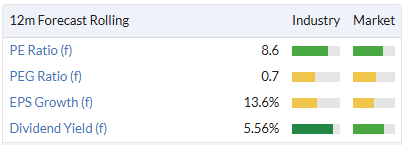
Consensus forecasts prior to today suggested earnings of 80.3p per share this year, implying a hefty 65% H2 weighting. The shares do remain cheap though, and I would guess that the 6% dividend yield (after this morning's drop) will probably remain safe, even if earnings estimates are cut:
Roland's view
Our last coverage of this stock was in July, when Graham took a positive view and noted that the low valuation meant that "the potential for a revenue/profit warning is priced in at this P/E multiple".
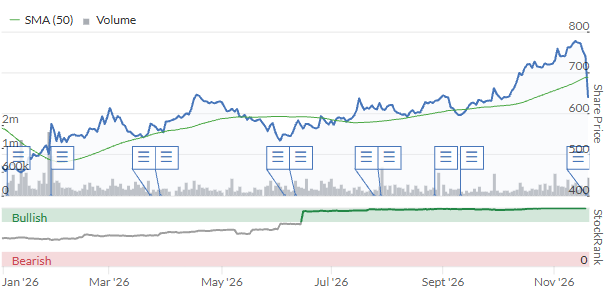
It looks like his view may have been correct: PayPoint shares have performed strongly since July. Even after this morning's drop, the company's share price is still higher than it was at the time of Graham's last comment:
Personally, I am inclined to take a slightly more cautious view today. While I agree that PayPal looks cheap and has attractive quality and cash flow metrics, I have never quite been convinced that the growing parts of the business can sustainably offset the impact of the weaker areas.
An additional headwind, perhaps, is that the end-customer demographic for its core services is skewed towards the less affluent, who will be most affected by cost-of-living pressures. I'd also like to see the company prioritise its balance sheet over share buybacks for a period.
To reflect this mixed update and outlook, I'm going to move our view down by one notch to AMBER/GREEN today. Still interesting, but with a few caveats.
Disclaimer
This is not financial advice. Our content is intended to be used and must be used for information and education purposes only. Please read our disclaimer and terms and conditions to understand our obligations.
Discussion on PayPoint (11)
Comments here are also visible in the Daily Stock Market Report
Graham, thanks for flagging the potential for a miss in the PayPoint (LON:PAY) Q1 update in the Summer. It stuck with me so sold a couple of weeks ago. Like the company a lot and will buy back in when the dust settles for the dividend.
Very disappointed with the update from PayPoint (LON:PAY) . I didn’t see that coming. I see this as a profit warning in waiting. It’s now hold or fold time.
“Performance weighted to the second half.” Is there not some comfort to be taken from that?
My view is that the pain at PayPoint (LON:PAY) is going to continue.
I sold out last year and have been flagging, most recently in Mar26, and a deeper comment on my thoughts on Inpost last Nov25. that the parcels business is due for some very tough times. Inpost locker competition, plus others. Paypoint is too dependent on revenues from the parcel business, so any drop there really feeds into the bottom line. And parcel lockers are a better solution, both in terms of cost to sender but also convenience of buyer. Right now both Inpost and Royal Mail and a few others are aggressively rolling them out nationwide.
The speed with which you get these summaries out is very good.
PayPoint (LON:PAY) and Sage group (LON:SGE) I dont agree with companies increasing borrowing to buy their own shares.
I understand using excess cash to buyback when shares are cheap (and management can't think of a porfitable way to deploy the cash) but increasing borrowing to do buybacks strikes me a robbing Peter to pay Paul (as the saying goes).
Traders have done well out of PayPoint (LON:PAY) buyback but long term I don't think this is a good strategy.
Sage group (LON:SGE)
Ref borrowing to buy one’s own shares back - it’s a dangerous game it’s best done when you are uber confident with regard to future organic earnings growth and also or that is kinda below par - reg sage they have worked wonders ref growing profits - so share buybacks probably will work out well long term - with pe 20 though it’s anything but suck buck now - good future row growth and it will be a good decision.
Note on technical point they had 575 million of free cashflow and 605 million of share buybacks - if one wants to argue first dibs on free cashflow is buybacks then you can argue that the share buybacks were 90% generated out of real cash earned - that’s a plain fact. You would then be left with debt gking uo due to acquisition costs - dividend payments and the other crapola - do its wrong to suggest they aren’t generating enough cash to mostly fund buybacks - they are - and the £1.2 bill spent on buybacks could easily be paid off from 3 years profits if they wanted too. imho its done from position of strength rather than weakness here - they will only have proven good value though if earnings are 25% higher and shareprice too inn3-4 years - if they keep increasing profits at a lick it’s job done - if you aren’t confident about future profits ramping up with or pe of 20 - well you shouldn’t be holding the shares !!! - let’s judge price paid for shares in 3-4 years time shall we to see if they got a good deal
Bit of a dubious way of looking at 'free cashflow', rmillaree. Yes, the £575m of operating cashflow could be applied to a buyback only and then it is covering 90% of the cost, as you say. However, all businesses have other things they want to spend cash on (e.g. acquisitions and dividends). I would hardly call dividends "crapola" so if you strip out these two expenses (£113m and £209m) Sage group (LON:SGE) have financed well over half of the buyback with increased debt. Not something I am comfortable with at all.
Sage group (LON:SGE)
i get your point 100% sparkler -my only point was that there is teh money made - the conversation should be perhaps more should we be having buybacks and dividends - so why is the buyback the devil here and the dividend not ? they both depart the cashflow out of the buisness in similar fashion.
If i know sage can grow profits at 10-15% per years for next 4 years am i happy to take on £1 billion of debt now and payback later - heck yes.
Would anyone have moaned if they splashed £1billion on acquisition making £50 mil pa growing at good lick - perhaps not and that is all the buyback is really - paying perhaps top dollar for more of the future pie
Do they in the very near future potentially have excellent spare cashflow to pay down that debt in short order - absolutely if they dont go on acquisition spree.
I get it many wont like doubling up on risk with buybacks - but facts are where business does have future know great cashflow (as sage should do !! they are a cash machine !!) and propscets are great - bit iof risk is no different to acquisition
i very much get other peoples point they dont like it - i am 100% comfortable here bearing in mind the sweet spot they are in ref core earnings - and the fact they should have £300-400 mill plus ish of spare cash per year in next copuple of years - so they ahev ability to reduce debt if they want.
Note its previously ben pointed out here - that they are going down this exact route - its a known known that they are going down this route - so its kinda done deal with is investors - yes when it turns up register your protest - i get you can continue protesting - but at some satge if thats what is being done you just gotta go with the flow.
Will be intersting to see end result in 3 years - if you expect business to do well and they do and you hang in i think you will see the benefit then when you own 10-25% more of that bigger compnay than you would have done without then buyback - remember also over time buybacks actually pay for themselves by reducing later cash cost of dividend payments made on lfl basis - thats a very slow payback yes - but is a payback that lasts forever.
it would be good, if the boffins at Stock have the time, to get their views on the Sage group (LON:SGE) results (too complicated for me to understand) and also to add their weight to the controversy over the share buyback. My ignorant gut instinct is that, unless shares are very underpriced, then buyback money is better spent on growth.
Be interesting to see what Graham thinks of PayPoint (LON:PAY) (hint hint!)??
" using excess cash to buyback when shares are cheap (and management can't think of a porfitable way to deploy the cash) but increasing borrowing to do buybacks strikes me a robbing Peter to pay Paul (as the saying goes)." Totally agree with you Revs8, although would rather make a profit than a porfit! :)