SIF Folio: Airtel Africa promises emerging market growth

African telecoms and mobile money operator Airtel Africa is a stock I’ve been watching as a possible income play for much of the last year. So I’m interested to see this stock now qualifies for my SIF buying screen. In this week’s piece, I plan to take a closer look at this business.
SIF does not currently have any exposure to the telecoms sector. Although this sector has a history of capital destruction, I think the African market in particular is attractive due to the parallel growth of mobile money services.
Airtel Africa (LON:AAF)
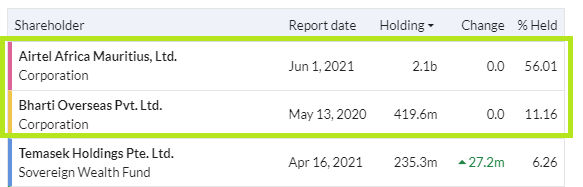
Airtel Africa floated on the London market in June 2019, when it was spun out of Indian group Bharti Airtel. Only 19% of the company’s stock was sold in the IPO and the former parent remains a controlling shareholder, via (I assume) the top two holdings listed in Stockopedia’s shareholder data:
The group operates in 14 countries in Africa, mainly East, Central and West Africa. It’s the second-largest mobile operator in Africa and is first or second by market share in 12 of the countries in which it operates. Nigeria is by far the largest market and generated 40% of revenue and 45% of EBITDA last year.
Customer numbers across the group rose by 6.9% to 118.2m during the year to 31 March, while the number of data customers rose by 14.5% to 40.6m. The number of active mobile money users rose by 18.5% to 21.7m.
These metrics translated into a pre-tax profit of $697m, 16.7% higher than in FY20.
I think that the big stories here are the growth potential of the African market and the value of the mobile money business. The other attraction, in my view, is that the company isn’t burdened with legacy assets and regulatory obligations (BT) or sluggish mature markets (BT and Vodafone).
In the short term, my main concerns are corporate governance and political stability in Africa, especially Nigeria. Longer term, what worries me is that Airtel could become too much like Vodafone.
However, that’s all for the future. Right now, what matters for me is to understand how Airtel Africa’s numbers shape up against my SIF buying rules.
The initial omens are promising. Airtel scores a StockRank of 96 and Super Stock status.
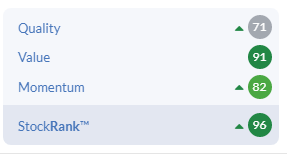
As usual, what I’ll do now is to break down the company’s QVM factor scores to understand more about Airtel Africa’s valuation, profitability and outlook.
Value: a cash cow?
Airtel’s ValueRank of 91 is its strongest factor score. The firm’s valuation metrics show some promising numbers:
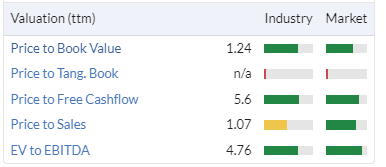
Cash generation improved last year, but the business is still modestly valued relative to its free cash flow.
When one of these ratios shows n/a, it means the denominator is negative. So in this case, Airtel Africa’s tangible book value is negative. The balance sheet shows us why. Goodwill stood at $3,835m at the end of March, compared with physical assets of just $2,066m.
This situation suggests to me that the company has been constructed through a series of acquisitions or corporate transactions. These have been priced at levels to reflect future growth potential - hence significantly above tangible net asset value.
There’s not necessarily anything wrong with this, but it will take some years for us to learn whether management’s judgement was correct.
Interestingly, I note that the company uses 10-year projections to test for goodwill impairment, rather than the more usual five years. Airtel says this better reflects the expected life of its network assets and the growth potential of the African market. Again, in principle this seems reasonable to me. But in practice I think there’s a risk that it provides significant wiggle room to mask short-term underperformance.
Even so, Airtel Africa’s valuation looks favourable to me, based on two of the other core metrics used in the ValueRank calculation:
Earnings yield (EBIT/EV): 15.6%
Dividend yield (trailing): 3.6%
The group’s net debt rose by around 8% last year to $3,530m, giving a net debt/EBITDA ratio of 2.0x. This is at the upper end of what I’m comfortable with for an emerging markets business. But I wouldn’t rule out the stock on this account, given the company’s strong free cash flow, improving performance and attractive profit margins.
Quality: strong profitability
Airtel Africa is one of the most profitable network operators among UK-listed telecoms stocks. Although the QualityRank of 71 is the stock’s lowest factor score, I don’t see any obvious cause for concern.
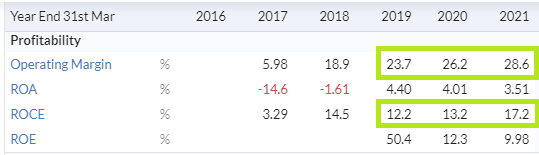
The group’s operating profit margin and return on capital employed have been high and improving since its 2019 flotation (I would disregard the pro-forma numbers from before the IPO, as they are likely to reflect a different corporate structure):
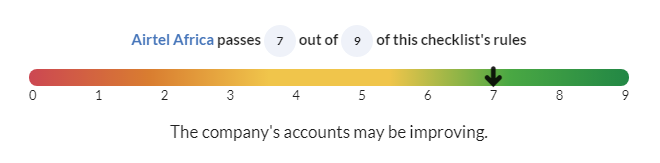
Airtel also boasts a strong Piotroski F-Score of 7/9. This fundamental health check tests whether factors such as cash generation and profitability are improving. The F-Score is an major part of the QualityRank calculation and I find it provides a useful snapshot:
Why is Airtel Africa so much more profitable than Vodafone, for example? After all, Vodafone also operates mobile networks and a mobile money business in Africa.
I’m not entirely sure why Airtel has such an advantage, but I would guess that much of the advantage is due to the group’s sole focus on Africa. According to the company, most African countries only have two or three mobile operators. In western Europe, there are usually more, especially when low-cost virtual operators are included. I’d guess that margins are higher in Africa and that regulatory price controls may be less onerous.
The other factor driving the improvement in Airtel Africa’s profitability is most likely to be its strong growth rate. European operators can’t match this, but can Airtel maintain its momentum?
Momentum: improving?
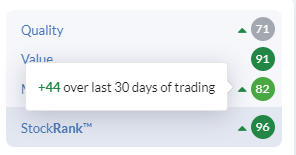
Airtel Africa’s MomentumRank of 82 is healthy enough, but it’s worth noting that this figure has risen by 44 over the last 30 trading days:
What lies behind this sudden increase? To find out more, I’ll look at the two components of momentum separately.
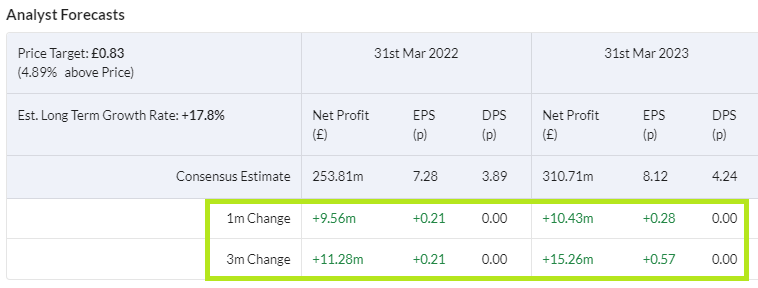
Earnings estimates: The change in MomentumRank coincides with the publication of the company’s final results, which were released on 12 May. The results appear to have triggered a round of broker upgrades, the second such increase in three months:
Price momentum: Airtel’s share price has not made much progress this year, although it is significantly ahead of last year. However, two key price momentum metrics I check for are showing green at the moment:
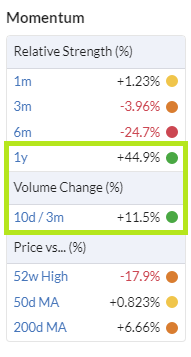
The 1y relative strength shows that the stock has outperformed the market by a big margin over the last year. This is one test used by my screening rules to avoid turnarounds and other special situations.
The 10d/3m volume indicator shows that buying levels have been higher over the last 10 days than the average over the last three months. This also seems to support my theory that market sentiment has improved since the company’s results were published.
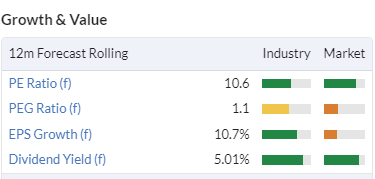
On balance, I think the near-term outlook is improving for Airtel Africa. Given the stock’s attractive forecast valuation metrics, I believe there might be an opportunity here:
My decision
In my working life, mobile network operators such as Vodafone have become known for their ability to destroy shareholder value. They must constantly invest in mature, competitive markets. In some cases, including Vodafone, this has driven returns below the cost of capital.
My fear is that Airtel Africa may eventually be destined for the same fate, but as yet I think we’re still a long way from this scenario.
Based on the group’s performance since joining the London market, I can see quite a lot to like about Airtel Africa. The stock’s valuation seems reasonable and the company has delivered strong growth in recent years. The outlook also seems positive.
Airtel Africa passes all of my screening tests and should add to the diversification of the SIF folio. For these reasons, I’ll be adding the shares to SIF this week, and to my own holdings. As always, I’ll make these trades after this article has been published.
Disclaimer
This is not financial advice. Our content is intended to be used and must be used for information and education purposes only. Please read our disclaimer and terms and conditions to understand our obligations.

20 comments
Airtel Africa (LON:AAF)
Going through today's results I was actually warming to this company; top line growth continues and the underlying cash generation seems to be improving vs what I've previously seen.
But then I start looking at some of the detail at which point the confusion begins.
---
At the end of the Cash Flow Statement, for example, the closing cash balance is stated as $847m, but I can't reconcile this with the numbers on the balance sheet.
This should really be a simple number to cross check. Can anyone see it?
----
At the bottom of the same page there is also the below note that indicates that there is restricted cash within the aforementioned $847m figure.
Even accounting for this I still can't get the cash figure to balance with the numbers on the balance sheet.
---
I'm also put off by the focus on EBITDA when the company has very material costs sitting beneath this, which are about to increase due to the sale and leaseback of telco towers in several of their territories.
The EBITDA/Net Debt decrease, whilst looking impressive, doesn't really mean very much to me.
---
There's lots to like of course. I wonder how many towers the company can still sell for example? The sales would be a great help to its debt position, which is one of the things that was holding me back from investing.
And I imagine there will be another cash injection once the Uganda subsidiary (is forced to) list on the local Stock Exchange as per Ugandan regulation.
What do others think? Beyond the "growth market" rationale, is there anything significant in the numbers today that makes this a definite buy? I know it's a favourite here on Stocko, which naturally make me wonder whether I'm missing something obvious.
The high Stock Ranks show a company that should be on a Buy List.
Thoughts as always appreciated.
A
Very strong results out today for Airtel Africa (LON:AAF) with a reasonable divi and further promising prospects, I wonder why that warrants a 5% share price drop!
It was down over 8% earlier, its the market, unless its well a head of forecasts it will drop. My issue is the profits are up around 80% but revenue only about 20%.
Very nice Q1 results out today! I hope very much that this company will continue to grow at a double digit rate.
surely the high debt is normal for this type of business (I hold both £air and £vod)
I am looking to buy Airtel Africa (LON:AAF). This Company has come up as a buy in one of my Watch List today. All the comments here and on Stoko are generally positive, but the Bankruptcy Risk indicator shows a serious risk of bankruptcy in the next two years. So I am not sure if I should press the buy button.
I spend most of my time in Tanzania where Airtel operates, in fact, I use there services and have no problems with them, but the bankruptcy indictor worries me.
Please feel free to comment, please.
I do hold a small positionin Airtel Africa (LON:AAF), yes debt is on the high side. I'm not sure sure how reliable the Altmann score is, the Guru screen which is a shorting screen has performed very well, ie very badly as a shorting screen: https://www.stockopedia.com/screens/altman-z-score-screen-4/
Thank Herbie
I hear what you are saying, so I have had a look at that screen and there are a lot of companies there (433) and some very big companies at that (ie. Royal Dutch Shell; BP; Marks and Spencers: Vodafone; Unilever and BT.). What's the lightly hood of these companies going bankrupt, very remote I think.
But as you have bought them (AAF) I am more inclined to join you, but I will sleep on it over the weekend.
Hi Terry, there's a learned post from February on the limitations of the Z-score which concludes:
"If you want to focus on avoiding companies which might become bankrupt, any company which has a good Z-Score is likely to be safe. But a company with a poor Z-Score probably won’t go bust either!"
You can read the whole thing here.
(FYI I bought Airtel Africa (LON:AAF) in mid-June.)
Indie - Thanks.
I have just read the post and found it very interesting
I think I have made up my mind, about buying AAF
As a general note, I think Stockopeder is just a wonderful site for getting all this information from fellow investors. Thanks, everone, it's much appreciated. ❤
Terry, your on-the-ground experience of Airtel Africa (LON:AAF) is v interesting (and reassuring) and something Stocko can’t provide. Keep it coming!
AAF Airtel Africa
I have bought it today (Monday 12 Jul 21) from IG SB at 297.60p. Let us see how it works out, I hold my winners for about 2/3 months and cut my losses after about 30/40 days.
Thanks for all your help, I am now going to top up my phone.
If you look at VOD (Vodafone) T (At&t) and some of the transport companies with lots of rolling stock NEX, GOG or ROL (Rotala) the Bankruptcy risk is also highlighted. AFF has a larger market cap than the transport companies.
Are n't you Terry the Trader who called the turn in the overall market last March? If so you will know that most of the move comes from the general market trend.
As soon as rates go up all these in-debted companies with stumble.
I started buying Airtel Africa (LON:AAF) at peak fear in Mar 2020 as I thought a prolonged pandemic would increase phone, data and mobile money use. Few people in Africa have access to broadband so there is little alternative. Singapore's sovereign wealth fund had also piled in which was reassuring. There are significant risks with the company: high debt, overexposure to Nigeria, currency risk, unpredictable regulation and taxes (e.g. Nigeria levied extortionate fines on rival Safaricom). I've noticed the SP is highly correlated to the oil price - presumably because the Nigerian economy depends on oil. IMO it is a rare stock that offers attractive growth prospects at a cheap valuation. The earnings are growing at a fair clip so the stagnant SP is a bit surprising. I think the market is worried about lack of covid jabs in Africa but even if infections rage I doubt the business will be much affected.
This is a coffee can investment for me. Its my biggest holding and my av price is 40p. I've lived in Africa for the last 6 years, and have been travelling here two decades before. The pace of growth and change is quite phenomenal. Everyone has or wants a smartphone, and having credit on your phone is almost as important as having water to drink. Young women who live in slums have the latest iphones.
Then mobile money is a different story altogether.
From World Bank: "Kenya has the world's highest share of adults with a mobile money account, at 58 per- cent, followed by Somalia, Tanzania, and Uganda, each with about 35 percent. " I live in Kenya and hardly anyone uses credit card or cash compared to MPESA.
Throw in the fastest population growth and urbanisation rates in the world and favourable demographics (in many countries about 50% are under 18) and you see that the macro trends will take the demand for mobile services forward no matter what.
Hi Retireyoung,
Thanks for your comment. It's fascinating to hear from someone on the ground in Africa.
I've always believed that Africa should be a structural growth story for mobile, but it's good to have this reinforced with first-hand experience.
Regards,
Roland
Airtel Africa (LON:AAF) floated in July 2019 with an offer of 80p, and the big shareholders that subscribed to that offer had signed a lock-in period of 12 months. Then Covid came, and the price collapsed. Now that the price is back up close to the IPO offer, and the 12m lock-in period obviously expired, some of these large shareholders want out. Hence the resistance at around 80p. I think. I hold, and I like the potential growth and the demographics.
I was interested to read this article as Airtel Africa (LON:AAF) It’s one of the larger go which I have fell for a little while. I bought on the potential of growth in Africa which I see as a young market compared to those that Vodafone operates in.
A negative point is that there seem to be fairly regular placings of late by an unidentified shareholder, perhaps one of those that has a controlling stake in the company that you mention. If anyone is interested in buying or adding this in their portfolio then maybe best to wait for the next placing...
I have owned 10K AAF Airtel Africa shares for more than a year. The price has gained 11.7% during that time. There has been nothing spectacular about the performance but generally the share price advances slightly each day, even when the rest of my portfolio is decreasing in value. This is the only telecoms share which I own.
The attraction of the company is its simple pricing structure with no charge for incoming calls, all calls are charged at local rates and there is a low. fixed charge for data and SMS. The company has 70 Million subscribers across 17 countries in Africa and is widely used for micro businesses, the fastest growing sector if these economies. It seems to be extremely well managed and I, too, hope for greater growth in the future.
One aspect of Airtel Africa (LON:AAF) being focussed on Africa is that the land line and fixed data infrastructure is much less developed meaning that mobile phones and mobile data are essential for 80%+ of the population - usage is high and penetration is still growing. Also countries like Nigeria have populations that are growing massively. This helps explain the cash generation / profitability IMHO