Small Cap Value Report (12 Dec) - MOSB, ZYT, CMX, RGS

Good morning! Ed held another Webinar on Stockopedia yesterday, and it was I think the busiest yet, with about 250 people registering. I listened in, and as usual it was chock full of useful information - and for those who missed it, the video of the webinar is now live. Well worth a listen - e.g. it flagged up a useful feature on Stockopedia that I hadn't even noticed was there - "run a checklist", which I shall experiment with later.
The US market had a noticeable pullback last night, for the first time in a while. This is what we need - a bit of fear coming back into the market, and taking the top off the most frothy valuations, which are in abundance. That is the way a healthy market should work, otherwise bull markets just soar out of control, and we end up with a market crash.
So we are forecast to open down about 30 points here in the UK, with the FTSE 100 Future indicating 6,486 at the moment. Why do I mention that? Just because it sets the background for what we can expect at the open.
It's fairly quiet for news today. Moss Bros (LON:MOSB) has issued an IMS covering the period 28 Jul to 7 Dec 2013, so that's the bulk of its H2, as the year-end date is on or around 26 Jan 2014. They have been trading surprisingly well for a while now, at least in terms of sales performance anyway. That trend continues, with an impressive H2 performance so far, with the key LFL ("like-for-like", i.e. eliminating the impact of new stores & closed stores) sales being up 5.3% against last year - that really is impressive, in an economy that's growing at nothing like that rate.
LFL sales for the 45 weeks of the year to date are up 2.2%, so this points towards an improving sales trend in H2 so far. Gross margin is 70 basis points down on the equivalent period in H2 last year, which will negate just under a quarter of the sales gain, in profit terms, by my rough calculations:
| H2 performance to date | Last Year | This Year | |
| Turnover | 100.0 | 105.3 | +5.3% |
| Gross margin | 60.0% | 59.3% | down 70 bps |
| Gross Profit | 60.0 | 62.4 | +4.0% |
(NB. These are not the actual numbers, but just start with a base point of 100, in order to show the overall impact of a combination of sales & margin changes)
So all I've done with this table is to combine the effect of a 5.3% increase in LFL sales in H2, with a 70 bps fall in gross margin %, to see what the combined impact on gross profit is. The answer is that 5.3% growth in sales turns into +4.0% growth in gross profit. So the conclusion is that the growth in sales far outweighs the negative impact of a decline in gross profit margin percentage here, which is a good thing.
It's rough & ready, but a quick calculation like that is very useful in my experience.
Other things that jump out at me from the IMS, are that e-commerce sales are up a remarkable 194% in the 45 weeks to 7 Dec 2013, although growth at that rate implies the starting figure was small. Note that e-commerce sales are international too, with sites in Eire, Sweden, and Denmark already launched, with Australia following early next year.
Moss Bros has a very strong Balance Sheet, and expects to end the year with net cash of £26.0m, which is material to the market cap of £69m at 70p per share.
Although the company doesn't look that great when you look at it on a PER basis. They say that trading is in line with market expectations, which is for 2.3p EPS this year, and 3.0p next year. So that's a PER of 30.2, falling to 23.2 - not exactly a bargain basement valuation! It's also worth noting that historically Moss Bros has only eked out a wafer thin overall profit margin - e.g. only £2.4m on sales of £104.6m last year. That's not great by any stretch.
Therefore, even though the IMS reads very well, I think it's important to recognise that the market price is probably fully up with events, and I don't see value here at the current price. That said, they have a unique market position in the hire market, and with international and e-commerce expansion possibilities, perhaps some people will be prepared to chase the valuation even higher? Personally I'm not - it's fully valued in my opinion. Good to see a traditional High Street name weathering the storm of the last five years though.
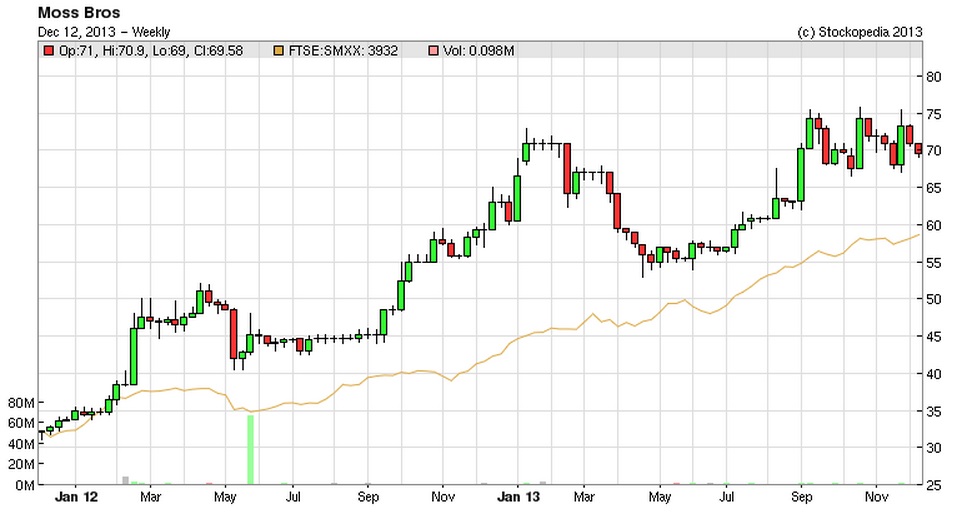
MOSB shares have done well over the last two years:
For anyone who hasn't seen it, and might be interested, I published a report on my meeting with management of Zytronic (LON:ZYT) on Tue 10 Dec. It was their latest results presentation. Overall I think it's a good company, paying an attractive yield, and seems to be recovering well from a glitch in trading earlier this year. The shares may not look obviously cheap, but when you adjust out their net cash, and factor in the likelihood that broker forecasts are now too pessimistic, then there's decent upside in my opinion. Only an opinion as always, never a recommendation, as our whole ethos here is DYOR (do your own research), which is what Stockopedia is there for - as a toolkit to help people make their own decisions.
Final results for the year ended 30 Jun 2013 for Catalyst Media (LON:CMX) have been issued. This is a strange situation, where the company only exists as a vehicle to hold a 20.5% shareholding in another company, called Satellite Information Services (SIS). So it's really a question of valuing SIS, and then calculating what the value of CMX's holding is, then applying a discount to reflect the fact that it's held indirectly.
The PER and dividend yield appear to be very attractive, but there is a big question mark over whether the earnings & dividends are sustainable, as SIS lost an important contract with the BBC, which finishes in Mar 2014. That has created uncertainty over cashflow & dividend payments by SIS, which in turn creates uncertainty for CMX.
Their shareholding in CMX has been written down by £6.6m to £28m, and CMX also has £623k of its own cash, although it's probably best to ignore that since it has (unnecessary) running costs of £150k p.a.
I suppose the best way of looking at it, is that CMX provides a back-door Listing for SIS shares.
For me this one falls into the "too difficult to value" category, and perhaps there isn't enough margin of safety given the uncertainty over the future of SIS, so I've never taken it any further.
Regenersis (LON:RGS) announce an extension of their bank facilities with HSBC from £23m to £39m, to finance its continued growth. This company is certainly on a roll, up 133% this year. There's been a double benefit - both from good growth in earnings, and the market has re-rated the shares onto a higher PER too.
However, in my opinion the company should have taken advantage of the buoyant share price to strengthen its Balance Sheet, instead of taking on more debt. The most recent figures show net assets of £39.4m, but once you strip out the £45.0m of intangibles, net tangible assets are actually negative to the tune of £5.6m. Not a great position to be in, if something were to go wrong in future.
I think it would have been better to do a Placing to raise say £15m in fresh cash, which would only dilute existing holders by about 10%, and in current market conditions could probably have been done at full market price. That would have moved the Balance Sheet into a positive tangible net asset position, and kept the Bank debt minimal.
Generally I'm not keen on companies that grow rapidly on an inadequate capital base, it's too risky if/when something goes wrong. The profit margins at RGS are quite slim too - especially after you take into account items which are stripped out & shown separately, such as acquisition costs, share-based payments, financing costs, etc. So a £39m debt facility looks a bit on the high side to me. Why take risks when you don't have to?
There's nothing much else to report today, so I'll wrap it up there.
Regards, Paul.
(Of the companies mentioned today, Paul has no long or short positions.
A small caps fund to which Paul provides research, has a long position in ZYT)
Disclaimer
This is not financial advice. Our content is intended to be used and must be used for information and education purposes only. Please read our disclaimer and terms and conditions to understand our obligations.

18 comments
Hi Paul,
The salaries in themselves are not the crux of the issue for me, it is the salaries combined with the lacklustre performance, trundling from year to year . This sort of over payment definitely would be a deal breaker for me. Why should we give management further opportunity when they have demonstrated poor levels of ability and decision making in the last 15 odd years. I think the market has this one right and see know evidence to believe that things are going to get materially better.
emmo
good work Paul - enjoy your siesta!
Paul,
Would be interested in comments on THG results?
Cheers,
Ian
Hi Ian,
I generally don't cover property companies, unless it's something very specific that I've researched in detail. So Terrace Hill (LON:THG) is not one I cover. Overall, I cover about 500 companies, but that's pretty much the limit of what I can manage!!! One day when I've got a team of researchers working for me, then we'll cover everything :-)
Cheers, Paul.
Hi Bsharman,
I recently looked at Creston and would suggest that it is a value trap. Yes - on a PE and especially on a free cash flow basis the company appears very cheap, but it has a solid record of poorly executed acquisitions, destroying any apparent value. You may also want to look close at executive remuneration and options when deciding. Just my take.
Hi emmo,
I've looked through the Creston (LON:CRE) Annual Report, and in my opinion concerns over Executive remuneration are exaggerated. Yes a £400k basic salary for the CEO is quite high, but it's not outrageously high - perhaps 20-30% lower would be more appropriate. That sort of extent of overpayment would not be a deal-breaker for me.
As regards the Share Options, it's just very confusing. There seem to be 2.8m share options under an LTIP, but this replaced 2 other schemes I think, but they are still disclosed. The price of the awards is not clear either. Is that the share price at the time the LTIPs were issued, or is it a strike price?
Given that there are 60.5m shares in issue, I don't see anything really horrendous going on here, although I don't fully understand the disclosures on share option schemes. A rule of thumb is that dilution should never get to 10% of the total equity in issue, and this seems well within that, so I'm not sure why the advfn commentators are getting so worked up over this, unless I've misunderstood the position.
If I get time, I'll ring the company to clarify, but it's time for my afternoon nap now!
Cheers, Paul.
very good objective summary and written in a dispassionate manner.
That's why I read these daily reports.
thanks.
yes perfectly reasonable Paul, I appreciate that cash on the balance sheet doesn't really help much so it could perhaps be discounted, however, this of course is only true until something unexpected happens or some opportunity comes up. Personally I'm very much in your camp, that companies with large debts are to be avoided, because if anything goes wrong they're at the mercy of the banks, well, having a good chunk of cash on the balance sheet is just extra protection, plus, it can be bought into use if a good opportunity comes up, for example to take out a competitor who hits on hard times, without the need to issue paper, at perhaps a bad time.
So while I agree, and in this case the amount of cash is a very high percentage of market cap, I do like to see cash on the balance sheet. I also take on board your comments re average bank position, because as you've mentioned before a lot of balance sheet massaging goes on at year end,
Cheers K
Thanks Peter,
I agree that Creston is difficult to accurately value. I haven't done the research yet but I wonder how the value of intangible assets and goodwill compares to similar businesses. I see that the forecasts for 2014 have been reduced and it seems that there is an issue with director remuneration (there are lots of unhappy shareholders on other BBs). I am therefore a bit wary - it could be a value trap.... I will hold off for now. If it gets down to 60-70p I might become more interested!
Hi,Paul.Regarding Catalyst,it looks as if the high yield is compensation for the risk.Perhaps some of the shares are held by high-yield funds.
Paul,
It's not one I would be interested in, but aren't you being harsh on Moss bross not stripping out the cash before calculating a pe ? if you take the 26M off the 69M valuation thats more than a third, which in rough terms would suggest a pe of 20 rather than 30, falling to maybe 14 next year ? no bargain, but not terrible if you believe the online will grow and that the potential over the next few years as the economy recovers is good. BTW on the stockopedia data it's showing a pe of 23.9, is this because it's stripping out the cash ?
cheers K
Hi Kenobi,
Fair point about the cash at Moss Bros (LON:MOSB) (although I did mention that in the report). However, if a company is just sitting on a pile of cash, and never does anything with it, then I would not value it at par. I would apply a discount, to reflect the reality that the cash provides little more than a comfort blanket for management, and also that they've probably timed the year-end so that on that date the Balance Sheet shows a spike in cash, rather than being typical.
There is a strong argument for requiring companies to disclose the average daily net cash/(net debt) position in their Annual Report, and maybe a chart showing that on a daily basis throughout the year. Otherwise there is a tendency for investors to over-value companies by assuming wrongly that the year-end cash balance is typical throughout the year.
The Stockopedia forward PER is a blended calculation of this year's forecasts (for however many months are left), and next year's forecasts. By doing it that way, all companies become comparable at this point in time, regardless of their year-end dates.
Regards, Paul.
"There is a strong argument for requiring companies to disclose the average daily net cash/(net debt) position in their Annual Report, and maybe a chart showing that on a daily basis throughout the year."
Alternatively, a rough and ready approach is to look at the interest receivable/payable note, - it should give a good indication of the average cash balance through the year.
Hi shipoffrogs,
Absolutely, that's a point I frequently make in my reports - i.e. reasonableness checking the interest charge on the P&L to make sure that it is consistent with the year-end net debt figure.
However, given that interest rates on cash balances are effectively almost zero at the moment, it doesn't help when estimating net cash, so only works for the debt side of things at the moment.
Hence why I would like more disclosure in Annual Reports to specifically explain the annual net cash/debt cycle, and therefore enable investors to work out a more accurate Enterprise Value using the average cash/debt balance throughout the year, rather than base it on a year-end spike (most companies window-dress the year end Bal Sheet in my experience).
Cheers, Paul.
Any views on Titon Holdings' (TON) results? Look value-ish to me.
Hi Paul,
Creston seem to be getting cheaper by the day and are now trading at c80p down from their trading range of 100-110p. As you mentioned yesterday they do seem to be good value on a PER and they do have lots of cash. It seems that some institutional shareholders have been selling however. I'm still holding off buying as it may have further to fall. It's very difficult to know what to do but the value investor in me is saying BUY!
Hi,
I have been following Creston all year, I do find media companies impossible to value as they usually pile in loads of goodwill which makes the P/Bk val look good, however, the P/Tang book value brings a touch of reality. Their projected earnings don't look that great going forward so like you l will hold off for a while.
Regards
Peter Barrett
Hi Paul, Many thanks for the heads up on the webinar yesterday, I found it very helpful.