Small Cap Value Report (15 May 2017) - FEVR, Velocity Composites, BILB

Good morning,
I hope you're all well rested.
There was an interesting discussion in the comments last week about general conditions in the market, and particularly small cap valuations.
I'm certainly not in a position to give financial advice to anyone through this blog, but I'd hope that most readers can afford not to worry too much about general valuation levels (which I acknowledge are currently much higher than average).
That's because I think excellent returns are reserved for those people who can afford to hold the best stocks for the longest periods of time, riding out corrections and bear markets and re-investing dividends along the way. There may be a few who can time the market well, but I think the simplest way to succeed is just to buy and hold good stocks for as long as possible (it's worth reading 100 Baggers by Christopher Mayer on this point!)
That doesn't mean ignoring valuation completely. Of course you never want to dramatically overpay for your stocks. But if you're not leveraged and you have a long time horizon, and you took care not to pay too much at entry, then doing nothing nearly all of the time after that sounds like a great strategy to me.
Remember that most of the financial services you use rely on the fees generated by activity, those fees being deducted directly from the value of your portfolio.
And when you're not invested, you don't get to receive the dividends and the internally-generated compound returns which are the basis of financial wealth-building.
In practice, most investors are not good at market-timing.
So it's better just to sit back and let the companies you've invested in do the work, in my book.
Rather than selling anything in fear of an approaching bear market, I'd be more inclined to passively allow the cash position in my portfolio to build up over time, if I can't find any individual stocks I want to buy. So my strategy is to (hopefully) buy more when the markets are cheap, not to sell when the markets are expensive.
But of course the strategy which suits your personal situation may differ. If you're leveraged or if your time horizon is shorter, then you probably have to act differently.
For what it's worth, a poll I conducted on twitter recently saw the majority of respondents saying that they would increase their equity weighting if the markets crashed from current levels. Good! Easier said than done, of course.
Really excellent reader contributions, as always.
Regards
Graham
Fevertree Drinks (LON:FEVR)
- Share price: 1702p (unch.)
- No. shares: 115.2m
- Market cap: £1,960m
Another ahead of expectations update, though this one has not moved the share price:
Fever-Tree remains the pioneer and market leader of the premium mixer category and the momentum seen in 2016 has continued in the first four months of 2017. Given the strong sales in the period to date, the Board anticipates that the results for the full year ending 31 December 2017 will be comfortably ahead of current market expectations.
Damian Cannon covered Fevertree in depth earlier this month here and of course Paul has been covering it too, so I won't spoil the broth by saying what's already been said.
Of course it's a little strange that the share price has not responded positively to an "ahead of expectations" update, but I guess investors must already priced in an upgrade?
One fact which might possibly have gone unnoticed: the key competitor to Fevertree, Schweppes, is owned by the US-listed Dr Pepper Snapple (US:DPS), which is held by Terry Smith's concentrated investment fund at Fundsmith.
So all sorts of interesting diversification/pairs trades possibilities available to Fevertree investors via DPS, for those who are happy to deal in US stocks.
Velocity Composites (New listing)
New flotations are always interesting to me, even if I don't plan to participate. It's fun to see new stocks as they hit the market, and it tells us something about valuations in particular sectors too.
Following on from the financial software company mentioned last week, this time it's an industrial business which makes machines for aircraft part manufacturers, focused on improving efficiency and reducing waste. It operates from a large facility in Burnley.
The admission document is available online (here) and the basic facts of the placing are:
- £10 million gross raised by the company
- £4 million raised by exiting shareholders
- £30 million market cap at the placing price.
As a general rule, it's good to see flotations used to raise funds for the company and not purely to let some shareholders out the door! Admission is planned for Thursday.
Scrolling further through the admission document, the following are the claimed savings to aircraft manufacturers by using Velocity's services:
• material spend reduction of approximately 10-53 per cent.;
• reduction in indirect support staff costs;
• reduction in cost of non-quality products;
• reduction in stock going ‘out of life’; and
• reduction in capital equipment spend.
In addition to these savings, customers also gain the following:
• material increase in productivity;
• increase in productive cleanroom floor space;
• full material traceability and regulatory compliance; and
• better payment terms resulting in improved cashflow.
And here is the summary financial table:
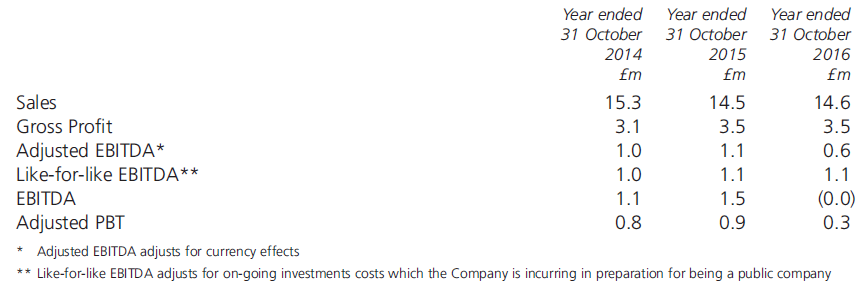
So historic PBT is not too large versus the proposed market cap. Furthermore, in the Outlook section, management expresses "a high level of confidence" in the current financial year, but also warns that results "are likely to be heavily weighted towards the second half with substantially all profits being generated in that period".
That's due to typical seasonality, a growth programme to shift toward aircraft whose production is now increasing, and a new site opening.
So I'm not sure about valuation based on the historic numbers, and results for this year are far from certain.
At least with an extra £9 million (net proceeds) of cash, you can argue that the pre-existing business is valued at "only" £21 million. And if it puts the cash to good use. with plans to develop a leading R&D centre in North West England, then it could potentially generate good returns for shareholders.
Let's keep an eye on its progress.
Bilby (LON:BILB)
- Share price: 66.5p (+11%)
- No. shares: 39.7m
- Market cap: £26m
A positive update from Bilby, the public sector building support services provider:
The Group is pleased to announce that as a result of its leading reputation and continued focus on operational excellence, a number of existing clients broadened the scope of work to be undertaken by Bilby companies in advance of the Group's year end. Additionally, customers that had awarded work to Bilby which was set to start in the current financial year, requested the Group commence work earlier than previously anticipated. The Group's year end audit is underway and the combined result of these developments means that in the year to 31 March 2017, Bilby expects to achieve EBITDA of not less than £3.6million.
Nine times out of ten, you read about customer delays slowing down results. It's great to read about customers asking for work sooner rather than later for once!
I wrote critically about this stock in December, arguing that further acquisitions would lead only to more exceptional costs and more complexity.
No further acquisitions have yet been executed, business has picked up, and the shares are up by 50% since then, so you can argue on that basis that I got it completely wrong.
If you can get comfortable with the strategy and with the sector, then perhaps it's worth a look. I'm not sure what Bilby's USP is from an investment point of view and I've been hurt too much by companies chasing acquisition-led rather than organic growth, so it's not for me.
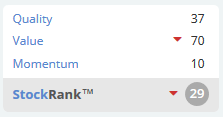
The StockRank makes sense: less than average quality, good value and terrible momentum.
That's all for today, I hope this was interesting!
Cheers
Graham
Disclaimer
This is not financial advice. Our content is intended to be used and must be used for information and education purposes only. Please read our disclaimer and terms and conditions to understand our obligations.

15 comments
Water Intelligence (LON:WATR) results are out today (Tuesday 16th). The shares are down 17% as I type. I'd welcome a view from Paul or Graham.
Re Fevertree. I had a few days Golf with my son and some of his 30 something year old mates. We stayed on edge of Cardiff. On Friday evening we went into centre of Cardiff for a meal and then toured the bars ( I know at 68 I should know better) What surprised me was how many youngsters were drinking G&T's and how often we got Fevertree tonics. Great news as I too have Fevertree shares. (You can only drink so much Brains SA!!)
Zytronic (LON:ZYT) interims tomorrow too
Graham, it's EIG & CYAN tomorrow, will you or Paul be reporting on them? And SOPH Weds? Ta!
Hi runthejoules, Paul will be on tomorrow and Wed. I'll help if needs be.
Graham
I took a look at Fevertree Drinks (LON:FEVR) for the first time this weekend (should have looked at it sooner, I know). I have to say, the economics of the business are truly amazing. The company has went from just about nowhere to £100M in revenue with virtually no capital expenditure (just £1M was spent on capex based on 2016 numbers). It follows that the free cash flow conversion on this revenue is pretty incredible too. From £100M in sales, they generated £20M in free cash flow. I have tried to find another non alcoholic beverage company with economics like this, but nothing compares. The closest company I could find was the US National Beverage Company, but even their numbers pale in comparison with what Fevertree Drinks (LON:FEVR) are doing (lower operating margin and significantly higher capex). The outsourced sales model combined with incredible growth due to a spike in gin sales has meant the numbers on this thing have just exploded.
Having said that, surely caution is needed now with the share price at 100x free cash flow? 2016 was a dream year for this company. The gin market recorded double digit growth, competition still did not materialize, the company got onto the shelves at big distributors like Asda, foreign revenue growth was juiced by a weak Sterling.
"Having said that, surely caution is needed now with the share price at 100x free cash flow?"
Interesting point about free cashflow but Boohoo.Com (LON:BOO) is actually negative. The point is it is still growing strongly, I find it a bit odd when a company puts out a statement saying "the Board anticipates that the results for the full year ending 31 December 2017 will be comfortably ahead of current market expectations." and the shares fall. Yes shares look fully valued but then many do look expensive and then look even more expensive some time later, that is one lesson I learnt last year. I think they are in the sweet spot at the moment, if drinking trends change then yes it's one to sell but I can't see that happening for a while yet.
Graham,
"Rather than selling anything in fear of an approaching bear market, I'd be more inclined to passively allow the cash position in my portfolio to build up over time, if I can't find any individual stocks I want to buy. So my strategy is to (hopefully) buy more when the markets are cheap, not to sell when the markets are expensive."
There is an intermediate sort of position suggested by Gervais Williams which is well fit for SCVR. I can recommend his last two books and await his first. Put very simplistically:
The next three years will not be like the last thirty.
Everything (including but not limited to: cars, houses, shares and gold are overpriced) but, just possibly - small cap, strong cash balance, profitable companies are way to go.
When it goes pear-shaped it will be swift and painful.
The ability we have to invest stamp duty free in a tax free ISA is a once in an investing lifetime opportunity.
I agree with JDW that it is hard to find places to put the cash but the ideas thrown up on SCVR plus the analysis on Stockopedia has helped me place all but 10% of the cash from sales of the likes of Vodafone (LON:VOD) £BT-A all banks and financials. I am now 10% cash, 5% big companies, 10% small countries (5% Vietnam) 25% short date ISA bonds in REITs (but selling as they become due for repayment) and the remainder (over half, yeah perhaps bit too much rounding up in list above) in AIM, including a couple of "fantasy" shares (accesso Technology (LON:ACSO) and DP Poland (LON:DPP) ) but most in profitable, strong financial balance smaller AIM shares paying dividends. Biggest holding now Treatt (LON:TET) but not quite a high a proportion as Lord John!
Is Ruffer for the 2010s what Soros was for 90s or Paulson in 00s?
If nothing else such musings keeps the geriatric Seadoc away from daytime TV on a rainy afternoon.
Time to take the dog for a walk, and as some may well suggest to take my pills!
Seadoc
Very interested in your discussion on how to respond to (current) high valuations on small cap growth stocks. For me at least it is important to balance two not always congruent objectives:
* to invest successfully
* to sleep soundly at night
For the second I need to be realistic about my own psychology and find a good way to manage my own anxieties. At present this means doing a bit of top slicing on the investments that have done well. That allows me to keep running my winners while at the same time being confident that I will make profits on those same winners even if they crash in the near future.
Mind you, this is a nice problem to have. The last 12 months and in particular this year to date have been very good to my portfolio and there still seem to be lots of good investment opportunities out there.
Thanks as always.
Dr Pepper Snapple also owns Canada Dry, but they have 50 brands in total so I'm not sure how material the loss of business to Fevertree Drinks (LON:FEVR) is at the overall group level?
But it does make me wonder if the Fevertree Drinks (LON:FEVR) decision to develop other mixers will be seen as an attack on Canada Dry that if it succeeds might provoke a bid from Dr. Pepper Snapple?
Hi Graham,
As the person that started the discussion on Friday, I'd just like to make clear that I agree completely with what you say and it matches my own approach to investments. As an example I still all own all the shares from my very first trade 18 years ago!
The conversation then meandered somewhat as threads do, however my initial question was not about market timing (which I know I am rubbish at!) or the possible end of the bull market (who knows? too macro for me!) but more to try and better understand what is driving the valuations of small caps, particularly those with a large retail investor following?
We all have to base our buy and sell decisions on our own valuation method, and it's funny you mention Terry Smith because for the past few years I have been using FCF yield rather than PER. But whichever metric you use many smallcaps are starting to look pretty expensive and I have been trying to think about what is driving this.
Is it possible that the StockRank system will become self-fulfilling should enough private investors use it? For many smallcaps it does not take a lot of volume to move the share price north or south quite sharply, and this could lead in turn to more extreme over and under valuation. The latter I'm perfectly happy with, the former not so much :)
All the best, Si
My test for whether a strategy is good these days is to ask whether it still works if everyone does it. These are "smart beta"-like strategies and very stable.
So clearly buying good quality companies at a reasonable price meets that test, whereas trying to sell just before everyone else doesn't, for example.
The "smart beta" way to handle market volatility is to rebalance, both within the portfolio and the portfolio:cash ratio but it takes discipline and I must admit I still don't get it quite right!
I have exactly the same approach, letting cash from dividends and takeovers (where I will either take the cash or sell the shares in the acquiring company depending upon terms) accumulate until something screams at me to buy it. It's served me well over the years - I'm about 10% a year ahead of my selected benchmark (http://funds.ft.com/uk/Tearsheet/Summary?s=GB00B59G4H82:GBP) for each of the past 6 or 7 years so I am happy.
I currently have a bit more cash than usual (also got Waterman cash to come at some point will be quite a lump as it was my largest position) but there's nothing that jumps out at me right now so it'll stay as "cash". (Inverted commas as it's all in Premium Bonds and other income producing vehicles where the capital is protected so at least it's earning me something to minimise the inflation impacts).
Most studies agree with your views and suggest investors fail in timing the markets and would have done better by staying invested. This includes professional fund managers as well as private investors.
Of course, life is never simple and there are exceptions. A few of the investors featured in Guy Thomas' book "Free Capital - How 12 Private Investors Made Millions in the Stock Market" made there initial money by investing in the technology boom but then timed their investments by getting out before the resulting technology crash.
Isn't "the simplest way to succeed is just to buy and hold good stocks for as long as possible" the principle exercised by Warren Buffett too?