Small Cap Value Report (19 Jun 2017) - BON, PTSG

Good morning, it's Paul here!
I'll be writing all 5 reports this week, as I've given Graham the week off, since he was such a superstar covering for me last week!
Isn't this heatwave marvellous! That was part of the reason that my report on Friday fizzled out, sorry about that. I tried to shock my Mum, by disclosing that I'd been nude sunbathing on my terrace. She brushed it aside, replying, "Oh, your father & I used to wander around the house naked all the time, in the 1970s, until you started complaining!"
Good weather should be positive for pubs, and retailers. Although when it's this hot, clothing sales usually dip initially, as people head for parks, the beach, and of course their ghastly, stinking BBQs, instead of shopping centres.
I'm still mulling over those retail figures from last week. The growth in online is extraordinary - still growing at 20% p.a. overall. That's creating terrible conditions for traditional retailers without their own decent online presence - it's like being permanently in recession for them - sales leaking away online, plus consumer disposable income now falling too. Also the threat of higher interest rates may be looming. Not to mention the unstable political situation, Brexit (will it, won't it happen? Nobody knows, nor on what terms). Plus the nightmare scenario of a hard-left Corbyn Govt, propped up by the SNP, destroying the economy with the usual left-wing profligacy.
Bull markets certainly climb a wall of worry, and I'm amazed that the market is as buoyant as it is right now. Last week's wobble seems to be receding, with a lot of fashionable growth stocks now bouncing back from sharp falls last week.
For the time being, I'm leaving BMUS 40% in cash. I just don't see any compelling buying opportunities at the moment, given that most stocks are expensive, yet there are so many risks out there. Risk:Reward looks lousy to me at the moment, with the market generally. Hence why I'd rather hang on to the excellent gains in the last 2 years, and have some powder dry to deploy in the event of a significant correction - there will be one eventually, things are way too buoyant at the moment. When buying the dip stops working, I think we could see a big market correction.
Value vs Growth investing
I was chatting to Ed (the boss here) about growth vs value investing. He was saying that value investing performs best in the long term. However during bull markets, there are periods when growth investing can be spectacularly successful - providing you cash out at or near the top. Everyone looks a genius in a bull market, but only the best investors hang on to those gains longer term.
That's very much been my experience, when I decided to focus more on growth shares about 2 years ago (with a particular focus on the fastest growing eCommerce companies, e.g. Boohoo.Com (LON:BOO) and G4M, both of which have been spectacularly good investments). Although I'm very conscious that this currently successful strategy will stop working, sooner or later.
We are seeing once in a lifetime changes in business models right now. The internet has completely changed some sectors, and is gradually destroying long-established traditional sectors. Internet disruption started with books & music, but has since moved on to many other sectors too. Estate agents' traditional model just looks broken now, for example. What's going to happen to all those (largely unnecessary) people & offices?
This got me thinking about whether value investing really will prove to be as successful in future, as it's been in the past? After all, if you chase low PER stocks, you're likely to end up in businesses that are in structural decline. In the past, value stocks have often bounced back, but that won't happen now, if the business model has been turned upside down by internet disruption. Cheap shares are likely to just get cheaper, until the declining company eventually goes bust.
Bottom up vs top down?
Many readers send me messages & emails, too many for me to reply to, but I do at least read everything sent to me. One reader commented that I should change my approach of being a bottom up stock picker, and consider macro economic factors! I thought that was an odd message, because that's exactly what I already do!!
As investors we can't just look at the figures, and ignore macro factors, business models, sectors, etc. Everything has to be taken into account. Taking Trinity Mirror (LON:TNI) as an example, the numbers look amazing - a fwd PER of just 2.89, and a dividend yield of 5.55%. Even the StockRank is very high, at 90. However, we all know that the business is in steep, structural decline, because each year fewer people are buying newspapers. Therefore, despite being superficially attractive, the share is probably not going to be a good investment long-term (there are often good short term trading opportunities though).
So internet disruption is a huge factor that we all need to carefully consider, before rushing into value shares, many of which could turn out to be value traps - declining businesses, which are cheap for a reason.
All that said, I think a lot of growth shares are now significantly over-valued, and this does feel like the later, euphoric phase of a bull market. So I remain cautious & nervous. That said, practically everyone who tries to predict the overall market direction gets it completely wrong & ends up looking a fool. On that note, I attended an investor lunch about a year ago, when an experienced analyst (who charges for his advice apparently) dramatically announced that we were now in a bear market, and that people should be selling everything. I wonder if he's still got any clients left?!
Hence why I've learned to just admit that I haven't got a clue what the market overall will do, and very often it does the opposite of what I expect! Although going along with the prevailing trend is usually sensible (i.e. buying the dips in a bull market, and selling the rallies in a bear market).
Therefore, my view is that good investors need to be both a bottom up stock picker, and a top-down thinker too. We may not be able to predict what the market overall will do, but we can identify and act on individual sector trends. Mind you, Ed reckons that these points are already baked into share prices, hence why he's a fan of using algorithms, rather than manually stock picking.
Overall, the best advice I ever received was that, whatever your particular approach to investing, "just do more of whatever works, and stop doing things that don't work" (easier said than done!).
Right, on to some small caps
Bonmarche Holdings (LON:BON)
Share price: 93.8p (down 2.8% today)
No. shares: 50.0m
Market cap: £46.9m
Preliminary results - for the 53 weeks ended 1 Apr 2017 (NB. the extra week usually boosts profits).
This is a retailer of low-priced clothing, focused on the over-50 female demographic, from 327 stores.
These figures look poor to me, but that is what the market is already expecting, hence why the share price is only down a little today. If these are the highlights, I wouldn't want to see the lowlights!
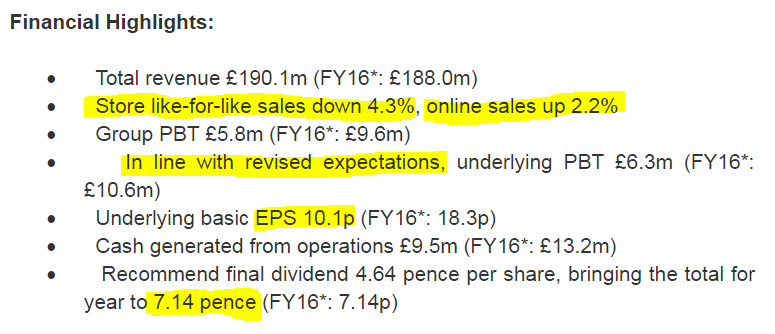
This is a great example of how vicious operational gearing can be when sales are declining. In this case, a 4.3% drop in store LFL sales has resulted in a 41% drop in underlying profit before tax. Less gross profit, but a largely fixed cost base, is a horrible situation to be in. Hence why I really don't like this sector at all, at the moment.
My feeling is that perhaps some investors might have been lulled into a false sense of security in recent years? Profits at many retailers have been steadily rising since 2009, but are now set for steep falls - due to the numerous negative factors hitting the sector.
Look how broker EPS expectations were lowered here in the last 12 months - halved from what EPS was expected a year ago;

Outlook comments are as follows (and there's more detail in the narrative);
Trading since the beginning of the new financial year has been in line with the Board's expectations and the financial position of the business continues to be sound, with no net debt and a balance sheet which provides a stable platform for the future.
We believe that the challenging market conditions are likely to continue but, as noted above, we are confident in our strategy and remain focused on executing it successfully. We believe that the 50 plus market continues to be under-served and this, combined with the forecast increase in the number of people who are potential customers for Bonmarché, positions us well for future growth. We therefore aim to meet our overriding objective of growing profitable sales by gaining market share.
Dividends - the company has remained generous with the divis. So the total payout of 7.14p is flat against last year, and represents a cracking yield of 7.6%.
The trouble is, that dividend cover has now fallen to 1.4 - that doesn't leave much scope for a further fall in profits, before future divis would need to be cut.
Generally I find that divi yields over about 6% need to be treated with suspicion - as that is the market warning us that the divis may not be sustainable at that level.
Online sales - an increasingly important area. To survive & prosper, I think retailers need to be successful at multi-channel, especially internet & mobile.
BON reports online sales of £16.1m, up only 2.2% on last year. As mentioned above, online overall is growing by c.20% p.a. at the moment. So to be considered successful, I would want a bare minimum of 20% online growth. The 2.2% growth here is dismal, and says to me that their internet strategy is not working as it should be.
I appreciate that the over-50s demographic may be part of the problem. Whilst there are plenty of silver surfers, it's probably safe to assume that relatively low income over 50 females are less likely to be buying frocks on their iPhones, than say a BooHoo or Asos customer.
The £16.1m of online sales represents only 7.1% of total sales (NB. take care to compare like with like, so I used the 53 weeks, incl. VAT figures). That's not very good.
Balance sheet - is fairly strong.
NAV is £34.8m. If we deduct intangibles, then NTAV is £29.0m.
The current ratio is sound, at 1.38.
Cash is down sharply, from £13.0m a year earlier, to £6.9m at 1 Apr 2017. Some of that drop is due to timing of capex payments. Note that the company is spending heavily (£5.6m in the year) to update its IT systems.
There is an asset of £6.7m described as "Derivative financial instruments" - I'm not sure what this is, and can't find any other reference to it.
My opinion - I would need a very good reason to invest in a company which has just reported a 40% drop in profits. Some of the issues seem to be self-inflicted mistakes, which the company is trying to rectify - although the narrative doesn't sound particularly strong on that front.
Brokers are forecasting that this year's profits should rise. How likely is that though? We know consumers are feeling the pinch, and retailers are facing multiple cost pressures, plus intense competition.
Therefore I'm sceptical about what upside there is for this company's profits? Its profit margin is now wafer thin, at only 3.3% of revenue (down from 5.6% last year). That's far too low to interest me. It can be a serious mistake to buy into weaker retailers in the good times, as their thin profit margin can easily turn into heavy losses in a recession.
Overall, this share just doesn't interest me. It's not a very good business, and performance has been weak. So why get involved, when the outlook for retailers is so poor?
Premier Technical Services (LON:PTSG)
Share price: 129p (up 4.5% today)
No. shares: 91.5m
Market cap: £118.0m
AGM statement - there's a reassuring trading update today from this company. It's an acquisitive group of niche service providers - e.g. high level cleaning of buildings, lightning conductors, electrical testing, etc.
The company has a 31 Dec 2017 year end, and it sounds like things are going well;
"I am pleased to report that the Group has seen continuing sales growth and strong levels of orders in the year to date. Working capital utilisation and profit levels are also in line with the Board's expectations.
I met management last year, and was very impressed with their approach to running the business. They're very focused on efficiency, and working to a strict process. E.g. they've written their own App which has automated a lot of functions, thus eliminating paperwork and inefficiency. Vehicles are serviced overnight, so that there's no down time. Mobile staff are out working for clients all the time, and are discouraged from calling into the office. All great stuff, which enables this company to improve profit margins at companies it acquires - thus making an acquisition-driven strategy worthwhile.
Outlook comments are also positive;
"The Group has secured new contract wins across all its disciplines, including a number of multi-discipline framework agreements with new and existing customers and our contract renewal rates remain high, which underpin our organic growth plans. Nimbus Lightning Protection Ltd which was acquired in January has been successfully integrated into the Group and is contributing both at a turnover and profit level.
"The Board is confident that the business is in a strong position to continue to grow both organically and through carefully selected acquisitions, which seek to achieve sector dominance in our chosen areas of operation."
Valuation - this valuation looks about right to me, possibly slightly warm, as companies in this sector don't tend to justify high ratings;

My opinion - this strikes me as a pretty good company, with a good business model (decent profit margins, and recurring revenues), and strong management.
On the downside, I'm not keen on the balance sheet, which has NTAV of about nil. Also, receivables seem very high - which for me is a red flag.
Another red flag is the shareholder structure, where management own too much, and Hawk Investment Holdings being involved is not a positive, the way I see things. Director remuneration also needs a close look - I seem to recall there were some overly generous payouts re bonuses or options.
Therefore, overall it's not for me. I'd look at if more positively if & when they get debtor days down to a more normal level of 60 days or less. Also I'd like to see management shareholdings reduced. Some skin in the game is good, but I think it's too high here.
(work in progress)
Disclaimer
This is not financial advice. Our content is intended to be used and must be used for information and education purposes only. Please read our disclaimer and terms and conditions to understand our obligations.

48 comments
Perhaps because Hawk Investment Holdings is owned by Bob Morton/Family and over the years they have been involved with questionable business practices in regard to listed companies to the detriment of ordinary shareholders.
That's the polite answer, anyway ;-)
Paul - re PTSG. Why is Hawk Investment Holdings not a positive please/
Hi Paul,
Whats the score re Hawk Investment holdings ?
Interesting comparison with Trinity Mirror (LON:TNI) (one of my larger holdings again currently).
It is something of an over-simplification to say that Trinity operate in a market that is in terminal decline.
Much as retailers such as Next (LON:NXT) provide goods (clothes & homeware) through both physical and increasingly digital means, so Trinity provide news through both physical and increastily digital means .
The challenges are similar; to deliver digital growth from a low base that offsets physical losses (& in volume terms Trinity is performing pretty well) and to deliver acceptable margins from the digital side (more challenging).
It is true that a low PE can be indicative of a business in trouble (a "value trap") or it can be indicative that "the market" doesn't 'get' the proposition. And while mentioning the PE, it's worth recognising that for Trinity Mirror (LON:TNI) cash generation is even better than earnings as they sweat the legacy assets. (On that score, there was an unconfirmed story a few days ago that Trinity is about to sign a deal to take over printing of the Grauniad, which would further sweat those assets).
Now is not really the time or place for a full inside out review of TNI (the interims end July-early August is better), but on my workings, considering the cash the legacy business has still left to throw off, the fledgling digital business is not just in the price for free, it's effectively valued at a substantial negative.
Similarly I'm sure mis-pricings will happen in 'bricks and mortar' retailing, but with the economic outlook I think it will be at least 12 months before I personally look for any bargains in discretionary retail.
"Oh, your father & I used to wander around the house naked all the time, in the 1970s, until you started complaining!"
Might depend on what age you were at the time Paul, age 2 or 3 maybe not such a problem; aged 22 or 23 I can see your point!. If you had a lady friend at the time then I am not surprised you complained!.
Thanks for your continuing efforts
Regrds
CM
Perhpas you weren't aware, Paul's a Chaka Khan fan.
Well clearly your education was deficient as you can't spell the word correctly.
Is not educted the meaning of the passive past form of verb to educate? Maybe the point Tango was making? (But never could understand this new speak, could be he learnt or if from over the pond learned.) Just a thought.
I totally lost any belief in Brown when, as a Chancellor, he repeatedly claimed to have ended the cycle of boom and bust in the UK economy..
Only when the crash came in 2008 did he finally admit he was wrong.
"Those whom the gods wish to destroy they first make mad” (as some wise dude said many centuries ago)
Brown also sold over half our gold reserves off at rock bottom prices and wrecked pensions.
Labour never leave any money left, overspend and then leave it for the next government to sort it out.
If Labour had stayed in power then we would be going the same way as Greece.
Quote from Mark Minervini's book (probably borrowed from elsewhere) :
"In a strong bull market, even turkeys can fly"
Gordon Brown was borrowing excessively at the top of the cycle. That left borrowing at 10% of gdp when the economy turned. Let that go unchecked & we will end up worse than Greece.
The previous Labour government needed an IMF bailout in the 1970s.
The other parties need to spend more time educating younger voters about this track record.
Aston Martin has recently started reporting profits.
That usually only happens in times of irrational exuberance and market peaks.
>>Ah but the trouble is, there was a boom under Brown, which led to unsustainably high tax receipts. He spent the lot, and managed to run a deficit on top, in the good times. So when bust inevitably came in 2008, a gigantic structural deficit appeared.>>
Hi Paul,
Before the financial crash Labour ran deficits, yes, but these were smaller than the growth in GDP, allowing them to reduce debt from 41% to 37% of GDP. After the crash the deficit ballooned to something like 11% of GDP – horrendous, and clearly unsustainable – but at least the economy was recovering at a reasonable rate when the Coalition took over, a recovery which was (arguably) snuffed out by increases in TAX (VAT) and cuts in public spending. And, as you probably know, the Coalition racked up more debt than all previous Labour governments combined.
Odd though it might seem, I don't wish to be an apologist for Labour, but I find that claims that only the Conservatives can be trusted with the economy at odds with my experience. You may or may not agree that cuts to public spending held back recovery under Osborne, but surely you remember the booms in the economy, housing and stock market under Lawson, each of which tanked in spectacular fashion.
Many thanks for your reports, which I find useful and enjoyable.
Hi Peter W,
>>Re zho
Just a note there was lots of off BS financing with Gordon but I don't know the extent it distorted the reported numbers.>>
Yes, agreed - I haven't had a look at this yet - but I was interested to see that the headline numbers appear to challenge the oft repeated claim that Labour will spend to destruction.
My provisional view on PFI is that it is acceptable if deals are struck at a sensible price - much like taking on a mortgage - but that that the margins built into contracts were far too large.
I'd be interested in your insights on Interquest (LON:ITQ) Paul - quite a remarkable suitation with a single independent director defending shareholders' interests and the rest of the board hopelessly conflicted. Whatever happened to fiduciary duty? More practically, what should shareholders do? Trying to take the emotion out of it, I am tempted to sell and write this off as a learning experience. On the other hand I don't want to give Chris Eldridge and his gang the satisfaction of seeing their ploy succeed. Do any of the regulators have a role to play - the FRC or London Stock Exchange?
black tuesday oct 1929
black monday oct 1987
black wednesday sep 1992
financial crisis sep/oct 2008
sep/oct 2017......re-run general election?.. yikes.
I agree with your sentiments in the main, however internet retailers BOO, ASOS, G4M, PURP are disrupting the market and are really only getting started as far as the rest of the world is concerned. There are risks there (PURP especially), however if they can pull it off, the earnings trajectory is potentially huge. I don’t blame anyone for profit taking at this point as the valuations do seem ridiculous based on current earnings, but I don’t think we have realised their potential yet or anything close to it. If they pull it off I think it wilI happen fast; if they trip up, they will drop like a stone. I too am cautious and a little nervous, and certainly wouldn’t buy at this point, but I intend to HOLD, and hope that fortune favours the brave!.
There is a massive transfer of value taking place, from bricks and mortar retail in particular, to on-line. We are still in the foothills of this trade.
>>Plus the nightmare scenario of a hard-left Corbyn Govt, propped up by the SNP, destroying the economy with the usual left-wing profligacy>>
I was interested to read that the tax burden (tax as percentage of GDP) was 35.2% under Thatcher and Major, 35.2% under Cameron and May, and 35.1% under Brown and Blair - virtually identical.
When it comes to spending (as a percentage of GDP), Thatcher and Major averaged 43.5%, Cameron and May 43.1%, and Blair and Brown 39.5% - significantly less.
Not too bad considering that Labour funded schools and the NHS properly.
Re zho
Just a note there was lots of off BS financing with Gordon but I don't know the extent it distorted the reported numbers.
zho,
Ah but the trouble is, there was a boom under Brown, which led to unsustainably high tax receipts. He spent the lot, and managed to run a deficit on top, in the good times. So when bust inevitably came in 2008, a gigantic structural deficit appeared.
So taking the average over Labour's 13 year period in office overlooks the fact that trouble was brewing in the first 11 years, to then explode in 2008. I accept that the financial crisis was not their fault, but they massively over-spent in the good years - as you can see from the OBR website. Brown was increasing public spending by about 5% p.a., compound, leaving behind a total mess, whereby national debt has doubled since 2008 - and that's with all the Tories spending cuts.
Things are likely to get much, much worse in future, as we have demographic timebomb of final salary pension schemes dying out - so the next generation of retirees won't have a proverbial pot to p@ss in, if they don't own a home. Plus demands on the NHS go up & up every year, as more things are curable. Then we end up with lots of very old people, many of whom get dementia & need social care that the Govt hasn't got the money to pay for. It's really scary where things are heading.
Regards, Paul.
" ...national debt has doubled since 2008 - and that's with all the Tories spending cuts."
Or, as a Keynsian might say, because of (or made worse by) all the spending cuts.
Neither overspending nor underspending is good for the economy. Complex problems often need complex solutions - which are typically hard for politicians to sell to the public (and the press) , and which often only show a significant effect after the next election.
Paul, Brown was never "spending", he was always "investing"!
The "Iron Chancellor" who also "saved the World"!
Not sure whether Brown had his own personal copy of Chairman Mao's Little Red Book to guide him, as McDonnell does, so undoubtedly Labour really could do even worse, perhaps far worse, damage than Brown did.
In reply to post 10 Paul makes excellent points re the future costs of providing for an ageing population and future funding of the NHS. Today's politicians need to put such problems before the people and we all need to engage in discussion.
It's a funny thing. So many commentators about political economics seem to think they are self made men when, in reality, we are standing on the shoulders of giants. Speaking for myself, I would be nothing today (indeed I would certainly be dead and gone) were it not for those early Labour administrations providing for my health and eduction and the council house we lived in. These were provided by the state out of general taxation, being perceived to be good for the nation as a whole. I see little reason why we should sneer at those noble aims. We should always realise that what goes around, comes around.
You're right but I'd wager that those sincere and economically-responsible people who made up the Labour Administration of 1945-50, which is when those major and necessary social advances were made, would have been as appalled as anyone else by economic incompetents of the likes of Blair and Brown and, by unreformed Marxists such as Corbyn and McDonnell being in charge of the Labour Party. Those early pioneers of social justice were also looking from the appalling poverty of the Thirties and aiming to create a better future. Labour's record since that Administration has been dismal.
Jane makes the right point. The current Labour leadership are far to the left of any previous Labour party with which we are acquainted. Comparisons with previous Labour spending are not relevant. The last manifesto was way above them. However you would expect these sorts of policies from a party that now contains Marxist and other Hard Left proponents in influential positions. The philosophy was to take over bourgeois left parties and to complement the legislator by the Street.
All governments in Western society overspend, though the Left overspends more. TheTory administrations since Brown have been pretty poor, failing to reduce the deficit in a reasonable time, mainly IMO by not cutting spending hard enough early enough and cutting taxes far too early ( why increase VAT and increase personal allowances) Indeed given the changing structure of our society, there may never be a time for tax cuts.
I suppose we get the politicians we deserve, though you have to ask what sort of an ego thinks it would be good at running the country.
I am more in cash than I have been for some years
The reforms were largely based on the reports and writings produced by William Beveridge. He was a Liberal.
hi everyone,
has anyone got any idea why there is such little volume today ? i had to check there wasnt an error with the LSE - 90% of my current trades have NO volume at all so far today - not one trade !
From the London Stock Exchange:
For technical reasons related to a third party data vendor, all trades which are off order book will not be included in the summary statistics, last 5 trades or Prices and Trade tab until further notice.
For further information please contact us on lse-website@lseg.com
Bonitabeach
ah thank you !
would you be kind enough to post a link to where you saw that post please ?
PHNX PHOENIX GROUP HOLDINGS ORD EUR0.0001 (DI)
For technical reasons related to a third party data vendor, all trades which are off order book will not be included in the summary statistics, last 5 trades or Prices and Trade tab until further notice.
For further information please contact us on lse-website@lseg.com
Example above: Phoenix Holdings
It appears to apply to all listings.
Bonitabeach
Flip, with all this nude sunbathing I'be decided to liquidate all my holdings in clothing retailers!
Interesting to note that Trinity Mirror (LON:TNI) has a PER of just 2.89. I made a note from Minervini's first book where he mentions that if PER is less than 5 it's the market telling you something is likely seriously wrong. Consequently, as a rule, I don't touch anything with a PER less than 5. I'm aware of two stocks that had big falls with PER < 5. ( DX (Group) (LON:DX.) and Zamano (LON:ZMNO) ).
You've been bearish on traditional retailers for quite some time Paul. For some time I took the other view, but have been coming round to your way of thinking recently.
Looking at the recent retail sales figures, I agree that the growth in online retail is astonishing, and particularly good news for online-only retailers such as Boohoo.Com (LON:BOO) and £G4M. My concern is for the big retailers such as Marks and Spencer (LON:MKS) or Next (LON:NXT) who have both bricks and mortar and online operations. The worry for me is that companies like this end up with lots of expensive, under-utilised store space (quite possibly under long-term leases signed at the top of the commercial property market) while their revenue figures are propped up by a growing amount of low-margin online sales. Most of these companies feel pressured into subsidising customer delivery charges to a huge extent, and offering a free returns service to boot. This must be hammering margins - and cannibalising your own in-store sales for lower margin online ones does not make for an attractive business plan.
I have about 50% cash too at present as think risk reward not good enough either currently and has coincided with run up to retirement where you need to be more careful.
Whats happening here in London is that pubs offices and shops are being turned into homes. not surprising with the huge reward on offer and need for homes. And we have a huge percentage of the local high street taken up by estate agents . When their offices become vacant in London they will get reused. But in the rest of the country you can only see downward pressure on rents ongoing.
Talking of growth stocks, a good trading update today from Innovaderma (LON:IDP).
Profit margin is skinny (just like their main product) but revenue growth and momentum in terms of product distribution is strong "revenue and profits for the full year to 30 June 2016 will be well ahead of expectations..."
Could be one to add to the watch list...
Agree. The house broker had predicted 7m revenue and in fact they are reporting they will achieve 9m revenue so quite a good beat. Broker had predicted 'normalised profit' of 0.5m and today they are saying they will achieve 1.28m underlying profit before tax compared with 0.28m in 2016.
Has anyone done any ballpark EPS calculations? Previous expectation was 4.9p but I'm guessing that's looking more like 6p?
The downsides are:
- The share is very expensive but if good growth rates continue then it starts to look less so next year especially with all the other product launches. I'd be interested to hear of any new broker targets for 2018.
- Graham has said previously that he's concerned all the different product launches could take management's eye off the ball of their main product Skinny Tan.
- Is Skinny Tan just a consumer fad? Potentially. It's difficult to predict growth rates going forward.
I had sold out on Friday to bank decent profits ahead of a trading statement I expected to be received flat or negative by the market but have decided to buy back in this morning given management is still executing well and expected results are above expectations.
Would appreciate any thoughts from Paul if he has time!
Skinny Tan gets lots of poor online reviews which made me wonder if it is sustainable.
Agreed. That's what put me off buying and makes we wonder how they're growing so rapidly
On Amazon the two most popular products are the gradual tanner (4 out of 5 stars) and the Skinny Tan 7 Day Tanner (3 out of 5 stars). The latter seems to be a bit love/hate. Also I've heard only positive reviews so far from women I know who have tried it. Can't say I'm tempted!
Hi Paraic
I don't recall seeing many reviews on Amazon when I did look, so I didn't pay too much attention to the star ratings, though I appreciate that may have changed.
I went through some of the vlogger youtube videos though, and there weren't that many who were impressed. Again, maybe some positive reviews have been released since I looked about 2-3 months ago (or maybe I just missed the positive vlogs!)
Clearly the product is more popular than I thought it was though as all the numbers keep going up!
Good luck to all holders
Interesting re the vlogger videos. I wouldn't mind watching one of them as part of my background research - any you'd recommend?
According to CityAM today "Analysts reacted well to the news, as Niall Pearson at Hybridan said he would look for a further 57 per cent growth in revenues in 2018. This would hike revenues to £14.1m, £12.6m of which they attributed to Skinny Tan." http://www.cityam.com/266934/skinny-tan-producer-looks-golden-after-predicting-profit
So maybe 9/10p EPS for 2018?
Here's one vlogger review I saw:
https://www.youtube.com/watch?v=Jf1AGLStaOg&t=
It's fairly positive, however, it ends with a few negative points - eg the high price point.
I also recall wondering why the product would be so successful in Korea. I used to live in the region - albeit 10 years ago - and most people were interested in fair complexions. Perhaps things have changed?
Totally off-topic but I absolutely agree with you re: "ghastly, stinking BBQs".
More on-topic I am seriously minded to sell about half of most of my holdings and look again in the autumn.
Totally agree! Worst are the disposable ones full of accelerants that end up creating clouds of noxious fumes in parks... not a good meat seasoning.
Nothing wrong with some sustainable hardwood lumpwood however!