Small Cap Value Report (22 Jan 2020) - TED, SOM, VCP, AIR

Good morning!
Some announcements I've noticed today:
- Ted Baker (LON:TED)
- Somero Enterprises Inc (LON:SOM)
- Victoria (LON:VCP)
- Air Partner (LON:AIR)
Putting the pen down at 11.20 AM, as I have to go and look at the house I'm about to buy. I didn't cover Sumo (LON:SUMO) or Burberry (LON:BRBY) (in which I have a long position). If I'm not back too late, I may add an extra section or two. Thanks for your understanding!
Ted Baker (LON:TED)
- Share price: 319p (pre-market)
- No. of shares: 44.6 million
- Market cap: £142 million
Update on independent review of inventory
Shocking news, although less shocking for those who run a mile at the first sight of accounting problems:
The Deloitte review has now largely concluded and Ted Baker expects to report that the value of inventory held on the Group's balance sheet at 26th January 2019 was overstated by £58m. This is materially higher than the £20-25m preliminary assessment announced on 2nd December 2019.
We've covered this share on numerous occasions in recent months - see the archives.
Both Paul and I tend to dramatically write down our valuation of companies as soon as accounting problems are revealed.
For me, it's a matter of trust: I can either trust the accounts, or I can't. If I can't trust them, I don't bother going any further. This lesson was learned during the period of Chinese frauds on AIM.
Paul wrote on December 10 in relation to TED:
I suspect that more, possibly deeper, inventories write-downs could be in the pipeline.
On December 2, when the inventory issues were revealed for the first time, I wrote;
Investors need to be wary of:
- Early estimates being too optimistic.
- Other accounting problems being discovered, after a more thorough investigation ("there's never just one cockroach in the kitchen").
- Accounting problems being indicative of wider ethical problems in a company.
- The company being unable to generate the expected level of profitability, when it starts telling the truth about its finances.
It wouldn't surprise me if all of the above four issues apply to TED.
Adding it up
I've gone back to look at the Final Results for FY January 2019, which are the focus of investigation (remember that final results are audited, whereas interim results are unaudited).
Cost of goods sold increased by £27 million during the year, and inventories increased by £24.5 million. On its face, that doesn't sound unreasonable. But inventories as a proportion of COGS had been increasing for some time, and by this stage had increased to an enormous ratio.
I've quickly put the numbers into Excel to demonstrate this for you, visually. I'm using the "Days of Inventory On Hand" metric, to show how long, on average, it took TED to sell its inventory:
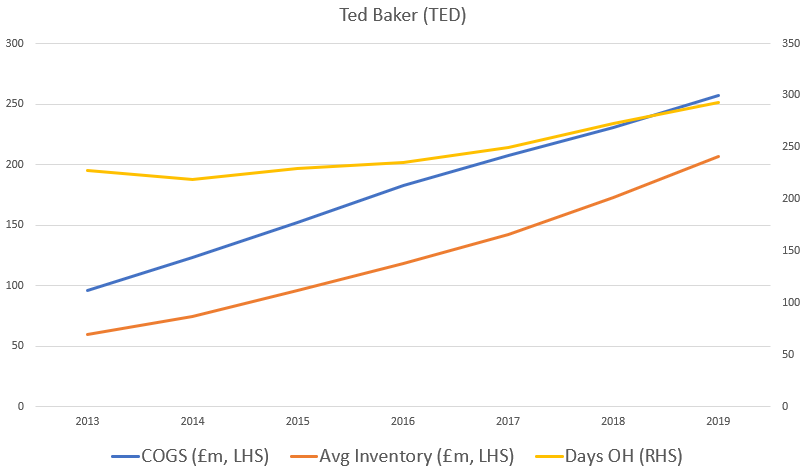
The blue line is COGS - the value of the goods sold by TED each year.
The red line is Average Inventory - how much inventory TED had on its balance sheet.
The yellow line is a sort of ratio between the two, giving us "Days of Inventory On Hand" - how long it took TED to shift a piece of an inventory, on average.
As you can see, since 2013, TED has had rising COGS and rising Average Inventory.
The two numbers have been rising in lockstep. Which again doesn't sound so bad, except that it means the ratio between them approaches 1:1.
Think about that for a moment: if your average inventory balance starts to approach the value of the goods you sell during an entire year, then it must be taking you about a year to sell each item, on average! (Edit: this is particularly dangerous if the goods you sell are seasonal, such as fashion items!)
TED's Days on Hand metric starts off in the low-200s, and climbs steadily to 292 days before the inventory problems are announced to the market.
The quantum of the overstatement is enormous. £58 million is:
- 25% of the inventory balance in January 2019
- 11% of TED's total assets
- 24% of TED's equity
- larger than the company's profit in 2019.
How could this have happened? It could just be an honest mistake. Perhaps a writedown was badly needed, but management didn't want to accept this. Maybe they were hoping that the problem would be resolved some other way.
The sinking ship has been deserted: founder Ray Kelvin is gone, the CEO who was appointed last year to replace him is gone, and the long-standing Chairman is gone. Needless to say, the long-standing CFO is gone, too (he's now at Mulberry (LON:MUL) !)
Where do we go from here?
As reported by Sky News, TED's lending banks hired expensive advisors to review the company's prospects. This will be money well spent: TED had net borrowings of £141 million as of last August.
At the time, TED said that it expected to meet all covenants associated with this debt.
Perhaps this is still the case - I can't tell. But if equity holders are nervous about what's going on, then you can be sure that the banks are nervous. The ultimate withdrawal of borrowings or changing of the terms on which banks lend to TED is what I would bet on. Stricter covenants and/or a smaller facility would require the debt load to be replaced by equity, i.e. an equity fundraise.
I also wouldn't rule out the possibility that the losses in the retail side of business might be too large for the profits in wholesale and licensing to swallow. We've seen this before with French Connection (LON:FCCN).
TED's retail revenues are c. 2/3 of total, and only about a quarter of retail sales are online.
Occasionally, value hunters will be right and they will get a real bargain with a share like this. But more often than not, in my view, this sort of situation turns into a nightmare for shareholders. I therefore would not extend my bargepole to TED.
Somero Enterprises Inc (LON:SOM)
- Share price: 284.3p (+9%)
- No. of shares: 56 million
- Market cap: £160 million
Great news from this US-based maker of concrete levelling equipment.
The Board is pleased to report that with strong, profitable trading in the fourth quarter which was ahead of the Board's previous expectations, revenues for the six-month period ended 31 December 2019 significantly increased from H1 2019 as weather conditions improved in the US.
I recommend the comment in the thread below from davidjhill, in which he discusses a method of valuing Somero on the basis of its earnings throughout the entire economic cycle.
What investors perhaps got blindsided by was the effect of persistent rainy weather, which wrecked the company's US sales back in H1.
Additionally, sales in Europe and the Middle East faltered, due to the timing of contracts and "wider macro pressures".
But thankfully, the sales warning in September turned out to be a false alarm. Full-year sales will be modestly ahead of the top end of the guidance, which was $87 million. For context, sales in 2018 were $94 million and in 2017 were $85.6 million.
Thanks to high gross margins (c. 57%) and operational gearing, "the majority of the additional revenue flows through to profits". So the top end of adjusted EBITDA guidance, $28 million, should also be beaten. And just for good measure, year-end net cash will be $5 million ahead of target, at $23 million.
Regional breakdown
The backlog of work in the US, delayed by rainy weather in H1, led to a huge rebound in H2. This seemed extremely unlikely six months ago, but it turns out that US revenue has increased, year-on-year!
Europe and the Middle East declined due to economic/geo-political uncertainty. I guess there are some real macro problems at play.
China showed "slight growth" - and I maintain the view that the opportunity for Somero in China should be viewed as speculative.
Product development
Despite a history of being conservatively managed, Somero does try to develop new products every year. Its latest product, the SkyScreed 25 (for high-rise buildings) has hit its initial sales target and:
"more importantly... we dramatically advanced our knowledge and experience in this attractive new market segment that positions the Company well for future growth."
I don't believe every company which talks up its prospects like this, but Somero deserves the benefit of the doubt, in my view.
Investment in the Skyscreed sales and support teams will be increased, and this will "temper our overall profitability in FY 2020". But again, I would trust Somero that it is going to direct funds wisely and for the long-term benefit of shareholders.
Outlook
The Board recognizes that while market conditions and activity levels remain generally positive in non-US regions, there are factors impacting each market that slightly temper underlying growth expectations for 2020. With this combined view, the Board expects 2020 will be a profitable year with healthy cash generation, revenues comparable to 2019 and EBITDA broadly in line with 2019 and in line with current market expectations due to the aforementioned planned increase in investment for future growth.
My view
Despite the unchanged profit expectations for FY 2020, I think this is a really positive update for Somero shareholders.
The company has made it clear that it could choose to let profits rip higher in 2020, but that it prefers not to - because it wants to invest in the SkyScreed.
You can see the launch video for the SkyScreed here. It looks like a useful iinvention, and if Somero thinks that it offers an attractive growth opportunity, then I'd be happy to trust it on that.
Somero offers high quality return metrics, plenty of cash generation and a conservative management style. There is a lot to like here. The current valuation, at perhaps 7x EBITDA, also looks very reasonable to me.
Victoria (LON:VCP)
- Share price: 445p (+7.5%)
- No. of shares: 125 million
- Market cap: £558 million
Intention to refinance term loan
This company's debt has been a source of controversy in the past.
It's an international group of flooring businesses (including but certainly not limited to Victoria Carpets).
As noted by Paul following his discussion with the Chairman in August, it consists of about 10 business units which have a great deal of independence. So the whole thing is a a sort of debt-fuelled Berkshire Hathaway, focused only on carpets, underlay, etc!
It is no secret that the company prefers bond financing to bank debt. Today, it announces the fulfilment of the desire to get rid of its bank debt entirely:
Following continued strong operating performance and favourable market conditions, Victoria PLC (LSE: VCP) today announces that it intends to offer €170 million in aggregate principal amount of senior secured notes due 2024 (the "Notes"). Net proceeds will be used to repay the Group's outstanding senior bank debt in full and, as such, the refinancing will not increase net debt (subject to fees and expenses)
It was back in October 2018 when VCP first announced its desire to issue bonds.
That time, it failed to offer the above reassurances (i.e. that trading was good and that the proposed bond issuance was a positive strategic decision, not something it was being forced into). The lack of explanation led to some private investors speculating that all was not well.
This time, with these reassurances now in place, the market is (correctly) responding positively to today's news. Bonds are a more secure form of debt and in general only available to healthier companies, relative to those companies that have to rely on bank overdrafts and credit facilities.
Current trading is good, too:
In the period following H1 FY20 the Group has continued to achieve positive revenue performance alongside an increase in underlying EBITDA margin of more than 200bps versus the comparable period in FY19, each on a like-for-like basis.
My view
I remain intrigued as to whether the grand plans of the Chairman, a former investment banker, will ultimately create a sustainable business.
Including net debt, the company's enterprise value (EV) is c. £920 million. EV/forecast EBIT is therefore in the region of 11x. That sounds fair to me.
Air Partner (LON:AIR)
- Share price: 77.6p (-19%)
- No. of shares: 53.5 million
- Market cap: £41.5 million
Bad news here:
The Group's UK Charter division has been impacted by slower than expected Q4 trading and as a result the Board expects to announce underlying profit before tax of not less than £4.3 million for the 12 months to 31 January 2020, which is lower than previously expected.
I can see an existing forecast for PBT of £5.7 million. So that's a significant miss.
Reasons given:
- a customer suspending an order (indefinitely, it seems)
- a "soft" private jet market
- revenue from another job falling into the subsequent period.
The US charter market is ok, and other divisions at Air Partner are doing ok, too.
UK outlook
While the visibility around Charter orders is always limited, it has been further impacted by the political uncertainty in the UK and headwinds in the global economy. From the UK perspective, the General Election result on 13 December 2019 delivered a clear majority, which we believe over time will help to build business and consumer confidence.
My view
I'm not an expert in this stock or sector, but on the face of it, this doesn't sound like a very serious profit warning. It sounds more like a company whose revenues are a bit lumpy and order-driven, and where macro conditions can have an impact. Hopefully, it can recover before too long.
That's all for now - cheers!
Graham
Disclaimer
This is not financial advice. Our content is intended to be used and must be used for information and education purposes only. Please read our disclaimer and terms and conditions to understand our obligations.

64 comments
Somero Enterprises Inc (LON:SOM) went into the hole on freak (bad) weather / its partially come out of the hole on freak (good) weather.
Somero will now most probably warn at some point in 2020 and so go back down into the hole and the freak-ish weather merely provided a smoke screen on cyclical (structural?) decline in terms of strength of demand and margin. This is why mgt appear surprised at how good it end of 2019 was.
All the words of praise re margins, customer service, end market, etc (and something rather obtuse re behavioural economics by simoan) will be forgotten when the cycle bites....as it will even if its not 2020.
Somero cannot be a a high quality compounder sort of growth thing. Its end market is too uncertain and prone to cycles and fads) and Somero has v low ability to generate demand in that market through what they do with service and product ie they are very dependent on industry factors.
It is as clear as the nose on my face (and I'm not Voldemort) that Somero have had excellent growth and margins as they have been selling into an end market in a sustained (near uninterrupted) upswing. There may be some barriers to entry for competitors but they ain't that high...the high margin is significantly a cyclical phenomena.
Ergo, margins will decline meaningfully in the next downswing. Somero may touch say 600p in future, but it will definitely be below 150p in next couple of years and probably less than 100p.
I've got no axe to grind on this company. I think it looks decent but people are creating attributes and narratives that this stock just can't hold. An end of cycle takeout by a bigger and broader offering operator is the glory exit....
Ergo, margins will decline meaningfully in the next downswing. Somero may touch say 600p in future, but it will definitely be below 150p in next couple of years and probably less than 100p.
Well you were making a reasonable case until you wrote this. Foreseeing future share price ranges of any company is a patently ridiculous thing to do. And you seem to comment an awful lot on Somero Enterprises Inc (LON:SOM) for someone with no axe to grind!
Si
Victoria (LON:VCP) I would be much more nervous as a shareholder about a bond financing for a fairly small company. The debt may be cheap, but the terms are very inflexible and if there is a bump in the road then the ability to restructure is very limited. Based on experience, I think that bond financing is way too dangerous for most companies. It often ends in tears. I have seen this happen many times. I avoid companies that take this superficially attractive option.
Victoria (LON:VCP) on the contrary, bond debt is far more flexible than bank debt. As long as you continue to pay your interest, there isn’t much bond holders can do. Look at the level of interest cover (EBITDA as a proxy of cash flow to interest costs) and what earnings would need to drop to for you to be left unable to pay interest from either cash flow or retained earnings.
Aberdeen New Dawn Investment Trust (LON:ABD) was meant to be £ABDP...
Whatever the merits or otherwise of the Somero Enterprises Inc (LON:SOM) business the share price action over the last 12 months is indicative of how difficult it is to follow a selling strategy which avoids the behavioural bias that Ben Hobson wrote about in his Stock blog recently. At the beginning of June 2019 the share price fell by more than 20 % on a trading update (profit warning) and then again by another 30% at the results announcement at the beginning of September 2019. At both these stages a trailing stop loss strategy would almost certainly have sold out (unless at a very wide margin) as would recognition of two negative reports on trading suggesting a third was inevitable (see Stocko research into profit warnings). However today Somero Enterprises Inc (LON:SOM) announces a storming 4th quarter that no one, not even the management, appeared to be expecting with a consequent 11% spike in the share price which has already moved higher from its 2H 2019 lows. This pattern seems to repeat itself quite regularly - at least for quite a few of my past holdings that were sold! (Avon Rubber (LON:AVON), Aberdeen New Dawn Investment Trust (LON:ABD), Computacenter (LON:CCC), Headlam (LON:HEAD) to name a few). It might be bad luck but faced with this history it is probably worth adopting the strategy referred to in earlier comment on today's SCVR. When a share hits x% above cost (say 50%) sell half and hold the remainder until, hopefully it goes up another 50%, and then repeat! This might not get too many multibaggers but for a low risk approach for investors with a shorter time horizon to retirement/living off investments it might be a safer option.
Hola Paul and Graham ,
Please could you update the heading on WYN it says " Full Quote " but this is an AIM stock . I can quite understand why you passed on this and looking at a house is much more fun . However WYN is as far away from ASOS / BOOHOO .. as you can get .. cyclical , low margin and subject to the Ag cycle . But at 280p we are back to Sept 2010 level , having touched 680p in 2014 when IHT buyers thought it was a growth stock . Like NWF this company has been going for over 100 years and farming might not be fashionable and too green but will not be massively disrupted by Amazon etc. The divi record is superb and although the outlook is poor and value investing unfashionable , this is one of the few AIM stocks on a 10 year low selling below tangible book . Worthy but Dull so I have put a toe back in the water today but expect to see it lower .
I've never looked at Wynnstay (LON:WYN) before
No growth, cyclical. Profits just down and will be worse again next year. Yield and PE okay, but not exceptional in the circumstances.
Just my sort of share.
If I can get the price right.
A lot of uncertainty though. Trade deals with EU and US could have substantial impact. Farmers will be protected but there's no political reason to support agricultural companies. We have no idea what sort of support mechanisms will be put in place of CAP but they could be environmental which would reduce demand for Wynnstay (LON:WYN) .
There's some real wonky thinking on this thread today.
Re: Air Partner (LON:AIR) and the idea rich people are going to stop using private jets and go with Ryan Air or Easyjet instead because of a 17 year old Swedish girl is laughable. The idea that they are not going to travel by air at all is also ridiculous. Rich people will still fly even if it is taxed to buggery - sorry to break that news Greta.
As for the idea Somero Enterprises Inc (LON:SOM) has no recurring revenue as well, that is not strictly true and shows a complete lack of business understanding. Recurring revenue is overrated as far as I am concerned. I want to be paid a lump sum up front, thanks, not the same amount over a number of years. A bird in the hand is much better, you can keep the one's in the bush, thank you very much.
I work in a similar lumpy revenue business and you get recurring revenue by selling more stuff to your existing customers - and this is where the Skyscreed will hit paydirt. because it will be a very attractive product to their existing customer base . These are the easiest sales you can ever make. This is why I'm very happy to see the investment being made in the Skyscreed product. It seems a total no-brainer use of capital to me and may even improve an already impressive ROCE in the medium term.
You will always have some recurring revenue for spare parts or extended warranty periods and this will gradually increase with the installed user base, However, if you're customer service is very good (and this is the USP for Somero because they rightly spend a great deal of money and effort on this area) as your customers grow they will need more machines and they are not going to go anywhere else even if your machines are way more expensive than a competitor.
I would suggest more reading of some good behavioural economics books.
Si
"Re: Air Partner (LON:AIR) and the idea rich people are going to stop using private jets .."
True to a point, I suppose. But I don't think it's global warming that's stopped a lot of them wearing fur coats.
Re: Air Partner (LON:AIR) and the idea rich people are going to stop using private jets and go with Ryan Air or Easyjet instead because of a 17 year old Swedish girl is laughable. The idea that they are not going to travel by air at all is also ridiculous. Rich people will still fly even if it is taxed to buggery - sorry to break that news Greta.
True, the very rich will go on using private jets - or at least some of them will. But it's not an all or nothing issue. If air travel gets taxed more, even "to buggery" is not impossible, it will of course have an impact. The only slightly very rich, and even the very rich with concerns for their children and future generations, are likely to end up flying less. Air Partner's market won't disappear, but that doesn't mean it won't shrink.
The problem for a fashion brand is that out of fashion has no value.
The problem for a premium brand is that discounting to clear aging stock presents a risk to future margins.
All fashion brands get things wrong sometimes.
I don't follow Ted Baker (LON:TED) so I've no idea what has really been going on there, but haven't they implied that the problem goes back some years?
If they have avoided dumping or writing down stock values since 2013 then some of their stock could be very old indeed. I wouldn't want to be a holder of Mulberry (LON:MUL) .
TED: Stockopedia rates it 77 for Quality and 97 for Value, with ‘Contrarian’ status.
This worries me given dramatically falling Operating Margin and Net Income, with poor ROCE and high Debt.
I am sure the analysis used by Stocko has been applied correctly, but this undermines my confidence in it.
The issue with Stockranks, is that they are entirely backward-looking and only update when new data is fed into them. The Value and Quality ranks only update when there's new financial data to input eg. published financials - not on best guesstimates. In a way, it can be quite easy to get ahead of the curve of Stockranks eg. We both know the TED one will fall in coming months (assuming Momentum unaffected), and based on today's "ahead" statement, SOM's will probably rise. Unfortunately you can't trade Stockranks - if you could many of us would be Billionaires by now!
With Ted Baker (LON:TED) the stock rank which best hints at trouble ahead is the Value Rank at 97. Very high Value Rank is often a sign of the market not believing the QM "story" so it is very cheap (but not necessarily good value!)
If you look at the individual P/E P/B P/S and P/FCF values they are all in the top decile. This suggests that people are actively avoiding it even though it is cheap by almost any measure.
It shouldn't do, if you fully understand how to use the StockRank.
(Sorry I couldn't find a way of saying that without sounding condescending - it's not intended).
StockRanks are a statistical (erm) Ranking.
If you compare a sample group of high ranking stocks with a similar sample of low ranking stocks, in the former you should more winners and less duffers (but there will still be some).
So my take on that is that there are two main ways to use the StockRanks :
1. To build a sufficiently diversified portfolio, based on the StockRanks alone - no or little interpretation needed. Yes you will pick some duffers, you might even have picked Ted Baker (LON:TED) but you should on average beat the market.
2. Use them as a starting point for further research on individual stocks. Here my view is that the focus should be on avoiding the duffers and particularly risky shares, that imho is more important than trying to find the stars.
I don't know if there is any truly systematic way to do this, but I am interested by NickRay's observation that a high StockRank coupled with a very high ValueRank could be a warning sign.
Hopefully not misquoting (NIck please correct me if I am wrong) but I think he has observed elsewhere that the very highest StockRanks can produce more extreme results on both the upside and downside. That leads me to wonder if an investing saw can be re-purposed - if the StockRank is too good to be true, it probably is?
Nq Minerals (OFEX:NQMI) What are they thinking of! A loss making company, operating in Tasmania, and listed on Next with a market cap of £27m wants to spend money on an additional listing in the US. Perhaps concentrating on turning a profit might do more for the share price. I hold.
Re Air Partner (LON:AIR), I was looking forward optimistically to the results but ended up disappointed and sold first thing this morning. I wonder if all the climate change objections to air travel is beginning to have an effect on private jets and charters
wrt Ted Baker (LON:TED)
It's worth bearing in mind that the revised stock value is a current estimate of the future sales value of that stock. It's all estimation.
Also, overstocking implies that previous profits have been overstated.
That's not quite right, re Ted Baker (LON:TED) inventories valuation.
Inventories have to be valued at the lower of cost & net realisable value, on a line by line basis. Therefore given that TED will have a high bought-in margin, being a premium brand, then most stock should be valued at cost. The retail value would be considerably higher (typically 2-3 times).
However, there may well be problem, slow-moving lines, that have been written down from cost to net realisable value, i.e. below cost. Only those stock lines would be in the books at the same sort of price they should sell at. I'd be surprised if that's a big number though, as even in half price sale, fashion retailers are still selling at above cost. It's when you're getting into the realm of 70% off original sales price, or worse, that you're selling below cost price just to shift dead stock.
There could also be a question of over-stating what inventories actually existed. To have to re-state your total inventories 25% lower, that to me suggests the original figure may have included fictitious stock holdings, as well as write-downs for slow-moving stock.
Also, I would assume that the accountants who did the review would be thorough, and prudent, so probably a kitchen-sink job.
All in all, it completely undermines trust in the figures, and makes old management look very bad indeed.
I closed my (tiny) short position in TED this morning, because the latest awful news has not had much impact on the share price (only down 7%). This suggests to me that the price might now have all the bad news in it.
Its freehold head office covers about a third of the net bank debt. NB note that Thomson Reuters now includes leasehold IFRS16 "debt" in the net debt numbers shown on Stockopedia. I wish they didn't, but they do. So if, like me, you don't want IFRS 16 lease debt included in debt or EV, then you have to manually adjust the figures.
The brand licensing revenues/profit of £22m are very valuable, so I'm wondering if the downside might already be priced-in? The founder owns about a third, so if he wanted to line up a bidder for it, then they would only need to come up with the money to buy out the other two thirds shareholders.
Overall it looks a big mess, but on balance I'd rather not have a position at all, long or short. The short has made me 25% profit in just a few weeks, so am happy with that - and it's thanks to a reader who posted something here about it.
Inventories have to be valued at the lower of cost & net realisable value, on a line by line basis. Therefore given that TED will have a high bought-in margin, being a premium brand, then most stock should be valued at cost. The retail value would be considerably higher (typically 2-3 times).
Yes, but we are looking at a substantial revaluation.
If the stock didn't exist or the historic cost had been misstated, that would be a very bad thing and I'd expect a hint in the statement.
That implies that there's a switch to a realisable value below cost, and that realisable value is an estimate. Possibly a conservative estimate if they are just trucking it all off to landfill and cutting out the middle man.
Ted Baker (LON:TED)
The wording of the statement is quite interesting
I suspect that is deliberately quite neutral, it does not tell us whether items of stock have been written down, written off or do not exist.
Inventories as at 26-Jan-19 were £226m so that's a 26% write down. Given that the £226m would have been mostly stock valued at cost, it implies that stock with original selling price in excess of £500m has been written down to a potential realisable value of £168. That is a c. 70% markdown.
Those figures however only apply if they have written down the entirety of their stock, which I would doubt, so if these are write-downs they would be huge.
I am very much minded to think that it is more likely to be, at least in part, "phantom stock".
Either stock that suppliers were supposed to have delivered but in fact did not or stock that did exist but has since disappeared.
I reminded that the December statement named the lawyers that would be working on this for them before selecting the accountants.
If it is fraud rather than valuation write-downs, I would see that as being more positive for the company going forwards. It is surely easier to fix a gaping hole in stock auditing processes than it is to fix a fashion brand not having the first idea what prices their good can fetch in the market?
No position at the moment, but getting interested.
Somero Enterprises Inc (LON:SOM) seems a decent business but I doubt it will prove out to be a growthy compounding sort of long term winner. The business is cyclical regardless of internet retailing warehouses, its machines have long life (so resale market), little protection against competitors and only very moderate demand for incremental innovation in the industry.
In addition, Somero will warn during 2020 (probably H1) that trading is below expectations. The exceptionally mild NA winter has meant construction took place at an unusual clip....however this was very skewed to the homebuilding with pronounced weakness in commercial. Expectations of an activity rebound in US generally look overly optimistic and led by the need to believe it as the market is very high. Given the backlog from summer it may be that any significant disappointment is H2.
The wild card is Fed action. The word is that from Feb onwards its thinking of tightening policy again (not rate increases but thro their money market activities around the repo market). This would be a huge error by the Fed and will cement a slowdown in US and temporarily rising yields. FWIW I believe they should raise rates but provide massive liquidity. The Fed does not understand that there is a problem is the global market for money which is called eurodollar market - this is where all the dollar action really happens in this massive alt reality version of the official dollar....
But, if the Fed accepts its inevitable role of monetising US debt then the market could really boom (economy and stocks again). Trump wants this but so far the Fed is intellectually resistant (note, Bernanke would support the Trump perspective - probably the best banker since Volcker, the rest pygmies)
After the next significant building slowdown or general slowdown Somero will not regain its current margin. Its margin is partly based on the ability to price due to a very strong and long duration market.
Regarding Somero Enterprises Inc (LON:SOM)
Hi Mojo
“ little protection against competitors and only very moderate demand for incremental innovation in the industry”
No idea where you’ve got that from. They have few competitors because of the barriers to entry. The construction industry does look to innovation. In fact, their whole business has been built on the take up of innovation in floor laying. The high rise market is a new, undeveloped market. It is too soon to tell whether or not their technology will deliver sufficient value there for it to be adopted at scale, but if it does there’s plenty of growth potential.
Hi Graham
I looked at Somero Enterprises Inc (LON:SOM) about 2 years ago or so and looked through a decent bit of info. I do not believe that they will possess significant barriers to competition...of course they will claim it. They will not gain a foothold in China as a copy or alternative will.
As I said I think they are riding a long uninterrupted wave at the moment so the demand is good. A slowdown will be the tell. My guess is they will emerge from that with structurally lower sales and margin.
But I do not know...
Well as Somero Enterprises Inc (LON:SOM) have been around for significant time now in the USA without significant competitors emerging I would have to say that their claims of barriers to entry in their main market are completely justified.
As regards China, it is clear that their value proposition does not work there. They are not alone in that. But more to the point, they are quite rightly addressing other potential growth markets namely the high rise market in USA and so the investment case is not predicated on China. Success in the high rise market in the USA can deliver plenty of growth.
Fantastic analysis on Ted Baker (LON:TED) well done Graham!
Thanks Paul :D
I'd be interested in Air Partner (LON:AIR) if you have time. Seems like a not too serious profit warning? I own it.
Hi Graham could you or Paul have a 5 min look at WYN , full year results out today .
Hi Graham, could you have a look at Alliance Pharma (LON:APH) please.
Full year results, in-line, but online looks very good/safe, of +8% excluding acquisitions, they sell lots of small over the counter medicines & have 3 big brands with largest selling +38 growth. Excellent cash flow& debt reducing, big founder share holding. A steady eddy compounder who add small drugs to the portfolio, too small for big pharma to care about, and slot them into their sales process, so far so good. Appreciate your view.
Edit: just noticed large share options exercised by ceo & cfo in last few months , with minimum allowed shares retained. Not so good.
Hi abtan, interesting you say revenue miss.
Alliance Pharma (LON:APH)
I pulled the full year revenue expectations of £144m (vs £136m announced today) from the Stock Report.
Perhaps:
but if I'm honest I'm not too bothered by forecasts (I'm a market cap vs cash generation kind of guy) and merely pointed it out as I thought it would have a short-term impact on the share price.
For today I remain a happy holder and will continue to hold
I'm reminded that the financial PR for Alliance Pharma (LON:APH) never replied to my question about management shareholdings. A big negative for me. One they can easily solve but seem a bit tin eared about it.
Hi Graham - Not good from Ted Baker (LON:TED)
Can you explain the relevance if any of this line in the statement
As previously stated, the overstatement is a non-cash item and related to prior years.
Surely yes the stock is non cash but still will impact the valuation of the company by the additional £33-£38mGBP
It is a non-cash adjustment to stock but ultimately less cash will be generated from that stock holding. So it will affect cash albeit in 292 days (average time they take to sell their stock).
Since Ted Baker (LON:TED) has paid for all this stuff, whatever they sell it for brings in cash and it would be quite usual to see a cash boost in the short term as sales (at significant discounts) sharply bring down the inventory levels. The sales will of course be at low or loss levels but the cash goes up.
Ted Baker (LON:TED)
Since Ted Baker (LON:TED) has paid for all this stuff
Rather intriguingly the bbc have the headline" phantom stock - so i wouldn't even presume the stock ever existed in the firstplace. If it didn't exist i would like to think they didn't pay for the item that doesn't exists - even then it's possible they may have paid for something that doesn't exist i guess.
https://www.bbc.co.uk/news/business-51204064
I thought previously there was a chance they may have been kitchen sinking the stock issue to give them better numbers this year - i couldn't have been more wrong with that bit of idle speculation. Very poor directorship to make the mistake once - and them compound the same mistake by misleading the market again by repeating exactly the same mistake. (very similar to staffline accounting issues where bold as brass directors did similar). I guess leopards and spots comes to mind. As graham and Paul say - exit the building (or don't enter) and worry about it later seems the only sensible course of action - unless there has been a clear change in leadership aligned with some clear evidence the kitchen sink is in hand.
Hi John,
re: "the overstatement is a non-cash item"
Companies tend to say this when something they have bought turns out to be worthless. It's an unhelpful statement.
G
I think that it is worth remembering that Somero Enterprises Inc (LON:SOM) is attractive partly because it taps into the growth of internet retailing. By that I mean the need for large warehouses with precision flat floors so that high storage racking can be used. If the floor isn’t flat then the racking will lean. So, while the overall construction market is cyclical, I don’t see the trend to internet retailing and need for these types of warehouses slowing for many years. They are also exploring what value their technology can bring to high rise buildings. This would be a new market for them. I like their thoughtful approach here - putting more sales resources into it after dipping a toe in last year but not attempting to go too fast before they’ve really determined that they have the offering right.
I hold.
A good statement by Somero Enterprises Inc (LON:SOM) I agree and I do like the management, I have also held for a few years so some great income alongside the capital growth.
I agree that the demand for absolutely flat concrete floors is unlikely to abate in the near future so gives it some defensive qualities that are probably underestimated by the market. The move into high rise is also sensible as this will also give them some protection, assuming any recession is not global in nature. However, all that said there is inevitably a cyclical element. Business will drop in a recessionary environment and Somero Enterprises Inc (LON:SOM) are quite dependent on the US commercial market for revenue and profits.
What I do now for cyclicals is to base my model valuation on an estimated average earnings over a cycle. I did this with Micron (memory chip producer in US) which is in a notorious boom/bust market. I noticed there that Micron had managed its business model better than it had done and that rather than the trough earnings being the significant losses seen historically these had stabilised at circa $3 positive, but that peak earnings had the capacity for $15+. It had gone from a net debt to a net cash position too and therefore was less stressed in bad times. I applied an 18* trough earnings and a 6* peak earnings giving me a valuation range of $54 - $90 p/share. The cycle in this market tends to be short - 5/6 years. That allowed me to buy in the low $40's with some comfort even when the share was falling. They are currently $58.
I think you can apply this logic to Somero Enterprises Inc (LON:SOM) : it too has gone from a net debt position in last recession to a strong net cash position currently. The cycle is longer, 10+ years I reckon. Let's assume revenues drop 40% in a recession (halved in 2009 but that was exceptional) and that profits fall 70% from the top. I consider 35-40p eps approximately peak earnings in this cycle so that would be 10p in a recession. Given the longer cycle I would place a 25* multiple on trough earnings and a 10* peak earnings (plus cash) giving me an expected valuation of 250p - 380p that I would consider fair value, almost irrespective of market conditions. Thus I'd be keen to buy below 250p if I see the market over react on a short term basis but probably looking to take profits above 380p if there is exuberance.
I don't know what anyone else thinks about this approach or if they use something similar. I find it allows me to assess the likely future value of a business more objectively by smoothing the short term volatility that usually over/undershoots.
I also note that Somero Enterprises Inc (LON:SOM) have downplayed expectations for next year. I have a sneaky suspicion that this is deliberate to avoid re-basing if adverse weather plays its part. I am therefore expecting earnings upgrades as the year progresses, so will be interesting.
I've used Through The Cycle earnings to value banks. Didn't work in the financial crisis, because bank balance sheets had become so much more fragile than previous cycles. For Somero Enterprises Inc (LON:SOM) it make sense though, as you note, it's gone from being indebted to net cash, and very high Return on Capital - so if anything, TTC might undervalue it. One I hold, so talking my own book.
Somero Enterprises Inc (LON:SOM)
Thanks for the great comment David - I have referenced you in the report and would urge others to read your analysis!
G
Thanks Graham - appreciated.
Hi David, how do you make your earnings estimates?
hi Jeff - a mix of history, analyst consensus and common sense (hopefully). I don't stick to estimates if the facts change though, which I think is the important element to this.
On Micron we peaked at circa $12 but there has been a large scale buy back that would push it closer to $14 on an adjusted basis before any growth. Therefore I use $15 though I think that could be light. As DRAm prices started to bottom and turned up again as demand/supply relationship changed I could see that lows were in around the 75c for the quarter. The year itself has come in at $3.10 but you could pencil roughly that number in about 6 months ago before the price turned.
Last year Somero Enterprises Inc (LON:SOM) made 30p. I don't consider this peak as I think there is more to go over next year or two as sky screed and other initiatives kick in. I don't want to over-egg the pudding so I have adjusted for a maximum of 15% increase in earnings from there before we peak. If it looks like that is a light number going forward I will adjust it, if we have a downturn before then I will move back to a 30p number. The low number is harder because the cycle is much longer. we know that revenues halved in 2008/9 and they were servicing a lot of debt hence the losses. They are at a much higher base now with more resilience to the cycle and net cash (but still cyclical) so I have adjusted revenues to a 40% drop and a bigger loss in profitability to reflect fixed overheads but think they will keep their heads above water unless the recession is prolonged or particularly savage.
Never going to be totally accurate but it gives me a good base for a ranged valuation and gives me a more objective view of where I might buy and sell.
Thank you David :)
Thanks for this David. Valuing share ranges is one thing I find very difficult and this is a very clear explanation of your approach that seems to make sense! Nick
Sorry, clumsy fingers.
David - I read with much interest you comments which contribute to my own appreciation of this company. I've added a few subjective commen ts down in one of the lower messages.
Update from Alliance Pharma (LON:APH) today falls short of revenue expectations (£136m vs £144m expected vs £118m last year), but with Free Cash Flow of £29.1m vs £16.1m recorded last year.
Growth across all brands continues, especially their biggest brand Kelo-Cote up 38% Year-on-Year.
Debt continues to be paid back rapidly.
All looks good to me. I hold and continue to do so.
As it looks like one that will be missed from today's report, any additional thoughts are appreciated.
Cheers
A
Woul be great if you could include air partner Paul. Thanks
I'm finding it slightly difficult to decipher the Somero Enterprises Inc (LON:SOM) update but I think it may mean EPS in the region of 35c, or about 27p
So a P/E of under 10, yield of over 6% and millions in the bank.I'm aware of the cyclical nature but I don't think that valuation is high by any means at this level.
Given it isn't likely to make an appearance in today's report, I would be interested in anyone's thoughts on Air Partner (LON:AIR) (which I hold).
Personally my long-term view is shaken.
The company makes a lot of cash, or least has done so in the past, with £4.0m operating cash flow generated before working capital movements in H1 (this excludes funnies with leasing liabilities.)
However, cutting guidance so close to the end of the year is off-putting, especially after the upbeat tone throughout the year.
Other opinions would be greatly appreciated.
Thanks
A
Hi Abtan
I had this on my watch list but was holding off as I noted Castlefield were selling down their large holding and I wondered why (Aberforth topped up ) I see the price is down- the standard bad news reaction. I think no surprise that the posh jet market in the UK has been underperforming given a lot of activity was stalled by Brexit and let’s be honest this seems like the type of market where a little green consciousness would have an adverse impact. Does not seem like too much is wrong and if I had I would hold. Thinking about adding a small position after today’s tumble but not sure there is a rush.
Regarding the Castlefield holding in Air Partner (LON:AIR) the S de L Buffettology fund has grown so large that small companies have become of little consequence so in June they announced that they would discontinue microcaps, defined as below £100m mcap. They held three. They sold down Air Partner (LON:AIR) in July and October and now have 14%. On 17/12/19 they sold their entire 16% holding in Driver (LON:DRV). The third is Revolution Bars (LON:RBG) where they sold down from 18.7% to 17% in July but have this month at odds with their policy increased to 19.7%.
Regarding the trading update today the question is whether this is a short period of low demand to which their market is prone or whether there is some underlying problem that would be of greater concern. The statement for the next financial year is upbeat so for the time being I am giving them the benefit of the doubt and holding.
Thanks for that. For what it is worth I think others seem to have taken my aside that there maybe some slowdown in private jet trade due to green issues as far more of an issue then I see it. Blatantly, the economy has slowed so like many situations it is reasonably apparent that such a trend should not be a surprise. I like this stock but not sure there is a rush to buy especially if Castlefield are going to sell down further
Trading statement out from NRR, which I hold (and have lost more money on than any other holding, ever!). A fairly routine ‘steady as she goes’ statement., but welcome all the same after the awful INTU news and reading that SHOE has pretty much halved it’s rent bill.
My preferred REIT is RLE, which is depressed mainly because of structural sellers. Directors have been consistent buyers. I have bought a fair few RLE recently; time will tell if that was a mistake.
When will we ever reform business rates?
Mike Ashley seems to be playing a blinder with negotiating reduced rents. He’s going to trade better as a result.
My big question is, what does this mean for pensions, which have relied on property to generate a consistent and safe income? No one ever mentions life and pensions funds ownership of retail property.
In my home town, shops are being turned into seriously high flat blocks with shops on the ground floor. It’s proving to be a really good decision. NRR should get on with it. PCA already are.
Good point Greyinvestor,
If you look at the contrast to European model of many towns & cities where people choose to live in apartments, they are blocks of flats, with shops underneath, as you say above, high density population with local shopping. Pension funds may take a hit but longer term higher density housing has to and is happening. Town centres are dying, it’s an old model, times have changed, rejuvenate them with higher rise & commercial on the bottom, works for almost every major town in many European countries. Provides housing, rejuvenates the town centre, lots of tax for the council , paid for by long term pension funds. Simples. Only needs a forward looking council, hmm, to create the plan and vision. It will happen though, land is always repurposed over the long run (even if we are all dead) , as some dude once said.
It appears that there are structural changes imminent in the regulation of high-rise housing in the UK. Dame Judith Hackitt's report after the Grenfell Tower fire recommended that a safety-case regime should be introduced, and the Government announced this week that HSE will become the building regulator for high-rise (18 story - possibly reducing to 11-story) housing, with Dame Judith leading an oversight Board (which must mean that her preferred safety regime will be introduced). The second phase of the GrenFell Inquiry is starting (so more recommendations are certain - you can't write an inquiry report with no recommendations). Meanwhile, buildings that currently have combustible cladding will have to have it replaced, and a safety-case regime comes with costs that tenants, freeholders and landlords will have to share in some way, plus restrictions on what changes can be made to buildings.
As for the ground-floor retail, I forecast that there will be more restrictions. Restaurants must pose a fire risk (it's already hard to get a mortgage on a flat over a chip shop), but they seem to be the preferred occupant of the ground floor of housing that has gone up near Battersea Power Station.
Greyinvestor
I commented on RLE before and being well aware of a number of these locations would say I am struggling with the quality which is where retail needs to be to prosper IMHO
I am sure there is a bottom in retail but I am not certain we have seen it, nor whether catching this knife is one to prioritise. I am not wholly convinced that whatever happens on business rates would be enough to justify buying a REIT which invests in Midlands shops . If pushed I may have a modest interest at a discount of 25% to current NAV but it is hardly compelling and would be bottom fishing. I note that Premier Miton have been reducing their holding so this may not help the share price if more shares over hanging from that source
Whilst I can see the logic in converting shops to residential, this seems like a disruption to income which hardly seems great news for a REIT where one is buying for the yield?
My morning smallcap tweet: 16 today. Stale stock iceberg grows at TED
Ted Baker (LON:TED) Deltex Medical (LON:DEMG) Dods (LON:DODS) Air Partner (LON:AIR) Somero Enterprises Inc (LON:SOM) Newriver Reit (LON:NRR) Plutus Powergen (LON:PPG) Tungsten (LON:TUNG) Sumo (LON:SUMO), Pets at Home (LON:PETS), Mission (LON:TMG), Tissue Regenix (LON:TRX), Pelatro (LON:PTRO), Alliance Pharma (LON:APH), Van Elle Holdings (LON:VANL), Netcall (LON:NET)
Ted Baker (TED) stale stock overstated by £58m, nit £20-25m guided in Dec.
Deltex (DEMG) guides FY rev £4.3m down 14% "reflecting the implementation of the new strategy focusing on generating profitable revenues and the cessation of the distribution of lower margin third-party products." F/C £4.6m. Expects positive adjusted EBITDA.
Dods Group (DODS) Publishing, events and training businesses still weak. Guides FY adj EBITDA at least £2.8m.
Air Partner (AIR) cuts FY U/L pretax guidance to £4.3m min. Confident outlook "supported by a strong order book in Safety & Security, with order book coverage of c.35% of the forecast outlook, and sizeable business wins in the Charter."
Somero Enterprises (SOM) good US weather leads to FY rev modestly ahead of the top end of the guidance of $87m and the majority of extra rev turning to profit. Sees net cash $23m, $5m above prev guidance. Will be $4m special div. Will hike sales and support staff in FY20, slightly tempering profit. Sees FY20 rev flat also, EBITDA in line with current market expectations. I hold.
NewRiver REIT (NRR) solid Q3 with an increase in retail occupancy to 96.1%, footfall outperforming the UK benchmark by 60 bps. I hold.
Plutus Powergen (PPG) borrows up to £150k at 10% PA from board members to keep the lights on until mid-May.
Tungsten (TUNG) CFO gives notice. He is thanked.
Sumo Group (SUMO) guides FY at least in line with market expectations. Has won a number of significant contracts.
In line: Pets at Home (LON:PETS) Mission (LON:TMG) Tissue Regenix (LON:TRX) Pelatro (LON:PTRO) Alliance Pharma (LON:APH) Van Elle Holdings (LON:VANL) Netcall (LON:NET)
Please include Air Partner, Paul.
Thanks, Barry
I like Somero, but I get the impression that sales generate very little recurring revenue, so when the next construction downturn comes, it will hit hard......
I hope not as hard as last time because they're in a much better position financially.
Also (I hope) there are labour issues and demand for bigger flatter floors which should help Somero Enterprises Inc (LON:SOM) through harder times.
I doubt it'll ever be rated as a growth share but it seems decent at these prices to me.
There are many thought-provoking comments here on Somero written by people who seem to be terrific analysts. The overall opinion appears positive, though several are concerned by the cyclical nature of the industry and the danger of new competitors.
I'll add just a few subjective comments which go in the sense of believing this is a super company with a brilliant future.
1. Management. Over the past year, I've had access to two lengthy management presentations through the good offices of Stockpedia. I was more than impressed by the professionalism and the ponderation of the various participants from the Managing Director through the Financial, Marketing and other Directors. These people know their business, their industry, and their customers. They are straight-forward in talking about their problems and do not over-gild the lilly of their successes.
2. Proprietary know-how. For the past years, Somero has significant patented techniques regarding laser and automated guided equipment that no one else has been able to replicate. And they take pride in not sleeping on their laurels but coming out annually with a new tool. A classic case of a niche player protected by a technological moat. Reminds me of a Michael Porter case.
3. Their SkyScreed innovation is of immense potential. Here I am being totally subjective, but I am willing to bet that the number of square meters to be screed in the hig-rise sector far exceeds those, though consequential, in the factory/warehouse/commercial center sector. That is certainly the sense one gets of management's commitment to developing their know-how in this area in 2020, even if this might dampen results (somewhat).
4. Finally, though never mentioned in all I have read on Somero, an acquisition by a larger, construction equipment firm may well be in the offing in the next five years. At a good premium given their competitive advantage and terrific financial condition.