Small Cap Value Report (24 Sep 2014) - JDG, RGS, SSY, MMX

Good morning!
Judges Scientific (LON:JDG)
Share price: 1297p
No. shares: 6.0m
Market Cap: £77.8m
These shares had been recovering from the shock profit warning in Jul 2014, but today they have lurched down again by 240p (15%) to 1297p this morning - roughly the previous low in July. So results must have disappointed, let's take a look.
Interim results - for the six months to 30 Jun 2014 are out today. The group's strategy is to grow through repeated acquisitions, buying private companies cheaply. This is kept rolling by having highly rated shares, thus the acquisitions are earnings enhancing, and only a relatively small number of shares need to be issued from time to time because the cashflow from the acquired companies, combined with a modest amount of bank debt, has funded most of the acquisitions. It's a clever business model, and has been executed brilliantly by CEO, David Cicurel.
The rating got far too high in the 2013/early 2014 bull market, and these shares have now almost halved since the peak.
The interim figures look OK to me, so I'm a little perplexed as to why the share price has dropped so sharply today. Adjusted EPS came in at 50.3p for the half year, up 22%. Although the growth seems to have all come from an acquisition, with no organic growth.
Outlook - the order book seems to be the reason investors are concerned;
Organic order intake during the six-month period decreased 4.8% compared to the first half of 2013; total order intake (including Scientifica) was 11% below the level required to meet the Group's sales budget without consuming its order book. The second quarter showed a moderate but insufficient improvement compared to the first. The order book at 30 June 2014 represented 7.8 weeks of sales, compared to 10.6 weeks at 30 June 2013.Trading at the start of the second half has continued to be difficult. Weekly order intake in the third quarter has broadly mirrored the activity seen in the first half.
Broker forecasts - WH Ireland has trimmed its full year EPS forecast from 86.4p to 80.3p, but given that the group achieved 50.3p in H1, that seems a fairly pessimistic view for H2 (of only about 30p EPS). I suppose if you assume that is the new level of earnings, at about 30p EPS per half year, then that suggests a drop to only 60p EPS next year perhaps?
Valuation - based on the 1297p share price at the time of writing, and revised 80.3p EPS forecast for this year, the PER is 16.2, which looks rather high to me, considering the company has a weak order book and some long term debt (although that was largely offset by cash on the year end date).
EDIT: I've just noticed that WH Ireland say they might be being overly-prudent in lowering their estimates from 86.4p to 80.3p. So if the company does achieve 86.4p EPS for the year, then the shares would be on a PER of 15.0 times - still rather pricey really.
My opinion - this company is difficult to value now, as the outlook is somewhat uncertain. If it can do some more canny acquisitions, and resume organic growth too, then the shares could turn out to be cheap. However, given the uncertain outlook, and weak order book, I'd say that risk:reward looks finely balanced at the moment.
So there are probably better bargains available elsewhere, based on what information we currently have available here. I wouldn't want to pay more than 10-11 times forecast earnings, given that the trend has been for those forecasts to be reduced. That implies a price of 800-900p per share, well below the current level even after today's drop. So I'll continue to watch from the sidelines.
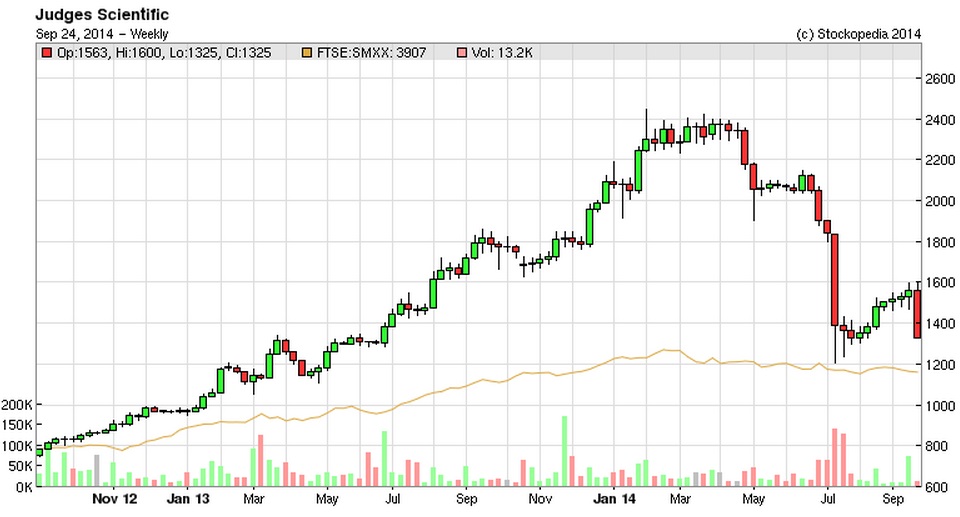
I think it's best to play it safe on valuations, generally and particularly at the moment as fear has once again resurfaced in the last few days. A lot of smaller cap stocks are being hit quite hard at the moment - so people are turning cautious again.
Regenersis (LON:RGS)
Share price: 221p
No. shares: 79.0m
Market Cap: £174.6m
This share was really slammed yesterday, just look at the chart;
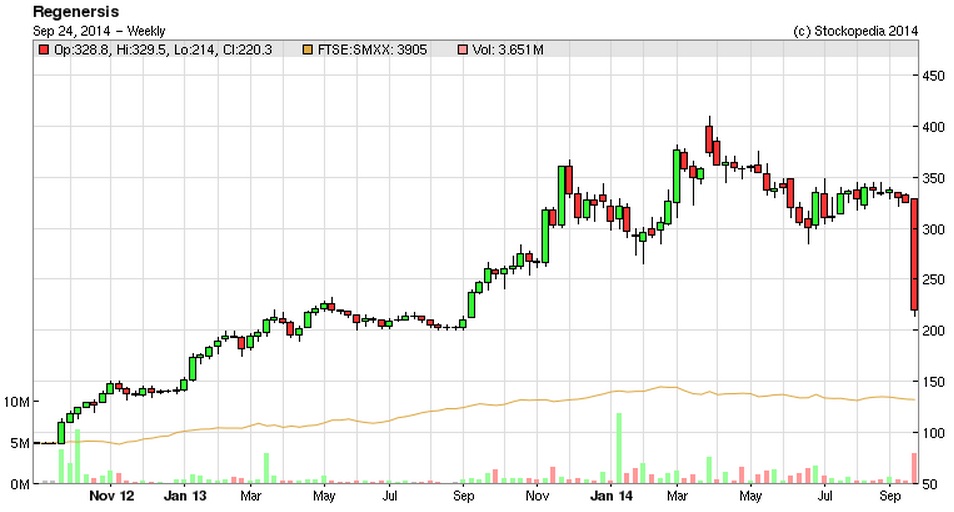
The shares have continued falling again today, down another 20p to 221p at the time of writing.
There is a webinar for investors are 1pm today, the sign up link is here. Should be interesting.
I've had my doubts about this company for a while. It looked fully priced to me, and management seemed overly keen to promote the share price, and the main business activities seem low margin & of questionable quality.
Results for the year ended 30 Jun 2014 were published yesterday, and must admit I'm finding them impenetrable - there are just far too many moving parts! I'd have to spend hours unpicking the figures, to properly understand them.
So I'm trying to resist the temptation to go bottom fishing with these shares. We'll see what management say in their webinar. No doubt the figures will be presented in such a way that they look alright, with various adjustments, etc.
I see that a holding related to the Chairman banked £17.5m from selling 5.8m shares at 300p in Jan 2014 - usually a very bad sign in my view. However, on the positive side the company successfully got away a £100m Placing at 345p in Mar 2014, to fund a big acquisition. So there might be an attraction to buying the shares now at a 36% discount to the Placing price?
I'm on the fence with Regenersis. Markets are a bit wobbly at the moment, so I've taken my foot off the gas, and am not really looking for any new positions unless they're real bargains.
Balance Sheet - despite raising £100m in a Placing this year, RGS only had net tangible assets of £20.1m at 30 Jun 2014.
My opinion - the main problem I have when looking at RGS is that the accounts are just far too complicated. This is because they've been growing by acquisition, operate in multiple countries, it's just impossible to get a grip on how the company is actually performing.
Investor evenings - London
There are two coming up which look potentially interesting;
ED Investor Forum - Thu 25 Sep 2014
Companies presenting: Benchmark Holdings (LON:BMK), Staffline (LON:STAF), Manx Telecom (LON:MANX)
Sign-up link click here. I'll try to get along to this one, but have a mega-busy day tomorrow.
.
Shares Investor Evening - 30 Sep 2014
Companies presenting: Conviviality Retail (LON:CVR), Park (LON:PKG), Rosslyn Data Technologies (LON:RDT)
Sign up link: click here.
SCISYS (LON:SSY)
Share price: 93p
No. shares: 29.0m
Market Cap: £27.0m
This is a niche software group, which I hold in my long term portfolio. It's not the most exciting share around, but it's modestly valued, and is deeply embedded in a number of impressive organisations, such as the European Space Programme, broadcasters, and other mostly public sector bodies.
There is also some impressive private sector work going on, such as designing a bespoke CRM system for a major European car manufacturer. So I like various aspects of this business - that there are recurring or repeat business opportunities, and that the company controlling the IT has a lot of leverage in any organisation. Also they don't have bad debts due to the nature of the client base.
I had lunch with the Directors a little while ago, and like their plans to gradually increase margins.
Interim results today look good to me. The company delivered growth in adjusted profit of 15%, with adj. EPS in H1 up to 4.3p. There tends to be a bit of an H2 bias, so we should be looking at perhaps 9-10p EPS for the full year. As such, the shares are good value at 93p, that a PER of only about 9-10.
Net debt is negligible at £1.8m, and I seem to recall there are some freehold property assets well in excess of that, so I just treat it as debt/cash neutral for valuation purposes.
Dividend - as I mentioned to the Directors, this is my main complaint - that they are so stingy with the dividends! The company should pay out much more than a 1.7% yield, which is over 5 times covered.
Outlook - sounds positive;
"I am pleased to report this favourable set of results for the half year ending 30 June. During the six month period the divisions have delivered solid performances consistent with their business plans. The business restructuring undertaken last year shows tangible outcomes. The Board continues to believe that results for the full year will be in line with its expectations."
My opinion - I think this is a nice steady stock, that I will happily hold for maybe 5+ years. I think it should deliver steady growth, and the occasional upward re-rating. I think the new CEO is focusing on the right things, and hope to see the company grow. The shares are illiquid, so it's not one to try to trade. Just a long term buy & hold in my view.
I see that Stockopedia likes it too, with a StockRank of 89, and it also appears on their "Neglected Firms Screen", so I shall check that out & see what else is on it.
Minds + Machines (LON:MMX) - Interim results look lamentable from this seller of fancy domain names. Just £68k revenue in H1, and a loss of £4.2m before they booked a £7.1m profit on some domain name auctions. Thus the overall operating profit of £2.9m doesn't look at all sustainable.
I think this stock is an accident waiting to happen. Their business model of flogging domain names looks woefully out of date - a throwback to the 1990s. Nobody cares about domain names these days - you just google everything to find websites.
No doubt StopLossSue will turn up shortly to berate me for my lack of in depth research on this one, like she usually does! I just can't see the point in taking a giant leap of faith to think that a successful business can be created out of thin air here. I might have a flutter at a sub-£ 10 m market cap, but this thing is currently valued at £92m! (at 11.2p per share). This type of share is just pure gambling in my view.
Risk:reward looks diabolical, so it's going on my bargepole list.
Signing off for today.
Regards, Paul.
(of the companies mentioned today, Paul has long positions in RGS and SSY, and no short positions).
Disclaimer
This is not financial advice. Our content is intended to be used and must be used for information and education purposes only. Please read our disclaimer and terms and conditions to understand our obligations.

32 comments
Just a quick comment on the whole Tesco/Aldi/Lidl thing
Its interesting to see how Aldi and Lidl seem to have this glowing reputation at the moment. It would be interesting to see how that stands up when their treatment of staff gets exposed and examined more widely.
On the subject fo their stores, the format is changing markedly. Yes, I have been a Lidl shopper for years (my wife is half German). The stores are being revamped and "tarted up" with greater range being introduced they even have fresh baked goods. What Ive also noticed though is that their prices have been rising sharply. With Tesco aggressively targetting the basics (cucumbers etc) at Lidl/Aldi prices as well as their reduction in on line delivery prices and the Fuel Save scheme, many people I know are startign to pop into Tesco more (or use their on line service) often rather than do a separate trip to a second supermarket.
On the subject of land - I wonder how much scope their is to release some of the land around the bigger stores and build flats/affordable housing.
They also have the biggest estate of local stores (having started that trend).
Overall, I think Tesco is looking very interesting at the moment. The only problem for me is the possibility of further accounting related fun to emerge first.
'ello sweetpea. You haven't done your research on MMX! I've had my doubts here as well but actually it's all rather clever. The profit derived from auctions will last another year or so.That gives them breathing space for new domains to ramp up and give them what is in effect an annuity income.
No question at the current MCap it's expensive but you have to think forward on this one. So far they have sold 65k domain names but we don't know the price....£20 upwards, a lot are premium. If we take an average of £30 per each then they have already booked £2m of revenue. Profit margin as yet not known. They are selling domains at the rate of a few hundred a day....like I say, you have to look forwards. You are right that we google but we still need to buy a domain for people to google.
They value their intangibles at £16m, not a lot when you think about possibble revenue/profit already in the bag. I would say it is fairlly obvious they will sell themselves to a bigger player in due course. How much would you pay for an annuity income?
So Dahlink....we don't really know how this will turn out and you are right to worry but you must start doing just a tiny bit of research else people might think you are a lazy git. Not me, I would never think that.
Love you.
S
Thank Sue!
I was wondering where you'd got to.
Was expecting a far more heated reply - this is terribly civilised by our standards lol!
I take your point about recurring income - but it's only recurring if people renew their domains. A few years ago I registered a lot of fancy domain names, e.g. pilot.info more as an impulse buy than anything. I was approached once to sell on the domain, for peanuts, and apart from that, there was no interest in the domain at all. So I just let it lapse - why pour more money down the drain, when you don't need to?
My main point is that Google will find, and rank highly in searches, and busy website with decent content. The domain name is completely irrelevant. You could register bt8+rf3.co.uk as a domain and Google will find you if you put decent content on it & build an audience.
Seriously, domain names just don't matter any more. So to try to build a business around them seems very behind the curve to me.
Regards, Paul.
Domain names matter in so much as we need to have one. We will put them on our biz cards, our biz van, marketing literature, advertising etc. They are not going away and they need some thought.
Yes, correct, it's not year one that counts but year two and three etc.
See you in 6 months when we will have the first clue as to how much they are making per registration.
S
p.s. The extraordinary thing about his biz is that there's no guessing involved. We know the numbers and soon we'll know the profit margin.
http://ntldstats.com/backend/Minds-Machines-Ltd
The make up of Tesco's board is a joke.
Until yesterday - there was one executive and nine non-executives.
And no-one with any retail background.
Applying a few Peter Lynch principles, it was clear to me that Tesco were going to struggle at least 3 years ago.
I was going shopping and could only buy about 80% of what I needed, as they just weren't getting the stock onto the shelves. Just Like Sainsbury's 10 years earlier when they got into trouble.
Tesco also have slow demotivated staff who pass your groceries over the scanner at a snails pace. Lidl staff must work at double the pace, whilst Sainsburys and Asda staff are more motivated as well.
On the positive side, there must be cost reduction opportunities from expanding self scanning and scan as you shop.
Tesco: BlackRock Sold 408.6 Million Shares. So they watch the shares fall 56% losing a billion pounds from the peak 5 years ago. Seems a bit slow off the mark? I would rather take my chances picking my own shares than leave it to people like this to make me money. Though I assume they do?
Getting back on track, Paul do you have any further thoughts on Regenersis (LON:RGS) after the Webinar? Market seemed to like it as the stock recovered most of their loss on the day.
Thanks.
Hi Paul,
Dragging the conversation back to Regenersis I listened to the presentation on the Preliminary results, it seems that they have not renewed some contracts in the UK that were proving to have very low margin in the UK in their depot business and as a result closed two factories, I assume this and the "currency headwinds" (such a great euphemism) resulted in a substantial reduction in turnover for the Western European Depot business.
Going forward they seemed keen to highlight their effort in maintaining // improving margins in the depot business and putting focus on the Advanced Solutions (Digital Care, In-Field Testing and newly acquired Blancco) which they think will go from being ~ 16% margin to over 20% margin.
It seems curious that the share price has been hit so hard. but their were a couple of large sells yesterday
Incidentally Matthew Peacock was Non-Exec Chairman of Fairpoint (£FRP) from 2008 - 2013 (according to his Linkedin page)
Hi sbotting,
I also listened to the webinar from Regenersis (LON:RGS) today, and was sufficiently reassured that I also bought some shares in it. It seems to me, on my fairly limited research, that the share price fall looks overdone, so I've bought more for a bounce, than as a long-term holding.
Regards, Paul.
In my view, the warning signs for Tesco were when they abandoned expanding abroad, as they have reached saturation point in the UK.
People are doing what Paul and others have said, in using Aldi/Lidl, and to some extent Waitrose and localised retailers again, which is also why there seems to be a general disillusionment with shopping at an aircraft hanger, not just the price, the experience.
A fellow poster mentioned that Tesco have a Bank, Insurance, Mobiles, and so on, yet I think tis has been a poor strategy, as people don't want to have everything under one roof, and it may be that the senior management at Tesco were so busy trying to get their fingers into every pie going, that they made the classic mistake that businesses make when in a 'death' spiral, which is to forget, and consequently neglect, their core business, and their core customers.
I have to say, we stopped buying anything fresh from Tesco many, many years ago, as the quality, in our experience, was not up to scratch.
The entire Tesco brand and shopping experience is far too complicated, with too many pointless and meaningless offers, and they need to up their game in order to stop the market share from falling further.
Based on a visit to one of their stores today, this seems a long way off.
The £250M "error" is astonishing, and who knows what else lurks in the murky depths.
A reputation can be destroyed quickly, and maybe Tesco has literally got too big for it's own good
I worked at the head office of a supplier to the major supermarkets some years ago. Tesco were renowned for being the worst of the lot to deal with, treated their suppliers like absolute dirt with the thinnest of margins - clearly not a sustainable relationship in the long run. And you had to get Tesco on the roster to get business in the others.
Finally the accounting irregularities are coming to light - taking longer and longer to pay suppliers whilst recognising 'incentive' payments up front. Personally I think this is the tip of the iceberg and there's more to be uncovered.
As for margins, UK supermarkets plc have been fleecing consumers for years and operating as an effective cartel - US retailers have a much lower margin, so I would expect margins here to move in that direction.
Retailing goes in cycles - out of town used to be better and convenience stores weren't trendy, Morrisons used to be lauded for being focused with no internet sales, no home delivery, no convenience stores - now it's the other way round.
I wouldn't buy shares in Tesco just because they are 'perceived' to be cheap - I think there are more fundamental issues here and wouldn't be surprised to see Tesco broken up and be a completely different company in 5 years time.
Cisk - why do you think UK supermarkets are fleecing consumers? Walmart, for instance - a company I would have thought was on the thinner margin end of the spectrum - earns 8% operating margins in the US.
Sainsbury's have sit just below 4% for a long time, Tesco were lauded for hitting 6, and MRW hover somewhere around 5. I can actually think of few industries where competition has been more effective at driving down prices for the consumer.
In fact, that they're all struggling to earn decent returns on their capital would suggest to me that consumers are doing rather well out of them..!
EV, the mere fact that new incumbents can enter the market and charge less, to me indicates that we're being fleeced, wouldn't you agree?
Groceries generally in this country are very expensive (notwithstanding the fact that we have less home grown produce).
Also I suspect that the cartel aren't particularly focused on minimising managerial overheads, and of course, historically have spent a lot opening large out-of-town superstores and accumulating land banks.
Cisk,
Two things re: the new entrants. Firstly, they run a slightly different operating model - something closer to the pound stores, by way of example. They get cheap stock by the crate and essentially put it out like that. Ranges aren't particularly fixed, but are dependent on cheap availability. This reduces operating costs, at the expense of meaning that at your typical Aldi or Lidl, you probably can't go in and get X Y or Z brand consistently along with another particularly item.
I say this not to say it's better or worse - it's just different.
Secondly, they're both private companies with no public shareholders (hence less disclosure) and clearly longer time-frames. A quote from an article from someone who probably knows a lot more than I do:
"Aldi’s private status has been key to it establishing a presence in numerous markets, regardless of the number of loss-making years this might entail. In Denmark, appropriately enough, it reportedly took 10 years for Aldi to make a profit."
Source: http://www.retail-week.com/comment/comment-aldi-and-lidls-discounting-is-no-new-phenomenon/5062220.article
The accusation of them being slow to move with the times, stodgy and rather self-serving isn't one I can disagree with. I remember studying a module in economics that was more or less about the fact that most competitive markets - where everyone is screwing everyone else in a desperate attempt to get their head above the parapet - are the least innovative, since no-one really has much slack to think on a long-scale timeframe. Maybe that hurt them.
EV, yes they definitely have differing business models.
I think one area where most can improve is customer service - e.g.:
- we have to scan our own items (in many, certainly smaller format stores)
- bags are charged extra e.g. M&S - if they are so worried about the environmental aspect, then free paper bags maybe?
- little or no help packing shopping
- constantly changing the location of items
- products being out of stock (in these days of computerisation and modelling, this should be predictable) etc.
I think when any of the big supermarkets puts themselves in their customers's shoes then the shopping experience would improve - not sure whether profits would though...
And when they end silly practices like at WHSmith in airports - who wants your boarding pass even when the item you are buying is not VAT-free and then charge you for a bag, shopping will be more pleasurable!
I think enough ranting on my behalf ;-)
Cisk,
God knows I've been Tesco's cheerleader for long enough - I'm hardly an impartial and fair observer like I'd hope to be as an investor!
One thing I definitely can say with my consumer hat firmly on - leaving my investor one behind - is that competition can only be a good thing. It's been a 4 player game for a long time, and not much has happened. A kick up the backside does make the sector better for consumers as a whole, whether it's by way of innovation or because the incumbents actually realise they have to start not taking your custom for granted.
Surely the problem in the UK is the cost of property. To make a decent return UK supermarkets have to charge more and screw their suppliers. You go to Spain and marvel at the cheapness of your weekly shop but the store probably cost £1m rather than £20m!
That's why I also do not trust the NAV's of the UK retailers. Who is going to pay the historical prices quoted if in the new era of austerity it will be impossible to make sufficient returns..
Too early for Tesco these things always take a lot longer to sort out and goodness knows what the new CEO and FD will find out. In early 1990's ASDA was not a buy until it had its rescue rights issue.
SBRY probably the best of the bunch given it's market position but even so I just think the sector is one to avoid. We don't know how TESCO will respond but it could be dramatic with repercussions for the whole sector. More pain to come I think.
Tesco - better to wait for all the dirty washing to come out. Sainsburys looks the best segment - aspirational but not double expensive like Waitrose.
As Morrisons, Aldi & Tesco chase Aldi customers and also cut costs the stores will feel cheaper and people will wonder why they are going to ersatz Aldis but still paying more.
I think fundamentally the change in supermarkets will be to reduce the choice to consumers, it will take a few years but it will come.
If you look at what you get in Lidl/Aldi, it is a cut down selection that is highly optimised. They don't offer the selection of a big supermarket or product lines that are less profitable. If you want heinz ketchup, you have 1 choice rather the 11 tescos offers. Do we need 11 sizes of the same ketchup in a tescos? Probably not.
I work in an industry that has been running a race to zero for the last 6-7 years. This initially (2-3 years) resulted in some extreme winners, way more losers (companies going bankrupt) and lower prices for consumers. After another few year there are now less new products for consumers, companies scraping by on very thin margins, the new products that get released are "safe" and many of the early winners are becoming losers.
It does beg the question, is lower prices really a "consumer victory"? Or do we pay in other ways eventually.
Don't want to hijack this thread as its the small cap thread but others have and its a fascinating subject. I bought some SBRY yesterday in their lurch down. What I don't understand is how do Aldi/Lidl sell so cheaply when SBRY/Tesco etc. already claim to have very low margins yet Aldi sell well below them. Are Aldi really buying cheaper than Tesco?
The answer is Aldi/Lidl have lower cost base as cheaper rents (taken out when commercial property cheaper) privately owned so can run with low/no dividend to increase market share and limited range of items so they have less floor space to service.
Is this model sustainable over the long term and can they continue to erode market share? I think its unlikely because shopping is about convenience as well as price/quality. There is a sector of the country who will forsake choice and convinence and go for Aldi/Lidl - no question - but I don't think they can completely usurp the big boys. SBRY and TSCO need to act quickly and as others have said beef up their quality value range while continuing to offer choice and convenience. I don't see why they don't have the means to compete with Aldi/Lidl and think they will fend off this threat eventually.
The corp governance/accountancy issues set TSCO apart and I certainly wouldn't buy them until these are resolved but the quality grocers who have sold off in sympathy look like a buy here.
Also don't underestimate the power of 5p/liter of petrol when you shop at TSCO/SBRY. Selling petrol at cost to keep your customer base is a really big deal. Aldi/Lidl can't do that!
Log
All supermarkets are in a destructive spiral of intense competition with ever decreasing margins and profits. The winners are the customers and the losers are the investors.
But the traditional grocers, Tesco, Sainsbury, Waitrose et al should be aware of another ogre waiting to eat their lunch. Online same-day delivery of all your groceries. Silly and preposterous? Well people said that of books in 1995, until Amazon opened the doors; a few years later of music and look what it has done to the music business, then white goods, electricals, cameras, dvds, TVs etc, and then clothes. At every stage, people said it will never catch on. Since last year, AmazonFresh in the US has started offering same-day and early morning delivery of fresh products in a few states, as a pilot stage. They are fine-tuning the logistics and supply chain.
As an investor, I have stayed away from this sector since the start of the year and will continue to watch the grocery wars from the sidelines.
Regards, Ram
Tesco
I hired a van recently & found I needed a 3.5mm jack lead to connect my phone to the radio so i could listed to an audiobook as I drove down from the Highlands.
The nearby pound shop was out of stock - at £1. Popped into Tesco who were selling the same thing, but branded, for £8 and £12 - I didn't buy this little piece of wire with 2 cheap plugs. And felt strongly that Tesco were taking the piss - but presumably they sell enough to dim shoppers to delude themselves into feeling that they can continue.
But, from all the comments above, they clearly can't.
I often shop in Lidl - they have the basics at good prices - and are (probably deliberately) unpredictable as to what they will be selling this week...... The Tesco value range is dangerous to Tesco - where there is a clear difference in quality it's OK - but where it's essentially the same product (eg Flour), the price differential only alerts shoppers to how much they have been being screwed. And, fairly frequently, they promote their main line (or even their "finest" line) to a cheaper price than the value product - another way to push customers away...
I owned Tesco shares briefly about a year ago, exiting slightly up, I think. I'm not rushing back - I think they have more problems to come - especially a revaluation of their land bank.....
Andy
The supermarket sector is going through unprecedented change, which reminds me of what happened in the passenger transportation market during the late 90's early 00's. The business model of major carriers such as British Airways were disrupted by the smaller 'low cost' airlines such as Ryanair and Easyjet. Competition in the market is good, especially for consumers - but perhaps not for business owners. It is survival of the fittest in business and the established players in the grocery market need to be proactive, adapt and change - this can only be a good thing! Personally I think that Tesco (LON:TSCO) have the edge over the other supermarkets in that they are global (the 3rd biggest supermarket in the world) and they are not just about selling apples and toilet paper. They have banking and insurance, clothing, online videos on demand via blinkbox (how does the valuation compare to Netflix?). I think that the new management will turn the business around - I'm impressed with Dave Lewis and i'm sure he and his team are working around the clock to undertake a root and branches review of the business and establish a solid and viable strategy for the future. I would like to see Tesco communicate this to the shareholders and rebuild trust and most importantly the trust of its customers. Tesco still have huge buying power in the market (this is a competitive advantage). Perhaps Tesco should be broken up into two store formats - high quality Tesco and stack it high and sell it cheap Tesco, depending on the area and the demographics. Each store would need to have it's own identity and in that way Tesco could more efficiently compete both with the likes of Aldi and Lidl at one end of the market and Waitrose and J Sainsbury (LON:SBRY) at the other?
Interesting view Paul, we don't have a local Aldi, but we do have a local lidl, I think its great and some things are great value for money, can you do a full shop there ? well I probably would but the mrs would want more choice from other supermarkets. Yes they're cheap, eggs particularly, but milk is cheaper in my local morrisons, before the morrisons price cuts, muffins (a big item in our house), cost 85p for 4, lidl did 6 for 65p, a huge difference. morrisons dropped 4 to 50p, and lidl changed packet size to 4 and now they're 45p, not really a price difference to get excited about. I think what the supermarkets need to do is to have a budget range that matches lidl/aldi, and then the more choice items cost more. And I don't mean a hideos tesco value blue and white stripes/ people are embarresed to be seen with range. I mean exactly what you get in lidl/aldi. If the higer value items don't sell, it just shows they're stocking too many ranges. Then the management's challange is to fill the store space with other stuff that makes money. Banking, hi tech, post offices, petrol stations, stuff that means I'll go there because I need to post a parcel and parking is easy while I'm there I'll do some shopping. I think the club card is great and it would be a mistake to cut it, but perhaps there are more things they could do with it ? The other challange is the pound shops, and I think this will be addressed with a pound shop range of items either sprinkled around the shop, or in their own section.
All the big supermarkets have cut prices and this makes lfl sales shrink, but Tesco have huge ecomomies of scale, it will be tough for them to realise that they'll have to work on thinner margins in the future, and of course profits will be lower going forward (unless they find other high margin items to sell), but they will all be up against softer comparisons next year, as the price differential shifts and the novelty of lowcost shopping fades a little, I think they'll stablise, certainly tesco and sainsburys, even morrisons, I'm amazed that the co op are still in business so not sure I predict anything for them!
One thing that 's for sure, as you point out, the new management will kitchen sink, dump the price and then award themselves share options against the new price, they say profit warnings come in 3's , we've had 2. It may still be too early to buy, but I agree they will recover to some kind of stable, lower profit level.
K
Hello K
You say Tesco (LON:TSCO) will have 'to work on thinner margins'; but the problem is that if what we are told about the accounting charade is true, these margins are already fag paper thin. WM Morrison Supermarkets (LON:MRW) cut costs by getting rid of an entire layer of management; I know Tesco (LON:TSCO) already have an effective overtime ban. Quite some time ago J Sainsbury (LON:SBRY) did away with the night shifts of shelf stackers, which is why you are always falling over the boxes in the aisles during the day now! All the supermarkets pay the minimum wage, or just above, to most employees. Where night shifts exist it is £7 an hour. It used to be double time! Whatever can be outsorced (such as cleaning and transport) has been. Costs have been slashed in every concievable way (except in the boardroom!). Rather than allowing margins to fall further, the supermarkets need to look into other areas of earning. This has been the motivation behind the banking and mobile phone ventures. They will be having to sprint to stay still soon!
Hi Paul
I realise this is totally off topic in more ways than one, but with your experience and knowledge I, and I suspect many others, would love to know what you think of the current accounting crisis at Tesco (LON:TSCO) and also the ways it has impacted elsewhere, notably J Sainsbury (LON:SBRY) . Any comment would be greatly appreciated and read with enthusiasm. Thank you. B.
[I posted this message on yesterday's report too, but am putting it here again in case it escapes your notice!!]
Hi Beginner,
I dabbled in Tesco (LON:TSCO) shares a few months ago at about 270-290p from memory, but thankfully realised that I'd made a mistake & sold them soon afterwards at around breakeven.
I shop regularly at Aldi, and have to say that I think they are structurally altering the UK supermarket sector in a dramatic way. You can get the same quality products (or better quality in some cases) for on average about 40% less than the other supermarkets at Aldi. It's a complete no-brainer, to at least buy some of your shopping there.
More than that though, shopping at Aldi changes your view of the other supermarkets - you realise that they've been over-charging you for years, and you resent them for it. Whereas when you shop in Aldi, you get a warm glow at the great value there, every day, no gimmicks. Aldi are not trying to cheat you, by moving prices up & down, etc. They're just cheap all the time.
Will Tesco recover? Yes, I think they will. The strategy they need to adopt is obvious - ditch all the gimmicks (like ClubCard & constant promotions), and just pare prices to the bone, and keep them there.
Trouble is, that will probably leave a business that doesn't actually make any money, and maybe even operates at a loss! So I think Tesco will survive, due to its size, Sainburys will probably survive because it's cornered the slightly more upmarket niche, a bit below Waitrose, but I think eventually Morrisons and Co-Op will go bust. There are just too many players in the sector.
I would say to anyone - don't buy shares in Tesco (LON:TSCO) unless & until you've shopped at Aldi. Then you'll get it - Aldi are blowing apart the business models of the existing supermarkets. Some people will still go to Tesco, etc, of course, but financially it will be like the economy being in permanent Recession - losing say 1-2% of their business to Aldi/Lidl every year. Then those huge fixed costs won't be supportable. It's a big mess in the making in my view, so I'm very wary of bottom-fishing with Tesco. At some point there will be a nice bounce, but probably not yet.
Also, the new CEO & CFO are obviously going to kitchen sink everything aren't they? So there will be more bad news. The ethical issue of screwing suppliers for retrospective discounts is also a long-term killer. You can't operate by permanently shafting your supplier base. It just means that you'll all eventually go down the pan together!
Fascinating to see how it will work out. This is low wage Britain - a large proportion of the population now have permanently low wages, with no hope of any real terms increase, probably ever. So people are changing their spending patterns, and squeezing every scrap of value out of their limited incomes.
Regards, Paul.
Thank you Paul. Fascinating, well informed and thoughtful, as ever. Aldi has not reached my part of the country yet, so I have yet to experience it. However I have a brother in Essex who now does all his food shopping there, formerly being a J Sainsbury (LON:SBRY) customer. He is a man who knows the price of everything and the value of nothing, but who has also seen his wages drop 50% in the last three years. He has glowing reports of Aldi with regards to both quality and price.
It is very tempting to see companies like J Sainsbury (LON:SBRY) and Tesco (LON:TSCO) as perpetual and invulnerable, but then I think that over the years I have shopped at Safeway, Caters, Somerfield, Lipton's and Dewhurst!
Thanks again
B
(PS We have a local Lidl, but the quality of the basics, such as bacon and cheese, is very poor. Also, despite their supposedly legendary managerial efficiency, they recently managed to advertise in the local paper for staff with a generic advert IN GERMAN!!!!!! Whoops!!)
Fascinating perspective Paul. Thank you.
My household has totally ditched Tesco et al and we comfortably do all our shopping at Aldi and a brilliant local organic grocery store. Totally agree with your comment Paul about resenting Tesco's over-pricing, and the limited choice at Aldi is a blessing; I get my shopping done in half the time without the stress of too much choice.
I have been watching the share price decline with interest, but this thread is an timely reminder that there's probably plenty more pain to come.
I go back many many years in supplying supermarkets who, in the beginning, did a great job and sold themselves as discounters. They wiped out thousands of smaller retailers and most of the lethargic coops. But they have failed to respond to current household budgets.
If you look at Germany, where Aldi & Lidl are massive, the German housewife has always refused to accept that grocers can be 'premium' - they are 'everyday' and fit for basic needs.
Tesco for years have deluded themselves that they can keep charging high prices to housewives and at the same time keep screwing their suppliers. Now Aldi & Lidl in the UK have caught them out.
Tesco needs to split itself between their current ranges (but not as much as the Extra stores that have failed) and some 'fighting' stores that go head to head with the discounters. Maybe 40% of listings have to be deleted in the premium stores and as much as 80% in the discounters. This will all be very bloody in the short term but can go 'below the line'. Of course Tesco will survive but only a fool will go near it until a firm new strategy is in place and the dust has settled.