Small Cap Value Report (25 Oct 2016) - SHOE, CPR, BMS, OTB, PDG, MPE

Good morning!
In case you missed it,here is my interview yesterday with Exec Chairman, Ric Traynor, of insolvency practitioner Begbies Traynor (LON:BEG) (in which I hold a long position). I thoroughly enjoyed chatting to him, and reliving a few moments from my own experience of working in the sector, 25 years ago.
The next interview planned is with the CEO of Staffline (LON:STAF) (in which I also hold a long position) - so I invite you to submit any questions you'd like me to ask on your behalf using this link.
Shoe Zone (LON:SHOE)
Share price: 169p (up 18.6% today)
No. shares: 50.0m
Market cap: £84.5m
Trading update - this covers the 52 weeks to 1 Oct 2016.
The key paragraph is more positive than I was expecting, saying;
The Board expects pre-tax profit for the period to be broadly in line with expectations and marginally ahead of the prior year.
The business continues to have strong cash conversion and closed the year with an approximate net cash balance of £15.0m (2015: £14.2m).
Valuation - broker consensus EPS forecast is 17.5p, so assuming they achieve about 17.2p (based on "broadly in line" actually meaning slightly below), then after today's big rise in share price, the PER is 9.8.
Given that nearly 18% of the market cap is the company's own net cash balance, then the ex-cash PER is about 8.1 by my calculations.
Dividends - the yield is generous, with a payout of 10.5p forecast for this year, yielding 6.2%
Outlook - the company has not really said anything about the future in today's update, and has therefore completely ignored the elephant in the room - the devaluation of sterling. Since ShoeZone imports product from China, cheap plastic shoes, then its future deliveries are bound to be more expensive.
Competitors will also have to put up prices, to protect margins, and we simply don't know yet how consumers are going to respond. Clearly higher prices will reduce volumes sold, but we don't yet know by how much.
I think it was a big omission for the company not to say anything about this issue at all in today's update.
My opinion - this is the calm before the storm for retailers. Hence I reckon today's pop in the share price may prove short-lived perhaps?
I'm avoiding apparently cheap retailers for now, because when business turns down next year, on more expensive product feeding through, and overheads rising, who knows what profits will be? Today's surge in the share price looks to me more like a selling opportunity, than a buying opportunity.
Carpetright (LON:CPR)
Share price: 196p (unchanged today)
No. shares: 67.9m
Market cap: £133.1m
Trading update - I read this update before 8am this morning, and was left feeling confused - it didn't seem to make sense to me - with LFL sales down, but then saying profit expectations were unchanged. Let's have another crack at working it out!
Today's update covers the 25 weeks ended 22 October 2016. The company has a 30 April year end, so this is the bulk of H1 for 2016/17.
Key points;
The Group's full year profit expectations are unchanged. (note 1)
I've been nagging for companies to provide a footnote to quantify what expectations are, and am delighted to see that this company has indeed provided such a footnote, as follows;
1. Consensus for the year ending 29 April 2017 is for Group underlying profit before tax to be £18.5m, with a range from £15.2m to £20.5m.
Although to get top marks here, the company could have included the EPS equivalents too! Let's assume that the 20.7p EPS forecast shown on Stockopedia is consistent with the company's underlying PBT figures above. It looks about right to me.
Therefore the current year PER is about 9.5. That's the cheapest I can remember for a long time. If you cast your minds back, Carpetright commanded a bonkers premium rating for many years - it was valued on a PER of about 40 for a long time, for no apparent reason.
Anyway, the price has finally come back down to earth - maybe due to more competitive pressure from other sector participants? In particular, the son of Carpetright's founder, has set up a new carpet retailer called Tapi, and is said to have taken some Carpetright management with him.
Doing a bit of googling, Tapi seems to already have 23 UK sites, with a target reportedly of 200. DFS founder Lord Kirkham is also an investor in Tapi - so it appears to be a serious competitor, out to eat Carpetright's lunch.
UK LFL sales have worsened from the last time reported, and are negative 2.9% in the most recent 25 weeks.
UK gross margins are under pressure;
Full year guidance of a decline in gross profit percentage revised to between 150 and 200 basis points, a combination of increased sourcing costs resulting from the devaluation of sterling, competitive market conditions and a mix impact.
I imagine margin pressure is likely to increase, as imported products rise in price.
Store revamps are underway, and seem to be working;
"The initial trading performance of these newly refurbished stores has been encouraging - they are outperforming comparable stores in the estate, giving us confidence that where we invest we are able to drive a material improvement in performance.
In addition, the introduction of new hard flooring sections in 26 stores, has contributed to a 15% increase in laminate/luxury vinyl tile sales. We continue to make progress with our plans to reduce property costs.
So there are some self-help initiatives underway.
European trading - this is only a small part of the overall business, but is benefiting from the appreciation of the Euro against sterling - hence results translate into more sterling. Although I note that it was barely above breakeven in H1 last year.
"Trading in the Rest of Europe continues to improve and is a little ahead of our expectations.
Outlook for H2 sounds reasonable;
"As we enter the second half, we are looking forward to implementing the next phase of our refurbishment and rebranding programme as we continue our drive to update and revitalise the business.
With the benefit of recent UK investment expected to flow through as the second half progresses, further significant refurbishment work already underway and a continued improvement in the Rest of Europe, our guidance for the year as a whole remains unchanged."
My opinion - I'm not convinced. To my mind, there's possibly an increased risk of an H2 profit warning. It's the increased cost of imported carpets that worries me, together with the founding family of Carpetright having set up in direct competition with it. They will know all its strengths & weaknesses, and how to undermine it - not a good scenario at all, in my view.
All too often you see old businesses gradually killed off by more dynamic, smaller competitors, especially when it's the most ambitious people who have left the old business to directly compete with it.
I don't find that an appealing situation to get embroiled in at all. I'd rather buy shares in the up & coming competitor (if it lists), than Carpetright.
Consumer spending will also be under pressure next year, as disposable incomes are squeezed, so it's difficult to find much to be positive about for Carpetright. It looks to be up against multiple headwinds, and the share price has reflected that.
My hunch is that this is likely to be a business that will struggle just to stand still in future.
Braemar Shipping Services (LON:BMS)
Share price: 323p (flat today)
No. shares: 30.2m
Market cap: £97.5m
Interim results - covering the 6 months to 31 Aug 2016.
The company describes itself like this -
Braemar Shipping Services plc (LSE: BMS), a leading international provider of broking, consultancy, technical and other services to the shipping, marine, energy, offshore and insurance industries.
Results out today are poor, with underlying operating profit having crashed from £7.1m in H1 last year, to just £3.2m this time, and even lower to £1.4m once one-off restructuring costs of £1.8m are taken into account.
Poor results were expected though, as the company issued a profit warning in the summer, which I reported on here on 31 Aug 2016. That was a strange profit warning, as there seemed a muted market reaction on that day, with only an 8.9% share price fall to 370p. The share price then continued sliding down to its present 323p. There's been no change today. Has it reached equilibrium, or will we see another delayed response to poor results? I don't know.
Dividends - this is a very high yielding stock, and the 9p interim divi has been maintained but is not covered by earnings, so future divis might be at risk.
Outlook comments confirm full year expectations;
"The Board is confident in our long term strategy to grow the business through both organic and acquisitive business development. The Board expects the underlying financial performance, excluding restructuring costs of the Group, for the full year to be in line with current market expectations following the actions we are taking to make structural changes within the Group."
Cost-cutting has already achieved £3m of annualised savings.
Market expectations seems to be for 22.1p EPS this year, rising to 27.8p next year.
Edison has today put out slightly revised (down) forecasts, showing 21.4p EPS this year, but rising to 29.4p next year, so in the same ballpark as the consensus figures on Stockopedia.
Valuation - using the Edison forecasts, this year's PER is 15.1, falling to 11.0 for next year.That doesn't strike me as a particular bargain. The shipping sector seems to be very depressed at the moment - who's to say it won't just stay the same, or get worse? It's all a bit difficult to predict.
Mind you, checking on Bloomberg's website, the Baltic Dry Index has recovered strongly from the extreme lows earlier this year;
The narrative in today's results indicates that the improvement in Baltic Dry Index should help improve the company's performance in future.
Forex - hedging arrangements have blunted what should eventually be a benefit from the weaker sterling exchange rate against the US dollar;
A large proportion of the Group's income is US$ denominated and the average rate of exchange for conversion of US$ income in the six months to 31 August 2016 was $1.39/£ (interim 2015/16: $1.535/£). The rate of translation as at 31 August 2016 was $1.31/£ (31 August 2015: $1.54/£).
The Group maintained its treasury policy during the period so the full positive impact of the movement of the dollar has not yet been reflected in the results. At 31 August 2016 the Group held forward currency contracts to sell US$30 million at an average rate of $1.43/£ (interim 2015/16: $17 million at an average rate of $1.52/£).
So this gives encouragement that, after a time lag, profits should rise from the favourable currency movements.
Balance sheet - mostly OK, although note that there is a fairly small pension deficit.
Also debtors seems very high, which would need investigating.
My opinion - there seem sound reasons to expect this company's performance to improve in H2 and beyond. Overall though, not really knowing much about the sector in which it operates, I'm not keen to get involved unless the valuation looks extremely cheap, which it doesn't.
Moreover, I think the divis look unsustainably high, and that it might be better if the divis were rebased to a level of say half the current level. That's a clear risk here, in my view.
Let's round off with a couple of quickies;
Pendragon (LON:PDG)
Q3 update (3 months to 30 Sep 2016) from this car dealership chain.
This sounds surprisingly strong;
"Despite significant commentary on the potential negative impact of the EU Referendum, we have not experienced any noticeable change in our customers' behaviour and we have continued to grow our business.
Like for like Group sales grew 5.7% in Q3 versus a strong comparator and Group underlying profit increased by 6.3%.
We are particularly pleased with our used revenue growth which accelerated to 8.3% on a like for like basis.
The performance of the Group is in line with expectations for the full year."
That's really very good, in my opinion.
Valuation numbers look very cheap;
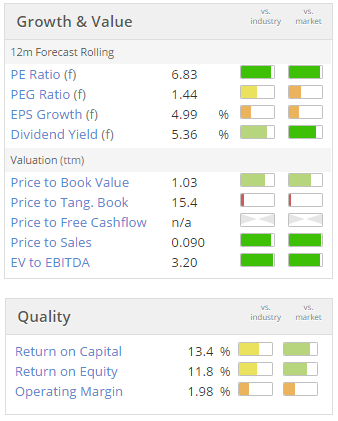
My opinion - I'm sorely tempted to buy some of these. However, the market is clearly worried about the negative impact of (broken record time!) sterling devaluation.
European car makers have already begun edging up their UK prices, and that is set to continue. However, car dealers make most of their profits from aftersales & secondhand sales, which both seem to be buoyant still & likely to remain so. After all, if new cars get dearer, then surely more people are likely to opt for a nearly new car?
I've been wrong about this sector so far, as it's continued its downward slide. However, the figures are looking really very appealing now. I don't believe for one moment that trade tariffs are likely between the UK & EU markets. They're too interdependent.
M P Evans (LON:MPE) - I don't recall ever looking at this company before. Pity, as its shares shot up 43% today to 610p, on an announcement that it had received, and rejected, a 640p takeover bid from a Malaysian company.
I see that it reports in US dollars, but the share price is in sterling. Perhaps that is one reason why it has attracted a bid? I think we'll see a lot more overseas bids for UK companies.
All done for today. See you in the morning!
Regards, Paul.
Disclaimer
This is not financial advice. Our content is intended to be used and must be used for information and education purposes only. Please read our disclaimer and terms and conditions to understand our obligations.

20 comments
Hi Paul,
Could you please upload your comments on On The Beach (LON:OTB). Very interested to read your thoughts.
Regards
G.Guram
Thanks for the Begbies Traynor (LON:BEG) interview. I'm a holder and it just confirms my positive long-term view, though no short term fireworks are likely.
I'm struck by your idea that far east sourced products are likely to rise 10-12 %. For most retailers product costs are only part of the cost mix and not the major part either. And the other costs will be in sterling. This is specially true for the high street, though less so for Internet. There will also be pressure on suppliers to reduce their margins. Next may be better than most, but 5% or so seems a reasonable guess to me for the moment.
Of course, if volume falls, then prices might have to rise more but that is not a currency effect and increases the opportunity for lower cost retailers.
Hedging only defers the problem, true, the challange is to work out what the exchange rate might be in 12 months or 18 months time, will we be over the worst ? will we have a deal with the eu ?
I doubt it personally, I think we'll only just be past Hollande and Merkle having had elections and perhaps going, and getting to the meat of the discussion. However the clouds might have passed somewhat if new leaders come in who are more inclined to do a deal, and less inclined to try to extract a pound of flesh.
all the above is of course a guess,
K
Looking at Shoe Zone (LON:SHOE), I have to say I am kicking myself from not investigating further. I know we've seen so many IPO's implode after listing, maybe investors have a mental block in looking closer at them.
I read the annual report, it suggests that Shoezone have FX hedging in place, so that might suggest the lack of explanation in this update.
Purchases are made on a central basis and the risk is mitigated through using forward foreign currency exchange contracts.
Hi tabhair,
Shoe Zone (LON:SHOE) may well have hedging arrangements in place for this year, as most retailers do.
However, hedging only defers the problem. When the hedges expire, then cost prices will rise significantly, and that will force retailers to raise shop prices considerably. Consumers are bound to resist price rises, which will result in a fall in volumes sold. We just don't yet know how the numbers will combine, in terms of overall turnover. Fascinating times ahead!
Regards, Paul.
Definition of a Giffen good and Veblen goods: http://www.investopedia.com/terms/g/giffen-good.asp
Takes me back to my Business Studies degree and an Economics module I studied, those were the days.
RE: G4M, I believe DYOR guys? Not sure its Paul's job to give daily running commentary on any share! And personally a 10% decline was a buying opportunity in my view...
Also an update on movements with Gear4music would be appreciated!!!
Gear4music chairman sold a portion of his shares yesterday. Possible trigger for the circa 10% decline?
Hi Paul,
jraitt has a point and you might be suffering from some unconscious bias. :) They are cheap and cheerful shoes which are the lower end and will rise in price I imagine... Shoe is managed by guys who are very vested in the success of the business and like paying big dividends. (I hold and will continue to do so due to fantastic div payments)
Hi Paul,
You say "Since ShoeZone imports product from China, cheap plastic shoes, then its future deliveries are bound to be more expensive." yet yesterday in your piece you said that the CEO of G4M had said that the yuan had also devalued which took away much of the diference. Also by ordering more he could further save - although I guess musical instruments don't go out of fashion (do shoes?)
Checking yesterday's article, the fall in the yuan made up only c1/3 of the difference. The pass through on shipping/distribution costs of the fall against the dollar will however be 100% with no mitigation.
Also of relevance is that ShoeZone's customers will in general have lower incomes. Indexation of in work benefits to mitigate inflation increases was cancelled in the last budget, which will squeeze them even more.
Hi dmjram,
I was in the midst of penning a similar response to yours about the relative extent of the yuan appreciation against the £ - you saved me the effort.
On the impact of currency fluctuations on UK prices and Shoe Zone (LON:SHOE) sales, I wonder if you are familiar with the economic concept of a "Giffen good"? The suggestion is that for the poor (who need shoes for themselves and their children as a basic necessity), as prices increase the demand for the poorer quality substitute (plastic vs leather shoes) actually goes up as they are priced out of buying the preferred but more expensive alternative. If a £ devaluation does drive up the price of imports in the high street coupled with a possible economic slowdown/rising unemployment there may perversely be an improvement in the sales figures (if not necessarily the margins) for discount retailers such as Shoe Zone (LON:SHOE) and the likes of £SPD
Gus.
I would agree this is a likely outcome. Look at the rise of Lidl and Aldi from the depths of the 2008 economic crash.
This would actually be an example of an inferior good, not a Giffen good
What's an example of a Giffen good, then?
Perhaps - maybe - some luxury items fall into this category.
EDIT: actually no, this also isn't an example... as other posters correctly point out, these are perhaps Veblen goods. I'm not sure there are any that actually hold up in real life..
Hi EV.
Probably a fair cop.
If we were back in an economics tutorial I'd argue the toss with you. Strictly speaking (I think, it was a long time ago!), I recall that a Giffen Good is a subset of the more widely defined Inferior Good. Both have the perverse characteristic of demand increasing where price increases. In addition, a Giffen Good is one where a consumer buys more of a good where their income falls as well as the price going up. (As dmjram says the textbook example was the potato in the Irish famine in the 1840's. As unemployment went up incomes fell and in addition the potato blight made the cost of potatoes go up so the poor had to buy more potatoes and less (preferable) corn just to survive).
In the context of Shoe Zone (LON:SHOE) it is possible that £ devaluation would increase import prices which coupled with a recession/higher employment and concomitant decrease in earnings could arguably satisfy the two conditions for a Giffen Good, I.e higher prices and lower incomes.
Anyhow, as our good friend the Naked a Trader might say, Deal or No Deal is on the telly, so enough of this history and economics banter and back to the serious stuff!
Best,
Gus.
Hi Gus,
Yes - studied the old Giffen good back in the mists of time. The classic example was the potato in the Irish famine.
Empirically there weren't (at least not a good few years ago!) any other examples. It takes a very strong set of circumstances for the demand curve for an inferior product to slope upwards, especially for goods which are consumed over a prolonged period.
In contrast Veblen goods which are the corresponding example at very high levels of income/prices exhibit quite good evidence of the upward sloping demand. Maybe Ferrari and Shelby dealers will become a good stock bet as the fall in the pound bites!
Mike
Hi jraitt,
Sorry if I confused you, and beatingmrindex with my recent comments on exchange rates.
The point I was making yesterday was this;
Sterling has devalued by 25% against the US dollar in the last year. Since goods imported from China & other Asian countries are usually billed in US dollars, then we might have expected prices to rise by 25% in UK shops for many goods next year.
However, the Chinese currency has devalued somewhat against the US dollar, therefore the sterling impact is more likely to be around 17%, not 25%. Furthermore, retailers are finding other ways to mitigate the price increases further.
So whilst these factors mitigate the problem somewhat, UK shop prices will still have to rise and by a considerable amount. I seem to recall Next said by around 5%, but I reckon that's likely to be one of the smallest levels of price increase. Think nearer 10-12% for most products made in the Far East, is my estimate.
This is the issue that ShoeZone will be grappling with, and indeed everyone who imports stuff from the Far East. So this is a widespread problem affecting all retailers, not just ShoeZone
There's no bias at all in what I wrote, nor any contradiction, I possibly just didn't explain things clearly enough (or people didn't read what I said carefully enough!) ;-)
This currency issue is likely to affect all non-food retailers, which is why I'm generally avoiding the sector.
Where G4M interests me, is that it's hoovering up market share at such a phenomenal rate (especially in sales to Europe, which of course won't have any problem over currency) that any slowdown from currency is only likely to trim their growth a little. Whereas for old style, UK based retailers with bricks & mortar outlets, the impact is likely to be far more severe in my view.
If retailers are able to pass on price increases in full, then their gross margin will be maintained, but sales are likely to drop by an unknown amount. Combine that with higher costs, from Living Wage, apprenticeship levy, compulsory pension contributions, business rates increases, etc, and the sterling impact is just the latest in a series of nasty headwinds for almost all retailers, not just ShoeZone.
I've commented in the same way about the impact of sterling depreciation on lots of retailers lately, so it's certainly not a case of me singling out ShoeZone in particular. I just don't think you can rely on broker forecasts generally for the sector, as in my view they're under-estimating the impact of price rises caused by weaker sterling, but time will tell.
So these PERs of 8-10 for retailers might look superficially cheap now, but I bet you they won't look so cheap this time next year, once the full impact of sterling's devaluation has fed through, and earnings have fallen, thus pushing up the PER. Caveat emptor with the whole sector, not just ShoeZone!
Regards, Paul.