Small Cap Value Report (28 Oct 2015) - GBO, UTW, POS

Good morning!
Globo (LON:GBO)
Shares suspended.
(I hold a short position in this share)
Update - I wouldn't normally comment on a share where I hold a short position, but seeing as this one is suspended, probably for some time to come, then it's an exception.
Today's update doesn't really say a lot, other than;
- The company has reported the situation to the police in the UK, Greece, and Cyprus
- The FCA is investigating the situation
- Shares remain suspended
What everyone really wants to know, is whether there's any cash left? It should be possible to ascertain that within 24 hours, just by contacting the various banks where deposits and loans were held. So I don't understand the delay on this point.
Personally I'd be surprised if there is much cash remaining, if any, but time will tell.
My archive on Globo - I thought it would be interesting to recap on the history of this situation, and see what warning signs were known, and when. Therefore, I collated all my own posts on Globo here on Stockopedia over the last 3 years into one, easy-to-read 29-page document, which you can read in Google Docs here, should you wish.
What is striking, is how obvious (to me anyway) the warning signs were. Bear in mind also, that I'm not given to false negatives - i.e. historically when I've warned about dodgy accounts, I've been right in pretty much every case.
Another interesting aspect, is how there was an intense bear raid in Oct 2013, which ultimately came to nothing, and the company managed to continue for another 2 years before the fraud was finally exposed by QCM using evidence obtained from scrutinising Globo's supposed distributors, and interviewing former employees.
I think it's very important that private investors learn the lessons from this case. It's depressing to see how the same people on bulletin boards seem to turn up at all the dodgy companies, stridently shouting down any criticism of a company, and then losing their shirts when it all goes wrong.
At some point, when time permits, I'm going to create a new scoring system to identify companies which are highly likely to be frauds or semi-frauds - i.e. to formalise what I already do in my head to spot these situations early.
Utilitywise (LON:UTW)
Share price: 180.5p
No. shares: 76.6m
Market cap: £138.3m
(at the time of writing, I hold a long position in this share)
Final results y/e 31 Jul 2015 - these figures were announced yesterday, but due to travelling I didn't have time to review them, so have circled back today. There was an interesting discussion about the numbers in the comments section below yesterday's article, which is worth reading, with readers making some excellent points - in particular flagging the terrible cashflow for the year just reported.
The financial highlights look good (as you would expect), with revenue up 41%, adjusted profit before tax up a smaller percentage (so a worsening profit margin) at £16.7m (up 25%). Diluted EPS is up 28% at 17.9p - so a PER of about 10, which looks great value on the face of it, for a company that's growing strongly.
Questionable accounting - however, as I've covered numerous times before here, Utilitywise uses questionable accounting - the main issue being revenue recognition, where it books revenue (and hence profit) often well in advance of the cash being received.
The company mainly generates revenue from commissions paid out by the big utility companies. Companies like Utilitywise are effectively outsourced sales operations for the utility companies. Why is it outsourced like this? Presumably to create a third party intermediary who (supposedly) achieves the most competitive deal for its clients. Whether that actually happens is open to discussion, given that Utilitywise has a gigantic conflict of interest - in that it is financially incentivised to chase the highest commission, which may or may not be the best deal for the customer!
Normally I would avoid a stock like this, with dubious accounting, like the plague. So why did I pick up some shares in it? Well because this is an unusual situation, where yes the revenue recognition is aggressive, however there's not really any (or much) doubt that the vast bulk of the debtors/accrued income will actually turn into cash. There's just a delay on some of it.
That's very different from a Quindell (LON:QPP) or Globo (LON:GBO) type situation, where their dubious accounting centred around booking (partially) fictitious sales, where there was no chance of collecting in any cash. With QPP they booked NIHL claims revenue which was unlikely to ever be received, in order to grossly overstate profits. That has been admitted & corrected now. With Globo, they appear to have booked some completely fictitious sales through undisclosed connected third parties.
Cashflow - taking a look at the cashflow statement for Utilitywise, it looks absolutely horrendous;
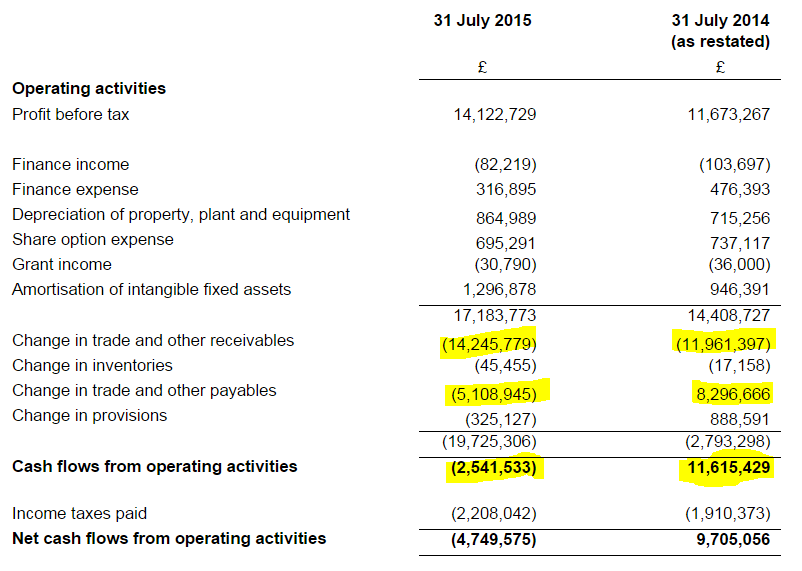
I've highlighted some of the key figures. Look how debtors increased enormously both years, by about the same amount as the company's entire profit. Normally I would run a mile from a situation like this, as it looks like profits are being deliberately inflated.
However, this is a largely unique situation. If you think it through a bit more, the receivables are contracted amounts, with major utility companies. So there's no question about it - Utilitywise will get all or substantially all of that cash, they just have to wait to be paid at the end of the contracts for some of it.
Change in payment terms - this was a separate RNS yesterday, and is probably more important than the results for me, because it shows that the company is addressing the issue of poor cash conversion, by renegotiating payment terms.
At a stroke they have recovered 13% of all debtors, in a single deal with one key supplier. If this is replicated amongst the other suppliers, then its 2015/16 accounts should show a dramatic improvement in cashflow.
The announcement says;
Utilitywise plc (AIM:UTW), the leading independent utility cost management consultancy, is pleased to announce an important and immediate change to its existing payment terms with a key energy supplier.
Following ongoing discussions, the supplier has agreed to amend its terms such that any extension secured on a contract that has not expired receives the same payment terms as a new customer would, in this case 80% on the extension signing and 20%, subject to the normal reconciliation process at the end of that contract. We have also agreed that this change of terms will apply to historic accrued revenue balances and hence we have as of today received £3.6 million in cash from the supplier. This amount represents approximately 13% of the accrued revenue balance due within one year at 31 July and approximately 13% of the accrued revenue balance due after one year at the 31 July.
As a result of our strengthening supplier relationships and the prevailing energy price environment, the length of the contracts we are securing for our customers has increased. Whilst the Group remains focused on acquiring new customers to drive growth, we have also prioritized securing existing customers on longer contracts with their incumbent energy suppliers, either as renewals or extensions to the initial contract. Historically our supplier payment term for this contract revenue was delayed until the extended period had commenced and was booked to accrued revenue on the balance sheet.
Discussions are ongoing with all of our key energy suppliers to amend payment terms to reflect the changing way that we are doing business, with the aim of agreeing revised terms resulting in the receipt of payment for renewals and contract extensions in a similar way to the revised terms detailed above
My opinion - initially I too was horrified by the cashflow statement. However, the explanation given by the company, and more importantly the announcement above whereby they have just collected in 13% of all debtors in one go, shows to me that this issue is being addressed.
I don't like their aggressive accounting treatment, but I'm happy that the debtor & accrued income figures on the balance sheet are probably pretty watertight. Therefore in my view the correct way to view this share is that it should be on a relatively low PER to compensate for the aggressive accounting, but it's not a bargepole stock.
Divdends are often the litmus test. Companies which are fiddling the books don't usually pay generous, and growing divis over a number of years. This company does.
Neil Woodford has gone over the figures with a fine toothcomb, as I reported here, and he's been a strong public supporter of this share. So if I have got it wrong, then am at least in good company. His funds own 26% of the company, so a serious vote of confidence there.
I believe that the accounting issues are well known, have been discussed here and elsewhere for several years, and are hence already in the price. To my mind this stock is more likely to re-rate upwards somewhat, and personally I've pencilled in a target price of about 50% above where we are today, so approximately 270p. In practice, I would probably sell at 250p, as it's not the type of stock that I would feel comfortable holding long-term.
So to summarise, I don't like it, but think it's cheap & likely to rise in price, which is why I own a few. The 4% divi yield whilst we wait isn't bad either.
Plexus Holdings (LON:POS)
Share price: 162p (up 4.8% today)
No. shares: 89.4m
Market cap: £144.8m
(at the time of writing, I hold a long position in this share)
Results y/e 30 Jun 2015 - this is a very interesting company, which describes itself as, "...owner of the proprietary POS-GRIP® method of wellhead engineering" - so if I understand it correctly, this product is sold or rented to oil producers, for use on oil rigs, and it seems to provide superior sealing of the wellhead, by using hydraulic clamps which squeeze the outer casing against the inner tube.
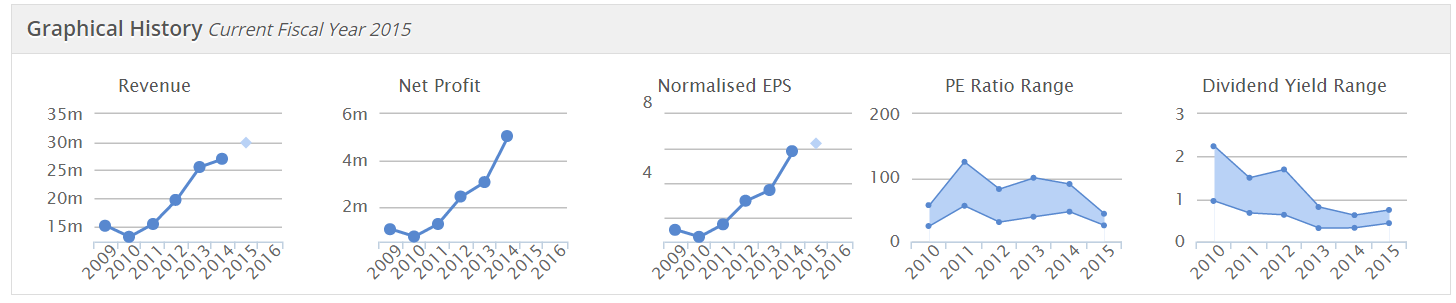
I've been very impressed with the historic performance of the company, as you can see from the usual Stockopedia graphics below. Note also that the PER used to be stratospheric, but has come down considerably - hardly surprising, given the problems in the oil sector at the moment;
There's no less than 32 pages of narrative with today's results, so I'm really struggling to motivate myself to read all of that. So just a quick review of the main numbers, and the outlook here.
Revenue up 5.6% to £28.5m
Operating profit down 4.9% to £5.0m (note the excellent profit margin of 17.6% - so this is a business with clear pricing power (its products are patented)
Profit before tax is up 10.5% to £5.9m, although that seems to have have benefited from a £352k gain on disposal, and a big jump in the "finance income" line (I have highlighted these items), plus a more favourable tax charge vs last year, see below;

Therefore it looks to me as if the improvement in basic EPS from 5.44p to 6.40p is mainly driven by the above factors, rather than by a real improvement in performance.
That said, remember this is an oil services company, and there is complete carnage in the sector, so to be reporting figures up on last year at all, is remarkable. If Plexus can trade like this when the sector is in chaos, then it strikes me they have something special.
Balance sheet - looks decent to me.
NAV is £38.5m, which drops to £24.5m once intangibles are written off, so still a sound position at the NTAV level.
The balance sheet was strengthened further post year-end with the issue of 4,468,537 new shares at 180p to Jereh International (A Chinese oil services group), as part of a licence agreement. Details here.
Overall, it's fine, nothing to worry about here.
Note however that profits are heavily assisted by the company capitalising £3.5m of development costs into intangible assets, which is markedly higher than the £454k amortisation charge - see note 7 to today's accounts.
Outlook - an extremely detailed outlook statement (probably the longest I've ever read!) can be edited down to these two key parts;
Notwithstanding our year on year growth and indeed record FY 2015 financial results, FY 2016 trading conditions are more challenging given the significant reduction in the oil price and related on-going economic pressures which surround the oil and gas industry and the support services underpinning it, and this cannot be ignored. This is especially the case in the UK North Sea which traditionally has been an important market for us...
For the reasons outlined in my statement, despite widely reported on-going challenges for the industry I am confident of Plexus' long term future prospects and our ability to deliver significant shareholder value from our patented POS-GRIP technology.
My opinion - how on earth do you value it? PER isn't particularly helpful, given that the company is serving a sector which is enduring a very low oil price - which must have some negative impact on Plexus.
Longer term, I think its products sound very exciting, and this could be a super-stock in the making, in my view. Once the oil price is stronger and exploration activity is increasing again, then who knows how rapidly revenue and earnings could rise here?
Overall, I think it's entirely possible that this share could drop more, maybe considerable more, who knows? But personally I'm happy to hold it for the long-term, as it's impossible to time the exact low, and I'm fairly convinced this company is a big potential winner in the long run. It seems to have something special in terms of technology, and that is evidence by existing growth & profits, and interesting collaboration deals focussed on China, and elsewhere.
Speculative to a certain extent, but a very interesting share for the long term, in my view.
No more time left today, so I have to leave it there.
Regards, Paul.
(of the companies mentioned today, Paul has long positions in UTW & POS, and a short position in GBO. A fund management company with which Paul is associated may also hold positions in companies mentioned.
NB. These reports are personal opinions only, and never recommendations or advice)
Disclaimer
This is not financial advice. Our content is intended to be used and must be used for information and education purposes only. Please read our disclaimer and terms and conditions to understand our obligations.

35 comments
Interesting to note that ahead of today's AGM Utilitywise (LON:UTW) has put out a separate RNS stating that another major supplier has agreed to amend their contract terms in a manner similar to that discussed by Paul above and that this is one of several similar ongoing discussions. It is not clear from the RNS whether this gives rise to the immediate acceleration of an outstanding A/c receivable.
Also, I have heard through the grapevine that the sharp fall in the Utilitywise share price last week may have been the result of a recently maturing SAYE share scheme within the company that provided a broad spread of windfall shares to a wide group of employees that may have elected to sell their small holdings to raise cash for Christmas etc.. I can't independently verify this but it sounds plausible. It looks as though most of the fall has been clawed back although we are still well down from the time of Paul's commentary in October.
Gus.
With regards to Globo....
Just in case any of you reading this have been affected by the Globo announcements last week
I think it is critical that those of you invested in Globo get a really strong and large group of shareholders together for a campaign and have it backed and endorsed by a shareholder organisation and ShareSoc are trying to help in this area so this is a good starting point..
http://www.sharesoc.org/globo.html
Personally I do not like to see resignations by directors and nomads just at the point when all the hard work needs to be done to help investors and shareholders to understand and hopefully recover something from the situation.
Why have the non executive director and company secretary resigned ?
What are the AIM team at the LSE planning to do for investors as it is very unlikely a replacement nomad will be found and delisting looks inevitable ?
Is an EGM needed to add shareholder action/campaign representation to the board of Globo ?
What will the larger institutional investors do in this situation ?
ShareSoc will certainly try to get as many answers as possible through official sources so do add your name and join the campaign.
http://www.sharesoc.org/globo.html
Hello I am a beginner in this but have simple question on UTW . My apologies if its too basic -I am just trying to understand and not trying to suggest anything else.. Someone more knowledgeable in accounting can help/comment.--
In Cash flow statement UTW have claimed that there is a negative impact on cash flow of 5108945 ( Due to trade payables) . But if you take difference in Trade Payables in balance sheet ( Year 2015/Year 2014) effect is only 1 Million. ( both current/Non current)
These numbers match in year 2013 and 2014 but not 2014 and 2015.
If my observation is correct then where is this 4M of difference in cash to be adjusted -In profit?
Hi,
Yes, as a post-script, I listened to the more bearish views here, slept on it, and decided that I couldn't make up my mind on Utilitywise (LON:UTW) - I can see merit in the bull case, but I can also see merit in the bear case. Hence my position is now neutral on the stock, and accordingly I don't want to hold shares where I feel neutral, so closed my long position in the share last week at 195p.
For the moment I'll keep it on the watchlist, and think about it some more. My general view is, when in doubt, sell out, which is what I've done.
Please can I reinforce the fact that I NEVER give recommendations here, so really what I do with mine & our clients' money, is neither here nor there. But it's very unusual for me to change my mind on a stock so quickly, and so soon after writing an article saying that I was bullish. So in this particular case, am happy to flag up that I've changed my mind (as previously posted on Twitter).
Regards, Paul.
FWIW - Citywire reported that Legal & General were writing off their £2m stake on which they said: " he did not expect to receive back any of his £2 million stake, fearing the company would be placed into liquidation, with potential lawsuits possibly eating up any remaining cash.
Spotted this today:
http://www.thisismoney.co.uk/money/markets/article-3297477/Scandal-hit-Globo-teetering-brink-main-lender-Barclays-warns-company-default-loan-agreements.html
I would assume that means there is no cash (as Paul said).
FWIW Paul has sold UTW
https://twitter.com/paulypilot/status/659762846855...
GBO Situation
Paul, I would like to say a big thank you.
Thanks to your very logical comments on this board and the sound advice of “listening to the bear case” it became obvious that something was definitely not right at GBO.
I have been an investor with Globo for several years picking up a large proportion in the early days at 18p. I initially viewed the shares as very high risk and speculative, slowly increasing my position to over £30k with a very good margin of profit as a safety net.
Have to say, I was never comfortable with the Greek connection and not happy with the way this was supposedly engineered out of the business. I promptly reduced my holding (50%) on the emergence of the Greek crisis.
Financial reporting was always a problem and the issue with the auditor BDO in March 2014, prompting a written response by BDO to Companies House, did indeed suggest they had stumbled onto something untoward.
Your last analysis of the accounts and the totally illogical requirement for a Bond Issue finally closed the door on GBO for me. I sold the remainder of my holding.
In hindsight, I was definitely wearing “bull glasses” for too long. Thankfully, with your assistance, I managed to remove them ………………………… just in time.
Keep up the good work!
?What a fascinating bull/bear discussion on Utilitywise (LON:UTW).
Adding my thoughts to the discussion:
- Regarding the recognition of revenue, from an accounting perspective what they are doing is understandable. The work they do to earn commission is done on day 1 and as such one can argue that they therefore recognise all revenue at that point, since afterwards they have no work left to do.
- The difficulty lies in how they estimate what they should recognise in the absence of a payment for the full amount on day 1. It seems that actually they don't seem to be over bullish in that respect. Looking at their prior year adjustment narrative, they state that:
"The commissions are calculated based on expected energy usage by the business customer at agreed commission rates with the energy supplier. Where the actual energy usage by the business customer differs to that calculated at the date the contract goes live, an adjustment is made to revenue once the actual data is known; this is referred to as the consumption variance. The Group has historically estimated the fair value of revenue recognised at 85% of the expected full commission at the go-live date"
For the non-accountants out there that is basically saying that they work out commission based on what they THINK the usage and energy costs will be for the life of the contract; but then reduce that by 15% to take into account low users, drops in prices, etc.
Obviously that leaves a large amount of scope for over-recognition, however they go on to say that on reviewing contracts which matured in the year just gone, "the overall consumption variance rate for this population of contracts was 15%, consistent with our revenue recognition policy". So it sounds as if the more recent contracts have been valued pretty much bang on.
The prior year adjustment seems to have been a balls up in not noticing that their contracts were longer than 2 years (hence provisions were released prior to the contract ending) and older contracts having a larger variability. I can understand an error in the "consumption variance" rate as they call it, however the length of contract point seems a bit of a schoolboy error.
- I'm slightly confused about the 80:20 statement they made in regards to the accrued revenue that they have received. This seems to suggest that for that particular energy supplier they get 80% of the commission value up front and then the final 20% is based on actual usage at the end of the contract.
If this was the case for all customers/suppliers then it would be logical to assume that there wouldn't be much accrued revenue. However it does state that this was only the case for renewals, so maybe it's just limited to that?
- On the flip slide they have just reduced their accrued revenue by 13% in one go; in addition their top 3 energy suppliers account for 50% of the revenue (and so logically you could apply that same assumption to the accrued revenue). So potentially if they get similar terms from the two other big suppliers we could be looking at another couple of big cash receipt.
- I would be intrigued to see what they had to offer the energy suppliers to get that payment though
- Their cash outflow is worrying, but as Paul says they pay a dividend and it has been increased this year - not exactly a sign of a lack of confidence
- Finally as mentioned earlier, they have Woodford on board and he has apparently been through the numbers. Whilst I don't think you can rely on that by itself (any more than an audited set of accounts), it does add some level of reassurance.
I'm long, however see this as a short term trade rather than a buy and forget. In fact reading the thread I'm more buy and keep a careful eye on at this point.
Hi lifford86
"- Regarding the recognition of revenue, from an accounting perspective what they are doing is understandable. The work they do to earn commission is done on day 1 and as such one can argue that they therefore recognise all revenue at that point, since afterwards they have no work left to do."
Surely the deal itself generates zero income and it is completely inappropriate to start guestimating what commission may be generated in due course and putting that through the accounts.
AIUI its energy usage which generates commission, so more prudent wouldbe to recognise this commission income as and when it occurs in the real world. In addition I think it would be highly informative, in a note to the accounts, to show UTW's estimates of how much income they expect to achieve on existing deals, sub-divided by FY and whatever else they feel appropriate, but this should not be going through to the BS or anything else that reflects current financials.
This is not to comment on the investment case here, just on their accounting policy.
What might be useful is to look at how a real "utility"company treats the other side of this transaction , ie.if both sides of the transaction are treating it in a similar non contradictory manner then that would be reassuring to Utilitywise shareholders? Obviously the amounts involved are critical to UTW and immaterial to the Utility company but the comparison would be interesting, equally the costs impacts are spread radically differently as well but ...? Might be worth digging into if I were contemplating buying the share.
Hi shanklin100,
If you think of other commission business I imagine that they do something similar to what UTW do. Take a recruiter for example I imagine they would recognise the full amount up front despite the candidate probably having to be in the role for say 3 months - 1 year.
Or an online comparison website like Moneysupermarket. Their accounting treatment for commissions is "Brokerage commissions are recognised at the point of completion of the transaction with the customer" ie similar to UTW.
Taking the alternative view to the extreme, that would mean recognising no revenue until the contract between customer & energy company matures. If that was the case then the company would be significantly loss making for several years and then make massive profits.
It sounds as if we both agree that the issue here is the company's view of the overall revenue which they expect to receive over the contract - we are just coming from different viewpoints. You are saying that they can't accurately measure it and so shouldn't recognise it until they know for sure; I am saying that some degree of estimate is necessary and that if they can prove that it is normally correct (ie by historical standards) then it is probably the best they can do in the situation.
As always with accounting policies there is typically no black or white answer, just shades of grey. It's ultimately down to what people feel comfortable with (investors, Company Directors and Auditors) - obviously this will vary person to person
Maybe the metric of the shade of grey could be mean time between recognition and collection. For the other businesses you cite, it's probably a few weeks (money supermarket) to a few months (recruiters) but for Utilitywise (LON:UTW) it will be 1/2 of mean contract duration which I guess may be years.
rhomboid1's point is also quite interesting: it seems unlikely the utilities account for this as a liability, so at the aggregate economy level you've got an accounting discrepancy: someone has assets for which nobody has a matching liability.
UTW
I don't buy the dividend argument.
During the three full years since the float, UTW has produced after-tax earnings of £25.5m. All of that - £26.3m - was absorbed into working capital. So I would argue the dividends of £6.6m (and acquisitions of £16m) of those same three years were funded by UTW's new shares, which raised £5m, and its net new loans, of £16.2m.
For a bit of further research, one example of a business declaring rising dividends while hiding accounting irregularities was Healthcare Locums. It raised its divvy from 2p to 5p for 2009, while the results the next year owned up to the inevitable.
Anyway, it's clear to me UTW has aggressive accounting and at the very best it is simply a bad business with awful cash flow economics. I can't see any reason why a sensible investor would go near it.
A bargepole list like you suggest is a great idea, though difficult to incorporate into Stockopedia's rankings, as they are all objective numbers and a bargepole rating has to be somewhat subjective. But if were available to view on Stockopedia, I for one, would follow it closely.
Thanks
"At some point, when time permits, I'm going to create a new scoring system to identify companies which are highly likely to be frauds or semi-frauds - i.e. to formalise what I already do in my head to spot these situations early"
Superb idea.
Can't say I followed Globo that closely.Went to a presentation a while back(2013?) and just couldn't see how it was going to go anywhere.
tend to avoid most AIM stocks, similarly Chinese, or Russian, or any that strangely list here rather than on their own native markets.
The list is endless of AIM scams that's for sure.But that seemingly has extended to FTSE250 companies recently.
Tend to stick to blue chips mostly,with significant leaning to US stocks - only occasionally dabble in the "Gamblers AIM market" ,and then only to lose my shirt! :)
I think I've answered one of my own question. It obviously depends on when the service is supplied. I assume in the case of UTW, once they sign up a customer they done their bit.
So unless I've misunderstood there seems to be the suggestion that as soon as a contract goes live, UTW will immediately recognize all the revenue they expect to receive from that contract regardless of how far into the future the contract runs.
What's the difference between that and a property company that rents out property say on a 5 year lease, and recognizes all rents now ?
Also I note the company has £28m of "future secured revenue" on contracts that have been won but are not live. This is not recognized as revenue. What's the definition of going live ?
Talking to my hat here ...
If energy suppliers think energy prices will go lower, then they'd want to push for longer contracts, which UTW seems to be doing. They might also be willing to incentivise UTW to that end, hence the money up front.
IF that's the case, then isn't that a recipe for a lot of stung customers who will take umbrage at that?
So many unanswered questions here.
Edit: "longer" replaced by "lower"
Hi Paul,
A couple of questions on Utilitywise (LON:UTW):
- Do you know what they offered to get better payment terms? No one just decides to pay an invoice early without getting something in return.
- What has changed in their business model? Surely they knew the cashflow implications of getting paid at the end of the deals when they set up the original contracts. Why renogotiate now?
- How guaranteed are the accruals? E.g. does the customer have to stay beyond an initially contracted period for Utilitywise (LON:UTW) to get full payment? If it requires a customer staying beyond an intial period then the accrued revenue figure could be impaired - particularly in a time of reducing energy prices.
I don't think they are doing anything wrong just that there may be risks here that are not fully captured by their accounting methodology.
I'm also not sure P/E is the best way of valuing such a business - it really needs to be a DFC of the payment of current accruals plus a model of what they can accrue in the future, discounted at their cost of capital. Given the variables that would need to be modelled I've put Utilitywise (LON:UTW) in the too hard to value camp. Not that that precludes you getting your 250/270p target in the medium term if positive cashflow changes sentiment towards them.
Cheers,
Mark
Re. Utilitywise (LON:UTW) . This company's revenue generation model is interesting and risky. Here are a few points to ponder.
- the contractual relationship is between the energy supplier and the end customer. There is nothing to stop the end customer doing a deal with the supplier directly after the end of the contract on better terms. Cutting out the middleman. This is recognised as a risk by UTW in their annual report and I thought it is worth pointing out.
- UTW recognises 85% of the deal on go live date, the remaining 15% is a reserve for as they call it leakage, i.e. contracts terminated early or customers going bust. Although 15% is based on historical analysis, there are probable scenarios where the leakage rate could be much higher and sudden. Is that a prudent rate? Maybe, maybe not.
- Contract extensions are probably the most questionable. As an example, if a contract which has say 3 years to run is extended a further 2 years, UTW recognises the revenue from the extension as accruals now, two years ahead of commission payment by the energy supplier. The revised deal announced today with one supplier is a major step in the right direction. They really need to do similar with the other suppliers soon before they are forced to change their policy.
Regards, Ram
(declaration: no long or short position)
Re: UTW
Johns,
The accrued revenue jumped because the company is picking up a higher proportion of extension rather than new business which has a different commission structure (though now appears to be evolving). This does though highlight the fact that's it's proving much harder to pick up customers than the company would like to admit. Key KPI's suggest 68% more staff picked up 7% less Future Secured Business.
PP
2013 results have had to be substantially restated precisely because they overestimated the amount of revenue the contracts produced.........perhaps they've learned perhaps not. The assumptions appear unchanged.
Assuming absolutely no skulduggery the aggressive rev recognition policy does bring forward profits by at least a year (compared with something more reasonable) which an investor should compensate for by applying a valuation discount.
I'm always suspicious of companies with aggressive accounting as it's often linked with sharp business practices which usually given time ends in tears. If UTW stop selling to new customers the EPS falls away very quickly because of no recurring revenue and the KPI's don't look great.
On dodgy accounting, I just wanted to recommend Howard Schilit's book "Financial Shenanigans"
I saw him talk a while ago, one point he makes is that you can't just focus on one measure. For instance "Cashflow from operations" rather than "profits". This is because companies know that investors begin to focus on one metric, they begin to manipulate that measure. I think he gives the example of Tyco, which was bolstering it's cashflow from operations, shifting items that should have been elsewhere in the cashflow statement (financing).
Globo, the "red flag" you raised for me was the raising expensive debt while claiming to be net cash. So thanks for that.
I don't understand at all UTW's revenue recognition policy. They talk here of receiving faster payment from one "supplier". How do they receive money from a "supplier"? Surely it's customers they receive money from? Or are they effectively talking here of payment from an actual energy producer in respect of an estimate of the margin they would be making on re-selling in the future energy from that supplier, that is the equivalent in other businesses of an estimate of commission on goods still to be resold over future months? In particular, what exactly does this mean, "80% on the extension signing and 20%, subject to the normal reconciliation process at the end of that contract."? Does that mean recognition of "revenues" in advance of the actual corresponding supply of energy? Perhaps I'm a rather simple soul but their revenue recognition policy (and hence their accounts) seem to me to be as clear as mud and I really can't be bothered to spend my time trying to decipher it all. For me, if it's unclear what they are putting into their accounts, why invest?
Jane,
It appears that UTW receives money from both the supplier and customer. Potential conflict of interest? You bet! In fact, it's a matter covered in ed's previously posted link:
http://bloodinthestreets.weebly.com/stock-ideas/november-16th-2014
It's very interesting.
I'm now out of this share, and won't touch it with a bargepole. Too many questions.Paul seems happy enough with the setup, but I'm not convinced. Things now smell too fishy for me.
Jane, couldn't agree more. I think history has told us that the more column inches a stock generates in this (and other) boards, from a wide number of people, with valid questions on the business model and / or accounting policies, why bother with it?
There's no smoke without fire. And plenty of other stocks out there to invest in, who don't have questionable accounting policies, or slightly dubious business models.
Yes, I agree Cisk & Jane. I think what is keeping this stock's price up is the Neil Woodford factor.
But then no one is infaillible. If Warren Buffett can get it wrong occasionally so could Neil W.
Hi Ram, I don't follow Woodford; some friends have his funds (like the new health one) but it goes against my principles to pay over the odds - i.e. above net asset value. The guy is obviously smart but it's the herds of investors that blindly follow him that push up demand for his funds and make them expensive. Anyway apologies for the off topic ;-)
I agree with everything you say Paul, I am also a holder and would expect to see a re-rating if the cash flow improves. It's probably worth mentioning that last year was positive to the tune of £10m.
Probably my main question is why has the accrued Revenue jumped from £10m to £23m. You would expect some increase as sales are rising, but 130% ??
Re: UTW note there are several very negative employee and former-employee reviews of UTW on the internet if you dig around for them, such as those at http://bloodinthestreets.weebly.com/stock-ideas/november-16th-2014 . Obviously, I am in no position to verify the claims of a few of the current and former employees, but their claims are serious.
I have no position in UTW.
Regards,
Ed
Ed, Thanks for the link to the negative comments about UTW. This goes on my bargepole list and I'm surprised it's not on Paul's.
My pleasure FREng - investing is easier when we help each other out. There is always so much research to do. Obviously, UTW is on my bargepole list! When Paul formalises his method for avoiding possibly fraudulent companies it will certainly help us PIs out.
Regards,
Ed
Thanks for the comprehensive writeup of Utilitywise (LON:UTW).
Why would an existing customer agree to worse payment terms that involved an immediate payment of £3.6m? They must be getting something significant in return or the Board are in breach of their duties. Is it clear what the full deal is?
Hi Paul,
I'm delighted to hear that you're going to formalise your instincts on potentially fraudulent companies. Even better if the scoring system you come up with could be incorporated into Stockopedia's stock ranking system too. This might help remove the occasional anomaly where a dodgy company sometimes has quite high Stockopedia rankings in some areas of appraisal.
Regards,
Clive