Small Cap Value Report (29 Jan 2014) - STAF, RNWH, MOS

Good morning! Fairly quiet for results & trading statements today, but here's a review of what has caught my eye.
Staffline (LON:STAF)
These shares had done very well, along with most other recruitment & staffing agencies, on the back of a recovering economy. Staffline also does interesting work on the Government welfare to work scheme, where they are paid by results if they manage to re-train the long-term unemployed and place them in proper jobs.
On the downside, rightly or wrongly STAF has been implicated in several recent exposes of questionable practices by employment agencies, which introduces potential risk, and has certainly hit the share price quite hard since the >600p highs late last year. Also, there is now (rightly) increasing political pressure to raise Minimum Wage, and stop exploitation of unskilled workers (e.g. zero hours contracts) who are currently being paid wages which are too low to give a reasonable standard of living, certainly in the South East anyway where housing is so expensive.
Doing some Googling also throws up examples of other problems - such as workers at a Hovis factory striking because of the company's use of cheap temps from Staffline. So this could be an increasingly difficult area to operate in, as in a recovering economy workers might be more inclined to dig in their heels, rather than be exploited for Minimum Wage?
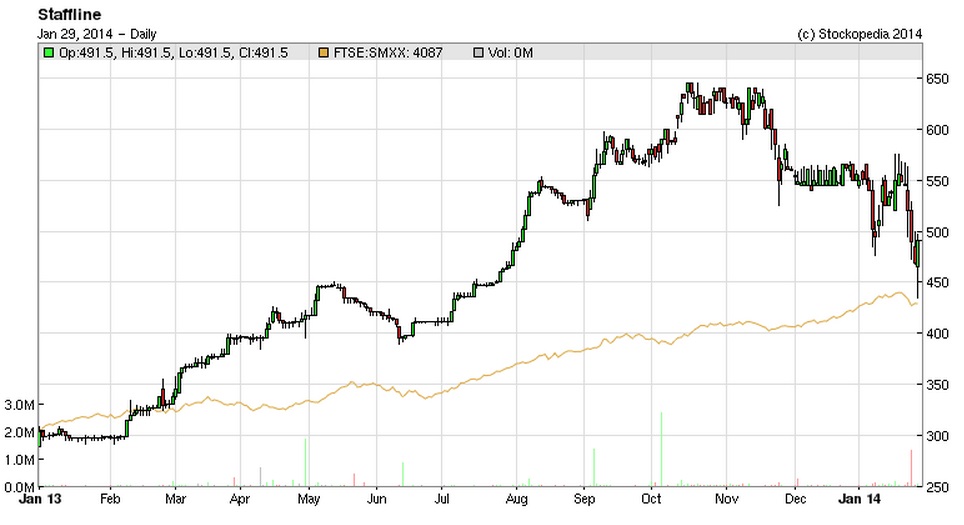
Staffline's results for the year ended 31 Dec 2013 are released today, and I'm impressed with their prompt reporting schedule - which is indicative of strong financial controls, being able to publish preliminary results just 29 days after the year end. The figures look good - adjusted operating profit up 15.6% to £12.8m, adjusted EPS up 21.6% to 46.1p, total dividends up 23.5% to 10p, and they moved into net cash of £4.9m (2012: net debt of £4.6m).
Therefore at 492p the shares look good value, on a PER of 10.7 and a dividend yield of 2.0%. The result for 2013 seems to be well above analyst expectations, so I would imagine these shares are likely to have a strong day today. Also, the company's financial track record in recent years has been impressive, and the welfare to work side of the business is a gradually increasing stream of income, as the up-front costs to Staffline being to pay off with subsequent payment by results.
Renew Holdings (LON:RNWH)
This is an infrastructure support group, which I've reported on positively in the last year, including a last mention here on their interim results published on 26 Nov 2013. It's a low margin business, and the main problem is the horrible Balance Sheet - current assets are £85.4m, whilst current liabilities are £117.6m, that's a yawning deficit of £32.2m. The percentage is 72.6%, whereas I normally look for 120%+. The additional £7.2m of long term liabilities is not helpful either.
Writing off intangibles takes their net tangible asset position to negative £26.7m, which is dreadful. Someone commented yesterday that I'm obsessed with Balance Sheets, which I took as a compliment, because it's the key way to measure risk. Nobody is saying that a company with a weak Balance Sheet is suddenly going to go bust, but it very much heightens the risk - so that if something else goes wrong, the existence of the company can be hanging by a thread (look what happened to Silverdell, which had a fairly weak Balance Sheet, although technically it was actually stronger than Renew's, with positive net tangible assets, but Silverdell relied on flaky bank financing, instead of customer financing that Renew uses). Similar sectors of operations too, in part.
The item of concern here is "trade and other payables" of £112.3m at the last reported Balance Sheet date of 30 Sep 2013, which looks extremely high, so I need to check what's in that figure in their 2013 Annual Report. The breakdown is given in Note 15, as follows;

The line that concerns me greatly is the £67.3m "accruals and deferred income". Accruals are costs that have been incurred, but not yet invoiced by suppliers. Deferred income is where a customer has paid cash up-front, in advance of a service being provided. So in an ideal world, you should see a corresponding £67.3m cash balance, but actually net cash is only £2.8m.
So what this means is that Renew is financing its business on up-front payments from its customers.
That's fine as long as they can keep it rolling. But if for any reason contracts change, and customers become less inclined to make large up-front payments, then Renew could face a disastrous cash crunch. I am very surprised that this risk has not even been mentioned in the "Principal risks and uncertainties" section of the Annual Report, on page 31, because actually it is by far the largest risk facing the business, in my opinion.
So before I could invest here, I'd have to find out which customers have made these large up-front payments, and what certainty there is that they will continue for the foreseeable future? We're in a bull market where many (most even?) investors are blissfully unaware or completely ignore risks like this, so I don't suppose it will stop the shares going up, but I think people are actually taking a lot more risk than they realise with this share.
This probably doesn't matter in the immediate future, as current trading is good, with the company saying in today's trading statement;
Trading for the first quarter of the year has been strong and well ahead of the comparative position last year. The Board expects this to continue through the second quarter of the financial year and, as a result, that the results for the year ending 30 September 2014 to be much more evenly weighted between first and second half than hitherto.
More colour is then given on the various divisions, all of which sounds positive. The order book is up 27% to £433m. The final flourish says;
Reflecting the profitable trading, cash generation in the first quarter has also been strong. The Group's net cash position together with its strong order book enables the Board to look forward with confidence to further profitable growth.
So all sounds great, and the shares are up 19p to 199p. The elephant in the room being the horrible Balance Sheet, is currently being completely ignored by the market, but it's too big an issue for me to consider investing here.
Mobile Streams (LON:MOS)
This is the biggest faller of the day, currently down 34% to 42.5p on a trading update.
I've commented before on this being uninvestable for me, because a lot of its operations & cash are tied up in Argentina, with restrictions on currency movements. They mention that in more detail in today's statement, and devaluation of the Argnetinian currency is causing them problems. They don't expect to meet market expectations for the year ending 30 Jun 2014.
It just looks dreadful to me, I cannot understand why anyone would take the risk of getting involved in an investment like this?
I see that Mulberry (LON:MUL) has tumbled 26% today too. It's not a small cap any more, but looks like it might be heading back down our way again if current share price trends continue - it's down 72% since May 2012 - I find it remarkable how so many high growth, fashionable shares subsequently fail to live up to elevated investor expectations. Which makes me more convinced than ever that keeping my feet firmly on the ground with solid, reasonably priced companies is far more sensible than chasing the latest growth story up to a bonkers valuation.
Gotta dash, heading into town again for more meetings. I'm turning into a commuter!
Regards, Paul.
(of the companies mentioned today, Paul has no long or short positions)
Disclaimer
This is not financial advice. Our content is intended to be used and must be used for information and education purposes only. Please read our disclaimer and terms and conditions to understand our obligations.

15 comments
Suspect the market makers are making pennies while the Ukraine is awry?
Does STAF normally have a spread of 20.56p?
At 9.03am on DL.
Sell @ 709.67p. Buy @ 730.23p.
Hi Paul, I'm not quite sure why you are so tough on Mobile Streams. OK they've had a problem with Argie money but on the other hand their balance sheet is positive (11A to 8L) with (to my eyes) no odd bids sticking out, plus they have increasing revenues while pushing, apparently successfully, into a global market of billions thirsting for mobile phone apps. Am I naive to hope that they will get this sorted in a year or so and, at the current price of 40p, they might be a good punt? (Even if they weren't when I bought them)
All the best.
Skilled and unskilled workers in the UK frequently need to compete with their equivalent in eastern Europe or the far east.
Skilled workers might be able to differentiate themselves on skills and experience. However, that's more difficult for unskilled workers.
Also, even an unskilled worker in SE England probably has a better living standard than his equivalent over the last 5000 years, or 80% of unskilled workers on the rest of the planet today.
Anyone getting paid for an unskilled job should consider how they're going to add more value than their global competitors, rather than having a hopelessly misplaced sense of entitlement.
Your comments on Renew seem to go against the market following the recent update. Shares up 10% today.
Paul, I am learning so much about balance sheets from reading your comments. I am finding it invaluable. Thank you.
Hi Paul,
Good analysis, as ever. However, I think it's worth digging into Renew's business a little deeper to understand the "deferrred income" and the risks it presents. Renew's management has delieberately repositioned the business to focus more on higher margin infrastruture maintenance business (e.g. acqusition of AMCO rail maintenance business). Similar to software maintenance contracts, I would expect these contracts to have an annual or quarterly up-front payment, and then for services to be provided, as required. There is normally a good margin on such contracts, so the cost of providing the services is significantly less than the up-front payments received.
One benefit of such business is that, whilst in many businesses growth is cash absorbtive - and many businesses have got into trouble by "overtrading" (i.e. growing too fast without having sufficient cash to deal with a lag in payments) - Renew and similar businesses can grow without an additional cash requirement. It is also notable that Renew traded through the 2008 recession without suffering any cash crunch, as evidenced by continuing payment of dividends, wihout being forced to cut them.
Neveretheless, I thank you for pointing out that if Renew's business went backwards, they could potentially face a cash squeeze. However, IMO these infrastructure maintenance contracts, are less cyclical that the construction sector in general, so the risks of a major drop-off appear low to me. They represent valuable recurring revenues - as long as Renew don't screw up!
Disclosure I have been a shareholder in Renew since 2006, and added heavily during the first part of the recovery in 2009 and in 2010. I have since topsliced in 2012 and 2013 as the SP recovery led to Renew becoming an uncomfortably large part of my porty. I am happy to retain my current holding, however. I have considerable confidence in Renew's management, who are highly experienced in the industry and large companies and have performed well, unlike Silverdell, where the CEO was relatively inexperienced in running a listed business.
Cheers,
Mark
Paul,
Great details as always.
I am delighted you are obsessed with balance sheets and I expect it to continue!!
Regards
Peter Barrett
Hi Paul
Re. Balance Sheets. In today's climate, my mantra is 'protect your capital' . So I took an axe to my portfolio and ditched any share which smelled of a weak balance sheet. I am glad I did this a few weeks back before the recent stock market correction. So please keep reminding people.
Regards, Ram
Paul - your obsession with balance sheets is healthy.
I finished Anthony Boltons' book "Investing against the tide" and he has some excellent comments on this point.
He says that looking back at all his stock failures - he identified all his failures as resulting from investing in companies with weak balance sheeets. He's intransigent on this now.
Second key learning is "to follow the cash" - if cashflow isn't there, well, something isn't right. (Brings back the conversation to the Greek stock that shall not be named, selling BYOD solutions..)
Well work reading.
Hi Paul,
Interesting article on Staffline (LON:STAF) on Shares magazine website which mentions possible mis-selling of personal accident insurance to their workers:
http://www.sharesmagazine.co.uk/news/staffline-stands-firm#.UujWQY1FBzm
Steve
Hi Paul,
Thank you for your Balance Sheet ‘obsession’ and your excellent analysis.
….people will always though stones at fruitful trees will….
Regards
Essam
Hi Paul -
Re. Staffline. You say that the results seem to be above analysts' expectations. A bit bemused. Stockopedia's Stock Report says analysts' expectations are Net Profit £9.3m and EPS 40.6p. Today's prelims show PTP £7.4m and EPS 33.1p.
Regards, Ram
Hi Ram,
Analysts tend to use the adjusted EPS figure, which with Staffline (LON:STAF) is 46.1p.
Although it's then up to you whether you accept the adjustments as bona fide! I think in this case they are because it's mainly relating to goodwill amortisation.
Although I do note that the Cashflow statement shows £2,040k of purchased intangibles, which suggests they have capitalised some internal costs (whereas none were capitalised the year before).
Also I note from the segmental analysis that the core business's profit actually went down, from £8.6m to £6.3m, but the shortfall was made up by a large increase in the profit from Welfare to Work. There's a large £2.15m share based charge too, so overall actually on a little more digging, I'm coming to the conclusion that the picture is not as rosy as the company is trying to show.
Regards, Paul.
Thanks for the clarification, Paul.
what are your thoughts on MOS?