Small Cap Value Report (31 Mar 2014) - RGS, VNET, FTC, YOU

Good morning! It looks like another busy week for results & trading statements in the offing.
Regenersis (LON:RGS)
My last report on Regenersis included the comment that their Balance Sheet was looking weak, and could do with being strengthened with another Placing. That's exactly what they've done today, and it's a whopper - the group has raised £100m in a "significantly oversubscribed" Placing at 345p per share. That's impressive because of both the size, and also the narrow discount to the current share price of 354p, just a 2.5% discount. Joint brokers Panmure Gordon and Cenkos have clearly done an excellent job here.
There is a current trading update buried in the announcement, which sounds reassuring;
The Group's trading for the period since 31 December 2013 remains in line with market expectations for the year ending 30 June 2014. The Board expects that profit growth in the second half of the current financial year will come primarily from the Group's Emerging Markets and Advanced Solutions divisions.
The Board believes that opportunities for growth, both organically and by acquisition, remain strong.
About half of the money raised is being used to buy a Finnish company called Blancco Oy Ltd, which specialises in data erasure. It looks a high growth company, with revenue growing at 25% compound from 2008-2013. Figures for 2013 for Blancco are E12.3m revenue and E4.3m EBIT. I'm not keen on the increasing prevalence of EBIT or EBITDA, particularly for technology companies, since you never know how much cost is being capitalised into intangibles. They don't mention profitability. That said, Regenersis management are pretty shrewd in my opinion, so this will probably be a good deal.
Vianet (LON:VNET)
Not one of my better share ideas this one. Although the lesson I've learned from this situation, is that no matter how much research & screening you do, something unforeseen can always happen. In this case it was a Government review of the brewery tie for pubs, which took everyone by surprise when a section was included within the original Govt document suggesting that beer flow monitoring equipment (where Vianet is the market leader) should no longer be used. It was a rather bizarre suggestion, since no evidence was given to support the idea.
This walloped Vianet's shares last year, although they have been creeping back up somewhat due to the maintained generous dividends. So if like me you've held the shares for a while, the total return hasn't been too bad once divis are included.
There's a trading update on the year end date today, 31 Mar 2014. It sounds reasonable to me, in the context of a depressed share price and despondent shareholder mood. H2 trading is said to have been "broadly in line" (i.e. slightly below) the Board's expectations. Full year pre-exceptional operating profit is expected to be in the region of £3.0m. That's not bad in the context of a £22m market cap (at 82p per share), in my opinion.
This bit sounds encouraging to me;
...the strength of the Group's recurring income and prospects for 2014/5 give the Board confidence in maintaining the proposed final dividend at 4p, which would give a total dividend for the year of 5.7p.
So at 5.7p the annual dividends represent a 7.0% dividend yield. In my experience, anything over about 6% is usually questionable in terms of sustainability, and that is probably the case here - I think it's fair to say that the dividend is a bit stretched, and might need to be lowered at some point, although I think the chances of dividends being cancelled altogther in the future are very low, because so much of group revenue is on long term contracts. Hence whilst the group might disappoint on profits, it tends not to miss expectations by that much.
As expected, the Government is taking much longer than expected to conclude its Statutory Code consultation, and having reviewed the arguments of both sides, I think it's highly unlikely that the Government will try to ban beer flow monitoring equipment. That would be bizarre - a bit like suggesting that shops should stop using EPoS, and go back to using pen & paper. Also, it would hurt the Exchequor, since removing monitoring equipment would make it much easier for pub landlords to use illicit supplies of beer from the black market, with the resultant impact on lower VAT, etc. Surely no Government would take such a decision, having considered all the consequences? Anyway, time will tell.
Vianet's vending telemetry division appears to be (at last) gaining some traction, in particular with coffee vending machines. On this are they comment;
The Group's existing orders in this market segment are being installed successfully and ahead of plan and we remain positive of securing a significant new business win in the first half of 2014/5.
The fuel division has reduced its losses throughout the year, and "is now trading profitably".
So overall I'm encouraged that things are at least not getting any worse, and the continued big dividend payments are most welcome.
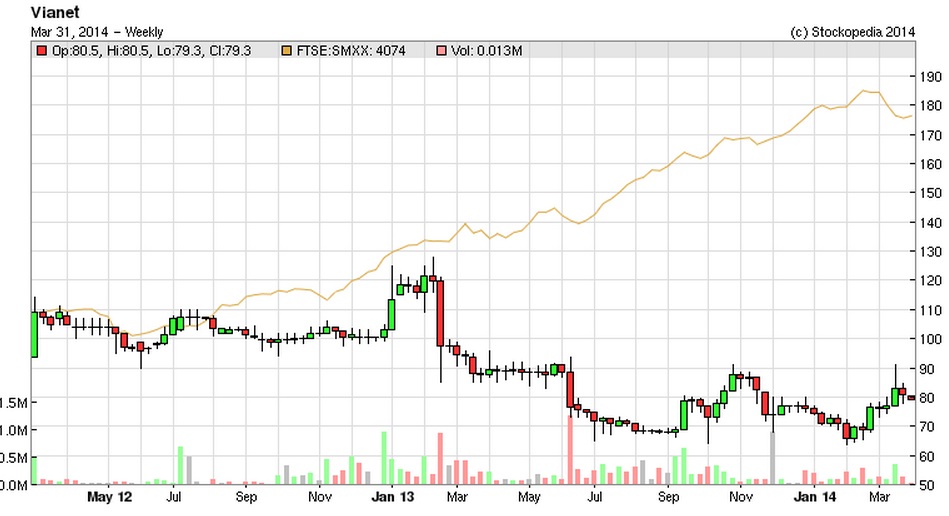
As you can see from the two year chart, these shares have significantly lagged the FTSE SMALL CAP INDEX XIT (FTSE:SMXX) since problems first surfaced in early 2013. Although it's also worth noting that for people like me who paid about a pound a share in late 2012, we're probably not far off breakeven if you include the generous dividends received over that time. Maybe we're over the worst? There certainly seems to be strong support around the 70p level;
I'm not sure I'd rush out to buy these shares with fresh money today, but as an existing long-term holder, I'm reasonably comfortable sitting tight for the time being.
Filtronic (LON:FTC)
Profit warning of the day is from Filtronic, the maker of microwave electronic products. Its shares are down 23% to 37.5p this morning, on the release of an IMS. Last time I looked at this company on 28 Jan 2014, I didn't feel able to form a firm view on its valuation, other than concluding that it didn't look cheap at 53p per share. Good job, as they're down almost 30% since then.
The company has an unusual 31 May year end, and reports today that its wireless division is "facing a sharp, but temporary, fall in activity for the remainder of the financial year". This is due to a number of large projects being deferred past their year end date. The financial impact is that wireless turnover in H2 will be 60% lower than in H1. Yikes! Although they say that this will cause a small operating loss in H2 for that business.
Their broadband division will deliver an H2 loss slightly lower than H1.
Overall the group is expected to deliver breakeven at the operating profit level for the year ended 31 May 2014. That sounds pretty lousy to me, given that the market cap was £47.4m last week, and is now down to £36.5m at 37.5p per share. Indeed I am wondering whether there is a viable business here at all?
It all hinges on the outlook, which sounds positive;
The prospects for FY2015 are nonetheless positive. The Wireless business deferred for the current period is largely expected to be secured in FY2015. Filtronic is currently engaged on approximately twice the number of wireless infrastructure projects as was the case a year ago. Some of these are potentially very large, but the degree and timing of Filtronic's participation is necessarily uncertain until contracts are finalised. Broadband meanwhile has successfully concluded its exit from legacy business and is seeing steadily growing demand for its E/V band radio modules.
Buying these shares looks to me like a leap in the dark. It would need very thorough research to understand the sector they operate in, and what (if any) competitive advantage this company has. I don't see anything even remotely attractive in the historic figures to motivate me to do any further research, so will move on.
YouGov (LON:YOU)
I've warned before about the (in my opinion) highly misleading accounts presentation adopted by this company, which materially inflates highlighted profit and EPS, and therefore leads to investors considerably over-paying for these shares.
My report of 14 Oct 2013 explained exactly why I think their highlighted profit figures are over-stated. It's because the company tries to focus investors on adjusted profit and adjusted EPS. That's fine if they are just adjusting out non-recurring items, and goodwill amortisation. However in this case, they go a lot further than that, and adjust out the amortisation of their own internal intangible costs. So this leads to adjusted earnings ignoring both the capitalised costs that go to the Balance Sheet, AND the amortisation of those historic costs. So profits are over-stated, simple as that.
You can see the effect of this in note 9 in today's interim accounts, reproducted below;
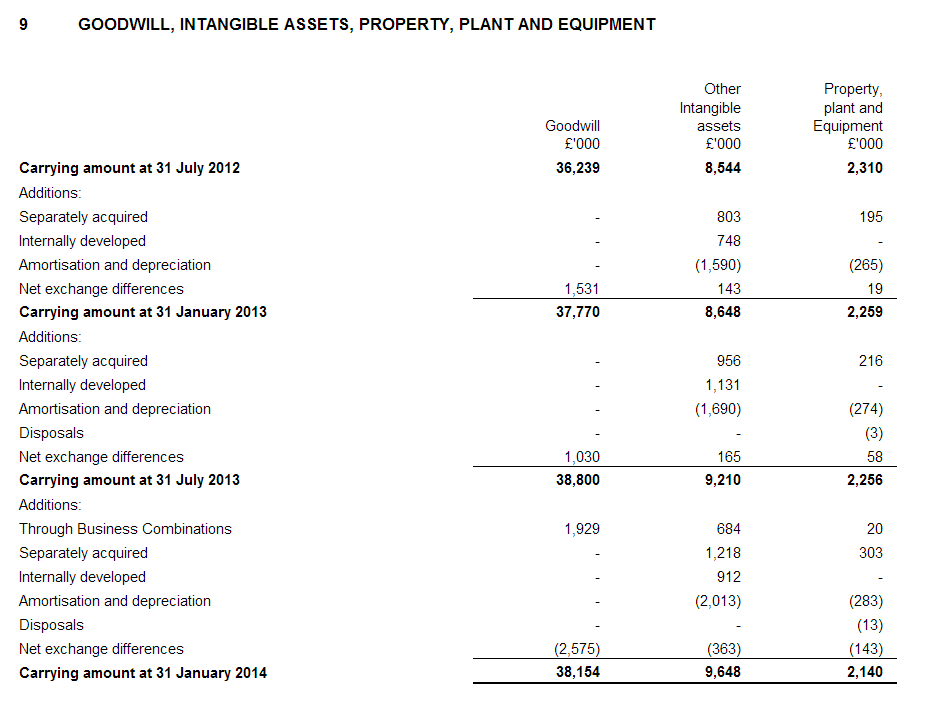
As you can see, they don't amortise the Goodwill at all. So all the amortisation (which is excluded from adjusted profit) is costs which are an inherent part of running the business.
Here is an analysis of the intangible assets (sorry for it being such a huge note). As you can see, there are five categories of intangible costs. It's fine to capitalise these, but you must then account for the amortisation charge. You cannot capitalise them, and then strip out the amortisation charge, which is what YouGov do, as that materially overstates their profit.
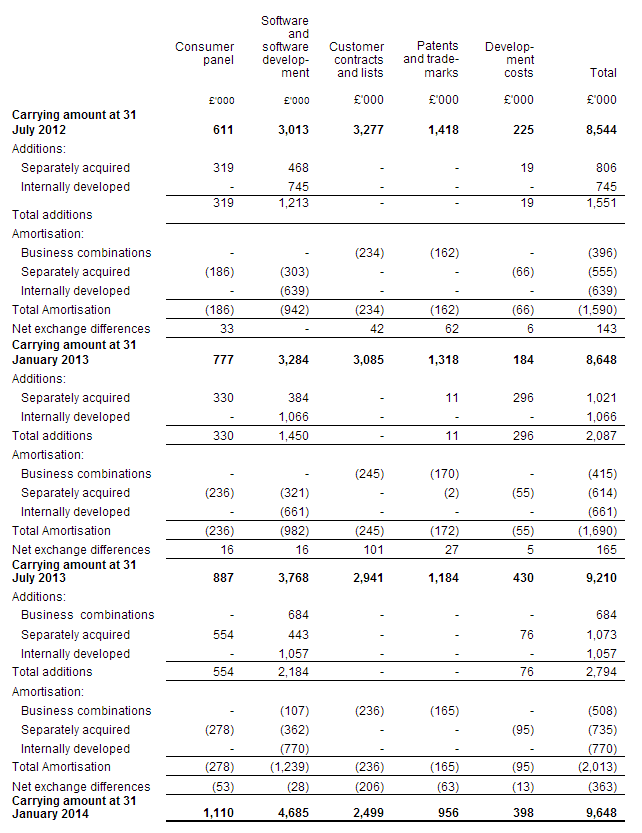
The numbers are material too.
After exceptional items of £1,057k for the six months to 31 Jan 2014, the group actually made an operating loss of £138k. Some net finance costs then took it to a £427 loss before tax for the interim period. Add back the exceptionals, and in my view the true underlying performance of the group is about £600k profit for the six months. That's slightly up on the equivalent period six months.
Overall, I think the market cap of almost £110m at 111p a share is multiples of what I would consider a sensible valuation, if you correctly account for the amortisation of intangible assets.
The Balance Sheet overall is dominated by intangible assets, so when you write off those, net tangible assets drops to £9.5m, so very little asset backing.
It's up to each investor how you regard capitalising of costs, but I do feel it's important to flag up issues that I'm not happy with, when I find them. This company doesn't actually make very much real profit at all, so the market cap is far too high, in my view. DYOR as usual.

See you tomorrow morning.
Regards, Paul.
(of the companies mentioned today, Paul has a long position in VNET, and no short positions)
Disclaimer
This is not financial advice. Our content is intended to be used and must be used for information and education purposes only. Please read our disclaimer and terms and conditions to understand our obligations.

17 comments
Possibly some good news - I would suspect that the share price would spike if as we all expect, the Government decide not to intervene.
Unless of course Beginner is right and they never report !
K
Just to put put some hard figures on the Vianet discussion.
Middle of last year there were approximately 24,000 tied pubs in the UK. About 10,000 of these were owned by Punch and Enterprise.The figure is probably closer to 9500 today as tied pubs are closing at a rate of 16 per week. The general industry view is that pub closures (all pubs) are increasing at a faster rate.
This has been a long term decline which mirrors Vianet's own performance - 3 years declining profitability and share price tell their own story and suggests that the management are a bit slow to react to this structural decline in their core market.
If this wasnt bad enough the obvious elephant in the room is that Punch and Enterprise carry significant debt which is just about serviced. Some would say that they are classic Zombie companies which will struggle when interest rates rise. Such forced closures and inevitable sale of pubs will hardly help Vianet who seem to be dawdling along rearranging deck chairs.
As an investor I need either a growth market or good management. In Vianet I see neither. So after looking at Vianet on a number of occasions I remain on the sidelines.
Possibly some good news - I would suspect that the share price would spike if as we all expect, the Government decide not to intervene. Hopefully this will be of some benefit to loyal Vianet shareholders who have stood by their company.
All in my opinion of course - DYOR
Re Synety, you might be interested to learn that they are one of the companies presenting at our seminar on the 8th May (see http://www.sharesoc.org/seminarmay2014.html) so there would be the opportunity to ask questions re the placing there. No doubt the topic will come up.
Hi Kenobi
Not entirely sure that there are enough sales in the first place. The tied pub industry has been in decline for a number of years and it wouldnt surprise me to hear that Vianet rip more units out of disused pubs than they sell to new ones.
The tied pub business model is probably going the way of the Dodo and Sabre- toothed Tiger. Nether the landlords or the Pubcos (think Punch) seem to be making much money from the business and both seem to exist in permanent conflict with each other. I personally cant think of a more uninvestable market than the tied pub business - but no doubt there is one somewhere.
I suspect you are right, however the uncertainty as to whether the flow monitoring equipment is to be banned or not must be acting as a huge brake on sales, So getting this resolved should slow any decline in flow measuring equipment, and perhaps trigger a spurt in sales that have been on hold pending the decision.
K
Hi Kenobi,
When I last spoke to management, they said that the uncertainty over the Statutory Code was unhelpful, but was not preventing renewals. Although it was having the perverse effect of encouraging some pub cos to accelerate their closure programmes - so well-intentioned Govt action actually having a negative unintended consequence.
The number of tied pubs is likely to stabilise in a recovering economy. Vianet has something like 60% market share, so totally dominant in that space, hence that side of their business should just continue to chuck out cashflow to finance the divi, and the other bits (vending, USA, fuel) might at some point become useful additional profit centres as well. If the USA works, it could be pretty exciting long-term.
Regards, Paul.
I suspect that the Government are most unlikely to ban the use of Vianet's flow monitoring equipment in tied pubs - but its continued discussion is a convenient smokescreen to hide behind.
Investors are more interested in the rate of decline in their core tied pub market and how this is being mitigated by growth in other markets. Not much information in the announcement on these important points or (as Delpher says) development in the USA.
Please note there is NO proposal or intention to BAN flow monitoring equipment. It is proposed that it may perhaps no longer be used as a basis for financial dealings between landlords and tenants though. Even if that does happen, which is unlikely, the equipment will be retained under the pretence of quality assurance. Tied houses are MUCH more common tham people think. The PUBCOs have been contracting, but do not forget major brewers like Martsons also still have tied estates which yield good profits for them.
Vianet (LON:VNET) will languish while the protacted inquiry continues. The committee will, in my opion, never report. This has happened before and will happen again. The compnan here, which I have a few quid in, will pay out dividends for the foreseeable future, but sustained share price growth will remain a while off due to government interference. Investing here seems akin to bunging money in a decent deposit account.
For all those interested in Synety, I received a reply back from Paul Williams, CFO:
The firm placing was not for corporate investors only as you suggest in your mail. At the beginning of the process we sat down with our brokers, Singers, and put together a marketing roadshow that covered both institutions and private investors alike. We also insisted on there being an open offer element for the smaller private investors that have been so important to us.
In terms of pricing, then this is always going to be a topic for debate. When we began the exercise, the share price was just over £2.50. Once a marketing exercise is running investors tend to ignore price movements that take place during that period when settling upon a valuation for the shares that they want. We therefore believe we got the right price for these shares.
Overall, we feel that the placing exercise has been hugely successful, giving us some high quality, long-term, cornerstone investors, as well a valuable opportunity to reward our smaller shareholders. We feel that this now gives us a great platform to move forward and develop this hugely exciting opportunity.
Hi CliveBorg,
Thanks for posting that reply from Synety (LON:SNTY).
I take their point on pricing at 250p. It can indeed be the case that the share price races up when a company is doing a roadshow. The same thing happened when Seeing Machines (LON:SEE) did a 5p Placing late last year, and the share price ran up to 9p.
However, the structure of the SNTY deal in giving 90% of the new shares to Placees, and only 10% (just £0.5m!) to existing shareholders, was ludicrous. Not only did this offer a derisory amount of new shares to existing shareholders (thus diluting us at an unfavourable price), but it must also have been highly inefficient on fees - i.e. they incurred all the extra cost of an Open Offer, without offering any meaningful number of shares.
They were badly advised, and it concerns me that they are trying to deflect criticism, rather than taking it on board. I shall reinforce these points in person shortly when I meet them, as they need to understand that structuring a deal in such as way as to alienate their private shareholder base, is not a good way to proceed. Trouble is, I think some of these brokers are totally out of touch from the PI shareholder base, and hence are giving advice that suits them & their contacts, with a degree of disdain for PIs.
Maybe ShareSoc could issue some guidelines on this, for companies & brokers, to protect PI interests, which are so often trampled all over by the City?
Regards, Paul.
Maybe ShareSoc could issue some guidelines on this, for companies & brokers, to protect PI interests, which are so often trampled all over by the City?
Quite agree Paul. At the moment there should be PIs names written on paving slabs all over the city. The place is a cesspit and needs cleaning up in so many ways. Instis have no interest to change anything yet in most cases they are investing money for the public.
Glad at least we got people like you to shout about it!
Hi Paul,
I'll be happy to raise this at the next ShareSoc board meeting, though we are somewhat snowed-under at present. It'd be helpful if you could email me some proposed guidelines.
Cheers,
Mark
Hi Mark,
To start the ball rolling on the subject of guidelines for the protection of Private Investor ("PI") interests in fundraisings, how about this;
1. The principle of pre-emption rights should be given the priority that company law intended - i.e. existing shareholders should always be offered new shares in preference to new shareholders - therefore an Open Offer to existing shareholders should be the default method of fundraising.
2. Where a Placing is used (e.g. for speed, and to underpin a larger offer of new shares), it should always be matched by an Open Offer for AT LEAST the same number of shares being made available at the same price to existing shareholders.
3. The maximum discount to average market price (in the preceding x number of days) with a Placing should be 10%. If the price discount is more than 10%, then an equal-sized (or larger) Open Offer must be made to existing shareholders.
4. A small Placing (under 10% dilution) at close to the current market price (less than 10% discount) should be permissible, but no more than once per annum.
5. Adviser fees should be minimised, and may not be necessary at all, as small Placings could be arranged privately. A 50:50 Firm Placing:Open Offer should not need underwriting at all.
6. Companies should maintain a list of existing shareholders who are able and willing to take up new shares (with a minimum of say £10k), and contact them first in the event of a Placing being decided upon.
7. Shares should be immediately suspended when a company decides to raise new funds, to stop the clearly widespread practice of insider dealing which currently occurs.
8. A time limit of 2 weeks should be placed on the suspension of shares related to a fundraising.
9. Where a Placing and Open Offer happen at the same time, then the Open Offer should take priority, and if over-subscribed should claw back shares from the Placing (in situations where there is both a Firm Placing and an additional Placing, in conjunction with an Open Offer).
Any other ideas, please add them to this thread, or we could start a new thread. Actually yes, I'll do that, as this is an important topic.
Regards, Paul.
"... the lesson I've learned from this situation, is that no matter how much research & screening you do, something unforeseen can always happen."
I had a look at Vianet sometime ago. I did a search and publicans were expressing hate on the forums, and claiming the Vianet machines were not accurate, so decided not to go for it. I wasn't sure if it was right to take that into account at the time, though, and I don't know if that has anything to do with the government's decision, so maybe it was just luck I didn't go for it!
Things are trucking along nicely at Tasty (LON:TAST) ... http://www.investegate.co.uk/tasty-plc--tast-/rns/preliminary-results/201403310700165111D/
Re Regenersis; more share issuance means more dilution. It's worth pointing out that if one ignores the headline revenue and profit growth figures, the earnings per share in 2013 were exactly the same as in 2008. I am always sceptical of companies that continually issue more shares to finance growth because it is return on capital that matters, and it's never been great at this company.
Good morning Paul. With regard to VNET past reports have included reference to the ongoing trials and potential of the US market. It's rather surprising that there is no mention in this update.