Small Cap Value Report (9 Jul) - HYDG, NPT, XPP, BILN, OPM

Good morning. Recruitment group Hydrogen (LON:HYDG) has been hovering near the top of my watch list for a while now, so I read their trading update today with interest. However, it doesn't really tell me much of interest. It keeps referring to "Net Fee Income", but this is just another word for gross profit. It doesn't tell me anything about overall profitability, or how the group is performing against market expectations - yet those are the key things one needs to be told in a trading update! Reading between the lines it sounds as if their profitability is probably flat or slightly down, but there's an element of guesswork in that. There shouldn't be, the RNS should be a lot more specific, so a thumbs down to whoever wrote that one - a half year trading update has to refer to profitability vs market expectations, or it's virtually useless.
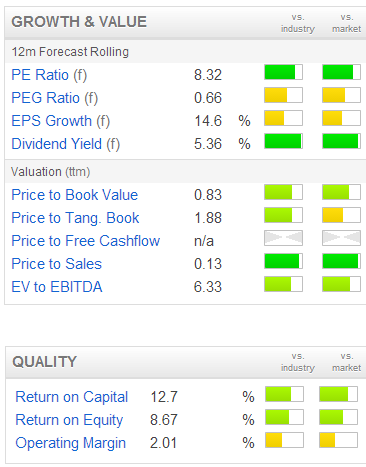
There's quite a lot of green on the growth & value graphics on the StockReport for Hydrogen, in particular the PER and dividend yield look attractive, which is often a good starting point, providing net debt is not too high.
At the last reported Balance Sheet, of 31 Dec 2012, net debt was £2.8m. That looks to be fairly typical, since the full year P&L interest charge was £167k, so if we assume a typical interest rate of say 5%, then that equates to an average debt figure throughout the year of £3.3m, which is near enough to the £2.8m year end net debt figure.
Broker forecast consensus is for a slight rise in normalised EPS this year (ending 31 Dec 2013) to 9.7p, so assuming they are on track for that (pity the RNS today didn't specifically say so though), then the PER is a fairly attractive 9.4.
You might be wondering why the table above right shows a forward PER of 8.3 then? Well, the Stockopedia system rather cleverly works out a blended 12 month forecast as from today, so it uses part of the 2013 forecast, and part of the 2014 forecast, so that all companies with different year ends are comparable at any point in time. Clever, eh?!
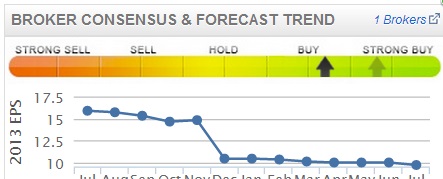
So on the face of it, Hydrogen looks potentially good value, although I am a bit concerned by the extent that broker forecasts have reduced this year, see small chart to the right. That doesn't look particularly healthy.
That said, the 5.2% dividend yield this year is very attractive, and it's twice covered. Furthermore, recruitment should benefit from an upturn in the economy, so there's scope for long term earnings growth too. I quite like this one.
FTSE 100 futures are indicating a strong open, up 35 at 6,483. It's impressive how quickly the main Indices have recovered from the (necessary) but sharp one month correction we saw from 22 May. Perhaps this will reinforce the idea that dips are for buying, not panic selling - all good bull market stuff!
The Stockopedia page for the FTSE 100 Index (FTSE:UKX) shows a forward PER of 13.9, and forward dividend yield of 3.1%, which are not expensive by historical standards. However, I note that the resource stocks & certain other large caps, such as Astra Zeneca, are on low valuations, so it would be interesting to strip them out to see what the rest of the FTSE 100 is rated at. There seem to be quite a lot with a PER of around 20, which is getting a bit pricey, although it depends where we are in the economic cycle, and we're not really sure at the moment.
What's next? NetPlay TV (LON:NPT) have issued a positive trading update for Q2, with their "KPIs significantly increased on a year on year basis" (for anyone not aware, "KPI" means Key Performance Indicators, and are what businesses use internally to measure performance & often pay staff bonuses. They are also sometimes used to muddy the water & create the impression of a business that is doing well. The only KPI that matters to me is profit!).
Crucially, Netplay say they are "confident of meeting full year market expectations". Stockopedia shows normalised EPS broker consensus for year ending 31 Dec 2013 of 1.5p, so at 17.25p the shares actually look quite good value, on a PER of 11.5 - not bad for a growth business.
A 2.6% dividend yield is forecast. This one might be worth a look, if you can stomach the sector - I don't like online gambling companies, because players tend to have a short lifespan before they run out of money & realise it's a mug's game. Also for me, there are ethical considerations - I would just rather not invest in gambling companies, and they tend to make volatile investments too. Very competitive sector too.
Well, a very buoyant morning so far, the FTSE 100 is now up 73 points, to 6.523, a very spirited recovery from the recent low just above 6,000. These are pretty volatile moves, everything seems to have sped up recently, with large moves occurring more quickly than in the past, not just with shares, but also with Bonds, and Gold. It must be because of all the electronic trading & the leverage. Let's hope the financial system doesn't shake itself to pieces again, but one does have the general uneasy feeling that things are running somewhat out of control generally in financial markets. The speculative forces are just too large (says he, as a market participant!).
The Dangers of Spread Betting
I note with interest that the recent, and bizarre price moves at Iofina (LON:IOF) seem to be subsiding. There was an extraordinary plunge on their shares on 20 June which took them from about 200p down to an intra-day spile on 22 June to not much over 100p. They then shot back up & found a floor around 145-150p, and are now back up to 185p. The company issued a statement on 24 June saying they knew of no reason for the erratic share price movements.
I asked around as to what had caused this, and the reason is that several spread betting firms had heavily geared clients with large positions in Iofina. As the price began falling, apparently several large clients were not able to meet margin calls, and so the spread betting companies began liquidating their positions. This was clearly done clumsily, and triggered further rapid & large falls in the share price.
The falling price therefore wiped out more spread betting clients, who were also over-leveraged, which triggered more client positions to be dumped (remember that spread betting companies will hedge their bets literally, so when they close out client long positions, they will usually be sellers of the physical stock, or CFDs anyway, which amounts to the same thing).
So what are the lessons to be learned from this? The key lesson is that speculative shares (whose value is based on expectations of future profits/cashflows, as opposed to existing profits/cashflows) are totally unsuitable for spread bets. As I discovered to my cost in 2007-8, gearing is extremely dangerous in a plunging market, as it magnifies the losses. Liquidity can dry up to a point where you can't get out, even if you want to. So geared positions, combined with lack of liquidity in the underlying share, and/or a particularly volatile share price, is just an accident waiting to happen.
So in my view the key rules for spread betting in equities go like this;
My Top 10 Rules for Spread Betting
1) Above all, only use a moderate amount of gearing (less than 2 times equity).
2) Diversify the account into at least 10 positions, so that no one share plunging will do serious damage to your portfolio.
3) Don't let any one position become overweight more than (say) 10-20% of the total account.
4) Don't spread bet at all on illiquid, or highly speculative shares.
5) Don't spread bet on anything where there are loads of other people also spread betting on it - so this means pretty much all shares that are very popular with private investors!
6) Think very carefully about using automatic stop losses - you are just presenting bear raiders with an easily guessable target price to attack.
7) Don't use gearing all the time - it should only be used in short bursts, when the market is in an upward trend. Easier said than done, this one!
8) Top-slice profits on the way up, not the way down! This allows you to buy the dips, rather than being forced out on the dips.
9) Above all, always calculate the underlying position value, and make sure that is appropriately sized relative to your overall personal wealth. There is a real danger of over-sizing positions, which can be disastrous if something goes wrong.
10) Calculate how much money you would lose if the company's share plunged by say 30-50% on some serious bad news. If that potential loss would be seriously damaging to your wealth, then the position is too big.
One final one, if I may;
11. If you don't know what you're doing yet, as an investor, then don't spread bet at all - it is the road to ruin for inexperienced and cocky investors, and should only be undertaken by investors who have a track record of consistently making money & managing risk well.
I've been looking at XP Power (LON:XPP) this morning, and like what I see. The shares are up 7% to 1304p today, on a positive trading statement. With a whisker over 19m shares in issue, that makes the market cap currently £248m, so relatively large in my universe of minnows!
They are a maker of power supplies based in Singapore. I don't usually touch overseas companies Listed in the UK, as there is often something wrong with them. In this case I'll make an exception though, as it's a decent-sized, consistently profitable business, consistently paying decent (and rising) dividends, and has been Listed in the UK since 2000. So an excellent track record.
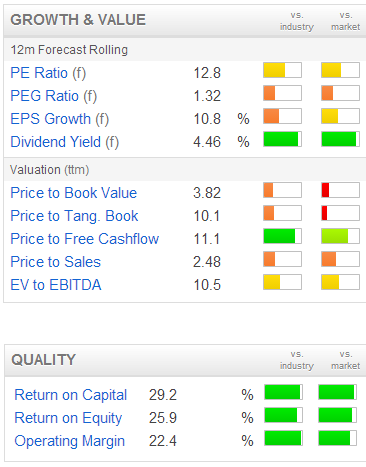
The historic financial track record is excellent, with really good operating profit margins, in a 21-24% range over the last three years, which is highly impressive - such a high operating profit margin indicates considerable pricing power - i.e. products in demand, and not much competition. So I'd want to understand what their niche is, and whether there are competitive threats, but the historic figures say they have a strong market position in a profitable area.
There's been tremendous growth in the dividend, from 22p in 2009, to 33p, 45p, and 50p, in the three subsequent years. It was 1.63 times covered at 50p too.
The balance sheet looks fine, with no pension deficit, and only £10.6m net debt, so all fine OK there.
Today's trading statement says that H1 trading was in line with expectations, so that's good. Group revenues were up 5%, so not terribly exciting growth really, which probably explains why the forecast PER is fairly reasonable, at 14.3 (I've adjusted for today's share price rise). That's not a bad price for a quality business that generates high margins, and pays a 4% dividend.
To my mind, the crux of the matter is whether there is upside on earnings from a cyclical economic recovery? If so, then the shares could be a very good long term bet. XP Power mention in their outlook statement today that their markets remain subdued, and indicating a fairly flat outlook for 2013. So I don't think there's necessarily any rush to buy the shares, but it looks potentially interesting as a long term investment. Would need more research on their products, markets, competitive position, etc.
There is a positive trading statement from Billington Holdings (LON:BILN) today. I've had a look, and think it looks potentially interesting. Can't get any shares though - the spread is absurd, at 70p Bid, 85p Offer, and there's nothing inside the spread, so a total waste of time it being Listed really. Pity.
I can't help feeling that a good idea would be to package up a group of say 5 good companies, and fuse them together into a mini conglomerate, with a single Listing. This would allow certain costs (such as the Listing, Non-Execs, etc) and even some back office functions like Accounts, to be shared, and thus profit margins increased.
More importantly, by bundling together five illiquid shares into one, you would create a much more liquid share, and something that overall would be a better proposition for everyone.
The stumbling block to this is obviously that management would resist it, but you could easily set up arrangements whereby the operating companies are autonomous, providing they perform at or near to budget. Interference only comes from the other constituent parts if any individual company under-performs. You wouldn't even need a top level Board, you'd just make each CEO of the operating companies a main Board member, and then have an independent Chairman.
Good idea isn't it?! If I wasn't so busy, I'd work on putting together something like that myself, but realistically it's not going to happen from my end, so thought I'd chuck the idea out there & see if anyone runs with it.
I could easily make up several lists of 5 good companies that would fit well together, and would be a more sensible Listed entity if fused together, rather than soldiering on as unloved, totally illiquid micro caps with a load of superfluous costs, and no significant benefit from being Listed. Forming such a mini conglomerate would be a much better bet than de-Listing, which destroys shareholder value & upsets everyone.
I've got to dash now, to prepare for a company meeting in London shortly. Just a quick mention of good results from 1pm (LON:OPM) today, which has found a profitable niche in asset financing, an area where the Banks have largely withdrawn from it seems. They have apparently good underwriting rules (requiring Personal Guarantees from small business borrowers), and it's easy to see this growing into a much larger business over the next few years. I missed the recent run in the shares, so probably won't be chasing it up.
Bah! 5 typos today, sorry about that, just run spellcheck to correct them. When I type fast, sometimes things go wrong, my apologies.
See you from 8 a.m. tomorrow morning.
Regards, Paul.
(of the shares mentioned today, Paul has no long or short positions)
Disclaimer
This is not financial advice. Our content is intended to be used and must be used for information and education purposes only. Please read our disclaimer and terms and conditions to understand our obligations.

13 comments
My maternal grandfather introduced me to horse racing with the following words "The only way to make money out of betting on horses is to become a bookmaker". I have never forgotten those words which is why I don't spread bet but do invest in IG Holdings.
Hi Bonitabeach,
If you manage the risk correctly, there's no reason why Spread Betting should be any different from buying physical shares. Nobody forces anyone to use the gearing that's available, and the tax-free status of Spread Bets means we should actually make MORE money on SBs than from buying actual shares.
The trouble is, hardly anyone actually manages the risks correctly in real life with SBs, but it is possible.
The use of the word "Bet" seems to be a red rag to a bull, and people throw their normal caution out of the window, but again there is no actual reason why this should be the case. If you run a SB a/c conservatively, with little use of gearing, then a successful investor should also be successful with that SB a/c. The trick is to stick to your knitting, and not diversify in hedges (i.e. gambles!) on other stuff.
It can be done, but it's bloody difficult.
Cheers, Paul.
I've looked at XPP before and the power supplies industry. My conclusion was that it was a very competitive/price based industry where XPP's only real moat was it's margin and lower cost base.
I concluded that although it will grow, it would be a slow minimal return that money may be invested elsewhere. I suppose the divi helps.
Excellent mention of spreadbetting Paul, the dangers and pitfalls, although some of it may fall on deaf ears as it's just too easy to get started. I do wonder sometimes why it's so easy to start a spread bet account, but getting a credit card or loan you often have to jump through several hoops.
I've only been spread betting a short while, and pretty much only doing it for tax reasons and the use of the excellent platform and charting facilities they provide. I'm not even venturing using any leverage at all currently.
If anybody is interested, and I echo all of Paul's comments and top 10 rules above, I'd recommend the following site which was invaluable for me as I started: http://www.spread-betting.com
Morning Paul,
Very interesting piece on the spread betting. Many thanks. Do you have any views you'd like to share on the use of spread bets v CFDs for the private investor?
Steve
Hi Gostevie,
I can't see the point in PIs using CFDs, because they are subject to Capital Gains Tax, whereas Spread Bets are not. CFDs were invented as a means of avoiding Stamp Duty, which is why they are used by the Spread Betting companies themselves to hedge client spread bets.
The only instance where a CFD mightbe useful to me, is if I had a Spread Bet that I expected to lose money on, but couldn't get out of, i.e. it was large & illiquid. In that case converting it into a CFD would at least make the loss tax deductible against other profits, which you cannot do with SB losses.
Cheers, Paul.
I would have thought spreadbetting companies would hedge directly both their CFD and spreadbet products, and get stamp duty exemption under market maker rules. I don't quite get the rationale to use (someone else's?) CFDs to do their hedging unless they're a really small shop with no exchange membership.
I would rather guess that the reason to create CFDs was to cater to the pro business who cannot benefit (I presume) from the spread bet tax rules, and for marketing purposes: despite being the same thing, CFD may look more serious to naive clients who see themselves as investors rather than gamblers.
I also don't understand your tax idea. If something has already made a loss it's too late to convert to CFDs, you'd get in at the low price at the time of conversion (not your entry price!) and get charged capital gains between that bottom price and the recovery price. I can't believe you could retroactively convert to a CFD taxed at the entry price: it'd be too easy, if you could do that why not then convert CFDs with a gain to spreadbets to erase the gain -- you can't pick the most tax advantageous form after you know the outcome, can you?
Hi Cig,
Nah, you've veered off on a complete tangent there, and didn't really follow what I was saying!
I didn't say anything about back-dating the prices on SBs or CFDs, obviously you can't do that!
I just pointed out that from my point of view, I can only think of one situation where a CFD would be better than a Spread Bet, and that is where I already have a large existing Spread Bet, on an extremely illiquid share, where something has gone badly wrong, and (say) the shares have already dropped from 100p to 30p, and I strongly suspect they are heading to zero.
Now obviously in that situation, I would ideally want to sell. But if my Spread Bet is for 2% of the whole company, and every time I try to sell a few, the share price drops another 10%, and the Bid dries up completely because we're in a major financial crisis, then my only option is to sit tight with the Spread Bet.
In this situation, it could be a benefit to ask the SB provider to convert the SB into a CFD, because FROM THIS POINT, the loss from 30p down to 0p would be tax deductible on a CFD, but wouldn't if I remained in a SB.
The drop from 100p to 30p is NOT tax deductible, because it was on a Spread Bet during that time.
I've never done the above, but was racking my brains to think of any situation where a CFD would be better for a PI than a Spread Bet, and that's the only one I could think of!
Cheers, Paul.
Thanks Paul, it makes sense now! It is a pretty niche situation indeed, you have a powerful imagination :-).
Hi Cig,
Glad that's clarified! As you say, it's a fairly unusual situation where a CFD might be better than a Spread Bet for a private individual. However, the situation I set out above was exactly where I found myself in 2007-8, with a number of Spread Bets that were far too large to close (being in almost completely illiquid micro caps where the Bid almost completely dried up). I didn't have the presence of mind to convert them onto a CFD, which would have saved me the tax, but never mind.
A good example was Voller Energy, which had fallen to about 32p just before financial crisis. It was a blue sky idea of some clown who thought he could commercialise fuel cells, but I got sucked in by the hype.
After a while, I strongly suspected it was a crock, and would end up in failure, but I had something like 1m shares on a Spread Bet (so £10,000 a point!). Every time we tried to sell, we could only get 10,000 shares away, and the MMs all ran for cover, taking the price down about 10%. This created a considerably bigger margin call than it solved - the figures were roughly raising £3,200 in underlying by selling 10,000 shares at 32p, so saving me £800 in deposit (at 25%) on the Spread Bet, but reducing the share price to about 29p, which created a paper loss of £9,900 * 3 points = £29,700 on the remaining Spread Bet!
So of course we had to stop selling, and whilst that stabilised the share price for a while, other people sold too, and the share price came down eventually to about a penny, and I lost £310k on the Bet in the end. Total disaster, which was one of several dreadful situations that cumulatively was how I got into such a mess in 2007-8.
So some horrible lessons, learned very much the hard way, which is why I now know what NOT to do with Spread Betting accounts! You don't tend to forget lessons like that in a hurry.
Of course if the SB company cannot get the underlying stock away from their hedge, then they won't close your Bet. These days though they will just dump them for whatever price they can get, so illiquid stocks are just a disaster waiting to happen.
Also remember that a small cap which might be fairly liquid now, could easily dry up completely in a savage bear market. Hence why it's so important to observe the rules in my Top 10 list in the original post.
Cheers! Paul.
Essentially CFDs and spreadbets are different packaging of the same thing. The main difference are tax treatment (a double-edged sword, as losses can't be offset against tax and most spreadbetters are loss making, so paradoxically HMRC collects more total tax thanks to the tax-free status of spreadbets!) and sometimes you may make bets with a free currency hedge for foreign stocks/indices, because the CFD will usually be expressed in the stocks' listing currency (same as owning the stock) while the spread bet sometimes is just a point bet on the nominal prices (without the forex impact). Again, cuts both ways.
Also beware of CFDs or spreadbets that charge you interest on your own money (e.g. does an unleveraged position charge interest?).
Morning Paul
I spent some time yesterday researching Harvey Nash (LON:HVN) but didn't quite get round to buying. Which would you consider to be the better GARP share between Harvey Nash (LON:HVN) and Hydrogen (LON:HYDG) ?
fek47 - see what the useful 'Compare Stocks' tool reveals when looking at Hydrogen (LON:HYDG) and Harvey Nash (LON:HVN) side-by-side:
http://www.stockopedia.com/compare/?tickers=LON:HYDG,LON:HVN
Hydrogen (LON:HYDG) is showing higher growth and dividend yield, and low PEG - though you pay more for it on the PE (9.6 v 7.8). Harvey Nash (LON:HVN) has a better Piotroski score though.