Small Cap Value Report (Fri 25 May 2018) - VLE, LSR, WSG, HUW, GROW

Morning!
There has been quite a lot of news from some of my portfolio's bigger holdings over the past week or two: Burberry (LON:BRBY) (final results), IG Group (LON:IGG) (trading update) PCF (LON:PCF) (half-year results) and Volvere (LON:VLE) (final results).
As some of you know, I tend to run a more concentrated than average portfolio, and I trade infrequently. This is the style which suits my personality and my (evolving) investment strategy.
To illustrate this, my top four holdings (VLE/BRBY/HAT/PCF) currently account for more than half of the value of my share portfolio. I haven't sold a share of anything at all since last August. I also haven't bought anything since March.
This should serve to give you some insight into how I handle results days. I'm very unlikely to react to the news, but I still tend to be rather nervous in advance!
The full list of stocks which caught my eye today, and are up for coverage (unlikely to get around to all of them, but we'll see):
- Volvere (LON:VLE) - final results
- Surgical Innovations (LON:SUN) - trading update
- Helios Underwriting (LON:HUW) - final results
- Local Shopping Reit (LON:LSR) - half year results
- Draper Esprit (LON:GROW) - final results
- Westminster (LON:WSG) - final results
Volvere (LON:VLE)
- Share price: 975p (unch.)
- No. of shares: 3.7 million
- Market cap: £36 million
(Please note that I own shares in VLE.)
I last covered this investment company in March, at its trading update for 2017. Here's the link. It's a turnaround specialist which finds companies in need of refinancing or some other change.
At the time of the trading update, it said:
The Group expects to report record revenue of approximately £43.2 million (2016: £33.0 million) and profit before tax of £3.22 million (2016: £1.94 million).
(I think there might possibly be a small typo above - 2016 operating was £1.94 million, but 2016 PBT was actually £1.98 million.)
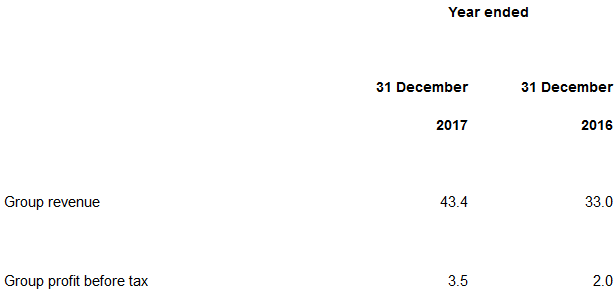
Today's results are even better than the trading update suggested. Revenue is £43.4 million, while PBT is £3.5 million:
As an investment company, it's important to think about it in book value terms.
Volvere's NAV per share increased by 7% in 2017, from 617p to 659p.
That might not seem terribly impressive, either in terms of the percentage growth rate or the NAV itself (compared to a 950p share price), but the important points for me are:
- There was no disposal in 2017 - so the 7% increase was derived only from profits and share buybacks.
- The value of private company shares can't be marked up in the absence of a disposal. So even though the underlying value of Impetus (the best-performing subsidiary) probably increased in 2017, this is not reflected in the NAV increase.
The performance of the two main subsidiaries was as follows:
- Impetus (consultants to the automotive industry): revenue £27.3 million (up from £17.4 million), adjusted PBT £3.6 million (up from £1.5 million).
- Shire Foods (food manufacturing): revenue £15.9 million (up from £15.2 million), adjusted PBT £0.6 million (down from £1.2 million).
Let's discuss these a little more:
Impetus
This is a consultancy outfit, helping big brand car manufacturers to increase their sales and after-sales. While they do provide useful software and e-commerce tools for clients, my understanding is that much of the work on the ground is quite labour-intensive. So on that basis, it's probably not the sort of company that I would invest in on a stand-alone basis.
It's also rather concentrated in a single customer, who is responsible for 42% of revenues.
However, Volvere only needed to put around £2 million into Impetus to achieve its 83% stake and keep it going, leaving the senior managers with a 17% stake. It has had some tremendous contract wins and as you can see from the summary numbers above (revs £27 million, PBT £3.6 million), the return on Volvere's investment has been tremendous.
It will be interesting to see if/when Volvere decides to dispose of its stake. I can't predict when that might be - whenever it receives a good enough offer, basically. In the absence of a good offer, it can hold on to its stake indefinitely.
Shire
This has been held since 2011, and Volvere has an 80% stake. Trading last year was a bit of a disappointment, and made worse by c. £0.2 million in an exceptional depreciation charge. Conditions are tough for food producers and food retailers, and I would doubt that Shire has enjoyed a particularly strong moat against competition.
It also has a concentrated customer base, with a single customer accounting for 42% of its sales.
So again, I might not be interested in Shire on a stand-alone basis. But Volvere only invested about £2.5 million in it originally, and has achieved a strong ROI on that amount. I'm also encouraged by today's announcement that it is spending £1 million on new equipment, to produce higher-margin products. I believe that Volvere will have done the maths on this and is more likely than not to generate a good return it. We shall see.
There is another Volvere subsidiary ("Sira") which remains too small to discuss.
Overall position
There is no change to overall strategy, and investors are reassured that more buybacks might be coming:
We remain committed to seeking under-performing businesses that we believe we can build into attractive market-leading companies. The Group's recent strong financial performance, coupled with the strength of its balance sheet, mean we will continue buying back the Group's shares when we consider to do so is in the interests of our shareholders.
Cash plus current asset (short-term) investments is £18.4 million, down a few million after £3.5 million of share buy-backs during 2017.
The effect of share buy-backs is illustrated by the fact that Volvere's total net assets went down, but net assets per share went up.
Net assets are now £26.1 million, including £2.6 million (after an upward revaluation) of freehold property at Shire and £18.4 million of cash and current asset investments.
I was curious to see what the company had invested in for its short-term investments, and today we find out in footnote 14:
During the year the Group invested in equity securities pursuant to its treasury management policies. The investments are carried at fair value as stated above. The historic cost of investments held at the balance sheet date was £6,258,000 (2016: £nil).
This is very interesting, and a new development. I'm minded to contact the company and ask for more detail on these equity securities - what are they?
Conclusion
Overall, things are going well at Volvere. NAV per share has increased again, the share count is down, the company has produced record profitability, and the balance sheet remains a fortress.
Valuation is anchored by the £18.4 million in cash and current investments. We can then consider the value of two subsidiaries producing a combined £4.2 million in combined PBT before Volvere's management charges. Volvere directors were paid compensation of about £0.6 million this year.
The market cap of £36 million, after deducting the cash and current investments, assigns a multiple of circa 4x to the latest PBT of the subsidiaries, before management charges.
If we take the management charges and the costs of being listed into account, the multiple assigned by today's ex-cash market cap is about 5x PBT.
I consider this to be a conservative valuation, especially when taking into account the superb track record of management.
I am also very happy with the share buy-back policy, because I prefer capital gains to income and I believe there is value creation in buying back shares at a conservative valuation.
So I'm still not buying or selling any Volvere shares, and haven't done so since May 2016.
Would I buy today, if I had none? I don't know - the margin of safety was particularly strong back in 2016. But I am inclined to think that the outlook remains satisfactory for shareholders today, even from the current level.
If good valuations could be achieved on disposal of Impetus or Shire, Volvere would see an immediate and material increase in reported NAV per share.
It's also possible that a rising interest rate environment and increased business distress (as reported by Begbies Traynor) could lead to attractive new opportunities for Volvere, so that its cash pile could be put to a more productive use. But there's no rush.
My original rationale from 2016 can be read at this link (external website).
Local Shopping Reit (LON:LSR)
- Share price: 31.6p (-4%)
- No. of shares: 82.5 million
- Market cap: £26 million
It took me a few moments to remember why I had been looking at this one recently, and then I remembered: the unusual holding company Thalassa Holdings (LON:THAL) has a 25% stake in it.
LSR in undergoing a disposal program, which was due to complete between H2 2018 and Q1 2019 according to the road map for property disposals set out in the 2016 annual report.
Property sales so far have exceeded all of the targets set out at that time.
According to that road map, by early 2018:
The Company will be left with a ‘core’ portfolio of approximately £55m (based on current valuations), comprising 200 of the larger and better-quality assets in a tighter geographic concentration.
According to today's interim report:
Portfolio valued at 31 March 2018 at £24.81m, reflecting an equivalent yield (excluding the residential element) of 10.67% (30 September 2017: £54.16m, equivalent yield 9.47%). In addition, properties categorised as held for sale valued at £10.8m after sale costs (30 September 2017: £1.3m).
So about £36 million was left by March 2018, of which nearly £11 million was exiting the portfolio.
There is not too much debt left after all these sales. My simple leverage test (assets/equity) shows that the balance sheet is now leveraged 1.37x, i.e. not very much (£44 million of assets versus £32 million of equity).
This is down from a leverage multiple of 2x as recently as September 2017.
The outlook suggests that LSR is making great progress toward returning capital to shareholders:
The property sales described above... puts the Group in a good position to achieve the target we set in December 2017 to dispose of 75% of the then remaining assets by the end of the current financial year. To achieve the remainder of this target, we plan to sell a further 40 assets by 30 September 2018...As soon as we achieve the sales targets set out above, we will turn our attention to the best means of returning cash to shareholders.
Property revaluation
Being able to trust the asset values is crucial. The 46 properties sold in H1 were disposed of 3.1% below their carrying value - not bad.
The portfolio comprises "local shops in urban and suburban areas, as well as neighbourhood and convenience properties throughout the UK", and it is no surprise that the value of these properties is in decline, given conditions in the retail market.
The latest revaluation produced a like-for-like reduction in value of 6.2% versus six months previously. The yield attached to properties at this valuation was 10.7%.
We might cautiously apply a further discount to these remaining assets, if we think their value is likely to continue to slide until they are sold.
Quick capital gain?
I'm curious as to whether there might be an opportunity for a quick capital gain, as LSR's NAV per share is 39p, versus the share price of just 32p, and the disposal programme seems to be going very well.
I don't think it's worth my while engaging in much deeper research for the sake of what could turn out to just be a few pence of gain per share, but it could be a low-risk trade.
It does have implications for Thalassa Holdings (LON:THAL), which might see its cash balance swell as a consequence of events here.
Westminster (LON:WSG)
- Share price: 13.5p (+6%)
- No. of shares: 125 million
- Market cap: £17 million
Extension of Convertible Secured Loan Note
I'm not sure if I can motivate myself to look at this one in much detail.
It has announced an adjusted EBITDA loss from continuing operations of £0.5 million.
Big picture view:
Our vision remains to build a global business with strong brand recognition delivering niche security solutions and long term managed services to high growth and emerging markets around the world, with a particular focus on long term recurring revenue business.
It signed an agreement to provide services at an Iranian airport, which has been delayed by Trump's withdrawal of the US from the Iran nuclear deal:
"...the Iranian airport project in question, which is just one of over 60 airports in the country, would, if it proceeds, add over €24 million Euros annually to our revenue."
So perhaps Westminster was unlucky this year. But it has been around for a long time. 2017 is its eighth consecutive year of losses, and over this time its share count has increased by over 700%. I can't see evidence of it having produced any intellectual property or a valuable brand in all of the time it has been listed. It looks fundamentally unsuitable for a stock market listing and I have no choice but to place it in the Bargepole category.
Helios Underwriting (LON:HUW)
- Share price: 115p (unch.)
- No. of shares: 15.1 million
- Market cap: £17 million
Mentioning insurance is enough to send many people to sleep, so apologies if you are one of them.
I wouldn't have mentioned this except that it claims to have an adjusted NAV per share of 160p. So I'm curious to see if there is some value to be had. I like buying insurance shares at a discount to NAV.
Helios is a passive participant in Lloyd's syndicates, e.g. it holds stakes in syndicates managed by Beazley (LON:BEZ) and Hiscox (LON:HSX).
I say "passive" because, in its own words, "Helios has no active involvement in the underwriting or management of the syndicates in which it participates".
So we can think of it as a fund that selectively invests in insurance policies.
Its track record is apparently rather good:
The underwriting results of the Helios portfolio of syndicates have consistently outperformed the Lloyd's market average both on an annually accounted basis measured by combined ratio and on a three-year account basis, measured by return on underwriting capacity. Helios' calendar year combined ratio (before corporate costs) was 106.9% in 2017 (94.6% in 2016) compared with the Lloyd's combined ratio which was 114% in 2017 (97.9% in 2016).
A combined ratio greater than 100% means losses, but Helios losses in 2017 were lower (relative to its size) than the Lloyd's market as a whole. That's a bit like an equity fund manager whose portfolio goes down but by a smaller percentage than the equity market as a whole.
Three huge hurricanes caused about $92 billion in insured damages, so it was a year to forget for the industry. Helios reports a loss of £1.3 million after booking an £8.8 million increase in its provisions for claims.
In 2016, a better year for insurance companies, Helios was more profitable than the market average.
The four-year track record:
Over the last four calendar years, the average combined ratio of the Helios portfolio was 91.5%, outperforming Lloyd's by six percentage points a year. These incremental returns compared with the Lloyd's market average demonstrate the quality of the syndicates in the Helios portfolio.
I need to do more work, to examine if this really has 160p of value per share.
The shares look very illiquid, so unfortunately it might not be something I could buy very much of, even if I wanted to.
Draper Esprit (LON:GROW)
- Share price: 448p (-0.4%)
- No. of shares: 71.6 million
- Market cap: £321 million
Proposed Placing and Subscription
This listed in June 2016, describing itself as:
one of the leading venture capital investors involved in the creation, funding and development of high-growth technology businesses with an emphasis on digital technologies in the UK, the Republic of Ireland and Europe
The RNS feed has been busy since then with a healthy supply of acquisition and investment news.
Today's results show NAV per share increasing from 370p to 431p (or from 319p to 402p, excluding goodwill).
These are final results for the year to March - great to see a company reporting quickly.
Scrolling through the commentary, I see that it is targeting returns of 20% per annum.
It has stakes in some businesses I've heard of, namely TransferWise and Trustpilot.
in separate announcements today, it announced that it has raised £115 million of new equity at 420p (conditional on shareholder approval). It sounds like investors are very happy with performance.
I don't feel qualified to comment on the prospects for Draper Esprit's underlying holdings but the overall group seems to be firing on all cylinders. In addition, the premium to NAV is not so large that I would automatically rule out investing in it (as I did with Allied Minds (LON:ALM) a few years ago, when it was trading at 720p). So I think this one could be worth a look.
Ok, I'm out of time for today. Have a great weekend.
Best,
Graham
Disclaimer
This is not financial advice. Our content is intended to be used and must be used for information and education purposes only. Please read our disclaimer and terms and conditions to understand our obligations.

30 comments
Quote Graham: "If good valuations could be achieved on disposal of Impetus or Shire, Volvere would see an immediate and material increase in reported NAV per share."
That call worked out exactly as you suggested.
Offloading Impetus looks like a smart piece of work, considering their contracts with a couple of car makers, who might just have a cyclical spending profile.
On the issue of re-investing dividends, unless they are in an ISA, as far as I am aware they are still subject to tax, and therefore you are if you invest with the same money, you are topping up your own investment with new money, but paying HMRC the tax later, if applicable, when submitting your tax return etc.
So all in all its quite complex to argue the +/'s of the whole thing with variable capital/income tax rates thrown in as well from the shareholders perspective.
It has always been a mystery to me why companies are not allowed to offer the choice i.e. use the monetary sum per share to sell a portion of your shares to the company, for cancellation/Treasury etc, or just take the dividend.
Maybe its just too complex to administer, but third parties could surely offer mechanisms that could achieve such a sensible outcome?
Nowadays even accumulation share classes are subject to tax - I noticed that my brokers send me a tax statement showing the accumulation "income" that was reinvested and the tax due on them. I never had this happen in the past, AFAIK acc shares were subject to capital gains tax, rather than income tax.
I don't know if this is a new thing, or always the case though.
Hi timarr
Thanks for further reply and good holiday wishes. Super bargain lunch today for just €12.50 with buffet starter and endless choice... prawns, cold meats, salads etc and very good and copious main course and then buffet deserts all home made and endless choice again. France and Europe sometimes more misunderstood than buybacks but I won’t go there!
Again agree with most of your friendly reply. Also I might have misunderstood what Graham meant and he was not assuming that buybacks always mean higher share price than would be the case with no buybacks.
One point not really worth debating and not really appropriate here is whether it is right for some Companies to spend SO much buying back just to reward shareholders and Management? e.g Apple looking to spend more than $100 BILLION on buybacks. It’s a lot of money that could surely be spent or invested in something more worthwhile?
Hi timarr
I’m on holiday in France and replying after a glass or 3 of Alsace Riesling and had had no intention of posting on anything but can’t resist when it comes to buybacks!
Yes, we’ve had this conversation before and I largely agree with you especially so on Next buybacks. They are a too rare example of a Company with a sensible buyback policy and only buy back when believing the share to be good value and also only when reasonably confident about prospects. And yes again; now that they have bought back more than half their shares they can indeed afford to pay much higher dividends than otherwise would have bee the case. BUT even with Next the argument that buybacks reward those who sell at the expense of those who stay has sometimes applied.
e.g I bought Next at £38 following brilliant comment from Paul Scott here at that time. The share price is now up over 50%, BUT those who have held NEXT since they were buying back above £50 and from memory above £60 too had to suffer that big fall to £36 last year.
You asked re reinvesting dividends...who does? I do for starters, but rarely in that particular share. The income from dividends can become huge over time and over 100% a year. So even if there are big market falls and the share prices of the investments we hold fall very heavily,massive dividends provide a big cushion against those falls and in time the value of our portfolios will increase even in the worst of bear markets! I only realised this a few years ago,but already my biggest dividend payers are paying out nearly 20% a year, and if the Company can afford to keep increasing dividends then eventually the dividend yield becomes massive. E.g John Lee has Investments he’s held for years now paying more than 100% a year.
So give me the certainty of real money from dividends ahead of possible benefits from buybacks, but it’s true, Next have often done both successfully.
This link shows clearly the power of reinvesting dividends.
http://www.cityam.com/282082/reinvesting-ftse-100-dividends-has-affected-isa-returns
Hi ken
Santé!
I re-invest all my dividends too, just not in the stock that pays them. As you rightly point out the compounding power of re-investment is a major driver of portfolio returns.
My broad point is that the "dividends are good, buybacks are bad" mantra is too simplistic: some buybacks are very good indeed and some dividends very bad, especially where the dividend could be better used to re-invest in the business or is unaffordable. How many times have we seen a company paying out dividends and then raising money from shareholders?
If any of my holdings starts buying back their stock I always take a hard look at whose interests it's in. Managements may be greedy, delusional or simply incompetent - BP pre the Gulf disaster was a perfect example of a management team that had all three failings, and probably a few more.
At the moment I have Burberry (LON:BRBY), M P Evans (LON:MPE) and £REL executing buybacks and I'm happy with all three as I reckon they're all undervalued at current prices. Of course, I might be wrong, I often am.
In principle if you want a simple approach then, yes, dividends are better than buybacks but at a level of detail that's often not true, it's just that the dividend payback is more tangible, more certain and more immediate. An automatic preference for dividends is fine if it's rational, but all too often I find it's not - it's just that people prefer a bird in the hand now to two in the hand later ... but it's easier to prefer buybacks if your target holding period is 20 years or more.
Enjoy your holiday, the sun, and the wine :)
timarr
Graham
Just a thought re your preference for buybacks over dividends.If I could live my long investment life again I would do what you and the incredibly successful John Lee does, and look to hold quality shares for years. But unlike you but like John Lee I prefer dividends to buybacks. With dividends investors are guaranteed to get the money. That’s not the case with buybacks. E.g I held BP at the time of the Gulf of Mexico disaster but sold at a loss AFTER they had spent £20billion on buybacks.And years ago Stuart Rose rewarded me and other Marks and Spencer shareholders with a £2 billion buyback around £4. Share is lower many years later. Also shares like BOO (thanks Paul) have proved brilliant investments without the need to buyback to try, and sometimes fail, to boost the share price.
Dividends reinvested greatly increase returns in time. Indeed in time the dividend each year is a multiple of the original stake. E.g anyone who bought Next in the early 1990s at 30p or lower and still holding now has an annual dividend many times their original buying price. There is a case f for buying back if nothing better to do with the money and if share price looks good value, but dividends are guaranteed.
Hi ken
I think we've had this conversation before :)
Next (LON:NXT) is about the worst example you could have chosen as they're the arch exponents of the properly done buyback. I (nearly) quote myself from a previous thread:
Since 1999 NEXT have repurchased 227 million shares at an average price of £15.98 out of an original stock of 375 million shares. Currently all of those were bought back at a price below today's.
The net effect of the repurchases has been to lift EPS today from £1.63 per share (i.e. the EPS if shares hadn't been retired) to £4.14 per share and increase dividends from 62.3p per share to £1.58 per share. Shareholders who held their shares for the whole period have seen over twice the level of dividends they would have seen if shares hadn't been bought back. Of course, shareholders could have reinvested the dividends - but who does?
It's true that many share repurchase schemes are value destroying, especially where they're directly related to share option schemes, where management aim to boost the share price to hit the option price to benefit themselves. However, where the buyback is at levels below a company's intrinsic value they're inherently value enhancing for the shareholders that hang on, as the NEXT figures show, and they have the secondary effect of getting rid of more fickle holders.
In short: if managements are disciplined like NEXT's and only buy back shares when they're relatively cheap then buybacks are preferable to dividends. Sadly many buybacks, in my experience, are more about managers enriching themselves, but that's a different issue.
timarr
Interesting comment in one of the newspapers that GDPR and another Govt/EU initiative may have contributed to a slower economy. I think it has been quite a large distraction for many small companies, and has probably only rewarded lawyers to date, as if we needed to encourage them any more!.
It also suffers the criticism that most people don't know what the boundaries are of being compliant, as it is bit like being told to be clear of sin.
Despite all its fine words by the Govt about small businesses being the crux of the economy, it has loaded more and more burdens on them.
I could not, as the owner of a small business (£1.5mil turnover), agree more. Yes all business needs regulating but the contempt with which small business seems to held by government, bureaucracy and the general public is beyond belief and yet we are the companies that provide the employment and the taxes that enable a functioning economy.
Wondering if anyone else is thinking that the significance of GDPR on dotDigital (LON:DOTD) has been over played and the current price weakness is a chance to top up their holding?
Forgot to ask Paul to flag up PayPoint (LON:PAY) when they released their preliminary results yesterday.
No shocks to cause a downgrading, and it remains hugely cash generative. According to the Stockopedia analysis the dividend is yielding above 7%. Not sure that is quite correct, as the shareprice is trending upwards, but the yield is good.
One interesting change that I think will attract certain types of shareholders is that from 2019, to make working capital less lumpy to deal with, it will divide its annual dividend into quarterly payments, rather than the two, final and interim.
Stockopedia says it has a PE of 15x, and it has a Stock Ranking of 80.
I am a holder
Hi Graham
A second for your thoughts on PCF (LON:PCF). Shares had risen well from my original purchase price but now dropped back a little post these results.
Thanks
Centamin (LON:CEY) please
re: Centamin (LON:CEY)
Apologies, I do not do Egyptian gold mines.
Graham
Please could you share your thoughts on PCF (LON:PCF) with us?
Martyn
Hi Martyn, I'm sorry I didn't get around to PCF (LON:PCF) today. I remain a happy holder after the interim results. G
Graham, I am having trouble understanding the bull case for Volvere. Only one of its 3 businesses is actually performing, the other 2 being underwhelming....love to understand how you value it.
Thanks
re: Volvere (LON:VLE), I don't have a precise value for it but I think the prevailing market cap is still possibly on the cheap side, as explained in the report. Do you see my perspective now? G
Graham
I am still not fully convinced. For turnaround specialists, 2 out of 3 businesses are not performing...therefore, its value is questionable unless you see it as cash plus the value of Impetus only
No worries. Shire is stil a very successful investment in my book and Sira has always been a tiddler and unimportant. The compound growth rate in NAV over the years by Volvere speaks for itself IMHO.
I hope you can please cover Draper Esprit (LON:GROW) Graham, the results look smashing with NAV well up and no not that far below the share price, even if it's a bit disappointing private investors can't get involved in the accelerated book-build placing also announced. To me, they seem a less riskier version of Volvere (LON:VLE) with a significantly broader spread of holdings... but maybe that's too simplistic a view.
Good morning Graham
When you cover Volvere I’d be interested in why you hold and why it is your largest holding. I was very impressed by management at a recent investor presentation and have held since then. At the same time the three very different holdings make the company more difficult for me to understand. Looking forward to your thoughts.
Graham, might be a smaller mcap than you'd wish to comment on but it would be great to get your assessment on Westminster (LON:WSG), been watching the story through the years and if they are not lying then they are either extremely unlucky or extremely incompetent, a huge loss but always a potential huge opportunity with Stockopedia correctly (so far) rating ot a sucker stock
Thanks
Hi threeputt, re: Westminster (LON:WSG). Unfortunately it's a Bargepole rating from me. Looks like a waste of time for investors. G
My morning smallcap tweet: SUN rise delayed.
EU Supply (LON:EUSP), Local Shopping Reit (LON:LSR), Fandango Holdings (LON:FHP), Defenx (LON:DFX), Surgical Innovations (LON:SUN), Volvere (LON:VLE)
EU Supply (EUSP) Placing and subscription to raise £0.6m at 15p, a 9% premium. Cash "will be used primarily to invest in the development of certain micro-procurement features within the Group's CTM platform to better address needs within the Company's client base and target markets and for working capital purposes" = keeping the lights on.
Local Shopping REIT (LSR) H1. NAV down 3p to 39p/sh in half.
Fandango Holdings (FHP) Possible Acquisition and Suspension of Listing. Has signed a non-binding letter of intent to acquire the entire issued share capital of two companies. Would be an RTO, hence shares suspended pending the publication of a prospectus and the application for re-listing.
Defenx (DFX) CEO resigns, leaves end May. He is thanked for his service, all six months of it.
Surgical Innovations (SUN) Delays in the supply of products for its UK distribution business, Elemental Healthcare , sourced from Meccellis Biotech. Guides rev hit of 10% "on the cautious assumption that sales do not resume in the current year." Guides modest growth in pretax.
Volvere (VLE) FY pretax £3.5m (£2m). NAV 659p/sh, up 36p in half. Strong performance from Impetus Automotive with pretax £3.3m (2016: £1.1m). Satisfactory performance from Shire Foods with rev up a little but pretax only £0.4m (2016: £0.9m). I hold.
Premier Asset Management (LON:PAM) reported half-year results on Wednesday if you are considering ideas. They continue to generate very strong profit growth from growing revenue faster than costs.
Morning all! Volvere (LON:VLE) seconded! Also interested in Haydale Graphene Industries (LON:HAYD) 's reported contracts in Silicon Carbide, not that it's a trading update or results. Not that interested in their graphene exploits!
Hi Graham, Volvere (LON:VLE) has released results for Y/E 31/12/17 and EPS has increased to 56.4p (2016: 32.6p). The automotive consultancy has had a strong year whilst Shire foods had a "satisfactory" performance with revenues increasing but profits decreasing as a result of cost pressures. They seem more optimistic for 2018 by increasing efficiencies and increasing the range of products.
The security business suffered a decline in revenues and profits.
I know you were keen on Volvere (LON:VLE) previously and would be keen to understand your position after today's results.
Hi reacher, yes I'll be covering Volvere (LON:VLE), as it is my largest holding. G