Small Cap Value Report (Fri 26 April 2019) - Diary, AJB, EUSP, ALM, BOOM

Good morning!
I'm a bit tired this morning, after a hectic week.
There have been plenty of RNS announcements here to keep me busy.
Apart from that, monitoring the fast-moving events at Tesla over the past few days has been as wearing as a part-time job, given the pace of news flow at that stock.
On Monday, the company released a nearly 4-hour video for Investor Autonomy Day.
Then on Wednesday night, it released detailed Q1 2019 financial results, along with the standard quarterly conference call. I listened to the call live.
Yesterday morning, after considering what I had just observed, I increased my position size first thing, when pre-market trading opened.
Something else that happened yesterday morning was that one of my tweets ended up getting retweeted by the #TSLAQ community and then later by Zero Hedge. This tweet is on its way to achieving 150,000 impressions.
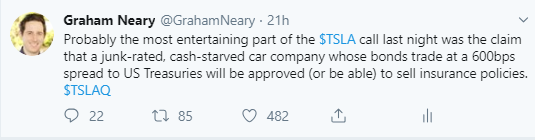
When a tweet blows up, the constant stream of notifications is incredibly addictive. Given Elon Musk's addiction to Twitter, I'm sure he feels the same way!
My main point is that staying on top of the analysis, and managing the trade, while also keeping an eye on all of my long positions and the rest of my portfolio, and providing media content too, is a lot of work.
Elsewhere in the last few days, I also had to deal with a malicious GDPR request by an individual who was upset that the writers on my website weren't bullish about a company he is invested in. I resolved the issue as quickly as possible.
This is merely to give you a sense of what's going on behind the scenes. I'm creating financial models, reading company reports, browsing the internet for any additional information that might give me an edge, talking with customers, and handling the occasional malicious attack. There's a lot going on that doesn't get talked about, but it's all part of the large mosaic of information and experience that gets pulled together to form this report.
What's different about this report compared to pretty much everything you would read from the City, is that this report is written by real investors who are putting their money where their mouth is.
That makes the production of this report a lot messier than the content written by sell-side analysts or PR agents. They rarely own any shares in the companies they talk and write about. Unlike those people, Paul and I are dealing with the consequences of our views on a day-to-day basis.
But we wouldn't have it any other way, and we're glad to share the journey with you.
Companies on the radar today:
- AJ Bell (LON:AJB)
- EU Supply (LON:EUSP)
- Allied Minds (LON:ALM)
- Audioboom (LON:BOOM)
- FairFX (LON:FFX)
AJ Bell (LON:AJB)
- Share price: 397p (+5%)
- No. of shares: 407 million
- Market cap: £1,617 million
This is not a small-cap and yet I feel that it deserves a mention.
My friend Andrew Latto has written a lot about this, and called it correctly as an attractive IPO opportunity. The IPO was priced all the way down at 160p in December.
This Q2 update shows customer numbers increasing by 5% in just three months, and assets under administration up by 8% to almost £48 billion (the increase in assets is mostly due to rising markets).
This article by Citywire focuses on the reduction in flows from defined benefit schemes, but underlying (non-DB) flows remained strong and in line with the prior trend. Indeed, CEO Andy Bell says that the H1 result will be slightly ahead of current market expectations.
I have to agree with the consensus view that this is a high-quality company with a serious growth opportunity in front of it, as it appears to be stealing business from the competition and has a lot of market share that it could expand into.
So I do think that it can grow into its valuation. But a lot of patience could be required, as the valuation multiples currently attached to it are very rich indeed. Much easier to hold it than to buy in at the current levels.
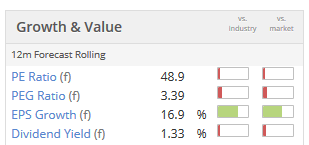
Forecast EPS growth of 16.9% can be contrasted with 11.2% at main rival Hargreaves Lansdown (LON:HL.)
EU Supply (LON:EUSP)
- Share price: 12.2p (+20%)
- No. of shares: 71.7 million
- Market cap: £9 million
This small software company confirms the results it guided for in February's trading update, and provides strong guidance for FY 2019 and the future.
It makes tender management and contract management solutions. In its own words:
The Directors believe that the Group's CTM™ platform is one of the easiest to use and most functionally advanced solutions available in the market. The CTM™ platform is used by over 8,000 European public sector bodies in 9 EU/EEC Member States and has National Procurement System status in four Member States (the UK, Ireland, Norway and Lithuania).
70% of revenues are recurring and the company has now made a healthy operating profit of £650k.
Reasons for caution:
- Top-line growth is modest at 10%
- There is a hefty interest bill, as a convertible loan note charges an interest rate of 10%.
- The company capitalised far more new intangible assets than it wrote off in the period through amortisation (£390k vs. £52k).
- Receivables book approaching £2 million
I'll keep half an eye on this. Management are looking for "stable organic growth" this year, to be followed by "accelerating revenue in 2020 and beyond".
Allied Minds (LON:ALM)
- Share price: 60.9p (-5%)
- No. of shares: 241 million
- Market cap: £147 million
This Neil Woodford-backed investor in US tech start-ups had a market cap of over £1.5 billion and was a member of the FTSE-350 index, back when Woodford mania was at its peak.
But public belief in Woodford's ability to do well in speculative ventures such as this is no longer what it was. The ALM share price reflects this change in perception, along with its own failure to make any real progress.
Huge losses at ALM have been racked up and the activist hedge fund Crystal Amber is now demanding that the vehicle should be shut down and liquidated for shareholders. Nearly 50% of the shares are still held by Woodford Investment Management and his old employer, Invesco.
Today's report from ALM, with the announcement of a new strategy, is a partial admission of defeat by existing management:
Going forward, we will cease new company investments and instead will focus exclusively on funding and operating our existing portfolio with a view to maximising monetisation opportunities...
Upon monetisation events, we expect to return net proceeds to shareholders after due consideration of potential follow-on investment opportunities within our existing portfolio and working capital requirements.
As for the numbers, there is an operating loss of $91.5 million, though for technical accounting reasons, the company reported a profit.
There is cash of $97.5 million on the balance sheet so there remains the possibility of a decent, non-zero outcome for shareholders, if capital is returned and subsidiaries can be sold off for a meaningful amount. Perhaps someone else will be motivated to study it in further detail.
Audioboom (LON:BOOM)
- Share price: 2.35p (-6%)
- No. of shares: 1.3 squillion
- Market cap: £30 million
Statement re Online Commentary
I'm surprised the market cap remains so high with this podcast platform. ShareProphets broke a story about it organising a placing yesterday, to which it has responded today.
The planned use of the proceeds:
It is intended that the proceeds of the proposed fundraising will be used predominantly to sign new third-party podcast talent. The proposed fundraising will enable the Company to offer, where appropriate, competitive financial incentives for leading podcast talent to join Audioboom's platform.
Hmm. This is a strategy which Audioboom has been executing for a while, but it seems totally backwards to me.
Because if Audioboom had a fantastic platform, then wouldn't listeners be begging podcast talent to move onto it? Which would make financial incentives from Audioboom unnecessary. Nobody begs a video blogger to publish on YouTube - video bloggers do that voluntarily, because YouTube is the best place for vlogs.
On the other hand, if Audioboom doesn't have a fantastic platform, then paying talent to publish on it is just a waste of time.
This feels like a bargepole type of stock to me.
Calling it a day there. Have a great weekend everyone.
Graham
Disclaimer
This is not financial advice. Our content is intended to be used and must be used for information and education purposes only. Please read our disclaimer and terms and conditions to understand our obligations.

49 comments
ALM "Perhaps someone else will be motivated to study it in further detail."
Allied Minds is complicated. Crystal Amber think their board costs are ludicrous, and have offered to manage the sale of holdings for far less cost. Woodford and Invesco are the biggest shareholders, and also hold a lot of CA.
"Shares in Allied Minds (ALML), the early-stage tech investor backed by Neil Woodford and Mark Barnett, have jumped 12% after Crystal Amber (CRS), an activist investor the fund managers also own, proposed taking over and winding down the company.
Stepping up hostilities against the US-based but London-listed intellectual property company, CRS chief executive Richard Bernstein said he had written to Allied Minds and offered to take over its management with the help of an American law firm with experience in this area.
In a statement to the stock exchange, Bernstein claimed he could slash Allied Minds’ shareholder costs by 70% by running the £135 million company for 1% a year while its portfolio of eleven companies was sold and capital returned to investors."
More here: https://citywire.co.uk/funds-insider/news/crystal-amber-offers-to-wind-down-allied-minds-for-big-backers-woodford-and-barnett/a1219243
With regards to the funds, investment trusts and individual shares discussion - I do all three. Funds are the lowest returns overall so far (but still positive), and I will probably cut the under-performing ones over the next month or so. Trusts seem to do better, but it's only the individual stocks that really outperform on their own (which is only natural when you pick the right one).
My handpicked stock portfolio contains around 25 shares now, and I'd say as a "fund" it comes somewhere in the top 20% of all my other funds/trusts performance. But it's certainly not the best "fund" I have.
As such, I thinks it's wise and gives me a level of comfort/diversiciation to have a portion of my money in some of the better trusts such as Allianz technology and Scottish Mortgage already mentioned. Plus there are other benefits such as exposure to other regions like China (Fidelity China Special Situations has done well for me) that might otherwise be difficult to do.
One last point - some of these trusts have a portion of their money in unlisted early stage companies as venture capital. So you get exposure, and some very good growth from opportunities that do a bulk of their boom growth before IPO.
Hi jared007..which trusts do you favour with some interesting early stage investments?
Hi hayashi22,
To be honest it's not something I went looking for, I just recently found out that two of my trust holdings were doing this - Scottish Mortgage and Fidelity China Special Situations. There was an article in money observer magazine about it recently. These are two of my better performing trust picks so far.
Many thanks
Ferrexpo (LON:FXPO)
Mary Reilly and Bert Nacken resign as directors. Both independent both on the audit committee.
No explanation, no "they are thanked" as Mr C would say.
Statement from Ferrexpo (LON:FXPO) this morning on the resignation of Deloitte as auditors followed by two of the non exec directors on Friday afternoon.
https://www.investegate.co.uk/ferrexpo-plc--fxpo-/rns/statement-from-the-board/201904290700193654X/
Statement includes the full letter from Deloitte as to the reasons for their resignation which appears limited to the timeliness of initiating an independent review into the misappropriation of charitable donations that may, or may not, implicate the CEO in fraud. Also addresses reasons why the IDs resigned - appears they didn’t like being expected to do any work for their stipend. Market reaction on Friday was to shoot first (c.30% fall in share price) rather than ask questions. For the strong stomached seems a lot of company for not a lot of market cap IF you believe the numbers and think the Deloitte resignation is a hiccup rather than bubonic plague.
Gus.
Thanks to everyone discussing trusts, funds, trackers and ETFs.
We are all at different stages of our investing. The stage I am at is where the portfolio is getting too big. This is not due to my exceptional skill but my ability to add £40,000 (wife's included) to the ISA each year. The amount of comfort with which I have been investing smaller sums is quite different to the level of comfort in investing in much larger amounts. The size of the daily rise and fall takes some getting used to.
I have recently been thinking of maintaining my smaller amounts and putting larger chunks into the type of instruments you have been discussing above.
Whatever happens I won't be putting Paul and Graham out of a job.
SJ
Hi Sirius,
You may want to trying looking at your portfolio as % swings and not monetary amounts. I spent 2 years working for one of the largest ‘locals’ trading futures on the LIFFE exchange, he only traded with percentages, if he viewed the daily p&l as cash it was too distracting. This is common across a lot of money managers in books like Marjet Wizzards, I only use percentages after reading those books.
I imagine %’s are a common approach here.
One that didn't get much coverage was AdEPT Technology (LON:ADT).
I do quite like this and they seem to be growing nicely. This surely must be close to the end of the acquisitions though.... with the payouts they are making it seems there might not be too much room left.
Their balance sheet makes me a bit uneasy though. they are very capital light, which leaves their liabilities being balanced mainly by intangibles. NTAV is negative.
This perhaps is not so much of a problem as they are clearly generating cash, the dividends look sustainable, and if there were no more acquisitions there would be room in the operating cashflows to pay down this debt. I do suspect though that this time next year they might prefer to acquire still.
Had a question on depreciation, it seems that many of their acquisitions being being depreciated at very slow rates, up to 30 years for Centrix, 10-16 years for the rest. Given that no customers are signing up for a 30-year deal I do wonder if this is too slow or a potential source of impairment in the future?
Their record for integrating the new businesses look good and many revenues look recurring. Is this the type of product where Amazon might become a threat one day?
I caught part of their presentation at Mello in November, which helpfully is recorded for posterity over at piworld (who incidentally have several other AdEPT presentations from the past couple of years. )
I probably wasn't paying the greatest attention to be honest as it wasn't at the time a core interest for me, but I am pretty sure they said that they still have a long pipeline of potential acquisition opportunities.
The one thing that did strike me though (and again it could just have been more my lack of attention) but they seemed to me to be presenting themselves as more of an 'investment fund' than an operational company. (No comment intended on whether that is a good or bad thing, just that it wasn't what I expected)
Returning from my day-dream about packing in the day job to the world of UK small caps I have a couple of comments about AJ Bell (LON:AJB).
I have several accounts with them, some of them bare trusts. While I have found their administration to be generally efficient I have had some issues with online dealing sizes. We typically deal in a minimum of £20k a trade and, on average £25k. We also have accounts with IWeb, Halifax and Hargreaves Lansdown (LON:HL.) to spread, so far as we can, the portfolios among different FCSC-backed entities. I also have level 2 through IG Group (LON:IGG) so I am able to compare real-time prices and sizes between the different on-line providers. I have found Hargreaves Lansdown (LON:HL.) to be easily the most easy to deal in UK small caps on-line in the types of size that I mention. I have found AJ Bell (LON:AJB) and the others much of a muchness really. Hargreaves Lansdown (LON:HL.) will often happily deal in up to £50k when the offer size on level 2 is much smaller, although, of course, they do quote a higher price. With the others they just want to take an order for anything over £20k and get back to you.
I didn't spot the opportunity with AJ Bell (LON:AJB) and am kicking myself!
Graham just wanted to say that I really appreciate all your hard work and reports, but yeah, sometimes you just have to take a friday off
mammyoko - don't know why you expected down votes. You've got another thumbs up from me. I'm sure lots of us feel the same way.
So, the answer that I've come to and am following, is to put a big chunk into ITs, a fair chunk in nice "safe" steady payers (bonds, prefs etc.), big allocations to whole markets (Japan, India, China) via ITs and ETFs and some "insurance" (gold) that I can forget about and then enough in individually chosen stocks to keep the interest but without worrying too much that I could become destitute next week/month.
Scottish Mortgage Investment Trust (LON:SMT) is already one of my largish holdings, not many of my individual stocks have managed to beat it over the time I've held. I really like the communication from James and Tom. Although I'd rather they weren't such big supporters of Tesla it's hard to argue against their performance over the time that I've held.
But then I don't play golf or much of anything else so need something to focus at least part of the day on. As you say, those that double in price keep the blood coursing - but some of those have come from PIBS and country specific ITs which were supposed to be "safe and steady".
If you have the spare time (!), I would be fascinated to know what a malicious GDPR request is.
Thank you for sharing with us Graham. Interesting to hear what goes on in the back ground.
For anyone interested, don't be put off by the fact that the Tesla Autonomy Day video (which Graham mentioned) is 4 hours long. The first hour is just promo material and the second hour is about chip design and can be skipped if all you want to know about is where they are with autonomous driving.
So the "meat" starts at about 1hour 53min on the neural nets followed by the software at 2h 50min - roughly an hour on each. I was extremely impressed. They use the "fleet" (i.e. all Tesla sold since Oct 2016 which contain the necessary hardware) to collect test data anonymously to train the neural net. If they have particular issues (e.g. recognising debris in the road) they can ask the "fleet" send more examples of just that kind of data - so they don't collect vast amounts of not very useful data they have to sift through. The cars do the sifting in advance.
Then having developed an FSD (full self-drive) feature they can send it to the fleet to execute in "shadow mode" which means that the hardware is shadow-driving the car even though the human is doing the real work. If it notices differences in what it would do compared with what the car really did, again it can send the "use case" back to Tesla to further train the system.
Musk does embarrass the speakers at one point when someone asks how it can safely merge into LA traffic where you have to be a bit aggressive or you would never get a gap, and he says there will be a user option to specify how much you are prepared to allow the software to risk a collision to achieve the merge! Pretty sure he was making that up off-the-cuff!
They do also address the issues of redundancy necessary to be a safe fully self-drive vehicle.
So basically, if this is an area that interests you, it is worth a watch and the commitment is "only" two hours not four!
Great insight into your busy schedule, Graham! I've never met either Paul or you but it's insights like that that make me feel as if I have and that make this website worth following.
Many people like to meet the directors in a company or at least listen to them speak. I have learned that I am a poor judge of character and so am susceptible to being charmed by good talkers or put off by bad ones.
There's something about the way in which honest people write that is easier for me to assess than when they talk. Transparent accounts don't necessarily mean that the company is worth investing in, but it's one less thing to worry about! We all spend way too much of our time trying to get at the truth behind what directors write (and say) that there is surely a market among many PIs for a company that tells it how it is.
For an excellent example of pretty Honest and transparent accounts I always recommend people to look at SysGroup (LON:SYS)1 . That may, of course, be the kiss of death for any holders there!
Nice sentiments in response mammyoko
After recent days comments on the yin and yang styles of our favourite SCVR authors and Grahams heart on a sleeve opener today I am reminded of the lyrics of a Groove Armada song
If everybody looked the same
We'd get tired looking at each other
You know
You know the fellas good
We'd get tired looking at each other
You know the fellas good for the moolah
Keep on doing just what your doing Guys
Hi Graham, FairFX (LON:FFX) too please. I’ve been very critical of the company previously in here regarding the poor fx spread but I changed my mind recently and bought. I thought oversold giventhe strategy being implemented buy the founder CEO. (Significant shareholder and very open & easy to email).
Slightly off topic here but a parallel for those who invest in small caps and look for moats, platforms and network effects. Each time I talk myself out of an investment in one of the FANGS, or my preference being Scottish Mortgage Investment Trust, based on value & the thoughts ‘ they must be ex growth soon’ we get stunning results from Facebook, Netflix, Microsoft and this morning Amazon. 16% growth in revenue, I find this a ‘wow’ figure for something all ready enormous. People like Buffett, Train, Terry Smith all view successful businesses can keep getting bigger in a way that most of us can’t really comprehend. For those interested James Anderson, manager Scott mortgage , is a very interesting read:
https://citywire.co.uk/investment-trust-insider/news/james-anderson-uncut-our-full-in-depth-interview/a1163991
‘’The company’s net income for the first three months of 2019 more than doubled year-on-year to reach a record $3.6bn (£2.8bn), or $7.09 per share, compared to the average estimate of $4.72.
Sales reached $59.7bn for the quarter, meeting estimates according to Refinitiv. Revenue growth came in at 16.9 per cent compared to last year, the firm’s slowest rate in four years. ‘’
Re: Scottish Mortgage Investment Trust (LON:SMT) interview
Many thanks for the link, John652. That looks like a fascinating interview. The Scottish Mortgage Investment Trust seem to be one of the best investment trusts / funds with a total return CAGR% over five years of 22.6%. I will watch the interview with interest today. As small cap investors, maybe we are sometimes too keen to find the next platform business / growth story. As a result we might be missing some of the gains to be made from the already established platform businesses who have established and successfully defended their strong economic moats.
It's worth noting that the Scottish Mortgage Investment Trust (LON:SMT) number 5 investment is in Tesla at 5.3% of the total. Baillie Gifford is a major Tesla shareholder.
It's for that reason that I prefer Polar Capital Technology Trust (LON:PCT) where Tesla doesn't appear in the top ten holdings.
You might also look at Allianz Technology Trust (LON:ATT) which also doesn't feature £TSLA in top 10 holdings and has been stand out performer in technology sector Trusts and Funds. Prior to the 2018 4Q it was one of the strongest performers but year to date it has been racing ahead with a gain of 34.5%. Unfortunately I missed the buying opportunity pre Xmas!
I have so often been close to packing it all in and just putting all my assets into a mixture of Allianz Technology Trust (LON:ATT) , Scottish Mortgage Investment Trust (LON:SMT) and £RII with possibly a bit of Blackrock Smaller Companies Trust (LON:BRSC) or Fidelity Special Values (LON:FSV) thrown in and then heading off into the sunset.
I have to admit that I would be wealthier and have fewer grey hairs. But I would have missed all that excitement you get when one of your holdings leaps 20% in a day or you wake up and find that another is 100% higher than when you bought it! Particularly if you manage to convince yourself that it was all down to your skill in anticipating it.
I am still very close to handing it all over to the investment trusts so would love to hear why others don't just do so and how many people think they have out-performed the trusts I mention over the last ten years.
Expect some down votes for this as it might put Stocko, Graham and Paul out of business if we were all to do it!
Surely mammy the logical top-down approach is to use diversified passive vehicles for your core allocation, then add in some active ITs, ETFs, UTs to get more specific exposure (tech, income, growth, Korean gold miners......whatever factor tilt takes your fancy), then some larger cap shares and finally some small caps - for icing on the cake, areas where you have specific knowledge, 'excitement plays' etc. And I suspect 'excitement' is the most dangerous word for many of us.
I'm constantly bemused at the concentrated portfolios run by many on here, advfn etc. Professional investment (and 'wealth' - yucky term!) advisers would have a fit. I was invited to a James Hay focus group a couple of years ago and found I was the only one in a room of 12 who invested in individual shares.
To my mind the biggest weakness of the Stocko 'community' (another yucky word!) is the minimal focus on the big picture. Starting with bond/equity/alternatives allocation, then considering geographical split (bearing in mind most UK and US investors display strong home-country bias), then considering how best to implement. Instead, so many appear to start with a bottom-up approach.
I'm in a position where in a few months' time I'll be transferring meaningful occupational DC pension assets (LTA-level) into a £400k 'unstructured' SIPP. There's no way I'd be comfortable adopting my past strategy going forward!
All of my DC pension money is in trackers. They have a straight split 20% each in the major geographies as I don't pretend to be able to predict at index level! It is the ISAs and non tax free portfolios which are in individual shares and some active Its. At the end of the day I am not a FT investor and one has to be sensible.
You are a more sophisticated and disciplined investor than me!
I save my overseas diversification for my defined contribution pot. I simply don't have sufficient conviction on the state of any world economy to feel comfortable in even selecting a country-themed trust or fund, so the funds that I manage are hopelessly concentrated in UK smaller caps.
I have passed about 30% of the family's trust holdings to a discretionary fund manager (Psigma) on an extended trial basis but I have to admit that despite a wide range of almost exclusively fund and trust investments in that portfolio, I don't feel that it is much less volatile. In the recent sell-off, my UK small caps lost about 10% and are now up about 15%. The discretionary portfolio lost slightly less (about 7%) despite its much wider geographical and product spread but has regained only about 7% in the recent recovery.
I recently took the US portfolio service for Stockopedia but simply haven't used it. Quite apart from the added FX exposure, I have no contact with most of the smaller businesses in its universe and so absolutely no impression of whether they are good or bad businesses. I also worry about my lack of understanding of US accounting rules and whether a subtle difference in these could be crucial.
Hence my challenge as to whether a portfolio comprised of some selected investment trusts with perhaps a dollop of £AMZN or £GOOGL for good measure might both out-perform with lower implied volatility than any carefully constructed portfolio from a financial manager. I'm sure other better-informed people on this site will be horrified by such risk concentration. Although I am a strong believer in mean reversion, I do think that there are trusts that have beaten their benchmark over extended periods so I just can't bring myself to trust entirely to index trackers.
I may well take the opportunity presented by recent strength to try this experiment and report back in three years as to how it is going. Given that my day job is management of family trusts I will need to find a new occupation not requiring me to get up at 7am to read the RNSs.
Apologies to all for extended divergence from the subject of UK small caps!
I have to agree with the sentiment about putting it all into an investment trust, or a low cost ETF.
For an ISA or SIPP there is still a lot of merit in self investing where in the small cap space, it is possible to outshine the managers. However, if you are paying CGT on every gain (i.e outside a SIPP and ISA once your CGT allowance is used up) then I am not so sure that self investing makes good sense. Perhaps it's best to simply invest in a spread of tracking ETFs and let the CGT liability eventually die with me.
Good question mammyoko. But here is the thing, professional managers make their money by taking 1% or more from other peoples' money. They don't take anything other than a business risk. If they underperform their benchmark they get fired at worst. They don't give the money they have earned back. In my opinion they are the ones who favour diversification for this very reason. Sure if you have a steady job and want your savings to give you an asset class return then this is ideal. Because that is what most of them do and let's face it you are still guessing. It is just you are guessing who you should trust with your money rather than which management team and business to go with. I once saw an interview with Jim Rogers in it he said "if you are going to get rich then you need to take on risk". I have never heard a truer thing, the question is how do you temper that risk. But investing 1% of your portfolio across 100 stocks for me is a waste of time. Buy passive and let them crunch the numbers and pay a lower fee. I still see very few examples of active management doing a good job. BUT they do exist, my great favourite was Anthony Bolton at Fidelity who returned something like 17% a year over 20 years. My approach is do your research, as Paul says pay attention to the balance sheet, then if it goes wrong you might get a second chance. Look for companies meeting needs etc etc but when you decide you are right back yourself.
There is a very good reason why I do not hand over my money to financial fund managers, this being that since I invested seriously using a disciplined approach, with Stockopedia being my chosen platform, my performance has been (for me) stellar compared to anything these guys can do.
To validate this to myself, I just checked my performance on the X-Ray on AJ Bell where I hold an account, and it gives me the numbers on my 'Time Period Return'
Best periods as follows:
3 months: 44.36% (Nov 16 - Feb 17)
6 months: 60.48% (Dec 17 - Jun 18)
12 months: 108.10% (Sep 17 - Sep 18)
3 Years Annualised : 50.69% (Mar 16 - Mar 19)
5 Years Annualised : 31.33% (Jul 13 - Jul 18)
Now I did join Stockopedia in Aug 2010, but did not use it properly, nor with discipline, this being the key, until around 3 years ago, so my 5 Year Annualised figure above of 31.33% also includes some of my usual 'under performance' years too, and as was so common before Stockopedia. My investing at this time was like a yo-yo - huge gains followed by huge losing streaks, which is largely hopeless.
So, what not to like, and hopefully explains why I will NEVER use funds again.
Best Regards, TT
Well done Techno. Why not share a couple of the star performers which have helped you along the way?!
Hello Hayashi22
I am happy to share all the current portfolio, as the historical picks will not help much now. So my currently portfolio is only numbering eleven, and I am probably around 45% cash still.
In no particular order, they are:
Fevertree Drinks (LON:FEVR)
Dart (LON:DTG)
Altareit SCA - Euronext PARIS (the £ before the ticker doesn't appear to work)
Bushveld Minerals (LON:BMN)
Lonmin (LON:LMI)
Somero Enterprises Inc (LON:SOM)
FairFX (LON:FFX)
RockRose Energy (LON:RRE)
JKX Oil and Gas (LON:JKX)
Sylvania Platinum (LON:SLP)
Water Intelligence (LON:WATR)
So, maybe a little too focussed at the moment on metals and oil/gas, but I am currently not concerned on this and will look to diversify more as I drip feed more cash into the market.
TT
Hi Techno Trousers
One thing to be aware of is the portfolio X ray tool valuation doesn’t track your portfolio at all...
Instead it looks at your current portfolio holdings/weighting and tells you how they fared going back in time
If your portfolio hasn’t changed over the years it is better...but not ideal still as it uses your current weighting to Imply past performance...which again can be misleading
Many thanks for sharing your current portfolio. Hope it continues to go well for you. I've been in and out of Dart (LON:DTG) over the years.
I think you raise some interesting points and I have quickly pulled together the below table to show the returns the Investment Trusts generated in 2018, although bear in mind these are not all calendar year but whatever year end date each investment trust has in place. I have taken the data from each IT website. For example Allianz's data ran for the year to 31 March 2018 which would be more favorable than taking data for the year to 31 December due to the sell-off in Q4 2018.
However, each trust has outperformed its benchmark from 9.3% to 26.7%. This is quite a significant out-performance. Taking into account and suggests there is definite advantages of employing the skills of a manager. Whilst the table below shows shareprice performance, it may not match the NAV performance and there may have been addition alpha as a result of this.
I have assumed that passive funds replicating the benchmark exist and charge 0.1% which is significantly lower than IT fees. It is apparent from the table that you would have generated a better return in 2018 by investing in a trust rather than a ETF/passive fund.
I did note on a few websites it was mentioned that a new charging structure was being introduced which was basically reducing the charges, perhaps as a result of the fee pressures from the passive.
I guess whether you choose to invest in an trust or self-select depends on your own skills set, time, risk tolerance etc.
Hi JohnE,
Scot mortgage & Tesla at 5%, that is the second biggest reason for avoiding it. As much as I like and respect James Anderson I canny get past the 5% or why he believes this is a good idea. Tesla just shouts investors using Other Peoples Money, ie fund managers. I think Musk is a great character & the world needs crazy billionaires but I wouldn’t put a penny in Tesla, the risk reward is appalling. That said James A has called a lot of other stocks right but again 5%, can’t do it.
Thanks for the other trust ideas from the other posters.
Hi Graham, EU Supply (LON:EUSP) has released their audited final results. It's one you have covered in the past. Is it possible to get an updated analysis from you? I personally think momentum has started to become more positive for the company. Still only ~7.5m market cap but you have 70% of the £5.1m revenues recurring. A profit before tax of 0.4m too. They have said Q1 had positive cash flow. Positive noises in the outlook too. Any thoughts from readers?
https://www.stockopedia.com/share-prices/eu-supply-LON:EUSP/news/eu-supply-plc-final-results-urn:newsml:reuters.com:20190426:nRSZ1637Xa/
(I hold as declared on twitter @MGinvestor )
I've had EU Supply (LON:EUSP) on my watch list since someone on this forum recommended it as a potential star in waiting (thank you whoever that was)
I too liked the results this morning.
Cash flow looks decent, growing revenues (although I don't like their use of "revenue of a recurring or repeatable nature" - how repeatable? every couple of years? or annual contracts?), no single customer making up a material part of revenue, positive outlook for the future.
A couple of notes I've made in the past:
Graham mentioned a 10% convertible loan note, but from what I understand this only runs until 2020 at which point they need to be converted at effectively market price...so not a long term cost to worry about?
One thing that did confuse me though was how staff costs were only up only 4% (£2.9m to £3.1m), yet number of employees increased by 20% from 46 to 55 - something just doesn't fit there. Or I'm misreading today's statement.
I don't hold, but I have a feeling I will do in the near future.
EU Supply (LON:EUSP)
I have not looked in depth at this company, but that query interested me and so I had a little dig.Without looking the two "obvious" options would be :
1. That they hired staff towards the end of the year.
Whilst that may be true, it is not the explanation as the headcount numbers they quote are averaged over the year rather than being year end positions.
2. That the increased headcount was for lower paid staff.
That doesn't seem right either, given that they say "Additional more experienced staff have also been contracted, hired and trained in H2 2018, and post-period end."
More experienced generally equates to more expensive. (Although they did reduce the number of directors by 20%)
There are I think instead two other possible answers :
> The headcount numbers they quote are for "The average monthly number of permanent employees".
- Do they use a lot of temps or contractors?
> Some of their payments to staff are not regarded as costs but rather as investments. "Expenditure being capitalised includes internal staff time and cost spent directly on developing the CTMTM platform. "
To be fair, they do amortise these costs over only three years, which is not unduly long, but it is worth noting that they capitalised net £339k of development spend in the year (zero the prior year). If the majority of that is staffing, then it would bring the increase in outlay on staff more into line with the increase in headcount.
Therefore, so long as you are satisfied with that capitalisation of development costs - I don't think that there is a significant issue.
FairFX (LON:FFX)
On the face of it very good results this morning with revenue rising 69% (39% excluding acquisitions).
Adjusted profit measures have risen 600%+ but are indeed heavily adjusted. I can understand that these items are ( hopefully) one-off and need to be highlighted to explain the growth potential but am slightly wary as they are not the normal items you see as adjustments.
Perhaps more interesting is the outlook increase in Q1 revenues of 43% - I suspect gaining scale is the key here at the moment rather than profitability.
Phil
Pondering a buy
Phil
I too am wary about FairFX (LON:FFX) adjustments, and would like Graham's interpretation of them. I see the shares are up nearly 7% today after recent weakness. I hold.
Richard
Another request for FairFX (LON:FFX) please. On the face of it (as presented) the results look great. My concerns are:
1. the heavy reliance on EBITDA and adjusted figures (as mentioned by RichardK
2. the significant reduction in cash during the year
* the acquisition cost £6.5m
* cash at the year end has decreased by £10m
* the additional cash outflow seems to be explained by the acquisition of intangibles - £5.8m. Did I miss an explanation of this? Is it a further cost of the acquisition (i.e. total cost of acquisition = £12.3m)
Overall I am impressed by their growth trajectory but concerned about their ability to generate consistent profits in a highly competitive marketplace. Is there any competitive advantage other than size and effective marketing? Will size guarantee continued success.
As a comparison, I have been highly impressed by my new Transferwise currency card and account (used on a long trip to New Zealand). Switching between currencies is very easy. Costs are very competitive. All transactions are immediately notified on my mobile so I can:
1. monitor my expenditure in all currencies
2. pick up any signs of fraud very quickly (if e.g. the card details have been cloned).
Not a small cap, but posting here as the topic of fraud has raised its ugly head with the likes of companies such as Patisserie Holdings (LON:CAKE) recently. Deloitte, the statutory auditor of Ukrainian miner Ferrexpo (LON:FXPO) has resigned with immediate effect this morning.
https://www.investegate.co.uk/ferrexpo-plc--fxpo-/rns/resignation-of-auditor/201904260700102131X/
Background relates to an ongoing investigation into the alleged misappropriation of substantial donations made to a local charity by the company over several years. One of the statements inferred that the CEO was potentially implicated but that the company’s own investigations suggested this was not the case. Disclosure by the company to date has been reassuring/complacent/dishonest depending on your point of view/degree of cynicism, but the sudden departure of the auditor today suggests there may be something more rotten than implied by the public statements made to date. May be perfectly innocent and blow over but past experience suggests otherwise. Interested to see what Deloitte say on the matter (if anything) but alarm bells ringing for holders in this FTSE 250 company.
Gus.
Interesting as Stockopedia has a very strong rank for Ferrexpo (LON:FXPO) at least before this mornings c. 20% fall: Overall 96 (Q 82, V 73, M 89). Will this be another case of the reported numbers not reflecting reality due to a massive fraud as with Patisserie Holdings (LON:CAKE). Unlike Patisserie Holdings (LON:CAKE) (after all how risky can a UK based cake business be?!) fortunately steered clear of this one as mining and Ukraine unlikely to make for a safe investment. Though to be fair my effort to catch the Lithium/Cobalt electric battery materials wave has failed miserably even though my investments are in supposedly safe, well regulated jurisdictions!!
Ferrexpo (LON:FXPO)
Not surprised that Deloitte resigned, if no other reason they have fallen out with the company.
Whether we find out more than that already contained in Deloitte's qualified opinion remains to be seen, there is, however, the requirement under s519 C Act 2006 that an auditor considers whether there are matters connected with ceasing to hold office that the auditor considers need to be brought to the attention of members or creditors of the company.
Phil
Morning all any thoughts on FairFX (LON:FFX) which seems to have doubled profits yoy & is off highs? PE of 14.3 according to stockopedia hi I think it’s best brings it to nearer 11 according to my crap mental arithmetic...
Hi, good morning all. RDL Realisation (LON:RDL) have been drifting for some time before announcing a relatively small writedown (on a Paul Scott day). The share price movement perhaps implied this news had leaked and also that it might be the tip of an iceberg (or alternatively, that there is a very small pool of potential buyers).
The company has a split structure with ZDP shares that have the first call on capital. To protect these shareholders there is a buffer in place that I believe is currently preventing further capital returns to ordinary shareholders. In November 2018 the company offered to buy them out for 116p. Today there is an announcement about independent discussions to redeem them between 120.75 and 122p. This is versus their contractural entitlement of 127.63 pence at 31 July 2021. On the face of it an uplift of at least 4% in just 5 months seems good news as it implies continuing or even increasing confidence. Similarly, the remaining return of no more than 5.7% over 15 months doesn't seem to be outsized, albeit much higher than the 2% rate they were issued with.
Graham, I wonder if you could find time today to look into recent events further?
My morning smallcap tweet: BOOM business booming - in issuing shares
Van Elle Holdings (LON:VANL), AJ Bell (LON:AJB), Audioboom (LON:BOOM)
Van Elle (VANL) guides FY rev 3% miss and pretax slightly below the lower end of the range of market expectations. Outlook: "momentum entering the new year underpins the Board's confidence in the prospects for the Group".
AJ Bell (AJB) guides H1 slightly ahead of current market expectations.
Audioboom (BOOM) confirms media report of planned £5m placing at 2.5p, a nil discount. Money mainly to sign new third-party podcast talent. It raised £1.5m at 1.3p only 2 months ago!