Small Cap Value Report (Fri 26 Jan 2018) - SDI, ARE, WTG, MLIN/MCAP, PAY, HW.

Good morning!
After a hectic month of news, we finally get a relatively slow news day today.
Stocks crossing my radar are as follows:
- Scientific Digital Imaging (LON:SDI)
- Arena Events (LON:ARE)
- Watchstone (LON:WTG)
- Molins (LON:MLIN)
- PayPoint (LON:PAY)
Thank you for suggesting PayPoint (LON:PAY) in the comments, which updated yesterday. It's not strictly speaking within our market cap limits, but it's a stock I have followed before.
Time permitting, I will cover other requested stocks.
Thanks!
Graham
Scientific Digital Imaging (LON:SDI)
- Share price: 29.5p (+13%)
- No. of shares: 89.6 million
- Market cap: £26 million
This is an acquisitive company focused on scientific and healthcare-related technology.
We haven't covered it too frequently here. Last time, I said that I was put off by the rapidly increasing share count, which has nearly trebled since 2015. In general, I prefer organically growing companies, rather than companies which are growing through acquisition.
The SDI share price would suggest that the company's strategy is performing extremely well, so maybe I should try to have more of an open mind?
These interim results are good:
- Revenue up 34% to £6.6 million. Organic growth from two subsidiaries, plus growth from two recently acquired companies.
- PBT up over 100% to £850k, adjusted PBT up 140%.
There are now six subsidiaries, following the most recent one in August 2017.
It turns out that the two most recently-acquired subsidiaries act as supplier to a third one.
This can be a source of confusion. What happens when your PLC's subsidiaries are buying and selling things between each other?
The answer is that any transactions like this need to be completely ignored when it comes to financial reporting for the parent company PLC. It should be as if the transactions didn't take place. That is how "consolidation" works.
But it doesn't mean that no additional value is being created by the interaction of your PLC's subsidiaries. The overall margin achieved by the company improves as there is more work being done between getting in the raw materials and turning them into finished products for customers.
In terms of margin, SDI's gross profitability has been consistently improving over the past few years:
- 2014 - 57%
- 2015 - 59%
- 2016 - 61%
- 2017 - 64%
- 2018 H1 - 67%
More acquisitions are on the cards. If they are more of this supplier/customer type of acquisition, I'd expect the margins to keep improving.
With up to £5 million available in a banking facility, I wonder if the share count might stop growing so fast now? That would be an important hurdle for me to consider personally investing.
Balance sheet: Nearly all of the value is in intangible assets, as you'd expect for a company pursuing this strategy. Equity of £11.8 million is almost fully accounted for by £10.6 million of intangible assets.
My opinion: The company has some attractive characteristics. High and growing margins, niche scientific products, and a healthy bounce into profitability over the past few years.
My only concern is over the strategy. When the share count is increasing so fast, I'd be concerned that it would be difficult to keep track of what was happening and that at some point, the wheels would come off with large deals which didn't work out.
On the other hand, I'm ok with modest increases in the share count, to enable a growth strategy. Perhaps this could evolve into having a more stable share count, over time?
In the comments, a comparison has been made between SDI and Judges Scientific (LON:JDG). If you compare how their strategies have been implemented, you'll see that the Judges Scientific (LON:JDG) share count has increased by only 50% over the last ten years. That's because Judges has had modest deals funded by its own cash flow and a debt injection, as required. I much prefer this strategy.
Stockopedia agrees with my lukewarm view on SDI for now. The shares look fairly valued to me.
Arena Events (LON:ARE)
- Share price: 61p (-1%)
- No. of shares: 117 million
- Market cap: £71 million
Arena listed on AIM at 55p in July last year, and this is my first time looking at it.
It's an international events business which builds temporary structures, ice rinks, seating, interiors etc. It has big-name clients in tennis and golf.
This update is in line with expectations, for the year ended December 2017.
The threat with every IPO is the "wobble" which, if it happens, is typically in the first 12-18 months, as the risks which IPO investors missed first become obvious.
So it is reassuring to hear that Arena hasn't had any wobble yet - maybe it will be one of those which doesn't have one!
A couple of big projects in H2 are mentioned: Dancing on Ice for ITV, a Koren golf tournament and an ice rink for New York.
It sounds like the cash movements have been moderately unfavourable, with increased capex and a higher working capital requirement. Net debt is £11.5 million. The current year has started "well".
IPO - checking the flotation data, I see that the company raised net c. £57 million, of which c. £44 million was used to pay down debt, and the rest is to be used for growth.
Unusually, IPO investors walked away with well over 90% of the company's share capital. It was a sale of almost the entire company from private equity investors to a range of fund managers.
Here is an excerpt from the admission document, which shows how overly indebted the company had become. The figures are 2014-2016, from left to right:

As you can see, operating profit was decreasing while finance costs were increasing, resulting in escalating pre-tax losses.
This probably explains why the pre-IPO owners were willing to give away nearly all of Arena in exchange for money with which to pay down debt - the financial structure had become unsustainable. Shareholder loan notes were a big part of the structure, so it also meant that they got back the money they had previously lent to the company.
With over £90 million in revenue by 2016, the operating margin implied by the above figures is a bit lower than I would expect from an events business. ITE (LON:ITE), for example, achieves operating margin of >20% when things are going well. But I suppose Arena is merely contracting for events, rather than owning them.
Checking the risk factors in the admission document, the customer base does at least sound reasonably well-diversified for an events business. "Certain customers... contribute up to approximately 4% of annual revenue" - OK.
Estimates - The broker forecasts available to me suggest that 2017-2018 will prove to have been much more financially successful than 2014-2016.
Now that we have a full-year update which is "in line", does that mean the 2017 forecasts have been realised? Normally I would say yes, but I'm nervous the figures available to me might be mistaken. I can see forecasts for EBIT of £5.6 million and net income £4 million in 2017, followed by £6.5 million EBIT and £4.9 million net income in 2018.
If those forecasts are true, it makes the current valuation a bit punchy but not unreasonable. I still need more information to form a view. In particular, I need to understand why 2017 has been such a stronger year compared to 2016.
Watchstone (LON:WTG)
- Share price: 102p (1%)
- No. of shares: 46 million
- Market cap: £47 million
Paul recently wrote a post-script on Quindell (see here).
The reverberations from that saga continue as this most controversial of stocks is not dead yet - now trading under the name "Watchstone".
It has slimmed down to just two operations - pt Health and ingenie (both external links).
The first operates 230 healthcare clinics in Canada, and the second is a British telematics company.
If you're perplexed by the logic in having these businesses under the same corporate umbrella, you must not have seen how crazy Quindell was a few years ago!
At least the new managers have been tidying things up. There are now just 3 full-time staff in the central team.
The shares remain a special situation. The company has £63 million in cash, significantly more than the current market cap.
The problem is that there's not much sign of any profitability (the latest interims showed a loss, even at the "underlying EBITDA" level).
There is a further £50 million of cash being held in escrow for Slater and Gordon, the Australian legal firm which bailed out Quindell by buying most of its worthless assets.
Slater & Gordon is on the warpath, and Watchstone has increased the provision for its legal defence against S&G's accusations of deceit. The SFO is also still investigating what happened at Quindell.
For these reasons, I see the risk as being skewed to the downside here. Even in the best case scenario, the retained businesses are not exactly inspiring with their financial returns, so probably the best that can be hoped for is a return of capital.
(This section was edited after a reader spotted an error - thanks! GN)
Molins (LON:MLIN)
- Share price: 157p (unch.)
- No. of shares: 20 million
- Market cap: £32 million
Change of Name to Mpac Group plc
Just a quick note on this packaging company.
It sold its tobacco division last year, in a £30 million deal (or £27 million net of taxes and fees) which also saw the "Molins" name being sold.
Therefore, it needs to change its PLC name. From Monday, the ticker will be £MPAC.
To recap: there is a >£400 million pension fund attached to this stock, and its outcome looks at least as significant, if not more significant, then the success of the remaining operating businesses.
As such, this is another stock whose fortunes would be transformed by rising interest rates.
PayPoint (LON:PAY)
- Share price: 897p (unch.)
- No. of shares: 68 million
- Market cap: £612 million
Trading Update for the three months ended 31 December 2017
The lack of news today lets me circle back to yesterday's announcement from PayPoint.
Most people are probably familiar with the PayPoint sign attached to convenience stores - it means there is a PayPoint terminal inside, where you can pay bills and top up your mobile phone. The traditional customer is someone who doesn't have a bank current account. Some "banked" customers choose to use it too.
I've previously bought this share on behalf of others, due to its excellent cash generation, high returns on capital, and relative immunity, as payments processor, to the vagaries of economic cycle.
Over the last year or so, PayPoint has launched an "all-in-one" platform for retailers, which looks very useful to me. You can see it on YouTube here (external link). Yesterday's update says that 7,400 retailers are operating it now.
In terms of overall performance, guidance is unchanged and everything so far is in line with expectations.
Some highlights from quarterly performance:
- UK retail services net revenue is down by 18% due to not enjoying last year's one-off benefit of a VAT recovery, and some restructuring in its click-and-collect service, Collect+. Excluding these factors, net revenue is up by 4.6%.
- UK bill and general net revenue down 3.3%. It looks like this division is in secular decline, with fewer people prepaying for energy and their mobile phone.
- Romanian division growing strongly, helped by an acquisition.
My opinion
I need to put this company back on my watchlist, and consider getting a few into my personal portfolio.
The main threat would be that over time, there are gradually fewer and fewer people without a bank account who need to use a PayPoint terminal to pay their bills.
On the other hand, I like the opportunity in providing services to retailers. That could be a great long-term earner.
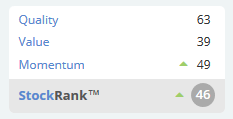
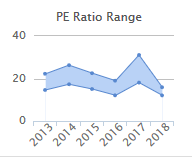
This graphic from Stockopedia says that the stock is currently trading around the low of its PE multiple in recent years. The StockRank is 81, with a Quality Rank of 95.
Harwood Wealth Management (LON:HW.)
- Share price: 147.5p (unch.)
- No. of shares: 62.5 million
- Market cap: £92 million
Scrolling back further again to Tuesday's results from this financial planning and wealth management group, based in Hampshire. It has been listed since March 2016.
These are full-year results to the end of October 2017.
Percentage growth figures are given, but they aren't interesting from a performance point of view seeing as seventeen acquisitions took place in the previous financial year, and another seven in the year which is being reported.
The acquisitions are all small however:
- FY 2016: seventeen acquisitions for aggregate consideration £11.7 million
- FY 2017: seven acquisitions for aggregate consideration £2.3 million
Headline numbers for 2017:
- Revenue £25.9 million
- Adjusted EBITDA £4.3 (a very heavily adjusted number)
- Net income £0.7 million, up from breakeven
- Period-end cash of £19 million, although another c. £2.2 million was paid out in acquisitions and dividends since period-end.
An improved final dividend is declared, reflecting strong net cash generated by operations of £3.7 million. There was no free cash flow, however, as a figure greater than that was used making investments during the year.
Digging into the cash movements, £10 million was raised in April 2017, following £10 million having been raised a year earlier, to fund the acquisition strategy. But the company has also been paying out an interim and final dividend since it listed.
This is a small source of inefficiency which I see very often - when companies are raising funds from investors but also, around the same time, paying out dividends to those same investors. If anyone can explain why such companies shouldn't stop paying dividends until they are generating free cash flow, I would love to understand!
Putting some of the key points from the statement together as bullet points:
- MiFID II has principal effect on Harwood's suppliers (fund managers), so perhaps not of great concern to shareholders in this case.
- Strategy is to aggregate smaller financial services businesses within its stable, integrate them, and benefit from improved economies of scale, as products are rolled out to an ever-widening network of advisors. In terms of organic growth, pension freedoms have opened up new opportunities to provide bespoke financial advice to customers.
- Rising equity markets are also a tailwind, as some fees are calculated as a percentage of AuM.
- Outlook statement is confident.
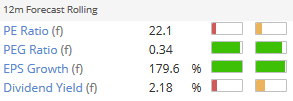
The broker to the company is forecasting adjusted PBT of £5.1 million for financial year 2018. It reckons the ex-cash PE ratio is 21x, not far off the Stockopedia non-adjusted PE ratio:
Future cash flow will be ploughed into more acquisitions, hopefully leading to compound growth.
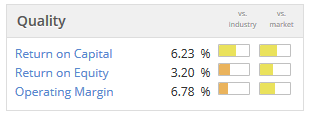
If I can see a route for the company to generate above-average ROE, then the compound growth argument would start to look very compelling.
My impression of Harwood is that it's still very much in the mould of a professional services company, i.e. a people business. Providing bespoke advice to clients with complex challenges is labour-intensive work.
For that reason, I think it might be difficult to achieve above-average ROE here.
The data so far confirms this impression:
Turned out to be a long day in the end, I hope you made it this far!
Have a good weekend all.
Cheers,
Graham
Disclaimer
This is not financial advice. Our content is intended to be used and must be used for information and education purposes only. Please read our disclaimer and terms and conditions to understand our obligations.

40 comments
Regarding the apparent inconsistency of companies paying dividends while also raising money from shareholders: I recall reading a book many years ago which made the case for doing exactly that. It may have been a US book but the point being made was that by forcing a company to pay out its entire after-tax profit, it also forced management (a) to generate enough cash to cover the dividends without having to borrow and (b) to be able to justify to investors the company's investment intentions, thus ensuring a focus of good capital allocation. By using retained earnings and borrowings to expand, there is a risk of poor capital allocation.
Of course, it seems likely that the cost of raising new money, allied to the mismatch of tax rates on income versus capital gains wipes out the logic of the case being made but it is worth giving it some thought.
Hi Paul,
Are you covering Conviviality (LON:CVR) today? Is today's dip a buying opportunity?
Regards, Peter
Thanks Graham for a superb effort today.
Enjoy the weekend, Dave
GN. TW at Share Prophets is the authority on WTG(he exposed the fraud which was Quindell). Only £5.99 pm sub. PS knows him well(tweets him middle of the night when he's pissed, so TW says).
Hi dewigo, yes I am familiar :)
re: Watchstone (LON:WTG).
Good point on the money in escrow - whoops. Fixing that now. Thanks for the correction.
Hi Graham
Just want to take you up on one point on Watchstone (LON:WTG). According to today's update the £50 m held in escrow is in addition to the £62m cash held. So that is potentially close to £3 per share of cash. They also say they have eliminated the the 2017 losses through the sale/closure of the loss makers and cutting costs. It's a slightly odd way of putting things but implies they are now at monthly break-even and with a fair wind may turn a profit (before exceptionals) in 2018, so you might value those businesses around 1 times sales or about £1 per share. So quite a lot of upside potential.
Of course there is the huge claim for damages from Slater & Gordon hanging over them which if it succeeded would leave the shares worthless. S&G are bound to pursue it but I would think their claim for misrepresentation and breach of warranty must be fairly weak given the circumstances of their due diligence and the limited warranties WTG gave. The amount in escrow is probably more vulnerable as I think it is at least in part dependent on how certain of the underlying cases S&G bought turned out, rather than whether there was any breach of the SPA.
There is also the outstanding SFO investigation into the accounting etc. It would be pretty perverse of the SFO to decide that the shareholders had been defrauded by previous management and decide the appropriate remedy is to fine the company (i.e those shareholders). But then the SFO is not interested in justice but merely in raking in as much money as it can so I would not put it past them.
So very much a special situation this one but I think worth a small bet (recognising it is just that).
Hi Graham, regarding your comments on issued shares & £5m bank funding for Scientific Digital Imaging (LON:SDI) (LON:SDI) - I spoke to the CEO, very approachable, for 45 mins two weeks and asked the same question. The response was the £5m was agreed so to avoid having to use shares for future acquisitions, now the financials are better, the funding was agreed. They seem to have a Judges strategy, capital allocation at group with CEO's running each business line, CEO performs the role of FD for each business.
re: Scientific Digital Imaging (LON:SDI)
Cheers for that John, if that's true then it's very comforting indeed. Thanks. G
Interested on your thoughts on Luceco (LON:LUCE) which you previously said was on your watch list - is now significantly cheaper without further news.
Good read!
Not RNS'd news, but on 13-Dec-17, Zotefoams (LON:ZTF) announced a strategic partnership with Nike, as per https://www.investegate.co.uk/zotefoams-plc--ztf-/rns/-12-million-investment-planned-at-croydon-facility/201712140700022514Z/
This agreement now seems to be reflected in a video on the Nike web-site:
https://www.nike.com/gb/en_gb/c/innovation/react?intpromo=HP%3AP1%3A20180111%3ARUN%3ALEARNMORE
Since Nike seem to be making quite a big deal of this, it could also be significant for Zotefoams (LON:ZTF).
With thanks to Dubia123 on ADVFN who posted this link on the ZTF thread there.
Hope this is of interest. Cheers, Martin
P.S. For avoidance of doubt I am long ZTF.
I had expected the Zotefoams (LON:ZTF) / Nike deal to have quite a long gestation period, but looks from that video that there might be an earlier impact.
Nice that Nike (500 x the market cap of ZTF), consider the foam a key selling point for the new shoe - hope they've been prepared to pay a decent amount for it.
It is possible that the foam being mentioned in the Nike video et al is not Zotefoams (LON:ZTF) foam, but I have not found details of Nike having any other agreements of this type.
Good point Martin - in fact though I've previously looked for evidence to challenge or at least question Zotefoams (LON:ZTF) 's view that they have a significant technical lead and not really found anything, although to be fair when it comes to Zotefoams and industrial foaming (sorry "cellular materials technology") in general it seems that the internet ain't interested! (It would be overly rampy to talk about a 'hidden gem' but I do quite like the lack of interest in advance of what could be some significant developments).
Anyway just for the record you linked to the wrong December RNS earlier - your link (14th Dec) was about a substantial investment in new capacity for their High Performance (& higher margin) strand. This (by pure co-incidence I'm sure - not) came one day after the Nike announcement, here.
Looking back on that it is clear (and actually now I see should have been obvious) that the strategic deal was on the back of existing positive engagements. In particular the release includes :
"The foams, which are designed for footwear, can be formulated to specific customer needs and are superior in performance, consistency, quality and purity to foams produced by other methods."
That would leave me comfortable that the new Nike shoes will sport the "Zotefoam inside" logo!
My only concern would be that I do get the feel that the Zotefoams (LON:ZTF) management have secured a reasonable share of the spoils for their great leap forwards (see what I did there?)
Quite looking for the results statement on 13th March or more particularly the outlook therein.
No surprise at all, if I tell you that I'm also long here - now one of my top 3 positions.
Gromley
Do you feel that Zotefoams (LON:ZTF) have a history of negotiating poor deals? Why do you think that the Zotefoams (LON:ZTF) might not have a reasonable deal with Nike?
Thank you, Martin
No specific reason to think that Zotefoams (LON:ZTF) negotiate bad deals Martin and I don't mean to denigrate the management. Just general caution of :
Don't want to sound too negative, I'm really hopeful for this, just not counting my chickens!
With a market cap of £19mm and only a 53% float Ingenta (LON:ING) , which reported an update today, is only really available for smaller investment amounts, but as the 13% pop up today suggests there may be something beginning to stir at this company.
Some significant overheads have been cut ( the previous FD salary being one) and after years of treading water on sales there is a sniff of some progress. The Stockrank rating is "sucker stock" and care is certainly needed but I am going to keep an eye on this stock, interestingly Minton is a major holder.
For a software company a ROCE of 12% is not impressive but it does pay a dividend and is freeing up the share premium account to ensure they can continue to do so.
Does anyone have any views?
For Ingenta (LON:ING) post I should of course have corrected "Minton" to Miton !
Apologies
Hi Graham,
PayPoint (LON:PAY) (Paypoint) put out an update yesterday. Would you be able to review it please?
Thanks, Clive
Hi Graham, PayPoint (LON:PAY) (Paypoint) put out an update yesterday: Please could you review it? Thanks, Clive.
P.S. Sorry for the repetition, PC trouble.
Hi Clive, thanks for the suggestion re: PayPoint (LON:PAY). I have covered it now. Cheers.
Many thanks Graham, very useful to hear your opinion. Regards, Clive
Fulham Shore is up nearly 50% in the last week - does anyone have any idea why?
Hi Graham
If there's not a lot to look at maybe you could cast your eye over the Harwood Wealth Management (LON:HW.) update from earlier this week: https://www.investegate.co.uk/...
They IPO'd last year, are a financial planning and discretionary wealth manager with what looks like a slightly unusual aggregator model. They're quite acquisitive, albeit with relatively small add-on purchases. Pays a dividend.
I quite liked this statement which, loosely, sums up my feelings about this type of business :
:)
timarr
Hi timarr, it took me a while but I eventually got around to completing a section on Harwood Wealth Management (LON:HW.), I hope you find it interesting. Thanks for the suggestion! Cheers. G
Great point about companies raising funds off shareholders then handing some of it back and inviting the taxman to take his share of the handback.
Thanks Graham,
I agree, I think it's hard to see them generating above average growth other than by acquisitions. However, there are a huge number of small financial advisers out there, so if they really can come up with a cookie-cutter approach to buying and integrating I think they could outperform. Lot of if's there, though.
And I agree on the dividend, don't get why acquisitive companies do this.
Thanks!
Tim
Hi Graham - good set of commentaries yesterday, thank you.
With regards to the apparent inconsistency of Harwood Wealth Management (LON:HW.) raising new shareholder funds at the same time as paying dividends, I wonder if this has something to do with the nature of the business/shareholder base and an exercise in tax management?
From the Harwood Wealth Management (LON:HW.) accounts I see that 79% of the shares are not “held by the public” - not sure if this includes or excludes institutional investors but for sake of the hypothesis, let’s assume a large chunk of the equity is held by employees of the company. While there are some chunky Director holdings, it may be that as part of their acquisition strategy they encourage the key personnel in the newly acquired companies to take shares in HW both locking them in/giving a vested interest in the success of the business. Potentially held in an ISA or SIPP or within the limits of the tax free dividend allowance, the payment of tax free dividends could also then be a more tax efficient alternative to salary or other earnings type benefits subject to income tax. No knowledge of the case, just speculation.
Gus.
re: Harwood Wealth Management (LON:HW.)
Interesting hypothesis Gus. Thanks! G
The issue I have with Scientific Digital Imaging (LON:SDI) is that I have no idea what the top line growth really is.
In an update published in July 2017 (here) I picked up on this comment:
"Sales of cameras to OEM customers, including intra-company sales to SDI's Synoptics group now account for around 80% of turnover."
When I queried this with the company their response was as follows:
"Interco sales from Atik to Synoptics £320k
Interco sales Sentek to Astles £20k but only 3 month period. Annualised £80k"
They also confirmed that a commensurate cost of sales entry was booked for the above entries in the company accounts ie increased sales had zero impact on the bottom line.
I looked back through previous updates and noted that there has never been any mention of intra-company sales. In other words there is no way to ascertain what true top-line growth actually was (however material or immaterial).
I only had a brief look this morning, and the bottom line seems to have grown, but I'm completely put off by the lack of clarity implied in the above.
A
Echo Scientific Digital Imaging (LON:SDI) request. Seems to be making fair progress. Are previous comparisons - not here - with a 'young' Judges Scientific (LON:JDG) fair? If they are, then long term holders could be in for a treat? Long way to go though. Perhaps easier for investors to but something like Herald Investment Trust for expertise and broader spread.
Interesting comparison ridavies - I mentioned it in the report. Cheers.
Morning Graham & everyone!
Just to flag up that I was burning the midnight oil last night, and added some more new sections to yesterday's report, which now includes sections on;
Restaurant (LON:RTN) - in line update
Lamprell (LON:LAM) - profit warning, including $80m+ losses on wind farm project!
MySale (LON:MYSL) - positive-sounding update, but lacklustre top line growth
Van Elle Holdings (LON:VANL) - profit warning due to Carillion & delayed high margin contracts. I have a delve into its balance sheet.
Mission Marketing (LON:TMMG) - upbeat trading statement. Very cheap on PER basis, but I don't like its balance sheet.
Vertu Motors (LON:VTU) - mild profit warning. New car market is still tough. Stand out property assets here.
Haynes Publishing (LON:HYNS) - turnaround looks quite good, but beware of huge pension deficit.
Here is the link again.
It seems to be a very quiet day for results & trading updates today. Scientific Digital Imaging (LON:SDI) figures look quite good, at first glance.
Best wishes, Paul.
Thank you for great effort and struggling through to a late Vertu Motors (LON:VTU) piece. Interesting.
Van Elle even stronger today, seems not everyone has seen this as a profit warning.
Valuation is pretty undemanding, I must admit.
Scientific Digital Imaging (LON:SDI) if you have time.....thanks
My morning smallcap tweet:
Avanti Communications (LON:AVN), Watchstone (LON:WTG), Palace Capital (LON:PCA), Physiomics (LON:PYC)
Avanti Communications (AVN) RNS last night. Trading - guides rev at least $50m. May add $40m if a particular infrequently recurring transaction occurs. F/C is $99m so could be huge miss. HYLAS 3 launch delayed another Q to 2019. Also Launch of Consent Solicitations to ease bondholder terms & cut interest rates, Avanti have persuaded bondholder to take so many haircuts they should open a barber shop.
Watchstone Group (WTG) FY trading broadly in line. Profitability in both remaining businesses down. I'm short.
Palace Capital (PCA) new £40m banking facility at 1.95% over LIBOR will cut company's average cost of debt to below 3%. I hold.
Physiomics (PYC) boasts a 'major' new pharmaceutical client. Only worth £35k though. "If this initial project is successful, we would hope to develop a longer-term relationship.
Reckon you can have a nice long lie in - After a mad day yesterday, doesn't seem to be much worth getting up for this morning.
Sorry, silly touchscreen hit the thumbs down instead of up button.