Small Cap Value Report (Fri 3 Nov 2017) - IPOs, HAT, SOS, FOOT

Good morning, it's Paul here!
Here is the (now usual) placeholder article for readers to discuss the morning's trading updates & results statements, from 7am.
By the way, please see the header for the stocks I am intending to write about today. Yesterday's article fizzled out, so I shall be revisiting that this afternoon, to finish it off.
H & T (LON:HAT)
Share price: 333p (pre market open)
No. shares: 37.3m
Market cap: £124.2m
Trading update - this is a pawnbroker chain of stores. Graham is keen on this one, and often covers it. Things are going well;
H&T is pleased to announce that the strong trading performance of the first half of the year has been maintained. The gold price has also remained broadly in line with the first half which benefits the Group's pawnbroking scrap and gold purchasing segments.
As a result, we expect that our full year profit before tax will be above current market expectations.
The CEO says that he's confident about the future outlook.
It's a pity that the company has failed to explain by how much it is exceeding current market expectations. Plenty of other companies report specifics, by giving their own projection for full year profit - so this really needs to become standard.
Instead we have to play the silly game whereby the company will brief analysts on the numbers, who then publish updated forecasts which many private investors can't get hold of. An utterly crazy system, badly in need of reform. Companies can & should be pushing for more openness, so that all shareholders are made aware of the numbers, not just institutions & professional investors.
Valuation - based on the existing forecasts, the valuation looks quite good value;
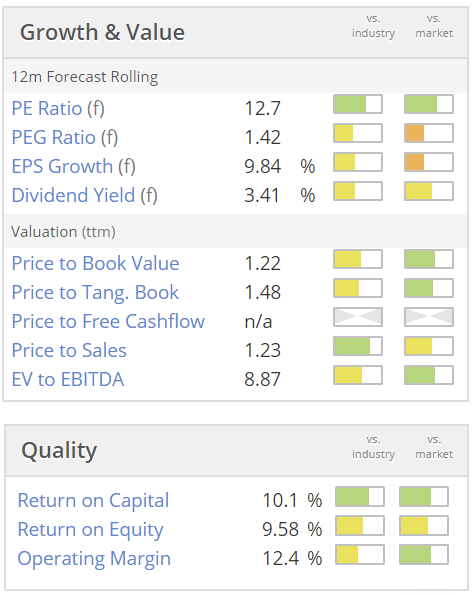
A lowish PER - although this type of business rarely receives a high PER.
Moderate dividend yield.
Note the Price to Tang(ible) Book (Value) - at just 1.48 this is excellent - demonstrating that the company has a solid balance sheet, with strong asset backing.
In the "Other ratios" box, note the green (positive) blob next to current ratio - which is outstandingly high, at 12.6 - again confirming that this company is very soundly financed, so won't be going bust like listed competitor Albemarle & Bond did a few years ago.

I would always want to do my own research on the balance sheet, but looking at a few key numbers on the StockReport is an initial shortcut.
My opinion - an analyst flagged this company to me a while ago, saying that its personal loans product was gaining traction, and could become much larger. However, when I checked the product online, I was appalled by the high interest rate, so declined to invest in this company. The numbers don't really matter to me, I just don't want to own shares in a company that exploits people in financial distress.
Based on the numbers though, and today's encouraging update, I can see why this share looks attractive to investors.
Stockopedia likes it too - a StockRank of 98, and "Super Stock" classification. I imagine the shares would rise maybe 10%-ish today - but that rise will depend on what revised forecast numbers brokers put out. I've requested broker notes, so will update this article with the figures, if anything comes through.
EDIT: I've now seen one updated broker note this morning. Its profit before tax (PBT) forecast for 2017 has been raised from £11.6m to £12.8m, an increase of 10.3%. So that backs up my hunch that we might see a c.10% share price rise today. I see the share price is currently up 6.1% today, at 353p (at 08:30).
In terms of EPS, the updated forecast is for 28.4p in 2017, with a 10.0p divi. That gives (based on the current share price of 353p) a 2017 PER of 12.4, and a divi yield of 2.8%. When you take into account the strong balance sheet asset-backing too, I think this share still looks reasonable value.
Today is the third time this year that analysts have increased forecasts, so the company is clearly on a roll.
I see from the StockReport that HAT qualifies for 2 guru screens;

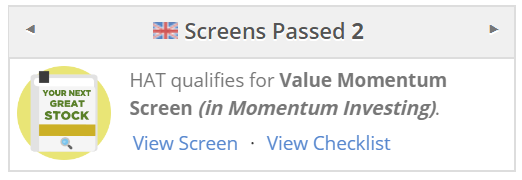
I often click-through to the guru screens which a share that I like qualifies for (NB. I like the numbers at HAT, but not the business activity, just to clarify!)
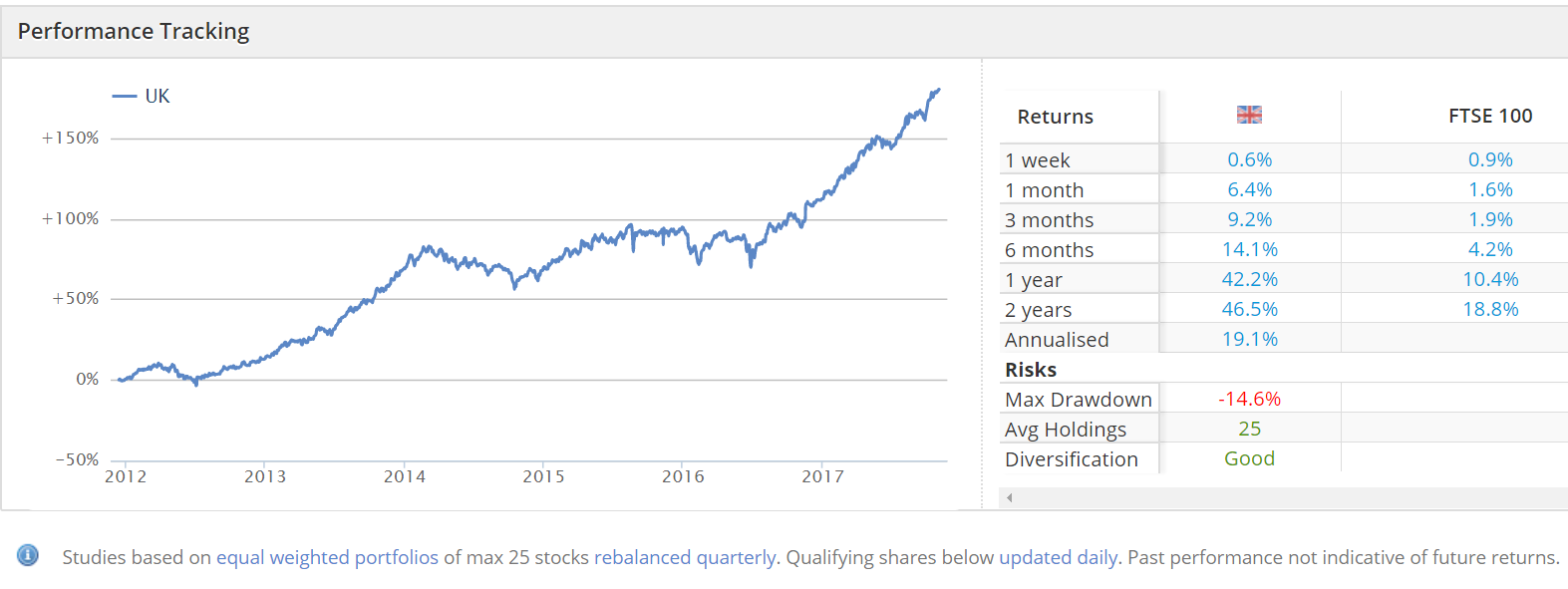
In this case, the Josef Lakonishok momentum screen (which I've never heard of before) has performed really well this year, and since inception, and also seems to have had very little in the way of drawdowns along the way. I like this look of this, so will do a bit more digging. This can often be a very good way of finding similar stocks to the one you originally liked.
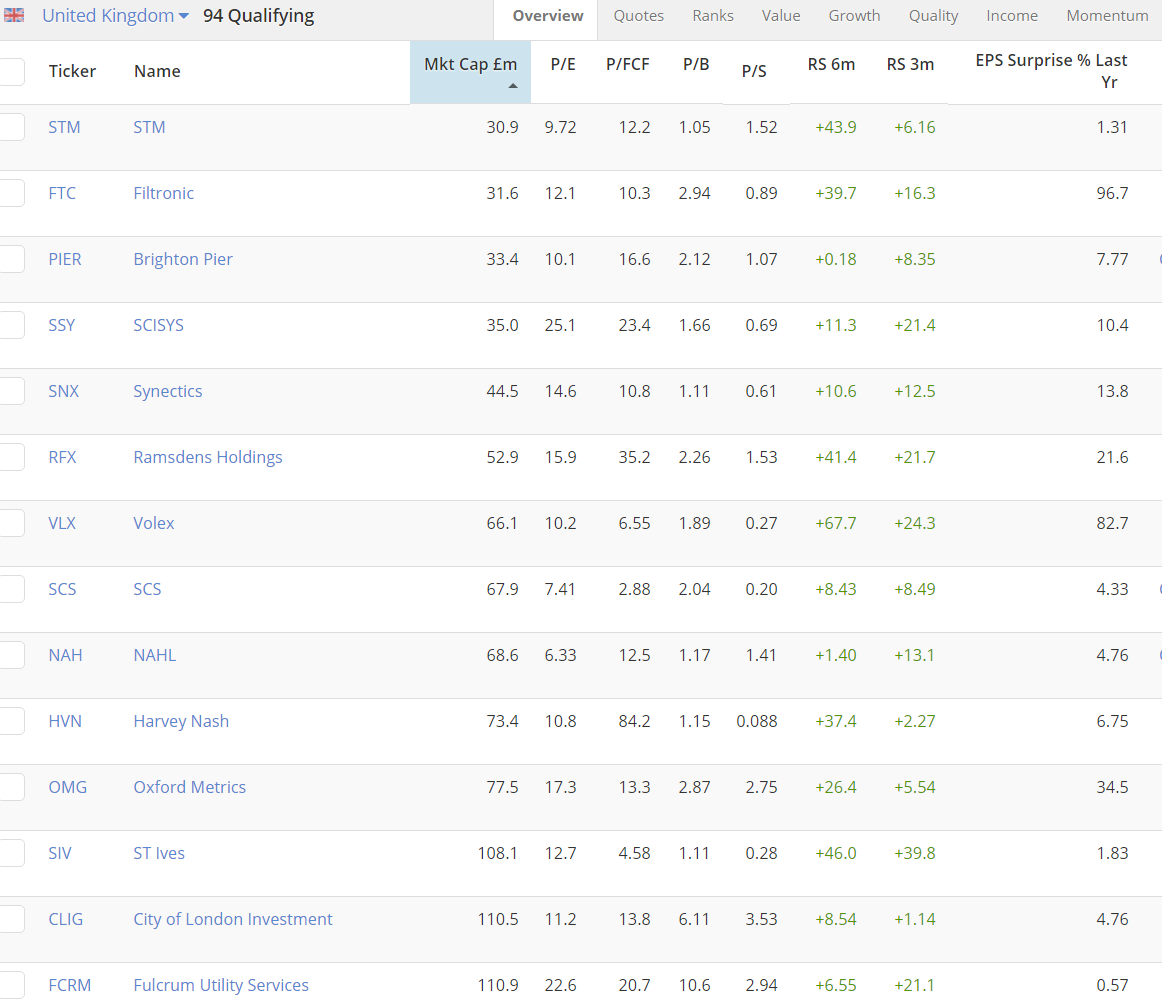
I've sorted the list of qualifying stocks in the Josef Lakonishok momentum screen, into ascending market cap order (to identify the small caps). I see that the screen is set up to £30m+ market caps. This can easily be amended by clicking on the "Duplicate" button at the top right of any guru screen page. I often do this to reset the market caps to just small caps (in my case I tend to use a £10m to £400m range). This could throw up more interesting stock ideas between £10-30m, which are not shown on the existing screen.
Here are the qualifying small caps over £30m. Some interesting companies in there. I like forecast earnings upgrades as a stock screening criterion, as it homes in on companies which have wind in their sails re earnings, which usually causes a rising share price.
These guru screens are very good tools for finding new stock ideas, in my experience.
Management Consulting (LON:MMC)
Share price: 5.75p (down 20.7% today)
No. shares: 511.1m
Market cap: £29.4m
Trading statement (profit warning) - this is a professional services group. I've not looked at it for a long time, but Graham covered its most recent interim results here on 18 Aug 2017. He missed one important point - that the group had sold a subsidiary, allowing it to repay all its debt, and pay £75m to shareholders - a payment of 14.673p per share. So the overall shareholder return has not been as bad as the share price fall suggests.
Its financial performance looks dreadful - see the graphs below. My question is not "why is it listed?", but rather, "why does it exist at all?" This looks like a business that could be in terminal decline, if the trends shown below cannot be rectified;

Although it's got pots of cash. So this might be potentially, a value/turnaround type of share? At the most recent balance sheet date of 30 Jun 2017, it held net cash of £28.4m - very close to the current market cap. Before getting too excited about that, I note a £9.9m pension deficit, and £5.4m of long-term provisions in creditors > 12 months. So in a wind-up situation, those liabilities would need to be settled. The pension scheme might require considerably more than the liability shown on the balance sheet to shut it down. So it looks problematic as a break-up, or shut-down type scenario. Sorry, I'm rambling off the point.
Trading update - this seems like a straightforward case of not winning enough business from clients & potential clients;
As announced with our interim statement on 18 August 2017, changes were made to improve our operations in North America given that revenues were not at levels to restore profitability. This change process has continued; however, it is taking more time than originally anticipated for revenues to reach required levels, in particular some large potential engagements failed to materialise in North America including the second phase of an existing project not moving forward. This has impacted the second half trading and as a result Group revenues for 2017 will now be below our previous expectations.
We have made significant progress on reducing costs but this will only partially offset these lower revenues.
The level of proposals in the US has now started to improve and the Global Natural Resources practice continues to show positive progress through new client acquisition.
There's some hope in the last paragraph.
Again, we're in the usual position of being largely in the dark about how much trading will be impacted. So this is yet another unsatisfactory announcement, which omits the specific details that investors need, in order to make informed decisions.
My opinion - I'm not going to bother searching out revised broker notes, as this looks such a lousy business, I wouldn't be interested in buying shares in it. H1 2017 saw an underlying loss from operations of -£4.6m, on £21.6m revenues.
The only redeeming feature is its strong balance sheet, and plentiful cash. That at least buys time, for management to sort out the business. As Graham quipped last time, maybe the company should hire its own management consultants, to tell it how to improve profitability!
In my experience of using management consultants, they're totally clueless, so it's money down the drain for companies whose management are so inept that they can't run their own business. As a recent TV show demonstrated, management consultants are also adept at relieving the public sector of taxpayer funds.
The other potential upside on MMC shares, is that the company achieved a very high exit price when it sold former subsidiary Kurt Salmon. So there's always the chance that the company might also find a buyer (at a premium price) for its remaining business. Stranger things have happened. So I can see a bull case here - that the cash underpins the market cap for now, giving them time to sort out the losses. Also potential upside from a possible takeover approach? Therefore this could be an interesting special situation, for people prepared to do deeper research on it.
Sosandar (LON:SOS)
Share price: 20.0p (floated at 15.1p on 2 Nov 2017)
No. shares: 106.8m
Market cap: £21.4m
(at the time of writing I hold a long position in this share, as I participated in the recent placing at 15.1p)
First day of dealings - this is from yesterday. I participated in the recent placing (at 15.1p per share) of this company. Sosandar is a fashion eCommerce company, which has only been trading from a start-up, for about a year. When I researched the company whilst the shares were suspended, my feeling is that joint CEOs Ali Hall and Julie Lavington have achieved a remarkable amount operationally, in so little time. So I see considerable potential here. However, it is important to realise that this is very much a jam tomorrow share - as you would expect at a start-up, the financial results so far have been poor - with tiny turnover, and losses of around £250k per month.
It reversed into what was formerly Orogen Gold, then Orogen, and it's now been renamed Sosandar. Orogen was a cash shell, having failed to commercialise its resource project. So the Chairman, Adam Reynolds, had the good sense to cease existing operations, turn it into a cash shell, and find something more interesting to reverse into the shell. The advantage of using a cash shell, is that it comes with ready-made liquidity from the existing shareholders. That said, given that some shareholders must have held the shares all the way down, as its gold project failed, they're perhaps not the sharpest knives in the drawer!
With the shares having been suspended for a while, I suspect there must be pent-up sellers, who are now using the first couple of days resumed trading to exit. There seems to be plentiful supply of shares in the market anyway. That's quite surprising given that the placing was heavily over-subscribed - my broker tells me that some people only got 30% allocation, and others got 0% allocation. So I was lucky to receive an allocation in the placing. To reflect this, I've added an opening position in SOS to BMUS. I'll monitor the company's performance, and add more if it does well, or ditch them if growth fails to live up to expectations.
Just to reinforce how small this company is, here are some more figures;
Thread achieved total gross sales for the 11 months ended 31 July 2017 of £847,000 and net sales (after returns) of £478,000.
That works out at a returns rate of almost 44%. That sounds high, but I've been making enquiries, and apparently the industry average returns rate these days is about 40% (which is what QUIZ (LON:QUIZ) told us at an analyst meeting recently). The returns rate historically for mail order, and eCommerce used to be about 30%. However, apparently shopping habits have changed more recently, and women especially tend to over-order website purchases, then send back the items that they least like, or which don't fit very well. As Sosandar's CEO told me on a recent telecon, "customers use their bedroom as the fitting room now".
After the fundraising, the company should have plenty of cash for 2+ years of cash burn.
Growth plans are for £1m sales in year 1, then £3m, and £9m in years 2 & 3. Those are ambitious targets, but management told me they feel the budgeted numbers are achievable.
Marketing - to date the company had little cash for marketing, but now it has raised fresh funding, it can drive growth by upping its marketing spend. Note that the company has used the contacts of the fashion magazine editor CEOs to promote the company. Sosandar punches way above its weight in terms of magazine & TV coverage. The TV show Loose Women are keen brand ambassadors, and wear Sosandar clothes all the time. Apparently a new pair of shoes launched by Sosandar sold out within 90 seconds when it was highlighted on Loose Women.
The idea is to develop the Sosandar website to become a hybrid between a fashion magazine and an eCommerce site.
My opinion - this is highly speculative, and expensive given that it's only been trading about a year. It's loss-making, and it will take a lot of work to develop this into a viable, profitable business. I very rarely buy any shares like this. However, I see real potential here, long term. It's really all about backing management. In my view, the two ladies are very backable - exactly what I would want, for an eCommerce fashion brand. Some people say, oh they're just journalists, but I think that doesn't reflect the depth of their fashion industry experience - which includes designing clothing ranges. Also, there is a procurement head with a background in sourcing at Matalan.
Anyway, despite being a highly speculative situation, I couldn't resist it. If the website & brand really take off, then this could be a 10-bagger (or more) over time. Or, if growth disappoints, then the share price could easily halve overnight, and then possibly need another fundraising in 2 years' time.
£FOOT
Share price: 198.5p (floated at 164p on 2 Nov 2017)
No. shares: 104.5m
Market cap: £207.4m
Admission to AIM - this is another interesting new listing. It's a rapidly expanding chain of sports fashion shops - appealing to the yoof market, of 16-24, with a rather tacky "gangsta" type of slant on things - which personally I loathe & think is very damaging to society (glorifying gangs & crime when so many teenagers are murdering each other with knives in London [over 30 deaths this year alone apparently] strikes me as irresponsible), but it's clearly profitable.
The interesting angle on things, is that FOOT is run by the founders of JD Sports - which dominates the sports fashion market.
For more information on the company, its AIM admission document is here.
When reviewing any admission document, I don't read all of it, but am seeking out certain bits of key information. In particular, I want to know how much equity the existing shareholders will own after the float. In this case, it's still very high, at 63.0%;
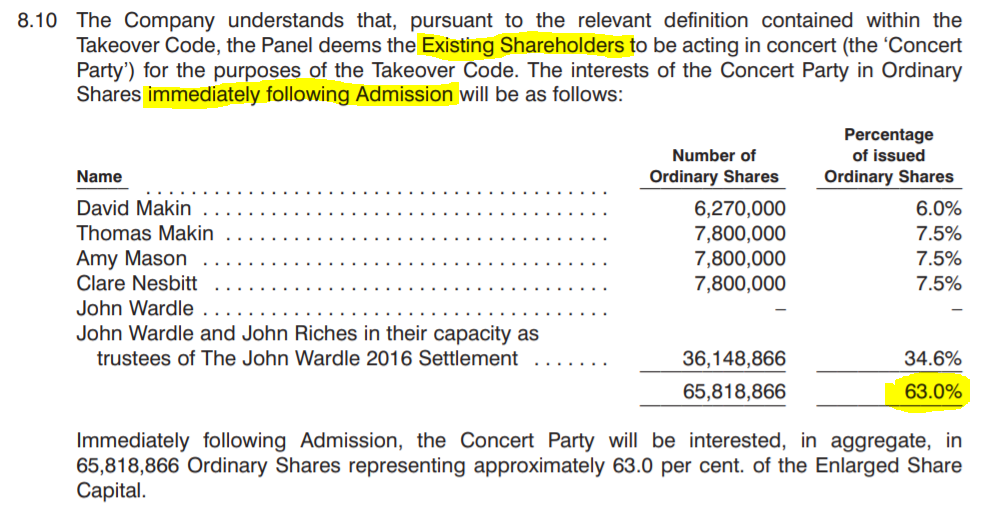
This reassures me that the float is not a mechanism for shareholders to cynically exit at a favourable price, before the business blows up (e.g. as happened with Entu, and Accrol). In this case, FOOT's major shareholders retain control & loads of skin in the game.
The purpose of the float seems to be to restructure the balance sheet, by paying off the shareholder loans (preference shares). That seems fine to me.
My opinion - this looks a promising growth company. I applied for some shares in the IPO, but got an allocation of zero! So clearly this company is in high demand, evidence by the premium to the listing price since achieved.
Overall, it looks one of the best IPOs this year (I know IPO is technically the wrong term, but it's just shorthand for a new listing, and everyone knows what I mean).
I'm reluctant to cough up 200p per share now, knowing that someone else paid 164p for them yesterday! Industry trends worry me a bit too. The big brands are apparently considering selling direct to the public, through Amazon & other routes. Could that mean this type of physical store has a limited shelf life? Possibly, but with their emphasis on creating an edgy store environment, to entice yoof into the shop, then maybe this would remain an important sales channel ? I just worry that kids would use the stores as a showroom, then buy cheaper online, direct from the manufacturer. FOOT has its own online presence, which is growing fast, but for how long, if manufacturers decide they want a fatter margin by cutting out the middlemen?
FOOT does also design some own-branded trainers, including "Glorious Gangsta" - I'm not joking. What sort of message is that sending to kids in deprived areas, who are tempted to get involved in gangs? It stinks, as far as I'm concerned.
So really it's another one where the figures look good, but there are ethical concerns.
Other IPOs (or not)
I see there are three "Intention to Float" type announcements today.
BOKU - looks interesting, and sounds similar to Bango (LON:BGO) . The valuation of BGO looks bonkers to me, as it relies on heroic growth assumptions. Why pay up-front?
Bakkavor - it's pulled the IPO. The reasons given sound weird to me, and doesn't make sense;
Whilst the company received sufficient institutional demand to cover the offering, the Board has taken the decision that proceeding with the transaction would not be in the best interests of the company, or its shareholders, given the current volatility in the IPO market.
Reading between the lines, that suggests to me either that Instis pushed back on price & wanted it cheaper. And/or they possibly demanded some other conditions that the company didn't like, perhaps?
Arqiva - says something similar today;
Arqiva announces today that it will postpone its proposed initial public offering. The Board and Shareholders have decided that pursuing a listing in this period of IPO market uncertainty is not in the interests of the Company and its stakeholders, and will revisit the listing once IPO market conditions improve.
That sounds like there wasn't enough appetite from investors to buy the shares.
Overall then, is the IPO market cooling? Or is it perhaps more a question that Instis are becoming more selective in what they back, and what price they're prepared to pay?
FOOT and (much smaller) SOS listing successfully, suggests to me that investors are happy to buy new issues that are decent quality, and sensibly priced.
All done for the day and the week. Have a lovely weekend!
Regards, Paul.
Disclaimer
This is not financial advice. Our content is intended to be used and must be used for information and education purposes only. Please read our disclaimer and terms and conditions to understand our obligations.

41 comments
"yawning gap in UK fashion retail for women aged 35-55, who were too old for younger brands like Asos, but not ready to go frumpy with M&S."
I am firmly in that target market but find the website boring and many of the items unflattering and frumpy - only a few items that I might not expect to find in M&S - and even they surprise themselves sometimes! Im also confused by their price point - they have a shearling coat for £795 - why would I buy that from a low price point website? All a bit of a mish mash and very unexciting IMHO. I won’t be buying any time soon.
"Suggestion - if readers have wives or daughters in the 35-55 target age group, perhaps you wouldn't mind asking them what they think of the Sosandar product. I'd be interested to hear more feedback."
Paul, an excellent suggestion but it may also be possible that you have a few loyal female readers & investors in that age range who could comment
I note that the rest are of my reply went awry but it was to the effect that I'm firmly in this age range & have my tongue firmly in my cheek
Re Paul's comment under H & T -all shareholders should be made aware of the numbers, not just institutions and professional investors. Several companies in which I have shares invited to give them my Email address so they could send me news of the companies activities. Few of them go so far as to let me have the numbers they make available to institutions.
I believe companies should be encouraged to ask shareholders for their email addresses and should be obliged to communicate the information given to institutions to shareholders who have given their address on the day they hold presentations.
It must be particularly galling to get to the edge of an IPO, and then to pull. The fees for getting to this position are eye watering for often quite small business. I have heard its now at least a £1m in terms of fees to float on AIM.
Arguably the prospectus, and the board, and having some integrity are the three most important things, other then than the viability of the business itself. Once floated there is very little stick to beat companies with, for any subsequent lack in these elements.
In some cases of floated foreign entities, all the pre IPO did was to put lipstick on a variety of pigs, which were as close to disguised fraudulent intent as you can get.
Really its aching for some disruptive model, because most of the £1M+ fees are ultimately ultimately of no protection to future shareholders.
Just published, Gervais Williams, from Miton (LON:MGR), talking about the current macro picture, the problems, and the opportunities, for the investor:
http://www.piworld.co.uk/2017/11/03/miton-group-plc-mgr-gervais-williams-investor-presentation-october-2017/
He goes on to talk about Miton Group.
Insightful thoughts on flat productivity, mis-allocation of capital and the investing opportunities. Worth a watch.
"given the current volatility in the IPO market" and "period of IPO market uncertainty"
translation
We didn't get the price we were expecting to get.
Re Sosandar (LON:SOS)
It's not often I find myself expressing a professional opinion (I'm a marketing guy) here but however smart management are, their branding and website are just not good enough. For instance, If I wanted to shop from their web front page, I can't without clicking again just to see what they're selling. And "Sosandar" is a very weak brand name, failing two of my B2C brand name strength tests (not easily transmittable and is more than two stresses long). Their brand representation also fails to be distinct (obscure their logo and you'll see what i mean) and there is no value proposition or clear definition of the customer segment(s) they serve. In fact, their website front page is mostly about them and not about what they offer customers which demonstrates a way of thinking that is not consistent with a strong brand. Without stronger marketing competence, I wouldn't invest in them.
I concur this view having perused their website. It does seem to me that the clothing they purvey is occasion sort of dresses etc. I know some women like to wear a different dress for each occasion, and I wonder if return rates could go higher as people decide that they can buy a dress, wear it carefully for an event, and then send it back. Must be a temptation to some.
Hi fwyburd & cic,
I'm not sure that you've grasped the specific niche in womenswear that Sosandar (LON:SOS) is targeting.
The ladies who set up Sosandar have long experience in fashion magazines, setting up the successful "Look" magazine, for example. Their insight was that many readers complained that there was a yawning gap in UK fashion retail for women aged 35-55, who were too old for younger brands like Asos, but not ready to go frumpy with M&S.
Sosandar has designed its own product, designed to specifically fill this gap in the market. So note that a lot of their dresses have longer sleeves & hems, designed to be flattering to a figure that may not be perfect.
I've conducted my own (limited!) market research, and shown the website to women I know what are the target age, and they all loved it.
The website is not designed to look like other eCommerce websites. It's meant to be a hybrid between a fashion magazine, with editorial about the clothes, seasons, what goes with what, etc., and a transactional website - this has the advantage that slower moving product can be stimulated with some editorial & photos which showcases it.
Note that all product has a short video of a model wearing the item & moving around in it, which really brings the product alive I think.
The marketing has been amazingly effective to far - and is focussed on celebrity endorsements & brand ambassadors. This page is very impressive, for a business that is only just over 1 year old. If they can achieve that much in a year, then I think there could be a bright future ahead;
https://www.sosandar.com/style...
That page also gives an idea of the target customers.
I've done quite a bit of work on this one, and I think management at Sosandar really know what they're doing. It remains to be seen if the company can grow fast enough to achieve take off. Or whether growth will be too slow, and then require another fundraising in 2020.
The product isn't special occasion wear. As you can see from the link above, it's stylish stuff for 35-55 women to wear to work, nights out, whatever.
Suggestion - if readers have wives or daughters in the 35-55 target age group, perhaps you wouldn't mind asking them what they think of the Sosandar product. I'd be interested to hear more feedback.
Just to reinforce, this one is highly speculative, and could flop if growth does not meet expectations. So higher risk than most of my more usual things.
Regards, Paul.
With regards to Sosandar (LON:SOS) If anybody knows this industry Paul it's you however, in an attempt to find reasons not to invest (something I do with all my potential investments) I would just say this:
1) I agree with the poster @fwyburd with regards to the website. It's too much form over function and the magazine element has been taken too far. I have no doubt the most women in the target audience age group would love it if asked; it looks fantastic but I've no doubt that professional task based user interaction testing would offer poor results. Browsing the site (as you would a magazine) is great, finding a specific product within a reasonable time period requires a whole different site architecture. Just try picking up a magazine and finding a specific paragraph or even article without any index or context. It gets pretty annoying pretty quickly.
It'll be interesting to see how the site evolves over time. BooHoo had an awful site for years and it didn't stop them!
2) On the subject of returns, with Sosandar being around 44%, I remember reading an article back in December 2016 where Carol Kane said:
“The teenage wallet has its limitations, We don’t have a high returns rate: our shoppers don’t want to tie up their money. If they are spending £20 on a dress they won’t spend £40 ordering two sizes. They don’t have that kind of money. It is quite different to the middle market.”
It's certainly an interesting idea that I'd never considered. That their customers' lack of money actually benefits to BooHoo and could be a negative thing for a company like Sosandar.
https://www.theguardian.com/bu...
@Paul I like going to the gym and yesterday coughed up £70 for a pair of wrist wraps supposed to be the best on the market called Gangsta. I actually felt embarrassed to wear something around my wrists labelled that name. But got it because they are the best around even at that price tag, So I guess it pays companies to include gangsta in their image.
here goes stoopid question of the day: if FOOT is run by founders of JD. then why would they not jut run the company under JD Sports rather than a separate listing. TO my mind that would reduce any listing costs.
Is there any merit sense in this position?
I have a question / muse for everyone on Seeing Machines (LON:SEE)
This had been on my radar from a long time ago but always felt there was too much "Jam tomorrow" even following its deal with CAT so steered clear. However, I have recently changed my view and have bought a few. The technology is good and with semi-autonomous and autonomous car industry acceptance on the increase it appears the big car manufacturers are starting to buy its product.
So my muse is this.
The company (either to its great credit or great folly) has provided revenue projections for the next couple of years that treble and double. The element that slightly vexes me is that on the one hand they say that these new revenue projections take into account the company's constrained balance sheet. On the other hand they talk about ongoing discussions to further fund the business. So it seems that we can reasonably assume a fundraise is coming and if it is equity based then a likely discount to current share price. For this reason I only bought circa half what I'd like with a view to buying more in a placing.
BUT if the revenue projections are anywhere near accurate then this business could be very very cheap and capture the imagination of investors at some stage soon in a similar manner to the way IQE has on facial recognition wafer, given the IP.
Interested in Paul/Graham or anyone else's views on the company. Strikes me Seeing Machines (LON:SEE) is right in the sweet spot for this group so I'm sure there are some well considered opinions on the topic. Naysayers thoughts also very welcome as I'm not just looking at my own bias.
Hi Paul,
I'd be interested on your view following an RNS ( https://www.stockopedia.com/share-prices/tristel-LON:TSTL/news/tristel-plc-directors-dealinggrant-of-options-urn:newsml:reuters.com:20171102:nRSB3213Va/) put out yesterday by Tristel (LON:TSTL) regarding share awards (to both Executive AND Non-Executive Directors!) based purely on share price targets.
Put simply very large amounts are shares are awarded, pending AGM approval, and are then exercisable based on share price. This is staggered in thirds based on increasing share price. All options also become immediately able to vest should "a change of control of the Company" occur!
There was some discussion on twitter last night, and I'd be keen to hear your take.
Thanks,
IG
I have previously ignored H & T (LON:HAT) as I will not be party to exploitation, but prompted by the comments here I have just looked into them in more detail to see whether I was justified. Fundamentally they have two types of loan:
Pawn loan (secured)
Interest rate: 4.5% to 9.9%
Maximum initial term of 6 months.
They don't state an APR (black mark), so I'm assuming 21% worst case.
Assuming they won't let you pawn your means to make a living (see: Pop Goes the Weasel) then this seems to be a valuable service to everybody (rich or poor) for truly exceptional circumstances.
Cash loan (unsecured)
Interest rate: 180% APR even for a relatively large amount (£5000) over a relatively long time (1 year). While the genuine costs of dealing with somebody face-to-face could quite reasonably result in 180% APR or more for a small amount over a short period, over a longer period this is clearly exploitative. H&T's Shorter / smaller loads are 450% APR typical.
Conclusion
We've probably all seen the adverts where a lack of emergency savings is normalised and people are encouraged to borrow at extremely high interest rates rather than suffer some minor inconvenience such as a few days of cold showers. It is debatable whether this is good or bad and whether consumer credit is ever in the borrower's interest or should even be allowed.
But given these cash loan interest rates anybody investing in H & T (LON:HAT) needs to be clear that a) they are exploiting and harming their fellow man, and b) their investment is at high risk of adverse regulatory intervention.
We've probably all seen the adverts where a lack of emergency savings is normalised and people are encouraged to borrow at extremely high interest rates rather than suffer some minor inconvenience such as a few days of cold showers. It is debatable whether this is good or bad and whether consumer credit is ever in the borrower's interest or should even be allowed.
Indeed, I used to have cold showers every day at public school. Never did me any harm ...
Of course, if your local food bank has run out of anything edible or your old, knackered fridge has finally given up the ghost and you can't access short term credit there's always the alternative of prostitution or drug dealing. I mean, let's encourage private enterprise rather than an unhealthy reliance on regulated lending.
But given these cash loan interest rates anybody investing in H & T (LON:HAT) needs to be clear that a) they are exploiting and harming their fellow man, and b) their investment is at high risk of adverse regulatory intervention.
A Which study from a couple of years ago showed the hidden cost of the official alternative -
Which? research finds that consumers needing as little as £100 could be charged up to 12.5 times more by major high street banks than the Financial Conduct Authority (FCA) allows payday loan companies to charge, when borrowing the same amount for the same period.
https://press.which.co.uk/whic...
As Professor Servon showed, people make a rational choice to use payday lenders and pawnbrokers. They're not stupid, but value the certainty that they won't be charged unexpected amounts and the personal service they get from the staff. When I was a kid you got that kind of behaviour from the local bank branch where the manager knew your parents personally. Nowwhat you get is a child that thinks it's a management consultant with a stupid haircut trying to flog you stuff you can't understand.
Each to their own though, I shall hold H & T (LON:HAT) and Ramsdens Holdings (LON:RFX) until Jeremy wins the next election after which they probably won't be needed any more ... :-)
timarr
As a former Director of a Credit Union in London of course I have a lot of sympathy with this view, but it is actually fundamentally wrong.
The "high risk, high rate" lenders don't create the problem, they address / exploit it.
Yes the rates are eye-wateringly high, but as someone pointed out above to a large degree this is all about pricing in risk. In fact this corner of the market is actually quite busy now so in fact the opportunity is there for shopping around and whilst the cost of credit doesn't seem to be a significant market play at this stage the opportunity is definitely there for "ethical lenders" to make price a key competitive advantage - so long as they can at least break even when considering the defaults.
I certainly agree that the high rates can cause debt to spiral and exacerbate the problem, but there is not a better option being provided by society. (Credit Unions even do not really address this, as they will generally only lend after they have formed a relationship with you as a saver and even they suffer some serious bad debt issues - largely due to borrowers misleading them).
"Regulation" should certainly be tightened here, but that is absolutely NOT about rate regulation that will only serve to ensure that the highest risk lenders will be excluded and forced into the illegal lending market (you think bailiffs are bad - think again!!) ; instead the "regulation" needs to be about ensuring borrowers have access to (and are directed to) proper advice and counselling.
That would certainly quell the market for this kind of lending, but will not kill it out-right.
None of these lenders (AFAIK) are currently so benevolent that they direct you to credit guidance services etc before they lend to you , but the level of ethics is perhaps about how clearly they explain what you have to pay (the rate itself & therefore the total cost is not that relevant to people under financial stress) and how far they assess real affordability.
I honestly do not know how H&T stack up in this respect, but having taken a small "trading" stake today I do intend to find out.
As a quick aside rant, I am reminded of my experience a few years ago when we were buying new sofas and chairs etc. - I had a clear idea of how much we were prepared to spend (and had the cash) - but as "interest free credit" pervaded we were going that route. In one retailer we found a "suite" we really liked and were discussing the different options (including some that involved paying interest but with a discount on the price!) Several times I asked them how much a particular setup would actually cost and every time the only answer they would give was a long the lines of - ohh on this one you would only pay £15 per week - they only wanted to sell me apparent affordability they could not seem to grasp that my frame of reference was that I wanted to know how much the goods I would buy would actually cost. Yes I could have worked it out for myself, but I left in disgust - it was totally clear that they only wished to convinced me that I could afford to pay for their product and had no interest in convincing me that they were offering a valuable proposition.
That imho is far more dangerous than "the money lenders".
Re: ethics of high rate lending
I was aware that my contribution was rather off topic and perhaps ill conceived in a thread about the day's smallcap news and tried to keep it short. Perhaps in so doing a couple of important points I was trying to make were lost. Now it is Saturday hopefully this is less of an issue.
I tried to make it clear that over short periods / small amounts high interest rates can be justified. Rather I specifically cited borrowing £5000 over 12 months at 180% APR. This means that if you fall behind and can only pay the interest, that's 180% x £5000 = £9000pa forever. Who could possibly afford that, let alone principle repayments on top? (Answer: A relatively rich person with a large excess income every month they are either saving or wasting and therefore has no need for a loan). The same argument scales down to smaller loans and disposable incomes.
This is how it should work:
1) Borrower comes in.
2) If borrower can afford interest at 180% APR (or whatever is necessary) then money is advanced (as hopefully at present). If not they are given credit guidance, including an explanation of why they can't afford the loan, what to do next, (what should be) the unenforcability of any loan they are offered on the same facts and the implications of making false declarations.
3) Once a borrower has demonstrated they can maintain payments for a few months (and therefore are not fraudulent or a fantasist) the rate should be cut but the monthly payment stay the same.
4) Once the loan is paid off they are contracted to continue to save with the same monthly payment.
5) Both their time lending and saving should equally count towards their credit rating (it is madness that somebody who has proven the ability to save over many years struggles to borrow money!)
5) Once they have saved the original borrowing amount they are free to stop saving and use the amount as an emergency fund, or to continue saving e.g. for a house deposit.
6) Institution makes money on normal rate lending and borrowing.
I strongly disagree that lenders "don't create the problem". Their advertising most definitely does create and exacerbate the problem. As I said, they go out of their way to normalise not having an emergency fund. For example there are a number of adverts which start with the boiler or car going wrong and don't even touch on the possibility of savings before suggesting you borrow at 500% APR to fix it. They explicitly ask "why wait?" when encouraging people to borrow for things that could be waited for, aren't really needed or quite often won't even be used.
I'm not completely against consumer credit, or use of credit for emergencies. For example, which is better:
a) A mortgage of £100,000 costing 2.5% and an emergency fund of £10,000 paying 0.5% that is used once every 5 years, or
b) A mortgage of £90,000 costing 2.5% and a £10,000 line of credit at 5% that is used once once every 5 years for a few weeks while you re-borrow the excess mortgage equity?
I have an arranged overdraft at 50%APR to cover very short term cash flow issues before I can borrow / transfer money from elsewhere, much better than always keeping a minimum £1000 balance paying nothing.
But I maintain 180% APR beyond anything but the very short term is exploitative, is unaffordable by anybody who actually needs the money and serves nobody.
As for loan sharks, what is the difference between demanding protection money and lending money then demanding repayments - both are equally unenforceable and illegal? Is this a police enforcement issue, or merely a false feeling of debt on the part of the victim?
Finally, what is the difference between profiting from H&T because they are better than loan sharks and actually being a loan shark who offers slightly lower rates and/or fewer broken fingers than the rest?
Investing in companies that profit from people's misery is a topic that comes up on a regular basis.
There are basically two positions on this issue.
First - I am here to invest or trade on the stockmarket, and as long as it is legal, then making a buck is my sole purpose. If my conscience bothers me, then I can always donate to charity or get directly involved in those causes.
Or - being legal is not enough, there is also a moral side to this. If a company makes a profit from adding to people's misery, then I don't want any part of it.
I respect people taking either one of these positions. Personally and over the years, I have swayed from one to the other.
I have been invested in Character (LON:CCT) for a couple of years, have confidence in the medium term and picked up more stock at 370p following the recent pullback.
We know the results to YE August, to be announced in the first week of December, will be excellent but I am concerned that the effect of the ToysRus administration in the States, although expected to be temporary, could be greater than we expect. UK toy sales appear to also be affected by the general weakness in consumption.
I also invest in the worlds largest quoted toy retailer Hasbro having recently bought back in following the shares pulling back from $116 in July to $90 due, in my view, to the overblown ToysRus concerns. Hasbro has been granted critical supplier status under the administration so essentially securing it's position. I doubt if Character (LON:CCT) has been granted such status.
Extracts form the Q3 Hasbro conference call-
"...the Toys "R" Us bankruptcy filing in the U.S and Canada negatively impacted our third quarter revenue and operating profit, including incremental bad debt expense associated with the bankruptcy.
"While the near-term impact of Toys "R" Us is disruptive, and we paused shipments for a short period as we gain clarity on the situation. We are working with them as we enter the holiday period. This doesn't impact our outlook for overall consumer takeaway, which has continued to be strong, but does introduce higher uncertainty as to the level of shipments to them in the fourth quarter."
"The challenges we saw emerging in the second quarter have continued in the U.K and Brazil, and we anticipate this will continue for the remainder of the year"
I fear that the outlook Character will announce for H1 could be even more dire than expected and have therefore sold around half my stock at 415p. I hope it is not as bad as I think it could be and expect to increase my holding again in the near future as I do see Character as a medium/long term position .
I fear that the outlook Character will announce for H1 could be even more dire than expected and have therefore sold around half my stock at 415p. I hope it is not as bad as I think it could be and expect to increase my holding again in the near future as I do see Character as a medium/long term position .
Hi Dave,
As we discussed, I sold out on the 8.00 am trading update on 11th October. Well done on timing the bounce which is in no small part due to buybacks by the company. However, I totally lost what faith I had in the management which is a really important part of my reason for holding a share. Also I'm not sure I've ever had one of my holdings give a "significantly below expectations" forecast for the full year only 6 weeks into it. That instantly struck me as being pretty bad!
All the best, Si
Hi Si,
Understand why you sold out but in defence of Character (LON:CCT) management, the year ended 31st Aug and ToysRus went into admin around 19th Sept at which point all the monies owed to Character became a bad debt and they would be left with a load of Christmas stock they could not dispatch to them as they probably didn't have critical supplier status. Other retailers, both UK and US, would immediately hold off on purchases believing there was going to be loads of cheap stock available. I think the 11th Oct announcement was in fact understandable and expeditious.
You may wish to take a look at Hasbro. Three years ago they were half the size of Mattel, now they are twice as big. I bought in and sold out too early but I have just bought back at $90 which I think is a steal but DYOR, as I know you would!
Dave
Understand why you sold out but in defence of Character (LON:CCT) management, the year ended 31st Aug and ToysRus went into admin around 19th Sept at which point all the monies owed to Character became a bad debt and they would be left with a load of Christmas stock they could not dispatch to them as they probably didn't have critical supplier status.
Yes, understood. But to some of us putting out a "significantly below" trading update at 8AM is simply indefensible. I don't want to retread old ground but if you add to that the sudden departure of the CFO at a board meeting a few weeks before, and the gradual "inexplicable" share price decline in advance of the trading update... it just gave off too much of a bad smell. There are plenty more fish in the sea...
All the best, Si
Trading update from SVCA if anyone is interested:
Servoca (AIM: SVCA), the specialist recruitment solutions and outsourcing provider, will announce its preliminary results to 30 September 2017 on 12 December 2017.
The Board is pleased to announce that it expects to report that its results for that period will be comfortably in line with market expectations.
Re £H&T, the high interest rates reflect the high rates of default.
I was in the moral high ground camp until I started lending money on P2P platforms - funny how your perspective changes when it's your money on the line.
If people think H&T or Ramsdens earn excess profits, their margin is your opportunity - try competing with them.
Agree that H & T (LON:HAT) is a similar pawnbroking business to Ramsdens Holdings (LON:RFX) who has also issued an exceed exceptions update - Clearly the sector is on a roll. Ian
I don’t agree that people are being exploited, if they stopped these loans then those people would suffer even more, believe some other loans have higher rates, will try to check cash converters rates, also you have consider the high default rates. Do you want people to use loan sharks?
One concern about H & T (LON:HAT) is they still seem quite reliant on the gold price, mind you I don’t think that’s a bad at this moment in time. Yes I agree they should have given more detail. Are the broker figures not shown on Stockopedia? I completely agree about availability of brokers information to everyone, this is a crazy system as I found when trying to do a trial of ResearchTree, why should doing 10 trades a quarter give you access and 9 trades a quarter not?
Hi Paul
Re: H & T (LON:HAT). Firstly, thanks for flagging this before the market opened. I managed to open a position on Ramsdens Holdings (LON:RFX) before the market woke up to the effect H&T would have on their share price. I did the same when you first reviewed IQE (LON:IQE) a few months ago before the market opened. I know you're not an early bird, Paul, but when you are, it can be very profitable so thank you.
Second, I take a different view on short term loan businesses. Yes, they carry high interest rates but they do provide an incredibly valuable service to people who have no where else to turn. Their lack of credit worthiness is part of their problem and aren't interest rates supposed to be based on risk? As I understand it, the vast majority of customers who rely on such services pay back their loans very quickly so the onerous cost of borrowing doesn't have too high an impact on them.
What do others think?
Francis
I agree, I have used payday loans a few years back and they helped keep me going through a difficult period.
Hi Paul
Compare the interest rates offered by H&T to the equivalent offers by the banks - overdrafts, short term loans. The banks deal in uncertainty, H&T deals in certainty. If your view is that the poor shouldn't have any access to debt then fine, but otherwise H&T are a decent option in a difficult world.
For the view of the people taking the loans rather than the ivory tower perspective I recommend reading Lisa Servon's The Unbanking of America. She's a rare academic who's actually prepared to go and experience what she's researching. Poor people aren't stupid, they have their reasons for using payday loans and pawnbrokers rather than the mainstream banks.
I talked to her when she was in the UK earlier this year, the US banks are worse than ours, but the same principle applies. Roll on open banking in January:
https://www.openbanking.org.uk...
As an aside I see that Boku have announced their IPO today. I'll be interested to see what their take is on the capping of direct carrier billing by the European Commission under PSD2 in their Admissions Document.
timarr
I think listened to a podcast with Lisa Servon. From memory, she said that there were more payday lender locations in the US than Starbucks and McDonald's combined. Even more staggering when you consider payday lending is banned in 30% of US states.
Do you have a link to the Boku IPO news? I couldn't find anything.
Nevermind.
http://www.londonstockexchange.com/exchange/news/market-news/market-news-detail/other/13419215.html
Valuation of Boku could have interesting read across for Bango (LON:BGO). Very strange for a US tech company to be listing on AIM. They must love Bango's valuation or belive that US tech investors don't understand/appreciate direct carrier billing.
I think the big concern is PSD2 in the EEA. Direct carrier billing companies are excluded from the requirements of Strong Customer Authentication (essentially a requirement to do KYC and 2-factor authentication) as long as no single payment is over €50 and the total transacted is less than €300 a month. Whether that impacts Boku or Bango I know not, but it's got to be taken into consideration with the implementation date now only a couple of months away.
timarr
Dear Timarr,
I really appreciated your perspective on this. I have always been in Paul's camp and have shuddered at the thought of owning shares in a company that compiled people's misery. However your comment will make me investigate as to whether that view is correct. The normal levels of ROCE and ROE are food for thought in themselves. Thanks,
Peter
Agree with you timarr, and others, with the following view:
Compare the interest rates offered by H&T to the equivalent offers by the banks - overdrafts, short term loans. The banks deal in uncertainty, H&T deals in certainty. If your view is that the poor shouldn't have any access to debt then fine, but otherwise H&T are a decent option in a difficult world
As sad as it may be, people "in financial distress" have ended up that way due to a variety of personal circumstances, some self-inflicted (e.g. gambling problem or severe stock market losses including spread betting defaults) and some that are out of their control, but the long and short of it is that they are a significant credit risk compared to Mr & Mrs Average ABC and the facility offered by HAT (and others) and much higher rates than typical bank loans reflect primarily that risk of default as well as the fact that HAT are offering a different loan service that caters for those who are refused loans at banks and have no other legitimate option for credit.
(Good in-depth analysis otherwise Paul)
Re H & T (LON:HAT) read-across for Ramsdens Holdings (LON:RFX) who are reporting on 27 Nov?
Your objectivity on both HAT and Earthport is much appreciated, Paul ! :-]
My morning smallcap tweet:
Management Consulting (LON:MMC), Silence Therapeutics (LON:SLN), H & T (LON:HAT), Mercantile Ports & Logistics (LON:MPL)
Management Consulting Group (MMC) warns again: " it is taking more time than originally anticipated for [North America] revenues to reach required levels, in particular some large potential engagements failed to materialise in North America including the second phase of an existing project not moving forward...revenue will now be below our previous expectations. We have made significant progress on reducing costs but this will only partially offset these lower revenues."
Silence Therapeutics (SLN) update on litigation matters. "Alnylam UK Limited and The Medicines Company UK Limited have sued to revoke the relevant Silence European patent in the UK...Silence regards the actions taken by the defendants as simply "normal course of business" at the commencement of litigation, and continues to believe that certain Alnylam products require a licence under the Silence patent estate."
H & T Group (HAT) exp FY pretax will be above current market expectations.
Mercantile Ports & Logistics (MPL) finished piling for 400 meters of jetty, "Company is working hard alongside its main contractor to enable the facility to commence operations by the end of the year." Note not commercial ops and don't say they'll have 200m of jetty done as they have previously. A year ago: "the Facility will be capable of receiving vessels by the end of this year, the Directors are not forecasting revenues from operations until the end of the third quarter of 2017 when, subject to securing the Funding, the Facility is expected to be fully operational."
H & T (LON:HAT) trading update looks good:
https://investegate.co.uk/h--3...
... Update looks good, but what an embarassing lack of detail. "strong trading", "good progress" etc. - fluff words with no detail . Why can't these companies take a look at the way that Next treat its shareholders / the market as grown ups and provide meaningful detailed information rather than hints and suggestions capable of being misinterpreted??