Small Cap Value Report (Mon 26 Oct 2020) - HSS, AUG, ECK, INL, DRV, UCG, AFN

Good morning, it's Paul here with the SCVR for Monday.
Today's report is now finished.
Agenda - these are the small cap company updates that I've selected to write about today;
Hss Hire (LON:HSS) - discounted fundraising
Augean (LON:AUG) - small tax refund re HMRC dispute
Eckoh (LON:ECK) - Trading update
Inland Homes (LON:INL) - Trading update
Driver (LON:DRV) - Trading update
United Carpets (LON:UCG) - Trading update
Advfn (LON:AFN) - Final results
Re Yourgene Health (LON:YGEN) - I've read through its update today, but I don't have anything to add to it.
.
Hss Hire (LON:HSS)
Share price: 22p (up 5%, at 09:44)
No. shares: 170.2m
Market cap: £37.4m
Proposed Capital Raise of up to £54m
Ever since this tool hire company floated in Feb 2015, I’ve been flagging that its balance sheet was dangerously over-geared. That, combined with disappointing trading & restructuring, has largely destroyed shareholder value. This is one situation where I don’t have much sympathy with shareholders, because the terribly weak balance sheet was obvious from day one. You just had to look.
This seems to be a preliminary announcement today, giving the outline of the refinancing. Key points;
- Firm placing & open offer to raise c.£54m
- Priced at just 10p (a whopping 55% discount)
- Dilution is heavy, with c.540m new shares to be issued, dwarfing the 170m currently in issue. This means the share count will rise more than 4-fold
- Possible covenant breach & serious consequences by end 2020 has driven need for fundraising
- Details of the open offer not given, or I might have missed them? £35.5m total, but it’s not stated how many new shares existing holders can apply for
- 3 largest shareholders are supportive - Toscafund (26.9%) often stands by its mistakes, or even takes them private
- Free float of only 13.8% has led the company to explore other listing venues - not stated, but I wonder if this might mean a move to AIM possibly?
- Revenues (presumably the monthly run rate?) now hack up to 90% of last year’s
- Increase in online penetration
- Intending to permanently close 134 branches
My opinion - this deal should avert financial distress, even insolvency, at end 2020. It shows the value of having a concentrated institutional shareholder base, in that they are defending their existing investments by putting in fresh client funds.
The problem is that this deal is not big enough. It doesn’t fix the balance sheet, it just makes it a bit less disastrous. Last reported NAV was £67.1m, deduct £159.6m of worthless intangibles, and NTAV was negative £(92.5)m. This deal might add say £50m extra NAV (after costs), thus NTAV will still be negative by c. £(42.5)m - still poor. The company will still be dependent on very large borrowings. Therefore I don’t imagine it’s likely to be paying divis for the foreseeable future. This probably won't be the last equity raise, as the balance sheet remains very weak.
Overall this share is a classic case of why a dangerously over-geared balance sheet is something best avoided.
.
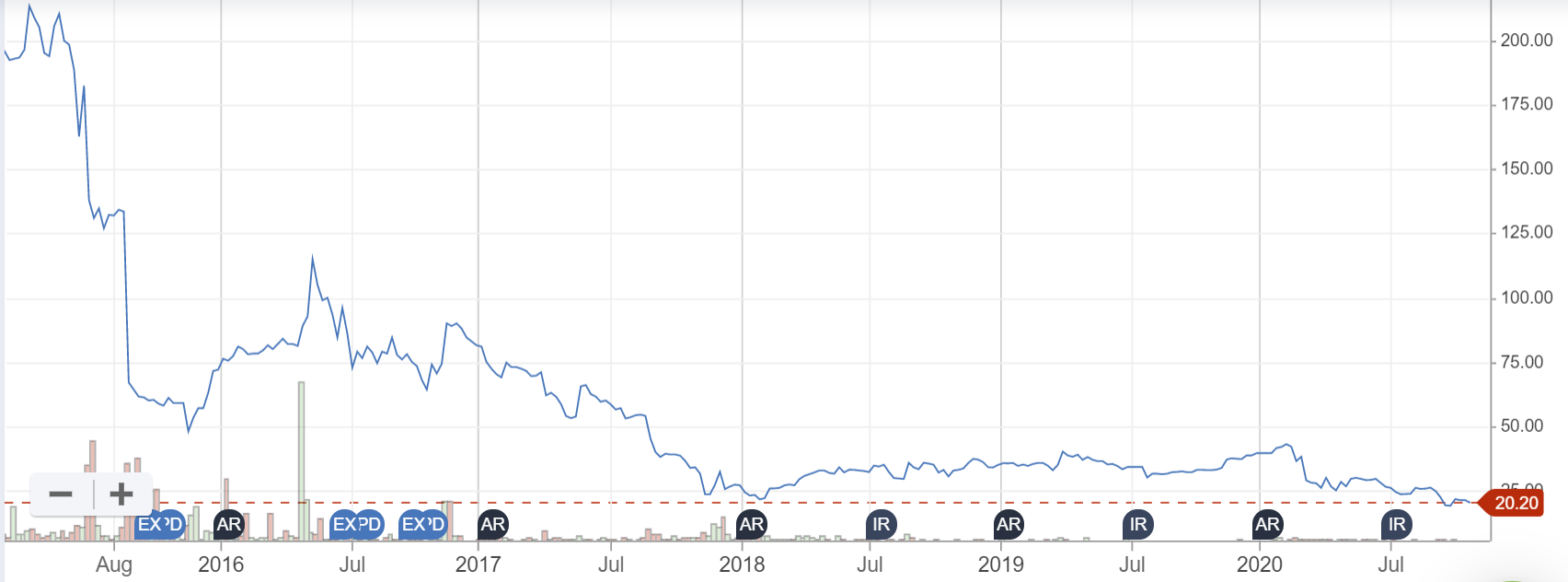
Augean (LON:AUG)
Many thanks to Berksbee for flagging this announcement;
Augean, one of the UK's leading specialist waste management businesses, announces that it has been notified by HMRC that it will be repaying £1.6m of Landfill Tax to the Group. The amount relates to a single biomass customer and is part of the £40.4m of disputed Landfill Tax assessments which the Group paid in full in December 2019...
Augean will also be seeking interest & costs.
Another disputed £16m was heard at a Tribunal in Sept 2020, and the decision is awaited.
Augean complains that the relatively small £1.6m case has taken 3 years to resolve.
My opinion - we've had interesting discussions here about Augean before. It looks very interesting, and profit growth in recent years does look stellar, if the HMRC dispute is ignored. The valuation on a PER basis looks modest, if forecasts are achieved. I don't understand how this sector works, and am not keen on heavily regulated sectors, so don't feel I can offer a meaningful view on it. But the numbers certainly do look interesting, especially if larger HMRC disputes are resolved in the company's favour. So I'll keep a watching brief on it.
Incidentally, I recently reviewed a much larger, but much more problematic waste group called Renewi (LON:RWI) in early Oct 2020 here.
I'll add charts & pictures later, once I switch from my chromebook onto my larger PC.
.
Eckoh (LON:ECK)
Share price: 64.5p (down 4% at 10:48)
No. shares: 253.8m
Market cap: £163.7m
Here are my notes from the FY 03/2020 results, published in June 2020. I was impressed, and thought the share looked potentially interesting, albeit rather expensive on a PER basis.
Today we have an H1 update, 6m to 30 Sept 2020.
Eckoh delivered a robust performance in the period and in line with Board expectations, generating comparable levels of profit to the prior year, reflecting the resilience of its business model.
High levels of recurring revenue, a solid order book, enterprise clients and a strong balance sheet, combined with prudent cost control, have enabled Eckoh to manage the impact of the global pandemic effectively….
We already knew that Eckoh should be resilient to covid, since it has recurring revenues, but I wonder if profits being flat against last year is good enough, when a share is on a high PER like this? Maybe not.
New business was “challenging” in Q1, with tender processes put on hold by customers. Q2 is seeing signs of momentum building.
More details are given about contract wins, including a 6-year renewal for Capita, re London Congestion Charge, and;
There are a number of other sizeable renewals expected to close in the second half of our financial year.
Liquidity looks fine;
net cash of £12.9m at 30 September 2020 (30 September 2019: £10.9m).
My opinion - no strong view either way. Maybe the shares are priced about right? I.e. expensive on a PER basis, but the market seems to be factoring in future growth, after a pause in H1 due to covid.
I have a nagging doubt about the longevity of companies taking payments over the phone. Surely, in the long run, this type of transaction would tend to migrate to apps, rendering Eckoh’s activities ultimately obsolete? What do readers think on that point?
.
Inland Homes (LON:INL)
Share price: 52.9p (up 2%, at 11:54)
No. shares: 226.5m
Market cap: £119.8m
Inland Homes ("Inland Homes" or "the Group"), the leading brownfield developer, housebuilder and partnership housing company with a focus on the South and South East of England, today issues a trading update for the year ended 30 September 2020 ahead of its Preliminary Results which will be announced in January 2021.
There’s a lot of detail in this announcement, but very little which I can actually use to form a view on the company. Nothing is said about profitability, for example, apart from this;
The Group was trading in line with market expectations to mid-March 2020, but its results have inevitably been impacted by the global COVID-19 pandemic.
Net debt is down a bit, but still rather high;
During the year, we achieved a reduction of Net Debt to £138.3m (30 September 2019: £152.3m)
My opinion - Inland has generated very little shareholder return in the last 6 years - the share price is back to where it was in 2014, and only modest divis have been paid over that period. Compare that with say Persimmon (LON:PSN) a larger and much more successful housebuilder, which has paid out gigantic divis over the same period.
Therefore, the discount to NAV at Inland is probably justified. They seem to be very busy, with lots of projects underway, of various types, but shareholder returns never seem to reflect all that work.
It would be interesting to tot up how much management have taken out of the company, in various forms of remuneration, and compare that with the dividends paid to shareholders over the years. I was unimpressed with management, when I attended an AGM a few years ago. The CEO behaved like a petulant child, when challenged about poor shareholder returns, and management bonuses. It was a very strange meeting. Things like that tend to permanently put me off investing in a company.
It’s a difficult share to value. You would need to do a sum of the parts calculation I think, to assess each development, what profit might be made from each, over what timescales, etc. Then there are JVs, property management deals, and other moving parts.
I’d be more inclined to look at the larger, simpler, and lower geared national housebuilders, if I wanted exposure to this sector.
.
Driver (LON:DRV)
Share price: 51p (up 15% at 12:30)
No. shares: 52.2m
Market cap: £26.6m
For background, here is my report on Driver’s interim results (6m to 31 Mar 2020), which produced good profitability, although cautious about the outlook due to covid uncertainty & limited visibility. Liquidity and balance sheet looked fine, although very high receivables stood out on the balance sheet.
Driver Group plc (AIM: DRV), the leading global professional services consultancy to the construction and engineering industries, providing multi-disciplinary consultancy services including expert witness, claims and dispute resolution services, today announces the following operational update on its activities.
This update today, for the full year FY 09/2020, sounds pretty good in the circumstances;
Activity levels overall have been broadly consistent with those achieved in the first half, with a strong performance in the UK and Europe offset by a weaker result in the Middle East and Asia Pacific regions. As a result, the Board expects in the absence of unforeseen circumstances to report underlying* PBT for the financial year of approximately £2.5m.
Cash conversion has been strong, which might address my previous worries about the high level of receivables on the balance sheet;
Cash conversion has been particularly strong in recent months resulting in a healthy net cash balance on 30 September 2020 of £8.2m.
That’s a good improvement on the £5.5m net cash reported at 30 June 2020, so it looks as if some of the receivables must have turned into cash.
Outlook - a strategic review & restructuring seem to have worked well;
I am confident that the reduced cost base and renewed focus on our core business of higher margin expert witness and dispute resolution in both APAC and the Middle East will deliver improved operating performance.
My opinion - I can see why the share price has risen strongly today, it looks justified, with a reassuring update.
The share price looks good value, given the resilient performance this year, strong cash position, and encouraging noises about improved future performance.
There was a flurry of takeover activity for consultancy businesses a while back, although Driver might be too small to attract bidding interest? But you never know.
.
United Carpets (LON:UCG)
Share price: 4.25p (up 31%, at 13:55)
No. shares: 81.4m
Market cap: £3.5m
United Carpets Group plc (AIM: UCG) the third largest chain of specialist retail carpet and floor covering stores in the UK, is pleased to announce the following trading update.
This relates to FY 03/2021 so far.
This share is too small for me to mention for itself (mkt cap only £3.5m, well below my usual cut-off point of £10m). However, I think it’s interesting for read-across to other home improvement shares, as this update reinforces that people are spending money on improving their homes, an enduring trend so far this year. It makes obvious sense, that with holidays largely cancelled, and people perhaps not so keen to visit shops or go out for meals, and other experiences, and being stuck at home a lot of the time, then it makes sense to make home a bit nicer to live in.
Since our 56 stores reopened on 22 May 2020 trading has been robust with good demand from consumers increasing like for like sales by 23.8% for the 19 weeks to 1 October 2020. This has meant the Group has recovered much of the ground lost during lockdown, when stores were closed for just over 8 weeks and virtually no revenue was generated.
That’s clearly very good.
Liquidity - looks fine. It had £5.4m in cash at 30 Sept 2020, but £2.0m of that came from a Govt-backed loan, and £1.1m short term boost from tax deferrals. That still leaves £2.3m of cash, if those items are adjusted out, which looks fine.
Outlook - various factors are mentioned which might present headwinds;
- Raw materials shortages, leading to higher input prices
- Demand could be harmed by further Govt restrictions on movement
- No deal Brexit risk could increase costs for goods imported from EU (also forex volatility)
- Recession risk in 2021
- Capacity constraints with not enough carpet fitters
The last point reminds me of the inept Govt adverts telling people in the arts (e.g. an unemployed ballerina) to re-train. My brother is a composer/saxophonist, and he was recently advised by a Govt website to re-train as a bomb disposal technician. I must call him, and suggest that carpet fitting might be a lower-risk career alternative!
My opinion - UCG looks quite good, but it’s really too small to be stock market listed.
.
Advfn (LON:AFN)
Share price: 16.9p (up 9%)
No. shares: 25.7m
Market cap: £4.3m
ADVFN, the global stocks and shares website, announces its audited results for the year ended 30 June 2020.
It’s difficult to shake off the impression that this company is a lifestyle company, which is operated entirely for the benefit of its Directors and staff. Shareholders are not even an afterthought, they might as well not exist!
Key points;
- Revenue down to £7.1m (LY: £8.7m)
- Costs cut, e.g. staff down from 68 to 38 and lease on London office not renewed
- R&D spending of £277k to keep website “up-to-date and fresh”! Strange, as it looks the same to me as it did 20 years ago
- Loss of £349k
- Weak balance sheet, but has enough cash to keep going. NTAV is negative
My opinion - the company has been resolutely averse to making sustainable profits, or paying divis, for the last 20 years. Therefore the only hope for shareholders is that someone might want to buy it, for the user base (the vast majority of whom seem to be multiple handles for certifiable lunatics). Anyone who has looked at the bulletin boards on advfn will know what I mean.
Still, it's always good fun to see what Clem has been up to. He's been trying to jump on the crypto currency bandwagon, without any apparent success. I wonder what they'll try next? A cure for covid maybe? Selling timeshares on Mars?
.
That's me done for today, see you tomorrow!
Regards, Paul.
Disclaimer
This is not financial advice. Our content is intended to be used and must be used for information and education purposes only. Please read our disclaimer and terms and conditions to understand our obligations.

91 comments
It also gives no acknowldegement to the role of identity that is expressed through one's work which gives meaning to many lives.
Having to give up a career/a profession/a vocation is like giving up on one's true self.
What is the first question we often ask strangers?
"And what do you do?"
Paul,
As a newbie in stockopedia: could you please explain where you get the value of £159.6M intangible assets from? The reason I ask is because you say "deduct £159.6m of worthless intangibles, and NTAV was negative £(92.5)m" indicating a weak balance sheet. I would like to be able to see how this was calculated.
Near Stockreport is Accounts where can see the Balance Sheet. Dec 2019 has Net Goodwill and Net Intangible Assets at around £160m. If your looking to put your hard earned in then I always look at the Book Value or Paul calls refers as NAV.
I did not think of looking how much BV contains goodwill and intangibles. They could be valuable assets or just something to er.. 'balance the books'.
Newby too and learning every day.
Go to the Annual Report. You will find all the details.
Thank you Gary
Sorry Garry!
spot on with your INLAND comment......met a few times myself . CEO raises £10m earlier this year as no land sales ( CV-19 blamed) then magic, does a few land deals soon afterwards (and today says at higher prices). NAV is like jelly as hard to nail down, too complex. The idea was to sell INLAND , as wbut like you no one trusts what is under the bonnet.
I must admit I did not see that much wrong with the widely-criticised Government ad on the ballerina retraining to go into Cyber. While Cyber is clearly not for everyone, surely the point of the ad was to make people think outside the box.
It reminded me of Mira Makar, who reportedly was an ex-ballerina before retraining as an accountant and then becoming CEO of IT firm Triad (LON:TRD) in the mid-90s. The subsequent history at Triad has not been plain sailing.
Hi Wimbledonsprinter,
I think the reason that musicians & other people in the arts found the retraining message from Government so insulting, is that it demonstrates a complete lack of appreciation of the dedication & skills that people in the arts have built up over their careers. Instead of respecting that these people have dedicated their lives to their work and are super-specialised & talented, the Govt says to them, "Go off and do something else instead", when there is temporary shutdown due to covid.
Would we say the same to professional people in other careers? No, because there is more respect for other professions, that's the problem.
Also, if a professional musician or dancer, stops daily practice, then they quickly lose their standard of performance. For example, my brother has to play his saxophone for several hours per day, in order to maintain his breathing control, pitch, facial muscles, etc.
We know one chap who is the drummer at Lion King live show in London. He's done that job for about 25 years. He can play the drumming part perfectly, whilst watching the cricket on his iphone, he's so practiced at it! So what on earth is he supposed to do now? He can't earn anything like his previous wage doing anything else, and as a society do we want him to throw away his lifelong skills due to temporary problems?
My sister-in-law is a professional harpist. Literally all her work has dried up. So she's now teaching on Zoom/Skype, and arranging live concerts online, but her income is nowhere near what it was, despite these innovations. So she applied to several local supermarkets, just to earn some extra money, but was rejected in all applications. Clearly the supermarkets took one look at her CV, and decided they didn't need someone who had spent the last 35 years delighting everyone with beautiful music.
Therefore I've been told that people in the arts feel insulted, and under-valued, by the Govt's attitude. Some have been able to claim the self-employed support package, which is good. But I'm told plenty has slipped through the cracks.
The arts support announced by Govt is good, but they have tended to send the money to buildings, and organisations, not to people. The danger is that the financial controllers of theatres, music venues, etc, might just pay essential bills, then sit on the remaining cash, as a contingency fund, rather than distributing it to all the desperate freelance people who make those places tick.
It's a very difficult situation in the arts at the moment, with lots of people quietly suffering. A hollowed out arts sector would be a terrible outcome after covid, because it's so good for children & young adults to learn how to play music, act, dance, etc, as these skills all tend to make better, kinder people, who learn how to work as a team with each other, express themselves, lower stress, and improve mental health. It's sad that we really don't value the arts in the UK as much as many other European countries, for its wider benefit to society.
Regards, Paul.
I wish I could upvote this twice, Paul. Very well said.
My brother is a composer/saxophonist, and he was recently advised by a Govt website to re-train as a bomb disposal
I bet Paul's brothers music goes down like a bomb!
Sorry, I'll get my coat lol
The Government jobs website has some value as entertainment. I tried it just to see how well it worked. Aged 72, after 50 years as a software engineer, I was advised to retrain as a cosmetic surgeon. My daughter, a polygrapher in the justice system, was advised to become a horse trainer or OFSTED inspector.
Narratives of end of the world are overblown. This includes covid which is undoubtedly serious and clearly highly problematic for some people. There's some beefing re stats here but its pretty clear that if under 50-60ish and in reasonable health its a low mortality risk...like flu. The long covid thing will be real but post-viral syndromes are quite common particularly young adults and particularly women. I had a very severe one in my 20s that wiped me out for 9mths and then another 6 to normalise after that (I was semi-pro athlete at time so 'healthy'). Its a novel disease so other problems going on too but we are better at treating.
Narratives of a brave new world where we can identify the clear winners and losers from here on in are very overblown too. IMO the dangers of running this narrative through your portfolio are now very high.
Diversify your risk taking and be wary of listening to the views of others right now...those that have done very well are super confident, super loud and super persuasive.
IMO 2010s were a demi-depression...we should have had a full one after 2008 but we partially prevented it particularly in financial assets and tech (which benefitted hugely from structural financial conditions given policy responses). 2020s will be the recovery and ultimately associated boom. Note, this is not necessarily an easy ride for a lot of popular themes right now.
Nothing happens immediately. The future comes in waves...slowly and then all at once
I was interested in Paul's observations on intangibles which he tends to write off against shareholders funds. Many companies assets these days are nearly all intangible. Last week there was Reach (LON:RCH) - have a look at its accounts and you will find more than £800m of intangible assets - presumably its investment in the web sites that create the revenue.
If you are going to write them off you also have to adjust the PnL for any increase in intangible assets.
Its a difficult area. At one of the last companies I consulted with (retired now) they capitalised nearly all of the spending on systems on the basis that they were creating assets. I went to the Hss Hire (LON:HSS) annual report and saw that they had capitalised brand expenditures, also a dodgy area (incidentally this was on about Page 120, another bug bear of mine - financial statements starting at Page 90).
I sort of agree with Paul but I dont know if I would write it all back. Maybe its an age thing we just prefer hard assets.
Actually in the case of Reach (LON:RCH) the intangibles are mostly acquired publishing rights and titles of all of the local, regional and national titles they have bought over the years. They have actually written off several hundred millions of these of the last decade and yet they still throw of lots of cash.
As far I know they don't capitalise their website spend nor do I think they capitalise possibly their most valuable asset for the future - digital registrations. So arguably they could / should have substantially more intangibles on their balance sheet.
That there is so much variation in policy on intangibles etc along with the fact that often "Property, Plant & Equipment" valuations often only stack up if they are able to generate future cashflows (ie minimal actual resale value) are the reasons that I tend not to concentrate much on NAV / TNAV.
Yes but.. the assets they bought from other companies were the result of this accounting.
I write off intangibles because they nearly always arise mainly or entirely from acquisitions of other companies.
Hence if company A grew entirely organically, it will have nothing in intangible assets.
Whereas if otherwise identical company B grew by acquisition, then it will have a ton of intangible assets on its balance sheet.
To make company A and company B comparable, we therefore need to write off all intangibles on company B's balance sheet.
As regards the P&L, I also always work on adjusted profit figures, which strip out amortisation of acquired intangible assets. That's normal practice, and broker research is nearly always prepared on this basis too, so it's standard practice.
Capitalising development spend, or purchasing of software, is a different matter. I prefer a prudent approach, to write off development spend as it is incurred. But you could argue perfectly reasonably, that developing software internally should be capitalised. The problem is that companies have such different approaches, from Accesso Technology (LON:ACSO) which capitalised anything that moved, to Quartix Holdings (LON:QTX) and others, which capitalise nothing.
Due to that wide variation in accounting treatment, I find it's easiest to level the playing field by writing off all capitalised spending at all companies.
Everyone has their own view on this, so it's something we can all decide for ourselves, and use whatever approach we personally are comfortable with.
Best wishes, Paul.
But how about Google and Apple? John Authers had a piece on this recently.
Well if you think the intangibles are worth something, then you include them as an asset.
On Hss Hire (LON:HSS) I guess the reason why the details of the open offer is not given is that there is a condition on property restructuring (still to be achieved) for the capital raise to go ahead. While the RNS is vague about how this property restructuring might be achieved, it would seem that landlords are not going to suffer from CVAs etc only from retail and food & beverage operators.
From the RNS: "The commitment of one of the major shareholders to participate in the Capital Raise is conditional on the outcome of the Group's property restructuring. The Group has certain leasehold properties within its portfolio which it no longer utilises (being 'dark stores' and certain other operational and office locations). As announced on 8 October 2020, the Group has taken the decision to close permanently a significant proportion of its branch network, as a result of which the Group's dark store liabilities may increase. The Group is working with property restructuring advisors as regards these site closures. The major shareholder's participation in the Capital Raise is conditional on the Group achieving a reduction of at least 75% in its dark store liabilities."
Thanks Wimbledonsprinter,
I skim read the RNS for Hss Hire (LON:HSS) but I missed this point about the property restructuring.
Thanks very much for flagging it, a very useful spot! As you say, it does sound like a CVA or similar is in the pipeline before the refinancing happens.
Best wishes, Paul.
Provided £JIM remain as Primary Bid's custodian, presumably this 7:00 a.m. RNS is pretty helpful for processing volumes and hence for growing profits
https://www.investegate.co.uk/...
Hi Paul
re Eckoh (LON:ECK), by now, people are usually calling a call centre because they are trying to do something that can't be sorted self-service, i.e. through an app or website. Webchat can solve simpler problems, but there are still plenty of scenarios where the customer has no choice but to talk to a real person. I don't see call centres disappearing any time now. I think it will take AI to make any impact, and that must be years off, if ever.
I also prefer to make purchases or other transactions via a website ahead of using a call centre. For a start, websites tend to be much quicker, with no waiting etc.
However, there are cases where companies deliberately like to make it difficult for customers, such as when they auto renew policies at a higher price.
I had this with RAC breakdown cover.
In year 1 it cost £80, after including the effect of a cashback.
The auto renewal price is £112. To correct this, I need to phone a call centre, go through a few menus, tell them I'm leaving, then they offer 15 months for £101, which amounts to a similar monthly rate.
I think they deliberately make this difficult. It's the same with anything else that auto-renews at a higher price. Cancelling the auto-renewal is one of the few cases where you need a call centre.
DearJonesy - its called 'inertia' and is the way most such companies make their money. Special offer to come in and then hope they stay and dont notice / dont bother to query the increase.
You'd think we would all have wised up to it by now. But this weekend our annual dance with Admiral started again.
kgb1953 - I'd be interested in hearing the outcome. From memory, when my Admiral policy came up for renewal last early this year the documentation specifically pointed out that a lower premium would not be offered in the event I contacted them about the premium or if I contacted them to cancel renewal. That's not the exact wording, they probably put it slightly better than that but it was what was meant.
Yes that’s the critical point, if there are no excess deaths, then does it matter if a person in their 80s dies with Covid on their death certificate or with another respiratory disease such as influenza? Yes, of course cases are going up, but tests have risen enormously (10 - 20k in April, 340k per day last week), but deaths are only a fraction of what they were in spring and are rising slowly. There were a huge number of excess deaths in April in the U.K., but this is no longer the case. If you look at graphs, the excess death bulge in April this year is shocking; but there is no excess death bulge at all this autumn.
Eventually Government will stop trying to ‘control the virus’ and accept that the virus is here but is a disease of a similar seriousness to influenza. As that realisation and the consequent relaxation of rules works through it should be very positive for the economy.
Intensive care units are almost at capacity. If they reach capacity, death rates increase. Treatment in hospitals are now saving many more lives than in April. If the hospitals cannot treat you properly, your survival is in severe danger. This is the point that scares me, scientists, medical professionals and those who govern us.
But the ICUs are not all at capacity. Some local ones might well be - but this is the usual operating state for ICUs - they are expensive and normally are scarce. But with Covid patients can be moved to there areas and also the 'Nightingale' hospitals. Why be scared? 99.97% of people who contract Covid survive.
Exactly. Every winter it is the same story from the NHS complaining they cannot cope. As regards the Nightingale hospitals I hear most have been dismantled as they were not needed?
Actually I do not think that is even nearly true yet, but if you want to understand what the Government will do (as opposed to what one 'side' or the other thinks they should do), that is a key metric to keep an eye on.
Part of the initial mantra was "protect the NHS" and that wasn't just there to encourage compliance it was an important objective.
If ICU capacity is breached then medics have to make decisions about "who to save" and death rates from covid and other things will increase sharply. Whatever your opinion on the subject, the Government just will not let that happen even if it means another full lockdown.
This would also bring prioritisation of other treatments firmly back into the frame - during the first phase and lockdown urgent, time sensitive treatments (eg urgent cancer care) were explicitly not supposed to be de-prioritised - why they were will need to be part of the enquiry into all of this.
Check out Dr Mike Yeadon who used to be a colleague of Sir Patrick Vallance. He says there are no 2nd waves.
https://lockdownsceptics.org/l...
Marigold
The flaw in Mike Yeadon’s argument has already been identified. Can you spot the highly dubious assumption that leads him to his erroneous conclusion though?
Im giving you an uptick. I managed to get a down tick for saying the same thing!
Interesting, I was reading that currently Flu in the southern hemisphere (impacts there before it comes here) is running at a tiny fraction to normal levels. They think that social distancing has had a positive impact. So hopefully the same low numbers will happen here to. (despite the mad panic to get a flu jab in the UK - the drive through centres where I am are totally chaotic with massive queues)
On the subject of IT launches...while I agree with all the sentiment surrounding equities and that there might be pain just round the corner, there is also the problem of what else to do with capital that might show a decent return which balances things up somewhat.
I'm in equities for the long haul, not selling in the spring has worked for me (If I'd sold, I would have done it too late and never bought back in) and I thought it was a great time to launch a small cap trust from that team. Maybe I'm not a typical investor?
Doug the issue is that ITs - particularly in the Small Companies sector - trade at a discount. Go and have a look at the AIC website. There are some good ones like Jpmorgan Smaller Companies Investment Trust (LON:JMI) and Blackrock Smaller Companies Trust (LON:BRSC) that are on c.10% discounts. The rather silly named Buffetology trust would likely immediately go to a discount.
In general there are too many small ITs and some consolidation is overdue. Wealth managers tend to invest only in ITs with over £500m of assets.
doug2500
I agree that now should be a very good time to launch a new small cap Investment Trust. But as has been pointed out, with so many others already trading at quite big discounts to NAV, the chances of that new Trust getting sufficient support are small, unless the Fund Manager has a big reputation like Woodford did. Hence my reminder post this morning that if Trusts want to get new issues away at what should be an ideal time from an investment angle, they need to add incentives like subscription shares.
Trusts find it easier to get new issues away when the sector or market is hot. Then existing Trusts can be trading at big premiums so a new Trust is then more likely to get sufficient support. BUT for an investor it means investing after big gains instead of like now, after big falls!
This website is superb for full info on every Investment Trust (as long as the Trust subscribes to the site).
https://www.theaic.co.uk/aic/find-compare-investment-companies
Just enter the Investment Trust code and then on the page that comes up, after looking at the overview check out the other headings like “performance “ etc.
By the way some Investment Trusts, especially so Property REITs, are exceptional bargains right now and paying big dividends too, and trading on discounts as high as 45% and occasionally even higher.
e.g check out AIRE Alternative Income REIT there. Share 53p. Dividend 8% paid quarterly and discount 36%
AEWU. AEW REIT. 77p. Discount 15% and 11% dividend paid quarterly. Dividend not quite fully covered so small cut is possible. Goes ex the next 2p dividend this Thursday.
EDISTON REIT. EPIC. 50p 8% dividend paid monthly! 36% discount.
SERE. 77p. SCHRODER EUROPE REIT. 77p. 36% discount and 6.5% dividend paid quarterly. One dividend increased after earlier cut and further increase quite likely.
I hold all 4.
Ken you have to adjust for debt levels when looking at the discounts. Net of debt they aren’t quite so high. I have some too like £SLI.
Big upgrade for Thinksmart (LON:TSL) and it hit 71p today. A special dividend is due on 9 December and every chance of further large dividends in the future in my view. The company has a lot of cash and a type of investment in tech giant Afterpay; the latter is going from strength to strength. Disclosure; holding.
Whilst I don't disagree that Thinksmart (LON:TSL) looks a good company, and is indeed on my own watchlist, readers should beware that this has now been tipped very recently in a couple of places - Simon Thompson in the IC at the weekend and David Thornton of Growth Company Investor. Worth noting as quite often these articles push prices up on the expectation of PI buying and then drift them down again over the next few days as the buying falls away. Always worth taking into consideration before buying. Certainly I won't be buying any until it settles down.
Seems to me that the markets in the UK and US don't care about the second wave as they know that the first wave had little effect on the market in general, individual stock yes, but on the whole, most portfolios (anecdotally) are back to either where they were at the beginning of the year or slightly down? There will be no panic selling this time around. Would be interested if anyone is still down by over 10%.for the year.
Dear Gibbo. My stats say that the FTSE was 7542 at the end of 2019 and is now 5835. I make that down 22.6%. We will never know what the market would be if there hadn't been a virus but its at least arguable that it would be higher than 7542. The market is also nearly 5% since the end of June. This was when the government started its 'back to normal' strategy and a V shaped recovery was likely. Unfortunately this was reversed and we now have the absurd situation in Wales where the devolved government seems to have take leave of its senses and has abandoned local small businesses.
I have a few different portfolios (SIPP, ISAs, investment) and overall not too bad. But most of my high returns are in overseas shares and funds. The UK market has been really difficult.
It's a good point but I don't hold any FTSE 100 shares. Maybe my assumption was incorrect then, but my feeling is that the folks on here are more proactive portfolio managers. I'm the same as you, 'not too bad' but it was stressful when I was down over 50% at one point.
I dont have the numbers but aren't the Small Cap and 250 showing similar falls to FTSE 100?
Maybe my assumption was incorrect then, but my feeling is that the folks on here are more proactive portfolio managers.
There's a thing called "self-enhancing transmission bias" which means that typically people talk much more about their successes than their failures and their listeners don't take account of this. Network effects mean this can make it seem that people are more successful than they actually are. Given that all UK indices are down this year it's a virtual certainty that most investors are down this year.
If you were smart enough to pivot quickly to online stocks or to have significant overseas diversification or to have gold or silver in your portfolio or to have invested in one of a handful of superstocks like Novacyt Sa (LON:NCYT) you'd have done better. We have people here who've done all of those, but whether they're representative is impossible to say.
If we ignore the impossible to quantify macro we can see the UK economy is a in sharp V shaped recovery :
Source: https://www.ons.gov.uk/economy...
You wouldn't know this because a) the media is in a frenzy about all of the jobs being lost in the sectors they understand (the average journo thinks cloud computing is what happens when you leave your laptop out in a thunderstorm) and b) because everyone is getting angsty about various lockdown measures trashing "the economy". In fact "the economy" is doing fine, it's just engaging in its normal process of creative destructionism to move capital from where it's being wasted to where it's needed.
My clients in the payments sector are telling me that they's seeing astonishing growth in online payments volumes from over 40s and over 50s who've never transacted on the internet before. We can see from the various business surveys that companies and employees are embracing remote working and that this is unlikely to revert fully. These are real world changes that will impact companies long after the minor blips in the road that are Brexit and CV19 are lost in the rear view mirror.
To return this to the original point - buying UK smaller company investment trusts while the world appears to be stacked against them is likely to yield good returns. But you need to take these trends into account. There are some good growth focused trusts out there - someone has already mentioned Standard Life Uk Smaller Companies Trust (LON:SLS) and I think Herald Investment Trust (LON:HRI) is worth a look - 52% UK allocation in technology stocks and at an 8% discount. Got to expect M&A in that area once the exchange rate has settled down.
timarr
I'm with you Timarr. But you must also be concerned that we are in a Nike swoosh recovery rather than a V which would have been possible until the government lost its nerve (again) in September.
But you must also be concerned that we are in a Nike swoosh recovery rather than a V which would have been possible until the government lost its nerve (again) in September.
No, not really. I'm not exposed to any of the sectors that would lose to another rise in cases. If anything it would probably benefit me financially, although I don't view that with any great happiness given the societal impact and the destruction of the arts. Most probably the economy would recover relatively quickly, although it'll look very different from what we used to know.
My working assumption since last April is that it would take a year for the crisis to ease - it's a respiratory disease which is more dangerous in winter, it's very infectious and, for those people who are vulnerable, highly lethal. No government with an eye to a long-term future would let this run unchecked and getting a vaccine pre-winter was an absolute long-shot. The current low but rising death rate is probably because the virus has mainly been circulating among younger age groups but as it works its way up the generations we'll likely see that rise.
What is sad is that we had an opportunity over the summer to put in place a shielding system that would have allowed us to protect the vulnerable through the winter and would have allowed the rest of society to function fairly normally. That would have needed to include sheltered accomodation for vulnerable people in mixed age group families (hotels would have been grateful for the business), allowing working age people with health conditions to take temporary leave of absence while replacements were funded by the state (which would have absorbed the rise in unemployment at far lower cost) and a rapid testing infrastructure that would allow healthcare workers and family members safely to visit those shielding.
Instead what we got was Eat Out to Spread the Virus and a test, track and trace infrastructure that's world-beating only in the sense of being an astonishing waste of taxpayers' money even by the low standards of UK government IT procurement. I can't even get an NHS test so I can see my very old and very vulnerable parents. Of course, I can afford to pay for a test but many can't.
timarr
But who are the vulnerable? Who is the arbiter of that definition? People who I consider vulnerable will tell you to do one if you dare suggest treating them differently. Track and trace was always doomed. Too many people either want it to fail or just don't care. I doubt the one in France or Spain or Italy or Belgium works any better. I'm sorry you cannot get an NHS test but do you need one? Will it make a difference? The Uk seem to carry out more tests per capita than any other country in Europe but it seems it's still not enough. I personally have never even tried to get one yet still see my old and vulnerable parents every week. If I don't call and see them, they just come knocking on my door. I guess we all manage and perceive risk differently. If covid does come knocking, I ain't gonna blame Boris or Andy Burnham or anyone else. Everyday we all spin the wheel of life. That Sharp V-Shape recovery you allude to; I am minded to agree with you. Hospitality and the entertainment industry will spring back very quickly once the conditions are right. It is and always has been very transient. Personally, I would let it all stay open 24/7 if it chooses but restrict capacity to some % of it's fire safety capacity to encourage good social distancing. Be ruthless with venue's who don't comply. Same with sport's stadiums and music venues. Good businesses will adapt until something changes. Bad businesses will fail as they always did. I think intrinsically the majority would prefer this approach but alas we pander to the very noisy but extremely significant minority so we end up with this horrible middle ground and live in misery instead. Bit like Brexit where we end up neither in or out. Better for everyone to lose than anyone win : ).
Oh that’s interesting about pessimism. I have found that after a very difficult first half of the year, my optimism has been growing these last few months for many reasons:
A trade deal with the EU looks like a certainty now, it’s all the usual EU last minute dancing now.
Japan trade deal signed, and a number of other deals are (apparently) likely to be signed shortly.
Regardless, come January, Brexit will be done, history at last, and markets will look at the new certainty around the U.K. economy and just how heavily discounted it is as an attractive opportunity.
U.K., and indeed much of the World is coming out of a deep but rapid recession, hence we are starting a new economic cycle.
U.K. Government and many others seen to have handled the economics far better than 2008 recession.
Covid pandemic has passed, excess deaths have been non existent or minimal since end of May, at some point Governments and media will realise that this is the case and start being more positive and releasing citizens from their restrictions.
Huge pent up demand, and indeed resources, for activities that have been curtailed or stopped this year.
Covid has unleashed and sped up many innovations that will bring success and profit to companies.
Many very attractive company valuations.
Personally I’m hoping Santa is going to bring a rewarding rally this year.
I agree with most of that, but on a question of timing I think it is way premature to suggest that the covid pandemic has passed.
Deaths are very much a trailing indicator and whilst I do think globally we have brought the fatality rate down, I think there is a second wave of pain still to come - both in a health and economic sense.
Seems to me that much of the world entered a state of euphoria - "it'll all be over by Christmas" - unlock, unlock. I personally think there is more to come - hopefully the economic impacts can be minimised going forwards, but they won't disappear.
I agree it is far too early to judge Covid-19, with France, Italy and Spain going into further lockdowns and cases still going up in the UK, I'm not so optimistic, add in the seasonal flu and we could be in a worse situation than back in April. Worldwide daily cases are still going up, USA has still got a problem, not sure if they are still on the first wave or second.
Although there have been suggestions in recent days that Covid has diminished the incidence of regular flu. Every cloud... and all that.
Yes but that seems to be because of lockdowns rather than Covid itself. If you do get both then the risk of dying doubles.
From 0.03& to 0.06%? Or even less if under 60?
Well the good news is that if the CFR is actually 0.03%, then everyone in the country has already had Covid-19 (at least twice) so we are obviously immune now and all of the cases we are now seeing reported are clearly false positives.
That is because everything is labelled Covid now, even if you die of an accident!
Hi Marigold
As I understand things - if you are hit by a bus 29 days after testing +ve - "Statistically" You died in an accident, even if you fell in front of it coughing and gasping for breath - You are NOT part of the daily CV-19 numbers
Your Death certificate however should have CV-19 as a contributing factor. The same would follow if you were blocking an intensive care bed fighting the virus for months
Yes Gromley you are certainly right in questioning the assertion that the COVID-19 pandemic has passed. A brief check at https://www.worldometers.info/... shows that worldwide new daily cases are at an all time high of around 500,000 and even if you assume that this is due to increased testing, this is still a huge number. Worldwide deaths have been around 5,000 to 6,000 per day since April and this shows no sign of declining. The number of deaths is already far more than would be expected for influenza so COVID-19 is clearly more serious than influenza, particularly because it is so much more infectious. There is now so much information available on the internet that it is relatively easy to check these facts.
From a risk taking perspective I believe its best to think that the pandemic is 75% over (clearly it either is or isn't however risk taking is a more nuanced thing). Why?
1) We have policy responses to forestall economic armageddon
2) Its clear that the mentality of western governments has moved to coping rather than hiding away. Its not always obvious and clearly we are having some short term anxiety re rates of infection and hospitalisation in some places. But the UK (well England) is really following a Swede-like model and full lockdown looks unlikely (of course possible as the politics could force it)
An adjunct to point one is that fiscal policy is going to remain active and significant. We are going to run deficits rather go for austerity. The US will lead this regardless of who wins. Modern Monetary Theory is the new economic tool. UK will follow US. Europe has a problem due to structure whereby states lack monetary sovereignty....so just like after 2008 Europe could be the place where residual risks fester due to the inanity of their governance structure.
Markets may fall from here but I think that would be driven by factors other than covid (eg large stimulus may cause indices to fall for variety or reasons...although be good for taking risk). Covid is now the rearview mirror
Hi Peter,
''There is now so much information available on the internet that it is relatively easy to check these facts.''
If you believe the data and so far the UK government is not squeeky clean on representation of data.
If the government is about to lock down millions shouldn't all the cases, hospitalisations, EUC capacity etc be provided, very clearly in a single format, on a single website, for that an all regions?
The centre for evidence based medicine is an excellent source of data:
https://www.cebm.net/oxford-co...
Edit: I take back my comment on why isn't the data on a single website, it is & pretty comprehensive, although co-morbidity should be included & age, maybe it is:
https://coronavirus-staging.da...
Eckoh (LON:ECK) - to stop this just being a covid rant, I'm undecided between Eckoh (LON:ECK) & Pci- Pal (LON:PCIP)
Echo have to put physical servers in the call centre, PCI-PAL are all cloud based and offer similar card services, PCI have recurring revenue & Eckoh contracts. PCI-PAL seems to have a more modern business model & tech.
Not so sure.
These are just my informed opinions from what I have gleaned from reading commentary. The SP may already have all of this baked in but, being an amateur observer of ebb and flow of markets, unless FT100 smashes through above 6000 convincingly I would be wary.
To be open I have been silently reallocating my assets away from UK to US,EU and Emerging markets.
Some FTSE high points:
6917 December 1999
6759 October 2007
7605 July 2018
5833 Today
Appreciate there have been healthy dividends along the way but its not been the best long term capital appreciation basket. FTSE has a lot of miners, oil, banks, insurance so it lacks growth engines.
Yes, UK stocks do look cheap compared to the USA, or even last year. But understandable given the rapids coming. Some of the workers coming of furlong will be laid off soon. In H1 next year the various govt support schemes delaying tax payments for businesses end and the first payments on the covid loans will become due. Also it's not clear how businesses and their European customers will react when Brexit really starts. 85% of the UK economy is services, will their access be restricted? Work permits required for projects in the EU? Will the EU put their foot down and move Euro bond trading and Fund mgt out of London ? Will Scotland run another referendum?
Against all this the govt will print money to fill holes but it's a bandaid.
Understandable why an international fund might put all this in the too-hard basket and avoid the UK. But I think small-mid caps earning revenues from abroad are more immune to the UK domestic situation and some are better value right now, which looks good.
Driver (LON:DRV) - like Mr C I feel the company is not giving much help by only quoting two numbers but the market seems to like it, so let's look at them:
Net cash at 30/9 £8.2m leaves us to dig up last year at £5.4m and 31/3/20 at £3.3m so that looks good and represents around a third of the Mcap.
Underlying PBT £2.5m. This is down on last year's £3m by 17%. Now this seems good for the bottom line for this company because "underlying" is quoted before "share based payment" . This swings in if profit increases. Last year when it decreased it resulted in a credit giving an increase in eps:
2019 2018
Underlying* profit before tax 3.00 3.84
Share based payments charge 0.25 (1.10)
Profit before Tax 3.25 2.74
Tax expense (0.50) (0.57)
Profit for the year 2.75 2.17
Basic earnings per share 5.2p 4.0p
So assuming similar credit this year we have still have a fall in eps whereas the forecast shows 5.4p
Anyone else got a back of envelope calculation?
Morning Paul, noted on the RNS that LON:AUG have had some of their tax bill repaid by HMRC and that are now going after them for interest and costs. This is only a small part of their Tax liability but it bodes well IMO. Wondering if you or any other of the Stocko Crew have a view on/experience in such matters.
Some positive noises coming out at the weekend ref possibility out vaccine being rolled before the year end - i don't like to jump the gun on anything but with the high level of current bad news ref additional lockdown measures and spike in cases in most areas it's time to focus on the good news i think. I was also reading that they have hopes the current years flu season may have low number of cases compared to average - if that turns out to be the case that will be a small blessing. Oh and finally Santa Clause is officially classed as a key worker (in Scotland) - although the welsh appear to have been very silent on whether they think it is sensible for Santa to be visiting 1 million homes in a day leaving his saliva on half eaten mince pies.
Which brings to mind: have there been tests to establish whether there is reindeer-human transmission, and is there a reindeer vaccine in train?
Frontier Ip (LON:FIPP) are involved in researching vaccine's for animals including for Covid. They have quite a number of interesting projects.
Without wishing to go down the line of conspirency theories - they are a still looking for covid case 1 (or is it case zero?) - presumably someone doing alot of travelling sometime around xmas last year and someone who has had close interactions with an animal species that the general public would stay clear of so perhaps some reindeer/elve to human transmision tests are needed just to put santa in the clear.
brings new meaning to the "santa rally" :-)
On reindeer, surely on a sled, not in a train :)
I think elves are in the clear, due to rigorous elf and safety.
LOL
Yourgene Health (LON:YGEN) somewhat surprised to see these going down today. The H1 results were always going to make average reading as the impact on international sales was well known but they were still +5% growth even with this impact . The fact that growth has now resumed and is close to previous levels bodes well at around +40%.
However, more interestingly I think the market in its excitement for Novacyt Sa (LON:NCYT) has missed that Yourgene Health (LON:YGEN) is now hitting capacity on its 10,000 Covid tests p/m and is expanding to 20,000 or £1m p/m of extra revenues with scope to increase further. That's interesting.
My morning smallcap tweet: Jesper With-Fogstrup news
Augmentum Fintech (LON:AUGM) THG Holdings (LON:THG) Advanced Oncotherapy (LON:AVO) Inland Homes (LON:INL) H & T (LON:HAT) ULS Technology (LON:ULS) HSS Hire (LON:HSS) Augean (LON:AUG) United Carpets (LON:UCG) Yourgene Health (LON:YGEN) Driver (LON:DRV) WH Ireland (LON:WHI), Eckoh (LON:ECK)
Augmentum Fintech (AUGM) placing and PrimaryBig offer at 120p, a 6.3% disc, to fund investments selected from the Company’s near-term qualified pipeline. [SP=128 Cap=150m]
THG (THG) Q3 rev up 39%, hikes FY guidance to c. £1.48bn to c. £1.52bn (+30% to +33%). [SP=666.6 Cap=6470m]
Advanced Oncotherapy (AVO) £7.7m subscription at 30p, a 13% discount, to keep the lights on. [SP=37 Cap=113m]
Inland Homes (INL) guides FY(Sep) rev at least £135m (£148m for 15 month year), so a higher run rate. Av sellng price up 15%. [SP=51.55 Cap=117m]
H&T (HAT) CEO retires in Dec. He is thanked. [SP=227 Cap=91m]
ULS Technology (ULS) appoints Jesper With-Fogstrup as CEO from early 2021. He is global head of digital as a channel at HSBC. [SP=54.39 Cap=35m]
HSS Hire (HSS) plans £54m max placing and OO at 10p, a 53% disc, to cut debt. [SP=22.4 Cap=38m]
Augean (AUG) Landfill Tax Repayment of £1.6m by HMRC, relates to a single biomass customer and is part of the £40.4m claim. [SP=194.65 Cap=203m]
United Carpets (UCG) rev up 23.8% in last 19 weeks. Outlook: "a number of significant, potential headwinds facing our sector and the UK economy". [SP=3 Cap=3m]
Yourgene Health (YGEN) guides H1(Sep) rev up 5%. Outlook: UK COVID-19 testing operating at its full capacity of 10,000 tests per month rising to 20k in Q3. That would be a potential £1m/month rev. Guides FY in line. [SP=19.5 Cap=140m]
Driver (DRV) activity broadly in line with H1, guides FY U/L pretax c. £2.5m. No help as to whether in line. [SP=43 Cap=23m]
W.H. Ireland Group (WHI) H1(Sept) rev up 15%, pretax £0.33m (-£1.44m). Outlook: "looks forward to the remainder of the financial year with some confidence". [SP=38.6 Cap=19m]
In line: Eckoh (LON:ECK)
The Buffetology Smaller Companies IPO has been pulled.
Further to the announcement made by Buffettology Smaller Companies Investment Trust PLC on 30 September 2020 regarding the publication of the prospectus for the initial public offering of the Company (the "Initial Issue"), the Board of Directors announces that the Company has decided not to proceed with the Initial Issue at the current time.
The Company has received a broad level of support from a significant number of investors and has been encouraged with the response to the investment proposition, however, overall demand has not been sufficient to meet the Minimum Gross Proceeds set out in the prospectus published by the Company on 30 September 2020 (the "Prospectus").
I was slightly surprised when the Tellworth IPO was pulled but I'm really gob smacked that this one is pulled too. I really thought 100m wouldn't be difficult for them, I would have thought they might have got that from main fund investors alone.
It's a far cry from the days of WPCT and SSON with their massive launches. If I remember correctly Woodford was scaled back to 800m or something? I wonder if this is a reaction to woodford or if it's reflective of how much UK small caps are out of flavour?
It has to be a sign of sentiment. But here’s little reason to buy in to a launch at par when there are good small company U.K. funds trading at a discount.
John, am interested which funds you refer to.
I had applied for a large chunk of these inside an ISA which is now "cash rich" as a result. Part of my personal strategy is to spread more risk across some funds rather than chasing too many direct holdings. It is not really my intent to buy back into direct equities having just sold out, but equally am not comfortable sitting on too much cash.
Any steers welcome.
There are a lot of them but one I have held in the past is Standard Life Uk Smaller Companies Trust (LON:SLS) which is at a 6.9% discount and has four stars from Morningstar. Also on four stars is Blackrock Smaller Companies Trust (LON:BRSC) at a 7.5% discount.
Invesco Perpetual Uk Smaller Companies Investment Trust (LON:IPU) is at a 14.8% discount with three stars from Morningstar.
I do my searches in SharePad so not sure how best to look on Stocko but I expect there's a way.
I agree entirely.
Why buy the Sandford De Land trust at NAV when one can have Standard Life UK Smaller Companies Trust (LON:SLS) at a discount to NAV, with a superb track record ? Harry Nimmo has done very well long term.
Sandford De Land have KAL and another fund manager. To me, it wasn't quite clear who would be the manager.
Until the last couple of years, I used the Morningstar UK website to search and compare Investment trusts. However, as some financial service sites are prone to do, they ruined the functionality when some twit decided the site needed a refresh.
Now it looks fresh, but it takes 10 times as long to extract less data: https://www.morningstar.co.uk/uk/screener/cef.aspx#?filtersSelectedValue=%7B%7D&page=1&perPage=50&sortField=gbrReturnM120&sortOrder=desc&universeId=CEEXG$XLON
So I now use Sharepad
Yes I agree, with discounts on many existing small cap trusts I doubt we'll see the re-launch of the Buffetology Trust for quite a while. Of all those out there Invesco Perpetual Uk Smaller Companies Investment Trust (LON:IPU) has caught my eye with an unusually large (historically speaking) discount to a recently rising NAV.
Hi Mike its a good trust but the spread is horrible compared to others in the sector.
John (and others below) - thanks for the info. Plenty to look up now - unless I'm missing it Stocko doesn't "do" funds etc. so will investigate other ways.
Appreciate the steer folks.
Trustnet.co.uk is also a good place to search ITs
There's the SDL Free Spirit fund, but its an OEIC
The Aberforth Smaller Companies IT is at a discount of more than 10%. The team have a good longer term track record although their value bias means more recent performance hasnt been as good.
If Investment Trusts IPOs are going to succeed they may well need to do what they so often used to do, and that is to issue free subscription shares or warrants , on say, a 1 for 5 basis as an incentive to subscribe. Thanks partly to lobbying by some MPs (including Lord John Lee from memory) subscription shares can even be included in ISA share portfolios.
The problem when trying to get a new Investment Trust away is that so often the Trust goes to an immediate discount, making it cheaper for investors to buy after it starts trading. So that free subscription share incentive is to solve that problem. And issuing subscription shares for free makes it far more likely to get the launch away successfully.
What’s more those subscription shares (and before that Investment Trust warrants that are the same in all but name) can themselves become fabulous investments. Some occasionally went up hundreds of times (e.g Atlantis Japan warrants) and in 1994 when there were hundreds of warrants in issue only two failed to go up, and most at least doubled, and many multi bagged,
Subscription shares and warrants fell out of favour partly because of a wish by Investment Trusts to keep them as simple as possible so as to compete more easily with Investment Funds/Unit Trusts. But imo dropping subscription shares was a big mistake and it is making it very hard to get new Investment Trust issues away.
On the Buffetology / Tellworth IPO withdrawals - it's obvious to almost everyone that November and December are going to be grim months for the UK. Most Investment Trusts launch into a wave of enthusiasm from naive investors about some marvellous trend that will generate infinite wealth: so they really couldn't have picked a much worse time to enter the market. Spot on from an investment valuation perspective, lousy timing from an investment psychology perspective.
Added to that overseas institutions currently regard the UK as uninvestable due to the government's handling of CV19 and Brexit. Which really only leaves you with UK institutions who already have their pick of cheap UK small cap Investment Trusts trading on discounts while invested in shares that are already heavily discounted.
Taking a broader view I think the prices of UK focused shares look out of kilter with the likely reality of 2021. But while I'm eyeing up the hazmat investing suit and pondering my options I reckon things will get worse before they get better. But the point of maximum pessimism is surely not too far away.
Still, there's a price for everything ...
timarr
Completely agree.
My timing (as usual) is out (*). I expected everything to start getting worse in oct and was stopped out of my short
Personally, I think a clear expectation of how awful the next unemployment figures will be (i.e. before the figures are announced) the catalyst (*).
(* please note my record on prognostication is not great)
The most remarkable thing about the market remains its robustness to the end of the world.
I note that its an end of the world day today and the FT100 is flat....its a hint maybe that a lot is in the UK price. Its been noticeable that in US value names have been showing strength even when more fashionable names are struggling. The US is bucking a bit as stimulus has not come...but it will and everyone knows it...
Rinse repeat https://www.stockopedia.com/co...
Good morning! Below covers today's regulatory and potentially price-sensitive announcements.