Small Cap Value Report (Mon 9 Sep 2019) - TENG, FLTA, UPGS, MGP

Hi, it's Paul here.
Here is the placeholder for Monday's reader comments.
I'm on the afternoon shift today, so estimated time of completion here is 5pm.
Update at 16:36 - today's report is now finished.
Ten Lifestyle (LON:TENG)
Share price: 119p (up 3.5% today, at 11:57)
No. shares: 80.65m
Market cap: £96.0m
Ten Lifestyle Group plc (AIM: TENG), a leading technology-enabled lifestyle and travel platform for the world's wealthy and mass affluent, is pleased to announce the following trading update ahead of its preliminary results for the year ended 31 August 2019.
I was deeply unimpressed with the figures, when reviewing this company after its profit warning here in Nov 2018. The share price has since more than tripled in less than a year. This seems to have been driven by a series of contract win announcements, and a global roll-out.
Looking briefly at its interim results for the 6 months to 28 Feb 2018, revenues were up 24% to £21.5m, but it remained loss-making, with an adjusted operating loss of -£2.9m. Cash was falling quite quickly, with £13.2m remaining. I'm remain not at all impressed so far.
Today's trading update -
The Board expects to report Net Revenue1 in line with market expectations2, whilst it is anticipated that the Adjusted EBITA3 loss for the full year will be ahead of market expectations.
Cash burn - has improved dramatically from H1 to H2. But should a company valued at £96m really still be cash-burning at all? -
The year-end cash balance will be c.£12m with no debt, representing an overall reduction in cash of c.£1m in H2 compared to an overall reduction of £7.5m in H1.
Outlook - its pipeline of new business remains strong.
My opinion - this business appears to be valued on the basis of hopes of further expansion, and breaking into profit in future. Therefore I think prospective investors would need to do more research on its services, and how they compare with competitors.
It's signing up some impressive customers (banks mainly). Also, H2 looks to have been a big improvement on H1.
It might be one to keep an eye on, but in current highly sceptical markets, I really cannot understand why this jam tomorrow share is so highly rated.
I suppose there is a counter-argument that in bad markets, we should be looking at the shares that manage to rise strongly.
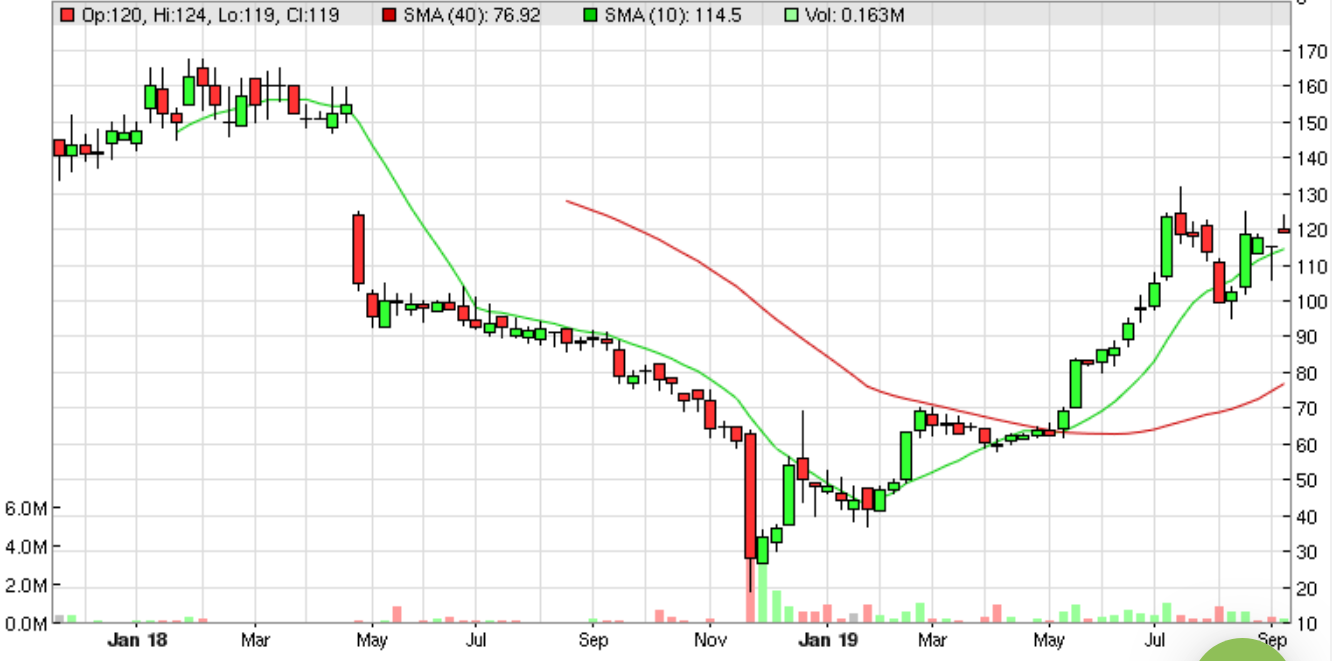
Filta Group (LON:FLTA)
Share price: 175p (up 14% today, at 12:53)
No. shares: 29.1m
Market cap: £50.9m
Filta Group Holdings plc (AIM: FLTA), a market-leading commercial kitchen services provider, is pleased to announce its unaudited Interim Results for the 6 months ended 30 June 2019.
Key points;
- Good organic revenue growth of 21% (6.6m LY to £8.0m TY)
- Acquisition of Watbio added a further £4.2m of new revenue, total £12.2m revenues in H1
- Only a modest increase in profitability though - Adjusted Profit before tax** increased 14% to £1.3 million (2018: £1.1 million)- why hasn't profit increased more, given strong revenue growth?
- The commentary indicates that substantial cost savings were made after the half year end, suggesting improved performance in H2 & beyond.
- Share based payments of £303k in H1 seems rather a lot - it's about half of operating profit!
Outlook - nothing very specific & no mention of market expectations;
... Following the acquisition of Watbio, Filta has become one of the leading providers of FOG Services in the UK, making us well-placed to capitalise on recent changes to hygiene regulation. This, in conjunction with the underlying growth in our other business areas, gives us confidence in the outlook for the remainder of the year and beyond.
Balance sheet - just about adequate. If you strip out intangibles, then NTAV is only just positive.
It has £3.6m of cash, and £4.2m of borrowings, giving net debt of £0.6m.
I am ignoring the additional £1.0m of notional debt under the ridiculous new IFRS 16 rules relating to leases.
Cashflow statement - not good. All of the operating cashflow in H1 was swallowed up in adverse working capital movements - in particular a big drop in creditors, see note 5. I'd want to better understand what has driven those movements. I would have expected trade creditors to have risen, given that an acquisition has been made in the period.
The other large item on the cashflow statement is £1.8m paid for acquisitions.
Is it wise for the company to be paying dividends at this stage?
Valuation - it looks as if Filta bought an inefficient operation (Watbio) and is turning it around. That's a perfectly good strategy, but it does rather render these H1 results as unreliable to value the business. Hence broker forecasts are of more use.
There's an update on Research Tree today, which shows a significant reduction in FY 12/2019 forecast - EPS reduced from 10.5p to 8.0p. Normally that would have triggered a sharp fall in shares price. So I'm a little perplexed as to why the share price has actually risen 14% today? That looks an anomaly, unless I've missed something very positive in the commentary perhaps?
Although FY 12/2020 forecasts have been left unchanged at 12.1p adj EPS.
My opinion - the main attraction here is good growth, and recurring revenues.
In summary, I'm not impressed by the balance sheet or cashflows. I feel that at the current price, investors are being asked to pay up-front for the turnaround measures being implemented.
Therefore it's not for me.
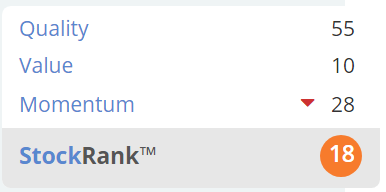
Note that the StockRank is very low. The system doesn't tend to like acquisitive groups.
UP Global Sourcing Holdings (LON:UPGS)
Share price: 74.5p (up c.4% today, at 14:55)
No. shares: 78.9m
Market cap: £58.8m
Ultimate Products, the owner, manager, designer and developer of an extensive range of value-focused consumer goods brands, announces its trading update for the financial year ended 31 July 2019 ("FY19").
The highlights section looks very impressive at first sight;
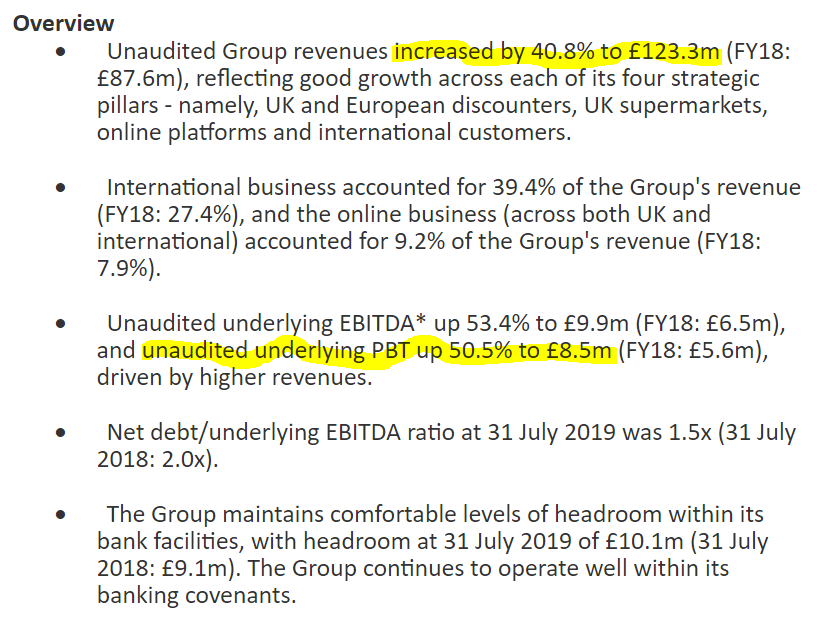
Stockopedia is showing £121.7m forecast revenues, so the actual result above is 1.3% ahead in revenues.
Profitability looks to be ahead of expectations - a new note today from Equity Development increases its forecast from 7.9p to 8.1p for FY 07/2019.
Forecast for FY 07/2020 is increased from 8.3p to 8.5p - giving a PER of 8.8 - which looks reasonable.
Outlook & current trading sound OK;
· Currently trading in line with market expectations with the FY20 order book moderately ahead of this time last year.
· Over the longer term, the Board is confident in the resilience of the Group's business model, and in particular the adaptability and versatility of its strategy.
Balance sheet - looking back at the last interim balance sheet, it looks adequate. NTAV is £10.4m, which is OK.
There's some net debt, about £14m, but this is supporting inventories + receivables combined of about £38m. Therefore debt is not excessive. It's fine for companies with decent stock turn to finance some of that with bank debt.
Dividends - forecast yield is a very attractive 5.8% - that's good for a company which is going profits strongly, and has a sound balance sheet. Providing nothing goes wrong with future trading, then the decent divis should be sustainable.
My opinion - my preconception was that this was a rather low quality company. But when the facts change, so does my opinion - it's so important to approach every share with an open mind.
There's a lot to like here;
- International, and online sales, are impressive & growing
- Excellent divis
- Strong profit growth
- Solid outlook
- Balance sheet is reasonable, with debt under control
- Management has loads of skin in the game - see here
On the downside, it's basically a distributor (although owns/licenses some brand names too), so not likely to ever command a premium rating. My other concern is over potential bad debts, from retail customers going bust.
Overall though, I think this share looks attractive, for investors seeking a decent, and probably sustainable, income from dividends.
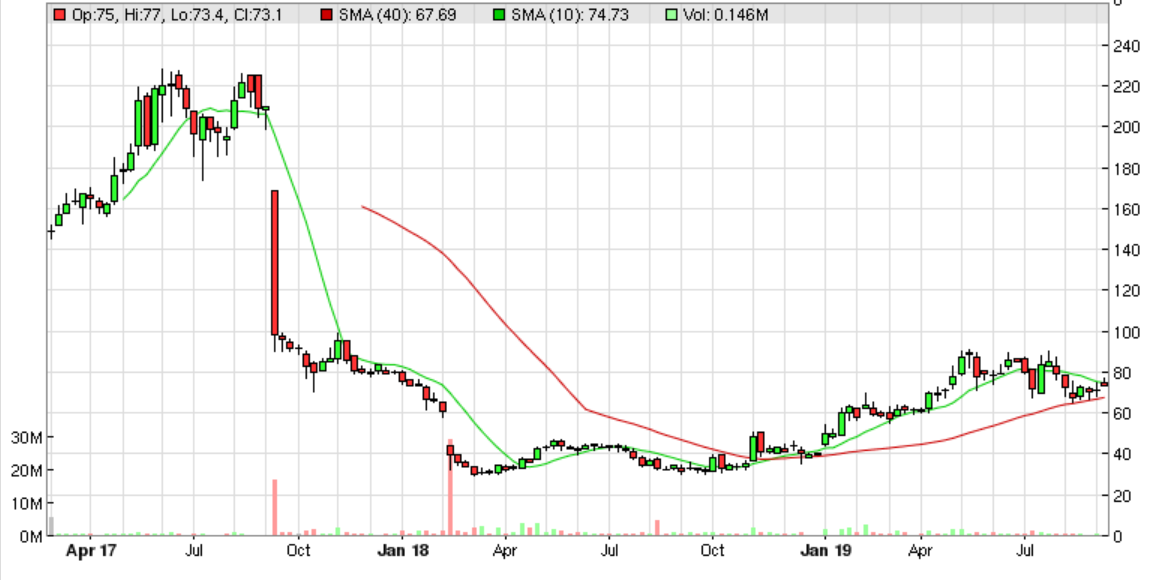
It was a disastrous float in Mar 2017, with the share price plummeting just 6 months afterwards. That dents investor confidence very badly, with IPO investors naturally likely to feel that they were stitched up. It's good to see the company getting back on track, with a strong update today. Therefore, despite the chequered track record, this gets a thumbs up from me today.
Here is the full chart since it floated:
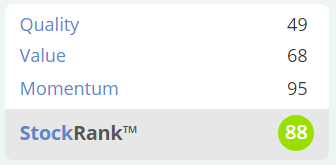
We also have the reassurance of a high StockRank:
Medica (LON:MGP)
Share price: 130p (down 1% today)
No. shares: 111.1m
Market cap: £144.4m
Medica Group PLC (LSE: MGP, "Medica", the "Company" or the "Group"), the UK market leader in the provision of teleradiology services, today announces its unaudited results for the six months ended 30 June 2019.
Note (from Google):
Teleradiology is the transmission of radiological patient images, such as x-rays, CTs, and MRIs, from one location to another for the purposes of sharing studies with other radiologists and physicians.
The Stockopedia historical graphs look terrific;
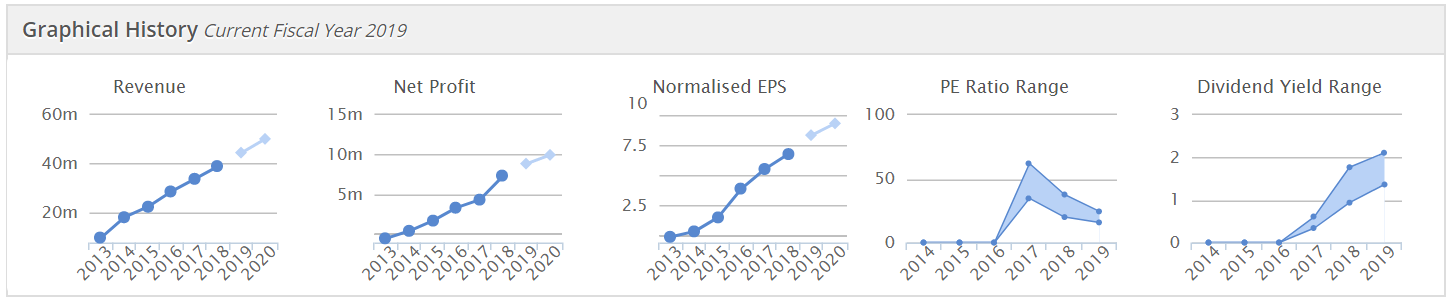
I don't seem to have written about this company here before. Graham's notes on the last full results, were published here in late Mar 2019. It's quite tough to impress Graham, but this share did so! It's currently at a similar price to when he wrote that article.
Results today have impressed me too;
- Revenue growth of +18.2% to £22.0m in H1- this appears to all be organic, from what I can tell, which is impressive
- Adj operating profit is only up 7.0% though, indicating lower margins
- Operating margin has fallen from 26.8% to 24.3% - overseas setup costs are blamed - but this is still a very high margin business - maybe too high margin, as this is likely to attract competitors to join the party
- Adj EPS is 3.98p, up 9.5%. Double that for a full year, and we're at about 8.0p, which is consistent with the 8.34p broker consensus forecast shown on Stockopedia. At 129p per share, that's a current year PER of 15.5 - which strikes me as very reasonable, for a growing, high margin business
Outlook - full year heading to be in line with expectations
Balance sheet - slightly odd. There's a remarkably strong current ratio -
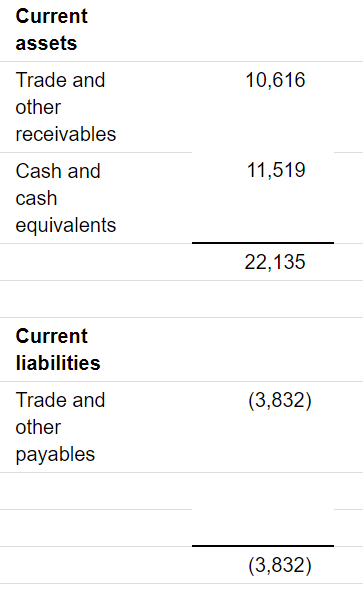
Tons of cash sitting there, and hardly any current liabilities. Very nice.
But then in longer term liabilities, there is £12.5m of "borrowing & other financial liabilities". How strange. Why have a lot of cash sitting there earning next-to-nothing in interest, then opposing borrowings, attracting debt interest? That doesn't make sense to me. Unless the cash pile is a seasonal spike perhaps, which could be atypical for the rest of the year?
Curiosity got the better of me, so I've checked the 2018 Annual Report. Page 29 indicates that the company has a £12m bank loan, and £1m overdraft facility. These are payable in Mar 2022, and attract interest at LIBOR + 1.75%. So cheap borrowings. I wonder though, why the company hasn't at least partially repaid this facility, to save on interest charges? That's a good question to ask management, if anyone speaks to them.
My opinion - I like this. It's a very high margin business, with good growth, available at a reasonable price of fwd PER of about 15. There's a 2% dividend yield, which looks to have scope to grow.
My only reservation, is that the operating margin is so high, this is bound to attract competitors, offering the same services at a keener price. There again, there seems to be much inertia within the medical sector - i.e. hospitals often seem to keep using the same products & services, once they are established. So competitors might find it difficult to dislodge Medica?
Overall then, a thumbs up from me for Medica.
In more normal market conditions, I would see this trading on a PER of at least 20. So this could be a buying opportunity. It's not likely to be affected at all by Brexit, either.
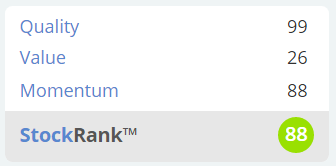
Stockopedia likes it a lot too;
For more information, there's a presentation slides pack from Medica to accompany these results, available here.
That's me done for today, thanks for dropping by.
Regards, Paul.
Disclaimer
This is not financial advice. Our content is intended to be used and must be used for information and education purposes only. Please read our disclaimer and terms and conditions to understand our obligations.

41 comments
Applies to Boohoo (LON:BOO) and Sosandar (LON:SOS) and other online clothing sellers.
https://www.dailymail.co.uk/news/article-7487959/Online-fashion-stores-introduce-smart-tag-fight-against-serial-returners.html
Wish I'd thought of that.
Regarding the clothing returns discussion, how does this affect logistics complexity?
I understand that outsourcing of the logistics operation is common, e.g. Sosandar (LON:SOS) use Clipper. However, with the need for the logistics company to check the returned items for damage, carefully refold and repack them (and may be iron them too), and finally put them back into stock as “new” there is a significant level of complexity. The logistics company is in effect running a repacking factory that is mission critical for the clothing company. It is no longer simple box shifting.
This strikes me as being somewhat risky. Outsourcing is fine and makes a lot of sense for non-core activity but 100% outsourcing of your repacking factory would seem risky for a 100% etailer with a high returns rate.
If something goes wrong at that logistics business over which you exercise very limited control you are potentially toast.
I can understand that an etailer may think that design is their competency and logistics is not, but if fifty percent of your business is repacking your own product because of the ridiculously high returns rate in this market segment shouldn’t that also be a core competency?
It's common for online sellers to use specialist reverse logistics providers. That allows the main business to focus on sourcing and shipping product. Often the returned product gets sorted and assessed by the return logistics provider and they sell it on through secondary channels like eBay or clearance outlets rather than it being injected back into the main supply chain. But at 50% return rates for clothing I would agree with you.
When I discussed this topic with BooHoo management (a couple of years ago now) they were very focussed on controlling and handling the whole thing themselves.
Paul likes UP Global Sourcing Holdings (LON:UPGS) and has upgraded from trash to decent as a company - praise be :)
My take is valuation is currently unkind and could be a few rating points higher as both margin and growth prospects decent. But there's perhaps a bit of caution weighing against it with Brexit uncertainty (aka brexshit) plus a potential recession brewing in its new growth market Germany. As a seller of decent but cheap stuff this is not necessarily too bad an environment for UPGS. In addition, they haven't updated on Russell Hobbs license...they've been confident in past they keep it. Would be a blow to lose it but not a killer.
Some views:
1) Its higher quality business than its given credit for with a margin it can defend. Why? Primarily as its not just import and resell business. Its active in product design and quality management with meaningful quality management presence in China. They claim, and I find believable, that they out do the big guys in this production chain management stuff and the independent quality assurance (aka box tick) firms. Margin is also protected by fact they don't make themselves an explicit part of retailer supply chains by agreeing future purchases etc. They provide product and the retailers order what they want. Means that they control their margin much more (at the expense of less demand visibility)
2) The growth opportunity in UK and Europe is still considerable
3) Senior mgt team with lot of experience and worked together for a while
4) Have developed scalable in-house procedures and systems critical to efficiently growing trading business like this. They integrate and comply with a lot of big retailers well and efficiently
5) In-house design team which has been successful in hitting right vibe so far (ie most product they sell is designed by them with aim of quality and style for low budget - John Lewis feel at Asda price)
6) Been around a while now, CEO has presence/charisma and has probably reached a stage where he gets time with big guys when he needs it...so not a struggle to open doors
I don't now Paul but I feel that if he net senior mgt inc CEO he would be v impressed with them as retailers.
I listened in at the CEO presentation at the last Mello and had a chat with the CEO afterwards - quite impressed but did not take a position. Was interesting to hear about the role they play in assist BigFish to source in China. Wondered about the future of their own China sourcing but trade wars cannot get that far? IMO they are in the right segment if times get tough - in the UK or Germany.
Was also interested in their recent acquisition of the KleenEzE brand - I saw at a distance the amazing resuscitation of an old, exhausted brand that I previously could see no value in!
Re UP Global Sourcing Holdings (LON:UPGS) I saw a presentation at Mello too. I think they did more than one but the one I saw was by Andrew Gossage (managing director) - not by Simon Showman (CEO). Gossage’s presentation was impressive.
I have owned this stock briefly, as a punt, but sold out far too soon a long time ago. My main concern around the company was that the business seemed like a lot of hard graft (getting product into retailers, finding lines that sell and negotiating with Chinese suppliers). Not too dissimiliar from Showman’s original job as an auctioneer.
Management (inc Showman and Gossage) had become rich following the IPO in March 2017, which raised no new money for the company but was just a sell-down by existing shareholders. Would management still have the same drive post IPO? But the recent recovery in the financials definitely gives confidence that management is still very much focused.
UP Global Sourcing Holdings (LON:UPGS) - The graft and complexity you reference is partially a moat. Likely, the hardest thing for newbie to replicate is top level relationships with the right people in retailers
Sanderson have been taken over at a price of 140p
SANDERSON GROUP Sanderson (LON:SND) shares are suspended this morning pending an announcement.
Anyone know what going on ?
Will be moving off the market after agreeing bid
Thanks , I had a small holding in Sanderson and i was hoping for a second bidder. I missed there last announcement on delisting dates, Looks like i should have sold out, instead i have wait for my money :(
Re online clothing and the returns problem, surely it can't be that difficult to come up with a low cost sensible solution?
2 minutes consideration has come up with - adding a very large colourful tamper proof label attached to the front of every item. If the item is returned with the label still attached and not tampered with then full refund - no problem. If the label has been removed then item considered as used.
How many customers would want to attend an "occasion" with a label saying something like "This item purchased from SOSANDAR" or similar? Not very facebook friendly I would have thought.
Clothing is a highly competitive business. It will solve the returns issue over time.
Poor retailers who can't control either fraudulent or legitimate costs of returns (like any other cost) will go simply go bust. This cost includes both the direct cost and the overhead/ distraction it causes
Better retailers will find solutions to cut fraud (as above tamper proof sticker, Social media checks) and/or simply price to cover it - especially as data analytics improve to identify aberrent behaviours. This will especially true of the most loyal customers (eg free returns or your returns cost credited against your account if you spend over £XXX pounds/yr).
The best retailers will even find solutions that offer sustainable advantage from such areas eg Next's online cross subsidy of its stores for returns or solutions that ensure good fit eg getting customers to share a 3D scan of your body and recommending fit.
Niche businesses will spring up to meet the remaining consumer need eg rent for-the-night-dress companies.
What's left will be small. But online is still, big picture, in its early days. Market needs time to sort it.
Disc. I hold £SOS and £NXT
2 minutes consideration has come up with - adding a very large colourful tamper proof label attached to the front of every item.
Unsurprisingly the fashion industry has put more than a couple of minutes into the problem. They're all over fraud prevention tags to defend themselves against wear and return fraud - or wardrobing, as it's known. They work, we know this, but there are issues.
At the high end, where fraudsters want expensive clothes to wear to an event without having to pay, then the monetary case is relatively straightforward. However, the problem is that with an estimated wardrobing cost of around 4% you don't have to put off many of your genuine high end customers to lose out overall. Real customers don't appreciate receiving an expensive item which they then need to try on with an awkward ribbon or tag and then have to carefully remove themselves. And if they get the removal wrong they can't return the garment.
At the low cost end then it's more straightforward - the cost of effective fraud prevention tags can be relatively high compared to the actual clothes and on a low margin business that can be counterproductive. Hence why businesses are resorting to analytics to try to identify and block serial fraudsters, rather than using fraud prevention tags.
It's tricky, but in a low margin business where a misstep can severely damage a business it's understandable that companies are cautious about how they deal with the problem.
timarr
What is it's underwear...?!
Well I did think of that but decided that they probably (hopefully) don't take returns on underwear to then resell.
In any event with a large label/tag I think the comfortability factor might be more of a deterrent than a missed photo opp.
Of course I could be wrong.
Paul: Would be interested in your analysis of Medica ; Graham last looked at them (positively ) in April 2018 and these latest results look good to me . Their business model looks good and is repeatable but in the the current climate any company with low net debt , strong cash flow , high returns on capital (21.7%) and equity ( 26.7) and an operating margin of 24.7 % has got to be worth looking at and all for PE of 14 .6 .
Hi,
DUKE isn't the sort of thing I cover unfortunately.
I'm happy to take a look at reader requests for FLTA, UPGS, and MGP.
Regards, Paul.
another vote for Duke please
Another one for £DUKE please - results look in-line, but no real detail on the restructuring of the debt and the dividend outlook seems to have been reducing from 3.6p to 3.3p currently.
Outlook is a little foggy in my view, more for what it doesn't say as opposed to what it does.
I'll second any thoughts on UPGS update this morning?
£SOS, £BOO, £ASC - very interesting episode of In Business on Radio 4 last night looking at the current retail woes. Particularly interesting bit at the end about return rates for online clothes retailers. Perhaps not news to anyone else, but the point was made re Coast administration that it was heavily focused on the segment with the highest returns (women's clothing), the product with the highest returns (dresses) and the type of purchase with the highest returns (occasion wear).
Overall, it was said that average return rates were around 40%, but that within Coast's area, return rates of 70% were seen. Made me think of two things re £SOS: they're in a brutal business and really have their work cut out, but that given their product mix, their return rates of ~50% maybe aren't that bad after all - though they could really do with getting them down.
A link would have been helpful but I have found it. To save others the trouble here it is:
https://www.bbc.co.uk/programmes/m00081xf
The blurb:
Online retail spending has increased more than four fold in the last ten years - it now accounts for almost one in five pounds we spend shopping.
But whilst times are tough for our high streets, e-retailing is far from a licence to print money. With widespread discounting and a growing cost of delivery and returns, margins are being squeezed and many are finding it a struggle to survive.
In this programme, Adam Shaw investigates how the economics of e-commerce work, what the move to predominantly online will mean for many retailers and what our shopping environment may look like in 10 years time.
I'm inclined to think of the latter for Sosandar (LON:SOS), although I hold so perhaps biased.
Having sold a few bits and bobs on Ebay I despair how some people are dishonest, people pulling stunts like buying an item and returning their own faulty ones (a case where Ebay will always side with the buyer). No doubt for occasion wear people will be buying things, using it for the occasion and then returning it.
Hopefully the demographic of SOS might be different.
I'd think on this level of scale that SOS will start to have that perhaps a 'returns consultant' might be deployed, calling up people in the database who have regularly returned clothes. This might have the effect of educating customers, or even SOS themselves into reducing this metric.
It'd be difficult to assess the impact of this member of staff, you'd probably need several hundred returns to be averted in order to say they have paid for themselves, and a reduced returns rate might not be directly attributable to them.
I saw ASOS had to tighten their policy a bit earlier in the year to tackle blatant abuse.
It shouldn't be too difficult to run regular reports to identify the customers who are never going to be profitable to deal with and decline their business. I would see it as akin to a regular credit control function.
ASOS said "If we notice an unusual pattern of returns activity that doesn’t sit right: e.g. we suspect someone is actually wearing their purchases and then returning them or ordering and returning loads – way, waaay more than even the most loyal ASOS customer would order – then we might have to deactivate the account and any associated accounts."
Edit - ASOS have resorted to checking social media accounts for photos of customers wearing items that they then return.
https://www.cosmopolitan.com/uk/fashion/a26073482/asos-returns-repeat-blacklist/
The reader comments on returns for online fashion jolted my memory of a conference call I participated in when Sosandar (LON:SOS) (in which I hold a long position) did their recent £7m fundraising at 15p.
They're always asked about the returns rate, and always reply that it's just a cost of doing business, and is unlikely to move down much from the c.50% level.
However, they also said that because they sell a lot of dresses, and that these are a more complex fit, that has inflated their returns rate somewhat. Therefore different product categories are being grown more aggressively. This autumn, they are focusing more on denim, footwear, and accessories. New buyers have been added for each of those 3 categories. Returns rates are much lower, hence why they are being developed as a priority.
Regards, Paul.
re Sosandar (LON:SOS) - I remember hearing this before from them about the returns.
To me it seems there is some lacking in logic to say c.50% returns is no problem and it is just a normal cost of doing business, then to say we are focusing on developing other products as a priority which have a lower returns rate. Surely that implies that they see the costs of the first business as being less than ideal. It implies they are want to report a lower cost of returns ratio than last year, when the reality will just be a different product risk.
I fully understand the logic for them to diversify and develop new products etc...
but the reason for that should be for the benefits of diversification.
disclosure - I have no position
An interesting view I heard was that some people order more than they need so as to bump their order value up into the free delivery category for some online retailers. They then just return the items they don't want. It seems there are many issues for returns, which was one metric the High Street had an edge over online. Looking at Sosandar's website they promote Free and Easy Returns on the main menu tab, so clearly they feel it helps alleviate a barrier to purchase.
1) Any views on Abcam? Fallen star or buying opp?
2) LLOY - I am a disgruntled holder but note that even with the HUGE increase in August PPI claims and the additional £1.2bn they are cutting the share buyback but not the dividend. Implied and probably sustainable gross yield of 7%
3) Yes a follow-up comment on Duke would be welcome
£MGP please Paul,
Possibly £DUKE as well if you have the time
Air Partner (LON:AIR) update as well. Less emphasis on the dreaded H2 weighting - which I guess should be positive. And I see Liberum have moved it to "BUY" - whatever thats worth...
I took the reduced H2 weight to effectively be a profit warning in the sense that they are less confidence about H2 than previously...
Hi Richard
Re. Air Partner (LON:AIR) that's certainly an interesting way to look at it, thank you. I always fear that my bias as a holder makes me miss what might actually be happening.
I was just going through my notes and the company updates for this year have been as follows:
1) May 2019 - H1 is "slightly ahead of prior year" (adj. PBT in H1 of 2018/19 was £4.2m)
2) June - H2 will be less than H1. Obviously not great, but the H1 result alone was enough to make me hold my position.
3) Today - H2 will be the same as H1
So if we assume adj. PBT will be at least £4.2m * 2 = £8.4m then we're looking at quite a good result vs a company with an EV of around £30m (excluding customer cash).
And even if there's a miss on that £8.4m, that still seems like a remarkable result vs the company's valuation.
It seems to me that last year's accounting mishap continues to hold this company's share price back, but having just written the above I'm actually minded to top up.
Cheers
A
My morning smallcap tweet:
MXC Capital (LON:MXCP), Eddie Stobart Logistics (LON:ESL), Midatech Pharma (LON:MTPH), Ten Lifestyle (LON:TENG), Cerillion (LON:CER), Luceco (LON:LUCE), Medica (LON:MGP)
MXC Capital (MXCP) FY trading, tender, demerger. Trading EBITDA* at least £1.7m. MXC Capital UK will demerge and list on International Stock Exchange in Guernsey. Guernsey? How is that going to get the best SP? Tiny tender offer (2.7% of cap) proposed at 117p. * =HEWCMU (Highest Earnings We Could Make Up).
Eddie Stobart (ESL) possible offer. No figure. Remains suspended pending accountng review.
Midatech Pharma (MTPH) CFO resigns but will aid hand over. He is thanked. New CFO starts today.
Ten Lifestyle Group (TENG) guides FY rev in line but adj EBITA ahead of mkt expectations.
Cerillion (CER) major new contract worth £3.7m but guidance kept.
Luceco (LUCE) H1 in line. H2 started ahead of expectations but maintains FY outlook due to Brexit threat.
Medica Group (MGP) H1. Guides FY rev slightly ahead but profit in line with mgmt expectations.
UP Global Sourcing Holdings (LON:UPGS)
Impressive TU this morning - Rev up 40%, profits up 50% - positive start to 2020 year - no mention of the B word.
( Lloyds Banking (LON:LLOY) warn of increased provision of up to £1.8bn for PPI - it seems claims from the banking sector will continue to boost the consumer for quite a while to come. Weekly levels of claims into the deadline quite astounding and one wonders about their quality.)
Phil
(Small holding in UP Global Sourcing Holdings (LON:UPGS) - potentially looking to bottom fish at Lloyds Banking (LON:LLOY) )
I wonder how many PPI claims are verified, or whether the banks just took a view of providing in their accounts and paying was the least line of resistance, a bit like insurance claims at one time, when it became easier to justify settling than to disputing, if the claims were lower than the legal costs of disputing? I recall the BP spillage where the claims became increasingly spurious because of a feeding frenzy, and dodgy politics pushed by Obama and others at the time.
As a holder of UP Global Sourcing Holdings (LON:UPGS) those were good sounding results. A modest PE and good dividend yield stands them in potentially good stead if there is an upwards market correction at some point in the future.
Filta Group (LON:FLTA) Interim Results look good
Filta Group Holdings plc (AIM: FLTA), a market-leading commercial kitchen services provider, is pleased to announce its unaudited Interim Results for the 6 months ended 30 June 2019.
-- Revenues up 86% to GBP12.2 million (2018: GBP6.6 million) - Fryer Management and Site Services revenues, 81%, represent recurring business.
-- Newly acquired Watbio contributed GBP4.2 million, 34% of Group revenue.
-- Organic revenue growth of 21% from Filta's existing business.
-- Gross profit up 50% to GBP5.0 million (2018: GBP3.4 million) supported by 9% organic growth.
-- Adjusted Profit before tax** increased 14%
-- Interim dividend increased 39% to 1.00p
Looks like they have got rid of a third of their newly acquired Watbio technicians! "New scheduling software implemented in July supporting a 28% reduction in Watbio technician headcount and a 25% reduction in overtime costs."
I no longer hold after selling out in June on a disappointing update at that time (they had said there was a slowdown in new Franchise sales in the US) maybe I wasn't patient enough lets see how the price reacts today maybe I should reconsider
9 new franchises sold in the period
Director Holdings are massive
What struck me about the Filta Group (LON:FLTA) results was the lack of EPS figures in the headline, despite all the other usuals included. Made me a tad suspicious, and lo and behold further down in the income statement diluted EPS has dropped from 2.98p to 1.22p.
It doesn't appear to have spooked the market so was likely expected, but still yet another fine example of headline window dressing!
I was also intrigued by the market’s reaction to the Filta Group (LON:FLTA) interims - although this is a stock I have not previously looked at. Hardman saw the H1 numbers as below expectations and cut its EBITDA numbers for both FY19 and 20 slightly. Given the large costs below the EBITDA line, the cuts to adj EPS were more brutal: 2019 to 5.1p from 9.9p and 2020 to 8.1p from 11.3p.
With the share price up 17% this morning, either this means the market’s reaction is irrational (usually an incorrect assumption); or that the market is well-ahead of the brokers’ research and the cut to forecasts was already in the price, which has fallen sharply since May.
I was also surprised by the market’s enthusiasm for Filta Group (LON:FLTA) . Once you get past the EBITDA, “adjusted”, “underlying” stuff the stark fact is that the final net profit after FX adjustment is £336k against £809k last year.
Also the cash is interesting in that it is heavily influenced by an astonishing drop in DSO. Despite having almost doubled sales the H1 receivables are actually down from the year end. This is generally laudable, but it is very surprising and requires a bit more understanding than I have so far figured out from the numbers provided. It could reflect a slowing of sales towards the end of the half year but this would probably have to be disclosed.
In fact for a small fairly straightforward company there is a lot going on here, with the sales in several markets and (presumably) lumpy receipts for franchises.
Intriguingly Filta also states in the notes that some accounts have been agreed to settle on extended terms.
(I do not hold)
Paul: Medica (LON:MGP) please - Looks cheap' ish on a PE/PEG basis for a medical related business with strong (if slightly reduced) gross margin and an in line Board expectations profit forecast