Small Cap Value Report - Part 2 - Wed 26 Apr 2017 - CRAW, PHD, WAND, REDS, HMLH, R4E, DSG

Good afternoon, it's Paul here.
Today I've covered:
Crawshaw (LON:CRAW)
Proactis Holdings (LON:PHD)
WANdisco (LON:WAND)
Redstoneconnect (LON:REDS)
Plus brief comments on: HML Holdings (LON:HMLH) , £D4E , and Dillistone (LON:DSG)
Crawshaw (LON:CRAW)
Share price: 23.75p (down 21.5% today)
No. shares: 79.2m
Market cap: £18.8m
Final results - for the 52 weeks ended 29 Jan 2017.
This is a chain of butchers + hot takeaway food, mainly based in the North and Midlands. The company added 11 new sites in the year, taking the total to 49 sites at year end.
As is clear from the figures today, this is a roll-out that has gone wrong. We already knew that though, as a series of poor trading updates have already crashed the share price from a peak of about 95p 18 months ago, to just 24p today. It's been even lower too - I sold mine near recent lows and only got something like 16-18p for them, from memory. Poor timing, as usual on sells! It's just so difficult to decide when to sell, I'm hopeless at that aspect of investing.
A few key figures from today's results;
- Revenue up 19.3% to £44.2m
- Operating loss of £1.4m (prior year £0.4m loss)
- EBITDA of £0.1m positive (prior year £1.0m positive)
So a clear deterioration in performance - which isn't what's supposed to happen when you're doing a roll-out. Each new store is supposed to bring additional profit, so clearly things are not working out very well here.
New sites - opening 11 new sites will definitely create additional pre-opening costs, and so the company does what Tasty (LON:TAST) did recently, and massages the figures to report a supposedly higher underlying EBITDA performance.
I think it's fine in principle to flag up genuine pre-opening costs (e.g. wages for staff being trained, before the site actually opens), and perhaps some Head Office costs related to new site openings. However, the same as with Tasty, I think Crawshaws has been way too aggressive with this process, and hence the numbers lack credibility.
Crawshaws says today;
*Adjusted EBITDA is defined by Group as profit/loss before tax, exceptional items, depreciation, amortisation, profit/(loss) on disposal of assets, net finance costs, share based payment charges attributable to the LTIP Growth Share Scheme and Accelerated Opening Costs.
Accelerated opening costs are defined by the Group as the overhead investment in people, processes, systems and new store pre-opening costs i.e. costs directly associated with our accelerated store opening programme.
In the period these costs amounted to £1.2m (2016: £1.6m) resulting in an adjusted EBITDA of £1.3m (2016: £2.6m).
Those figures look daft to me. Claiming accelerated opening costs of £1.2m, for 11 relatively small sites, is £109k per site! That's ridiculous. A credible figure, for this type of business, would in my view be about £20k per site. So I am just treating the adjusted EBITDA figure with the contempt it deserves.
Also, given the dismal share price performance, why are there any share based payment charges at all?
Director remuneration - shareholders may well question why the CEO is being paid so much? A salary of £326k for Noel Collett, looks ridiculous to me - given that he's made a complete hash of the job so far. This seems a good example of how a bigger company executive can often flounder in a smaller, more entrepreneurial business.
He's made basic mistakes - including not understanding that Crawshaws is a discounter, and instead alienating customers by pushing up prices, to drive higher gross margins. That strategy has failed - as demonstrated by these poor figures.
LFL sales were significantly negative for the year, at minus 7.3%. The company can however point to an improving (but still negative) trend;
Like-for-like sales have improved from -13.0% in Q3 to -7.4% in Q4 further progressing to -4.5% in the first 10 weeks of the FY2018
So current trading is still below prior year, which is clearly a concern.
Balance sheet - isn't strong any more. It looks acceptable to me, but there's not much cash left for any new stores.
Net cash is down to £2.0m.
Working capital looks OK to me (retailers can operate with a lower current ratio than other companies, because they get cash immediately from sales to customers) - so whilst a current ratio of 0.9 is quite low, it's not a concern, in my opinion. Although I wouldn't want that to go any lower.
Cashflow - when a roll-out goes wrong, companies can often remain cash generative, once they stop opening new sites. In this case however, reversing out the depreciation charge of £1.2m only gets them to about cashflow breakeven. Not good.
£2.9m was spent on capex in the year - expect that to fall drastically in 2017/18, as it no longer makes sense to open new sites.
Dividend - is passed (prior year 0.47p). I think shareholders can probably forget about divis here for the foreseeable future.
Factory shops - this is probably the only reason to continue holding Crawshaw shares. This is an out-of-town concept, like a small, drive-in discount store. This format does seem to be working well;
Strong performance from our 5 standalone Fresh Meat factory shops, giving confidence for a further targeted rollout of this format in FY2018
Outlook comments don't sound too bad;
"The momentum in second half sales, followed the successful opening of our new stores in the first half of the year. We now have 49 sites in the portfolio, each benefitting from the innovation and expansion within our fresh meat and food-to-go categories. In 2017, we expect to open a further 5 stores, with specific focus on the fresh meat factory shop format."
"Looking ahead, the momentum built through the last six months has continued into the new financial year, and trading is recovering in line with our expectations. With the business stabilised and having returned to cash generation, we are returning our focus to the store roll out programme."
Although I think the tone of that commentary seems somewhat detached from reality. Talking about momentum, when your LFL sales are still significantly negative, is stretching credibility in my view.
My opinion - despite all the negatives mentioned above, the situation does at least sound like it's being stabilised. So I don't think Crawshaws is likely to go bust - there's no debt to worry about - which is the usual killer when companies experience poor trading.
Therefore, if you want to take a positive stance on this share, upside could come from management efforts to improve trading - e.g. localising the product offering, making sure price points are correct, and attractive to customers - really just basic stuff.
The exciting upside from a rapid store roll-out seems to have gone for now. There again, if the 5 new factory outlet stores planned for this year all do well, then there's a possibility the company could drive a more rapid expansion of that format.
So optimists, who are also prepared to be patient, could possibly be rewarded in the future, if a revised roll-out plan does work.
Overall though, for me, once a roll-out has gone wrong, and the upside looks limited (in the short term anyway), then it's difficult to rekindle any interest. There's also the issue of stale bulls - I'm not sure what Hargreave Hale's current view is, but they can be very aggressive sellers once they lose faith in a share.
Also, the results today don't really mention competition. My feeling with this share has always been that it's vulnerable to supermarkets fighting back. Whilst CRAW only had a few shops, selling surplus stock cheaply, they were not a threat. However, with 49 shops now, and clearly trying to take market share from supermarkets, then it's inevitable the supermarkets are going to fight back, with their own offers to attract back lost customers.
So the key missing ingredient is that CRAW lacks pricing power. Also, in the background are possible risks from meat contamination. Putting it all together, I'm probably 70% wanting to keep away, and 30% vaguely interested in having a punt on it, but probably not at the current price.
Many thanks for the reader prompts for me to look at the additional RNSs from Crawshaws today, which actually look more important than the results statement.
"Transformational partnership" with 2 Sisters Food Group - this looks a very intriguing deal. It requires shareholder approval, but the key points seem to be;
2 Sisters is said to be "one of Europe's largest meat & food manufacturers".
Its founder, Ranjit Boparan is intending to subscribe for 33,794,490 new shares in Crawshaws, priced at just 15.2p (a deep discount). This will give 2 Sisters a 29.9% holding in the enlarged share capital of Crawshaws.
This will raise just over £5.1m in fresh cash for Crawshaw.
Why is the price so low? Because this deal was put together when the market price was around that level. It has shot up recently.
Warrants - this looks odd. It's a 12 month scheme, which seems to be designed to push up the share price to 40p - which would then trigger 2 Sisters being entitled to buy another 45.4m shares at the same price of 15.2p - giving an instant profit of £11.3m, and obviously diluting existing holders significantly more - as 2 Sisters would then hold, in total 50.0% of the company.
Chairman - Richard Rose is stepping down at the AGM on 28 Jun 2017. He is to be replaced by Jim McCarthy, who seems to have an impressive CV.
Roll-out - the funds are intended to be used to accelerate the store opening programme - focussed on factory shops.
My opinion - Crawshaws shareholders are being asked to give away half the company for £12.0m in fresh cash (79.2m shares at 15.2p, if the warrants are exercised).
The funds will enable an accelerated roll-out of factory shops. Also, there are likely to be benefits from securing access to cheaper meat supplies through 2 Sisters, as this is structured as a JV - hence 2 Sisters looks incentivised to provide cheap product to Crawshaws, and thereby increase its profits - and share price, of course - benefiting 2 Sisters as 50% shareholder (after exercising warrants, if they do so).
I don't suppose shareholders would be complaining about this deal if the share price does rise to 40p, which is necessary to trigger the warrants.
Overall, this certainly looks a game-changer. The dilution is nasty, but this deal could inject some significant upside from better sourcing, and faster expansion. Overall, I quite like it.
I hadn't intended on spending most of the day on Crawshaws, but it's such a fascinating situation, it was worth trying to get my head around it!
EDIT: after writing the above, and pondering the position further, I bought some CRAW for my personal, and fantasy portfolio (which closely mirrors my real world portfolio, largest positions) here. Obviously, as always, please DYOR and don't rely on me - as only some of my ideas will actually work!
Proactis Holdings (LON:PHD)
Share price: 179p (down 4.5% today)
No. shares: 50.2m
Market cap: £89.9m
Interim results - for the 6 months ended 31 Jan 2017.
This is a stock I've previously held, but decided to sell and watch from the sidelines recently, as the price looked to be possibly up with events.
This is a spend control software & services business. It's grown organically, with growth typically in the low teens. Then a series of acquisitions have bolted on companies with complementary services.
Today's figures look solid, rather than exciting in terms of growth - with revenue growth up 35.6% to £11.8m, but the organic growth element was +13.4%.
I'm not keen on using EBITDA figures here, because the company capitalises around £2m p.a. in development spend. Whilst that it perfectly permissible, it does of course render EBITDA meaningless. This is because EBITDA ignores both the capitalised development spend, and the amortisation charge. You can't do that, as doing so produces a nonsense number. That doesn't stop companies & brokers still using it as a (bogus) performance measure though.
In other sectors, EBITDA can be a useful proxy for cashflow, but not in the software sector, due to capitalised development spending.
Recurring revenues - this is a positive factor. The company says that annualised contracted revenue is now £22.9m. FinnCap predicts total revenue for FY 07/2017 of £26.2m, so this means that the bulk of revenues are recurring. That should make a profit warning fairly unlikely in future, due to good visibility.
Profitability - the market cap here only makes sense if you use adjusted profit.
FinnCap is predicting adjusted profit before tax of £5.4m for the current financial year (ending 31 Jul 2017), which is the equivalent of 8.7p adjusted EPS. So that's a PER of 20.6 times.
Next year's numbers should benefit from a full year contribution from recently acquired Millstream, and more organic growth. So the forecast of 10.7p EPS would lower the PER to 16.7, which looks about the right price to me.
Dividends - are negligible really, with 1.4p forecast for this year, a yield of 0.8%. People don't buy growth companies for the divis (short term anyway), so this is not a concern.
Balance sheet - the problem with being acquisitive in the software sector, is that you're buying almost entirely intangible assets. So the balance sheet can quickly become very top heavy with intangibles, which is exactly what has happened here.
The company did a placing to raise £12.5m, at 135p, to fund the bulk of the Millstream acquisition. Despite this, I feel that the balance sheet is still rather weak.
NAV of £26.3m drops to negative territory once the mainly acquisitions related intangibles of £38.1m are written off. So NTAV is negative at -£11.8m. Personally, that's a concern. The business is being funded by up-front cash paid by customers - note the £9.6m deferred income, which reflects the element of cash which customers have paid up-front, but not yet received any services. Services which of course cost money to provide, in future.
Acquisitions - expect more, by the sounds of it;
The Group's M&A pipeline remains strong as it seeks further acquisition opportunities.
I hope placings are done to finance any further acquisitions. This has actually been positive for the share price in the last year. It underpins that this share seems attractive to Institutions, which seem happy to fund acquisition-related placings.
Supplier commerce opportunity - this is the most exciting development at Proactis. I've written about it before. It's a new service which seeks to tap into the supplier base of Proactis's large clients. The idea is that each supplier on the purchase ledger of a Proactis client would be required to pay £50 p.a. in order to get access to their customer's purchase ledger. This would enable many functions to be automated. Advantages would be that suppliers could check online to see when they're to be paid. They can update their own details (e.g. if they move premises, or change banks, etc).
This should bring considerable advantages for both the client (fewer staff required in purchase ledger), and its supplier base. As Proactis customers typically have a large purchase ledger, with many suppliers on it, then the £50 per supplier fees could mount up to millions of extra, high margin revenue for Proactis, if this new service takes off. Suppliers will also be able to use this platform for early payment (for a fee), which also enables Proactis to make a profit - not unlike what Tungsten (LON:TUNG) tried to do.
There's not much detail on progress in today's update. There are 3 pilots underway ("early adopters") with Screwfix, Flintshire County Council, and P&O Ferrymasters. Today's update only says;
The early adopter programme, is progressing well and is providing informative data together with commercial and operational know-how that will be invaluable as the concept evolves to product and the early adopter customers become referenceable.
Maybe shareholders wanted a bit more red meat on this, which could explain why the shares have drifted down today?
The size of the opportunity is reiterated today;
The Directors estimate that these opportunities could increase the revenue per customer significantly from level which is currently being achieved. The Group has more than 800 customers with an estimated spend of more than £100bn with over 1m suppliers.
1 million lots of £50 p.a. is clearly a decent market opportunity. Although it's probably sensible to assume a take-up rate of maybe 10% at this stage, to be prudent? That's just a guess.
My opinion - I like this share, but feel that, for now the price is possibly up with events.
Any signs of the supplier commerce product taking off in a big way would entice me back in. So I shall watch carefully from the sidelines.
WANdisco (LON:WAND)
Share price: 462p
No. shares: 37.4m
Market cap: £172.8m
(for the avoidance of doubt, I do not currently hold this share)
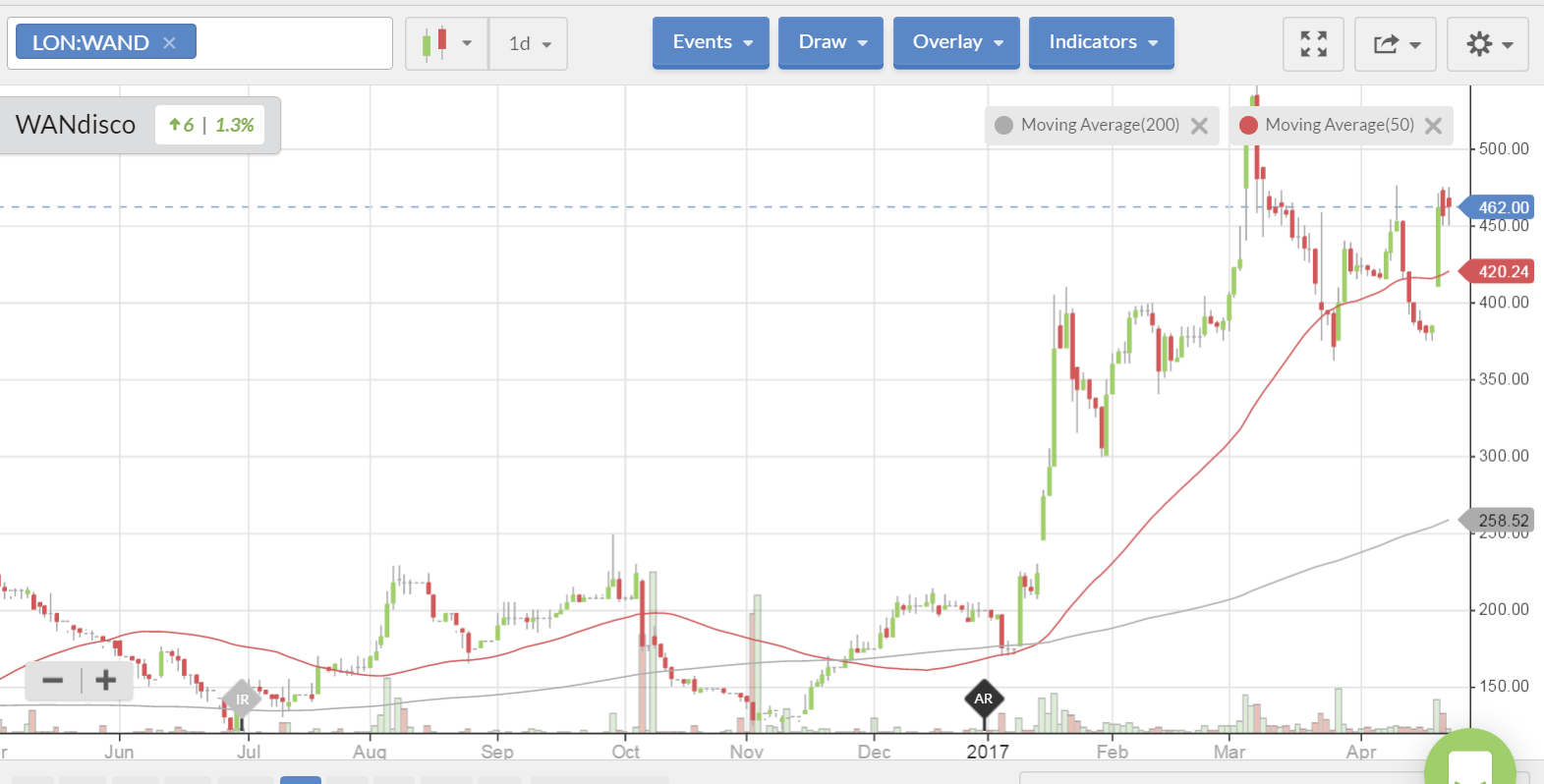
Q1 update & significant customer win - this announcement came out on Monday. I didn't have time to report on it that day, as I was out & about. Several readers have asked me to circle back to it, so here goes.
I flagged to readers here on 16 Jan 2017 that the newsflow seemed to be turning more positive at this company. Good thing too, as its longer term track record has been appalling - huge losses & cash burn, with little growth being delivered.
The contract win is for $4.1m, with a "major financial services multinational", and is WAND's largest ever contract. What's interesting about WAND is that it claims to be unique;
Fusion was selected after an extensive period of testing by the Client and was deemed to be the only enterprise-grade solution able to support critical Cloud and Big Data applications.
Central to selecting WANdisco was Fusion's capability to enable the Client to move active, critical data seamlessly between both primary and disaster recovery sites and the Cloud without any downtime.
Although as one analyst has pointed out, if WAND's software is so special, how come the major internet companies out there seem to be able to function fine without it?
Cash burn - this is a bit disingenuous, as there have clearly been one-off factors which flattered cashflow in Q1. These factors are mentioned, but not quantified. So the question remains, what is underlying cash burn excluding these factors?
The Company is also pleased to report that it ended Q1 2017 with cash of $7.6 million, reducing cash burn in the quarter to zero.
The combination of strong prior quarter bookings, good cash collection and expense efficiencies realised in the quarter, along with the receipt of the annual R&D Tax Credit from HMRC all contributed to zero cash burn in the quarter.
Outlook comments sounds positive;
"We continue to see increasing traction with WANdisco Fusion, which is providing the foundation for our strong order book and sales pipeline for the current financial year."
My opinion - I sold my last tranche of WAND shares on the big move up on Monday. For me this was an interesting trade, a bit of a punt really.
There was some broker coverage on the day basically saying that the newsflow is good, but don't get too carried away - it's still loss-making.
I shall monitor things with interest, but personally the temptation to bank a big gain in just 3 months, on a very speculative stock, was too much. So I did.
Redstoneconnect (LON:REDS)
Share price: 1.68p
No. shares: 1,645.1 (per company website)
Market cap: £27.6m
(at the time of writing, I hold a long position in this share)
Final results - for the year ended 31 Jan 2017.
This company is basically the good bits from Coms, with good new management. So it's been a turnaround, that seems to be working. I visited the company's HQ last year, and like what they're doing.
A few key numbers;
Revenue up 3.5% to £41.5m. Whilst this looks somewhat disappointing, the company has been focusing on higher margins, rather than higher turnover.
Gross profit rose an impressive 33%, to £9.2m, which is an increase from 17% to 22% - a very good improvement.
Profitability - is difficult to ascertain, as there is a confusing variety of measures provided. In such situations, I tend to revert to the cashflow statement, as I find that much easier to understand, and is less prone to manipulation.
Note that there's a negative tax charge in the P&L of £0.6m, which flatters the profit after tax, and hence EPS figures too.
Cashflow - this looks quite good, and much improved from last year. The operating cashflow (before movements in working capital) was an inflow of £1.9m, versus an outflow of £617k last year.
Only £367k of development spending was capitalised, so the accounting doesn't look aggressive to me.
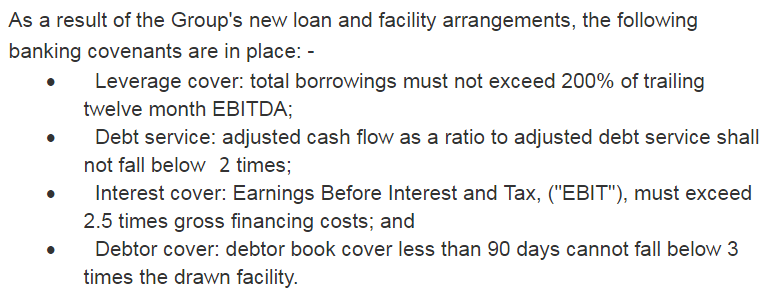
Bank covenants - I really like that the company has disclosed its banking covenants in today's announcement. This should be compulsory for all companies in my view, because it's vital information for shareholders to assess risk;
Balance sheet - looks a bit weak to me.
NAV is £14.5m, but that includes intangibles of £14.3m.
Therefore NTAV is just £0.2m. That's not a worry particularly, because the company is now profitable & cash generative. Although it should be borne in mind that there's basically no asset backing to speak of.
Outlook comments - sound generally positive, although light on specifics.
The pipeline & order book are described as strong.
My opinion - so far, so good. The turnaround under new management seems to have worked well, with a decent move into profit. The finances look stable now too.
I like the area in which this company operates - smart office management, and services. It's also got a very impressive client list. So it will be interesting to see how this develops.
A few quick comments to round off with;
HML Holdings (LON:HMLH) - a trading update for y/e 31 Mar 2017.
Earnings are anticipated to be in line with market expectations.
This property management company is expanding with lots of small acquisitions.
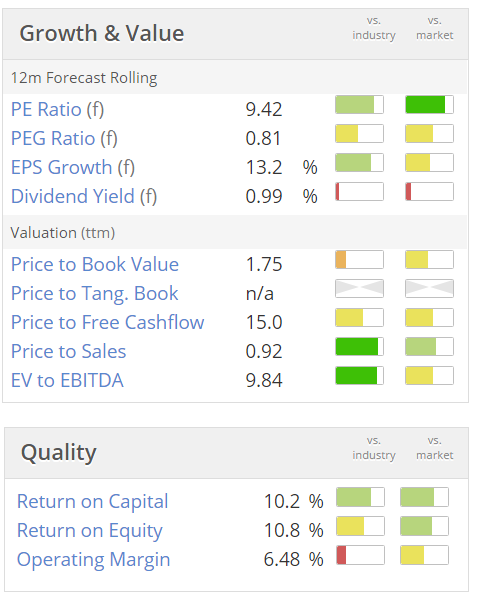
It looks good value, with a forward PER of only 9.42.
Although bear in mind that it's an illiquid stock;
£R4E - very late results for y/e 31 Dec 2016 are out today.
I looked at this one recently. It was a complete basket case, but a clever restructuring in 2015 resulted in some of the bank debt being written off. As a result, the balance sheet is looking more viable now, but is still weak.
Performance in 2016 was OK - operating profit of £0.85m on turnover of £96.6m, suggests a lot of "pass through" revenue perhaps. The company does marketing for theatre shows.
This is a Nigel Wray stock - he owns 26.9% of it. Although looking at today's unexciting numbers, I'm struggling to understand what the attraction is. Probably the best thing that can be said about it so far, is that it managed to avoid going bus, and has moved into modest profits now.
The still-weak (not not as bad as it was) balance sheet means no divis.
Who knows, maybe there are hidden charms to this share?
Dillistone (LON:DSG) - another company reporting calendar 2016 results very late. The figures look reasonable. Adjusted operating profit is up slightly at £1.46m. Although note there are large adjusting items of £1.05m, so the net operating profit is only £412k (down from £1.1m in 2015).
Checking note 7, the adjustments are all non-cash things, basically writing down intangibles, so that's OK.
Note that there's an unusually good dividend yield for a small software company here - almost 5%.
Recurring revenues are strong, and cover the basic admin costs, which is good.
The narrative has some interesting & positive outlook comments. Regulatory changes could drive improved sales. Also, the company mentioned a new product which they sound excited about, but no specifics.
Overall, I like this company, but have found it impossibly illiquid to deal in, in the past. Pity, as if it was more liquid, I'd probably buy some.
That's me done for today.
I've not had a chance to look at Boohoo.Com (LON:BOO) results yet, so will do that now, and may comment on them in the morning.
See you tomorrow!
Regards, Paul.
Disclaimer
This is not financial advice. Our content is intended to be used and must be used for information and education purposes only. Please read our disclaimer and terms and conditions to understand our obligations.

39 comments
Crawshaw: Yesterday I attended a meeting with Crawshaw management. I am sharing my notes on the meeting. My conclusion is purely my opinion and is not advice. I could be wrong, I often am!
Crawshaw Group (Aim All Share, Market capitalisation: £23m, 29.5, 2.4% of JIC Portfolio and 7.6% of JIC Top 10):
Meeting with management:
I attended a meeting with Noel Collett, CEO and Alan Richardson, FD earlier today
Conclusion: Having listened to the management I can understand why, after yesterday’s initial drop in the share price, buyers are coming in. The arguments about Boparan holding all the cards and being able to ‘screw’ Crawshaw shareholders in the future are difficult tom refute but is that really his primary motivation. It might be but one must ask why. It makes more sense for him to gain both the soft, and hard, benefits from a successful Crawshaw in his distribution business and from his 50% shareholding in the business. It’s likely that once he exercises his warrants he might try and take the rest of the business off shareholders at a cheap price but I think that is something to worry about later.
What to do now? This is a different story from when I first invested in November 2013 or indeed from when Noel Collett was appointed CEO in 2015. Would I buy it if I didn’t already own it? Most probably not. But I do own it, have made good money out of it and want to maximise the returns from my current 2.4% holding. (I have realised profits of £10,333 and after today’s rally, have unrealised losses of £1,284 on the remaining 30,250 shares in the JIC Portfolio). My judgement is that over the next year the benefits of this deal will become more apparent and the share price will make progress towards 40p. I will most likely sell some, or all (depending on news from the company), before 40p but 38p for instance, is still 30% higher than the current share price of 29.5p. I feel more comfortable about the deal after today’s meeting and am Holding on!
Main points:
The deal with 2 Sisters, Mr Boparan’s company, was the result of a strategic review that the Board was undertaking.
They concluded that if they were going to do something they should do something meaningful. They already had a supply relationship with 2 Sisters. The new agreement should be seen as a 50:50 partnership.
The initial three-year agreement covers most of Crawshaw’s chicken requirements. We are talking 40,000 odd birds per week. This is a small fraction of Boparan’s total production of 7.5m birds per week.
What’s in it for Crawshaw? Significant cost savings which are fixed for 12 months and renewed in years two and three, negotiable on a formula based on the prevailing market price. It also brings in £5m initially and hopefully, if the share price exceeds 40p, £7m more in a year’s time to help fund the business. In due course, Crawshaw is likely to source other meats, (red and other white) from 2 Sisters.
What’s in it for Boparan. Makes use of stock which might otherwise go to waste (landfill), which is good from an economic and corporate responsibility angle. There is also the potential to supply Crawshaw with red meat and other products from his businesses such as Bernard Matthews, Hollands, Matthew Walker and perhaps even Fox’s.
They talked a lot about the “Spirit of the Partnership”. The share price was 15p when they were agreeing the fine points a month or so ago. That was why it was struck at 15p. Boparan wanted 50%, to make it a 50:50 partnership. Crawshaw insisted on the inclusion of warrants that were only exercisable when the share price is above 40p.
They said they could have come to market to raise more cash but that might not have been so popular at 15p and in any case, it wouldn’t have come with this “transformational deal”.
They banged on about the transformational nature of the deal; “benefits are huge”, “with the deal, Crawshaw gets bigger returns, quicker and with less risk.”
Richard Rose first bought into the business 10 years ago and felt it was time to leave the Board. He still owns 5m plus shares. Jim McCarthy, Rose’s replacement as non-exec chairman, the was part of the succession planning and he was “on board” before the 2 Sisters negotiations began. Research I have done suggests McCarthy is an excellent appointment for Crawshaw. I understand that in the past he tried to recruit Collett to Poundland.
Ken McMeikan, who joined the Board as a non-exec last year, is also leaving due to other commitments. He stayed on to help with the 2 Sisters deal. It was interesting to see that his parting gesture was to buy 150,000 shares yesterday at 26p. Of course, that might just be a case of averaging down after his purchase last year or perhaps, he likes the deal and thinks the shares cheap!
The company is confident that it can open 200 of its fresh Meat Factory shops where the returns are compelling and it is experiencing performance significantly ahead of its base model economics.
" Would I buy it if I didn’t already own it? Most probably not."
A few brownie points from me for such candour.
Thanks for the write up.
What it seems to boil down to is (unspecified) cost savings for 12 months on chicken purchases after which it reverts to market price.
In return for which existing shareholders have given up to half their company for 15p a share which most definitely wouldn't have been possible in the open market. Plus the buyer gets to sell other products in with no discounts.
The story is fundamentally the same but with significant existing shareholder dilution - do you believe the management can execute an effective, profitable rollout of the format, or will they just burn the funds received on poor operational decisions, high pay, high costs and share awards as previously?
I think the discount is quite large and will give a decent boost to margins and sales. I don't think it reverts to market price at end of year one. It will be at a discount to the prevailing market price, so still giving Craw a competitive advantage.
As I said , it is a different story from when I first bought but I think by accident or design they have stumbled on a format that gives good returns. Those returns should get even better with cheaper sourcing.
In short I think the management can execute an effective, profitable rollout of the format. The lessons of the last year, although painful have been taken on board and I would still give Collett and Richardson the benefit of the doubt.
The big question must be over Boparan's real objectives. The appointment of Jim McCarthy gives me some comfort on that front. Nice to see he bought 190,000 shares yesterday.
"if WAND's software is so special, how come the major internet companies out there seem to be able to function fine without it"
Paul, a very broad generalisation, but the systems operated by financial institutions run under very different constraints than the major internet companies. The former are looking for absolute accuracy and consistency under any failure scenario, the latter require broad resilience but can be quite sanguine about losing the odd shopping basket or social media post. This difference has huge implications for system design and management. I have no idea how good WANDisco's product is and I do not hold, but the problem you describe that they are trying to address is genuinely a hard one.
I'm long Dillistone (LON:DSG) mainly because Mike Love is Chairman and I admire the way he has run SCISYS (LON:SSY) - conservatively and effectively for many years. If he can replicate that with DSG, the dividend (currently forecast at 4.77%) should be safe.
Thanks for the WAND thoughts Paul, can't blame you for banking the dosh! Think I'll see where it goes with the new customer...
Paul, thanks for the marathon report.
After making a great call on WANdisco (LON:WAND) I'm surprised that you've sold all your shares. For me it's a hold for now - it looks like the Fusion product is gaining traction, and technically volume has been higher on up days and lower on down days which is a positive sign.
Hi ricky65,
re WANdisco (LON:WAND) - I suppose that I don't feel qualified to judge its prospects. For me, it was a trade based on improving newsflow. I doubled my money almost in 3 months, so that's a good result.
It wouldn't surprise me at all to see the shares go bananas, as we're in a raging bull market, and it does seem to tick a lot of the boxes that speculators look for in a bull market.
So I may well be kicking myself in future for having sold too early!
Also, my personal circumstances are that I've got too much gearing, so wanted to reduce my overall market exposure. So I've been cutting back on non-core positions like WAND in recent weeks.
Good luck with it, I think WAND looks potentially interesting, and who knows, I might revisit it at some point in the future perhaps?
Regards, Paul.
Hi Paul,
Thanks very much for the write up.
RE: WANdisco (LON:WAND) 'Fusion'.
In my day job, I work for a global leader in, amongst other things, infrastucture cloud delivery, and fail to see the application for 'Fusion'. DR (Disaster Recovery) must always be an exact mirror of the Production (Live) environment. Why would a client want to move data from one to the other manually? This concerns me that the DR solution isn't in fact a 'hot' DR at all (you would need a hot DR for mission critical apps so you can switch between datacenteres if one failed).
In my experience you don't want the client going anywhere near DR, and in fact at our company, it is treated the same as Production. Why they, an application would seemingly allow client root access is beyond me.
WANdisco (LON:WAND) claim that Fusion is "deemed to be the only enterprise-grade solution able to support critical Cloud and Big Data applications." This is simply not true, hence the bold section.Deemed by whom? The client, I hope, because if WANdisco (LON:WAND) believe this, management really are delusional!
The company I work for host mission critical cloud apps 24/7 365 on 99.999% uptime. We are talking the types of critical Govenment applications which, if failed, have 'rioting' & 'severe social unrest' as documented risks. Why WANdisco (LON:WAND) believe they can indicate that they have excelled in this area, when their own RNS' show their lack of understanding, is a mystery.
IG
Re. WANdisco (LON:WAND) When I was active in technology management, I would look for a Gartner Report for whatever major technology product that a vendor was pushing. Gartner's magic quadrant is very useful in identifying the competitors, leaders, best in class, etc.
Wandisco has a number of products and Wandisco Fusion is only one of them. The fact that Wandisco Fusion appears not to be covered by a Gartner report would reduce my interest considerably. Not a show stopper but definitely a red flag.
No position long or short. This stock is too erratic for the good of my health.
Yes - I should add, for clarity, I have no position in WANdisco (LON:WAND) whatsoever, and no plans to initiate any.
One of the last innovations I got involved with in IT before I retired was storage area networking (SAN) where mirrored data was stored at two sites using point to point fibre connections with no single point of failure. Fusion apparently achieves the same effect of data consistency at multiple sites around the world whereas my experience was limited to 10 Kms and as far as I can tell by just a software "plug-in". Neat trick if it does and they seem to have a long list of partners but at current price plenty of time to do further research.
WANdisco (LON:WAND)
Things have moved on as they do in computing and Fusion is designed for use on Apache Hadoop Distributed file system which is an open source software framework for distributed storage and processing of big data sets. Something like Raid but implemented on multiple nodes across a network instead of on multiple disks on one. The main investment risk is that most of the functionality is open source software with a patented software plug in which competitors could possibly develop independently. Too risky at present valuation imho. This Wiki article will tell you more than you can possibly want to know I'm sure.
https://en.wikipedia.org/wiki/Apache_Hadoop
Delete
Any thoughts on ULS Technology Paul. It has a few people excited
Hi goingbroke,
Yes, I've just been reading the update from ULS Technology (LON:ULS) . Am too tired now to properly report on it.
However, it looks good - ahead of expectations.
I looked at this company a few months ago, and remember thinking that it looks potentially interesting. I tried out their websites, etc, but didn't quite understand it properly, so in the end gave up & moved on.
It looks worthy of further research though, definitely. I'm not really looking to open any new positions personally at the moment, so will pass on it, but for other people I'd be interested in your findings, if you do research it.
Regards, Paul.
Boohoo.Com (LON:BOO) My pennyworth on whether to sell or run a winner or top slice, which surely depend on so many factors:
- your time horizon. Mine for Boohoo.Com (LON:BOO) is 10 years plus
- whether you have a better idea. So if something better comes along (as Paul points out about £G4M)
- whether you want to trade in and out of the share or whether you see yourself more along the lines of owning part of a business.
- whether you like to be fully invested all the time or hold cash and try to time the market.
I made my first purchase in Nov 2015 and made three additional purchases in the following 6 months. Boohoo.Com (LON:BOO) now represents 19.2% of my ex-cash portfolio. I am happy to sit any falls in the share price out, particularily as the management seem to have a good plan for future growth.
I like to be fully invested (I am about 7.5% cash now). I really don't feel that I can time the market and that if it is a sound company time/patience will see the investment turn out right.
Thanks for the Crawshaws write-up. Hope your back gets better.
Paul
AFAIAA, there is no commentary in the CRAW results indicating whether they are currently trading profitability. Given all the bad news in the RNS, if they are currently trading profitably, I would have stated this explicitly.
So, lots of bad news provided and trading at a loss still? I do wonder.
Thank you for a very interesting write-up on CRAW.
Best wishes, Martin
It was that one where you produced written reports of interviews.
Making a contribution is very much an impulse decision.
apad
Hi apad,
Oh do you mean my website QualitySmallCaps.co.uk ?
It's got a PayPal button for donations, is that what you mean?
If so, it's just a standard PayPal thingy. I don't know if it's customisable or not.
Sorry if it's displeased you. I'll see if I can adjust it.
Regards, Paul.
Just checked and it's easy through a Paypal account. I must have tried to pay by credit card before and got fed up of entering details.
Not displeased.
apad
I think the bigger news for Crawshaw (LON:CRAW) was the second RNS this morning outlining the proposed investment/strategic partnership with 2 Sisters.
http://www.investegate.co.uk/crawshaw-group-plc--craw-/rns/transformational-partnership-with-2-sisters/201704260701043200D/
Appears to be placing an initial 30% of the company based on a price of 15.2p per share (last night close above 30p) with warrants over a further 20% on similar terms. Appears hugely dilutive at face value but difficult for shareholders to assess the value of the new blood/cash without fuller information. Note the warrants only kick in after the share price is above 40p.
Today's share price fall at "only" 22% to c. 24p suggests, perversely, that perhaps the market approves?
Gus.
Paul,
I tried to make a contribution on your website a while back and it asked for so much detail I could feel a lorry titled Marketing Opportunity bearing down on me, so I gave up. I do have the attention span of a gnat.
Might be worth having a lower activation energy way of funding?
Easy to do by making lots of fields non-essential.
apad
Hi apad,
Are you talking about Stockopedia (which isn't my website, it's Ed's!), or something else? If so, maybe drop him a message to make that point. I agree that registration procedures for websites should generally be as light as possible. On the other hand, if you want free, unique content, then it's not unreasonable that the provider might want to email you occasionally, trying to persuade you to subscribe. Without subscribers, there wouldn't be a website.
Regards, Paul.
P.S. slight crossed wires here, resolved below. So pls ignore this post.
Hi Paul,
Any chance of looking at Plus500's Q1 results? Appreciate this company may be too large to be considered.
Many thanks
CRAW. What about the future with Two Sisters billionaire taking up to 50% of the Co.
Hi tads,
Ah yes, sorry I forgot about the additional RNSs from Crawshaw (LON:CRAW) today - I'll check it out & add more detail to the article.
Regards, Paul.
2Sisters has paid loose change to be able to sell their surplus output (which varies week by week as production is pretty much fixed while sales vary hugely with supermarket promotional activity and demand seasonality) to Crawshaw at retail prices rather than having to take lower wholesale market prices or freeze it at high cost.
Given his record of swooping on troubled companies, it's very probably a good deal for Mr Singh, whether it is for existing Crawshaw shareholders remains to be seen.
I agree, it's a smart move by 2Sisters and should work well for Crawshaw as well. From memory the fall in the pound post the referendum hit their Polish supply arrangements hard so some availability of cheaper supplies from the UK is good news for them.
That being said, I'll leave them to it rather than get involved. I expect Mr. Boparan will come out on top in this situation.
Re Crawshaw,
One point to watch is that 2 Sisters don't load Crawshaw (LON:CRAW) with cheap/suplus chicken thereby artificially inflating Crawshaw (LON:CRAW) profits, until such time as the share price reaches 40p and the 2 Sisters warrants kick in @ 15.2p giving them 50% of the company. Thereafter it’s entirely possible that 2 Sisters chicken will return to a realistic market price. Unusual trading opportunity to 39p, but one that doesn’t fit my investing style, so I am going to pass.
It's just so difficult to decide when to sell, I'm hopeless at that aspect of investing.
Paul, Sorry mate, but you will no doubt recall Ed Croft's research study into 245 small cap profit warnings and the basic rule of thumb is that overall you will do better to sell at the first profit warning which in Crawshaw (LON:CRAW) 's case would have been last September when you could have got 40p/share. Same applies to Fairpoint (LON:FRP) and no doubt several others along the way.
The converse is to keep your winners. Today's example being Boohoo.Com (LON:BOO) A share who's valuation is crazy which is why I topped slice several months ago (big mistake in monetary terms but at least I can sleep at night!). I seem to recall you sold out of BooHoo some months ago.
Anyway, as hard as it is, running winners and cutting on profit warnings is something that after 20 years of investing I am actually doing (by and large) as opposed to telling other people to do it and not following my own advice. Maybe you could try the same??!! :-)
Carcosa
Hi Carcosa,
Thank you for your sage advice.
CRAW was a bit different for me, as I only bought AFTER the profit warning. So it was a bottom-fishing attempt, which was ill-timed on the way in AND the way out!
FRP - well that one was just a disaster, and I think management were probably dishonest about performance.
I think position-sizing is key. Neither of the above were big positions for me, so the losses didn't particularly matter, compared with profits elsewhere which were many times larger.
Every profit warning is different in my view. So when good companies hit a bump in the road, that can be an excellent entry point. Although I think it's best to have a bias towards selling on a profit warning. Mind you, if everyone does that, then the over-reaction creates opportunities for others.
Running winners - yes I agree, that is important. Although bear in mind we're in a fairly crazy bull market right now. So that strategy is working well - for now. I can remember plenty of other times when banking bumper profits, instead of holding out for more, was the best approach.
As regards BOO - yes I sold way too soon. HOWEVER, I recycled the money into G4M, which actually rose faster than BOO, from that point (although the gap has narrowed more recently). So personally I only kick myself for selling too early, if I recycled the money into something that under-performed.
All fascinating stuff, and whatever we do, the market will always give us a kicking from time to time!
Regards, Paul.
You seem to forget Boohoo.Com (LON:BOO) had a profit warning, I bet you would be gutted if you had sold everything and not bought back in. Crawshaw (LON:CRAW) was one of the big stars not so long ago, went up about 50x in one year, probably best to take some profits before the profit warning as you would have lost 50% of your money. Some high flyers soar and then crash and then recover ASOS (LON:ASC) is one example.
You seem to forget Boohoo.Com (LON:BOO) had a profit warning...
Perhaps a re-read of the research would assist???
Carcosa
Hi herbie,
BOO was certainly included in the research as a profit warning - however, I regarded it as an expectation failure rather than a profit warning. BOO was growing extremely strongly at the time. Possibly a semantic difference but excluding would make the findings even more conclusive.
Also the food in Crawshaws is pretty unhealthy. Really going against consumer trends to eat less meat and pies and more salads and wraps, which Greggs is getting right
No surprise re Crawshaws - parachuting in execs from big companies (Lidl and Morrisons in this case) rarely works out, they often just don't have the skill set needed when they can't call on sophisticated systems and legions of support staff to assist them, as discussed and highlighted on here months ago.