Small Cap Value Report (Thur 10 Oct 2019) - OTMP, MCL, CTP, NMRP

Good morning!
Thanks for your suggestions.
Let's take a look at:
- Onthemarket (LON:OTMP)
- Morses Club (LON:MCL)
- Castleton Technology (LON:CTP)
- National Milk Records (OFEX:NMRP)
Onthemarket (LON:OTMP)
- Share price: 81.75p (-2%)
- No. of shares: 64 million
- Market cap: £52 million
Please note that I own shares in Rightmove (LON:RMV), so I'm not exactly disinterested when it comes to the success or failure of Onthemarket.
This update show good growth in the number of branches listed (up 28% in the year) and excellent growth in traffic, with a 75% increase in the number of site visits.
I also note that its stock of available property has improved, and its stock is now c. 64% of Rightmove's.
It generated far fewer leads per property advertised than Rightmove, but it claims that if you adjust for how much more expensive Rightmove is, that it offers twice as much value (i.e. leads per pound spent).
The rate it uses for this calculation is £331/month, which is the rate at which long-term contracts are offered to agents, for 3 or 5 years.
It also offers short-term, low-cost contracts at just £203/month.
The bit where I have a big problem is that the revenue under long-term contracts of £331/month comes at a price in terms of share issuance.
The business model is to outcompete Rightmove (which itself was founded by estate agents) by regularly giving "free" shares to estate agents, to get them on board.
That's great for the estate agents, but this regular dilution says to me that it's unlikely to be a high-grade investment.
Indeed, the need to dilute shareholders risks creating a self-fulfilling prophecy, whereby a low market cap (c. £50 million) means that ever greater numbers of shares are needed to incentivise agents to sign up, only serving to make the dilution worse.
OTM recently reported that agents weren't committing to long-term contracts at the rate expected, implying that the existing offer of free shares wasn't enough to get agents on board. Hence, the introduction of short-term, cheaper contracts.
Analysis
During H1, 1308 branches signed up for long-term contracts, receiving 1.8 million shares in return. That's about 1,400 shares per branch, with value of £1,100 (at 82p each).
That's about 3 or 4 months' worth of free advertising, in a contract which lasts for 3 or 5 years.
The idea is that this incentive, along with lower advertising rates, will help OTM grow to Rightmove's size in terms of stock availability. When OTM has a huge stock of property, and with estate agents actively preferring it thanks to the lower fees, it could pose a threat to Rightmove (and Zoopla).
My view
One possible outcome, in my view, is that Rightmove and Zoopla might charge estate agents slightly less, to see off the threat of OTM.
There is little doubt that consumers, as demonstrated by the existing traffic statistics, still have a huge preference for the big two incumbents.
Rather than let that advantage slip away to an upstart working on behalf of estate agents, I think that Rightmove and Zoopla are more likely to ease up a little on pricing, if necessary, until they have seen off this threat.
Rightmove (LON:RMV) is well-financed, reporting a cash balance in June that was equivalent to OTM's current market capitalisation. It has the lead in terms of data collection and technology, and I expect that it will continue to invest to ensure that it has the best platform. So I do not believe that there is any technological threat from OTM.
It's true that OTM are copying certain of Rightmove's products and features, but I can't see any reason why they would be able to improve on these products and features.
In order to keep the agents on side, all Rightmove needs to do is charge them rates which don't squeeze them too hard, relative to their profitability and the offer from OTM. It can always relax a bit on pricing, if necessary, and it will still have a huge operating margin.
Perhaps I'm too stuck in my thinking, but it looks to me that property portals are a natural duopoly: we have the main portal where customers go naturally, and an alternative portal which prevents the main one from draining estate agents completely dry.
While I don't think that OTM has any chance of becoming the main portal any time soon, it might pose a more significant threat to Zoopla in the race for second place.
Outlook
The outlook statement is measured:
challenging backdrop of relatively weak and highly uncertain market conditions for agents has undoubtedly slowed our progress. However, the ever-improving performance of the portal and the current level of take-up of both our long-term full-tariff contracts and our revised short-term offers provide grounds for optimism.
Current trading is in line with recent guidance.
The cash balance as of September was £8.6 million.
Given that the company has reported a loss, even on an adjusted basis, for the H1 period of nearly £7 million, and reported a loss last year of £14.5 million, I would pencil in another fundraising needed, to keep it going, if it doesn't see a lot of revenue growth very soon. Otherwise it would have to slash its marketing budget, which would be devastating.
Stockopedia rates it as a Sucker Stock and it passes a short-selling screen. Statistically, most companies with this profile don't make it.
Morses Club (LON:MCL)
- Share price: 104.5p (-%)
- No. of shares: 131 million
- Market cap: £137 million
Interim Results for the 27 weeks ended 31 Aug 2019
This is primarily a doorstep lender, one of the largest in the UK.
Most of the numbers presented here are fine, but profits are held back "by the integration of the new digital businesses".
For example: revenue is up, the loan book is up, the return on assets is up slightly (to 19.1%), the number of customers is up, and impairments as a percentage of revenue is down to 19%
(However, I note that the lower impairment charge is due to lower sales to new customers in the core division - new sales bring with them an upfront impairment charge. So there is no improvement expected for long-term impairment rates.)
Home Collected Credit
This division seems to be performing fine.
Digital lending
MCL's main online brand is dot dot loans. It also picked up loans from WageDayAdvance, which fell into administration, and it bought a business offering online current accounts.
This division produced a loss of £5 million, versus revenue of just £6.9 million.
Excluding costs which MCL says are non-recurring, the loss was £3.5m million.
Funding
MCL needs to refinance its revolving credit facility by August next year. It's working on it.
Overall leverage is modest: the company has £110 million of total assets on its balance sheet, funded by £70 million of equity.
My view
The doorstep lending division is easy enough to understand, with MCL having the second-biggest operation in the UK.
I'm not sure about the plans for the online lending division - where is it hoping to position itself? What will its competitive advantage be? The link with the existing customer base of MCL will help, but is that it?
These shares probably do offer some "value" at the current levels, but I can't get excited about the digital lending division until I understand the game plan.
Castleton Technology (LON:CTP)
- Share price: 55.2p (-41%)
- No. of shares: 82 million
- Market cap: £45 million
This is a profit warning (no surprise, with the shares down 40%). Commiserations to anyone holding this last night.
Trading in HY2019 has been behind expectations, primarily due to product and professional services revenue being lower than anticipated. The increase in recurring revenue has not been enough to offset the reduction in one-off revenue, and as a result of this, revenue, EBITDA and operating cash are lower than the strong comparable period last year.
A "material improvement" is expected in H2, but the company will still miss full-year expectations.
The CEO comment says that weakness one-off revenues are to blame for the miss, and this "highlights the importance of transitioning away from one-off revenues".
He also says:
In the first quarter of the year we reorganised the Group to streamline our sales and delivery functions. Embedding this has both taken longer and been more disruptive than we anticipated, however it positions the Group well for the longer term.
My view
I haven't covered this share since June 2019, and was neutral on it (share price 83p at the time).
At that time, I created a list of positive and negative features.
Positive features included good cash conversion, which Castleton has again highlighted today.
Negative features included the B2B nature of the work and the labour-intensive professional services/consulting element.
I've basically stopped investing in this sort of thing, because I lack the ability to predict the flow of lumpy contract work at small companies - unless you're close to the story, it's very very difficult.
I also try to avoid acquisitive companies, on the basis that most merger activity destroys value.
"Streamlining our sales and delivery functions..." has "been more disruptive than anticipated", as part of a Group reorganisation. Once again, it sounds like the costs of an acquisitive strategy have been underestimated.
This is in my "too difficult" tray. Good luck to all holders.
National Milk Records (OFEX:NMRP)
- Share price: 116.5p
- No. of shares: 21 million
- Market cap: £24 million
This is on the NEX exchange, not AIM.
As the name suggests, NMRP is "a leading supplier of dairy and livestock information services". It's the market leader in this regard.
My friend Simon is a shareholder at this company and he said he was pleased with these results.
Key points:
- Revenue up 6.5%, op. profit up 20%.
- Dividend is halved (1.25p) to allow for increased investment in "laboratories and IT".
- Net debt £1.7 million, small relative to profitability.
The company says the outlook is positive, due to dairy farmers becoming "more professional and data-driven", and consumer demand for food safety and traceability.
We get a few Brexit comments. NMRP sounds calm, while cognisant of possible short-term disruption:
I am sure the UK dairy sector will not be immune from short term issues regarding uncertainty and confusion particularly if there is a no deal Brexit. As an example, in the event of a no deal the current understanding is that the UK would not impose any tariff on cheese imported from the EU, but the EU would levy a 45% tariff on cheese imported from the UK. As another example, there are approximately 80 road tankers of raw liquid milk which move from Northern Ireland into the Republic of Ireland each day to be processed. Both examples demonstrate there is plenty of work to be done in the run up to Brexit day.
My view
I think this is interesting. I like unique businesses with control of a specific niche, and NMRP fits the bill. Worth researching in greater detail.
Out of time for today, thanks everyone.
All the best
Graham
Disclaimer
This is not financial advice. Our content is intended to be used and must be used for information and education purposes only. Please read our disclaimer and terms and conditions to understand our obligations.

22 comments
Regarding further research for NMRP as an investment. Please see page 26 of this report :
https://www.rethinkx.com/food-and-agriculture
The whole report is also essential reading.
Hi
For those who trade US stocks (or Canadian) you might be interested in this from Charles Schwab
'On 10/7, Schwab eliminated online stock, ETF, and base options commissions for trades placed on a U.S. or Canadian exchange.¹ (NOTE date is US format thus it's 7th October 2019).
I do not yet have an account, but my investing friend does and says it works fine and saves a great deal of money on spreads and trading costs. I will be opening one very soon.
Regards
Howard
Tekmar (LON:TGP) has reported today on an acquisition that appears well placed to add to their offering in the undersea cable business. Tekmar does not yet appear visible to most investors and there may be chance to invest in what seems to be a good company holding a strong position in its market.
Significant part of its business relates to offshore wind power and while this is of course a hopelessly inefficient and unreliable source of power that a sane government would have quietly strangled, it does not appear likely that we will have such a government in the near future.
Significant part of its business relates to offshore wind power and while this is of course a hopelessly inefficient and unreliable source of power that a sane government would have quietly strangled,
I thought windpower was starting to make progress now? - i know it used to be something like treble the cost but from stuff i have read the trend isn't too far away from being in the right ballpark if you exclude the extra one off costs of connecting to the grid and i would be gobsmacked if its not cheaper than the new nuclear power station we will never build. I exclude those costs as every new power plant must have costs to connect it to the grid. I would agree we are probably not quite there yet as there will be much more flexibililty when associated battery storage prices hit rock bottom - and we are still i think testing bigger and bigger turbines. There is the danger i am reading the wrong biased websites in that regard (though i must admit i do like wuwt - as i thing some of the renewable spin end of the world stuff might be a tad excitable in the extrapolations)
Offshore wind is now a mainstream energy source, by 2025 offshore wind will be producing wholesale energy at under half the cost of nuclear, and below the wholesale market price.
https://www.bbc.co.uk/news/uk-49769259
Opportunities for clean electricity to be stored and transported are only starting to become established, but once they do, electricity generation could be used for transport and heating our homes in a way we've never seen before.
This will fuel huge market growth in these technologies and any business placing themselves to serve this market has great potential growth opportunities in my opinion.
Paul- if you should be reading, I wondered if you spoke to Intercede management and I’d be interested in what your thoughts were.
Thanks
Andrew
Nothing of interest for me, so I am going to be boring. Long long recovery since 2008. Brexit, who knows? Trump destroying many of the traditional relationships in the West. Rise of the strong man. Historically low interest rates for long time. Glass half full, empty? Just interested to know what investors are thinking. Traditional view at this stage is cash/gold/quality and NOT AIM stocks.
Some think small caps offer value. US tech carries premium.
I do like OTM (also own shares), once they reach IT and sales personnel capacity I can see large potential for leveraged earnings to overheads.
The key risk is their cash burn and conversion of free to paying contracts which they seem to be very actively addressing by offering cheaper short-term contracts.
There is a risk they will need to go back to markets to raise funds at the end of 2020 if they don't continue the current trend of conversions but I do think there is a large potential upside.
XP Power (LON:XPP)
the Board anticipates the Group’s performance for the full year will be in line with its current expectations as outlined at the time of its interim results on 1 August 2019
In some respects an inline trading update is good news as they had a poor first half and needed some h2 growth to avoid a very poor year. At least the ytd order intake how now turned positive.
Note although the update is inline, its not particularly great news compared to where we were on h1 update day (1/8) as the broker forecasts for this year and next have reduced materially since then. I am presuming that is simply delay in forecasts being updated after the h1 news.
The trend in normalised eps is down over the last 3 years however that's expected to bounceback next year , net profit has hardly moved since 2017 although next year is expected to show 10% increase. Note in this period they have had material acquisitions that have flattered the figures. At present the next year forecasts do look somewhat glass full - albeit q3 order intake is up 8% on the prior year so a flicker of light.
The shareprice has done ok recently improving 20% since the interims presumably the bottoming out of the poor trend in numbers has probably helped. I am still a happy long term holder in this share albeit it doesn't particularly look cheap at present if we give the company no credit for the recent patchy results and increased debt level they currently carry compared to prior to 2018 (they are normally a reliable cash making machine)
Another for £CTP please.
Morses Club (from their website)
Representative Example:
£200 loan repayable over 34 weeks at £10 per week, Rate of interest 107.1% p.a fixed; Representative 466.37% APR, Total amount payable is £340
466.37% APR!
Morses may well charge a high rate of interest – but this is only of use if the borrower actually pays up. If a borrower defaults, it takes a considerable amount of time and effort to jump through all the hoops (agent visits, letters etc.) to pursue what could well be a lost cause.
In tough times, the combination of reduced repayments and increased admin costs is quite a burden and for me makes this type of lender impossible to value.
The history of such unsecured lenders isn’t very encouraging either e.g. Cattles. There do seem to be many bumps in the road, all of this before you consider changes to legislation and possibly a different government in the not too distant future.
Morses Club (LON:MCL)
Yes, the APR of 466% is high. It's a function of the small loan size and high default rate.
With this example, if you give out loans of £200 and earn £140 in interest, then that £140 has to pay for:
1. bad debt. If 1 in 5 loans are bad debts then write off £40 from that income
2. marketing costs of sourcing new business
3. running the agent network - the door to door collectors earn commission
4. central overheads
5. funding costs, they are not a bank so have to arrange commercial funding
6. Return on equity - as a sub prime lender, they will be on low leverage
I'm not advocating high cost lending, just using this example to demonstrate the margin dynamics of small loan sizes.
According to Stocko Morses ROE is 23.5% which is good but not so high given the risk.
No question Morses is cheap with a PER of 8.5 and dividend yield of 7%.
Your point of exclamation on the 400% APR is valid, in that any lending over 100% is classified as high-cost short-term credit, such that they are squarely in the regulatory space under scrutiny.
So any position here as an investor, you must have a view on the regulatory landscape regarding the FCA and the FOS.
My view, sub prime lenders are interesting in a recession. Any lenders with weak balance sheets, over-extended lending or short funding lines exit. The survivors gain a bounce post recession from a larger customer pool and less competition. I'm not sure we are at peak pessimism yet, but this sector is getting beaten down.
Re £MCL - I think the H1 results were OK and that the 38% decline since peak (176p in March 19) reflects wider economic concerns and the short term losses that taking on Curo & U holdings, plus the fear of a radical Labour govt. It has not really been problems with £MCL or its business plan.
Graham, to me the long term game plan is a clear 2 step:
1. Slowly grow current doorstep lending and its profitability - by folding in exiting small players forced out by ever more onerous regulation and cherry picking its best customers to make a very profitable, cash generative business with a high (relative) quality loanbook generating lots of cash
2. Use this cash (and to a lesser extent, this consumer base ) to build a specialist sub-prime consumer focused digital financial services provider. It now has in-house as well as Home Collect, online loans, basic banking and cash cards having bought complementary assets on the cheap. No other provider, even Provident has this breadth of offer. Lots of work to tie it all together but a huge opportunity relative to current size (& valuation). Big banks and start ups never do well here but conservative specialists certainly can
I think quite rapidly (3-5 yrs) the Digital division will grow to equal and then surpass the by then declining doorstep lending operations but the latter will provide steadying ballast as this occurs
The whole "non-standard" and especially sub-prime sector is unloved by investors and undervalued. I (wrongly) backed £NSF and their experienced mgt team. They created real value through the Every Day Loans branch network but over-reached themselves and fought the last war in trying to take on £PFG .
In contrast, I think Morses Club's management have been much more canny and will win big once the integration costs are behind them and a few more competitors are pushed out. The poor are not going away any time soon nor their propensity to take on debt and they will need loans and baking services. Who else offers PAYG transactional banking to these types of borrowers? Who will then provide them with online loans? I like how they are testing small and cheap to learn; portal and Morses card both now at >30K users now.
Only a radical govt or regulatory overhaul (eg a Labour govt setting up a national poor person's bank) will stop Morses becoming a success, I believe.
I already own a small stake in £MCL and will buy more on weakness as, actually, I think they will do well in Brexit meltdown, as the govt firstly underwrites their final customer's earnings through welfare payments and secondly, both Tory and Labour govt now compete to shower cash on previously forgotten towns in the North where MCL is centred.
So short term, 7% dividends look secure given the strong cashflow against a robust balance sheet. Long term, I think its share price will appreciate.
"The poor are not going away any time soon nor their propensity to take on debt and they will need loans and baking services."
Is this your way of saying "let them eat cake?" :)
Thanks for the comment Peter.
G
Half baked analysis from me, I guess
Morning all!
Seconding £CTP amd £MCL please? Hold neither but they were on watchlists (& price alerts). I'm not sure £CTP is oversold at 50p if this years EBITDA is a miss on £2.5m. £MCL looking tempting for the income portfolio...
Also - what looks to be a decent update from £XPP + special dividend. market seems to like. I'm holding here.
Damm tickers still not working on the new site??
Painful drop on Castleton Technology (LON:CTP) after a H1 2019 profit warning
CEO says
The second quarter of the financial year has been significantly weaker than we expected particularly compared to the strong comparable period last year. This is primarily due to revenues of a one-off nature.
EDIT: So they must have either lost a customer or else had some big one of sales last year that they were not able to repeat this year
It looks over sold at the current price of 50p
Morning Graham,
Shearwater provided an RNS:
'Shearwater Group plc, the organisational resilience group, announces that its group company, Brookcourt Solutions has secured a three-year contract worth £8.5 million in aggregate with a leading FTSE 100 global telecommunications company.'
SVCR hasn't covered this share for some time and I would be interested to hear your thoughts.
I have a small holding.
https://www.investegate.co.uk/shearwater-group-plc--swg-/rns/brookcourt-solutions-secures--8-5m-contract/201910100700063637P/
Michael
Morses Club MCL please.
Interims out today, profit and EPS down but the interim divi is maintained. Nice yield if they can keep it going.
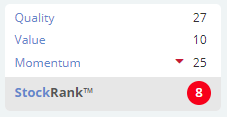
Very healthy Value and Quality ranks, but Momentum has suffered in the last 6 months.
My morning smallcap tweet: IQE buys out worthless JV
Castleton Technology (LON:CTP), John Lewis of Hungerford (LON:JLH), Velocys (LON:VLS), IQE (LON:IQE), Low & Bonar (LON:LWB)
Castleton Technology (CTP) guides H1 behind expectations mainly due to product and professional services. Warns on FY.
John Lewis Of Hungerford (JLH) guides FY loss ~£230k after H2 better than expected. However order book is only £1.6m (£1.9m). Hopeless.
Velocys (VLS) Bayou Fuels project set to produce negative emission fuels - will capture and bury CO2 from waste biomass fuel generator. Will get US Govt payments for sequestration.
IQE (IQE) buys out partners at CSDC joint venture in Singapore for $2. So it's worthless then? Will hit FY19 adj op profit by £0.5m.
Low & Bonar (LWB) gets Nov covenant tests waived pending takeover. If takeover fails they will be re-instated.