Small Cap Value Report (Tue 21 Mar 2017) - IQE, FEVR, SCS, PTD, GOAL, JDG, ACSO, UBI, BILN

Good morning! It's Paul here. I'll be writing today's report.
Loads of results today, so I'll probably be doing shorter sections, so I can get through more companies.
Please note that I added several new sections to yesterday's report last night, on;
Finsbury Food (LON:FIF) - underwhelming results & prospects
Michelmersh Brick Holdings (LON:MBH) - very strong balance sheet & big increase in divis
Maintel Holdings (LON:MAI) - very brief comment, doesn't interest me, but market liked its results
Please click here to revisit yesterday's full report.
IQE (LON:IQE)
Share price: 47.0p (down 14.4% at 08:28)
No. shares: 675.7m
Market cap: £317.6m
Final results - for the year ended 31 Dec 2016.
The share price has been volatile so far this morning, on heavy volume, hence why I've added the time in the price snapshot above. It's a popular private investor stock, so perhaps some stop losses were triggered this morning, with a larger fall earlier?
The share price of this company has been roaring upwards, tripling in price since Jul 2016, so perhaps good news is now already priced in?
Results today look good to me;
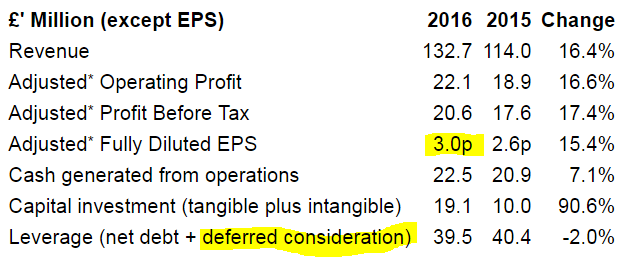
Adjusted EPS of 3.0p puts this share on a PER of 15.7. This seems to be ahead of the broker consensus figure on Stockopedia, which is 2.91p.
It's interesting to note that the company includes deferred consideration within its leverage figure, which seems prudent. I think many investors focus too much on just bank debt, and hence give enterprise value calculations too much emphasis. At many companies, other creditors (especially trade creditors) are often greater than bank debt. Yet many investors ignore those creditors (which are easy to manipulate, to reduce reported net debt on balance sheet dates).
Outlook comments sound upbeat to me;
The Group's technology and market leadership, and its strong pipeline of high growth opportunities positions it well to continue its growth profile over the coming years.
The current financial year has started well and trading is in line with expectations.
The outlook for the full year remains very positive, with good upside potential.
The Board remains confident that the Group is on track to achieve expectations for the full year, and anticipates that the Group will continue to benefit from strong cash flows.
I don't know much about this company, but so far, given strong results & very upbeat outlook comments, I'm wondering why the price spiked down c.16% at the open today? Seems rather odd. Perhaps some investors/punters were hoping for even stronger results?
Capex - note that this is a capital-intensive business. Whilst cashflow looks good, at £20.1m net cash generated from operating activities, almost all of this was invested in capex (£11.0m purchase of physical assets, and £8.1m in intangible assets). That's probably why it doesn't pay any...
Dividends - the StockReport shows a big slab of empty space in the dividends section - nothing appears to have been paid in the last 6 years. The word "dividend" is only used once in today's results statement, in this sentence;
"The Board will not be recommending the payment of a dividend."
My opinion - I fail to see the attraction of this business model. It reports big profits, but in cashflow terms that is almost all used up on capex. Leaving nothing in divis for shareholders. That doesn't sound much cop to me.
Shareholders who caught the big wave up from Jul 2016 to date have done very nicely, tripling their money. Not bad for a business that's generating virtually nothing in free cashflow, and paying nothing in dividends.
I see the share price has now (at 09:03) recovered to -7.5% on the day, at 50.6p. It's an interesting share, where you could argue that it's good value on the strong profit growth + positive outlook. However, the lack of cashflow generation and dividends rules out this one for me. I prefer businesses that require little capex, churn out cash, and give it to shareholders as divis.
Fevertree Drinks (LON:FEVR)
Share price: 1381p (down 5.5% at 09:21)
No. shares: 115.2m
Market cap: £1,590.9m
Preliminary results - for the year ended 31 Dec 2016.
Sorry, I can't resist commenting on this one! I know it's not a small cap, but it's such a fascinating situation. Results today are terrific;
Revenue growth (organic) of 73%, to £102.2m (so the PSR is a tad warm, at 15.6)
Operating profit up 99% to £34.4m (note the superb operating margin, of 33.6% - so a third of revenue is pure profit)
Outsourced business model, so capex is negligible (P,P & E is only £1.2m)
Strong balance sheet (although on a small scale relative to the market cap)
Diluted EPS up 106% to 23.7p - giving a PER of 58.3 - expensive, but if earnings continue soaring, then the company would rapidly grow into that valuation
Outlook - no specifics, but "an encouraging start to 2017"
Dividends - total for 2016 has more than doubled, to 6.25p - that's a small, but rapidly growing yield of just under 0.5%
Overseas - this isn't just a UK business (still the biggest market though, at 43.7% of sales), but there is also strong growth coming from USA, Europe, and (much smaller) RoW
My opinion - who cares what I think, as like most other commentators, I was completely wrong on this! People who better understood the opportunity, and bought at IPO have absolutely cleaned up.
As regards the future, it all depends on how sustainable the growth, and profits are?
Bull case goes something like this - there's only room & appetite in most bars for one premium brand. Fevertree spotted the opportunity, and is now unassailable as the market leader. The product tastes great, and people love the premium branding. Why buy premium spirits, and then put in a cheap mixer, which makes up the bulk of the drink? So more growth is likely to continue. Hence the share price likely to continue rising.
Bear case - it's a fad, and competition will fight back with their own premium products (Fevertree caught big brands like Schweppes napping). There's little to no difference in taste, people just think there is (for now), because the clever marketing has fooled them. Valuation is crazy, and the first signs of slowing growth are likely to see the share price crash.
Overall, I can see merit in both arguments. It all depends on consumer behaviour. Drinking out is now so much more expensive than buying from the supermarket, that I think that many people do want premium products & experience, and are prepared to pay extra for that. If people think that a drink tastes better with a Fever Tree mixer, and it makes them feel good & special, to be drinking something premium & fashionable, then everyone is happy.
Whether it's sustainable or not, Fever Tree are in my view, marketing geniuses, and they deserve their success, raking it in from this clever business model. Well done to shareholders who spotted the opportunity too. The trick is knowing when to sell, of course.
Also, I question the wisdom of selling the product in non-premium places, like Asda. If your huge margins depend on people perceiving that the product is special, then selling it in a downmarket environment is a well-established way to cheapen your own brand. So the dash for maximum growth could begin to sow seeds for erosion of the brand premium, and margins, longer term perhaps?
SCS (LON:SCS)
Share price: 163p (up 1.0% today at 10:20)
No. shares: 40.0m
Market cap: £65.2m
Interim results - for the 26 weeks ended 28 Jan 2017.
The first thing that strikes me from these results, is that the company seems to have a very lop-sided year - with H1 being loss-making, and H2 decently profitable last year. A similar pattern seems to be occurring this year.
A few snippets;
Operating loss of £2.6m is improved somewhat from a loss of £3.4m in H1 last year.
Interim divi raised by 4.9% to 4.9p. That seems consistent with forecasts of 14.9p total divis for the year, for a staggering yield of 9.1%. That's usually a red flag - a 9.1% yield is the market telling us that it doesn't believe the divis are sustainable at that level. Either that, or this share is a stonking bargain.
Strong prior year comparatives are mentioned several times - together with 0.9% LFL order intake growth (33 weeks to 18 Mar 2017), suggests that further organic growth may now be hard to come by.
"Challenging" recent trading in Feb 2017, but improvement since beginning of March.
Key Easter & May Bank Hol periods yet to come, and facing "very strong" comparatives during the remainder of the year. So it sounds like they're trying to lower expectations.
"Board currently expects" to be in line with full year expectations. In conjunction with other cautious comments, this doesn't fill me with confidence - I wouldn't be surprised to see forecasts edged down later this year.
Profit margin - has always been low at ScS. This is fine in the good times, as it gives scope for profit to rise strongly. However, it also means that when demand dries up, profits vanish very easily. Remember it went bust in the last big recession - although that was exceptional, and more due to withdrawal of credit for customers. The business is forecast to make a net profit margin of only 2.6% this year (a good year).
Cash - looks great, at first glance, with £36.8m in the bank. However, it's vital to understand that this cash is mainly customer deposits. This can be seen from a corresponding entry in creditors of £22.8m called "Payments received on account". That's a favourable cashflow profile, but remember that when business slows down, then the business becomes cashflow negative, as the deposits unwind. Combine that with a lot of fixed costs, and trading losses in a downturn, and it's easy to see how this business would probably be one of the first casualties of the next big recession. So this is very much a share to enjoy in the good times, and run for cover when the next recession looks even vaguely possible.
My opinion - I feel management are being imprudent, paying out far too much in dividends, and leaving the business potentially unprepared for the next recession. You would have thought they'd have learned to fix the roof properly in the good times, after last time, but people have short memories.
Overall, it may look cheap on the usual value metrics, but you can't get away from the reality that this is a low margin business, operating in a very cyclical area, with a lot of fixed costs. That's why the forward PER is only 6.94, and the dividend yield 9.4%. The market is just factoring in the cyclicality.
The valuation figures look remarkably similar to Bonmarche Holdings (LON:BON) actually.
There may be money to be made on these shares, if you buy at the right price, and ditch them at the right time, but to my mind, both are fairly poor quality businesses that are not resilient in economic downturns. So the pattern tends to be that they get floated on the stock market when times are relatively good, then go on to disappoint when times become tougher. I can't see the attraction in either share. They're cheap for good reasons.
Pittards (LON:PTD)
Share price: 81.5p (down 2.4% today, end of day)
No. shares: 13.9m
Market cap: £11.3m
Final results - for the year ended 31 Dec 2016.
New management have recently been put in, and a profit warning which I covered here in Dec 2016 had already warmed us up to expect unimpressive results. I've been saying for years that the balance sheet contained unacceptably, indeed irrationally high inventories. Sure enough, new management has tackled this issue - with a horrible £4.3m exceptional stock provision, which dominates today's figures.
The trouble is that, even after making this provision against slow-moving or obsolete stock, the company still has a massive £17.4m of inventories on its balance sheet. That compares with P&L cost of sales for the year of £20.6m - so stock-turn is still appallingly slow, at nearly a year.
Overall, there's a £4.1m loss before tax for 2016. Or, an "underlying" profit before tax of £0.2m, if you ignore the stock write-down.
Is it likely to go bust? Net debt increased by £3.6m, to £10.1m, which seems far too high to me. The bank is therefore funding the excessive inventories. However, the balance sheet does contain £7.6m of freehold properties, in Yeovil, and Ethiopia. Banks like lending against the security of freeholds, so that's probably why the bank has remained supportive. So providing trading doesn't get any worse, then I would guess that the company should survive. Another equity fundraising wouldn't surprise me though.
Outlook - so are things getting any better? This sounds tentatively encouraging;
The restructuring and strengthening of the management team was completed in the final quarter of 2016 and strides have already been made to evolve and progress the strategic priorities and milestones for the next three years. Further updates on this will be given later this year.
Whilst it is still early days, we are beginning to experience a more positive demand environment for leather. Together with the actions being identified and taken, the Board believe we will start to see a benefit in the latter part of 2017 and that the prospects for the future are promising.
My opinion - It's a possible turnaround situation, but the level of bank debt worries me too much to want to get involved.
I do feel that this company has potential, if it can emulate the success of say Mulberry, with its handbags - where the profits can be huge, if the designs become a must-have fashion item. Looking at Pittards website, its products look very frumpy, so I don't see that being on the cards any time soon.
Another worry with Pittards is instability in Ethiopia, where it does a lot of manufacturing.
Goals Soccer Centres (LON:GOAL)
Share price: 109p (up 14.7% at end of day)
No. shares: 75.2m
Market cap: £82.0m
Final results - for the year ended 31 Dec 2016.
The price barely moved this morning, but then suddenly put on a big spurt this afternoon - so clearly someone decided they liked the results.
This is a turnaround situation, which the Chairman is very open about, saying;
"2016 has been a huge period of transformational Change. Its a good start to report profit growth and positive trend in like-for-like sales.
These results are early but encouraging evidence of our new strategy starting well. The business is on its way to being fit for purpose."
The trouble is, this business has to spend heavily on capex & maintenance, to produce better figures. I think it was a reader here who commented a while back that his experience of this company's premises was that the pitches were run-down, and poor quality. Today's results say that 136 pitches have been re-laid. Yet despite heavy capex, LFL sales growth was only +0.5% for 2016 as a whole. Although H2 showed an improving trend, at +2.9%.
Note that the company seems to make use of heavy exceptional items, in order to show decent underlying profits.
Balance sheet - is quite strong now, following a fundraising at 100p per share. NAV is £91.7m, dominated by £115.2m of property, plant & equipment. I seem to recall the property is leasehold.
Only £5.1m is intangibles, so NTAV is £86.6m - a solid asset base, which only contains a relatively modest £24.0m in net debt.
Cashflow - this shows clearly that this business is basically a bottomless pit for capex. That's likely to be ongoing, in order to maintain & improve existing facilities, and open new sites in America.
Expansion - most sites are in the UK, but expansion was halted a while back, when it became clear that the roll-out wasn't really working. The focus instead turned to the USA, where the company has 2 sites, with a third one under construction in H1 of 2017. So the bull case rests on US expansion being profitable.
Dividends - the fairly modest divis stopped in 2016. Today the company says it intends recommencing divis "when appropriate".
My opinion - this strikes me as a roll out which went wrong, and is now bumping along in limbo - with new management trying to improve things. The trouble is, it all requires enormous capex. Historically, when cashflow did become positive, that seems to have been at the expense of running down the assets (i.e. inadequate maintenance capex).
Therefore, to my mind, this business is just a poor allocation of capital - building soccer centres that get heavily used by customers, then need a fortune spending on them to bring them back up to standard.
There have been various waves of shareholder optimism, and even a bid approach I seem to recall some time ago, but bottom line, the share price is now back to where it was at the start, in 2004. It really doesn't seem a sensible business model to me, unless management can do something transformative in terms of performance.
Probably the best hope is if someone comes along and bids for it, based on faulty EBITDA-based spreadsheets - mistakenly thinking that it's a cash cow, when it really isn't.
A few snippets now, to round off with;
Judges Scientific (LON:JDG) - results for 2016 - this collection of medical devices companies had a bumpy year in 2016, with a couple of profit warnings, and forecast reductions. The market seemed to be quite forgiving, perhaps because of the quality of management, and that previous profit warnings proved only temporary glitches.
- Adjusted EPS down 22.3% to 84.8p
- At 1587p per share, the 2016 PER is therefore 18.7 - looks a bit steep to me, given poor performance - maybe the market is anticipating an improvement?
- Divis - up 10% to 27.5p, yielding 1.7%
- Order books stronger than a year ago
- Net debt of £9.9m, looks fine
- 4 more small acquisitions have been made, totalling £9m
- Forex - as a UK exporter, this is providing a helpful tailwind
- Upbeat outlook comments, point to a better performance in 2017.
Overall I'd say the current price looks about right, as the company looks set to report a better performance in 2017 than last year.
Quality management here too, who've created decent shareholder value with a long series of good acquisitions. They've managed to follow an acquisitive path without wrecking the balance sheet too, which is impressive. So this is a rare case of a successful acquisition-driven strategy.
accesso Technology (LON:ACSO) - nice results here out today, and a confident outlook for 2017.
Although at the moment, the market cap is very big, at £353m (share price of 1583p per share). I wonder whether the growth reported today is enough to justify that? It seems to me that the market cap mainly rests on expectations for the future, and the unique nature of this business - dominating its niche globally. So undoubtedly a special business, but looking very expensive right now.
Revenue up 10% to $102.5m
Adjusted operating profit of $15.7m, up 24.6%
Capitalised development spending has shot up, heavily flattering the 2016 results - e.g. capitalised internal costs rose from $6.2m in 2015, to $11.6m in 2016. The amortisation charge in 2016 was only $1.9m, so profit was boosted by $9.7m through the arguably rather aggressive accounting - that's nearly 62% of profit which came from capitalising costs, versus what it would have been if all costs had been expensed as they go along.
It's up to each investor how you view this accounting treatment, I'm just flagging it up. In this particular case, I tend to agree with analysts who have said that the money is well spent. ACSO seems to have terrific market opportunities, so it makes sense for the company to deepen its dominance of this niche market, by developing the right new products.
The company is open about where it is, stressing in today's announcement that it's in an "investment period", to capitalise on the opportunities ahead of it. That's fine, and makes sense in my view. Far too many British companies try to maximise profit in the short term, and miss out of the bigger picture because they under-spent on R&D when they had a big opportunity. Shareholders here seem to understand that, so it's not a share to try and value on a PER basis - as with a lot of growth companies, that's missing the point.
Balance sheet - looks alright to me, in the circumstances. It's a tad on the weak side, but good to see net debt has reduced. Although personally I think a small placing, to make the balance sheet bulletproof, would be a good move - e.g. raising say £10-20m would cause very little dilution, but would protect the downside if anything were to go wrong in future.
My opinion - I like the company, and recognise it has a unique niche. However, a lot of highly rated growth stocks are seeing quite sharp corrections at the moment. So it's difficult to see what would propel this stock any higher in the short term at any rate, given that it's already very expensive.
Ubisense (LON:UBI) - 2016 results - show an improvement, under new management, but I'm still far from convinced that the company would make a good investment.
Despite an equity fundraising, the company is still strapped for cash. Also, the debtors figure looks much too high. The company says this is due to orders received towards the end of the year. I'd want to see confirmation that these funds have actually been received.
The outlook section doesn't sound particularly upbeat, and this bit in particular sounds worrying;
Looking forward on the Geospatial business, we see an excellent opportunity for the myWorld geomobility platform and its valuable attached services. However, we anticipate that the historic GIS services will show some decline in both revenues and potentially margin.
The highly specialist skills required to deliver myWorld services have been built on our long history of working with customers' GIS databases, and this transition will continue, leading to an expected improvement in margins and better penetration of our current and future customer base.
On this basis, we fully expect some older GIS consultancy services contracts not to renew and the associated revenue stream to begin to decline through 2017 and 2018, which we will look to offset with higher margin myWorld software sales and related services.
The company only just scraped into the black at the adjusted EBITDA level, to £324k in 2016. That of course ignores the £2.1m of costs which were capitalised, to it's really still loss-making. That's not good, when you have bank debt, as this does. Although the £324k EBITDA in 2016 was a big improvement on the £5.2m adj EBITDA loss in 2015.
My opinion - with a weak balance sheet, poor historic performance, and the prospect of some historic revenue streams needing to be replaced in 2017 & 2018, I see an unacceptable level of risk here. This strikes me as one of many weaker companies that has been lifted by a rising tide in this bull market, but where management have still got a lot to prove, before it can be considered a good investment.
Billington Holdings (LON:BILN) - 2016 results out today look pretty good to me. This is a structural steel manufacturer - so obviously a very cyclical business, but experiencing good times at the moment.
EPS up 20.4% to 25.4p
Share price 227.5p (down 3.2% today), so that's a PER of 9.0 - good value, but I wouldn't expect this type of business to command a high PER
Dividend - up 67% to 10p - yield of 4.4%
Good order book & upbeat outlook comments
Balance sheet looks reasonable. Includes £6.0m of cash, and £2.5m of borrowings, so £3.5m net cash.
Pension - is shown as an asset, but £123k of additional contributions were made in 2016. Not a big issue, but worth noting.
Overall - it looks OK, if you particularly want to own shares in a structural steel manufacturer. I tried to buy some shares in this a few years ago, around 100p, but found it fiendishly illiquid. So the risk with this type of stock is that people buy it on a half-hearted basis, but then find they can't get out when they want to. And/or have to suffer a horrible bid/offer spread cost.
It's not the sort of thing I'd be interested in buying, but looks reasonable value if you expect the good times to continue.
All done for today, what a marathon!
See you in the morning.
Regards, Paul.
Disclaimer
This is not financial advice. Our content is intended to be used and must be used for information and education purposes only. Please read our disclaimer and terms and conditions to understand our obligations.

51 comments
Thanks for your reply, Jane. What do you mean by 'recorded late'? A buy at 55p (ten per cent higher than the prevailing price before and after) wasn't actually made at or around 14.50 but a lot earlier than the other trades apparently preceding and following it?
Shine,
Large trades are frequently reported "late" - they carry an L flag on many platforms. They can be reported a few hours or even a day late - so the price at which they traded may seem to bear little relation to the time at which the trade was reported - producing the apparent spike in your charts.
Trades that are much larger than the normal market size (the number of shares mms are supposed - in theory - to be able to trade on demand) are allowed to be reported late - the logic being to avoid a single large trade causing an excessive short term change in the share price.
Peter
Thanks, Peter.
If you look at the full day's trading on Google Finance, this shows real-time prices and you'll see that there are several times during the day when there are very sharp spikes and dips up or down.
Now I know that certainly the dips in the morning do not actually reflect the prices available to buy or sell at those particular times.
How do I know that? Well, simply because I was following this stock all morning and looking for chances to buy more at lower prices and it was never possible to buy on those few sharp dips.
The dips shown actually lasted only a few seconds so I doubt they were due to the share price being manipulated. I think it far more likely they were trades going through and so being picked up by the system some time after they had been actually executed. I have not cross-checked the actual times of the dips with the details of the actual trades but I have noticed very often on other occasions that trades are put through the system later than the times they are actually executed (actually sometimes on the following day!). I've no idea how or why this occurs since one would expect everything to be automatically joined up.
https://www.google.com/finance?q=LON%3AIQE&ei=SE_RWOmBApXAUKbRmvgE
Jane.
(PS: These dips are not on your chart, no idea why)
Thanks for the informative reply, Jane. I've never looked at google finance before but after visiting that link you provided I imagine I will be a regular from now on. Great charts.
Hi Paul
Thx for the late shift, isn't IQE (LON:IQE) doing exactly what accesso Technology (LON:ACSO) are doing, spending heavily on Capex/R&D to capitalise on a market where they are dominant globally and shifting technology is creating even bigger opportunities?
I hold IQE but not Accesso
On accesso Technology (LON:ACSO) I attended the Richmond Sharesoc meeting in Feb and noted the below on another thread in Stockopedia. Thought it would be useful to re-post here as its all growth areas that are not mentioned in the trading update but that the CEO discussed in some detail over dinner. I work in the travel & ecommerce industry and was impressed by his vision / understanding of how they could enable the opps below:
I attended the presentation and through questions afterwards picked up 2 key growth opps on top of their business as usual that could cause a major re-rating:
1. the same end to end services that they provide to attractions and theme parks are needed by the cruise industry and also hotels (esp leisure and resort hotels) e.g. Prism chip wristband for access, payment and on site ticketing etc .., It sounded like they were in a number of discussions already both direct and on a licensing basis. A deal with Carnival could be like Merlin Mach 2
2. Distribution - this is a key area of opportunity for them to help their theme and attraction clients to fill the parks, or fill their event venues which they are not doing today (focus is on monetising them when they are there). On top of this, its an area that they can expand into across travel and entertainment spend which is $$$$$.
Leisure - What was really interesting was that today accesso is becoming a distribution partner to the music industry competing with the AEG, Eventims and Livenations of this world e.g. an artist like Lady Gaga will work with Accesso to plan her tour in LATAM to venues that they manage with their technology. GaGa will then exclusively work with Accesso to sell her tickets typically via social media to her fans (using their passport ecommerce platform) as accesso will charge a much lower % fee to manage this distribution + technically it can provide a much more integrated experience to then monetise these customers when they go to the show. Gaga will always sell out her shows so the question is not how can you sell my tickets but how much does it cost and what extra $$$ in ancillaries can the partner bring to the table! Lots of potential here to expand through music, theatre and sport ... and many are hating Livenation with their high fees and Ticketmaster after their ticketing sites falling over so ripe for disruption!
On the travel side its clear that they are looking at some interesting partnerships to extend their technology so can see them powering a google, tripadvisor, expedia, airbnb style instant book capability for partners for this event and attraction content. Equally it sounded like Accesso saw distribution as a great opportunity to not capture its usual $ cents per transaction but multiple $$$$ where they look to bring in customers to these venues / attractions.
I'm bullish on them as a LTBH, believe the management have proven they can execute their plans / integrate acquisitions to build scale and love the recurring revenue model. Appreciate some of the detail noted above from other posters on the downside.
In my recent quest to understand the sudden 'spike' movements in share prices that last usually just a few minutes, (usually a plunge down but sometimes up, as here). I see IQE (LON:IQE) had one this afternoon. Any thoughts of what is going on? Is it purely trading led or manipulation by the MMs?
I think you will find these are simply trades recorded late, nothing else,
The computer systems simply take the trades in the order they are recorded,
irrespective of the times the trades were executed.
You'll see here, trades are often recorded late:
http://www.lse.co.uk/ShareTrades.asp?shareprice=IQE&share=iqe
Thanks for your reply, Jane. What do you mean by 'recorded late'? A buy at 55p (ten per cent higher than the prevailing price before and after) wasn't actually made at or around 14.50 but a lot earlier than the other trades apparently preceding and following it? Sorry, I'm probably being a bit dim.
I browsed round a few furniture stores at the weekend, and must say the SCS outlet was by far the worst. It's no exaggeration to say everything looked like it belonged in an old grandma's house. It wasn't a nice place to be and upon reflection it felt like a business that would struggle to survive.
Hi Chris,
Yes I agree about SCS products - I always cringe when I see the hideous designs of their sofas on the TV ads - with the tiny (to make the sofas look bigger), enthusiastic woman who says, "Say yasss to ScAsssss!"
Looking on their website tonight, the product looks cheap & nasty. Really common. Horrible, ugly designs mostly. Who buys these things? Chavs, basically.
Regards, Paul.
Agreed. And I don't believe that the leopards have changed their spots, i.e. SCS went bust nearly 10 years ago (same management I believe) and the product range is still woefully awful.
Throw in threat of rampant inflation and the knock on effect of interest rate rises, those shiny pink sofas will be the first cull from household expenditure when things start to get tough.
I shop in Waitrose and boutique foody shops and will trade down to Sainsbury's when I need to. Tesco if there's not an option but Asda never!
That says a lot about me...but Tesco and Asda (in a scale and revenue sense) are the players - its where 'ordinary' people go.
There's a lot of different living rooms around the country and different budgets and tastes. Not everyone is monied middle class with middle class perceptions of taste (I believe that using the term 'living room' reveals a lot about me in a class and background sense...talks to a council estate upbringing...I leave that to the sociologists). Buying a sofa is a big deal for many in my extended family...but, along with the TV, Sky/Netflix/Amazon Prime subscription and now games its a key component of entertainment and relaxation. I wouldn't buy the sofas they do but there a lot of tacky and sh1tty sofas in living rooms I have visited that people feel different about than I do.
What did you think of DFS when you went in? I plan to read their accounts to work out why they have much better margin than SCS. At a glance I believe it is as they are leveraged compared to relatively under leveraged SCS (I don't think this is sensible by DFS) and as they have not had the same investment/growth program costs as SCS (which is increasing market budget and sales incentives). There seems scope for margin uplift to me but the socio-demographic they serve is lower than DFS.
Its not exactly been a sunny time for the lower income groups in society in recent years so SCS haven't been in a bull market environment for their product. However, if we do go into a harder time people will spend on the home. My mate is a blind fitter in Aberdeen and he's never been busier than since the oil business took a very viscous downturn.
I own SCS shares. Up due to the divi and about flat on share price basis (fraction down). I share many of concerns articulated however its in the price and I don't see a business that is as financially vulnerable as its portrayed by bears here. The comment above by Dave (#31 I think) is great as he does lay out the operational dynamics well)
I like management. I think they are simple, direct and disclose well. The market wont like the current results as there is not a simple LFL and eps story. They got no credit for a great result last year either. This is a stock with no 'rational' pricing. One day, as long as the wheels don't come off its going to gap up and double in a short period of time.
Or I am just a deluded fool :)
Could I bring myself to invest in a company that's developing things to mix with whisky? Probably not :-)
As Brighton Pier (LON:PIER) is not in the list of companies that Paul has planned to cover, here is a brief commentary for those who are interested.
This is a Luke Johnson company incorporating the old Eclectic Bars Group and the Brighton Pier bought in April 2016. This HY report is the first which has full comparatives for the Bars but only a half year for the Pier.
The company has been culling unprofitable bars over this period and investing in the Pier.
Comparatives are a little meaningless because of the inclusion of the Pier in April 2016. The report says that the financials are seasonally first half weighted roughly in the ratio 69:31.
Adjusted and diluted eps was 7.9p. Using the weighting above, I make full year expected eps to be approx 11.5p
EBITDA is reported to be 3.5m . Again using the above weighting, FY EBITDA is likely to be 5.1m
So that makes forecast PE = 9.6 and forecast EV/EBITDA = 8.6
The company has net debt of £6.7m . Debt/ forward EBITDA = 1.3 comfortably within acceptable range.
There was a question mark last year about potential repairs to the Pier. The RNS confirms that the dive survey and annual survey were both completed, resulting in no additional maintenance needs other than the budgeted requirements.
My take is that the downside is limited whilst the upside, in the hands of LJ, could be very interesting. I took a small holding this morning, basically backing the man.
All IMO and PDYOR. Regards, Ram
IQE has invested over the years large amounts in research/innovation/development, which is now beginning
to bear serious fruit. I see no need to pay dividends. At this stage Innovation and Growth are much more important than dividends, IMO. PE-ratio is by no means high for what has now become an established, proven, quality growth company. I reckon IQE's share price will rise this year by a further 40-50% from current 50p territory,. Cheers.
ScS A few points to make on this
1. First Half/Second Half Split: As Paul says, all of the year's EBITDA is made in the second half. The Brokers Forecast is c £17m, yet only £0.1m of that was achieved in the first half. It took me a while to get my head around this, given that Boxing Day thru January is by far the biggest trading period of the year for furniture , and January is in the first half. This is followed in importance by Easter (second half), August Bank Holiday (First Half), the two May Bank Holidays (second half). The unusual skew between 1st/2nd Half relates to the fact that there is a 8-10 week lag in time between orders taken and the furniture made and delivered, so the "Sale" is recognised at that point. All the Sales from that crucial January period will appear in the second half, even though the Orders were taken in the first half. Rather than thinking that all the "task" lies ahead of ScS in making £17m for the full year with only £0.1m in the tank so far, it would be more accurate to reflect that with Orders known for the first 33 weeks, the Order->Sales lag means they really know the Sales for perhaps 42 weeks already. Easter and the May Bank holidays are still important in determining the outcome, though.
2. Last Year saw an exceptional Order LFL of +14% for the full year, with second half even stronger than the first. That "only" led to an EBITDA increase of £5m year on year...much less than I had initially expected from such a stellar LFL. A major reason that the Operational Gearing didnt come through to the degree I hoped was that Commission/Bonus increased by £7m. However, looking forward, If Second half Orders this year are more disappointing, then a good proportion of that Commission/Bonus should unwind...and this does provide a big cushion to the Profit if Sales are difficult.
3. Customer Deposits: The £22m Paul highlighted is unusual compared to its normal level, a real high point in the yearly cycle, because the peak December/January Orders are dispatched in the second half. A more typical level is c£10m which you see at year end. ScS do not have to "ringfence" this or hold it in any type of escrow separate from other cash.
4. The Cash position you now see at Year End and Half year ends is actually at a low point in the monthly cycle, immediately after the monthly Supplier Payment and Payrolls are run. This was explained as a quirk of the 53rd week last year, and the cash balance a week earlier was actually c£10m higher.
This the extremely low valuation is a function of many things - the business going bust in 2008 the profit warning in 2015 straight after IPO, the low profit margin, Sun Capital Owning a high proportion of the shares are all amongst them, together with the obvious Consumer Sentiment / economic risks post Brexit etc. A EV/EBITDA of only 2 suggests to me that a very difficult trading prognosis is already more than factored in. .
Great post that balances some of the shoot from the hip negativity on SCS.
I own it. I worry about it. There could be a meaningful dip from here with a tough easter/May period just as there is no interest in this due to size, sector and history....but if that happens then it will just need to triple to a fairer price rather than just double :)
I would like to comment on Paul's concerns about IQE's relatively high capex and lack of dividends by agreeing that these are negative points but that they are to be expected for a technology company tooling-up for further growth. For me the important point is that IQE generates signficant revenues and, over the past few years these have been growing. As far as I can tell, IQE operates in a sector with major growth opportunities and I can understand how the capex will enable the company to exploit these opportunities, so spending the cashflow at this stage of the company's development does seem rational to me. If IQE were a blue sky company I would not be an investor, but I think the company's progress so far is real.
On Fevertree, there seems to be agreement on the high standard of the company's marketing. I wonder if there is any chance that it is strong enough to lauch a "stand alone" (rather than mixer) premium cola to compete with Pepsi and Coke head on - I think this could certainly be a large market! Those interested in premium drinks might also want to look at Chapel Down which is developing its own premium beer/lager range, as well as wines, and if you want to see a really curious company, have a look at Reeds Inc in the US.
I think the reason for the fall of IQE (LON:IQE) this morning was at the interims the EPS was up about 62% and also in December they stated that "it is on track to deliver FY 2016 revenue and adjusted1 operating profit ahead of expectations."
I think many investors were expecting far more than around 15%. The shares were also up from 20p to 54p in less than a year. So bound to be some profit taking.
Interesting to read Victoria Moore the Telegraph Wine Correspondent in Saturday's paper. She says she much prefers the taste of Schweppes tonic in her G&T and that she told Fevertree so to their face. She did say that she had been invited to taste a new range of products from Fevertree which are aimed at mixing with what was described as brown spirits rather than the white ones which often get tonic added. She was rather impressed by the things she tried and said they'd be great with rum/whisky. Perhaps Fevertree are opening a new line of product development?
Hi tournesol,
From today's FT
https://www.ft.com/content/fd6d2f70-0e30-11e7-a88c...
Fever-Tree, the maker of upmarket mixers for alcoholic drinks, is to shift its strategy away from the tonic water that helped it more than double its profits last year to focus instead on products for the much larger dark spirits category.
Tonics were the company’s best-selling and fastest-growing category last year in the UK, where Fever-Tree generates nearly half its revenues, spurred by the resurgent popularity of gin. But globally the market for gin is only a tenth of the size of that for dark spirits, which include whisky, bourbon, rum and cognac.
HTH and ATB
Lion Tamer - yes, there is no lock in like the ARM business but there shouldn't be either*. People need to multi-source in order to guarantee deliveries for customers. For example, Apple are notoriously hard to win business with as you need to prove that you can deliver the quantities you are signing a contract for. You *need* to multi-source just to protect yourself.
However, IQE seem to have an advantage in the cREO tech they've licensed: http://www.iqep.com/markets/cmos/creo/. The big issue with manufacturing CS materials on Silicon, which is where the market is going for cost reasons, is that the mismatch in crystaline structure between Si and GaN, for example, causes a non-optimal interface. You want this interface to be as smooth and flat as possible in order to get the best performance. It remains to be seen how much of an advantage IQE have over their competitors, but they've been shouting about this for a long time.
In summary, my view is that IQE have an advantage but that they don't need to secure 100% of the market. There will be, and there needs to be, multiple successful companies delivering CS materials.
*As a side note, you weren't locked into a 'chip design' with ARM, you were locked into the ISA, of which there was a huge choice of competing semiconductor partners providing choice and variety to the market. This is a good thing and why Intel failed.
I think that the people at Fevertree Drinks (LON:FEVR) are clearly very clever marketeers. I am very frugal so I tend to buy the Tesco own brand tonic water at 45p per Litre or 4 Litres for £1.50. Fevertree 4x200ml premium tonic sells for £3 at Waitrose, which is 650% more expensive than the own-brand Tesco stuff.
It definitely does not taste 650% better!
IQE (LON:IQE) - I've held for many years now but have been taking profits recently. I think this is a superb niche hi-tech business, which is operating in the right areas such as the internet of everything. Because of this however they do need to continuously recycle profits into R&D. I'm positive about them still and feel that this morning was all PI profit taking on the news and due to the strong recent share price performance. It's worth noting that Miton and KatiePotts at Herald have been buying fairly recently.
Cheers,
Ben.
I'll have a Bombay G & a Tesco T later on!
Earthport - I hold,has it graduated to 'semi-bargepole' on today's news ? :-]
Hi Paul & Graham, may I second Cowlid's request for a look at SAT's results published yesterday (just about). Although I no longer hold them, I just think you might appreciate the mental challenge.......
I think IQE, and a lot of the semiconductor business, is quite hard for people to get their heads around. Compound Semiconductors are the future - no ifs and buts, we need this tech to continue the progress in a huge range of markets. You can do your own research but their website is a good place to start and the results break down the market areas. I do laugh when I see people mention an iPhone camera being the reason for the lift. It just shows the same lack of understanding of semiconductor companies that we had when analysts described ARM as an 'internet protocol' company.
IQE supply wafers to the semiconductor industry. They do this because it costs a huge amount to get to the point where IQE are. The investment in CAPEX, the IP protfolio,etc etc. It's the same underlying business model as ARM - take the hard part away from your customers and supply them with a product that allows them to build on top of that to differentiate. There has been consolidation and outsourcing in this market for a number of years and IQE are well placed.
The one thing to note with a wafer manufacturer is that the costs involved in producing the end product are complex. However, overly simplifying this, the basic goal is to run your fabs at close to capacity, somewhere between 85-90% if I remember correctly. This is the best trade off between utilisation and lead time. I believe the costs of running the fab are similar whether you are at 50% or 90% so you can see how your bottom line would improve as your customers ramp. I think IQE were at the 50-55% utilisation recently. I haven't checked to see if they mention this is the results.
If this company isn't bought out, it will be the next big UK semiconductor company. The markets for compound semiconductors are only just coming online so the next 10-20 years are going to show extraordinary growth.
Maybe one difference between ARM & IQE (LON:IQE) is compatibility. Once phone software was written to work on ARM designs, the phone producers were locked in so even if another supplier had made a better chip design it would not be possible for the phone manufacturers to swap horses during the race. I wonder if CS wafers were replicated or substituted by another supplier at less cost, if phone manufactures could more easily swap technology with little impact to the other IP in the phone (software, etc).
(Disclosure, Sold out a small holding this morning. It might stay on my watch list for a while.)
Hi Paul
Thanks for your review of Fevertree Drinks (LON:FEVR). I was very interested to read the CEO's comments under Market Developments:
The Group's sales mix, particularly in the UK and Continental Europe, is currently skewed towards Indian Tonic and other Tonic flavour variants, as the quality and awareness of these products, alongside the reinvigorated gin category continues to drive growth in the popularity of a premium gin and tonic. However, it is notable that gin only accounts for 6% of the global premium spirits category. The dark spirits category, on the other hand, accounts for 60% of global premium spirits, ten times the size. Within the dark spirits category the same trends of premiumisation and mixabilty that are driving the rise of premium gin and tonic consumption are also emerging, with major premium dark spirits brands actively promoting simple long serves. New Fever-Tree products will be launched in 2017 to complement our existing dark spirit mixing range, reintroducing quality and choice to the trade and consumers of dark spirits. We believe that an exciting opportunity exists to work alongside the premium spirits brands to reinvigorate the dark spirits category, in much the same way we approached the gin category over ten years ago.
I agree with you that they are marketing geniuses and if they can repeat their success in the dark spirits category (and why shouldn't they?) then the future looks very bright!
Morning Paul
Very interesting point from you here:
"Also, I question the wisdom of selling the product in non-premium places, like Asda. If your huge margins depend on people perceiving that the product is special, then selling it in a downmarket environment is a well-established way to cheapen your own brand. So the dash for maximum growth could begin to sow seeds for erosion of the brand premium, and margins, longer term perhaps?"
I have started seeing FEVR products in all sorts of places but Asda doesn't sound very wise if you want to preserve the premium image.
For me, there is still huge growth potential overseas, especially in the US, and Schweppes have done a terrible job so far in responding to FEVR. Their premium branding of an identical product doesn't fool anyone. So despite the high multiple on which it trades, if it continues to grow at these rates then it will quickly eat up that premium.
Hi Paul
Any chance you might cast an eye over Satellite Solutions Worldwide (LON:SAT) today? There was some balls-up with the results yesterday, due out at 0700, but didn't arrive until 1600 with nothing from the company as to why - caused the share price to drop c8% presumably as investors were afraid of unforeseen bad news.
Anyway, not yet profitable, but seems to be growing quickly.
Thanks, as ever!
Dave
Hi Dave,
I've had a quick look at results from Satellite Solutions Worldwide (LON:SAT) - I'm not impressed. The breakneck speed of multiple acquisitions must be a nightmare to manage, and the trouble is, it's crippling the balance sheet - which now has a ton of intangibles at the top, and looks very weak indeed. So dilution from an equity raise looks inevitable.
Plus the acquired companies aren't really making much money, only a scrap at EBITDA level. So the £50m mkt cap looks pretty bonkers to me.
That said, I had a good telecon with the CEO some time ago, when he explained the strategy to me, and he seems a very switched-on boss. So maybe the share price here contains a premium for management?
Overall, it just looks way too aggressively-valued to me.
Regards, Paul.
Thanks for that, Paul.
The trouble I have with this share is that it is such a good idea. I recently spent a week in Devon in a holiday let with no broadband (the place was lovely, but not being able to download the paper in the morning was a nightmare!), and there's bugger all mobile signal too. The local exchange is full, and the owner said he would have to pay for an additional cable to be laid at vast expense to get broadband. BUT, satellite broadband through one of Satellite Solutions Worldwide (LON:SAT) companies is only £30 a month, and although usage is capped during the day, it's unlimited between midnight and 0600 (this is beginning to sound more and more like an advert, isn't it?!?).
Perhaps time to put the heart to one side and engage brain a bit......
Cheers
Dave
Hi Dave.
Thanks for raising Satellite Solutions Worldwide (LON:SAT) for discussion. I was drawn by a similar knee jerk reaction to you to the company's USP. Having lived in the sticks for a while (albeit within 5 miles of the M25!) and putting up with various lame excuses from the likes of BT as to why it was unreasonable to expect a connection to the 21st Century this side of 2020, I found the SAT story promising satellite broadband connectivity at a reasonable cost pretty compelling. Ever was it so with story stocks I guess.
They do seem to be making a pretty good fist of hoovering up smaller players and have also been successful in raising equity (£12m placement last July) and debt (a decent sized R/C facility from HSBC) although as Paul comments the balance sheet is pretty poor. Perhaps telling that most of the acquisitions seem to be mom and pop operations running at a loss - can Satellite Solutions Worldwide (LON:SAT) achieve the critical mass to cover central overheads and fix the balance sheet before they themselves go pop? I do hope so and have a small position that I'm happy to let run but perhaps more in hope than expectation.
Good luck.
Gus.
Hi Jane & David,
Good points - if investors are anticipating new products, etc, from IQE (LON:IQE) then that might be a perfectly valid reason for looking through the current not very good cashflow, and no divis having been paid for (at least) the last 6 years.
Mind you, I can't help thinking back that other company, called Pure Wafer, I think? It's factory burned down, and they got a huge insurance payment. Instead of replacing all the equipment, they just shut the factory down & distributed the insurance money to shareholders - recognising that the fixed assets were not worth replacing, as technology was moving on so fast, as to make them virtually obsolete.
Regards, Paul.
Hi guys,
I think one factor that drove down IQE (LON:IQE) shares today, despite a solid set of results, was that EPS fell 6% on a reported basis but rose 15% on an adjusted basis.
Looking at the adjustments, the main driver to this was a £5m gain that was stripped out in 2015 relating to a disposal of a fixed asset. This compared to only a £2.3m gain being stripped out in 2016, and relating to a deferred consideration no longer needing to be paid.
Both adjustments seem reasonable to me but they had the effect of making the change in reported numbers y-o-y look worse than reality.
CFO rose in line with the adjusted numbers, but I take your point regarding the levels of CFI and therefore FCF.
Hopefully the accesso Technology (LON:ACSO) finals get a mention in today's SCVR.
Overall it looks pretty decent to me with a nice boost to gross margins, but at 10%, revenue growth looks a bit pedestrian for what is supposed to be (and is priced as) a high growth company. And looking at the H2 figures, adjusted operating profit was actually £1.7m lower than a year earlier.
The biggest problem I have with ACSO is its accounting methods, buried in the accounts is a whopping £11.6m capitalisation of R&D for the year. If this was put through the P&L it would have resulted in a statutory loss for the year.
I have read a couple of good investment books in the past year, both put an emphasis on trusting cash earnings more than accounting earnings, ASCO are claiming adjusted profit of £15.7m while the cash position has improved by only £6m. If you look back a few years this difference is repeated year after year.
Given the nature of the business it seems likely that R&D will continue to use lots of shareholders cash and the disconnect between adjusted earnings and cash available to distribute to owners of the company will remain and ASCO still has a negative tangible net worth.
I would normally agree with you about focusing on cashflow over accounting earnings, but with a company like accesso Technology (LON:ACSO), focusing on the accounting policies for development spend is to an extent missing the point because it is the development spend that is a major contributor to the company's moat and source of future profits. There's also the fact that the accounting standards these days require development spend to be capitalised where there is a clear path to commercialisation so it's not like the company can choose to write it off.
The £11.6m capitalised this year was large compared to previous years as a result of "significant one-off investment in the development of accesso Prism". It's like the discussion with Focusrite (LON:TUNE) yesterday - if you believe (or trust in management) that this investment will more than pay for itself in the form of increased revenues and profits in future years, then to me it makes sense that the spend is capitalised.
Furthermore the company describes itself as being in an 'investment period' and acknowledges the reduced current profitability in the outlook statement: "The Board believes that the Group is currently within a stage of its development that should be considered an investment period as it invests heavily in product, people and infrastructure to support the global opportunities that present themselves. While this may restrict our operating margin growth in the short-term, it presents opportunities for accelerated margin improvement as we exit this investment period."
The balance sheet does indeed appear relatively weak given all the intangibles, but it's not as if the company is in financial distress. A positive retained earnings balance means they could even pay a dividend if they wanted to. Personally as a shareholder I'm happy not to receive a dividend for now because at this stage of its development I believe the company can generate a far better return on capital if it retains the funds for investment/expansion.
They could improve the balance sheet if they wanted to by raising more equity, but I think this is a problem of perception rather than reality, so I'm not sure what this would achieve other than paying for some investment banker bonuses.
The other cautionary note with accesso Technology (LON:ACSO) is "Management is assessing the impact of IFRS 15 "Revenue from Contracts with Customers" and whether the application of IFRS 15, once effective, will have a material impact on the results of the company. Management is also currently assessing the impact of IFRS 16 on the Group's financial statements, but has not yet formed a conclusion.
Adoption of the other standards and interpretations referred to above is not expected to have a material impact on the results of the company. Application of these standards may result in some changes in presentation of information within the company's financial statements"
The bull case is that this is just a change to the way the accounts are presented but I suspect the share price may be harshly treated when the time comes. However this is in the medium term. For now all is rosy in the garden.
Carcosa
That looks to me like boiler plate wording they are required to include, rather than a coded warning of changes to come. Their revenue recognition policies don't look aggressive to me so I wouldn't expect any share price disruption if the impact is only additional disclosures.
Re IQE (LON:IQE), it is the buzz around the rumours that Apple will include a sensing camera in the iPhone8, that is what has been driving up the share price over the past few months.
This article from "Seeking Alpha" refers to that possibility and the effect that could have on IQE (LON:IQE):
http://seekingalpha.com/article/4053636-iqe-plc-focus-photonics-vcsels
Thanks Paul: I am guilty of using EV as quick indication of debt level, you make a good point on trade/other creditors being potentially significant - so how do you normally check for that, is there a quick rule of thumb you use?
On IQE (LON:IQE), historically they have made a distinction between leverage (which includes deferred consideration) and net debt (which doesn't).
So although leverage has reduced by 2%, net debt has increased by 70%. Guess which metric made it into the headlines at the top of the report and which metric was buried in the detail?
The increase in net debt had actually been flagged indirectly in the last trading update as a result of increased capex and fx translation effects on the debt. I think they are pretty much at peak capex spend and peak net debt at this stage, so just because capex spend has absorbed 95% of operating cash flow in this period, this shouldn't be taken as indicative of what the normal state of cashflow looks like.
It's a classic case of invest today for growth tomorrow. They have considerable growth prospects in their markets (photonics in particular), and the capex spend this period was to take advantage of that. There is certainly an element of 'jam tomorrow', but the company is profitable and I think it's a decent buy if you're prepared to hold for the long term.
I think the share price action this morning is down to expectations getting ahead of reality. There is a great story behind the growth prospects, but the nature of the technology is such that it takes time to establish itself and I think investors have been suckered to an extent by the story, without fully appreciating the capex spend and other developments that have to be in place before the company can reap the rewards.
Precisely - Capex should reduce and EPS growth should continue. As this is partly a play on the internet of things as well as photonics a well executed plan will put them right in the middle of the industry as a key supplier. The key here is also the value of the IPR and I can see them as a potential takeover target.
FCF had c11m of plant/equipment spend, materially higher than previous years and with this normalising they should eliminate net debt quite quickly at which point I would expect dividends to begin to accrue.
This mornings share price volatility was just a classic reaction to a strong run. However, I would say 3.04p eps consensus looks on the very light side to me and I would be surprised not to see broker upgrades ending up closer to 3.5p this year (implying c15% growth). If I am right a current year PE of 15 with increasing FCF doesn't feel expensive for this type of stock.
I've held for a couple of years now from the 20's and don't feel inclined to lose them below 60p. What I have seen in that time is considerable progress by the board on the business and some genuine value creation. Whether that type of story is ones cup of tea is each to their own.
Hi Paul. Any comments on SCS interims this morning?
These were my thoughts.
Disappointing interims, especially the outlook. The top line figures were well flagged in the earlier Trading Update. However, the like for like progression over the last 12 months has been nothing short of diabolocal. Starting Jan 16, 8.8% (and for varying periods of time which have been chosen to fit in with the timing of trading updates or results); April 12%; June 14.6%; August (53 weeks, the peak) 14.8%; October 4.5%; Nov 5%; Jan 17, 2.7%; and the latest to end March 0.9%! February challenging, bit better in March, but they warn that the crucial and tough comparables of Easter and May holidays have yet to come.
The business continues to lose money at operating loss and loss per share level, though at a slightly lower rate.
There are the 4 new srores which have come on since Sept (1 in Sept, 3 on Boxing Day) but this is not a successful business. Yes, it has a low PER but also the PEG going forward is well over 1. It scores highly at 93 on Stockopedia though I am not sure why. It has a high score for Value - low PER, high divi - but also a high one for Quality - I suppose it is steady but declining in some ways and dont see the justification. It is of course lamentably rated for Momentum.
In the face of potentially forecast tough times in th next couple of years for Uk households, sales of high priced items may well be hit. Not a share to be heavily invested in IMHO. Surprised to see the SP holding up this morning, but I guess that the Trading Update forecast the bad news and it is bad! Great divi yield but a value trap? Maybe the value of the divi will be wiped out by falls in the SP duing the year?
Still regard it as a 'get out now' share and seek better prospects elsewhere with the cash raised. Weak sell at best, strong sell if you are feeling depressed with where this business seems to be going.
Re. IQE (LON:IQE) It is not a share I follow but looking at eps growth, it was only ( adjusted & diluted figures 3.0/2.6 % = ) 15.4% .
Not exactly in line with the SP spectacular growth.
Paul.
Is not the "profit" and capex just donations <offloading> of old kit to Cardiff enterprise park in association with the university? Hence no FCF and no dividends? Not a CA but I am clearly not alone on my concerns if sp is an indication from those better qualified. But clearly PI are lapping it up. Did hold, sold, perhaps should have waited a bit longer?
Seadoc
Paul, thanks for IQE (LON:IQE) review, figures did not look that good so I sold first thing at 52p. I find the figures somewhat confusing. Can you shed some light on the £24m from "Currency translation differences on foreign currency net investments"?
Paul - A request from me to report on Luke Johnson's Brighton Pier (LON:PIER) ? Thanks
Thanks for covering IQE (LON:IQE) Paul which has significantly recovered at 9am. I wonder if IQE spiked down on retail investors reading the headlines but not the detail and maybe banking profits after a decent recent run? Apparently there is an in-person investor update later this morning so there may be revised broker targets issued later. The photonics growth looks promising. I don't understand the technology here if I am honest but bought when it looked very undervalued given growth measures and still hold. I'd love to see any comments from readers who better understand the technology and potential of photonics in particular.