Small Cap Value Report (Tue 31 Dec 2019) - EAH, BGO, End of Year Review

Good morning, it's Paul here.
Apologies for yesterday's report not getting off the ground. There wasn't any interesting news, and I had a case of writer's block unfortunately. I'll circle back, and write something about BigDish (in which I hold a long position) in yesterday's report, which also ties in nicely with the theme of investing mistakes!
EDIT at 20:49 - yesterday's report is now finished.
Note that the London stock market closes early today, at 12:30. This is easily forgotten. I remember one year, when I was still staring at my screen, monitoring prices at 1:00 pm, when it suddenly dawned on me that the market had been shut for half an hour! Too much eggnog probably.
EDIT at 14:11 - today's report is now finished.
I'll be watching out for any profit warnings that are slipped out today.
There are a couple of trading updates out today, so here goes;
ECO Animal Health (LON:EAH)
Share price: 215p (pre market open)
No. shares: 67.5m
Market cap: £145.1m
ECO Animal Health Group plc ("ECO" or "the Group") researches, develops and commercialises products for livestock. Our business strategy is to generate shareholder value by achieving the maximum sales potential from the existing product portfolio whilst investing in Research and Development ("R&D") for new products, particularly vaccines, and seeking to in-license new products.
Results for the six months ended 30 September 2019
We can see from the two-year chart, that the price has been steadily drifting down, then a gap down in Nov 2019, which must have been a profit warning:
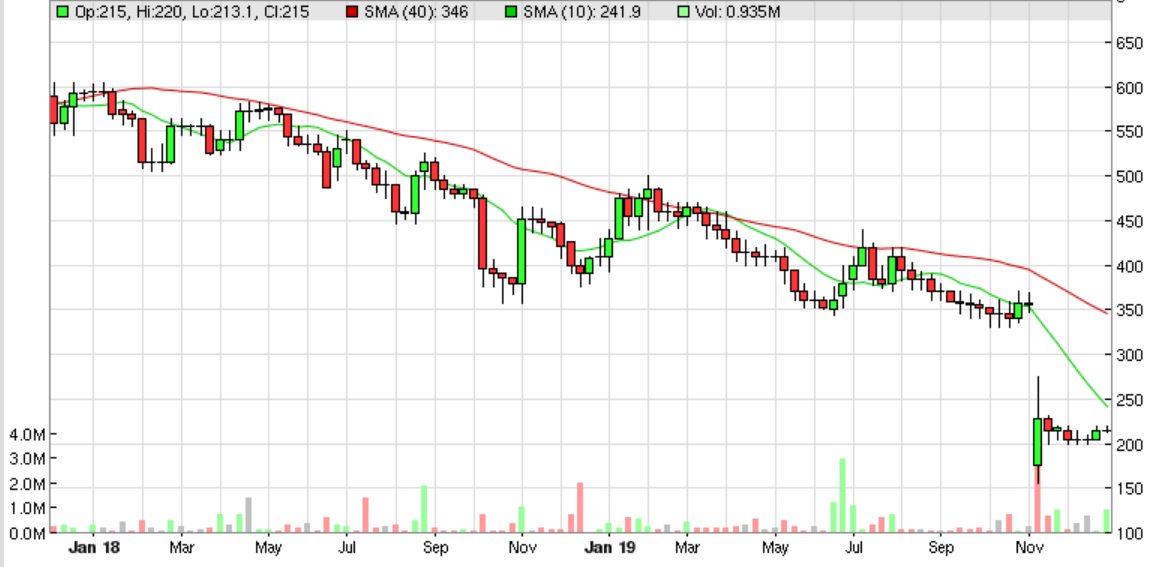
I reported on the profit warning here on 11 Nov 2019. My conclusion then was that this looks a potentially interesting recovery situation, with a strong balance sheet, good dividend yield, and problems specific to one particular market - China, its largest market (due to Swine Flu). Although I decided that this share was impossible to value at the time, due to lack of detailed numbers. Also it reported some accounting irregularities, which is usually a warning for investors to run for the hills.
Note how broker consensus earnings for this year, FY 03/2020, have recently been more than halved from 20.3p to 9.65p. This is a useful reminder of the impact of operational gearing - something that investors often overlook - i.e. it doesn't take much of a problem to really clobber many companies' profits, due to the gearing effect of fixed costs, combined with reduced sales. Especially where the gross margin is high.
To illustrate that point, here is the financial highlights section of EAH's interim results today;
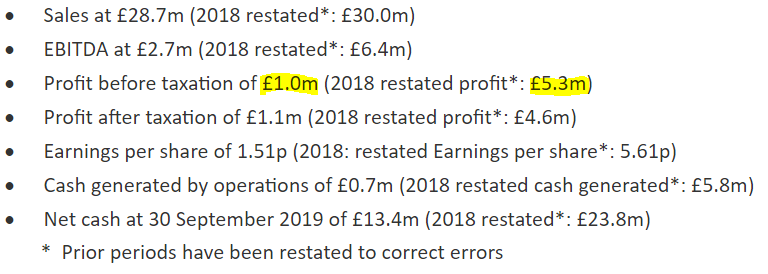
Profit has been absolutely smashed, from £5.3m in H1 LY, to just £1.0m this year, which must be due to more factors than just the relatively small drop in revenues.
Gross margin also fell significantly, from 48.9% in H1 LY, to 43.0% in H1 TY.
In addition, both administrative expenses, and R&D rose significantly.
Putting all those negative factors together, results in H1 profits falling by 81%. I'm writing this before the market opens, but my hunch is that the market is not likely to be impressed with these numbers, so we could see another lurch down in share price today, possibly. It depends on how much the commentary can calm investors, and convince them that the problems may be receding.
Dividend - this could hit the share price today, as income seekers might be tempted to sell up;
The directors recognise the importance of the dividend to shareholders. However, having due regard to the Group's operating cash flow, the investment in the new product pipeline and the trading conditions described above, the directors consider it prudent to defer the declaration of a dividend at this time.
Balance sheet - is strong, although both inventories & receivables strike me as a little too high.
Note also that the £23.8m cash pile a year ago has fallen sharply, to £13.4m - worrying, if that becomes a trend, rather than a one-off.
Outlook - there's a fair bit of detail, so I'll summarise it into bullet points;
- Swine Flu in China - "Early indications in buying behaviour for the Group's products support a stronger second half in China."
- USA - improving margins for farmers will enable EAH to reduce discounting in 2020
- Other territories are expected to perform in line with expectations
- Important milestones in the R&D programme in next few months (could provide some positive newsflow, hence help the share price recovery, maybe?)
Overall;
The Board looks forward with confidence; it is not possible to declare that the past six months' poor trading conditions are behind us but it is correct to indicate that the rest of this financial year will be significantly stronger than the first half.
Brexit - comments below from EAH on Brexit today are very interesting, and confirm my thinking that many UK companies can mitigate Brexit risk by setting up a subsidiary within the EU, and authorising/selling product via that subsidiary, whilst the main work continues as before, in the UK.
The key point is that companies adapt to changing circumstances, and the disaster scenario peddlers have always struck me as doing a disservice to everyone by failing to take into account such mitigating factors.
The Group has successfully transferred all EU marketing authorisations to a new European subsidiary, ECO Animal Health Europe Limited with a registered address in Dublin, Republic of Ireland. All contingency planning is in place and the financial and operational impact of Brexit is expected to be minimal, irrespective of the outcome and the timing of its implementation.
My opinion - the table of revenues split out per country/region does confirm that China is the main problem, with revenues down 53%. Although N. America isn't so good either, with revenues down 21%. Other areas seem to be trading fine, with reasonable growth. Growth into new markets provides interesting upside potential (Mexico, Brazil & India are mentioned positively)
My main concern is the extent of the fall in H1 profit, down 81%. Even though a better H2 is expected, I wouldn't be surprised to see full year forecasts come down again.
This share is so difficult to value, without detailed sector knowledge. How do we value its R&D pipeline, for example? There could be the seeds of considerable future growth in there, or there might not be, I don't know. Reading some broker research on the company could help give some pointers in that regard.
I see the shares have opened down 9% this morning, but that is on negligible volume so far.
This does look like quite an interesting company, but I'm struggling to see any reason to rush out to buy the shares right now. I wonder if it might attract bid interest, if the share price keeps falling?
Bango (LON:BGO)
Share price: 125p (down 8% today, at 11:22)
No. shares: 70.7m
Market cap: £88.4m
Trading update (profit warning)
Bango (AIM: BGO), the mobile commerce company, provides an update on expected financial performance for FY 2019.
This is the financial year ending 31 Dec 2019.
The market has been kind, punishing Bango with only an 8% drop in share price today. I can see why, because although it's missed expectations for 2019, the announcement today has plenty of positive noises in it too.
Revenue miss - is due mainly to a specific deal, which sounds like a timing issue - I don't mind profit warnings due to timing issues, providing the deal(s) do actually happen in the new year;
Group Revenue growth of over 40% to at least £9.3m. Total revenue below market expectation primarily due to a Customer Data Platform (CDP) license and Marketplace supply deal not concluding in December as expected. These deals are now expected to close in early 2020.
Although as a general point, companies & brokers really should factor in more of a safety margin, so that forecasts are not dependent on closing particular deals by the year end date. I would rather see achievable forecasts, and companies generally beating them. Rather than setting the bar too high, then missing.
Stockopedia is showing forecast revenue of £11.9m, so actual revs of £9.3m is a 22% miss - not good at all, coming so close to year end.
Note that interim revenues were £4.32m (up 64% on H1 LY). FY revs of £9.3m would mean H1 to H2 sequential growth of only about 15%. That doesn't tie in at all well with the talk of exponentially rising revenues.
Profit miss - this is a big miss, as gross margin is high. Adj EBITDA forecast drops from £2.3m to £0.4m. I'm becoming increasing surprised that the share price is only down 8% in response to a big miss.
The company is capitalising around £2m p.a. of costs into intangible assets, so the EBITDA number does not translate into a proxy for cashflow. Although, tax credits are an important contributor to cashflow - the last balance sheet (interim) shows just over £1m sitting in receivables, due from the taxman. The new Govt recently announced its intention of making this scheme even more generous.
In a separate announcement, it turns out that R&D tax credits have been wrongly accounted for by the Govt, for years, and that the annual deficits were actually quite a bit bigger than previously reported.
Adjusted PBT for FY 12/2019 has been revised down from £0, to -£2.0m. But remember to allow for the positive impact of R&D tax credits - arguably we should use PAT not PBT as the benchmark for companies which claim tax credits in this way - as it's a bona fide contribution towards cashflow.
Forecasts for 2020 have also been slashed today - which doesn't make sense to me, if the problem is a contract slipping from 2019 to 2020 - surely that would mean 2019 forecast figures are cut, and 2020 forecast profit should actually be increased?
Adj PBT for 2020 forecast drops from £2.7m to £0.9m.
Cash - has improved in the last 6 months, probably due to receipt of tax credits;
Cash has increased from the end of 1H 2019 and will be at least £2.5m at the end of 2019.
Strategy Day - is being held on 29 Jan 2020. These meetings can often be a precursor to a placing. Bango looks as if it could benefit from a smallish top-up placing, to give it more headroom. So I would imagine that a £5-10m placing is possibly on the cards? With a market cap of £88m, that's not much dilution, so isn't a major concern.
You have to remember that big name customers expect their key suppliers to be well financed.
My opinion - I feel that the bullish commentary today doesn't quite match up with the sharply reduced forecasts. Maybe the PRs were allowed a bit too much leeway, given the time of year?!
If this company does manage to produce exponential growth, at high gross margins, as it talks about, then the shares could do very well indeed. The figures today put a question mark over how realistic that is. It looks to me as if the growth rate is slowing, at least for now.
Overall then, I can see the potential here, if growth accelerates again, but for the time being I'm a bit sceptical due to today's unimpressive update & big forecast reductions.
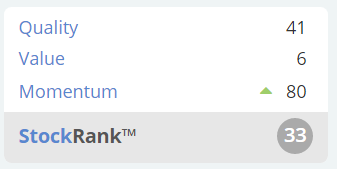
Stockopedia is very sceptical, with a low StockRank. Bear in mind that the high momentum score is likely to fall, once revised forecasts work their way through;
Good, with that out of the way, I can focus on what I really want to write about today, which is a review of my investing year.
My Investing Year
As mentioned recently in another report here, I've had a pretty dismal 2019, on top of a dismal 2018. Therefore, the most useful thing to do, is reflect and learn from those mistakes.
Background
Newer subscribers may not know my background. So to recap;
Did 3 year training with PWC (chartered accountants) after university - got sick of it, and flunked my finals exams. There had to be more to life than doing the most boring work (auditing) and studying for exams - pointless & boring accounting rules - in what spare time I had left. So I talked the staff partner into giving me a 6-month payoff to leave voluntarily (they wanted to reduce numbers anyway, due to the recession)
An astute employment agent matched me up with a small, ladieswear retailer called Pilot, in 1993. I went in as a sales ledger data input clerk, and 3 weeks later was running the finance department - part luck (as the existing CFO was working his notice period), but also me spotting & grabbing the opportunity
I spent 8 years as the CFO for Pilot, as we grew it from 16 shops to about 150 shops. My team grew from 4 to 25 people, all of whom I recruited & trained. The business was severely under-capitalised, and lurched from crisis to crisis along the way, but was in rude health when I got sick of it, and decided to leave in 2002.
Professional investor - 2002 to now, which splits into 3 parts - or the short version is this: try to visualise a roller-coaster!
Phase 1 - from 2002 to 2007 - everything I touched seem to turn to gold. A starting pot of about £180k turned into several millions, even after spending a lot, giving away lots, paying a lot of tax (not a problem - people who do well should be happy to pay tax, not try to avoid it)
Phase 2 - the roof fell in, with the great financial crisis. It took me down with it, and by the time the dust had settled in late 2008, my portfolio was gone, and I owed Spreadex nearly £2m. As I never tire of telling people at investor meetings, the crucial thing is to never combine gearing with illiquidity. I made that mistake, and boy did I pay a high price for it, it ruined my life at the time - I had to sell everything, house, cars, furniture, the lot.
Phase 3 - sorting things out. This took a lot longer than I expected, about 9 years to fully fix things. Spreadex were amazingly helpful, because I didn't run away from the problem, but kept communication channels open & made modest monthly payments to acknowledge that the problem existed, and could somehow be sorted out.
I tried to rebuild a new portfolio, using a bit of money lent to me by a family member, but after a superb 2009, things soon went into reverse, and I was more or less back down to zero by 2012. I can't really remember much about those 4 years from 2008-12, as it's a period of my life that I'd rather forget - feeling miserable & depressed all the time, and repeated attempts to rebuild my portfolio going nowhere.
Anyway, things started to improve from 2012. One day I decided that I needed a big challenge, and thought about writing a shares blog, covering every small cap in the UK market. The number of companies was too large, but by splitting off some sectors (e.g. junior resource stocks, biotech/pharmas, blue sky, etc) the number reduced to about 500. That should be do-able, and would certainly keep me busy & focused on something positive.
Soon my shares blog built up a decent following, and I had initially thought of monetising it through ads. I think the ad revenues peaked at £100 per month, and by the time Google had realised that people were clicking on the ads to help pay me, it dropped to £10 per month. Then I wondered about asking people to pay a subscription to read it, but that idea sounded like a lot of time & effort on admin, so fell by the wayside.
Meanwhile Stockopedia asked me to syndicate my blog through their website, this would have been around 2012. It would open it up to more readers, so why not? Some time later, another website had spotted my reports, and offered to pay me to publish them there instead, with exclusivity. I met the Stockopedia guys for a drink, and to explain that I wouldn't be able to syndicate my blog through them any more, and quick as a flash they offered to match the other website's deal!
From that point on, things started to really improve. I had a regular income coming in, so wasn't worrying about money all the time any more. Readers seemed to like the SCVRs, and I focused on improving them gradually, going into more detail.
I think people definitely make better investing decisions when the essentials in life are sorted out - number one is having a secure roof over your head, and then having enough income to pay the bills, and being able to live a vaguely normal life. That meant having to unlearn my previously profligate ways, which felt like a humiliation at first, but after a while became quite liberating. It's a great feeling to wander through a glitzy shopping arcade, and not actually want to buy anything!
After a couple more years, with a more stable grounding, I was able to build up a "start again fund" to a reasonable size, and work out a payment plan deal with Spreadex, where they wrote off a good chunk of the money I owed them (we haven't actually got a confidentiality agreement, but I feel it would be wrong & commercially sensitive to mention any figures here), in return for a hefty initial payment, followed by instalments until 2023.
From that moment, there was light at the end of the tunnel, and I felt highly motivated. Also it was rather lucky that a roaring bull market in small caps started c.2016. This completely turbocharged my new portfolio, and everything I touched seemed to turn to gold again (we all think we're geniuses in bull markets, but really we're not!)
This enabled me to pay off Spreadex early, in 2017, and buy some property, and sort out pretty much everything else that needed sorting out.
An old friend of mine from Motley Fool days, called BillyBonkers, used to ring me up when he was blind drunk, and spend hours on the phone, which was fun at first, but then got a bit annoying. So I asked him to stop ringing me when drunk, which he took umbrage about, and I've not heard from him at all since, which is a pity. The reason I mention Bill, is because he always stressed to me, this is pre-2008, that I should divert some of my good fortune into buying a house. He always said that, as long as you own the property you live in, preferably without a mortgage, then it doesn't matter what happens with the market (providing you're not geared). I should have listened to his advice first time around. Well second time around, I have taken his advice, and I must say that having a secure roof over my head has made the difficult markets of 2018 & 2019 much more bearable.
Incidentally, this is all very personal, so I'd appreciate it if this article could be not copied elsewhere. There are a few haters out there, sadly.
2016-2017 Bull Market
Looking back, this was an incredible time for small caps, with a clear speculative frenzy developing in many more racy stocks.
I find it impossible to avoid getting caught up in that type of bull market, because it's so ridiculously easy to make large amounts of money, especially through spread betting accounts.
Ironically, in my situation, the only way I could grow a small portfolio (remember I had to start again after 2009 with a starting position of not zero, but minus £2m!) rapidly, was to use gearing again - exactly the thing that had ruined my life in 2008.
Although this time I did keep the gearing at a relatively more modest level, and spread it over more stocks, so that in theory it would be easier to exit from positions if the whole financial system shook itself to pieces again.
In early 2015, Ed challenged me to set up an online portfolio, to measure my stock-picking success, which went almost exponential in 2016-2017. In reality, the % gains were much higher than this, as I was geared (the BMUS portfolio is ungeared);
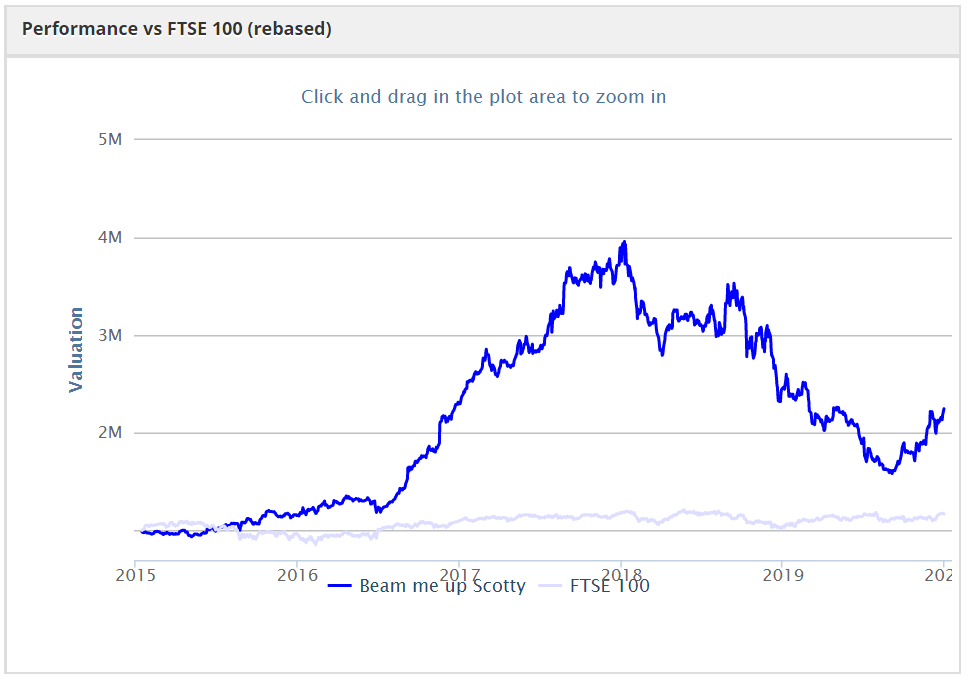
The same old problem then reared its ugly head - hubris! It's impossible for me not to get carried away with excitement when my portfolio goes through a patch of doing really well. Then as before, I laid the seeds of my own subsequently dismal performance.
This has lead me to a conclusion that may surprise you - namely that, whilst I love doing the analysis of shares & results/updates, I'm not temperamentally suited to managing a portfolio.
More specifically, I know exactly what I should do, but like a mechanic who neglects to service his own car, I don't have the discipline to apply that consistently. Instead I go through patches of extreme out-performance, followed by the inevitable hangover. By the way, I'm not looking for any advice here from anyone, as I already know what I should be doing!
I think everyone's enjoyed a decent bounce in the last 3 months, but why was my chart above so extreme in the small caps downturn in 2018 & 2019?
Let's look at what specifically went wrong, in order of importance:
Over-concentration
I deliberately run a highly concentrated portfolio. The reason being that, for experienced investors, putting most of your money into your top 5 shares, is the way to generate really serious returns, in a relatively short period of time. Obviously that carries risk, because unexpected things just happen, from time to time. So a concentrated portfolio is not to be recommended. But that's how I like to do things personally.
To be clear, I'm not asking anyone to follow my investments. I only publish BMUS because Ed challenged me to do it, and I feel it would be a cop-out to stop doing it now, just because things are going badly. In a way, the value of the thing is to show that I'm fallible, and to analyse what went wrong, and also hopefully what I'm doing to fix it. Why not be an open book, and expose this all to the glare of public scrutiny? I ate so much humble pie after 2008, that this all seems like a walk in the park, comparatively!
A concentrated portfolio is fine up to a point, but being a rather over-the-top personality (I can't help it, that's just how I was made), I did take things to extremes. I became absolutely convinced (and still am actually) that Sosandar (LON:SOS) was likely to be a great success. Small caps are really all about backing great management. Arguably all investing is, but with small caps they don't have layers of intermediate management to run the company. So I put about 60% of my real, and BMUS, portfolios into SOS. On reflection, that was way too high.
Things went great for a while, but as with many/most small caps, there were bumps in road, which happened twice with Sosandar. The gut-wrenching falls did serious damage to my portfolio. The timing was awful too, as I was trying to buy the penthouse next door at the time, so was forced to take money out of spread bet accounts at the worst possible time. Thankfully my SIPP is out of bounds, as I can't draw anything out of that until I'm 55, which is probably a good thing.
For the avoidance of doubt, BMUS reflects my SIPP (long-term holdings), as it would be too complicated & time consuming (for no benefit) for me to be constantly updating it for whatever I happen to be punting on in spread bet accounts.
I've recently trimmed my SIPP position in Sosandar by about a quarter (reflected in BMUS update recently), but it remains by far my largest position.
My current view on the company is positive. Management are absolutely brilliant, and I have no doubt that the business should be a big success. They bit the bullet this year, and raised £7m more funding, which has been applied to greatly increase the product range, and the depth in which it is bought. Also, they're spending big on marketing. This makes a lot of sense, because once acquired, customers are sticky, and the underlying stats are that a typical customer buys twice from Sosandar each year. Rapid growth suppresses the published number to about 1.7.
It's fair to say that the original business plan under-estimated the marketing spend needed to drive growth as fast as planned. The most recent update from Sosandar confirmed that, with heavier marketing spend, the growth rate has shot back up again.
How do we value it? I don't know! Sceptics are wrong about this company, in my view, and I've not heard anything negative from sector experts. Yes, valuations can look crazy in the early days for growth companies - remember how Asos looked insanely expensive at about 80p, and went on to nearly 100-bag from that point? Look at BooHoo also - very expensive at sub-50p, people thought.
It's fair to reply that Sosandar is much earlier stage than those behemoths. But investors are now wise to the upside potential, once an online fashion business achieves critical mass. That's why I think Sosandar's valuation could go higher, sooner than people might think. However, a lofty valuation also makes it very high risk - if anything goes wrong, then confidence collapses, taking the share price down with it.
Sosandar had a tough patch in spring of 2019, but I think they've fixed the issues, and the growth numbers have since dramatically accelerated, due to the heavy marketing spend. I reckon we could be in for a positive Xmas trading update, but that's just my hunch, I don't have any specific information.
Over-concentration was also a problem for me with £RBG
Failing to sell at the right time
The number one question that investors ask, is when should I sell?
There isn't a simple answer, as Sod's Law seems to intervene more often than not.
Probably the best answer I've heard, is to sell when something better comes along, or when a share becomes over-valued. The trouble with that, is that it leads to often selling off our best stocks, and missing out on multi-baggers.
The reality is that people who make serious multi-baggers have usually ignored a patch where the share was significantly over-valued on conventional metrics. They've seen something special or they just got lucky.
A big mistake I made, was failing to sell Revolution Bars (LON:RBG) (in which I have a long position) when the takeover bid from Stonegate at 203p came along. I could have banked a large profit, but instead, foolishly imagined that a higher bid was likely, when it wasn't. The deal fell through, and the price has since crashed to only 68p.
Why haven't I sold since? Two reasons - because I've done detailed research on this, and firmly believe that the price is likely to go up considerably from here, if the turnaround gathers pace. I've met management several times, and gone through the detail with them very thoroughly. With strong reasons to believe the price is likely to at least partially recover, then it would be crazy to sell now. Yes it annoys me that I didn't sell previously, but who cares? The market doesn't know or care what price I paid. The only thing that matters is what the price is likely to do from this point onwards.
With a programme of refurbs now underway, and no expansion capex, the LFL sales have already turned positive, and should continue to do so. Management is doing all sorts of basic sorting out, none of which has yet been priced in. Therefore, I could see RBG being a nice recovery situation for 2020. As always though, I'm trying to predict the future, and sometimes will be wrong, and sometimes right.
Outside investors never really know what's going on within a listed company. We delude ourselves that we know the business, but in my experience there are often things lurking below the surface that investors don't know about at all, but which matter.
Luck & when to sell
Most of the successful investors I know, cheerfully admit that some of their best investments have actually been down to luck.
Quite often the biggest gains are made from catching a speculative bubble, running it, and selling out at the right time. Mark Minervini points this out in his excellent book, where major multi-baggers very often go on to drop by 50-80% from their peak, sometimes a lot more.
This got me thinking, that I should pay attention a lot more to deciding when to sell things. If something is close to, or above what I think it's fundamentally worth, then I really should be selling, instead of doggedly hanging on.
If I'd taken my profits in 2017, when I knew that most of my stocks were fully valued (or more), then things would be looking a lot more rosy now!
Lack of liquidity
2019 has made me think a lot about whether I should be concentrating on small caps.
Specifically, my concentrated small caps portfolio resulted in a situation where I was needing to raise cash for properties, giving my broker a list of things to sell, and finding that there wasn't any market bid at all for some of my smallest positions.
In particular, a big disappointment this year has been £MLVN I bought some in the 4p placing a while back, and thought I was a genius when it went up to 7p. New management seemed to have a good turnaround plan.
Anyway, it's been a disaster, with the shares having lost about 90% from that peak, after a string of disappointing announcements. I managed to sell a few on the way down, but more often than not, attempts to sell resulted in an end of day phone call from my broker, saying "nothing done on the Malvern, I'm afraid". So I'm stuck with the damned things.
If it had been a mid, or large cap, I could have just sold on the opening bell when bad news came out, and moved on.
A lot of people have done a lot better than me this year, because they adopted a better approach of having a decent spread of large, mid, and small caps. I'm thinking in terms of possibly adopting that approach myself in future.
Although with small caps having done so badly, and large to mid caps doing well, then this might actually be the best time to be focusing on overlooked, under-priced small caps. Particularly as confidence is now returning. Yes, I've already talked myself out of switching to mid & large caps, the time isn't right.
Brexit
What a horrible experience this has been, for all of us, in the last 3.5 years.
Even quite sensible people became ranting maniacs. It definitely did a lot of damage to many peoples' mental health (including mine), so thank goodness a way out has now been agreed, even if it's not what some people wanted.
The protracted political stalemate definitely caused a partial buyers' strike, particularly affecting small caps. that dented my performance badly in 2019. It's already reversing though, with a very positive business sentiment survey out from the CBI recently, and a recent press report that £billions have flowed back into UK equities since the election.
On a personal level, it put a considerable strain on my relationships with friends & family. Although I'm pleased to say that we had a lovely family Christmas this year, with no political arguing at all. What with that, and the heart-warming Xmas special from Gavin & Stacey, equilibrium has been restored - and life really is mainly about friends & family, not money. As a bonus, I was pleased to hear that Gavin & Stacey even mentioned going to Revolution Bars, in the dialogue. What better endorsement could there possibly be?!
Conclusion
Both 2018 & 2019 have been lousy years for my portfolio, so I certainly need to try harder & act on some of the lessons learned in this article. Hence a lot of this is "memo to self"! Well, it all is actually. If other people find it interesting & thought-provoking, then great, it's been worth typing up.
Therefore, when reading my articles about companies reporting results or trading updates here, please remember that I'm definitely not either a shares guru, or a tipster.
These reports are just the personal opinions of a private investor who sometimes does well, and sometimes does badly. I'm not very good at managing my own portfolio, in a nutshell, and have psychological flaws which make me quite unsuited to managing a shares portfolio!
Despite that, I've somehow managed to make a decent (often very decent) living from the market for the last 17 years, so must be doing something right, some of the time!
However, I hope most readers will agree that digging round in the results statements often throws up some interesting points which you can take or leave as you wish, as part of your own research process.
It's been a pleasure writing here for you, and thanks to everyone who contributes such useful points in the comments sections. Maybe some of you lurkers could add this to your new year's resolutions lists?!
Let's hope 2020 is a good year, wishing you all the best.
Paul.
Disclaimer
This is not financial advice. Our content is intended to be used and must be used for information and education purposes only. Please read our disclaimer and terms and conditions to understand our obligations.

85 comments
Thanks for your article Paul. It is a message of hope as well as caution for us all. Please keep your reports coming. They are invaluable.
Here's to success in 2020
Hi Paul. Thank you for the review of your history, it shows there is always hope after a fall.
Have a great new year.
Happy New Year Paul and Graham and many thanks for all the effort you guys put in on this. There have been some great reports that have kept me away from some dodgy companies in 2019 so long may you continue. And a special thanks Paul for sharing your story, it's refreshing to see that even those with expertise and insight can get it wrong and admit it!
awesome Paul. Thank you for sharing this with us all.
Excellent, well written piece Paul. Huge thanks.
Ive only just got round to reading all this on 4th Jan, but do enjoy taking stock and thinking to what the year ahead might bring during this festive period.
All the best for 2020.
Thank you Paul for adding warmth to what is too often dry and cut throat stuff. I've met some horrible rich people and lovely people who have lost it all on great ideas, I know who I'd rather spend time with. Anyway, it's always the same people who win multiple raffle prizes. Scientists will flush them out someday. Really useful stuff, thank you and Stockopedia.
Paul, a really nice article. You and Graham make a great contribution to the Stockopedia site, many many thanks from me. See you at the next Mello and best of luck for 2020 and beyond!
Paul, your story paints a human side to the professional analyses you make. Am also enjoying your light and frank writing style - including where you admit you just don't know - how refreshing! Have a good 2020.
I too would like to offer my sincere thanks to both Paul and Graham for the consistently informative, insightful and entertaining SCVRs, and to wish you both a very happy and successful New Year.
happy new year to you Paul! I find your updates extremely useful and all credit to you for my first 10 bagger - Boohoo (LON:BOO) !! ;-) Thanks again and here's hoping for a most excellent 2020
Thanks Paul for a brilliantly honest article - as always it is completely fascinating to read. Keep up the good work and be assured that your thoughts and insights are greatly valued. Best wishes for a successful 2020.
Happy New Year Paul!
Amazing article. Also thanks so much to you and Graham for your advice on the Small Cap Value Report. I'm new to investing and your insight really helps a beginner like me to understand how to analyse the market, and hopefully make more gains than losses. Keep up the great work.
Paul! I'd just to say that this has been a very fascinating article for me to read. Thank you so much for sharing such a personal experience. Judging by the number of upvotes this article has, others have found it to be particularly illuminating and interesting.
I would definitely put you in a class above me when it comes to investing. Your insights into companies is much deeper than mine. In terms of our investing styles, I am a fox, you are a hedgehog.
Over the last year or so I have tried to disengage to investing. It's all too fascinating, and too easy for me to get caught up in it. Stockopedia is great in this respect. I can just update my portfolio once a month (with exceptions) and follow a quantitative approach. No hassle, all nice and smooth.
If I'm beating the index noticeably over an extended timeframe, then I'm happy. There are guys on here and elsewhere who will have Buffett jealous. I'm not one of them. I wish I was, but I know deep down that I don't have the perspicacity for it.
My favourites are mid-caps stocks. Reasonable spreads, more likely better returns on capital and debt levels, I prefer them to large-caps. Small-caps are a minefield.
Whilst I appreciate your greater insights into stocks, there's some things I would not do. Like, I wouldn't have bought into Sosandar (LON:SOS), let alone sink 60% of my wealth in it. It's not making money, so it's not for me. There's also some things that Graham likes (a fitness club whose name escapes me) that I wouldn't touch. This is despite the fact that I consider him a far better investor than me.
It's probably because I approach things from a slightly different angle to you guys. That's probably inevitable, as we each have taken different paths and have learnt different lessons.
A point of note about your fund: you seem despondent about your performance, but the chart clearly shows that you have trounced the index. Sure, your performance is highly volatile (crikey yes!), but you seem to be adding alpha, so why the long face?
All the best for the new year, Paul. And my regards to Graham, and Ed. And let's not forget the dedicated team of programmers our there, those unsung heros who have to realise the the grand visions of their captains.
What an excellent article. It takes some guts to put it all out there so transparently but I certainly appreciate the effort you made.
- Taking your last point first I definitely do appreciate your analysis and opinion; I bought BEG after reading your analysis as a virtually indestructible, counter-cyclical yield play, offering a free call option on what I thought would be an increase in interest rates. Turns out management were just solid and rather than flatline while zombie firms remained afloat made a number of well judged acquisitions to develop the business. I recently sold 30% as it had become too much of my total SIPP value at about 15%.
- What, for me, makes your work unique is the recognition of the many contradictory factors at play and their cycles. It would be rational to avoid small caps after your experience with Revolution Bars (LON:RBG) but also rational to stay in as they have NOW reached a price and position operationally where they should be held. It is your disclosure of what you actually did and the reasons that make for compelling reading as that resonates with my own doubts and second thoughts about actions taken (and equally, those not taken).
In my opinion 2020 will be good for those overlooked small caps and also those quality operations that, with the Brexit question answered, will earn a still higher rating. I doubt you will regret your decision to remain focused on the small cap space.
Thank you Paul for this fine honest article and for the many daily reports, much enjoyed. You bring a different dimension and a deeper knowledge to the mix when making my investment decisions.
A very happy ( and prosperous ) New Year to you and the Stockopedia community.
kkmea018
Happy New Year Paul (and everyone on Stocko).
A fantastic report for its pure honesty and open heart approach. Very brave and refreshing.
People will inevitably want to give you advice, because they know you have stock picking talent and a lazer insight into a company's financial make-up and well being. They just want to see you succeed.
All the best for 2020 and thanks for the SCVRs in 2019 (Graham too).
Mark.
Happy New Year! It really does help when a writer on shares is prepared to share mistakes as well as successes. I respect those who run a concentrated portfolio but could never do so myself having suffered shocks like Patisserie Valerie and 2 other wipe outs in my investing life.
I am really surprised that two of your concentrated portfolio are Sosandar and Revolution Bars. By so many measures I see other shares as much more promising. But very glad that you are present so much detailed and reasoned analysis on them. Even if not interested in the specific shares I often find points that you make useful to other shares.
Paul, what can i say that hasn't already been said? You are a star! Have a mega 2020.
Hi Happy New Year
l love the article. Had I written about my younger investing life many parts of the story would have been similar
Most of learn as well we get older even with all of the faults that we start out with and to be honest looking back l loved it all “the good the bad and the ugly”
Love all of the daily reports and comments they really do make us think
Benson
Hi Paul,
That is the best thing that I have read in a long ,long time. You have described exactly what every investor has experienced but were to scared to admit. Well done! Happy new year to you and graham. Keep up the good work.
micke
Really interesting article Paul - fascinating to hear your journey. I do wonder how some younger readers will fare in the inevitable next bear market, having grown accustomed to a long bull market. Looking forward to a profitable 2020!
Morning Paul
First and foremost a happy New Year to you, Graham, Ed and all the team at Stockopedia. It is an an excellent website for the retail investor, but the cherry on the cake is the SCVR.
A wonderfully candid and open account of your investing history, successes and failures, from which we all can learn. Particularly the catastrophe that can be visited by the combination of illiquidity and gearing in a bear market. Thank you for sharing.
We have never met although I have seen you on several occasions at Mello events. I shall make the point of coming over to say hello and perhaps sharing a beer if the opportunity presents itself at the next Mello.
As to the markets I have no idea where they will be this time next year, but I shall stick to the approach that has generally served me well....investing in smallcaps that generate cash and have little or no debt with management that have decent holdings and which to my mind have better prospects that the market gives them credit for. Current examples being Volex (LON:VLX), Amino Technologies (LON:AMO) and £BLV.
I would also recommend the book 'The Art of Execution' which others have mentioned assuming you haven't read it and watching the recent interviews on PI World that Tamzin conducted with Spencer Crooks, who was until 2017, head of market making at Winterflood Securities. A fascinating insight into the world of the market maker. In particular how they endeavour to capitalise on the overreaction in share prices .
Very best wishes for the New Year.
Paul - this is the most beautiful piece of honest writing I've read in a long time, and possibly ever on this site. You regularly touch greatness with your stock selection so I've no doubt that another halcyon period is right around the corner. Happy New Year to you and everyone here !
I think 2020 could be a good year for UK investors - small caps are still at a discount and the Boris bounce ought to continue.
The only thing that worries me is the US stock market looking toppy. If the US sneezes you never know what happens to global markets, but all around the world there are some pretty neglected equities.
I always like to read Jesse Stine's market outlook at this time of year. I highly recommend this as a read. He clearly spends weeks putting it together. It's not a polished publication, it's a scrapbook - but it's gold. He called the market bottom last year, and this year is a bit more balanced between bullish/bearish. But he's very bullish on China and Asia - do read.
Dec 2018: "Greenspan tells stock investors: 'Run for cover;"
There's a certain, shall we say, "inevitability", about the outcome after making such an announcement.
Hi Paul
Thank you for the best post in the nearly (May 2012) eight years I have been a Stockopedia member.
I have had a reasonable year but I have also realised that I have to be more disciplined at selling (well in fact I have to learn to sell at all). I have watched a 100% paper profit in Accesso Technology (LON:ACSO) turn into a 25% loss when I finally hit the sell button and Fevertree Drinks (LON:FEVR) where I watched my holding halve in value. I have now sold some with the value of the holding equating to my profits.
The only advice I would give you is that I really do think you should write that book which has been mentioned here occasionally!! I am sure it would be a mentally draining process and incredibly time consuming but I think it would be a fascinating read.
Anyway here is to good (great!) 2020. There surely has to be a (significant? Though hopefully not on the scale of the GFC) pull back at some point but with a US presidential election at the end of the year and Johnson wanting to ensure that we all feel warm and squiffy about him and his new (erh) government I don’t think 2020 will be the year. Hopefully I won’t have to eat my words!
Happy New Year.
Michael
What a brutely honest apraisal. Great read and plenty to take away for lessons learnt. Thanks
A big thumbs up for today SCVR,
my personal opinion for the markets next year is that brexit negotiations will have big affect on the markets , so thread cautious with small caps and purchase quality and growth prudently,
As for timing the sales and purchase of shares , I found "The Art of Execution " a great book that improve my selling of shares , "sell when the story changes" " sell after first profit warning " and many others quotes etc.
Happy New year , to all
Francis
Hi Dustyie
Would agree completely about The Art of Execution. I think it is one of the best “investing” books out there and one I have a reminder in my diary to read annually to keep me in check.
Great feedback from subscribers today, many thanks, much appreciated! :-)
Best wishes, Paul.
Fascinating article Paul on your investment history - shows how it's the misses rather than the hits that have a major impact on overall portfolio performance as I said in a recent blog article. And a very good analysis of todays Bango announcement which I hold as it's a sector I am interested in. But it's one of my smaller holdings as it has yet to prove it's a predictable business.
A very good and honest write up! Well done, Paul
Great write-up Paul.. You could become a writer for a hollywood movie :-)
Happy New year and love reading yours and Graham's daily commentary.
Superb commentary as always Paul - best wishes to you and Graham for 2020
Paul,
I appreciate the candid write-up of your investing history today - it made for a very interesting read. I wish you a lot of success with your investments in 2020.
Cheers.
Where can I find BMUS these days? The previous links don't work (on both the old and the new sites)
Thank you so much Paul and Graham. You analysis of the small cap space has been invaluable. Happy New Year!
Paul
That is by some distance the most heartfelt & open article I’ve ever read...as such it’s invaluable to all investors but especially to those who’ve yet to learn the lessons you’ve learnt at considerable expense
Happy New Year & best wishes for 2020 & beyond
Hi Paul
What a brilliant blog today. Your openness is really energising, a reminder on how to pick ourselves up again when things go south! Thank you.
And thanks to you and Graham for such great insights this year. Here’s to a better 2020 investing wise.
Jon.
p.s.I also sat up when £Rbg was name-checked in Gavin & Stacey. Get in I thought.
Hello Paul, I'm sure a lot of us would have wanted to have had a similar portfolio to yours at sometime (Without the gearing). It comes over that a lot of members are like puppy dogs waiting for the next feed.
Thanks to Paul, Graham & the Stockopedia team, also the more knowledgeable members than me (Most of them) ( Ok it's all of them) & the Tamzin video's. All very interesting. Have a good year everyone!
Wow, Paul! Fascinating post about 2018 and 2019. I knew most of your history from following here for some time. However, I learned some more about your history.
My investment journey has been very different to yours and far less exiting. However, I thought I could add a few comments about my portfolio that might be of use to others. I manage a range of family portfolios that have been about 50% invested over the last two years in UK small caps or proxies for them such as Rights and Issues Investment Trust (LON:RIII) and Blackrock Smaller Companies Trust (LON:BRSC) . The high cash level was justified by the extended period of uncertainty due to Brexit. Consequently, 2018 was a bad year for me also. Like you, I avoid all resources, blue-sky, pharma (mostly), property and contracting businesses. I have learned to my cost to also avoid retail over the last two years. I was lucky to sell out of Revolution Bars (LON:RBG) at above the bid but then lost it all by dabbling on the way down. I also lost on Footasylum (LON:FOOT) , Bonmarche Holdings (LON:BON) and £G4M in 2018.
At the end of 2018 my portfolios were down around 12% overall. By the time of the election I was back to breakeven - a rather unsatisfactory outcome for nearly two years of full-time effort but still better than the 8% decline that discretionary funds at Psigma had achieved over the same period. I have only been actively managing extended family portfolios for the last five years - prior to this I kept my own family's funds almost entirely in Rights and Issues Investment Trust (LON:RIII) and £RIIC and was happy to do so. But a family dispersal for IHT reasons and the illiquidity and concentration risk that our family holdings represented in Rights and Issues Investment Trust (LON:RIII) led me to dispose of our family's share of the holding and a decision to become more actively involved in management of our money.
In 2019, some luck in trading Frontier Smart Technologies (LON:FST) and Avon Rubber (LON:AVON) in a size that I would never normally trade in (a typical holding for my portfolios would be £50k) enabled me to compensate for some of the howlers in smaller size on £C4XD , Alfa Financial Software Holdings (LON:ALFA) and Burford Capital (LON:BUR).
So on 12th December I was still sitting about flat for the now two years of effort, thinking that a Tory win was already baked into the price of small caps and fearing a hung parliament would wipe 20% off my portfolios' value.
It is clear that the scale of the actual Tory majority was not in the price of small caps that I am holding. Overall, in the eighteen days since the election result, I am up 20% overall and over 30% up from my lows over the last two years.
So what went right for me? Blindly sticking with £K3C all the way down and adding more on the way and at the bottom to end up (I sold out today) with a 17% profit on an out-size (for me) position. Jumping on the bandwagon in Cerillion (LON:CER) , Aptitude Software (LON:APTD) and IG Group (LON:IGG) helped but I sold out of all of them and watched them to continue to rise. And I watched my current biggest holding Hill & Smith Holdings (LON:HILS), a FTSE 350 share, nearly touch £10 (I hold at £11) and finish the year at nearly £15.
At many times this year I wondered how I had ended up with what seemed to be a bag of low quality shares when i had ditched things like Belvoir (LON:BLV) , GB (LON:GBG) , Future (LON:FUTR) and Games Workshop (LON:GAW) way too early. I still have some howlers - Cenkos Securities (LON:CNKS) owned at 90p, some of my Scapa (LON:SCPA) were bought at over £4, Burford Capital (LON:BUR) with an average price of £11 and a small holding of SysGroup (LON:SYS)1 bought on the way down at £2.75.
What have I learned from the last two years? Firstly, that the market is very poor indeed at assessing the intrinsic value (if such a thing even exists) of some small caps (and even some much bigger caps). I not only watched £K3C fall from £3.95 to £1.10 and back up to £2.63 but watched Gooch & Housego (LON:GHH) fall from £15.27 to £9.54 and then climb back up to £13.90. In both of these cases, as with many other small caps, one or other extreme price may have seemed like the correct price at the time but have subsequently been proven to be wildly wrong. So I have learned that provided the company has a strong balance sheet and reasonable future prospects there is still hope. Hope is a much maligned quality in share trading but should definitely not be under-estimated in small caps!
The second thing that I learned was that small caps can and do recover very quickly and dramatically. Just as they can fall very swiftly and stomach-churningly after a 'trading update'! 20% movements are the name of the game with many small caps. If you can keep your head while all about you are losing theirs etc.
The third thing that I have learned is that adding to a failing position can sometimes be effective. On Black Monday 1987 I was a bond trader at Kleinwort Benson trading US Corporate names. The head of the bond trading floor was the youthful Stuart Fordham, ex Chase Manhatten, who was, I think 24 years old at the time. I was 21. We had a hedging position of some $100mn in the US long bond - a pretty large position for the time. The futures dropped 10% when trading opened so the position was $10m underwater very quickly. Cool as you like, Stuart bought another $100mn right at the bottom and traded the position out flat in a day's trading when the cat bounced. It taught me that catching the bottom can have some very powerful benefits to your position. If you get it right! I heard later that Stuart had put Kleinwort’s whole financial stability at risk but those were the days before Compliance had even been thought about!
The fourth thing that I learned is that you have to be nimble with small caps. You have to be buying as the tide is starting to turn and you may only have seconds to do so. Similarly with taking profits. You have to realise when others are staring to say that a share has been over-bought and be prepared to sell and possibly buy-back in a at a lower price if the over-bought signs change. You simply don’t get very long to decide whether to be brave or cut and run because there is someone else out there doing just the same as you and small volumes can have outsize effects.
Finally, I learned that there is no substitute for gut feeling about a company’s CEO and CFO. Let’s face it, you are not always presented with the kind of naked self-protection that was displayed by the Board of Frontier Smart Technologies (LON:FST) this year. So you do have to be alert to the nuances of what the board say. This is where I have come to rely on the professional cynicism that you, Graham and Tom Winnifrith have. I am way too insensitive to the subtleties of Directorspeak and so rely heavily on your commentaries about the inconsistency between the words and the numbers in an RNS. I have also learned so much from routinely reading everybody else’s comments here which can give a different (and frequently more positive) slant on those words.
Turning to 2020, the big question for me is whether the recent spike in nearly all of my holdings can be sustained and extended in 2020. I have cut some positions (in £K3C , Cerillion (LON:CER) and £ZYT) but have added to others such as Quartix Holdings (LON:QTX) , Tracsis (LON:TRCS) and Elecosoft (LON:ELCO). As you have already pointed out, profit warnings seem to be being shrugged off (e.g. Staffline (LON:STAF) ). Quality companies remain well-bid although increasingly expensive. I am anticipating some selective weakness arising from the January update season and also from the realisation that Brexit is happening towards the end of January. But it feels to me as if all kinds of deferred investment (consumer, producer, private equity) could under-pin the small-cap market for some time to come. Strength in the US as a result of reduced trade tensions with China and the inevitable inflationary boost that Trump will want to give there could mean that all boats get floated in 2020. I am looking to deploy at least 20% more of the cash that I hold on any sign of weakness towards the end of January but am finding it hard, currently, to pay the 30x earnings that is being demanded for companies with growth potential or a record of beating forecasts.
Like you this has been written as a note to self. About the only thing that I can claim to have done right over the last two years is not to give up hope and hand over management of our portfolios to the ‘professionals’. At times, I was sorely tempted. Instead, I will be seriously looking at the performance of these ‘professionals’ and considering whether to give them another year or bring those funds back in-house.
Anyway, thanks for your honesty about your past. As one accountant to another, the only advice that I would dare to give is to always question yourself. But not too much.
Brilliant & brutal note to self Paul. All the best for 2020!
Just read the name Stuart Fordham and nearly fell off my chair. He was one of my first bosses too. I’ll never forget accidentally buying 5m BT 28’s on his book and having to fess up to him what I’d just done. Still makes me shiver to this day. You’ve prompted a flood of memories about my early days as his junior!
Best wishes all for 2020!
Was this at KB or at Chase? Or later? Would love to know what happened to him after KB. he brought a whole team of bond traders from Chase with him. It was a really fun environment and not a lot like work. Some big names and characters in the bond market then - I was hired by Ozzie Grubel who ran CSFB and UBS and traded US Corporates with Colin Grassie who later became head of Deutsche Bank. I left the bond market way too soon - the story of my life!
Hi Paul,
Many thanks for your fascinating insights into your investment process. I too stick mainly to small caps, though with a wider spread of shares.
One rule I have adopted and found valuable is to avoid micro caps. Anything under £50m. seems to me to be too difficult to get out again when things go wrong. Even that is cutting it fine, as a market value of £50m. can drift down to £40m, then 30m.....seemingly for no reason. And then the reason starts to become clear and I may be a forced seller. So far I have managed to get out in time, taking the losses.
Nice one Paul, you have my respect for your naked honesty; Hope you have a happy and prosperous 2020
Thank you for your honesty, it can not be easy reminding yourself of that roller coaster ride. Best wishes to you and Graham for 2020.
Paul, what an interesting life you have lived and continue to live (a movie's worth!). A good read and some serious pointers for all. Keep up the good work. All the best and happy New Year. Simon
I'd put myself in the 'lurker' category. I've only been actively investing a couple of years, and have found my interest has gravitated to mining and oil and gas stocks (which hardly get a mention from anyone on Stocko - which is a shame but I can understand why). I do skim and enjoy the daily reports but don't generally contribute as my interest is in other sectors. I too was transfixed by the investing year update - in some ways I find these sort of write up's more valuable than anything else. Thanks for taking the time to write that up, and best wishes for next year.
Amazingly honest and very useful, many investors have been just a hairs breadth away from losing a packet.
Hi Paul, many thanks for your fascinating & candid self evaluation,and of course your & Grahams work this past year.
ATB,
NM
Enjoyed the article Paul and your honesty,keep up the good work although sometimes I wonder how you find the time.
I wish you a very Peaceful and successful New Year but will leave you with one biblical thought. Quote: " What does it profit a man if he gains the whole world but suffers the loss of his own soul"
Happy New Year
what a great, thought provoking read!
Paul. Great article. It's rare to find someone as honest about their experiences in the market as you. For many men I suspect their investment portfolio is a hobbyist interest. I can't speak for women investors, but suspect that many women are less excited by the vagaries of passing fancy that sometimes masquerade as educated investment.
As much as I want to admire those who stick to rules, and have a more scientific approach to investing, I think most of us get infected by the prospect of a lottery style win on the markets. It certainly adds more fun, and I hope never to find myself trapped by anyone at a drinks party who wants to talk about PEGS etc.
Of course my slipshod approach has rationalised itself over the years, and I now split my picks in two camps. One is the ISA, and the other a market based account for racier bets.
I am not a full time investor, and whilst I appreciate money, and am comfortable, and I am sadly too boringly sensible to do anything totally outrageous, I do occasionally think constantly looking for profit on the market is a poor use of one's time on earth. Maybe I've watched Dickens' Christmas Carol too many times.
However, I have seen incompetence with money absolutely ruin relationships and compromise lives so I do not wholly give in to my inner voice, and I am concerned that we should build a prosperous society built on work, sensible choices of use of money, which may not always be options available to all in our society. I hope the new Govt will pick its way carefully and get more of its choices right than its get wrong for the sake of everyone in 2020 and onward.
Thanks for your 2019 contribution.
Apologies for the ramble.
Happy New Year to all!
Regards
Trident
Great story Paul and quite heartwarming .
Happy New Year
Dear Paul,
What a fantastic read that was. Please never underestimate the value that your perspective adds to less experienced investors (like myself). Down to Graham and yourself, I now spend a lot more time looking carefully at Management Teams and their personal wealth being tied up in the companies which i invest in. It's served me quite well in the last couple of years.
Happy New Year to you and I really look forward to reading these articles in 2020.
All the best to this entire community too.
I have been thinking for a while that there is an issue with Stocko rankings for small early growth companies. SOS is a good example of a company on an impressive business development and growth trajectory and yet its scores are so low, similar to or lower than real deadbeat companies. I don’t think this helps you Paul, or us, as it creates a tolerance for ignoring Stocko scores that is perhaps not helpful generally.
I have been following your commentary on and off since the early Motley Fool days, and have always valued your clarity of thought and analysis. Your self analysis here is searingly honest and again insightful. Thank you. I hope it helps you have a slightly smoother investing career....though it’s something we can all hope for but never quite achieve.
Here’s to a successful 2020.
Martin
”I have been thinking for a while that there is an issue with Stocko rankings for small early growth companies.“
I woul agree but I think that (and Ed would be far better positioned than me to explain) the rankings are captured from metrics that companies like Sosandar (LON:SOS) (I do not hold but did and may in the future, I hold Boohoo (LON:BOO)) simply score negatively for.
I have just read “The Man who Solved the Market” by Gregory Zuckerman about Jim Simons, which is absolutely fascinating. They were/are crunching huge volumes of data to achieve their extraordinary returns (see image) and even then only 50.5% of their trades were/are profitable. If Stockopedia’s computers could crunch different data sets they might be able to rate Sosandar (LON:SOS) differently but it would be a big ask and of course giving Sosandar (LON:SOS) a rank of 22 might be right!
Double Thumbs Up! Thanks for sharing your experience.
Fantastic write up Paul. Like GavSmith01 I was compelled to read to the end and now running late. Your journey is fascinating and helps me accept the investing mistakes I've made over the last few years. I realised this year that a more balanced portfolio suits me more as previously I had been guilty of taking single stock position sizes that were too big. These were the things that turned this year into being ok rather than where it should have been.
Anyway you live and learn! Happy New Year to all and hope that 2020 continues where 2019 closed out.
Hi Paul, I joined Stocko earlier this year as I needed a platform with fundamentals and techs but I did not expect to gain access to such insightful analysis on small caps. This has deepened and helped clarify my investing approach and given me a "tribe" who understand the immolation turmoils of investing. Brilliant work from both you and Graham. All the very best for 2020
Hi Paul. Firstly my thanks to you and Graham for your valuable blog entries over the last few years. Secondly, don't beat yourself up about selling at the wrong time. I seem to remember that you got out of IQE very soon after the peak of around 170p, so captured some good profits. Me, I hoped for a retrace and instead gave back most of the paper gains I had accrued. Lesson learned...... I hope!
Paul
Second attempt at posting, not sure what happened to previous post!!
Thanks for write up and news on your portfolio.
Bought Revolution Bars (LON:RBG) on the back of your write up a few months ago, and the fact directors has constantly bought at far higher prices for the last 4 years with not a single sell.
Not sure if you saw my post yesterday but happy to send £50 to a charity of your choice, post details.
Have a Happy New Year
Bob
Paul. Thank you for your very honest and thought provoking article today. We all have a human bias that makes us largely unsuitable for running portfolios and finding it hard to know when to sell. We all at times are too confident about our own portfolio performance and that is usually when it all unravels by making incorrect investment decisions. That is why we need Stockopedia to help take the emotion out of investing so we stick to the factual information. Making rules and STICKING TO THEM has given me a better portfolio performance. Also when investing in a rapidly rising share, it will stall at some point on some slightly disappointing news so we should not be afraid to take a profit. Your in depth analysis of Accounts is hugely enlightening for those like me who are not so gifted. Thank you Paul for your valued contribution in 2019 and I wish you prosperous investing in 2020. Happy New Year to you and other valued Stockopedia contributors.
Thanks for all the work you’ve done here this year Paul. I’ve always admired the way you’re open and try to help people. Best wishes for 2020.
Andrew
Paul what do you reckon are the fundamental differences that justify the three fold difference in enterprise value between $mlvn (lon:mlvn) and Wey (lon:wey)? Thanks
Paul,
Today’s SCVR is absolute gold. My favourite one of all time - thank you for sharing. Your writing style and story telling is compelling, so much so that I couldn’t stop reading and am now 20 mins late for where I need to be!
All the best for the New Year - you really must consider writing that book!
G
Hi GavSmith,
All the best for the New Year - you really must consider writing that book!
Thanks! Today's SCVR is my abridged autobiography LOL! :-)
Best wishes, Paul.
What a fantastic review Paul, I knew most of it already having "lived much of it with you" back from the TMF days, although I absent from bulletin boards in general for personal reasons during your "darkest days" (I think though you were too).
There are some fantastic words of wisdom in there that I will reflect on.
Interesting your considerations, I've noticed over the years where we share positions I have mostly sold before you, with varying degrees of success, although my perception is that I probably come out best in the comparison. If I might be so bold, it sometimes seems to me that you get too emotionally attached to your original decision, but take that as you will, I have no doubt which of us is the better all round investor (hint : it's not me!)
Amusingly I can think of just two instances where you sold before me, with very differnt outcomes.
The first from yonks ago was Trinity Mirror, where I think you sold out somewhere in the 50s on phone hacking concerns - although I had been sniffing around TNI, it was you that first alerted me to the idea they could be worth £2+. Off course the price did steadily climb above £2 (from my initial purchases averaging around 40p) . I sold some on the way up to £2, precisely none above £2 some more on the way back down from £2 and hold a small amount of the original investment to this day. As you'll know it is now Reach (LON:RCH) and I was buying more again at around the beginning of 2018 - it has taken longer than I thought, but is coming good again.
The second was IQE (LON:IQE), where from memory I think you sold pretty near the top on the basis that despite you initial investment decision you had come to the conclusion that you didn't understand the business (somewhat disproving my observation above!) I think I lost about 30% on that and another 20% when I had a second nibble. I still think there is a strong bull case on this one, but I'll be waiting for evidence/proof that their "run of bad luck" is over.
No further point to that ramble, but just wanted to share the anecdote.
Thanks again for all your (& Graham's) excellent reports throughout the year. I hope you appreciate how much I value them. Let's not though go back to how much I would pay for them. ;-)
Great view on Bango (LON:BGO) today also - I hadn't gone into the detail of how big the miss was - surprisingly large to be notified to so late (perhaps they were still holding out hopes of being able to close the deals late in the month). On the flip side a £2.6m revenue miss giving rise to a £1.9m profit miss, might give some indication of the extent of operation leverage, so if they can continue to generate the growth ....
Anyway all the best to one and all and see you in 2020.
C'mon Paul lets have a book about your adventures I feel it would work better how you have outlined today's blog above, plus your tales as a young lad flipping books to shops rather than 12-14 chapters of stock case studies. I still remember when you nailed Trinity Mirror for a huge win and you mentioned after the gearing car crash it took 6-7 years to get your investing condidence back up to pre crash levels.
Awesome stuff in the above blog i have followed you since the early days on Mike Walters site when you were using your blash strategy.
It might be worth looking at higher cap stuff ITV for example has put on 50% in six months, Legal and General 30% and these type of stocks shouldn't halve overnight, appreciate its partly due to value coming back into fashion after ten years or so.
Anyway wishing yourself Graham and everone else here a healthy and prosperous 2020.
Hi
for those on Hargreaves you will encounter this message.
'Share prices
The London Stock Exchange closed at 12:30pm on Tuesday 31 December and will re-open at 8:00am on Thursday 2 January. Some share prices may currently be displaying incorrect closing values and this could impact account valuations. Please accept our apologies for any inconvenience.'
I sent this message ........
'Hi
Instead of posting a message that your year end closing balances will not be correct (and many of mine are not). Which is very frustrating as I want to capture my 2019 performance (as I am sure many, many of your clients also want to do).
Why cannot you at the very least, post in the message when they will be corrected?
Regards
Howard'
If others on Stocko feel so inclined please also email them as I think this is very poor service at year end. Fell free to use my words if you so desire.
Happy new year to you all
Howard
Hi Howard,
I share your frustration, and I'm not even with HL. I'm with AJB, and their prices were wrong after the early close on Christmas Eve (and didn't reset correctly at 5pm as they usually do), and are wrong again after the early close on New Year's Eve, just when every man and his dog want to calculate their annual return!
Fortunately the Stockopedia folios seem to be valuing correctly.
Hi Howard, the problem seems to be fixed now (at least as far as the stocks I own), although the message is still up there.
Paul: "comments below from EAH on Brexit today are very interesting, and confirm my thinking that many UK companies can mitigate Brexit risk by setting up a subsidiary within the EU ..."
I am not a "disaster scenario peddler" as you call them, I am a realist. So I know that setting up new subsidiaries with new offices and staff in new countries, getting new staff up to speed, implementing new processes, paying redundancy money etc does not come cheap. Brexit may be mitigated but at some cost, including "exceptional" costs to companies.
I can also see that where jobs and operations have been transferred to the EU, this will cause a reduction in UK growth against what it would have been without Brexit. The more we can mitigate this the better (expect some significant increases in the government deficit) but let's not fool ourselves that it isn't happening.
Happy new year to everyone.
Hi cmpeckham,
Yes, I agree there could be additional costs to companies.
However, the point I was flagging, as made by EAH, is that they have been able to mitigate in a way which sounds cheap, and effective. They're not moving their operations, which is what most negative commentary has been implying in recent years. They've just set up a (small by the sounds of it) subsidiary in Ireland, in order to retain EU authorisations. I think that's an important point, and worth adding to the mix when we think about these things, whatever your overall view.
I can't think of any UK small cap which has said that Brexit is going to seriously damage their business, nor any that are relocating.
Regards, Paul.
Paul, you're correct that small caps are not relocating to the EU, but this is not all for good reasons. In part it's because many are just domestically focused, in part it reflects a more limited ability to make strategic moves and sometimes it's because they're prepared to give up some business in Europe if they have to, rather than face the risks and costs of setting up there (this is not conjecture, I know this).
But you'd be wrong to say that many haven't already been badly damaged. Any business that bought from overseas and sold in the UK was hit badly by the ~20% decline in Sterling. Most going concerns obviously didn't want to criticise Brexit, but it would be interesting to count the number of profit warnings mentioning "political uncertainty" and "exchange rate volatility". The ones that went bust were more blunt. Flybmi was one that explicitly blamed Brexit.
The picture is very different with multinationals of course. Dozens have announced moves and many have been explicit about Brexit as a cause. Under the surface, many smaller moves have been happening without public announcements (I know this too!).
P.S. Great article today as always. As others have done, I pay tribute to your honesty. For mere mortals such as myself, the first step is just to be honest with ourselves about our investment decisions and mistakes. I only learned by keeping a diary.
Hi Paul you mentioned the B word so just to point out this won’t work for the car industry or my former (I am retired/full time PI now) industry which relies on FOM and employs 25,000 people (about 4 times number employed by the much talked about fishing industry).
Still time will tell.
Happy New Year and here’s to a great 2020 investing wise!
Michael.
Bango (LON:BGO) Despite missing their targets I don't think the results look so bad. Bango is growing fast, doubling end user spend every year. This year was no exception with end user spend up 97% vs 2018. The change of strategy to drive more traffic through to their data monetisation platform has meant sacrificing a bit of margin in their payment processing business. I think the strategy is genius. The more traffic they can process through their payment platform the more data they can collect. This data can then be used to achieve greater sales from data monetisation. This should have the knock on affect of driving further traffic to their payment processing platform. The strategy creates a virtuous circle to drive growth.
The strategy seems to be working. Total revenue is up 41% vs FY2018. Payment processing revenue is up 35% and revenue form data is up 60%. If the company are able to continue this stellar growth rate I think 2020 could be trans-formative for the company. They have managed to double end user spend for 6 years in a row. If they manage to continue this trend in FY2020, we are looking at an end user spend of over £2 billion. Assuming their are no major increases in operating costs and they are able to maintain their gross margins of over 80%, Bango will become a very profitable business indeed. I don't hold a position but its on my watch list
Watchstone (LON:WTG) announced today that "Further to its announcements on 17 September 2019 and 29 November 2019, Watchstone Group plc (LON:WTG) announces that its Canadian subsidiary, Quindell Services Inc. still awaits a final change of control consent in respect of its agreement to sell its wholly owned subsidiary PT Healthcare Solutions Corp. and other subsidiaries forming its Canadian Healthcare services business to 11628542 Canada Inc. a wholly owned subsidiary of LM Holdings Corp. The parties have, therefore, agreed to further extend the long stop completion date to 29 February 2020 as they await the final consent which is expected in January 2020."
The market is currently unmoved.
I'd like to add my thanks to Graham & Paul for another year of excellent commentary. Thank you, too, to all those who contribute to this page and make it such an informative read, to Tamzin for the superb videos and a special mention to Mr Contrarian for his succinct & witty summaries. He is thanked.
Best wishes to all for a healthy and happy 2020.
Hi Paul
Any chance of a look at Bango, which I’ve held for around a year? Slight undershoot might be a buying opportunity?
Thanks for all of your commentary this year. I enjoy reading your reviews and find them very educational. The biggest issue for me this year has been too many disasters - weed these out and I’d be doing OK!
Jim
Hi Jim,
Sure, Bango is next on my list!
Regards, Paul.
I have been a bit of a sceptic of Bango (LON:BGO) for some time and in fact had a small short position last year.
Today's announcement I see has being potentially encouraging, but I do wish they would learn to use the English language properly.
NO!
EUS growth has not doubled each year, growth was roughly 100% last year and roughly 100% this year. EUS itself has doubled each year for the last five.
EUS is a scarcely relevant measure anyway imho. Revenue growth of over 40% is the more meaningful measure.
Overall their payments based revenue of 7.1m is 0.65% of EUS, more tellingly though EUS increased by c. £540m but EUS revenue only by £1.9m - so incrementally 0.3% of EUS. That reinforces my view that they are close to giving the transactional business away in order to harvest data.
Revenue from the data analytics business is up an impressive 60% to £2.2m and given that should be at a very high margin that should be encouraging.
So what does that mean exactly - are they now cash generative or on the way to being so?
Implies that they are now cash generative, cash was £2.25m at the end of June and £3.81m last December.
So if they are now finally cash generative that takes away one of the investment downsides - that they might run out of money.
Personally I still have doubts that they can carve out a lasting profitable niche of sufficient size to reward investors.
Revenues are now closing in on £10m pa (which I guess is close to the break even level - with apparently very strong operational gearing) but that still leaves a long way to go in my book to justify the current market cap of nearly £100m.
It does not look like a bargain to me.
Leaving it to the final day, can I add my many thanks to Paul and Graham for their informative and entertaining commentary throughout the year. The Stockopedia sub is great value because of the content you provide. I will always forgive you the occasional day off - no justification required!
Can I also to wish everyone here a successful and healthy year in 2020. I have seen a few of my investments moving steadily in the right direction recently, after a long period of mostly overdone falls and sustained weakness, so let's hope there's a lot more upside to come.
B2V
My morning smallcap tweet: Little cheer in end of year RNSs.
Redx Pharma (LON:REDX) Bango (LON:BGO) Inspiration Healthcare (LON:IHC)
Redx Pharma (REDX) possible offer from Samuel D. Waksal, founder of Kadmon Pharmaceuticals and ex-con (RNS doesn't say that). Also co seeks capitalisation of £2.5m loan at 5.25p, a 21% discount.
Bango (BGO) guides FY rev £9.3m, below market expectation primarily due to a Customer Data Platform license and Marketplace supply deal not concluding in December as expected. Operating costs in line, adj EBITDA over £0.4m.
Inspiration Healthcare (IHC) holding in NPXe may be worthless as NPXe enters Chapter 11 and seeks fire sale. £111k book value.
As others have said - a great read.
While incurring losses from time to time, I have built up a profitable portfolio by mostly buying and holding. In small caps I prefer to buy in placings for the benefit of SSITLR and usually EIS as I have more than enough capital losses. Most LTH shares I have are now in my SIPP or ISA.
Thinking back to Stocko, a comment on another site has been about the low rating of GRG, which has turned in a stellar performance in the last 5 years or so. I bought it for £4 for my wife's SIPP [which was drawing in]come] some years ago and decided I didn't need an income stock. Now £22 and a consistent performer. So why such a low Stocko rank?
Keep it up and enjoy Hogmanay!