Small Cap Value Report (Tue 4 Oct 2022) - CCT, WJG, NMRP

Good morning from Paul & Graham.
Agenda -
Graham's Section:
Character (LON:CCT) (£94m pre-market) - a profit warning from this designer and distributor of toys, games and giftware. FY August 2022 has been impacted by freight rates and the strong dollar, as the company makes purchases in dollars but does not earn in dollars. As a consequence, results will only be “broadly” in line with expectations. FY August 2023 is shaping up to be worse, again due to the strong dollar/weak Sterling but also due to the expected cost-of-living crisis. This perhaps should not come as a surprise but CCT shares are likely to dip further into bargain territory as investors wonder how long they’ll have to wait for trading to recover. I view this as a decent company with a strong balance sheet and I suspect that the shares will offer good value over the coming months, until economic conditions start to normalise.
Watkin Jones (LON:WJG) (£258m) - an awful sell-off for this developer, builder and third-party manager of new homes for rent (purpose-built student accommodation and built-to-rent). FY 2022 finished with disappointment as some forward sales were delayed and higher borrowing costs for buyers hurt the margins achievable by the company. Watkin Jones is sensibly expecting this softness to continue, as there is no reason to believe that borrowing costs are going to reduce in the year ahead. The business model of forward sales and high visibility has served the company well over the years but I’m taking a neutral stance due to the risk that interest rates continue to increase and given the fact that Watkin Jones shares still trade at a high premium to their balance sheet value.
National Milk Records (OFEX:NMRP) (£23m) (+4.7%) [no section below] - please note that this company is listed on the Aquis Stock Exchange, not on AIM, which can have some tax implications. It also indicates that this is a particularly small company with even less liquidity than you would normally expect from an AIM stock. NMRP provides data services for farmers, vets and milk purchasers and as far as I know has very little competition in this micro-niche (50% of the UK cattle herd is tested by NMRP). This would explain its historically very high ROCE and ROE: for such a small company, it has a great track record of profitability. Today’s results continue the theme with revenues up 5.7% to £23m, operating profit up 20% to £1.6m, and diluted EPS of 11.5p (last year: 9.6p).
Digging into the commentary a little bit, the key drivers of the performance have been stable milk supplies from UK agriculture, along with increased demand for Johne’s disease tests, farm software, etc. The company is also working on various initiatives for growth including a genomic testing service where NMRP owns the underlying technology. I can’t help but have a positive impression of this company (I love any business with a high market share) and better still, the valuation does not look overly stretched. So this one is worthy of additional research and may be worth buying, in my view.
Explanatory notes -
A quick reminder that we don’t recommend any stocks. We aim to review trading updates & results of the day and offer our opinions on them as possible candidates for further research if they interest you. Our opinions will sometimes turn out to be right, and sometimes wrong, because it's anybody's guess what direction market sentiment will take & nobody can predict the future with certainty. We are analysing the company fundamentals, not trying to predict market sentiment.
We stick to companies that have issued news on the day, with market caps up to about £700m. We avoid the smallest, and most speculative companies, and also avoid a few specialist sectors (e.g. natural resources, pharma/biotech).
A key assumption is that readers DYOR (do your own research), and make your own investment decisions. Reader comments are welcomed - please be civil, rational, and include the company name/ticker, otherwise people won't necessarily know what company you are referring to.
Character (LON:CCT)
Share price: 489p (pre-market)
Market cap: £94m
Unfortunately this looks like a profit warning from Character.
The company “is engaged in the design, development and international distribution of toys, games and giftware”.
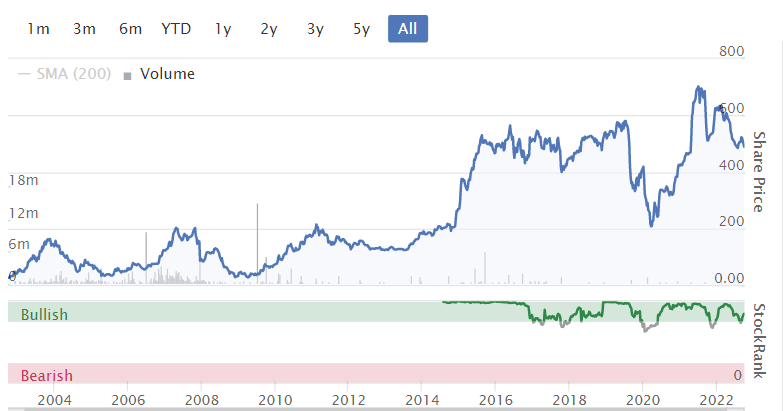
I’ve had a positive impression of this company for many years, but I felt priced out of it after the share price increased in 2015. Here’s the long-term chart:
Firstly, let’s deal with FY August 2022:
the Group's sales momentum continued.... Despite the influence of adverse factors, such as continuing high freight rates and the increasing strength of the US Dollar, the Board expects the Group's underlying profit before tax and highlighted items for the year ended 31 August 2022 to be broadly in line with current market expectations.
As a reminder, Character imports manufactured goods from China. Manufacturing “is carried out on a strictly managed, collaborative, sub-contract basis with closely vetted, reputable suppliers” (2021 Annual Report).
Contracts with Chinese manufacturers tend to be priced in US dollars and so Character is in the currently unenviable position of paying out dollars while earning other currencies (mostly Sterling but also Danish and Swedish Krone).
The interims were published back in May (see coverage by Jack here). Considering the difficult macro circumstances from May to August, I personally wouldn’t be disappointed with the outcome for the year only being “broadly in line”. (Broadly in line is usually code for a slight miss.)
The rest of today’s update is not great, however, detailing the company’s prospects in the run-up to the Christmas period for FY August 2023:
The industry previews of our new product ranges and introductions for the 2023 season have been well received by our customers and prospective customers alike. However, given current macro-economic headwinds, including the weakness of Sterling and the expected curtailment of consumer spending in the lead up to Christmas due to concerns over cost-of-living increases, the Group's trading conditions remain challenging. Against this economic environment and although only one complete month into the 2023 financial year, the Board considers that the trading performance for the current financial year is unlikely to match the expected outcome for the year ended 31 August 2022.
For context, the EPS forecast for FY August 2022 is about 44p.
With the company “broadly” hitting that, we could pencil in 43p-44p.
But then FY August 2023 is “unlikely” to be at the same level.
As Character itself says, we are only one month into the new year and so it’s too early to pin down forecasts with accuracy.
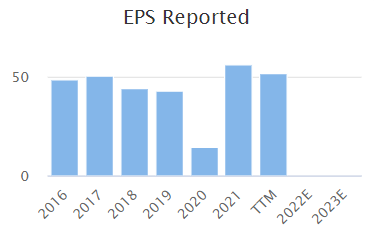
Could the current year be as difficult as Covid-impacted FY 2020? I would say that’s unlikely, but for the record this is what happened to Character’s EPS in 2020:
The good news is that these conditions won’t last forever and the company has net assets of £35m, nearly all of which are tangible and include net cash of £21m (figures from the interim report).
The company reassures us today that it is currently still profitable and so the net asset/net cash position should continue to increase or at least not decrease too much, after the company pays out the progressive dividend it is planning.
As such, I think Character should be categorised as a decent company that’s potentially worth buying for the long-term during this broad sell-off in small-caps. It’s likely to have a difficult year, for easily understandable reasons, but maybe it will be a good stock to hold for whenever things recover?
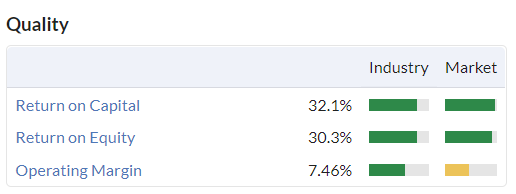
Here’s a reminder of its quality metrics in a “normal” year:
The company also has the (in my opinion) very nice habit of buying back its own shares, which has done a lot to boost EPS over the years.
Watkin Jones (LON:WJG)
Share price: 100.8p (-34%)
Market cap: £258m
Commiserations to anyone holding Watkin Jones this morning after a nasty share price fall.
Let’s get straight into this update and see what happened.
FY September 2022:
- Strong operational performance
- Six schemes forward-sold in H2
- “Some pricing and margin softness on sales concluded in the second half, with purchasers facing increased funding costs”.
- Two forward sales impacted by market volatility and postponed.
As a result: FY 2022 underlying profit to be c. 10% below expectations.
According to a note published by Progressive in May, the adjusted PBT estimate for FY 2022 was £55m. So let’s make that around £49m now.
Outlook
The company points to positives such as: “very good visibility over its development pipeline” (£270m of revenue secured already), “low levels of asset exposure” and “strong liquidity”, giving it plenty of flexibility when it comes to purchasing more land.
But…
…we also believe it is prudent to assume that margin pressure as a result of purchasers' elevated borrowing costs will continue into FY-2023.
My view
When I’m looking at housebuilders, my first port of call is always the balance sheet. At the interims, Watkin Jones had tangible net assets of £145m.
It looks like the company has paid a 2.9p dividend since then, which would have a value of around £7.5m if my sums are correct.
So excluding any profits made over the past six months, we have a balance sheet value of £137.5m. Profits made in H2 should have been substantial, however.
I use these numbers to anchor my expectations, because my long-run view is that most housebuilders tend to be worth around book. In the good times, margins and profits take off, and they trade at a premium. In the bad times, they can sometimes trade at a discount.
Even after today’s sell-off, Watkin Jones continues to trade at a very high premium to book, suggesting continued high confidence in the business model, management, and/or the development pipeline.
If we valued it on earnings, then I’d look for a modest PE ratio (all the way back in 2017, I was arguing that Watkin Jones should be valued at around 9x earnings).
Watkin Jones, prior to today’s sell-off, was actually trading at only around 7x forecast earnings. Unfortunately, these earnings forecasts in hindsight might be viewed as temporarily increased by low interest rates, and not representative of sustainable earnings:

If higher interest rates are here for the foreseeable future, then the margins and sale prices currently achievable are likely here to stay (and could deteriorate further).
Alternatively, you might take the view that rising interest rates are temporary, and that we’ll have low interest rates again soon, enabling higher sale prices for Watkin Jones’ projects.
It bears repeating that cyclical companies often look expensive when they are cheap, and look cheap when they are expensive.
Still, Watkin Jones shares might be worth buying at the current level if you have a strong belief in management and the business model - focused on purpose-built student accommodation and build-to-rent developments. But I prefer these types of shares when they get to around book value, which is where I think their valuation risk has been almost completely eliminated.
Disclaimer
This is not financial advice. Our content is intended to be used and must be used for information and education purposes only. Please read our disclaimer and terms and conditions to understand our obligations.

55 comments
Deleted
I'm fast learning everything seems to revolve around the fed if they are cutting interest rates and doing qe invest if they are raising rates and doing qt get into cash and go to the beach until the first situation presents itself. An expensive lessons learned over many years but at times like Jan 1st 2022 to date maybe better to go and do something less stressful and just keep an eye on fed interest rate announcements.
475 gainers? I'm sure to have an up day for once... err .... Except Watkin Jones, for years one of my few winners, has been smashed and I am right back to the price where I first bought it. I originally bought Boohoo at 48p and sold out at around 200p. Genius! Then I bought back in higher and didn't bother with a stop loss.
I hate the irrationality of the market, how can Sosandar, now in profit and growing fast, be worth half what I paid for it when it was a tiny, money-losing start-up? Rhetorical question - of course I overpaid.
I take responsibility for all of my decisions, but I have concluded that it is practically impossible for me to make good ones. Whatever I do, I seem to always run into disaster.
For the record, I am now about 50 percent down this year, I have very little in cash and I am bereft of hope that anything I buy now will turn out to be a successful investment.
B2V
I feel your pain brother. We are all in the same boat.
We feel your pain this year and as painful as it has been it's a learning exercise.
Start of COVID, I sold everything, lost about 20%, but then trebled my original pot, how clever was I.
This time with more solid companies, Rio Tinto (LON:RIO) Persimmon (LON:PSN) etc I decided to hold everything incl Saga (LON:SAGA) now 30+% down not feeling very clever now.
I believe they will come back, however what I have learnt is, pound cost average every purchase over 10 months, and at the next sign of the next black swan, 20% stop loss everything, no questions asked, I'll sleep easier and you can always buy back in.
Chin up, get some cast iron rules in place, ala The Naked Trader.
ps. I thought black swan were once every ten years, how many have we had in the last two.
Judges Scientific (LON:JDG) interim results presentation from last week. Geotek their largest acquisition to date has been a step change. Lots of questions on Geotek. Order book 21 weeks v 17.5 (H1 21). Trading ahead of expectations notwithstanding the challenging economic environment. Excellent explanation of their business model and how they achieve their excellent return for investors. Video and podcast.
Thanks for all the replies, I think I get the gist now.
P.s. davidjhill - good to see you back on the boards.
Thank you Paul for your comments on Watkin Jones, duly noted. I take comfort in their forward selling on major projects and our previous experience as shareholders. Vertu tomorrow as noted by Tamzin Pi world, we hold so as markets are so unforgiving, adopting the brace position might be sensible advice although I consider it undervalued.
You're very welcome, JASVFS, markets are indeed unforgiving with few buyers out there now to mop up any profit warnings. Good luck. G
Hi Paul and Graham, I see the tickers are dropping off the report again... I've reported it on the green button. I know CCT was there earlier, but it's not there now, and I'm guessing WJG should be there too.
Thanks Indie, will mention that. G
As a quick aside RE: retail investor participation in placings. I made use of the new AJBell facility for the H & T (LON:HAT) placing within my SIPP. I have to say, it just worked - you put in an order for the number of shares you want and they appeared in my account this AM, as expected. So much easier than Primary Bid with the huge benefit that you can take part in placings within tax sheltered accounts.
All the best, Si
Really useful information for AJ Bell account holders - I am one. However much I applaud Primary Bid for being the first mover on this, my experience of using them (three times) has been consistently poor. While their Trustpilot rating looks good, it is based on only 180 reviews. I suspect that if other, much better funded platforms muscle in, Primary Bid may be toast
Really useful information for AJ Bell account holders - I am one. However much I applaud Primary Bid for being the first mover on this, my experience of using them (three times) has been consistently poor. While their Trustpilot rating looks good, it is based on only 180 reviews. I suspect that if other, much better funded platforms muscle in, Primary Bid may be toast
Of course, the other big benefit is that you can take part in placings where there is no Primary Bid offer (not the case with the H&T placing). I believe Hargreaves Lansdown also have the same facility now for retail to take part in placings. I assume it should be possible to take part in placings for companies you don't already hold also, but have not looked at this yet. Good news for all of us but most likely the end for Primary Bid. And I agree using them was a real faff.
All the best, Si
Cannot use PrimaryBid for a SIPP at Hargreaves Lansdowne.
Cannot use PrimaryBid for a SIPP at Hargreaves Lansdown.
I know because I hassled them about it several times. There was a point when they told me in a secure message they were thinking about it but I subsequently read they had decided to give customers access to any placing directly on their own platform... although now I can't find where I read it, so that could be wrong. I thought they announced it around the same time as AJBell but maybe I was imagining things :)
great idea Primary Bid on the face of it, but having used them several times, I learnt the hard way it's actually a great way to lose money... if shares are on discount, the market corrects to that level and lower in the preceding days anyway (and if they're being offered on discount the company knows they're overpriced IMO - just look at Best Of The Best (LON:BOTB) Argo (LON:ARGO) Jarvis Securities (LON:JIM)) and as far as IPO offerings go I wouldn't go there anyway.
For what it's worth, bought 5,000 Watkin Jones at 99p indicating selling pressure continuing.
I was in for 20000 @ 102p
Me 2,000 @100p.
I'll add my voice to those hoping Paul or Graham might offer observations on Watkin Jones. We've done quite well out of them in the past and this sell off looks overdone to me too, we will buy a modest amount today. One would hope Kwasi and Lizz now realise that Mark Carney's comment during the referendum about the UK relying on the kindness of strangers was not an empty one. Pension funds not completing agreed deals on time is part of the blow-back on their sudden liquidity problem.
Unless I'm missing something, Stockopedia doesn't appear to have a 'dividend tracker tool' or for that matter, a 'director buys' daily listing (quite an omission for a subscription service I'd say...)..? Am I incorrect, but if not what do others use please?
Surely this is asking for the Moon?
I don't think so; there appear to be quite a few sites that (for free) provide a daily list of 'director buys' so it can't be difficult to do...As for a dividend tracker, I'd imagine that this'd be a bit more challenging (there do appear to be plenty of sites that do provide sucha service though) but would be really useful if tied in with the Folio tool on Stockopedia...Here's hoping!!
Stockopedia appears to have the data on dividends. When one adds a new dividend transaction, the latest dividend value per share is displayed under the dividend box. It would seem easy to provide an alert that a dividend had been paid for shares on ones portfolio and to provide a button to add the transaction.
I asked for an 'ex-div' date column on the folio tables - Ed replied to me saying that they were working on some date related improvements that might take about 6 months to come through. Was suprised to have the head guy reply to me in less than an hour !
Interesting news from Allergy Therapeutics (LON:AGY) this morning. Stopping production facilites for weeks. Proactively…but they just secured more funding days ago. Not sure what to think of that, but bought more on the SP dive this morning. I have a feeling it is preparation for future growth with new products. Any views?
What does everyone think of the panorama expose on Drax (LON:DRX) last night. Poured cold water on their business case and ESG credentials. Cutting down primary rain forests to produce wood pellets that apparently puts out more CO2 than coal??
Its not a new story; I saw the same Drax (LON:DRX) allegations back in 2020, 2021. Biomass will always be a contentious issue. But that hasn't stopped Drax massive SP increase from 2020 to 2022.
Its a regulatory risk; do we think UK government will one day rule biomass as not being green? Can't see it in this day and age where we're desperate for non-volatile energy sources to smooth our wind and solar.
The No Free Lunch column in the Investors Column has run two articles over the last couple of years drawing attention to Drax's false claims, and putting both sides of the argument. Biomass is a viable environmental solution if the wood come from offcuts and is locally sourced - and if the carbon produced is captured and stored safely underground. Drax is developing this technology, but is being the ESG credit now as if it was already up and running.
And wind turbines and solar panels aren't exactly that green either. There's a lot of green hypocracy about and biomass is not the worst - albeit those that peddled it were probably not top of their respective classes in maths back in their school days if they thought there were enough trees to go around.
I think biomass got off the ground with a lie that it would be made from our waste much of which has energy. If Drax are burning good timber they are only converting it to biomass to hide whaT it really is. Which is a bit of joke, I cant believe burning logs wouldnt be miore efficient from most angles
It was hardly a revelation. BC's temperate rainforests (Fun fact we have remnants in Britain on our W Coast, there is one near Calder Hall in Cumbria and last year we visited one near Porlock), have very little protection, as such things are delegated to Province level and there appears no genuine interest in Ottawa to reform the logging industry or make habitat protection more of a federal issue. Green Washing isn't just a tactic for publicly quoted companies, sadly. When Greta Thunberg told world leaders "How dare you" (Make the right noises and do nothing), I assumed she was aiming at noted halo-polisher Trudeau as much as Trump.
Regarding Drax themselves, they are a corporate supporter of reopening our railway from Skipton to Colne, as it will lop over 100 miles off the route that their biomass trains take, as they currently bring it down from the Firth of Clyde to Staffordshire and then do an about-turn up the Midland mainline via Leeds. Which tells me that they see logging imports as a long term strategy.
I doubt it will affect their share price, Drax's output is systemically important and people- in my experience- are very grudging about modifying their behaviour for the common good. This week I've had several people grumbling about the hardship of having to wear jumpers indoors. So Drax's product will remain in high demand at least as long as our politicians gently squabble about next generation nuclear and the Marie Antoinettes amongst us fret about having knitwear imposed on them.
Tomorrow Vertu Motors (LON:VTU) H1 results. PIWORLD have a webinar with Robert Forrester CEO and Karen Anderson, CFO, at 2.15. A good update on the car market and VTU which seems undervalued. Register here .
Watkin Jones (LON:WJG) profit warning approx 10% off target in todays trading update. However share price has nosedived 33%. Looks an overreaction to me. Would appreciate your view chaps.
For what it’s worth (ie, not much) I agree and bought some more at £1. I don’t see how the medium to long term value of the company has all but halved in a month and a 33% drop on an PW that is 10% below expectations seems excessive to me. But I am often wrong.
Watkin Jones (LON:WJG) profit warning approx 10% off target in todays trading update. However share price has nosedived 33%. Looks an overreaction to me. Would appreciate your view chaps.
It doesn’t help that UK property funds are gating withdrawals this week while mortgage rates soar to 6%. It all adds to concerns of a recession-driven property valuation reset that might turn WJG’s “delayed into the next quarter” closures into temporarily stranded assets. Acknowledging that 30% is the current bog-standard reaction to a PW for UK small caps anyway, we should not be too surprised at the reaction. But it does look a good entry level if you believe in the business plan and the commitment of management (because that is what you’re buying) to see through the tough times. I would also be concerned that profit and cash flow recovery might be slower for property investments than, say, semiconductors or travel and hospitality. But WJG has an asset-light model which should work in its favour. It’s a fundamentally good business going through a tough period.
looks like an overreaction off an already discounted share price to me. Sentiment is so on the floor at the moment that any hint of margin compression is met with complete doom so I suppose it isn’t that surprising. But in reality 40% of the market cap is now covered by net cash. It’s an asset light business model and build to rent isn’t going away in the medium term given housing shortages. But so many stocks have more than halved in this period as panic ensues around the market.
Watkin Jones (LON:WJG)
FWIW Progressive have put out a note on RT.
"We have cut our FY22E EBIT from £60m to £54m and, taking a prudent stance, for FY23E from £80m to £55m. Our adjusted PBT goes from £55m to £49m for FY22E and from £75m to £50m for FY23E. Our dividend expectations are unchanged."
For 2023 this translates to an EPS of 15.8p - a reduction of @29% from consensus on Stocko - seems to be along the lines the market is thinking.
Phil
(No holding)
Hi Bristolian, my pennyworth is that, as with most shares, a close eye is needed to be kept on investments because things can change a lot and positive actions must be taken either way, I no longer hold Watkin Jones (LON:WJG) but keep my notes, one from 2018/19 simply says "Best to Hold, Stocko likes it". A year or so later the share price crashed, much as has happened now, I held on till last November when the price had recovered but had I added in midsummer of 2020 my profit would have been all the greater, I don't have the funds at this time or else I would go back in.
I know Legal & General (LON:LGEN) is not SCVR but re the issue of LDI, pensions and BoE - a robust statement to say the least. Still - although not on their balance sheet if I had taken advice and was now being asked to supply collateral I’d be pretty pissed. BoEs 50% non contributory LDI pension Muddy’s water on this whole issue. Anyway it’s a good statement from Legal & General (LON:LGEN) but I fear you ain’t heard the last of this.
Thanks for highlighting RDH.
As you said, in its statement Legal & General (LON:LGEN) says it has no balance sheet exposure in relation to LDI business, and acts as an agent between its clients, and the LDI counterparties. But (in your opinion), what other financial risks could there be?
I'm guessing that if it is acting in a pure agent (and advisory) role, then it shouldn't have any counterparty insolvency risk.
But if its clients are having to put up more collateral, then this could lead to redemptions from its clients, to meet increased collateral (assuming the client doesn't become insolvent).
Any of this sound legitimate, or is it just catastrophising?
Cheers
Chris
LDI probs are liquidity and not solvency problem. Avoid the incompetent and sensationalised news bulletins on this (and that goes for some of the financial press like Bloomberg which really is a clickbait machine). Catastrophising is too OTT. Client (ie pension funds) just need to rebalance their assets. They use futures to minimise move in their physical assets. Overall the process works well and has benefited UK pension funds and their beneficiaries.
And clients will not be miffed at L&G re any structure issues only if they messed up on execution. If you want to pick on anyone then look to scheme actuaries who will have advised on asset allocations and LDI structures.
This thread from Chuckle Fox is a bigger perspective on what went down (I know him and he knows his stuff...he's a fringe uncredited player in 'The Big Short' fwiw)
https://twitter.com/jimdelisle...
Mojomogoz excuse me if I come over like a numpty but when you are talking liquidity is this relating to the bond market or asset classes as a whole, I get liquidity issues in general like the financial crisis when all the banks were scared to lend to each other, but if yourself or anyone else could expand on this into what happened last week and possible future knock on's would be appreciated.
Hello The Phoenix, may you continue to rise. The liquidity i refer to is of defined benefit pension funds which are super asset rich and in absolutely no danger of being insolvent. However, they were mugged by the market (of which what Kwasi said was at most marginally causal...he could maybe be blamed for accelerating a global market event) that moved very fast and burned through the liquid resources they kept aside to make margin calls for futures linked to long dated govt bonds. So these trillion pound plus asset rich in no way insolvent funds didn't have enough cash on hand to meet margin calls to their broker. Some talking heads talk about leverage etc and say they were using leverage to generate excess returns...and so then make comparisons to the banking crisis of 2008...but this is way off beam and when commentators (inc in financial press that should know better!) make the comparison they are talking through their ar....
Their is a form of leverage in that they are using futures to manage risks in a bigger asset exposure. But this far removed from leverage in banks and not systemic solvency...unless you believe that UK gilts are going to move to pricing default by the UK govt
Many thanks Mojo unfortunately after the last nine months I'm still in the ashes stage maybe the US mid terms coming up will give the last three months a kick up.
I also can't see Putin giving up before winter is over given gas issues in Europe hes then in rock and hard place as far as I can see he either wheels out a small nuke or trie's to sell the locals it was all a dream story and given how zombified/scared of him the population are he might just get away with it.
Sounds from what you are saying that these LDI's are harmless, which presumably means the Bank of England over reacted when it felt it had to manipulate the gilt market ?
The consequence of the BofEs intervention is that instead selling £80bn of gilts, it bought £65bn. I assume that the Bank is compensated for the consequential losses of the actions it took to help those LDI funds by them or their promoters.
Thanks for your comment and the link to the twitter feed.
Jeffries spent yesterday reviewing risk disclosures - could be something that passes but clearly an emergency BoE liquidity programme isn’t part of the investment case
LDI is a strategy/structuring technique rather than an investment as such. It is a perfectly sensible approach for pension funds & their corporate sponsors who want to dampen the volatility of funding ratio and prevent a large accounting deficit from springing up suddenly in the corproate balance sheet.
There is quite a bit of sensationalist, inaccurate twaddle in even the more sophisticated press (not helped by Blackrock allowing a rather poorly briefed American to make some comments at a conference). Much as I admire Lord Wolfson, I suspect you will find his recent utterances can be lumped together with Warren Buffet's colourful comments on derivatives (while leveraging the float of a large insurance company that had traded plenty of derivatives).
It is the deployment of high leverage within an LDI strategy that is the culprit, rather than LDI itself. Like debt, it depends on how much, and opinions may vary as to how much is too much.
The problem wass more one of short-term liquidity than solvency:
The deeper problem is that pension funds are concentrated owners of long gilts/linkers and combine that with QE and you have a problem if a large chunk of the market becomes a forced seller in a narrow time period. That is not a problem unique to LDI.
It is rather puzzling that Kwarteng, being rather well read in these matters, completely ignored this little quote from history:
Clinton political adviser James Carville said at the time, "I used to think that if there was reincarnation, I wanted to come back as the president or the pope or as a . 400 baseball hitter. But now I would like to come back as the bond market. You can intimidate everybody."
As for Legal & General? I'm not too worried, they were generally at the more conservative end of the spectrum (or at least in my day).
pension schemes understand collateral requirements RD. it’s very clear in the market and a day to day requirement they deal with every day. The issue isn’t collateral requirements it’s liquidity.
I'm happy to see any sensible comment about any UK listed company on here, it's the only investment forum I read.
I note that Phoenix group (LON:PHNX) is up today as well, following Legal & General (LON:LGEN) announcement. Phoenix haven't released their own statement yet, but their CEO has just bought £100k shares, so I take it from the buy that financial outlook has not changed significantly at Phoenix, from LDI. He was a consistent buyer in 2020, 2021. But this is his first buy in 2022, so I take that as a good sign given he has not been tempted by the price so far, but is now with the dip.
Phoenix has a very good capital buffer/ratio I believe (I'm no expert in this), so possibly any additional collateral requirements from LDI was easy to meet from reserves or selling other liquid assets.
I would say the medium term outlook for a pension, annuity, and life assurance consolidator like Phoenix group (LON:PHNX) just got brighter, as many insurers and corporates are probably waking up to the fact that they might have time bombs on their balance sheets, and want to explore offloading this non-core risk.
(I hold in the Boon Fund)
Yes and many pension funds will now be hugely in surplus after surge in gilt yields and I can see a rush to offload these with life insurers - they may never get a better opportunity. LGEN reported very strong demand in their update, and would expect PHNX to also be winning new business (remember they are no longer just a consolidator of closed books but also writing new business).