Small Cap Value Report (Tue 5 Mar 2019) - BILB, SWL, SBIZ, DEB

Good morning, it's Paul here!
Here's today's usual placeholder. I'm making an early start today, in order to cover today's news, and then circle back to finishing off yesterday's report, plus telling you about my meeting yesterday with management of Revolution Bars (LON:RBG) which went very well. There was so much to take in, that by the time I got home yesterday, I'd used up all my mental bandwidth for the day. That's the trouble with trying to write a report, and have meetings on the same day.
Taking a quick look at the day's top % movers (at 09:10) which fall within my remit;
Bilby (LON:BILB) - down 39% on a trading update - must be a profit warning, I'll look into that below
WH Ireland (LON:WHI) - down 29% to 45.5p on news of a discounted £5m placing
Swallowfield (LON:SWL) - down 13% on interim results - I'll take a closer look below
Looking at risers, the ones that interest me today are;
Netcall (LON:NET) - up 14% to 34.5p on interim results
SimplyBiz (LON:SBIZ) - up 6% to 192p on full year results. I've reported positively on this company before, so will review these results below
That's my initial to do list, so let's get cracking.
Bilby (LON:BILB)
Share price: 40p (down 39% today, at 09:42)
No. shares: 40.5m
Market cap: £16.2m
Bilby Plc, a leading gas heating, electrical and building services provider, announces the following trading update for year ending 31 March 2019.
Checking back through my notes here on 11 Dec 2018, this contracting group put out a mild profit warning.
Today it warns again, due to problems with various contracts. That's the Achilles Heel of contracting type businesses, and why I avoid this sector altogether now. The work tends to be low margin (due to competitive pressures), and sooner or later something awful seems to go wrong with contracts, leading to cost over-runs, disputes, etc.
Helpfully, the company does today quantify the likely outcome for the year;
As a result, P&R, through which the Company was undertaking both contracts, will now report a significant loss for the full year. Accordingly, the Board expects the trading losses and associated write offs at the division to lead to the Group reporting a positive EBITDA of between £2.0 to £3.0 million before non-underlying restructuring costs and losses associated with the termination of the contract for Ministry of Defence properties. Whilst the future of gas services within the P&R division is now being reviewed, it remains a core service for the rest of Group.
The other divisions of the Group continue to trade well and in line with management expectations for the current year.
My opinion - as you might have gathered, this share just doesn't interest me at all, at any price.
There's little in the way of balance sheet support - net tangible assets are positive, but small. Exceptional costs look likely to weaken the balance sheet when next reported, and there is some bank debt to take into account.
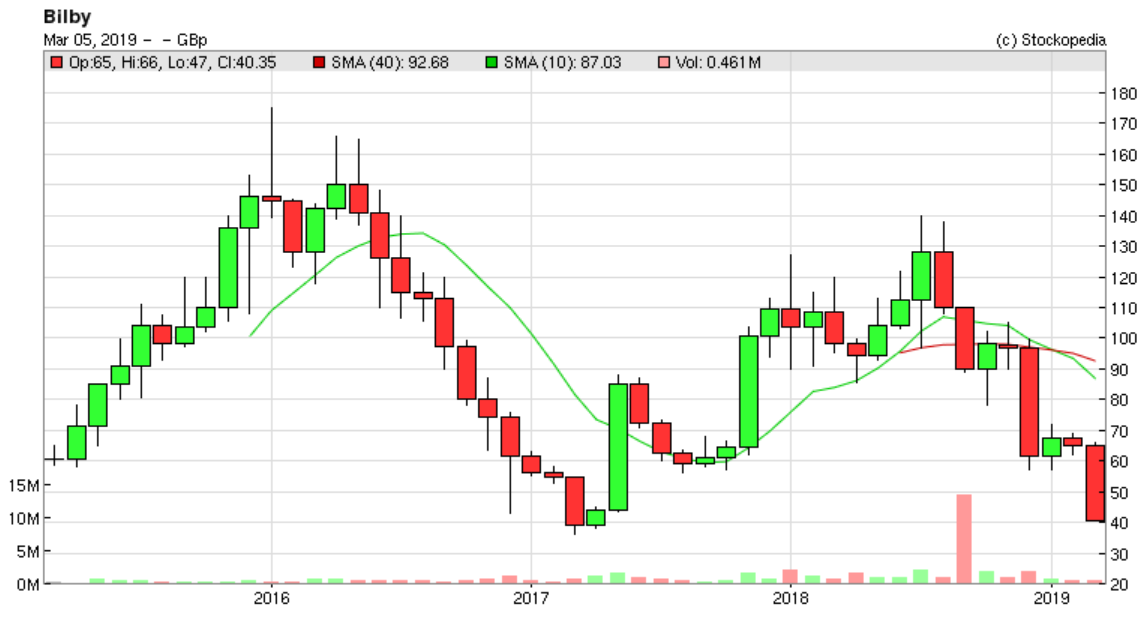
Mind you, looking at the long-term chart below, 40p was the level where it previously bottomed out, and staged a strong recovery. So if you are prepared to invest in this sector, it might be worth a closer look perhaps? Definitely not of interest to me though.
Swallowfield (LON:SWL)
Share price: 170p (down 13% today, at 10:13)
No. shares: 17.1m
Market cap: £29.1m
Swallowfield plc, a market leader in the development, formulation, and supply of personal care and beauty products, including its own portfolio of brands, announces its interim results for the 28 weeks ended 12 January 2019
I last reviewed this company here in Nov 2018, finding it apparently good value at 253p per share. The price is now down by a third since then - I wonder whether something has gone wrong, or if it's just been pulled down by the general, low liquidity, downward drift, which is affecting so many small caps right now?
These interim figures are poor. Underlying profit fell from £3.4m last time, to £1.63m this time - a drop of 52%. Reasons given are increased cost of materials, and weaker product mix.
Outlook comments indicate an improvement is expected in H2. This sounds more than just wishful thinking, as some reasons for optimism are given;
In our Manufacturing business, we expect a significant second half recovery given the visibility of the order book and as we benefit from the positive impact of pricing initiatives, product mix and cost base optimisation already implemented...
This is countered by cautious comments about market conditions;
There is clearly a considerable level of uncertainty in the current business environment and we expect consumer demand to remain subdued...
Balance sheet - looks reasonably solid. Note there is a £6.6m pension deficit.
Cashflow - favourable working capital movements have generated decent cashflow, which has mostly been used to reduce invoice discounting borrowings.
Dividends - interim divi has been raised 7.5% to 2.15p. If the (larger) full year divi is also increased by a similar amount, then the yield would be just under 4%.
The risk is that if H2 disappoints, then the final divi might be cut.
My opinion - I'm not keen on situations where a poor H1 is expected to be recouped in H2, as very often that fails to actually happen.
Whilst management sound fairly confident, I wouldn't want to hang my hat on this, in current market conditions;
... we are confident in a materially improved performance in the second half and believe results will be broadly in line with market expectations for the full year demonstrating profitable growth.
With the share price now depressed, the market has probably factored in further downside. However, we seem to be in a market where further disappointments (even if already priced in) trigger a further plunge in share prices. So why take the risk?
SimplyBiz (LON:SBIZ)
Share price: 184p (up 2% today, at 11:04)
No. shares: 76.5m
Market cap: £140.8m
SimplyBiz (AIM: SBIZ), the leading independent provider of compliance and business services to financial advisers and financial institutions in the UK, today announces its audited consolidated results for the twelve months ended 31 December 2018.
These figures look very good. Stockopedia is showing broker consensus of 10.5p normalised EPS for 2018. The actual EPS figure of 11.92p looks a comfortable beat. The PER of 15.4 looks reasonable. A year ago we would have considered that cheap, but in today's more bearish markets, it's probably about right.
There is a caveat though. Looking at the figures on a broker note today (available on Research Tree), the EPS beat is entirely down to a low tax charge. The commentary says this about tax;
The tax charge for the year includes the beneficial impact of research and development claims submitted in respect of FY17, offset by non-deductible expenses incurred during the IPO process.
At the adjusted PBT level, the 2018 results are actually in line with forecast of £10.0m. It's always worth checking the figures carefully.
Growth is both organic, and from acquisitions.
Dividends - are kicking in, with a final divi of 2.05p. The cash generative, capital-light nature of this business should see a good flow of future divis. Providing nothing goes wrong.
Finance costs - note that these relate to pre-IPO. Zeus has this dropping to zero in 2019 and beyond, as most debt was paid off with funds raised in the IPO. There is a £7.5m loan remaining on the balance sheet, which is more than offset by £13.3m of cash, giving net cash of £6.4m at 31 Dec 2018.
I spoke to the CFO some time ago, querying why the company has both a large cash balance, and simultaneously a bank loan. I can't remember exactly what he said, but one reason was to give plenty of headroom at the time of the IPO (in April 2018). There could also be seasonal fluctuations - i.e. balance sheet dates are often chosen to reflect seasonally favourable highs in cash.
Outlook - non-specific, but upbeat;
The Board strongly believes that SimplyBiz is well placed to continue to take advantage of the opportunities that arise within the markets it operates in, and that its strong business model positions it for continued growth to deliver a successful year ahead for the business, clients, staff, and Shareholders.
My opinion - as mentioned before, I like the look of this share. It has a lot of favourable characteristics;
- Sticky revenues, being recurring in nature, and spread over lots of clients
- A clear value proposition for customers (an affordable fee, to deal with very complex regulatory issues)
- High profit margins (although this can also be a problem, as it attracts competition)
- Rising divis
- Balance sheet looks adequate, given capital-light model
My main worry is that the business model might possibly prove too lucrative, and could lead to key staff peeling off and setting up their own competitor. That's the big risk with people businesses. So a key question to ask management here, is how they lock in key staff (hopefully with generous long-term share options schemes)?
The numbers look very good, so I continue to view this share favourably.
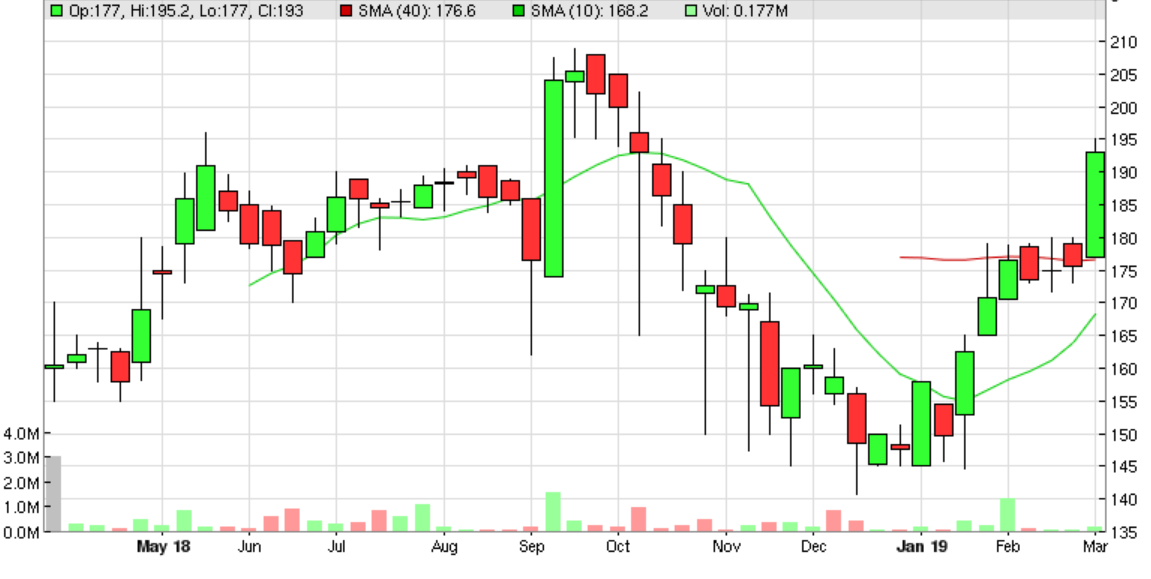
As you can see below, this share has recovered well from the indiscriminate small caps sell-off late last year;
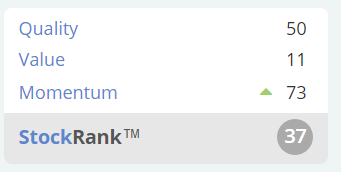
The StockRank system here doesn't like it. Although that is often the case with recently floated small caps. I think the Stockopedia computers like to see more track record.
Disclaimer
This is not financial advice. Our content is intended to be used and must be used for information and education purposes only. Please read our disclaimer and terms and conditions to understand our obligations.

47 comments
You're wrong - there's never been a perfect technology released and there never will be. Users value convenience over security and expect that someone will fix things when it goes wrong.
Sorry I was not making a case for perfect technology!! That's a ridiculous assertion. As an engineer I know full well it does not and never will exist. The point I was trying to make is that everything in life has a risk and reward trade-off and the deployment of blockchain technology is no different. When I say "users" I was referring to the corporations and governments that may deploy a blockchain (not their customers, consumers, population etc.). If they fear that reputational risk is too high, particularly in being an early adopter, then the technology will never take off or at the very least it will take far longer to reach critical mass than all the evangelists predict. We see this time and time again with newer technology.
As you say, not much point in debating this further. This is after all an investment blog and the bottom line is there is absolutely no investment angle to this unless you want trade cryptocurrency or buy shares in IBM et al.
If we only issued perfect technology we'd still be looking at the lever and wondering how to get rid of the pivot :-)
Yes, but please don't try and paint me as some kind of luddite. There's a world of difference between between a pragmatist/realist and someone that doesn't believe in technology.
All the best, Si
Hi Si
Clearly no point in going round the houses with you on this one. However on this:
I don't think most users can accept this "shit happens, so what?" approach to the deployment of technology in the real-world, and certainly not the customers I work with.
You're wrong - there's never been a perfect technology released and there never will be. Users value convenience over security and expect that someone will fix things when it goes wrong. When the thing that goes wrong is regulated - such as the use of chip & PIN cards - then they're right. When the thing that goes wrong is unregulated - such as Bitcoin or any of its progeny - then they're wrong.
If we only issued perfect technology we'd still be looking at the lever and wondering how to get rid of the pivot :-)
timarr
FREng,
Sorry, but in my previous post I meant to reference unintended hardware attacks. Until the Meltdown and Spectre vulnerabilities were discovered, no-one mistrusted the Intel and ARM CPUs that most of our digital lives depend on.
https://meltdownattack.com/
And then with regard to hardware subversion we have the ongoing Huawei saga. It seems to me we live in a world where trust is deteriorating, and in that environment I do not see blockchain/DLT flourishing.
All the best, Si
Hi Si
How is blockchain different from any other transactional technology? They're all built out of hardware and software developed by inefficient humans. They're all flawed, but that doesn't stop us using chip cards or relying on cryptography or smartphones, etc, etc. because we have to balance security against convenience. Otherwise we'd still be sending people out on horseback to courier bearer bonds and contending with a plague of highwaymen.
In the end blockchain is just a ledger with some interesting properties which can be deployed in a number of different ways. In some situations it's probably better than existing technologies, in many it isn't.
timarr
P.S. You can't put an identity on a blockchain because it's irrepudiatable. Under GDPR we have the right to be forgotten, which is tricky if you can't delete the ledger record. So we're all safe until March 29th, at least :)
How is blockchain different from any other transactional technology? They're all built out of hardware and software developed by inefficient humans. They're all flawed, but that doesn't stop us using chip cards or relying on cryptography or smartphones,
Because it is distributed and (in theory at least) no-one takes ultimate responsibility for fraudulent transactions and more importantly these transactions cannot be undone. I don't know about you but despite my best efforts I've had fraudulent transactions on my credit card and I still use it to make internet purchases because I know the card issuer is going to cover any losses. Were that not the case I may be less inclined to use it. However, I presume you are referring to the use of blockchain where such an institution still plays this role?
The point I was making to FREng about hardware was really just to remind him that software does not run in splendid isolation. I apologise, it's an old habit having spent the past 30 years reminding software engineers of this fact :-) Actually, one of the strengths of blockchain is that verification takes place across multiple nodes using a range of different hardware and software platforms. However, if someone just happens to get hold of your personal keys by hacking your platform, that's not going to be much consolation, so the risks are real.
In the end blockchain is just a ledger with some interesting properties which can be deployed in a number of different ways. In some situations it's probably better than existing technologies, in many it isn't.
I agree. I said I could see DLT being deployed in some private, non financial applications. I can definitely see it being useful where there is no financial incentive to gain the system and so the cost of doing so is not worth the effort. For currencies though the situation is different... I can just see a Bond film where the villain strokes his cat and hits a return key to steal all the money in the world and bring down the entire global financial system :-)
P.S. You can't put an identity on a blockchain because it's irrepudiatable. Under GDPR we have the right to be forgotten, which is tricky if you can't delete the ledger record. So we're all safe until March 29th, at least :)
This is my concern, and of course, we already have the Investigatory Powers Act. However, you don't have to explicitly identify someone to provide information about them and what they are doing. A public blockchain is a perfect way to do traffic analysis in the same way that messaging metadata can provide as much information as the content of the message itself.
All the best, Si
Hi Si
Well, "blockchain" is a technology that can employed in a wide range of ways. There's a taxonomy of different types, as outlined in the diagram in this article:
https://www.chyp.com/a-legacy-...
Bitcoin runs on a double permissionless public ledger - the ledger is public and integrity is maintained because users are incentivised to do on the ledger, via rewards for mining. But there are other types - particularly private ones like Bankchain (a private, permissioned ledger) or Ripple (a private, privileged ledger). Even within public ledgers there are a range of possible consensus mechanisms, the Bitcoin variety is an example of a type, not an invariant model.
The point I'd make is you can't extrapolate from the flaws of a Bitcoin style public. double permissioned proof-of-work variety blockchain to all blockchain technology. Most of the investment is going into other areas or even into different consensus mechanisms that are less vulnerable.
Bitcoin style blockchains are popular because neo-liberal, anti-authoritarian activists see them as a way of achieving trust without needing a central counterparty. This is good, because they're putting their money into ridiculously risky schemes and will lose it all, and thus pose less of a threat to society. It's bad, because it's obscuring the value of the technology and people conflate the Bitcoin style blockchain with all blockchains.
As a general point unregulated cryptocurrency is an idiotic idea for many reasons of which your point on reversals is only one: after all reversals are only possible on credit cards because Visa and Mastercard make it so. There are still two underlying ledger entries - a debit and a credit. The first one doesn't cancel the second out, they both still happened, the ledger is a record of what happened, not the eventual outcome.
And as for identity, the triangulation of data to determine identity as you describe should be outlawed by the ePrivacy Regulation, which is an extension to GDPR. But all technology is flawed, and no doubt someone will find something. But that's what happens when people and technology collide: things go wrong, it gets patched. C'est la vie.
timarr
Hi timarr,
Well, "blockchain" is a technology that can employed in a wide range of ways. There's a taxonomy of different types, as outlined in the diagram in this article:
https://www.chyp.com/a-legacy-...
Bitcoin runs on a double permissionless public ledger - the ledger is public and integrity is maintained because users are incentivised to do on the ledger, via rewards for mining. But there are other types - particularly private ones like Bankchain (a private, permissioned ledger) or Ripple (a private, privileged ledger). Even within public ledgers there are a range of possible consensus mechanisms, the Bitcoin variety is an example of a type, not an invariant model.
Yes, I understand there are different approaches and consensus mechanisms of which bitcoin is just one. However, I think for most applications there is some kind of viable alternative to using even a private blockchain with permissions/privileges, so I still pretty much concur with Schneier when he says:
Private blockchains are completely uninteresting. (By this, I mean systems that use the blockchain data structure but don't have the above three elements.) In general, they have some external limitation on who can interact with the blockchain and its features. These are not anything new; they're distributed append-only data structures with a list of individuals authorized to add to it. .... They're blockchains in name only, and -- as far as I can tell -- the only reason to operate one is to ride on the blockchain hype.
I know you don't agree, so we'll have to beg to differ on this point. I can understand why people like the FCA are looking at use of blockchain (particularly for financial compliance and regulation purposes) but as things stand this does not seem very well advanced, it is still a technology looking for a killer application. And let's face it, it is not exactly a new technology - just new to a number of bandwagon followers. In that respect, the hype around it is not currently well founded.
And as for identity, the triangulation of data to determine identity as you describe should be outlawed by the ePrivacy Regulation, which is an extension to GDPR. But all technology is flawed, and no doubt someone will find something. But that's what happens when people and technology collide: things go wrong, it gets patched.
Obviously, your faith in regulation is far greater than mine. And of course, to patch something you need to know there is a bug in the first place. No-one really knows if the Meltdown and Spectre bugs had been utilised before found comparatively recently by Google researchers. Seeing that the bug had been present in Intel CPUs for many years I think it would be naive to assume someone had not already found and used it.
C'est la vie.
I don't think most users can accept this "shit happens, so what?" approach to the deployment of technology in the real-world, and certainly not the customers I work with. For public blockchain applications it's not really much of a selling point is it? :-) Especially if by deploying it you are putting information into the public domain that was not previously public and/or easily accessible. This leads to potential reputational risk, breach of customer trust, and ensuing litigation for banks, corporations etc., and at the very least gross privacy invasion if incorrectly used by governments.
All the best, Si
I'm surprised no-one has mentioned 4imprint (LON:FOUR) yet, which announced final results today. At a market cap of £572m it's only just out of small cap territory. In summary, revenue up 18% (organic growth), PBT up 9%, EPS up 22%, dividend up 25%. They make promotional material (company branded mugs, pens, etc) and have largely US sales.
EPS +22% was greater than PBT +9% largely due to the US tax changes resulting in effective tax rate of 20% vs prior year 29%.
PBT +9% was lower than revenue +18% due to reduction in operating margin from approx 6.6% to 6.1%. They address this in the results and state it is due to a ramp up in brand advertising this year.
They sound confident in the future, and are increasing distribution capacity in Wisconsin to support further growth.
Balance sheet is sound, with net cash and net tangible assets. There is a pension deficit, but not large in the context of the company size, and the scheme is closed.
Chart looks great, with a pop from a base on results today, and a steady but slowing rise over the last few years.
The Stockopedia computers like it, with a stockrank of 89, and high-flyer classification.
I don't hold, but am considering taking a starter position tomorrow. Any thoughts welcome before I commit!
Did all the BKS holders see the attached presentation. Very good.
https://www.piworld.co.uk/2019/03/04/beeks-financial-cloud-bks-h1-results-february-2019/
If you're interested in what's going on in blockchain technology, listen to our interview with Erik Townsend from Macrovoices.com , discussing how Government and Central Bank might adopt digital currency. The technology is not there yet, but Erik likens now to the 80's and the internet. At that time, the masses did not believe the internet would be the norm in the future - and the rest is history.
Erik's comes from a tech background. On selling his company for $36m, he started investing, with a particular interest in macro. For the last 10 years he's run a hedge fund (well till mid way through last year). If you've heard his macrovoices podcasts, you'll know he's a great font of knowledge on the macro picture for investors.
Erik is NOT a fan of cryptocurrencies, and was the first to pour scorn on the ICO's and bitcoin bubble. However, at some point, he realised the technologies being developed were too good not to be adopted by Governments. The big question is who will get there first?
This interview covers the main issues in Erik's book:Beyond Blockchain - The Death of the Dollar and the Rise of Digital Currency. The book itself takes the different elements of money supply: Government, Central Banks, Sovereign Debt, Fractional Reserve Banking etc; it discusses the motivations and technologies developed by the cypherpunks; and brings it all together to give a picture of how an International Digital Currency could become a reality. It's a fascinating read.
Anyway, enjoy the interview. We were flattered to get such a 'big' speaker on piworld, and he didn't disappoint.
Blockchain technology is just hype. From an investment perspective it should be totally ignored. I fundamentally disagree with what Erik says although I appreciate it is how he makes his living. But don't take my word for it, so do many of the world's most respected security experts. See:
1. https://www.wired.com/story/theres-no-good-reason-to-trust-blockchain-technology/
2. https://arstechnica.com/information-technology/2019/02/researcher-counts-the-reasons-he-wants-cryptocurrency-burned-with-fire/
3. https://queue.acm.org/detail.cfm?id=3305265
4. https://www.technologyreview.com/s/612974/once-hailed-as-unhackable-blockchains-are-now-getting-hacked/
Erik doesn't make his living from this? (Books do not make a lot of money). He just believes passionately that technology will enable a mass adopted digital currency, and that is going to make a big difference to the world and society.
I guess only time will tell if you are right, or he is right.
In the meantime personally, I've learned a lot from the book, which is a mastery in explaining money supply, central banks, sovereign debt, FRB, etc, simply. Ironically only about 25% of the book is discussing digital currency. On the premise, the reader has to understand the monetary system, to be able to conceive how and why an international digital currency might be adopted.
Whether it will or will not, the book is still a fascinating read, (or listen, as in the case of this interview.)
Erik doesn't make his living from this? (Books do not make a lot of money). He just believes passionately that technology will enable a mass adopted digital currency, and that is going to make a big difference to the world and society.
I guess only time will tell if you are right, or he is right.
Yes, and in that time lots of people are going to lose lots of money if they invest in this pointless over hyped technology. I have been involved in this area through my work since 2010. As such, I have probably as much, if not more, direct experience of the realities of the practical uses of blockchain than Erik.
As I said, you don't have to believe me just read the articles I linked to including the thoughts of the likes of Bruce Schneier and Nick Weaver, two of the greatest security and trust thinkers of our generation.
"(Books do not make a lot of money)" - listened to the Radio 4 money box podcast about authors writing for a living and they interviewed Mark Dawson, he writes through Amazon and is making over 7 figures a year he says - nice money! https://www.bbc.co.uk/programmes/m0002ml5
These articles were interesting and some of the best refutation of blockchain that i've read. I'm fundamentally bullish on bitcoin, the more i learn on the subject the more my conviction grows. And i'll mention that i am the kind of person who looks for hype in the stocknarkets and shorts it :-) Like any wise investor though i seek out the criticisms and as yet i havent found anything to alter my fundamental conviction.
Id encourage anyone with the time to understand Bitcoin more. Be careful to differentiate between Bitcoin and other blockchains.... they are almost entirely get rich schemes following on bitcoins coattails. Bear this in mind while reading the articles because some of the criticism is rightfully levelled at some blockchains but doesn't hold true against Bitcoin.
I wont bore people with in depth responses to the articles key criticisms but as a theme many related to the 'on and off ramps' to bitcoin rather than the bitcoin blockchain itself. We are still early days and the related infrastructure and services are in their infancy. Wait until these are mature and you'll have missed the investment opportunity.
Oh and just one more thing which is a key point to understanding Bitcoins value. It is a store of value first, payment system second.
All the best,
Shaun
I'd suggest people listen to the piworld podcast before rushing to judgment. Bitcoin and blockchains get fairly short shrift before getting into the meat of Erik's arguments. Cryptocurrencies are not what is being promoted.
I'd suggest people listen to the piworld podcast before rushing to judgment. Bitcoin and blockchains get fairly short shrift before getting into the meat of Erik's arguments. Cryptocurrencies are not what is being promoted.
I did but unfortunately my BS detector exploded. What Erik and many other people who come at this from a technology standpoint fail to understand is the importance of trust. That is the reason I provided a link to the Schneier article in Wired.
We live in a world where trust is decreasing by the day, not increasing, so it is difficult to see anything worthwhile happening in my lifetime. Any financial system has to be built on trust and if you thought Brexit was difficult to negotiate just imagine sitting the EU, Chinese, Russians and Americans round a table to agree on an international digital currency.
Who knows.. by the time anything worthwhile comes to fruition it will probably be made worthless by the widespread availability of Quantum computers!
All the best, Si
Hi Si
Who knows.. by the time anything worthwhile comes to fruition it will probably be made worthless by the widespread availability of Quantum computers
Indeed, I'm fully expecting this to be the next big thing :)
I'm not quite so pessimistic as you on blockchain. Schneier is correct, as usual, on the nature of trust in blockchain systems - if trust is dependent on technology then you're ultimately trusting the developers of the technology. And having worked around a few software houses I'd rather not, if you don't mind.
However, where I think he's wrong is by setting one standard for existing technology and another for blockchain. Partly that's because of the hype around blockchain, but there's no reason we should expect it to be better or worse in implementation terms than any other technology. If we set aside the "bigger trust in technology" issue and think about it in pure implementation terms the question is whether there are reasons for preferring blockchain over existing technology in any specific use case.
In many cases - as Schneier points out - the answer is no, you can use a big database and achieve similar results, at less cost. But there are situations where blockchain does look like it offers some advantages. In the UK, for instance, the FCA is looking at blockchain based audit which would allow automated analysis of company accounts. There are certain features of that situation that are appealing - in particular there's minimal downside to a problem with coding; basically it'll throw up false positives. And if helped catch issues like those at Patisserie Holdings (LON:CAKE) then it would be a valuable addition to our current armory of tools.
Another area where it looks like it may offer distinct advantages are where you have complex internetworking - each network boundary introduces translation issues (and therefore potential technology failures) and additional costs. Again this needs to be backed up by regulation, as part of the total trust environment, you can't simply rely on technology.
I'm not a starry eyed enthusiast by any means - and I think unregulated cryptocurrencies are unicorn faeces - but if you strip away the hype and treat blockchain as another tool which in certain circumstances is beneficial then you can find genuine opportunities, On the other hand, leaping on those as "proof" of its general applicability would also be nonsense - horses for courses, and all that jazz.
timarr
For anyone who wants to understand how bitcoin and the blockchain work, my Gresham College lecture is online. The slides from the lecture are also online and I wrote an accompanying paper that gives all the references (and takes less time to read than listening to me talk).
I think that distributed ledgers such as blockchain will be important and there will probably always be some "cryptocurrencies", but I very much doubt whether Bitcoin itself will remain significant other than as the trailblazer.
All these technologies depend crucially on the security and correctness of the software that has been written to implement them, and none of the existing blockchains and wallets have used provably correct software development methods such as those used for military secure systems and for the iFACTS air traffic control system. So they almost certainly contain errors, as the users of several cybercurrencies have already discovered to their cost.
If you treat Bitcoin as a "store of value" you are betting that no-one discovers how to exploit these software errors.
Personally, I wouldn't make that bet.
Hi FrEng,
For anyone who wants to understand how bitcoin and the blockchain work, my Gresham College lecture is online. The slides from the lecture are also online and I wrote an accompanying paper that gives all the references (and takes less time to read than listening to me talk).
A very interesting talk and a good introduction to bitcoin and DLT for lay people, so thanks for posting the link. It was probably as good a description of how digital signatures work as I have seen although I hope you use your own personally generated key pair with your email to avoid weak primes :-). My own interest in blockchain applications id via my day job in particulars from the cryptographic algorithm and data security side of things, and more latterly the privacy and trust aspects of (supposedly) secure systems.
All these technologies depend crucially on the security and correctness of the software that has been written to implement them, and none of the existing blockchains and wallets have used provably correct software development methods such as those used for military secure systems and for the iFACTS air traffic control system. So they almost certainly contain errors, as the users of several cybercurrencies have already discovered to their cost.
I would add that even more importantly ALL software-based technologies like blockchain depend on the security and correctness of the hardware platforms on which the software runs. This is not a given. As someone interested in cybersecurity you will only be too aware of the subversion of hardware by state actors, in particular those highlighted by Snowden. What state actors can do today, criminal gangs will be able do tomorrow. If you can't trust the hardware, then by definition you cannot trust the software that runs on it.
I completely agree with Schneier here - trust is absolutely critical to adoption of blockchain technology, and yet in reality, provably 100% trustworthy hardware and software is very very difficult to achieve. I can maybe see some private type blockchain applications taking hold, particularly where there is no financial incentive to subvert them but I can't ever see the widespread adoption of a digital currency standard in my lifetime (and I'm not that old!). There are of course privacy aspects to all of this and I would not be happy to have my own personal details transmitted in the clear on a public blockchain. I dare say that any government use of blockchain will also not include the option to opt out.
I would be interested to here your thoughts on the Schneier article and the options for investing in DLT technology (for those readers interested), if you have the time.
All the best, Si
MIRI, an advertising company, crashed by 60 per cent at one point today. Never heard of it? Me neither. Another victim of City Financial who are dumping holdings at almost any price to raise cash. Always the problem with illiquid stocks; if a forced seller wants out look out below.
CF seem to have 3 to 5% in dozens of small and micro caps so sudden and huge drops are likely all over the place. I think this will be a buying opportunity; I dont set stops on this type of stock for this very reason.
is a list of their holdings available anywhere? thanks in advance
@mrosbiston (#27) re City Financial share holdings.
@Luthrin posted about this on Friday's SCVR (post #65) which has a couple of links
https://www.stockopedia.com/content/small-cap-value-report-fri-1-march-2019-duke-rbg-rmv-453208/#comments
This may also be of use - searching for City Financial words on RNSs :
https://investegate.co.uk/Index.aspx?searchtype=1&words=city+financial
https://www.cityfinancial.co.uk/assets/download/15013/City%20Financial%20Investment%20Fund%20Series%20IV%20-%20Reports%20and%20accounts%20(interim)%20-%202018%2010.pdf
Thanks Rhomboid - useful.
I will bet that the 1.4m of Somero Enterprises Inc (LON:SOM) shares dumped in the market and causing the 8% drop that got discussed briefly here was them then!! Glad I topped up on the drop now :)
thanks very much all
The exposure to Ten Entertainment (LON:TEG) sticks out to me
More bad news today I see for Debenhams (LON:DEB) and by extension QUIZ (LON:QUIZ) shareholders. Even if Debenhams (LON:DEB) limps on, the store closure programme is bound to have a negative impact on QUIZ (LON:QUIZ) unless it can grow its online revenue fast enough to compensate for the loss of income from its concessions.
I too would appreciate a look at Begbies Traynor (LON:BEG). I have some and should obviously have sold out when it failed to clear 75p a second time recently, but those chunky divs are tempting and I am thinking of planting another small tranche of hedge. After all, this is one business that should never go bust, right?
Thanks for the comments on Intercede Paul.
Regards
Andrew
GOCO's Chairman Peter Woods has raised his stake to 29.9% after buying 17.8m shares. Shows confidence from a successful entrepreneur, also once he has finished selling esure I wonder if he could try to buy GOCO? This is the floor for the share price in my opinion.
For Swallowfield (LON:SWL) :
2017 Half Year Report - £39.7M Revenue £2.2M Op Profit.
2017 Full Year Report - £74.3M Revenue £3.3M Op Profit
2018 Half Year Report - £40M Revenue - £3M Op Profit
2018 Full Year Report - £73.9M Revenue - £4.7M Op Profit
So for the last 2 years - the H2 Weighting has actually been less than H1. Today they announced a miss for the half year, but confident of a pick up in H2. Evidence on previous years suggest otherwise, but who knows?
Hi Paul, can I ask whether you’re still invested in Intercede? I continue to hold.
Thanks
Andrew
Yes, I still hold Intercede (LON:IGP) - I don't have anything to comment on, as there haven't been any results or trading updates. The last interim figures looked OK & reasonably positive outlook.
It's one of those annoying micro caps, where the share price just drifts down relentlessly on absolutely tiny volume. So there's no way of knowing if there's something wrong, or if it's just background noise. Institutions don't go into the market to buy in such tiny size. Equally, there's no overhang of stock out there, my broker tells me. So even if insiders wanted to buy, they probably wouldn't be able to either.
We're completely in the dark basically.
It's high risk/high reward. I hold because I'm told the product is world-class, and the client list confirms that. Also it's a potential turnaround, under new management, which has slashed costs.
As we know, turnarounds sometimes work, but often don't. So this is (and always was) a calculated high risk position.
Regards, Paul.
I have minor concerns on XP Power (LON:XPP) but had already decided to top up on results unless there were real problems
Cash flow could be better, but I accept their reasons - inventory build, acquisitions
Needing to build inventory is a small concern too but hopefully this will unwind.
Moving up the value chain is positive, but pressure on the cheap end a negative.
All in all, a solid, long term, dividend paying, built in demand, good company.
I also notice Montanaro have now got a notifiable holding, although I don't know if it's all new or if they've just topped up. They seem to be well regarded small cap wise.
With regard to your concern about inventory at XP Power (LON:XPP) this is explained about 6 mins. in to the results video here:
http://fast.wistia.net/embed/iframe/n5277g4mzh?popover=true
Basically this is to protect against the shortage of incoming components, The FD says it cost about £200k in extra interest but the upside is that no deliveries to customers have been missed.
Thanks Share
I'll watch that asap. Since seen clues to the same fact in the narrative to the RNS. Actually it's just good management so I'm reassured.
Paul/Graham
I suspect along with many others I would appreciate your views on Taptica and Revolution Bars.
Hi derekwb,
I don't have any view on Taptica International (LON:TAP) - it's in the "too difficult" tray, and in any case I'm really not a fan of Israeli tech shares on AIM. They're too accident-prone - as indeed are many overseas companies which list on AIM.
I'm struggling to get back into work mode at the moment, so am afraid you'll just have to bear with me on Revolution Bars (LON:RBG) . I'll get round to typing up my notes as soon as I can (hopefully later today).
Best wishes, Paul.
Craneware (LON:CRW) reported HY19 today, market doesn't seem to have liked the results much. Very optimistic tone from management. Highly rated share (PE of 45) - I imagine 15% revenue and 7% PBT growth wasn't enough.
Morning all,
Request for Swallowfield (LON:SWL), who's interims have just been released. Lacklustre growth, "strong" second half weighting, but net debt down and dividend up. Question being, is this baked into the price, which has been steadily falling. I think you said it was going on your watchlist when you last commented, when the SP was up at 253p.
Paul, I expect there's a lot of folks dying to year your take on Revolution Bars (LON:RBG) from yesterdays meeting too. I can see plenty of frustrated holders (like me) who threw in the towel, but equally I see people seeing value now the price is decimated. I get the feeling that after quite a run of LFL declines, it was inevitable that growth had to stop, along with the dividend. It's a turnaround now. My own experiences of visiting sites was poor - others are doing what they do and better. Time is running out. But could there be another bid. Are Deltic still interested? Good job some of us did well when the Stonegate bid was there - I sold at 203p, and bought back in seeing value again as the price (knife) kept falling. Mistake?
I'm also a holder of XP Power (LON:XPP) (comments already coming in!) - if you are inclined I'd be interested to read your thoughts on this too.
Edit! Sparking FY results from SimplyBiz (LON:SBIZ) this morning. Blimey, busy morning.
Morning Paul,
Full year results out today from SimplyBizz.
They look good to me.
Please could you take a look.
I have a small position.
Michael
Begbies Traynor (LON:BEG) - am I reading too much into their statement, but are they implying they are slightly behind of expectations at this stage (due to delays in completion of work), and laying the ground for a possible small FY miss (if this work is not completed by the end of the period)?
I currently have small position after being lucky enough to reduce at higher levels. I have them in my SIPP whereas I would normally have AIM shares in my ISA so I'm going to follow my hunch and try to sell the rest first thing with a view to buying back later in my ISA at a lower price.
Some stockbrokers have a policy of failing to execute limit orders for the first 5, 10 or 15 minutes of the day. My SIPP is with AJ Bell don't disclose any such policy, but I would generally rate their service as poor, so let's see what happens. As previously mentioned, idealing are very good at selling limit orders first thing.
I read the Begbies Traynor (LON:BEG) statement as being in line with expectations. I am considering adding to my position at this price.
XP Power (LON:XPP)
Very sold year end results out today, they expect growth again this year - albeit reliant on the dreaded H2 weighting.
Looking forward i think my expectations are for lower growth in future and 2019 expectations are presently for 6.7% growth - if anything based on todays news this might be slightly trimmed perhaps.
I am 100% happy with debt levels and reasons for sharp increase in debt , i expect the cash to be rolling in this year.
There are concerns about low cost competitors, but they seem to be managing fine and their products now really aren't the sort where customers should be trying to save a penny or two by switching from them to low cost competitor.
with current year forecast of 180p EPS - a p/e of 11 seems about as cheap as one could hope for for this reliable plodder of a company. I do though expect future growth to be much more pedestrian than prior growth so the lowering of the p/e ratio makes some sense albeit the eps is way higher than it was 3 years ago (2016 eps was 111p)
I guess the main danger here is that if trump was to pick his next fight with Vietnam trade wise.
Full year audited (applause for timely accounts) results for Science (LON:SAG) this morning. Plenty of detail on a pretty good set of figures with most KPIs going in the right direction. Also a good summary of the businesses to anyone new to the stock in the commentary.
https://www.investegate.co.uk/science-group-plc--sag-/rns/audited-results-for-year-ended-31-december-2018/201903050700168114R/
Possible hiccup in 2019 US figures flagged due to extended govt. shut down and some caution around Brexit fallout but a generally measured outlook.
Gus.
XP Power (LON:XPP)
https://www.investegate.co.uk/...
The results seemed not too scary at all, orders up both total and organic, likewise most other metrics. Cash flow not so good, and I still need to read on to see about the integration impact on costs last year Vs some apparent integration costs this year.
However... It has a "second half weighting" warning. Oh no!!
Well bit of a cheek to ask before fully reading everything, but as I'm in hospital I can't read it all before my first thing happens, but I was interested to know any views on this one.
Disclosure... Long term hold, average weighting. Prepositioned to sit out out.
My morning smallcap tweet: WHI wails woeful warning
Bilby (LON:BILB), WH Ireland (LON:WHI), Batm Advanced Communications (LON:BVC)
Bilby (BILB) guides FY EBITDA only £2-3m before non-underlying restructuring costs and losses associated with the termination of the contract for MoD properties. Blames delays to a major gas installation contract.
W.H. Ireland Group (WHI) placing and warning. £5m placing at 45p (30% discount) to boost regulatory capital. Guides H2 op losses substantially higher than H1. Also exceptional costs, some of which are the result of the ongoing transformation strategy. SP year ago 145.
BATM Advanced Communications (BVC) wins first international customer for agri-waste treatment solution. Worth $1.5m and is expected to be delivered in 2019.