Small Cap Value Report (Tues 26 July 2022) - STEM, SHOE, ANCR, OTMP, FRAN, WIX, RCH, PIER, DOTD

Good morning from Paul & Graham! Today's report is now finished - 9 companies, didn't we do well! :-)
Agenda -
Paul's Section:
SThree (LON:STEM) (£529m) - sparkling interim results, from this decent quality, international staffing group. The valuation metrics remain attractive. Strong balance sheet, although cashflow has been mainly absorbed into receivables. Interim Results video presentation is here.
Shoe Zone (LON:SHOE) (£100m) - another positive update, coming just a month after the last one! Profit guidance upped from £8.5m to £9.5m. Interesting that is also notes supply chains are easing, and margins improving. I think that has potential read-across for other retailers, where bombed out valuations may contain some bargains, possibly?
Reach (LON:RCH) - this took me a lot longer than expected, as it's a complicated situation. It could be cheap (if the disputed pension scheme payments reduce), or it could wither away to nothing by the time the pensions are fully funded (last reported as expected c.2027, in the 2021 Annual Report). Short term headwinds on ad spending are becoming apparent. I don't have a strong view either way, as the pension situation is so highly material, little else matters. Digital growth story has stalled too.
OnTheMarket (LON:OTMP) (£69m) (I hold) [No section below] - an AGM statement today contains nothing new. It reassures on trading so far in FY 1/2023. This excerpt might be of interest, given that it's the latest property-related company to say that the market remains healthy -
"The Group has made a positive start to FY23, and trading has been in line with the Board's expectations. Notwithstanding the well-publicised macro-economic uncertainty, the fundamentals of the UK residential property market currently remain good, with market activity remaining high and demand for properties significantly outweighing supply."
I think many property-related shares look good value right now. Property prices go up in times of high inflation, not down. It's only when interest rates go sky high that property prices are impacted badly. No sign of that being likely, real interest rates remain massively negative, so fixed rate borrowings against property, at a historically advantageous negative real interest rate, makes a lot of sense to me. So I suspect the property market might remain buoyant. Just an opinion, could be wrong, as always!
Brighton Pier (LON:PIER) Up 6% to 86p - [No section below] - a positive trading update for FY 6/2022. This looks quite good. Ahead of expectations. £10.8m EBITDA (on what basis?) for H1, on revenues of £40.1m. Cenkos forecast adj PBT of £6.4m, EPS of 13.5p, but falling back to 9.0p in FY 6/2023. Net debt reducing rapidly, forecast £6.1m at year end. All divisions trading well. Looks good, but why decline in EPS forecast for next year? I’m intrigued, worth a closer look.
dotDigital (LON:DOTD) up 28% to 99p - [No section below] - TU for FY 6/2022. Revenues in line, at £62.8m (up 8% on LY). 94% recurring revenues (I’m impressed). As before though, the growth is driven by charging more per customer (ARPC up 17%), which again suggests customer numbers must be shrinking, to only achieve 8% total revenue growth. EBITDA & op profit (adj) both ahead of market expectations.Cash pile up to £43.9m (=15% of market cap). Strong Q4. and sales momentum continuing into FY 6/2023.
Thanks to Canaccord for an update note, they reckon it’s a 3-4% earnings beat. Does that justify a 28% share price rebound? I don’t think so, and with customer numbers still declining, how is this a growth business? BUT, if revenue growth (from a shrinking customer base) is now accelerating, it could be worth a fresh look, and a re-rating. Also, I like the big cash pile. Overall, I’m not convinced, but good luck to holders.
.
Graham's Section:
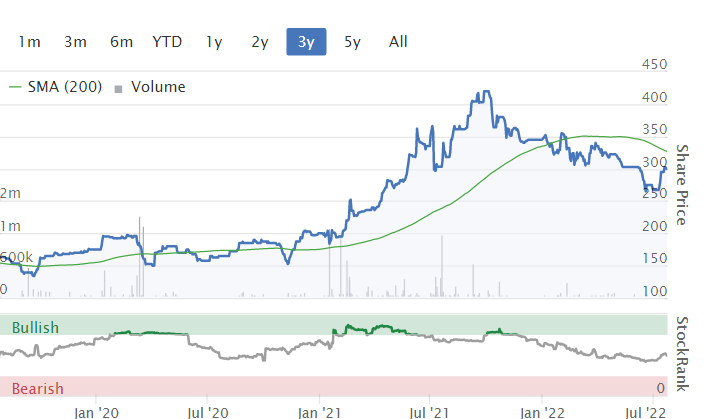
Animalcare (LON:ANCR) (£180m) - the H1 trading update for this animal products company is confident and in line with expectations. Revenues are flat/lower (depending on how you measure them) as the post-Covid spending boom could not be repeated. The company is focusing on higher-margin products but also increases R&D spending, and has some inflationary pressures. So there is no improvement in underlying profitability. I’m still waiting for a clean set of results from this company.
Franchise Brands (LON:FRAN) (£194m) - an excellent set of H1 results from this franchisor. It provides services to commercial kitchens and now includes the international operator Filta (FLTA). Revenues, profits, EPS and the dividend are all significantly higher, thanks to both organic and inorganic growth. I previously thought that this company’s shares traded too expensively, but I’m being won over. In addition to the attractive franchise model, with good cash generation, there is also a strong argument for synergies to be extracted from providing a wider range of related services.
Wickes (LON:WIX) (£355m) (-19%) [no section below] - this was supposed to list in 2019, but eventually floated during the Covid-induced DIY boom in 2021, as a spin-off from Travis Perkins (LON:TPK) . Today’s trading update starts promisingly and reports like-for-like sales growth of 5.4% in Q2 (so that H1 like-for-like sales are up 0.8% overall). But it then describes “signs of softening” in its markets, in more recent weeks.
Customers are “reacting to the uncertain macroeconomic backdrop” and “taking longer to commit to big ticket projects”. Full-year adjusted PBT is now expected in the range of £72-82m. At the bottom end of the range, that looks like a miss of up to c. 17% against consensus forecasts, helping to explain the sharp drop in the share price today.
The DIY retail sector is one of the most economically exposed. While business at Wickes has boomed recently, the high profit margins seen in FY 2022 may not be representative of a sustainable or average performance. Estimates can get cut very, very quickly and the volatility of trading may correctly justify the cheapness of these shares.
Explanatory notes -
A quick reminder that we don’t recommend any stocks. We aim to review trading updates & results of the day and offer our opinions on them as possible candidates for further research if they interest you. Our opinions will sometimes turn out to be right, and sometimes wrong, because it's anybody's guess what direction market sentiment will take & nobody can predict the future with certainty. We are analysing the company fundamentals, not trying to predict market sentiment.
We stick to companies that have issued news on the day, with market caps up to about £700m. We avoid the smallest, and most speculative companies, and also avoid a few specialist sectors (e.g. natural resources, pharma/biotech).
A key assumption is that readers DYOR (do your own research), and make your own investment decisions. Reader comments are welcomed - please be civil, rational, and include the company name/ticker, otherwise people won't necessarily know what company you are referring to.
Paul’s Section:
SThree (LON:STEM)
395p (up 2% at 10:21)
Market cap £529m
SThree plc ("SThree" or the "Group"), the only global pure-play specialist staffing business focused on roles in Science, Technology, Engineering and Mathematics ('STEM'), today issues its financial results for the six months to 31 May 2022.
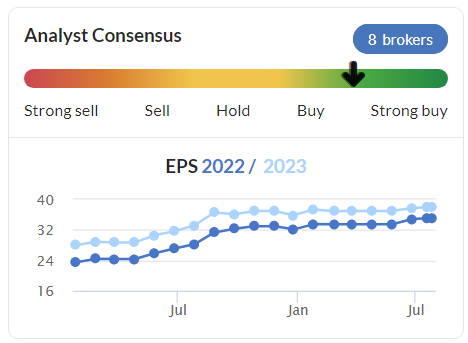
Sparkling H1 figures are published, unsurprisingly, given a series of strong trading updates this year. We flagged here on 20 June, that STEM shares looked excellent value, and an attractive entry point at 319p, after a series of positive trading updates, and steadily increasing broker forecasts -
.
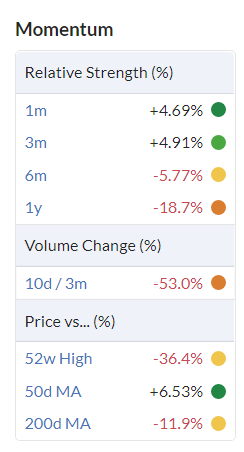
STEM shares have already bounced 23% from our last look in June, and the 1m and 3m relative strength indicators have turned positive, as well as the 50-day moving average, for chartists -
.
Is sentiment levelling out?

.
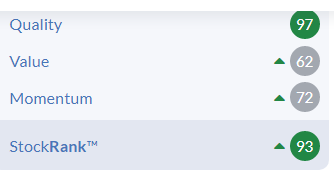
Also note the high StockRank -
.
Lots to like here - STEM is trading well, has positive momentum on earnings, a strong balance sheet, and a modest valuation. Hence why we like it here at the SCVR.
Some key numbers from H1 results -
Revenue £772m (up 26% on H1 LY) - includes pass-through revenues of contractors’ wages, as 77% is contractors (temps), with the balance being perms.
Net fees £203m (up 24%)
Strong across all regions - this is an international group remember, not just UK focused.
Profit before tax £44.3m (up 60% on H1 LY)
Strong rise in operating margin, from 17.1% H1 LY, to 22.0% this year - so presumably this means a tight labour market is enabling STEM to charge more.
Diluted EPS 23.4p (up 68%)
Interim divi of 5.0p (H1 LY: 3.0p) - policy is to maintain FY dividend cover of 2.5x to 3.0x - not very generous, considering the balance sheet strength - so there is capacity to pay more in divis, in my view - it’s always better that way around! Forecast divi yield is 3.3%
Fantastic numbers there, but are they sustainable, or is this an earnings peak? That’s key for valuing the shares.
Forecasts - Liberum helps us out with updated forecasts. Note that the company flags costs are expected to be higher in H2, so we cannot just double the H1 figures to estimate the FY 12/2022.
Latest forecast is -
£71.5m PBT, and 37.6p EPS for FY 12/2022 (a PER of 10.5),
rising to 41.2p for FY 12/2023, (a PER of 9.6)
The commentary from STEM suggests that it sees growth as structural, with ongoing strong demand for candidates with the necessary skills in its niche areas.
Also note that STEM is an international business, so you have a good geographic spread. I wonder about possible vulnerability in Germany, a big market for STEM, if its dependence on Russian gas hampers things this winter?
Outlook -
We are very pleased with the continued momentum in the business. Sales remain robust, with good new placement activity. Productivity levels remain high, even as we hire new heads into the Group, and we are executing very well against all elements of our strategy.
While mindful of the changing macro-economic situation, we are confident in the resilience of our business and the macro trends that underpin our continued growth. Our relentless focus on delivering the skills our customers require to succeed means we occupy an important role as trusted talented provider at the heart of their operations, a position we value and take great care to fulfil.
The addition of our strategic investments will provide us with an exciting opportunity ahead, though will impact on the conversion ratio in the very short term. We are well placed to build on our position as one of the leaders in the sector and continue to deliver very good growth for our stakeholders…
…This strong cash balance positions us well for the Group-wide strategic investments in our people, talent acquisition and digital infrastructure, which is weighted towards the second half of the year and will require significant expenditure over the coming years.
They’re calling it “strategic investments”, but being old-fashioned, I think I’d just call this: higher costs.
It’s in the forecasts already, so isn’t a new negative.
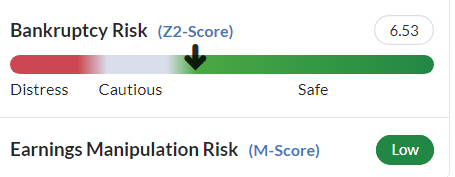
Balance sheet - NTAV of £176m is good, very robust. So dilution/insolvency risk looks negligible. This is confirmed by a “safe” Z-score, and earnings manipulation score is also low -
.
Working capital is healthy, with £391.2m of current assets (including cash of £48.4m), less current liabilities of £231.3m, a current ratio of 1.69 - good for the sector, where some competitors rely on debt, STEM doesn’t, so it’s safer.
There’s only £22.7m in non-current liabilities, being mainly lease liabilities.
Receivables (money owed to the company from its customers) stands out at a gigantic £342.5m. This is up 15% on a year earlier, which is not surprising considering revenues are up more, at 26%.
Reasonableness check on receivables - if we take H1 revenues of £772m, double it for a full year that’s £1,544m, add say 20% sales tax (because receivables are stated at full invoice value, including VAT or similar), that’s £1,853k annualised invoiced sales. Hence £342.5m unpaid at year end, is 18.5% of annual sales, times that by 365 days, and I arrive at debtor days of 67. There are probably some smaller items in receivables that are not trade receivables, so the reality is probably closer to 60-days payment terms. That’s fairly normal.
It does however mean that STEM is helping its clients cashflow, by absorbing costs (wages to contractors) before it gets paid by the customer - not ideal, but it can afford to do it with such a strong balance sheet.
I think a key priority would be to tighten up credit control, and persuade customers to pay more promptly. This looks a little slack.
Cashflow statement - reflects the big increase in receivables. Positive cash generation mostly ended up being absorbed into larger receivables on the balance sheet. That looks inevitable given strong revenue growth, combined with customers paying on c.60 days. Hence if revenue grows, then the business absorbs cash into receivables.
The reverse happens in recessions, working capital unwinds, and companies in this sector generate cash, as receivables reduce. We saw that happen in 2008-9, and during the pandemic. So it’s not a major concern. The cash hasn’t vanished, it’s just temporarily tied up in receivables.
Although I generally prefer businesses where the customer subsidises the company’s cashflow, rather than the other way around, in this case!
My opinion - I think STEM’s claims are convincing, that strong demand is structural for its niche of technical expert contractors. Hence it’s credible that demand could remain strong, even in tougher macro conditions.
For that reason, I remain of the view that this share seems good value.
Robert Walters (LON:RWA) is another good option in this sector, in my opinion.
A more bearish view would be to avoid staffing companies altogether, if you think a recession is coming.
See yesterday's SCVR, for an interesting reader discussion of this share.
.
Shoe Zone (LON:SHOE)
200p (up 8% in early trades, at 08:18)
Market cap £100m
Shares in this budget shoe retailer have been a rare standout performer in an otherwise very tricky sector.
We covered SHOE in my interview with Richard Crow (CockneyRebel) last Friday, here. We both rate this share highly, due to its strong performance in tough times.
A key point we both spotted a few months ago, was the broker forecasts seemed too low, relative to the trading updates being issued. That removed the risk of a profit warning, and made an earnings upside surprise likely. Which is what has happened today -
Shoe Zone is pleased to announce that since the publication of its trading update on 29 June 2022, trading has been stronger than expected due to higher than expected demand for summer products, particularly in the last two weeks. The Company has also continued to experience margin improvements as a result of good supply chain and cost management.
As a result, the Company now expects adjusted1 profit before tax for FY 2022 to be not less than £9.5m.
1 Adjusted to exclude the profit on the sale of freehold property and foreign exchange revaluations
Supply chain - this is very interesting. One of the reasons why both Richard Crow and I are bullish on some retailers now, is because they could now be seeing upside from supply chains easing, and freight costs from the Far East reducing. The stock market doesn’t seem to have factored this in, instead being obsessed with the consumer squeeze.
Many retailers took big hits last autumn, from excessive container shipping costs, often long delays to shipments, meaning the peak period inventories weren’t necessarily in the right place at the right time.
This year should see those problems easing comparatively, and retailers should have worked out how to get stock in earlier. Shortages often become gluts, so this is also quite encouraging with regard to the outlook for inflation, which I think should come down somewhat in 2023, as some of these negative inflationary factors start to feed through.
Hence it’s particularly interesting to hear SHOE confirm this idea, in saying that margins are now improving. SHOE makes particularly strong gross margins.
Demand - strong in the last 2 weeks particularly. Again, that doesn’t seem to be consistent with the daily deluge of doom from the BBC and others, about consumer retrenchment.
If products/services offer good value for money, they sell, even in recessions.
Latest guidance is now at least £9.5m for FY 9/2022. They’ll probably beat that number too!
Checking my previous notes here, it was only a month ago here that it last upped profit guidance, from £6.5m to £8.5m.
Back in May, I flagged up here that the forecasts looked clearly too low, and this share seemed excellent. Although my worries about low income consumers retrenching, has clearly not (so far anyway) happened.
Many thanks to Zeus for crunching the numbers through its spreadsheet, which comes out at 15.2p EPS for this year FY 9/2022, but a drop to 11.0p EPS next year.The valuation looks reasonable on this year’s forecast, but not so much on next year’s.
So shareholders need to hope that forecasts for FY 9/2023 end up being far too pessimistic. I can’t see any specific reason for Zeus’s caution on the FY 9/2023 numbers, but think it might be related to higher costs, and normalising of business rates, possibly?
My opinion - another terrific update from SHOE.
Given how cautious current year forecasts have turned out to be, shareholders need to be confident that the low forecasts for FY 9/2023 also end up being way too cautious.
So far, so good though. Well done to shareholders here, you’ve certainly picked a rare winner, in a bombed out sector. I would expect to see some people banking profits though, since it’s had a great run this year, and there’s still a lot of macro uncertainty.
As supply chains ease, and margins recover, we could see more retailers reporting better than expected progress from here. Although that depends which areas consumers decide to cut back on, when they feel the pinch in the autumn from another wave of food & energy price inflation that seems likely.
.
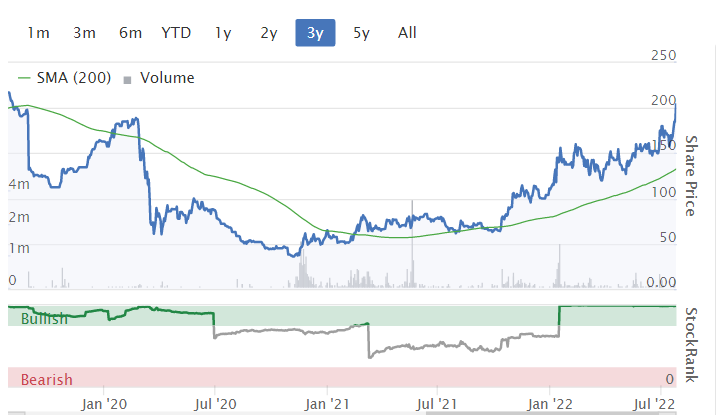
.
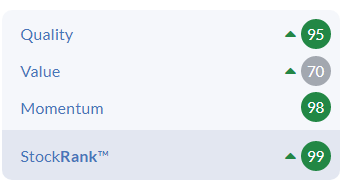
Stockopedia loves it, with the StockRank jammed on maximum -
.
Reach (LON:RCH)
85p (down 27% at 09:32)
Market cap £269m
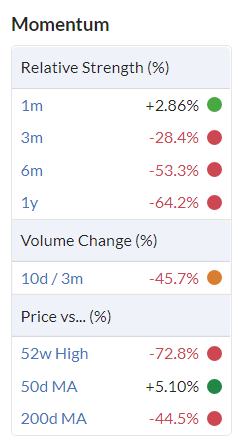
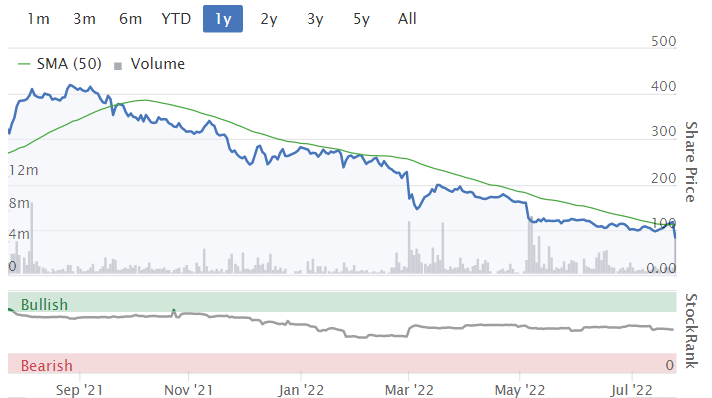
The selling seems to be accelerating this morning, so I’ve moved this up my list of priorities. Reach had attempted to bounce a little in recent weeks, but has today given up all of that, and reached a new low for the year. Momentum has been terrible, and remember that the data is updated overnight, so these numbers will probably look even worse tomorrow -
.
Is it a buying opportunity I wonder? Also, remember that RCH seemed to get into a speculative bubble last year, with a lot of talk about it being an emerging digital advertising giant. There wasn’t enough hard evidence, from facts & figures, to verify that claim, so personally I treated it with a pinch of salt. Although am keeping an open mind, it might still happen, but we need proof, not aspirations & general chat on the subject.
So it could be the case that the negative share price momentum is just re-setting valuation back down to where it should have been all along - a highly cash generative, but cigar-butt type share, in a structurally slowly dying sector. Facing a cyclical downturn in advertising as the economy slows. With a massive pension scheme.
It’s amazing how the market can swing so quickly from glass half full, to glass half empty, isn’t it?. I wish I’d seen that coming, but was far too complacent last year, drunk with success, which the market has now quickly erased! We’ll get it back though, over time.
On to today’s figures -
H1 revenue of £297.4m is down 1.6% on H1 LY - remember that in a high inflationary environment, that’s a real terms fall of c.10%
The headline figures don’t look good - a big drop in H1 operating profit margin, from 22.8% to 15.9%, although last year was outstandingly good.
The main culprit seems to be higher newsprint costs, which rose from £25.2m to £38.8m in H1 (the commentary says mitigating actions will help newsprint costs in H2).
Other costs look well-controlled, which they have to be, in a declining sector.
Adjusted PBT is £45.9m (down 32% vs H1 LY) - a big drop in profit, but still a substantially profitable business, that’s just for a half year remember, so full year c.£90m, for a £269m market cap company remains impressive. Broker forecasts are actually a good bit higher than £90m profit, see further below.
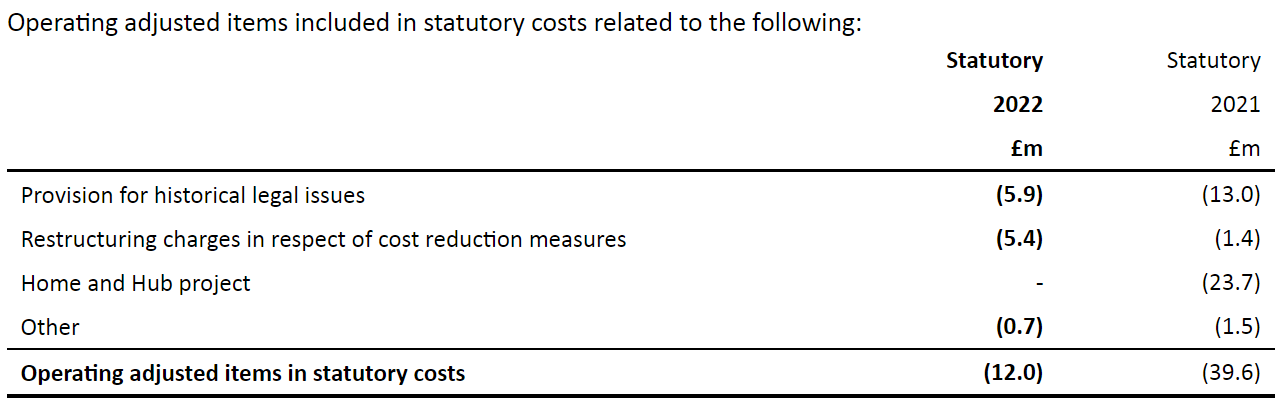
Adjustments boost PBT by £13.9m, so statutory PBT is £32.0m. My concern is that the adjustments seem to be recurring, although £13.9m adjustments is a lot lower than £42.1m in H1 last year (LY), but similar in nature - including phone hacking that’s still rumbling on (there’s a £40.8m provision, which should be remembered is future cash leaving the business, to pay people off, and pay lawyers) - and restructuring costs, which I would argue are an ongoing thing, not one-offs, as the business has to downsize as circulation & ad revenues gradually fall -
.
.
Going concern statement - these are so useful, and I try to remember to always read them, not gloss over.
The downturn in digital demand in Q2 is mentioned.
Net cash of £43.8m, and no drawdown on the £120m bank facility (RCF), trumps other considerations, hence the Directors are on solid ground, adopting the going concern accounting basis.
Digital revenue is quite significant, but only grew slowly (+5.4%) to £72.5m, or £74.0m if we include recruitment website, which is 25% of total revenue.
A “marked slowdown during Q2” occurred with digital advertising. Hardly a surprise really, that companies are trimming their ad spending, that’s what happens when economic conditions tighten.
Pension scheme - as I’m always droning on about, accounting deficits are often meaningless, and usually horribly under-state the real world cash outflows required. So I’m ignoring the £69.1m accounting deficit, down £48.1m in the last 6 months. That may look nice, but it doesn’t matter, because cash outflows are not calculated using this number. As the last Annual Report told us (in note 20) -
Pension scheme accounting deficits are snapshots at moments in time and are not
used by either the Group or Trustees to frame funding policy. The Group and Trustees
seek to be aligned in focusing on the long-term sustainability of the funding policy
which aims to balance the interests of the Group’s shareholders and members of the
schemes. The Group and Trustees also seek to be aligned in reducing pensions risk
over the long term and at a pace which is affordable to the Group.
Actuarial deficit - this is what matters for funding. The Dec 2019 valuations have still not been agreed for 3 out of the 6 pension schemes. I don’t like this comment today over delays being due to -
…differences between the Group and the Trustees as to possible de-risking and the required pace of funding.
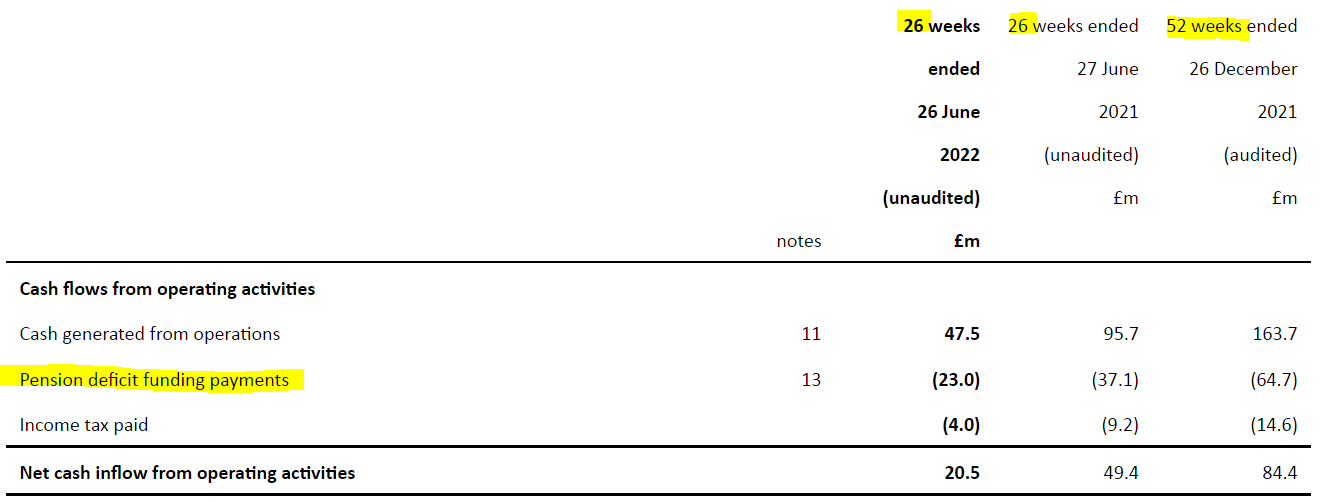
The cash contributions (which remember, are not accounted for in the profit figure, so this comes off profits) are still massive -
Group contributions in respect of the defined benefit pension schemes in the first half were £23.0m (2021: £37.1m), under the current schedule of contributions of the five schemes. Contributions in 2022 are expected to be £55.1m under the current schedule of contributions for the remaining five schemes.
The pension deficit is still a massive cash drain, and this is a big issue re valuation of the shares.
I think a lot of investors don’t understand this issue, and wrongly think that the accounting deficit of just £69m means that the problem is resolved. Yet the cash contribution this year alone, is £55m, not fast short of the entire deficit on the balance sheet! The real world deficit is probably hundreds of millions, which is missing from the balance sheet, due to pension accounting rules being unfit for purpose.
See the top of the cashflow statement, to see how much of the cash generation has to be put into the pension scheme -
.
The biggest items further down the cashflow statement, are -
£13.9m divis paid in H1
£17.1m deferred consideration paid
£4.0m internal development spending was capitalised
Overall, the cash balance fell from £65.7m to £43.8m in H1.
That’s fine, it’s not a problem, I’m just highlighting the key facts.
Balance sheet - NAV is £682m, which needs to be heavily adjusted to make sense.
First I would deduct the humongous intangible assets of £863.5m.
Pensions - there’s an asset of £94.4m, and a liability of £185.8m, which net off to a liability of £91.4m. I think the real world position is probably nearer £500m liability, so I’m going to add £409m in additional liabilities onto the balance sheet.
We can probably lose the £201.2m deferred tax liability too, as that normally relates to intangibles & pensions.
That results in my heavily adjusted NTAV being negative, at £(389)m. What does that mean in reality? The short term liquidity & working capital positions are fine, no issues there. However, in future years, it could well be that declining cashflows are increasingly absorbed into paying off long-term liabilities, especially the pension scheme, but also balance sheet provisions for things like phone hacking, property closures, etc.
This share is incredibly highly geared to pension scheme cash contributions. The delay to the 2019 triennial calculations, due to a dispute between the company and the trustees, worries me, and doesn't seem to augur well.
Hence dismiss the pension scheme at your investing peril. This is actually the biggest issue facing the company, in my view. £55m in agreed cash outflow for 2022, and they can’t agree subsequent years. I’d be very worried about that, if I held this share. It might turn out fine though, I don’t know the outcome, am just flagging the risk.
Singers comments today that the accounting deficit could close in just 2 years. If that is reflected in the actual cash contributions too, then that would be fantastic, but it doesn’t seem to work like that in reality.
I’m looking through note 20 in the 2021 Annual Report, and it says that the arrangement currently involves annual cash payments of £52m from 2022 to 2027. I make that £312m! So unless a much more favourable agreement is made with the 2021 triennial valuation (currently in dispute for 3 out of 6 schemes), then contributions look very high still.
Higher bond discount rates might reduce the actuarial deficit, possibly?
This is also said in the 2021 Annual Report -
At the reporting date, the funding deficits in all schemes are expected to be removed before or around 2027 by a combination of the contributions and asset returns. Contributions (which include funding for pension administrative expenses) are payable monthly. Contributions per the current schedule of contributions are for £55.1m pa in 2022 and 2023, £54.9m pa in 2024 to 2026 and £52.9m in 2027.
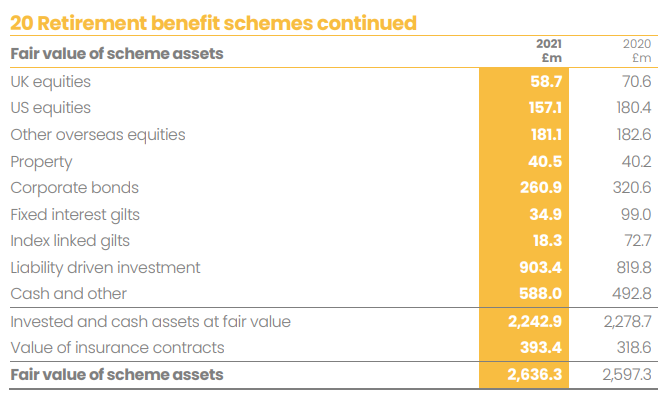
This is where the pension assets were held at end Dec 2021 (from note 20 in AR) -
.
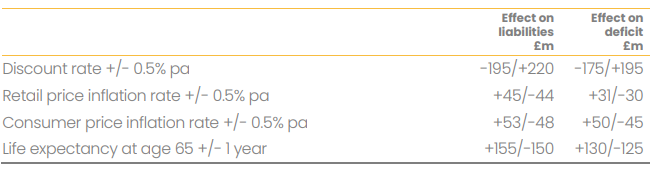
The sensitivities of the pension deficit are so massive, that anything could happen, look at this -
.
If you think the pension liabilities could disappear, then that could present a buying opportunity for this share.
Even if the pension scheme deficit were to disappear, it could come back again, if the assets are not somehow locked in with the liabilities, e.g. through an insurance contract, or disposal of the scheme.
It’s way too complicated for my pay grade, and arguably this share is probably only investable for actuaries! The rest of us probably cannot reliably determine what is likely to happen next, which is highly material to how much the shares are actually worth.
Many asset classes have plunged in value, especially shares and bonds this year. Also RCH pension schemes holding £588m in cash doesn’t look too good, when inflation is eroding the purchasing power by 9% p.a..
Outlook - drawing out come key points -
We therefore expect total H2 digital growth to remain subdued.
Circulation will benefit from a full half of increased cover prices during H2, strengthening print revenues.
We expect a year over year improvement in total operating costs during H2, with the benefit of further strategically driven changes to our operating model and additional cost management actions mitigating the impact of inflation and preserving our ongoing investment plans.
We do not anticipate an improvement in the existing rate of newsprint during the second half.
In the context of an uncertain macro and political climate, we remain mindful of the risk of further deterioration in economic conditions.
We currently expect management actions and the natural phasing of our business, to support a stronger than historical H2 profit contribution.
Well that’s just confusing overall! I’ve read it three times, and in the circumstances, I think it sounds quite reassuring actually, so I’m confused as to why this has triggered a 29% share price fall, to 83p at the time of writing (12:19)?
Broker comments - let’s turn to the experts - Singers has put out a brief update on Research Tree, many thanks for that.
It’s trimmed operating profit forecasts by 11% for both 2022 and 2023, so fair enough then, this update is negative overall. That wasn’t really clear to me from the results RNS itself.
But the profit forecasts are still huge: £113.3m PBT (adj) for FY 12/2022, and a rise to £119.8m in 2023.
That’s EPS of 28.6p, and 28.0p.
So at 83p per share, I make the PERs 2.9, and 3.0! - a level that is so low, it’s flagging that there’s a problem. Net debt is not an issue any more, as it holds net cash, but clearly the pension scheme is a big risk.
Summarising -
Bear points seem to be -
- Pension scheme sucking out £55m p.a. in cash, which is about half forecast profits. So the PER is really more like 6, once this is adjusted for.
- Long-term decline of the sector, as we’ve known for 20+ years - it’s amazing that newspapers still exist really, and even more amazing that they’re so hugely profitable.
- By the time the pension scheme is fully funded (c.2027 according to 2021 AR, but that might have changed since), there could be little to nothing left, in terms of profitability or cashflows.
- Short-term decline in advertising revenue is apparent in today’s update, due to macro factors - could get worse - profit warning likely?
- How will circulation hold up in a tighter consumer spending economy?
- Is there a limit to cover price increases? I baulked at paying £4.50 for the Financial Times this weekend (buying 4 tins of Carling instead). The Mirror is up to £1 a copy now, which could be a psychological barrier to go above, in terms of demand holding up?
Bull points -
- Incredibly cheap PER, so if the pension scheme does get resolved in a positive way, then this share could soar from current levels, as much more generous divis could be paid in future.
- Digital is a decent chunk of the business, so if growth were to resume there, once we’re through this soft patch in the economy, the bull story could come alive again.
- RCH remains a highly profitable & cash generative business, with a dirt-cheap market cap.
Overall - for me, it all hinges on the pension schemes. The cash requirements for those are so material, that almost nothing else matters in terms of valuation.
Reach has proven resilient, and well able to manage costs, and increase cover prices, over multiple years.
It’s 83p currently, and I must admit to being tempted to have a nibble. Or it might be easier to just watch from the sidelines, and see where it settles?
.
.
Graham’s Section:
Animalcare (LON:ANCR)
- Share price: 300p (pre-market)
- Market cap: £180m
This company provides products for a wide range of animals - all the way from “Companion Animals” to “Production Animals” and Horses.
Spending on pets is a growth trend, so naturally the company’s current priority is to focus on the opportunity in this segment.
Today’s H1 trading update is in line with expectations. Some key points:
- Sales £38.3m, which is flat at constant exchange rates (down slightly at actual exchange rates). This is attributed to Covid volatility - very tough comparatives for last year, when markets reopened.
- Gross margins improving thanks to product mix, offset by higher R&D spending and staffing costs.
Net debt finished the period at £7.5m. Animalcare sees this as providing opportunities for further M&A and other investments.
It’s a confident RNS:
Despite the deterioration in macroeconomic conditions over the period we have yet to see a widespread negative effect on the veterinary pharmaceutical market and our business. However, we continue to carefully monitor the impact of inflation on costs and customer demand levels.
People cut back on lots of things in recessions, but spending on the health of their animals is presumably one of the last things that gets cut back?
My view - I used to think that this was a high-quality company, but its financial performance has been poor for several years now. I’m wondering if we could soon reach an inflection point, where real, healthy profits are generated at last?
Judging by its valuation, the market seems happy to judge it on the basis of the underlying figures it presents. On that basis, maybe we will get a clean set of results one of these days. I’ll reserve judgement for now.
.
Franchise Brands (LON:FRAN)
- Share price: 150p
- Market cap: £194m
These interim results have a joyous headline:
Trading in the first half of 2022 has been buoyant, at the top end of expectations, supporting a 50% increase in the interim dividend
During the period, Franchise Brands completed the acquisition of the international franchisor Filta (FLTA). This deal was described by Roland here.
I’m encouraged to read that instead of looking for any more deals, their main focus is on exploiting the deal they’ve just completed:
"In the near term, we are focussed on integration to capitalise on the opportunities the acquisition presents.”
Let’s take a look at some of the key figures from this report:
- Total revenue +60% to £44.5m, a mixture of organic and inorganic growth.
- Record organic growth, driven by commercial drainage company Metro Rod (revenues +17% in this division to £19.5m).
- There was also good organic revenue growth at Willow Pumps (+12% to £8.8m).
Note that under the franchise model of doing business, revenue numbers don’t necessarily reflect sales to end-customers. Instead, they often represent sales from Head Office to franchisees. That is the case with Filta and with Metro Rod, for example.
Overall profitability has leapt higher:
- Adjusted EBITDA +74% to £7.3m
- Statutory PBT +83% to £4.8m
- EPS +89% to 3.08p with the help of some non-recurring gains. Adjusted EPS is +51% to 4.07p.
The Executive Chairman confirms that the full-year performance is expected to come in at the top end of market expectations, and the consensus expectations are helpfully provided: revenues £91.2m, adjusted EBITDA £14m.
Net cash - the company reports net cash of £4.7m. It gets there by subtracting obligations under leases (£2.8m) from cash (£7.5m).
I think that few investors would begrudge FRAN if it ignored obligations under leases when calculating net cash (leases are a “non-financial” form of debt, and they bring operational benefits).
Personally, I would be happy to sign off on FRAN having net cash of £7.5m.
My view
There is a lot to digest in these interims, due to the acquisition, the many different moving parts, and the unconventional nature of the franchisor/franchisee reporting.
As I’ve read through it, however, I’ve warmed to this share. Whenever I’ve studied it before, it has always looked quite expensive to me. But I can’t deny that its cash flow generation is good. For example, it generated £5m of cash from operations in H1 - or £7.3m, before working capital movements. While I tend to distrust adjusted EBITDA, I don’t mind using cash flow numbers! And these are good numbers.
I also understand the attractions of running a franchise model. It’s possible to generate very high returns on capital by doing business this way.
Finally, the combination of Filta with the many different services already included within Franchise Brands is interesting to me. In addition to making cost savings, they also aspire to offer a comprehensive set of services for commercial kitchens. I’m curious to see how the synergies will work, in reality.
Peter Lynch used to look for companies like this (as summarised by someone else):
The name is boring, the product or service is in a boring area, the company does something disagreeable or depressing, or there are rumors of something bad about the company--Lynch likes these kinds of firms because their ugly duckling nature tends to be reflected in the share price, so good bargains often turn up. Examples he mentions include: Service Corporation International (a funeral home operator--depressing); and Waste Management (a toxic waste clean-up firm--disagreeable).
What could be more boring or disagreeable than fixing blocked drains or cleaning deep fat fryers?
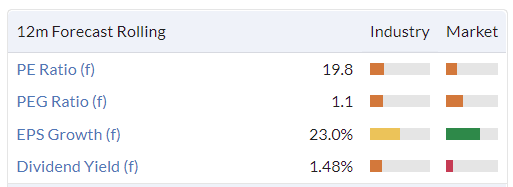
I don’t know if this one is overvalued any more. Given its positive characteristics and trading momentum, it might be at fair value or even cheap:
Disclaimer
This is not financial advice. Our content is intended to be used and must be used for information and education purposes only. Please read our disclaimer and terms and conditions to understand our obligations.

51 comments
I'm sorry GAW is outside the scope of the SCVR, but I have covered it elsewhere -see my Twitter.
Reach (LON:RCH)
A large £2.6 billion pension fund with a side line in newspapers. The shares are a highly geared punt on UK and US markets. If the fund rises 10%, the shares are stupid cheap. If the fund falls 10%, the shares are worthless.
There will be a lot of hedging going on in the pension fund, and a lot will be held in low risk instruments, such as bonds. Unlikely to rise or fall 10%. But agree on the wider point that there is an obvious risk in having a 2.6bn pension deficit offset by a 2.5bn asset portfolio - a small movement in either of these two can have massive impact on the deficit/surplus so personally prefer just to avoid such companies.
This is totally misleading in many aspects.
Just to be brief , the pension fund holds shares of not even 10% of its whole size and its performance is minimal to the overall stock market performance.
Thanks
Correct yiannos1 - most people don't really have a clue about how pension schemes work in reality and also get the differences between accounting and actuarial valuations too skewed (Pauls comments above a case in point - sorry Paul, I love your work but not those comments :) ).
However, those perceptions even if not bathed in reality, get focused on and do obfuscate the real business performance so it is useful to pay attention to the sentiment.
I don't currently hold Reach (LON:RCH) but will buy back at some at some point (doesn't appear to be a massive hurry after todays news). A few things going on that I think are key share price drivers
1) cash outflow for the half year (due to divi, pension deficit and deferred consideration)
2) decline in profit due to print cost inflation. I find this odd though as it was well flagged and had driven price much lower. Numbers came in almost exactly as I expected and H2 forecasts were better, though we still have to see those come through.
3) the lack of progress on agreeing pension contributions - markets hate uncertainty.
Interestingly (tho I can't remember name of the study off hand) it has been found that investors extrapolate into the future based on what is happening today and actually don't focus properly on the future prospects of a business. This happens in good times and bad. So investors will look at Reach (LON:RCH) today and extrapolate £45m in H1 as £90m for the full year and then £90m going forward. Of course this misses many factors and assuming print inflation comes under control then future years profits could be considerably higher. Indeed the company itself has pointed to H2 being much higher than H1 though this also got lost in translation.
Anyway at a general investing level it is interesting to consider that investor psychology trait and perhaps if one invests on the basis of reversal it would have got people out of growth stocks somewhere toward the top and probably back in somewhere around now. Food for thought for me at least, as I am probably also guilty of extrapolation in my analysis. Not always but certainly sometimes, and I probably need to try and eliminate that from my investing.
Paul, dotDigital (LON:DOTD) just struck a chord and checking up I note that I sold my holding on this day in 2021 at 249.8 pence. Perhaps I should have bought back in yesterday! It seems to me that for the patient PI even today would not be a bad entry.
Both SThree (LON:STEM) and Robert Walters (LON:RWA) down sharply - can't see any reason though and wider market looks well behaved. Possibly a bad update from another recruiter or negative broker piece?
"I baulked at paying £4.50 for the Financial Times this weekend (buying 4 tins of Carling instead)." Classic. I doubt that the FT have had customer feedback like this before.
The above comment comes from the section on Reach (LON:RCH) (well done for making it interesting to read someone "droning on" about pension deficits). I am not an actuary or an expert here in any way, but my guess is that the situation is not as bad as you suggest because:
(1) The accounting deficit is still meaningful. I defer to anyone who knows IAS19 etc, but I believe it is like an actuarial measure but with slightly different assumptions e.g. company's own assumptions on longevity rather than the actuary's. Do Reach state the actuarial deficit? For many companies, the actuarial deficit is smaller than the accounting deficit, not larger. Either way, the fact that the accounting deficit came down substantially over the last 6 months is meaningful information (despite high inflation increasing the level of liabilities, the higher discount rate more than compensated).
(2) The agreement reached (geddit?) on group contributions is likely to represent a worst case scenario. I know that if I was a trustee looking at Reach 5 years ago, I would have been pretty sceptical about the company's prospects and so would have demanded an aggressive schedule of contributions to protect the pension scheme before the company went belly up. My guess is that is what the current disagreement between the company and trustees is about. The company can see that the current contributions are excessive and the trustees would prefer to stick to the agreement they hammered out before. It seems quite possible that these contributions will result in a surplus, which will ultimately be to the benefit of the company.
You're absolutely right to highlight the risks, but I suspect your focus on the level of current contributions might be casting too negative a light on the situation.
Reach (LON:RCH) I sat through the analyst call this morning and the pension deficit was raised early in the Q&A. The actuarial shortfall was not revealed but the company response, to the best of my recollection, was as follows (paraphrased):
- we continue to expect the scheme to become fully funded by or before 2027 based on the currently agreed contribution schedule.
- one might infer from macro trends that it could become fully funded earlier - if so, that's obviously good, but we're not making any such assumptions in our planning.
- discussions with the trustees continue, as they always do, but it's not a major focus of attention for us at the moment.
I didn't listen to the entire Q&A , so there may have been more later on!
hi Paul
Reach (LON:RCH)
Thanks for your update. Could I just query something please? You said........
'The cash contributions (which remember, are not accounted for in the profit figure, so this comes off profits) are still massive'
It is my understanding that the annual pension deficit payments do not come off profits (via the P&L account). The accounting entries are a reduction in cash on the balance sheet (and shown in the Cash Flow Statement) with the balancing entry being a reduction in the pension deficit on the balance sheet.
Hence the impact of pension deficit payments for shareholders is a loss of cash which would otherwise have been available to the business (e.g for dividends, re-investment etc). There is no impact on profits.
Have I got this right?
Snazzy
Hi Snazzytime,
Hence the impact of pension deficit payments for shareholders is a loss of cash which would otherwise have been available to the business (e.g for dividends, re-investment etc). There is no impact on profits.
Have I got this right?
Yes, that's correct.
Regards, Paul.
Loved Paul opting for four tins of carling over the Financial Times. Absolute class..
RE Property market:
I think many property-related shares look good value right now. Property prices go up in times of high inflation, not down. It's only when interest rates go sky high that property prices are impacted badly. No sign of that being likely, real interest rates remain massively negative, so fixed rate borrowings against property, at a historically advantageous negative real interest rate, makes a lot of sense to me. So I suspect the property market might remain buoyant. Just an opinion, could be wrong, as always!
Paul, I agree in principle with what you say, although I offer up this alternate view for balance.
We have to consider the multiple of earnings that properties now command. In the early 90's when interest rate were at circa 15%, a modest starter home could be had for 2.5~3.5 x annual salary. We all know what has happened since then...
The current squeeze on disposable income affecting us all but particularly, the less affluent bulk of society is real and shocking. When the choice is between heat or eat in the autumn and winter months this year, the mortgage will come a poor 3rd. Will people be driven to handing back the keys if rates continue to rise? I don't know but the sums now involved are so much bigger and therefore the potential movement in interest rates required is much lower.
How tolerant will the banks be, before they start packaging up 'bad loans' and selling them off on the cheap?
The wheel always turns full circle - it's just difficult to know sometimes where you are relative to the ground and which way you are rotating!!
In the early 90's when interest rate were at circa 15%, a modest starter home could be had for 2.5~3.5 x annual salary.
I do not have the research evidence to support my view but I suspect that a major driver in what has changed is that many more mortgages are obtained based on two incomes. If household formation is often driven by forming partnerships and increasingly those formations happen maybe 10 years later than in the ‘80s, then not only are calculations based on joint incomes but those incomes have had time to get larger. The scaling up of womens salaries to more equal levels with men, only makes the calculations larger. Once you have more financial “firepower” the house prices have risen to meet them and the boomer parents have had more time to generate a significant “Bank of Mum and Dad”.
None of this may be fair, particularly for those on low incomes, but it is does help explain the “multiple of salary” disconnect
In the early 90's when interest rate were at circa 15%, a modest starter home could be had for 2.5~3.5 x annual salary.
I bought my first house in 1980. It cost about 4x my salary. To buy the same house now would cost about 30x the equivalent salary at 2022 prices. It was in an area that has probably seen higher house price inflation than many areas, but that sort of increase is way beyond effects of joint incomes. The interest rate I paid was a lot higher than people are now used to. It even briefly hit 15%. That has a lot to do with the multiple. If you are paying 1-2% mortgage rates as many were recently , it has a very big impact on the salary multiple you can afford - until interest rates rise. We could see some big shifts in house prices over the next couple of years if interest rates rise much further.
PeterG,
Fair points, well made.
Although someone tweeted a graph from the Sunday Times (which I didn't see as they had sold out at my nearby Co-Op by 2pm), which showed an astonishing growth over the last 25 years in houses owned outright - which is now c.8m homes, versus 7m homes owned with a mortgage.
Those figures absolutely astonished me.
Also remember that people buying a (say) £1m home, will probably only need a mortgage for less than half the total price, because they will have accumulated so much equity from previous houses.
Plus nominal incomes are now growing 7-10% for many professional people.
Meanwhile fixed rate mortgages can still be had for 3%.
Hence I would say the housing market looks likely to stay remarkably buoyant.
If central banks put up interest rates to say 7%+, then it's going to be carnage. But how likely is that? I reckon low interest rates & QE are here to stay. Things are very different to how they were previously.
Regards, Paul.
"SThree (LON:STEM) (£529m) - sparkling interim results"
Yes great results but the shares are down 6% today, what sort of market are we in? I hold, could be a buying opportunity but who knows in this market.
I like STEM and have held before. I wonder if the recession fears in Germany are playing on peoples minds with SThree (LON:STEM)
I think the staffing companies seem out of favour and any perceived head winds seem to put pay to rising S.P.
I was disappointed with the market reaction to Robert Walters (LON:RWA) decent trading results recently, and decided to exit out of staffing companies for now.
Investors taking a view on the cycle perhaps? Their IR website has a link to research:
Analyst coverage | SThree
A quick plea for any advice from any fellow past holders of River and Mercantile shares as they went through the buy out by Assetco (LON:ASTO).
As anyone who followed this may know, part of the deal was a cash payout done via a capital repayment for a repurchase of "B Shares" that were issued as part of the scheme. This was worth about 75% of the value of the entire company - it was around 220p per share I think from memory.
I held via a broker in my trading account (with SWISSQUOTE) and on the day the B Share Scheme became effective my remaining shares value dropped by 75% overnight to account for the coming cash payment. All well and good at this point and exactly as expected.
A month later however, the cash payment has still not appeared in my account and, worse still, the broker is now saying that their custodian is claiming nothing is owing to me and they are not paying any cash payment for the B Shares. So now I am left with a huge loss on my investment. Broker is pointing fingers at the custodian and saying they can only pay what the custodian says and they are just a pass though. The custodian itself I have no direct contact with (broker won't even name who they are using). Broker has just sent me the name of the regulator to lodge a complaint if I am not happy and they are now refusing to communicate any further.
Anyone else held during this period and actually received the B Share scheme payment? (Timarr I seem to remember you posted about this stock - did you eventually hold it through the sale process?). I want to check I am not wrong in the timing of payment for this before I do anything more.
I've never had an issue like this before in all of my investing career of 20 years. It's quite a terrifying experience having such a large amount disappear and then simply being told there is nothing you can do and the money is gone.
I suspect I might be better protected in the UK, however as an expat my account is held in Switzerland and with all the international intricacies I suspect making claims is not going to be easy.
BIACS
Hi BIACS
I'm sorry to hear about this. I held my RIV shares through AJ Bell and the entire process went through as per timetable.
I can't offer any advice I'm afraid, but it might be worth checking with Jefferies who were the deal broker. I have a vague recollection that sometimes takeover funds due to overseas shareholders get held by the broker (sorry, I can't remember why).
Hope you sort this out.
timarr
Thanks Timarr - I hope so too! The reply is really appreciated and its helpful to know that others have been paid as expected so that I know there is a specific problem here with my account and not a general issue with the scheme. Jefferies has confirmed to me by phone that the scheme is complete and all payments have gone out, but the custodian and broker still deny receiving anything. What a mess.
Hi Biacs
I have received my payout through IWeb a while back.
TommyGood luck chasing
Decent in-line update from Medica (LON:MGP) which is my fav defensive growth holding at the moment. +27% LFL growth in half year to June 2022, albeit against covid affected period where hospitals cut back non-urgent care. But even non-COVID impacted services like NightHawk, was up +14% YoY revenues.
They are seeing increasing costs due to inflation (mainly salaries), but gives reassuring statements that they are controlling them well.
Second half outlook is bullish, confident of more growth to come in all divisions, it looks like. Macro-wise, there is a huge backlog in medical systems in the UK and Ireland, due to people putting off routine diagnostic tests. This will all support growth over the next year or two. The NHS has also been given a big lump sum earlier this year to get more scans and tests done (of which a good proportion will be sent for outsourced radiology to the likes of Medica).
Regardless of what happens to the economy this year, activities and revenues will be secure. In addition, there should be decent growth. So Medica is giving that rare combo at the moment of defensiveness, but also growth.
Its not cheap, at a 15x PE for FY Dec22, of which half of it is in the bag already. But there are few other places for Defensive + Growth at the moment. Not a multi-bagger in its current state, but I can see a pathway to continued EPS upgrades as the months go by (there is already momentum in broker forecasts), leading to a potential 20-30% share price re-rating over 12 months, with very little downside risk.
(I hold in the Boon Fund)
Franchise Brands (LON:FRAN)
Graham Neary - thanks for the write-up.
Ive been invested for 3-4 years.
Biz seems quite inflation proof as their services are required in all economic environments. Also a great para in today's results confirming this.
Exec chair Helmsley and Nigel Wray, ex Domino's Pizza owners, own about 20% of the shares each. FRAN is their baby and they look after it. They like to get a dividend which is small but just increased by 50%.There is also massive employee share ownership. Helps prevent fall in SP. In fact SP rarely falls.
Happy holder.
Appreciate the comment, Michael. Thanks.
Any chance you guys could look at Reach (LON:RCH) - Getting clobbered. Think Paul has been long in the past? ( no position )
Morning lestat101,
Yes I'm looking at Reach (LON:RCH) as we speak - section should be up by c.11am.
Regards, Paul.
For thise with the appetite for tiddlers there's a TA this morning from Touchstar (LON:TST). We're talking EV of £5m.
If I was to pick a single quote it would be: "Substantially higher profitability achieved". Net cash at last results, should have grown a bit since.
It's very much a turnaround situation (really since 2016, so a long one!), however it seems to be bearing fruit, the market likes todays TA.
Paul - you have I think been a very (small) holder, is your confidence (like mine) slowly growing?
Morning Mark Tughan,
Well remembered! Yes I still have a small position in Touchstar (LON:TST) which I've had for years.
Today's update sounded quite good. As you say, a real tiddler, but seems to be going in the right direction. I'll ignore it for another year probably! If it can properly accelerate growth, then it could get more exciting.
There's a note out from WH Ireland today, no change to forecasts, which are:
WHI est. FY 2023E revenue £7.4m, PBT £0.7m, EPS 6.7p, net cash £2.6m,
FY 2024E revenue £8.0m, PBT £1.0m, EPS 8.4p, net cash £3.1m.
Market cap of c.£7m looks reasonable. I bought in July 2018 at 80p, and have been patiently waiting to get back to breakeven ever since - almost there LOL!
Regards, Paul.
I reckon Touchstar (LON:TST) has missed the summer, and winter is coming to the transportation logistics sector. Its been a boom time for the last two years, so trading conditions would have been easy to sell more tracking units to fleets.
I don't know in the UK, but at least in the USA, there was a business sentiment survey done recently and transport logistics came out very negative sentiment, from managers in that sector. Also seen a few articles where trucking rates are coming down, so alot of truckers who bought expensive trucks last year, now idling, fuel costs up, job rates down, and struggling. In this scenario, it would be a hard sell, whether capex or SaaS subscription.
They do give a strong order book, but they don't provide order intake numbers for recent months, nor an outlook that current demand is still strong / with momentum. Reading the statements, you can see that if market has gotten softer recently, the way they've crafted the statement, might allow for that possibility.
In fact, their outlook statement is a rather veiled along the lines of "management is now focused on delivering the FY results to market expectations", or something to that effect.
Thanks for the comprehensive write up on SThree (LON:STEM) Paul. Here is their interim results presentation from yesterday. Video & podcast. Agree with you, superb results and perhaps it's sold off due to recessionary fears. They are very bullish due to the demand for STEM talent. You point out Germany is an important region, DACH is 35% of sales, EMEA excl DACH 37% both growing fast +24% and +28% yoy. They cite decarbonisation and resolving the energy issues as one of the growth drivers. USA is 25% of their market with 21% growth.
They are laser focussed on finding the best returns for the business.
They have a new CEO and CFO. The CEO was responsible for the huge success in the DACH region.
Separately, from last week Tpximpact Holdings (LON:TPX) full-year 2022 results presentation. Video & podcast.
Going forward the market is very strong, with market research suggesting 9.9% increase on digital spend by Health and Central Government. TPX are looking to scale to £200m run rate rev by March 2025 having reached their £100m target a year early. For FY23 they are in line with forecasts, which are Rev £97.4m and EBITDA £13.8m but it will be heavily H2 weighted.
Thanks for the additional info Tamzin! I think the content from you & Tim at PIWorld is fantastic, so keep it coming! I spend a lot of time watching webinars & results presentations, and wish all companies would do them. They help immensely, enabling me to make my own (often subjective!) assessment of management. I'm asking myself, during webinars, are they on top of the facts & figures, or are they just robotically reading a script? Are they energised, entrepreneurial leaders, or just gravel-voiced financial engineers? All great fun, as well as helping me choose companies that float my boat. I always learn so much about the businesses too, and feel I understand them better after a presentation, and Q&A. Several of my City friends have commented that the questions from private investors are often just as (even more) insightful than from the city analysts, which I think helps to undo some of the damage done by bulletin boards, which management do read, and are generally dismayed at (the gutter level stuff, e.g. advfn, which does us a great disservice).
Franchise Brands (LON:FRAN) looks to be firing on all cylinders
Franchise Brands (LON:FRAN) looks to be firing on all cylinders
As I read it, the group appears to be firing on only two cylinders, albeit the two largest ones! The B2C franchises look to be treading water or even going backwards. The company might benefit by jettisoning all but Metro+ and Filta.
The Barking Mad is weakest of B2C but with less holidays being taken less demand for pets needing looking after so that should improve in time. Mind you I wouldn't have thought there were many barriers to setting up own pet sitting business and saving on franchise fees.....Gross profit for B2C increased by 7% so still some life in it but Metro + Filta looking productive - restaurants save money by recycling oil
Franchise Brands (LON:FRAN)
Correct that the B2B businesses are doing very well and the B2C less so.
The Filter acquisition provides scale and also a foothold in the US so seems a decent acquisition.
Obvs if you are working from home, you are less likely to require the services of Barking Mad. Not sure if this will change anytime soon but not a large part of the biz.
The plan was to make further acquisitions in the B2C side of the biz, but furlough and government support during and post Covid has prevented this as opportunities at the right price did not appear. Presuming inflation bites and some biz get into trouble, this is likely to change.
I hold
I see Wickes (LON:WIX) down heavily on what I thought looked pretty good udpate. They note they are starting to see a slowing in their core business, which is obviously driving today's fall, although this is hardly unexpected and would have thought already priced in. Certainly looks very cheap at current levels and tempted to have a nibble.
RE: Wickes (LON:WIX) - it's a decent company and I'm happy to keep dribbling money into it over the next year or so but wouldn't be surprised to see it grind lower over the winter. The profit warning from Walmart last night is a straw in the wind as the mass market consumer is forced to reduce spending due to increased fuel and food costs.
In the past when large companies have seen that kind of hit they've tended to reduce investment as well as squeezing suppliers, so it also wouldn't be surprising to see the impacts of inflation spreading to business services as well. It's going to be a very interesting few months.
timarr
SThree (LON:STEM) - Paul, I see the parsimony over the dividend ratio as bullish - they anticipate further cash demand from growth in contractor numbers. A view reinforced by the dropping of cash flow improvements from the company’s KPIs.
You are correct to raise the issue of debtor days although your calculation might be skewed by the timing of the accounts. There are times in the month (typically week 1) when cash gets really extended by payment to contractors for month B before payment has been collected for month A, so the cash requirement to support the contract becomes not one, but two months. But this soon reduces to one month again as month A is collected early in month C. I hope that makes sense.
I cannot stress highly enough how the near 80% bias toward contract in the revenue mix distinguishes the company from other listed names. And how contract in IT differs from temp in commercial or industrial in both duration and scale. Compare annual vs monthly durations and £500 pd vs £500 pw. And how it crushes perm in lifetime value. Contracts often endure for a matter of years with each c.5month period generating the same gross profit as a perm fee - at far lower sales cost. Perm in specialist niche areas is hard, and the way is paved with frustrations and disappointments (drop-outs).
Anyone have any thoughts on Tremor's Tremor International (LON:TRMR) purchase of Amobee? From my untrained eye $239 million looks a lot to pay for a company that achieved minus $22 million EBITDA in the last year, but maybe it's a good investment to access the US market? I would love to know peoples thoughts.
If you were a Singtel shareholder you would be wondering how management spent $1billion to build the Amobee platform, to create a loss making business, that they sell to Trenor for a 75% write-down. Incredible value destruction,
I hold Tremor for my sins - the bull case would suggest they will strip out a stack of synergy costs (like they did in previous loss making M&A) and then leverage the expanded customer base to drive incremental sales at a juicy 50% margin. If they do that, this share price must surely rocket…..but it is another 12 months of nail biting to see if they deliver it. High risk reward and I will stick with them given they have done it before and have a playbook for M&A integration.
I believe this industry consolidation in AdTech will continue, with three global players left standing. Tremor is playing a consolidator role, with their big cash pile. On a 3 year view, this could be very interesting for those with the nerve.
they do say "Accretive financial growth expected within first twelve months of completion," so i think you're right about stripping out synergy costs...
To answer your question c038644 on the whole I would prefer if Tremor International (LON:TRMR) had spent the $239m on buying back its own undervalued shares, rather than an acquisition. The trouble is these deals are so difficult to assess from the outside.
With hindsight, the purchase of Unruly was a brilliant strategic step that propelled the company to much higher sales and profits in 2021. This morning's announcement implies that there are similar strategic benefits to be gained from Amobee. We just have to trust the management, I think, both that their strategic case is sound and that they can integrate the new business successfully.
I completely agree that it looks expensive if you focus on the price paid relative to the target company's EBITDA. Tremor International (LON:TRMR) will need to achieve synergies and cross-selling opportunities to justify the price - which they say they will.
Looks like an excellent deal to me but they are not buying access to the US market as they already have that. They are really buying global scale. Yes, they will get some extra US business but that's not the rationale.
The key will be to integrate the tech platform as done with Unruly and cost base will come down dramatically, plus given their self serve product offering there will be some good cross selling opportunities.
I wasn't convinced as to the value of taking on some debt to do the deal. This suggests to me that they want to retain firepower for more M&A and/or share buyback. Not a particular issue if the business can keep throwing off $150m of cash per annum but did raise a question that I'd like an answer to.
Shoe Zone outlook (LON:SHOE) seems very good......well above forecasts....
Games Workshop (LON:GAW) - outside the scope of the SCVR but popular amongst its followers. If only all TUs could be so open and comprehensive. A model of disclosure.
On the other hand - it is a tablet from stone. They communicate so rarely, it is just as well their results statements are so comprehensive.
Games Workshop (LON:GAW) - yes, Graham please would you let us know any thoughts on Games Workshop ? I recollect this is a former holding of yours and a well followed share for a variety of good reasons.
Equals (LON:EQLS) - JP Morgan Asset Management increase their holdings to just over 5%.