Small Cap Value Report (Wed 1 August 2018) - NXT, CNKS, SOG, HSP, FCA, GETB

Good morning!
Today we have:
- Next (LON:NXT) - trading statement
- Cenkos Securities (LON:CNKS) - acquisition
- StatPro (LON:SOG) - interim results
- Hargreaves Services (LON:HSP) - preliminary results
- FCA - statement re: CFD products
- GetBusy (LON:GETB) - half-year report
Next (LON:NXT)
- Share price: 5596p (-6%)
- No. of shares: 140 million
- Market cap: £7,817 million
(Please note that I currently own NXT shares.)
It's an H1 update from this retailer. The new bit is the middle column:
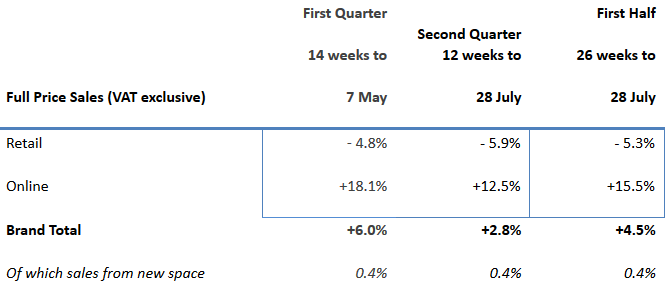
The sales growth in Q2 is not as good as Q1, although those Q1 numbers were remarkably strong.
The company puts the results in context: it had guided for full price sales for the rest of 2018 to be up around +1%. Therefore, this +2.8% result for Q2 is ahead of guidance.
But, since many of these sales have probably been pulled forward from August, Next is leaving full-year guidance unchanged.
We get a useful chart showing the performance of each week compared to last year - it shows that the first week of heatwave in 2018 saw sales up more than 25% against the same week in 2017.
The end-of-season sale went better than expected, but gains were offset by higher warehousing and distribution costs.
Cash flow & profit guidance: no change. 2018 PBT is still guided to be 1.3% below 2017 PBT, though EPS will be higher thanks to the completed share buyback programme.
My view: Share price weakness today reflects the fact that the company has been so conservative with its full-year forecast, implying that H2 is going to be much weaker than H1.
I'm happy to continue holding. This share fits my pattern of buying into large, leading companies where growth may have stalled in the short-term but where management are highly competent and the balance sheet and cash flows are strong. Next expects to generate £300 million of surplus cash this year and that's after paying ordinary dividends. And crucially, it looks like it will survive the ongoing transition to online sales.
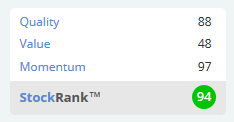
The algorithms love it:
Cenkos Securities (LON:CNKS)
- Share price: 92.5p (+0.5%)
- No. of shares: 55 million
- Market cap: £51 million
I've been mentioning this mid-tier investment bank a few times lately.
The share price has been struggling as revenue forecasts for the rest of the year have been slashed.
And then shareholder Crystal Amber came out swinging with the call for the entire company to be put up for sale.
Today we learn that rather than putting itself up for sale, Cenkos has instead made a purchase of its own: the Nomad/Broker business of Smith & Williamson.
The sale price isn't given, but I'm sure that Cenkos can afford it. I've not seen Smith & Williamson signing off vast numbers of RNS announcements. Six staff will join Cenkos as a result of the transaction.
I continue to suspect that a trade buyer (for example £NUM? it has a £450 million market cap) would be willing to pay a premium to the current share price to take over Cenkos. There has been speculation that one or two of these smaller banks might be thinking about or hoping to merge.
It's not my style to speculate on deals like this, as I've been hurt betting that deals would go through before. Nonetheless, I do think the Cenkos share price is near some interesting levels.
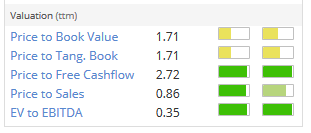
The trailing value metrics are extremely strong:
StatPro (LON:SOG)
- Share price: 162.5p (-5%)
- No. of shares: 66 million
- Market cap: £107 million
This company provides software to the asset management industry - very sticky customers who provide a dependable revenue stream.
Sadly, organic growth has been hard to come by and today it reports organic growth of just 3%.
It also has found it very difficult to convert adjusted EBITDA to pre-tax profits in recent years. Today, it shows £4.3 million of EBITDA and £0.9 million of PBT for the H1 period.
The use of EBITDA as a KPI looks questionable to me, as Statpro capitalises a lot of its spending on intangibles - so if you focus on EBITDA, you never take into account this spending.
A more interesting KPI is the ratio of a customer's lifetime value (LTV) to the average cost of customer acquisition (CAC).
The big acquisition Statpro made ("Delta") has reduced the group's overall ratio of LTV:CAC, implying a lower general rate of profitability in future. Though Statpro still reckons it is well above the industry average.
I've been sceptical of the Statpro market cap for a while and don't seen any reason to change my tune today.
Showing weak organic growth, a balance sheet stuffed full of intangibles and £23 million of net debt, I don't see why the share price has remained supported around current levels for so long.
Hargreaves Services (LON:HSP)
- Share price: 353.5p (unch.)
- No. of shares: 32 million
- Market cap: £113 million
Hargreaves Services plc (AIM: HSP), a diversified group delivering key services to the industrial and property sectors, announces its preliminary results for the year ended 31 May 2018.
This is an unusual conglomerate with a lot of asset backing and where earnings have been volatile. You can find some decent coverage of previous results in the archives.
Trading has been in line with expectations.
The group remains too complicated for most investors to be bothered with, and it continues to trade at a discount to net assets of £136 million.
Management have made some progress in winding down and disposing of legacy assets, "with the majority to be realised by 31 May 2019".
These lines sound interesting:
- Independent property valuation confirms £20m market value uplift and a further £28m development value uplift
- Total property valuation uplift equates to 129p per share
As for the earnings performance, there is a small operating loss on a reported basis, but this is after lots of items that the Board considers to be "non-underlying" or "exceptional".
I'm a little disappointed that net debt is so high (£31 million). It has previously been promised to reduce.
If we scroll back to February 2017, management promised that net debt would fall to less than £10 million. That didn't happen.
Moving forward, HSP intends to continue running the following divisions:
- Distribution & Services - This consists of "Production & Distribution", "Industrial Services" and "Specialist Earthworks".
- Hargreaves Land - a property developer and regeneration specialist.
It still feels too complicated as a structure, and the sectors don't excite me anyway (coal distribution, construction engineering, etc), so I might cease coverage of this stock from now on. If you fancy digging around for an asset play with it, you won't have much competition.
Financial Conduct Authority
Statement re: CFD products - this struck me as negative news for the CFD providers but their share prices haven't reacted much. The FCA is preemptively warning companies not to provide "substitute products", with similar leverage to CFDs, as a way of getting around ESMA's leverage restrictions.
When recently covering IG Group (LON:IGG) (in which I hold a long position), I noted the firm's reference to
"new, alternative, OTC leveraged derivative products under development that are compliant with regulations and that will be attractive for retail clients".
My interpretation of the FCA's statement today is that trying to work around the regulations is probably not going to work. If firms such as IG create products that share similar features with traditional products but are exempt from the rules, then the FCA/ESMA will ban those new products, too.
So if UK/EU retail customers want to trade the FTSE at 100:1 leverage again, for example, their only long-term option will be to use unregulated brokers operating outside the EU. It won't be possible to find any alternative products offering this at regulated brokers.
GetBusy (LON:GETB)
- Share price: 51.5p (-6%)
- No. of shares: 48 million
- Market cap: £25 million
This is a new one for me. It's "a leading document management software business".
The numbers reported today are unattractive. The only way it can present a positive earnings number is if it uses "adjusted EBITDA before development costs".
And even by that measure, it only generated £780k of earnings, less than it generated in H1 2017.
More positively, if you also exclude "corporate costs", which have increased following the company's IPO, then adjusted EBITDA (before corporate costs and developments costs) is up 33% to £1.3 million. But of course that is a very heavily manipulated number.
I'm expecting that there is a lot of growth and expansion baked into expectations, to justify a £25 million market cap.
The top line grew at a good pace: up 18% (at constant currencies), compared to a year ago.
One of Getbusy's major products, "SmartVault", has been launched in the UK and Australia as recently as last month (it is said to be long-established in the USA). This sounds like it could be an important source of growth. GDPR compliance has been a tailwind.
Coincidentally, Getbusy references its LTV:CAC ratios for SmartVault (see the section on StatPro (LON:SOG) above). It says "both the US and Australia have virtually pure-play subscription models, enabling us to benefit from favourable LTV:CAC ratios to build a strong, growing recurring revenue base".
LTV:CAC has improved to 5:1, suggesting an improvement in the long-term outlook for profitability.
My view - it's too speculative for me, but I can see that there is potential for SmartVault to roll out successfully in new regions and for the company to benefit from a growing base of recurring revenues.
Paul previously mentioned the balance sheet when he covered this stock, and it's worth a mention. The latest position is as follows:
- Intangibles & PPE: £700k
- Receivables £1.7 million
- Cash £2.4 million
- Trade Payables (£1.65 million)
- Deferred Revenue (£4.7 million)
Leaving the non-current assets (intangibles and PPE) to one side, the company only has c. £4 million of current assets to protect it from £6.3 million of current liabilities.
However, most of the current liabilities are in the form of deferred revenue, and are therefore non-cash (clients paying upfront for products and services)
Given the company's very low historical COGS, I would hope that the future cash outflow associated with satisfying these liabilities will also be very low.
So I don't think there is any current distress, but it's just something to be aware of. When you have a company that is in negative equity and is loss-making, you need to check how vulnerable the balance sheet is. Because most of its liabilities are in the form of deferred revenue, I think Getbusy has some headroom.
I've checked the most recent annual report, and I see that the auditors have been investigating certain matters to do with revenue recognition and the capitalisation of the development costs.
This seems like an interesting quote, recorded as a "Key Observation":
We note that there is insufficient evidence available to support the reliable measurement of development costs capitalised in previous periods.
It's generally impossible to know for sure what intangible assets are worth, but I would take this as a sign that Getbusy's intangibles are particularly mysterious.
I'll keep an eye on this share going forwards, and see if it can evolve into something a bit more blue-chip.
I might call it a day there. Thanks for dropping by.
Graham
Disclaimer
This is not financial advice. Our content is intended to be used and must be used for information and education purposes only. Please read our disclaimer and terms and conditions to understand our obligations.

29 comments
Am at the early stages of inspecting the apparent bargain that is Cenkos. Other than being in a sector with very uneven income, I haven't found much wrong yet. Must be missing something.
Maybe Next should have sponsored Love Island:
http://www.dailymail.co.uk/femail/article-6007211/The-Love-Island-effect-Missguided-report-staggering-9000-increase-sales.html
Hi,
FWIW on StatPro (LON:SOG)
I looked at the product as a potentially cheaper version of Bloomberg some time ago. It looks to be a generally good tool, however, its not really any better than the similar Bloomberg offering (PORT) and Bloomberg comes with so much more, that for the relative price difference I can't see why any professional wouldn't opt for Bloomberg. I suspect they offer large discounts to get clients in so they may well get cost conscious start ups in but I doubt any major fund manager would need them as most will either use Bloomberg or have better internal portfolio management tools.
Regarding the Delta purchase I can't really understand where they hope it will go. It is really yesterday's news as far as the professional bond market is concerned. By way of background, UBS Credit Delta as it used to be was an amazing tool c2004-2006, which generated huge revenues for UBS trading desks. Essentially, what it did was analyse a credit portfolio and suggest optimising trades for a given set of parameters which could run into literally billions of notional. Clients were offered Credit Delta free as the trading desks made substantial bid/offer from it. This drove a substantial amount of UBS FICC revenues in those years. Most other Investment Banks were incredibly envious of the revenue generating capacity and set about developing rivals or solutions that would at least be alternatives and capture the consequent bond flow. If you fast forward to today, undoubtedly many fixed income managers will still find value in it, but I suspect most won't given that when UBS tried to start charging for it if clients didn't trade on the back of it to a certain level. As a result, most clients just stopped using it.
The other issue is that optimisation more generally of massive fixed income portfolios. It is now a very difficult process as liquidity in the bond markets can't sustain, for example, a £1bn transition trade like it used to. The banks just don't have the balance sheet to warehouse that kind of risk anymore. Therefore, the product has less value than it once did. Also, Barclays has a similar offering that was perceived to be at least as good if not better than Delta. What this means in practice is that why would an FI manager pay a standalone company ie StatPro (LON:SOG) for it when Barclays will offer it largely free in return for the subsequent flow it will prompt. Undoubtedly, MIFID 2 might help Statpro, but I have no doubt that the likes of GS, MS, Citi & JP will have world class offerings that will be heavily subsidised, if not free, for most clients who trade with the secondary desks. Furthermore, a lot of the larger buy side firms took a lot of this kind of work internally by just hiring the boffins who created the code. To that end I see limited possibilities for this purchase.
All in all I have suspicions about its product offering vs the natural opposition and can't see where the substantial growth can come from for such a high rating. Plus if they come up with some particularly impressive the banks/Bloomberg/Reuters have the knowhow to just do it better. I'm probably missing a key moat that they have but I can't see what it is.
Regards
Interesting update on Next (LON:NXT). I understand the investment case here i.e. a cheaply rated online clothing business if you strip out the stores. However, isn't it somewhat hard to get excited about? The market environment is becoming more competitive and Next (LON:NXT) is a somewhat mature and staid brand. The clothes are very good but can they really beat the online only competition?
Re: Benfords law and Excel:
https://www.journalofaccountancy.com/issues/2017/apr/excel-and-benfords-law-to-detect-fraud.html
Auditors at the end of the audit meeting will invariably ask the management to sign a letter of representation. This shoves a lot of the 'risk' of what has been given to the auditor to review back onto the management/company.
They may highlight risks in their annual audit review document, but this is in a sense a basis of recommendation to the management, if indeed they suggest changes because of risk.
If the board don't make changes, the audit can qualify the accounts, or resign.
In many instances they are only in the company for a few weeks, and they usually don't have the insight to second guess lots of detailed information.
It really is for the audit committee to have a bit of backbone, and be more active in the audit overview if they have concerns. Too often, as we have seen with Remuneration Committees, they tend to be nodding donkeys.
Interestingly, in the Fundsmith 2018 AGM, they were asked about company fraud as an investing risk, and what they said was they they sometimes run a Benford formula on figures in report and accounts. This is apparently a mathematical formal which tends to pick up anomalous figures, based on normal distribution statistics.
Don't ask me how this works in relation to a normal set of report and accounts, but made up numbers tend to fall out of normal distribution patterns, apparently.
Trident, I don't think you can run Benford numbers on figures in reports and accounts to determine fraud.
The fraudulent figures would sit below those reported in the accounts which would be aggregations of the individual entries in the books. Because they're aggregations I don't think a Benford comparison would identify fraud.
The individual entries though could be benchmarked against the Benford distribution and it is a tool available to the auditors. And the Inland Revenue.
Thanks Graham as always, much appreciate the report.
I wonder though, or perhaps I am being a bit think - But why is are the terms "Retail" and "On-line" used these days when the "On-line" side is retail too. Maybe being a bit picky here but when they sell "On-line" it's still...
"the sale of goods to the public in relatively small quantities for use or consumption rather than for resale"
Julian. Interesting points. I was at a Sharesoc/PWC meeting a month or so ago about the role of auditors and audit committees. There was a lot of nice words spoken about how whistleblowers are encouraged and taken seriously. But when I asked if the auditors / audit committe would ever try to speak directly or indirectly to a short seller on why they were shorting the stock - this seemed beyond the pale. While shorters short for all sorts of reasons (hedging, arbitrage, think stock is simply overvalued), when there is a large short in a share this should be a heads up for the auditors. It cannot be beyond the capabilty of the audit committee to use the company broker to try to discover why people are shorting the stock, without encouraging manipulation. Due to the risks of getting it wrong, shorters are generally highly informed (while obviously not infallible) about the stocks they are shorting.
Did anyone see this weeks news that the FRC has stopped a 2 year investigation into Grant Thornton over its audit of Globo?
https://economia.icaew.com/news/july-2018/frc-closes-probe-into-grant-thorntons-globo-audit
Paul Scott (in this column) had been highlighting Globo as a fraud for almost almost three years before the company collapsed after the company admitted that its accounts had been fabricated.
https://www.stockopedia.com/content/small-cap-value-report-26-oct-2015-gbo-im-vindicated-rstr-pim-109308/
If Paul could see the ref flags in the information reported in Globo's RNS's surely there would have been enough there to encourage the auditors to do a little bit of verifying:
* do the customers exist (they didn't)
* do the bank balances exist
* does the product work (it didn't)
Aren't auditors required to apply a little common sense to go with all then ticking and bashing of documents provided by the directors? What hope us poor investors when directors can so easily pull the wool over the eyes of somnolent auditors?
Agreed - another company was Redcentric (LON:RCN) which gave a bad warning over accounting irregularities in November 2016. I wrote at the time "...to me the most disturbing bit of the November bombshell was "The Board also believes that the underlying net debt position at 31 March 2016 was materially higher than as reported". Those a/cs were signed off by PricewaterhouseCoopers who were paid £126k to do so on behalf of the shareholders. Now you might be able to hide a fistful of invoices from the auditor to reduce the 'payables' but I would have thought that net debt was one of the most verifiable figures by checking bank statements. They have some explaining to do. It also adds to the argument that auditors should be changed every so often".
Would you also consider Sylvania Platinum (SLP) please ?
Hi grout, I'm afraid I don't do resource stocks. G
Hi WS, good points re: Next (LON:NXT). Thanks. G
Graham I agree that Next (LON:NXT) has been a superbly run company but I think it is a bit of an understatement to say that short-term growth has stalled. Top line growth at Next has been only 22% cumulative in the 10 year period to 2018 - which will be a bit less than CPI over the same period. Over the same period PBT has risen 46%, as the company has managed well the transition from bricks and mortar to online.
But what the management has done extremely well is be prudent with the cash generated. Reasonable dividends have been paid and on top of this the share buy-back policy begun in March 2000 has been consistently applied. In the last 10 years 60 million shares have been bought back reducing the share count from 201 million shares (2008). This has led to a 147% increase in EPS over those 10 years.
Share buy-backs often get a bad rap, but when done consistently, as in Next’s case, in a mature business can really generate EPS growth.
Next (LON:NXT)
I am a bit surprised by the drop today seeing as its pretty much as expected - perhaps bods where expecting the reversal of fortune to continue with another slight upgrade. The one figure that did jump out a little was the lowered increase in the online comparatives - online is presumably the future and i am hoping there was plenty of double digit growth still to come, perhaps the future implied growth is now a bit lower.
One bonus is the share buyback increasing EPS by 4.7% i didn't realise it had that much effect, albeit the increase will likely be mitigated by lower store profits.
Hey ho was tempted to sell 50% the other day (the shareprice has had a decent rise from its lows) and didn't, i guess its back to the bottom draw for these.
Unless you're in the lottery, it's "bottom drawer".
Thoughts on GetBusy (LON:GETB) would be appreciated.
Morning Graham. Thoughts on GetBusy (LON:GETB) following their interim's today, an IPO from a year ago? A software company focusing on accounting companies in the UK and Australia. Thanks if you can fit them in.
Hi, nice suggestion, I will consider GetBusy (LON:GETB) for inclusion. G
Gus, Henry James didn't write RNSes, but if he did, they would be overlong (with too many qualifying, bracketed clauses), filled to the brim with obscure banking references, those to EU regulations about which we know nothing, and be entirely about banks we do not care about; in short, much like the one you have so graciously shared with us this morning, but longer, and with an even more deleterious effect on my productivity this morning, as evidenced by this sentence. Thanks for sharing :0)
... and yet my A Level English Lit teacher described Henry James as 'God'.
My morning smallcap tweet:
Filtronic (LON:FTC)
Filtronic (FTC) get first order for mMIMO antenna product. $2m order is an initial production requirement for the mMIMO* antenna recently developed under the agreement previously announced on 4 April 2018. It expects further orders. * mMIMO improves 5G capacity.and is a key part of 5G mobile infrastructure.
In amongst today’s trading announcements from the likes of Lloyds Banking (LON:LLOY) , Dignity (LON:DTY) and Next (LON:NXT) , this gem from Polish Bank Pekao SA caught my eye.
“With reference to Current Report No. 10/2018 dated 18th June, 2018 and Current Report No. 15/2018 dated 28th June, 2018, the Bank Polska Kasa Opieki S.A. ("Bank") hereby informs, that on July 31, 2018, the Bank received an information from the statement of the Polish Financial Supervision Authority ("PFSA") dated 31 July 2018 that the PFSA, acting pursuant to art. 46 of the Act on macro-prudential supervision over the financial system and crisis management in the financial system, after consulting the Financial Stability Committee (acting as the competent authority in the field of macro-prudential supervision), imposed on the Bank, on a consolidated basis and individual basis, a buffer of another systemically important institution equivalent to 0.75% of the total amount risk exposure calculated in accordance with Article 92 (3) of Regulation (EU) No 575/2013 of the European Parliament and of the Council on prudential requirements for credit institutions and investment firms, amending Regulation (EU) No. 648/2012 ("Regulation No. 575/2013").”
Glad that’s all been sorted out then.
Gus.
Brilliant Gus, that gets my vote for the plain English award ;-)
How many full stops did they manage to fit in?!
Hi Graham
Which company did you mean in this statement above in your report for Cenkos Securities (LON:CNKS) ? -> " (for example £NUM? it has a £450 million market cap) "
Thanks
Numis (LON:NUM)
I think a book of incredible RNS's is in the making.