Small Cap Value Report (Wed 17 Oct 2018) - FISH, TSTL, ASC

Good morning!
Not a very busy day on the RNS feed for small-caps so I might devote some time to ASOS (LON:ASC), which is up 15% with its final results.
Other stories to mention:
- Fishing Republic (LON:FISH) - suspended, out of funds, new CEO won't be joining.
- Tristel (LON:TSTL) - final results.
Fishing Republic (LON:FISH)
- Share price: 5.25p (suspended)
- No. of shares: 52 million
- Market cap: £3 million
Statement re Appointment of CEO
I mentioned this last month at its interim results, arguing that the c. £2 million market cap was "about right", and that it was a delisting risk.
The delisting has happened faster than expected, although it's yet to be made official.
For now, the shares are merely suspended. According to an RNS yesterday:
Group sales have been significantly affected by strong competitive pressures. This difficult trading environment has continued and the Board has been informed that certain major shareholders are no longer willing to provide further short-term financial assistance to the Group.
It's the end of the road for the business in its current form (and possibly any form?)
An inconvenience for the new CEO, who was supposed to join today! His appointment has been cancelled.
There was a point in time when I thought this might have turned out ok for shareholders, but it become clear soon enough that the offering was not competitive and that its financial characteristics were too ugly (e.g. massive inventory requirements) for it to earn a good return on capital.
We still have Angling Direct (LON:ANG) as a publicly-listed contender in the fishing space, although it's very highly rated and I'm not sure how its own rating is justified. The Stocko algorithms aren't sure either, assigning it a very weak Value Rank. So I wouldn't be in a rush to buy shares in that one either!
Tristel (LON:TSTL)
- Share price: 257p (-8%)
- No. of shares: 44 million
- Market cap: £112 million
Tristel plc (AIM: TSTL), the manufacturer of infection prevention and contamination control products, announces its audited results for the year ended 30 June 2018.
Readers have brought to my attention the idea that Tristel's share-based payments might be excessive, and that management incentives might be skewed excessively toward the share price.
It's usually straightforward to investigate this, as the relevant disclosures have to be made in a company's annual report. You may have to dig into the small print of the remuneration report to get all of the details, but you can usually find them.
There are also red flags, such as when a company focuses on results before share-based payments (SBP):
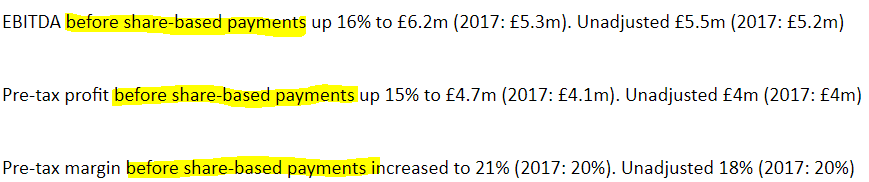
For 2018, Tristel's SBP had a value of £665k, versus operating profit of £4 million.
So approximately 14% of the operating profit was spent on SBP.
I don't consider that to be ludicrously large as a management bonus, for a small company, but it is a bit larger than I'm comfortable with for a medium-sized company such as this.
Share Options vs Physical Shares
I've pulled out the annual report from the company's website. The total compensation package for the Board adds up to £950k in 2018, up from £885k in 2017. Again, we can compare this figure with £4 million of operating profit.
Additionally, the Directors have 2.5 million share options outstanding, up from 1.7 million a year ago. These can be exercised at very favourable share prices (all of them less than 100p), and about half of them can be exercised at 1p, i.e. almost for free.
It means dilution of c. 5-6% for existing shareholders, when all of these are exercised.
In contrast to heavy exposure via options, the two Executive Directors are recorded as owning only a little more than half a million physical shares between them.
Again, that isn't a huge problem for me. It's more like an amber flag - halfway between the ideal situation and a red flag.
Ideally, the executives would be more heavily weighted towards share ownership rather than exposure via options. But we should recognise that the heavy use of options in this way is common practice, even if it's not the ideal.
Incentive Schemes
This is a key factor for me - how are management incentivised? According to the annual report:
The existing Executive Directors' bonus scheme pays out upon the achievement of pre-tax profit in excess of the company's budget on an annual basis.
That's fine. Nothing too clever but it's ok. However the "Bonus" attached to this is very small, i.e. less than 20% of the Executive's base salaries in FY 2018.
Also:
In line with the Company's policy to grant Executive Directors share options with vesting conditions linked to the Company's performance, the Committee implemented a new scheme which is linked to share price performance. The scheme was approved by shareholders at the Company's 2017 AGM.
Annoyingly, the terms of the scheme aren't included in the annual report (link). All it says it that the terms were approved at the 2017 AGM.
When you go to the AGM page, you can find the "AGM summary of 2018 plans", which includes a summary of the share plan.
This is how it describes the conditions for award of the options:

So what are the performance conditions? It doesn't say!
This is the resolution voted on at the AGM, to approve the share scheme:

So the rules were shown "in the forms produced to the meeting", but weren't published online? Seems a bit strange to me. Why not just show the performance conditions in the annual report like other companies do?
My investigation comes to a fruitless end, and I'm left with the conclusion that the conditions for granting the share options haven't been published online.
UPDATE: Thanks to a reader for pointing out this RNS (November 2017).
The conditions for the 2018 scheme were as follows:
The options will be exercisable at 1 penny per share and will vest in three equal tranches as follows:
· One-third will vest upon the achievement of a share price of £3.50;
· One-third will vest upon the achievement of a share price of £4.25;
· One-third will vest upon the achievement of a share price of £5.00.
To vest, the average share price of Tristel plc must be above the hurdle rate for a minimum three-month period
This is about as bad as a share option scheme gets: management are incentivised for the share price to reach a certain level and stay there for three months. How is that aligned with the long-term value of the business?
Additionally, the RNS says that the aggregate number of options outstanding after approval of the scheme is 4 million, 9.4% of the existing share capital at the time.
That scale of potential dilution is a real red flag to me.
The Business
The business itself appears to be doing well, making steady gains in the top line (sales). It sells primarily into hospitals and veterinary practices, places where there is a critical need to prevent cross-infection between people/animals/things.
It claims to have a distinct approach to what it does:
We are not only unique in providing chlorine dioxide as a high-performance disinfectant within hospitals, but we are also unique in our focus upon specific clinical departments within them. We target clinical departments that carry out diagnostic procedures with small heat-sensitive medical instruments.
...In these departments, we are the only simple to implement, affordable, high-performance disinfection method available. Consequently, in geographical markets in which we have been present for some time, we hold truly dominant market positions.
Sounds excellent! It has 250 patents in 36 countries. Strong IP is the hallmark of a quality company.
It is still working on its planned US roll-out. This seems to be taking a while:
Whilst no revenues have yet been generated from the United States, significant progress has been made to build a commercial platform from which to enter the market.
My View
Overall, I have a positive impression of the company. The remuneration issue does look like a legitimate concern, and some further clarity would be helpful, though I don't believe it makes the shares uninvestible.
My larger concern would be the valuation, as it looks fully priced to me:
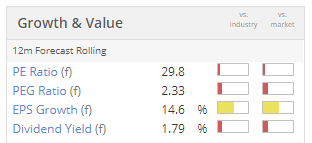
To read more about concerns relating to remuneration practices at the company, check out the comment thread below and especially post #13.
Update: Having read the November 2017 RNS, I now think that the scale of dilution from options is simply too large, and it would be enough on its own to put me off buying these shares.
But that's just me - other investors take a more relaxed view, and are happy to vote through schemes like this.
ASOS (LON:ASC)
- Share price: £57.17 (+14%)
- No, of shares: 84 million
- Market cap: £4,779 million
Let's have a quick look at these results:
- Sales up 24% at constant FX
- Gross margin up 130bps
- PBT up 28%
- basket value up 1%, order frequency +7%
FY 2019 guidance is unchanged.
Very impressive stuff, and the CEO underlines the achievement:
Our reported profit increase was achieved despite bearing material transition costs due to our investment programme.
The gains, both in the UK and elsewhere, are coming directly at the expense of traditional High Street outlets whose business models look hopelessly out of date in comparison.
See the growth in the online apparel market from 2014-2018:
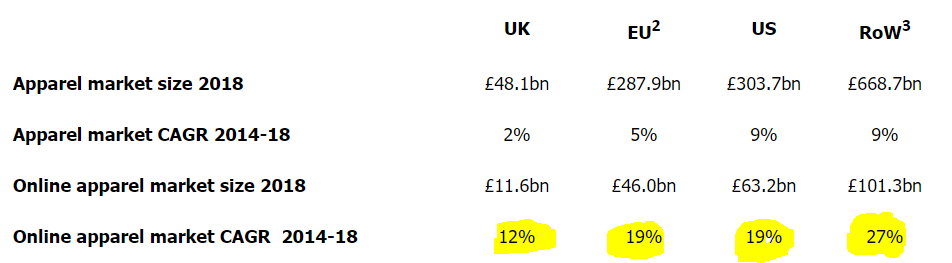
Not only is the online market growing rapidly, we have a business in ASOS which seems to be growing its market share within this market (on a global basis). That makes for an awesome combination.
Outlook - sounds great.
We remain in a period of high investment, confidently pursuing the considerable opportunity we see ahead of us. We also remain equally focussed on our core financial disciplines, reflected in our unchanged sales and EBIT margin guidance both for the current year and into the medium-term, after incorporating significant ongoing warehouse transition costs and the phased transition to US import duty.
My view - as someone who tried shorting ASOS shares a few years ago, I now have a much stronger appreciation for its achievements.
Indeed, I now think it's more interesting as a potential long idea. The valuation always looked out of whack to me, but with FY 2019 EPS forecast at 117.6p, it's currently trading at a forward P/E ratio of perhaps 49x, or a forward earnings yield of c. 2%.
Ok, it's going to take quite a long time to get your money back in dividends at this price. But still, it's good value compared to where ASOS has traded at before.
These historic P/E ratio charts from Stockopedia are very useful:
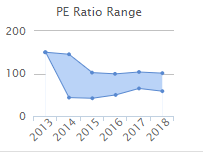
Since 2014, it has traded at a ratio of between 42x and 145x. I believe that recent prices (especially last week) compare favourably to this range.
The operating margin is admittedly weak, and is forecast to stay low at c. 4% through FY 2019.
However, the company overcomes this issue by making very efficient use of its balance sheet. We can confirm this by using the "Efficiency" section of the StockReport (in the right-hand column, under "Other Ratios"):
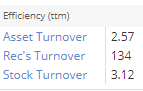
Asset turnover of 2.6x means that ASOS is generating lots of sales relative to its asset base, and that translates to a good return on capital (ROC is 22%, according to Stocko).
So while the valuation is still a bit too rich for me, I would much rather be long than short of the stock!
That will do it for now. Cheers!
Graham
Disclaimer
This is not financial advice. Our content is intended to be used and must be used for information and education purposes only. Please read our disclaimer and terms and conditions to understand our obligations.

28 comments
Thank you Graham for highlighting TSTL remuneration,i was interested in investing in them 18 months ago, after reading quite a few blogs & then investigating decided not yo invest on the grounds that it wasn't an even playing field,felt that as a shareholder i was taking all the risks to supplement their no risk bonuses & options,Thank you PortsmouthPirate for taking the time to write a comprehensive & passionate analysis.
Tristel (LON:TSTL) is audited by the same office of Grant Thornton as our friends at Patisserie Valerie - Grant Thornton in Cambridge!
Surprised that Flybe got missed out here - down over 40% on the day.
Would it not be worth acquiring for the aircraft?
Admittedly, the business looks in a tough place: plenty of headwinds regarding costs (oil, labour) and unlike the other low-costs they seem to lack a super-peak season due to their locations.
Last year flew Gatwick - Newquay for cheaper than the train ticket and this was the end of July.
I'm going against Graham's consensus on ASOS. I believe the competitive advantages that ASOS once had has changed.
Article out tomorrow.
btw, Orangetree, your blog link doesn't work.
Tristel (LON:TSTL) 's products are based on a chlorine based bleaching agent, chlorine dioxide, which is not patentable. Others supply this, too. It is quite a nasty substance, and there is a risk of explosion during the manufacturing process. There are many other bleaching agents which are suitable for disinfection purposes; these are widely used.
Here are their patents: https://patents.justia.com/assignee/tristel-plc . Most, perhaps all --I have only read the recent patents-- relate to dispensing methods.
The most recent patent is this one:
Hand-held pump apparatus
Patent number: 9970431
Abstract: A hand-held pump apparatus has a peristaltic pump head and a container for a liquid to be dispensed. The pump head has a rotatable peristaltic pump member and a flexible dispensing tube in fluid connection with the inside of the container. A finger-actuated trigger is arranged to drive the peristaltic pump member when actuated so as to cause the peristaltic pump member to turn and pump fluid through the dispensing tube. The pump head has a thumb hole disposed through it, the thumb hole being disposed within an area around which the peristaltic pump member turns when actuated.
Type: Grant
Filed: July 31, 2013
Date of Patent: May 15, 2018
Assignee: TRISTEL PLC
Inventor: Jeremy Turner
I have something similar at home for dispensing hand soap.
I think this is very harsh towards Tristel (LON:TSTL) management, and hopefully Maynard is reading so he can give some further context around his blog post you have quoted (incidentally this was when the shares were less than half the price they are now). As andrewjames comments, I find Paul and Liz open, approachable, and very PI friendly; they have hosted webcasts in the past and they currently host annual presentations at their premises. I feel the current incentives are challenging (£3.50, £4.25, £5.00 share price targets) and are aligned with shareholders' interests. The numbers in the business speak for themselves - 10%-15% revenue growth, 20% margins, net cash, frequent special dividends, US expansion imminent. If they perform as they have done, I am more than happy to cede 5-6% of the company to them. I'd actually welcome any negative impact on the share price as it would give me the opportunity to add at reasonable levels. For some years their rating has reflected their intrinsic quality (i.e. a premium PE) - any discount to this would be welcomed!
I find Paul and Liz open, approachable, and very PI friendly; they have hosted webcasts in the past and they currently host annual presentations at their premises.
Gav,
I think you need to be careful that you are not unduly influenced by the apparent openness of the management. It seems they are maybe only open and transparent when it suits them, and after all, they need some punters to offload their share options to when they dump them! Certainly you calling them by their first names makes me a little uncomfortable. I never attend company meetings or AGMs for this reason and I very much enjoy being an arms length investor. It works for me and means I am not open to undue influence. I would highly recommend you or anyone else that attends these meetings reads the brilliant book by Dr. Robert Cialdini:
https://www.amazon.co.uk/Influ...
FWIW I have a very small historic position in Tristel (LON:TSTL) but it is not a holding I am that comfortable with because of the reasons mentioned on this thread. It is clear that the CEO and CFO are not shy in filling their boots with options using a very dubious hurdle as a basis for vesting. IMHO performance metrics for options should not be based on the share price but rather metrics better matched to the performance of the business e.g. ROCE, margins etc.
All the best, Si
As I said it is circumstantial evidence, but enough for me to want to avoid it. A number of readers agree with me, it seems. I presented the facts and gave my interpretation of them. There are thousands of stocks out there. This is a good enough reason for me to avoid this one. I do my best to avoid mistakes. If i avoid mistakes regularly I figure I'll do well. The managment are indeed friendly and approachable but they ignored a submitted question regarding the aforementioned pay scheme too, according to Maynard's blog. Perhaps comments might have clarified the situation, but they ignored to opportunity to do so. Similarly, according to Maynard's blog apparently they did not answer Richard Beddard's question RE revenue guidance at the time of the share scheme.
I linked to the entire article so people who click through can read Maynard's entire opinion of the business. Of course, I directly quoted the bits relevant to my opinion and no more. The post was already long enough.
Sorry if you feel it is harsh but there's no room for sentimentality in business. I owe the directors nothing.
Tristel's management have a track record of paying themselves rather than shareholders, in my opinion. I wouldn't touch the company with a bargepole until there was huge change at the top.
A few years ago, some commentators were suspicious that Tristel had withheld poor trading news to ensure management bonuses would vest. There is no evidence that could not be described as circumstantial, but it is a must read for anyone considering an investment. Come to your own conclusions, but I am sceptical of the CEO and CFO...
The bonus (which was sizeable) was dependent on the shares remaining above a certain price for a certain period of time (30 days if I recall). The shares hit that level just before the AGM - and the company released less information about trading during this period at the AGM than they had in previous years. Revenue guidance was omitted.
The shares remained above the level required for their bonus, but rather soon after the AGM the company reported slowing revenue growth and shares plunged 20%. This news was reported after the 30 day window required for the bonus... and some commentators reckon the directors must have known about slowing revenue growth at the time of the AGM and withheld it to keep the shares above the bonus level.
Sorry if that explanation is a little unclear, I've got lots of work to do and am in a rush - no time to edit for clarity.
The following is taken from a blog post detailing this suspicion in more detail:
"You see, throughout 2015, TSTL had been confident about its near-term revenue performance.
Results issued in February 2015 and October 2015 had both cited (in the RNS) a £20m revenue target for 2017 — implying near-term revenue growth of roughly 15% a year.
It was a bold, public prediction, and naturally shareholders had considered this revenue target in their own valuation sums… which was reflected by TSTL’s c70% share-price gain recorded during 2015.
Importantly, TSTL’s management was given the opportunity to clarify its first-half revenue performance at the AGM.
Financial writer Richard Beddard quizzed the board at the meeting but there was nothing forthcoming about revenue:
Here’s what Richard has recounted to me:
“He just refused to comment. Can’t remember the exact words but it was something like we’ve said what our expectations are and we’re not going to say any more about it.”
Now at the time, all of this could have been viewed as something about nothing — especially as the AGM statement had claimed “Growth is coming from all areas of the business”. What’s more, the directors had bought a few shares on the day of the meeting.
But roll on to last week’s interim results, and the AGM statement takes on much greater significance:
***They must have already known the £20m target would be “unlikely to be met”***
Last week’s results revealed first-half revenue had grown by 8% — some way short of the c15% growth rate that had been projected by TSTL’s management for 2016 and 2017.
TSTL’s management confirmed during the results webinar — but not actually in the results RNS — that the £20m revenue target for 2017 was now “unlikely to be met”.
Stalled UK revenue — the NHS has apparently become a much more difficult customer — was cited as the main reason for not reaching the original goal. It all led to TSTL’s shares dropping 20% on the day.
Anyway, my suspicion is that TSTL’s executives must surely have known at the December AGM that first-half revenue would be up only 8% — and that the original £20m by 2017 target would now be “unlikely to be met”.
I mean, past AGM statements had indicated first-half revenue figures… yet management remained tight-lipped — even when pressed at the meeting.
Now you could say management has done nothing wrong here.
For one thing, earnings for the current year are set to meet forecasts because of higher margins — so the lower revenue expectations might not really have constituted ‘price-sensitive information’.
Furthermore, the NHS difficulties may have started only after the AGM. And/or perhaps the firm’s broker has given some bad advice about market communication.
Normally I would try and give management the benefit of the doubt with this sort of setback, because the future is always uncertain and disappointments can always happen.
But in this particular situation, I have my doubts.
Indeed, it just seems so obvious to me (at least now) that a revenue figure ought to have been included in the AGM statement — and the market could then have decided for itself whether that figure constituted ‘price-sensitive information’ or not.
Furthermore, overall UK sales have been at a standstill for 18 months now, which suggests the NHS difficulties are nothing totally new. (And yet, if you recall, the December AGM statement claimed “Growth was coming from all areas”!) Oh, and TSTL found no problem communicating its original £20m revenue target to investors.
But what really rubs salt into the wound from all of this is the the revelation about the recent vesting of staff options worth £1m…
***They never said all these options could vest immediately***
All of a sudden, this innocuous statement from last August has come to the fore. Here is what it said:
“Tristel plc (AIM: TSTL), the manufacturer of infection prevention, contamination control and hygiene products, announces today that Paul Swinney, CEO and Elizabeth Dixon, Finance Director, have been granted options over 636,567 ordinary 1 pence shares (“Ordinary Shares”) under the Tristel plc Performance Share Plan 2015. The options are exercisable at 1 pence per share subject to certain profit objectives being met or the share price of the Company being equal to or greater than 134 pence per Ordinary Share for a period of 30 consecutive dealing days.
The options are exercisable for a period of five years from date of vesting in three equal tranches following publication of the annual results. The first tranche will vest, if performance conditions are met, on publication of the results to 30 June 2016.”
What was not said at the time — and revealed only last week in the results presentation — was that there were 1.2 million options granted and that they would all vest immediately if the 30-day share-price condition was met.
The original statement certainly reads to me that vesting on any condition would only occur after the 2016 results, and in three separate tranches.
Anyway, last week’s results confirmed the 30-day share-price condition had been met and the interim results carried a £1m share-option charge (a substantial sum when annual operating profit (pre-option costs) currently runs at about £3m).
It just so happens the 30-day share-price condition was achieved on 6 January. As such, the 30-day period must have started on 23 November…and day 17 was 15 December, the day of the AGM.
***I suspect they deliberately withheld a revenue figure***
Now imagine you are part of TSTL’s senior management team. You have been awarded part of 1.2 million options at 1p each, and the share price has been at or above 134p for 17 days.
So there are just 13 more trading days to go before you collect part of a £1m-plus option jackpot.
It’s a tantalising windfall — and one that appears to at least double your team’s annual pay (the 2015 annual report cites “key management” — including the two executives — received total compensation of £944k last year).
But you have to issue an AGM statement. What do you do?
Well, I have no proof about this of course…but I suspect TSTL’s management deliberately withheld a revenue figure from the AGM statement for fear of missing out on the £1m-option windfall.
Judging by the share-price reaction last week — the shares fell 20% on the results day — I am sure news of 8% first-half revenue growth would have also prompted the shares to drop below 134p…and thus leave this £1m-option award dangling for another time."
Full write-up is available here - most of it in the comments:
https://maynardpaton.com/2016/02/24/tristel-these-results-were-a-letdown-and-i-have-been-selling/#comment-9221
Couldn't agree more PortsmouthPirate and thanks for bringing this back to people's attention. Circumstantial it might be but the whole episode stinks to high heaven. I would agree that this share is uninvestable with the current management.
Thanks Damian. I know my post was damned long but it is a complicated situation and one that new investors should be aware of before making the plunge with Tristel shares.
Especially with further bonuses based on share price levels. I really don't like the incentives behind them.
Re Tristel, relating to historic concern over lack of detail in a 2015 trading update and subsequent large bonuses.
That’s really helpful, thanks for sharing. I did have my suspicions about this at the time- lack of a revenue figure in the late 2015 trading update which had the effect of keeping the share price high and subsequently large bonuses vested. Revenue was then shown to be disappointing.
There were also two small share purchases by the CEO and CFO (circa £7,000 each) both on the same day around this time. When I saw them, I looked at the market cap of the company and thought it’s so high I wonder why they are buying shares and why for such a small amount. I did wonder after the bonuses subsequently vested and the revenue growth was shown to be disappointing if those share purchases had been intended to send a signal to the market and to attempt to buoy the share price allowing for the bonuses to vest. I don’t know whether that was the case but it did look suspicious to me and it really worried me as to what their intentions had been with those co-ordinated share purchases. I have to emphasise though that this was just a concern on my part and we don’t know the intention behind those share purchases.
Regards
Andrew
On the issue of the terms of the 2018 Scheme for Tristel (LON:TSTL), see the RNS issued on 2 November 2017. The split between the directors of the 990,000 share options subsequently granted on 1 January 2018 is set out, as are the vesting terms. Briefly, one third vest if the SP reaches £3.50, a further third if the SP reaches £4.25 and the final third if the SP reaches £5.00. There are some further conditions, including a requirement that the average SP must be above the applicable hurdle rate for at least three months. I recall that there was quite a lot off shareholder and financial press comment at the time, but I believe that I was the only external shareholder to show up at the 2017 AGM and ask the Board/Nomad about the background to the scheme and the industry comparable used. I then voted in favour.
As to whether the company is investable with the current management, each to their own view, but I consider the company to be more transparent than most small caps and also more PI friendly. To that end, they do presentations and Q&A sessions following publication of interim and FY results and they also host a shareholder open day at their HQ each Summer. All those events are usually well attended and there is never a shortage of questions.
Finally, I suspect (but it is obviously a guess) that the main reason that the SP has gone down today is because of the timing of the FDA submission, rather than general Brexit malaise. The company has now said that it expects to make its submission to the FDA for use of Duo as a high-level disinfectant (it already has approval from the EPA for use of Duo as an intermediate level disinfectant) by the end of the current FY (i.e. by 30 June 2019). It had previously said in its July 2018 TU that it expected to submit by end December 2018. So, whilst we are all guessing at likely revenue levels if approval is secured, some people doubtless have a hole in their projections. I am not sure that it matters that much in the grand scheme of things, but it is certainly a topic to explore at the Q&A sessions following the presentations in London tomorrow.
Hi Andrew - thanks for pointing out the November 2017 RNS. I have updated the article to reflect its contents. ATB. G
SCISYS (LON:SSY) has just announced a change to its corporate structure as part of BREXIT contingency planning.
Hi Graham,
I’d be interested to know what you make of Tristel’s share-based payments and whether you think they’re excessive.
Thanks
Andrew
Berkeley Energia (LON:BKY) down about 35% after they're suspended in Australia but not here - it seems like they're not going to get the permits they need for their uranium mine. I've been selling on the way down (as rumours of this emerged) and dropped the last bit today - another story stock hiring the dust - I'm learning to avoid them, I hope!
Discoverie (LON:DSCV) more for general comment. The share doesn't seem to get much love. The company has announced a new acquisition today of Cursor controls for £19m (plus further £4m depending on performance) from existing debt facilities. Acquisition will be immediately enhancing to underlying earnings (cursors fy2017 rev £7.9m, op profit £2.1m, over 90% of sales to international markets).
Share has dropped to 380p from highs of c420p in August. Brokers targets range from 480p to 520p.
Tristel (LON:TSTL) does indeed do it again. PBT up only 1% versus +14% excluding share-based payments, and basic EPS DOWN 5% (diluted down 6%) for the same reason. This company has form in giving the upside in the company's performance to directors and employees so the owners of the company (shareholders) get no upside at all - or less than nothing this year.
(Disclusure : I will continue to hold until the company's presentations tomorrow)
I know it's £1.4bn cap but anyone got any idea why, with such good results, Softcat (LON:SCT) is down 7.5% so far today? Was thinking of buying.
New COO for Seeing Machines (LON:SEE) and deal with Groupon for accesso Technology (LON:ACSO) plus WANdisco (LON:WAND) have offered a new data thingummijig, probably important (I hold all three, WAND less so)
Softcat (LON:SCT). Since Graham is on today and he considers larger caps sometimes, I will add a bit to your comment on Softcat (LON:SCT). Prelims this morning have missed expectations but not by much, and taking out share-based payments (which have doubled to £2.5m), the results are significantly better than expected. But as for Tristel (LON:TSTL) today, I guess the market is not being taken in by this "adjustment", which however nearly all companies try on in their results these days.
(Discludure: I continue to hold.)
re: Softcat (LON:SCT) I have no idea - revenue up, profit up, customers up.
Down 9% as of writing. Most peculiar.
Yeah I'd be interested in thoughts on Softcat (LON:SCT) as well. Revenue and profits up, by circa 30%, with profits improving more than sales which is indicative of margin improvement. Then there's the cash generation and special dividend. What's not too like?
Possibly the price is down because FY19 forecast is for limited growth? I don't see how this ties in with the reported strong markets but it does make the share look expensive.
My morning smallcap tweet: AIrline cracks at FLYB.
Totally (LON:TLY), Solid State (LON:SOLI), Tristel (LON:TSTL), Flybe (LON:FLYB)
Totally (TLY) wins £3.3m contract extension for Staffordshire NHS 111 services. Only until March 2020 though.
Solid State (SOLI) H1 trading. Guides FY ahead of market expectations.
Tristel (TSTL) FY rev growth (10%) at bottom end of mgmt target range (10-15%), adjusted pre-tax (up 15% before share-based payments) and net margin beat market expectations. Adjusted EPS 9.16p up 10%.
Flybe Group (FLYB) H1. Guides FY lower than market expectations.due to soft H2 bookings.
Final results out for Tristel (LON:TSTL) this morning.
https://www.investegate.co.uk/tristel-plc--tstl-/rns/final-results/201810170700052668E/
Figures seem reasonably encouraging and reporting progress in North American markets. Interesting to note they attribute fall in eps primarily to “share based payments” (read “egregious executive largesse”) which has been a bit of a bug bear with this company in the past. Some comment on how they’re preparing for possible Brexit disruption. Question whether the actual results are keeping up with the high rating given by the market.
Gus.
Tristel (LON:TSTL) feels a bit "smoke & mirrors" to me as the profits are actually down. The high rating must be due to an anticipated explosion in profit levels once the USA sales kick in with a potential takeover offer at that point.