Small Cap Value Report (Weds 7 Sept 2022) - Energy. HFD, FSJ, SOM, HEAD, AVON

Good morning from Paul & Roland!
Govt energy measures
Press reports are saying that a huge series of support measures are in the pipeline from the Govt, to cap household energy bills at around the current level. Plus big support for business. All at a massive cost of somewhere between £100-170bn. People will have different views, but mine is strongly supportive (although we don't know the details yet).
The biggest driver of high, and rapidly rising inflation, is energy costs (per the Bank of England analysis I copied here recently). Therefore putting a hard cap on these energy costs is the most effective way to stop inflation in its tracks.
The knock-on effects of another winter of discontent, with the usual culprits going on strike demanding (say) 15-20% pay rises, should instead now be easier to deal with at a lower level, since inflation might even begin to fall in a few months' time, possibly. Instead pay rise deals might now be struck in a more palatable range of say 5-10%, and be one-offs, rather than getting into a hyperinflationary spiral, which would have happened if energy bills had been allowed to soar to say £6k per household. So it looks as if household concerns should greatly reduce, which should help restore some level of consumer confidence.
The next big question, is what happens for business? Clearly it's going to bankrupt many small businesses, if there is no relief for the huge increases in energy bills we're hearing about. Presumably something similar is in the pipeline, because I can't see that Govt would throw everything at households, but do nothing for businesses. They tend to favour small business though, so I hope the expected assistance will also filter up to our small caps sector of the market. We wait with baited breath, but so far anyway, the news seems exactly what I was hoping for - big, bold action, to stamp on inflation, and support households from what would have been, for many, completely impossible energy cost increases.
How will financial markets react to this huge increase in borrowing, which looks set to soar back to 10% of GDP p.a., or even above? (typically the peak level of annual spending deficits in recessions). Who knows? In any case, gilt yields can be tuned to anything the Govt wants, using QE - as we've seen since QE started in the 2008/9 crisis. So personally, I'm not worried about how this is all funded. In a crisis, we need bold, decisive action, not hand-wringing over how to pay for it. That was very much proven in both 2008, and 2020. The cost of inaction is worse than taking bold action. Other opinions are available of course, from other people, this is all quite subjective.
If you want to worry about another sovereign debt crisis, then I think Europe has far bigger problems to deal with, especially Italy - where debt to GDP is 150%, and the only buyer of Italian bonds has been the ECB, which is now holding an astonishing E700bn. How will that ever be repaid? That's their problem to worry about, but a re-run of serious problems over Euro looks a bigger problem than anything we have here, in my opinion.
All the above is clearly bullish for shares, as the worst case scenario of something akin to economic collapse is clearly now not going to happen. So we could see some buying interest in bombed out small caps now. Selectively, I think this might be a good point to put some cash to work. It reminds me a bit of a previous key tipping point, e.g. when the vaccines were announced, when disaster looks to be averted. That started a very strong recovery in many shares, that lasted about a year, starting in Oct 2020. We could be at a similar point now, where decisive action to tackle energy costs, transforms the economic outlook for the better. So dust down those buying lists, if you agree with me!
Agenda -
Paul's Section (brief comments first) -
Loopup (LON:LOOP) [no section below] - there’s an update on its deal with PGi Connect, which is to migrate its conferencing customers over the LoopUp, in return for a revenue share agreement. I might have missed something, but it doesn’t seem to have anything meaningfully new in it, the figures look the same as last time this deal was announced.
When small, cash-strapped companies start recycling the same positive news, it does arouse my suspicion as to why? The obvious thought is that they possibly want the share price up, to make another placing more do-able. To reiterate my thoughts on this share, it looks potentially interesting, but it’s uninvestable for me, until the cash position is sorted out with another placing - which needs to be big (relative to the market cap), to clear the £8m net debt, and provide the funding for continuing, heavy cash burn. So a speculative, but risky share, I’d say. I'm holding back until it sorts out the funding problem.
Paul - longer sections:
Halfords (LON:HFD) - a scheduled update for the first 20 weeks trading of FY 3/2023. This seems surprisingly resilient, with full year guidance reiterated. The shares have collapsed, along with the sector, over the last year. This looks a potential buying opportunity to me.
Headlam (LON:HEAD) - interims from yesterday are exactly in line with guidance provided in July. Self-help measures mean HEAD is trading OK, and it reiterates full year expectations. The balance sheet is superb, including loads of freehold property. Crucially it has more than passed on cost inflation on product, with a rise in gross margin. High dividends & dividend paying capacity. Short term uncertain due to macro factors, but long-term shareholders should be fine, I see 100% upside here longer term.
Roland's Section:
James Fisher And Sons (LON:FSJ) - this family-owned marine services group is going through tough times. Today’s half-year results appear to include (another) profit warning and a rather mixed trading outlook. However, I think the foundations are being put in place for a turnaround. I’d be interested to learn more here, as I think there are some attractive elements to this business.
Somero Enterprises (LON:SOM) (I hold) - another solid set of results from this US-focused concrete-levelling specialist. Somero reports record half-year revenue and a strong non-residential construction market in the US. Full-year guidance has been confirmed, with a caveat about supply chain disruption. I remain happy to hold.
Avon Protection (LON:AVON) - [no section below] - shares in this fallen high flyer are up by 18% as I write, after the company announced a $15.1m US defence contract to supply 380,000 M61 filters (gas masks). Deliveries are expected to begin in early FY23 (Avon has a 30 September year end).
Today’s release also includes a positive trading update. As guided in May, trading during the second half of the year has improved. Full-year results are now expected to be “at least in line with market expectations”, excluding the armour business, which is being wound down.
The company also says that it’s making good progress with the search for a new CEO, following the resignation of current boss Paul McDonald. He leaves at the end of September.
My view: looking ahead, I think Avon could offer some value. FY23 forecasts put the shares on 11 times forecast earnings, with a possible 5% dividend yield.
However, I think it’s worth noting that while the company left the interim dividend unchanged, it warned that the full-year dividend would not be determined until the end of the year.
Net debt has also mounted over the last couple of years. Leverage reached 2.6x EBITDA at the half-year point (31 March). Avon has covenant limits at 3x EBITDA, so I wouldn’t be completely surprised if the board uses the recent turmoil as an excuse to reset the dividend.
On balance, I’m encouraged by the outlook here. My feeling is that the worst is over and the group is now well-positioned to resume growth as a specialist defence supplier. However, I’m uncomfortable with Avon’s debt levels. For this reason, I’d be inclined to wait for the full-year results later this year before deciding whether to invest.
Explanatory notes -
A quick reminder that we don’t recommend any stocks. We aim to review trading updates & results of the day and offer our opinions on them as possible candidates for further research if they interest you. Our opinions will sometimes turn out to be right, and sometimes wrong, because it's anybody's guess what direction market sentiment will take & nobody can predict the future with certainty. We are analysing the company fundamentals, not trying to predict market sentiment.
We stick to companies that have issued news on the day, with market caps up to about £700m. We avoid the smallest, and most speculative companies, and also avoid a few specialist sectors (e.g. natural resources, pharma/biotech).
A key assumption is that readers DYOR (do your own research), and make your own investment decisions. Reader comments are welcomed - please be civil, rational, and include the company name/ticker, otherwise people won't necessarily know what company you are referring to.
Paul’s Section:
Halfords (LON:HFD)
133p - mkt cap £292m (pre market open)
This covers the 20 weeks to 19 August 2022, of FY 3/2023.
The summary looks encouraging -
Full year profit guidance unchanged following good performance across the business, and market share gains across Motoring and Cycling products and services.
This announcement looks a lot better than I feared it might have been. So this could be a good entry point for this share.
Key points (for 20 weeks) -
Revenues down -1.9% on a like-for-like (LFL) basis, against strong LY comparatives.
Total revenues up 9.2%, reflecting acquisitions.
LFL revenues well ahead of pre-pandemic (up 11.7%)
Autocentres are stand-out performer, up 28.2% vs pre-pandemic, suggesting that acquiring and rebranding autocentres is a good strategy.
Changing shape of the business - due to acquisitions, services are now 42% of revenues, as opposed to just 22% pre-pandemic. So it’s not just a retailer now.
Guidance for FY 3/2023 is unchanged at £65-75m (down from £90m LY) - this strikes me as pretty resilient, given the macro situation.
BUT the outlook section says this guidance assumes no further deterioration in macro & consumer confidence, which seems imprudent to me!
Loyalty club - has done well, with 500k members since launch.
70% of revenues are motoring, and tend to be needs based, i.e. essentials - makes the business resilient in a downturn.
Balance sheet - nothing said, but I’ve checked back, and it looks OK, with NTAV of about £110m.
My opinion - I’m be tempted to buy after this unexpectedly robust trading update.
Headlam (LON:HEAD)
282p - mkt cap £240m
Figures out yesterday, and triggered a bounce in the share price. This is one of my favourite value shares (no current position), so am keen to circle back to it, in order to decide whether to buy back in at some stage.
Headlam Group plc (LSE: HEAD), the leading floorcoverings distributor, today announces its interim results for the six months ended 30 June 2022 (the 'Period') and an update on current trading.
Company headlines -
Improved profitability despite economic backdrop
Pleasing progress in delivery on the strategy
The numbers today look familiar, and that’s because the H1 trading update told us what to expect - see my bullish commentary on it, here.
H1 revenues are £323.8m, exactly as previously guided, with UK down, and Europe up.
Underlying PBT is also exactly as guided for H1, at £17.3m (which is up slightly against H1 LY of £16.7m - impressive).
Pricing power - a key point here is that gross margin actually rose at 33.7% (from 32.7% H1 LY) - which indicates to me that HEAD has the ability to pass on higher product costs successfully to its customers - very important, and clearly a positive.
An insurance claim boosted reported H1 PBT to £21.6m - helpful, but I would ignore this for valuation purposes, as a one-off.
Net cash is healthy, at £6.0m, plus £74m of undrawn bank facilities, so HEAD remains superbly strong financially - this business could weather pretty much any storm I reckon.
Outlook - sounds a little cautious, albeit in line -
· Revenue performance year to date continuing to be only marginally below the prior year period
· Company remains on track to meet market expectations4 for the year, although trading remains challenging and operational cost inflation continues
4Company-compiled consensus market expectations for revenue and underlying profit before tax, on a mean basis, are available on the Company's website at www.headlam.com.
Balance sheet - is fantastic. It’s now almost £200m of NTAV - so the £240m market cap is largely supported by tangible assets, which is very unusual, and really positive. It’s the freeholds which provide about half of that NTAV, which I love. It means you don’t have to worry, and even if the business needs to borrow in a lean patch, the banks are happy to lend against freehold property, because it’s secured, hence close to zero risk from the bank’s point of view.
My opinion - remains very positive. I think this share could double in the long-term, once economic conditions are more normal, and it still wouldn’t be expensive even then.
Obviously in the short term, times are harder, but it’s still performing resiliently - that’s because there are a lot of self-help measures underway, in an extensive rationalisation of the business, which seems to be absorbing softer demand.
Why does a carpet distributor exist? For a very good reason - that the product is bulky, and with huge product ranges, it’s not possible for retailers to stock all the products they need. So it’s out-sourced to Headlam, which also gives Headlam better bulk buying power. Headlam then charges a reasonable mark-up, sensibly not too high to encourage competition or being sidelined by customers buying direct.
There’s always the risk of an H2 profit warning, if demand nosedives, but that shouldn’t matter to long-term shareholders.
Meanwhile, this share gives a nice divi yield, and seems to offer inflation protection too, since it has demonstrated that cost increases are being passed on to its customers. That's ideal in current circumstances, in my view.
A thumbs up from me!
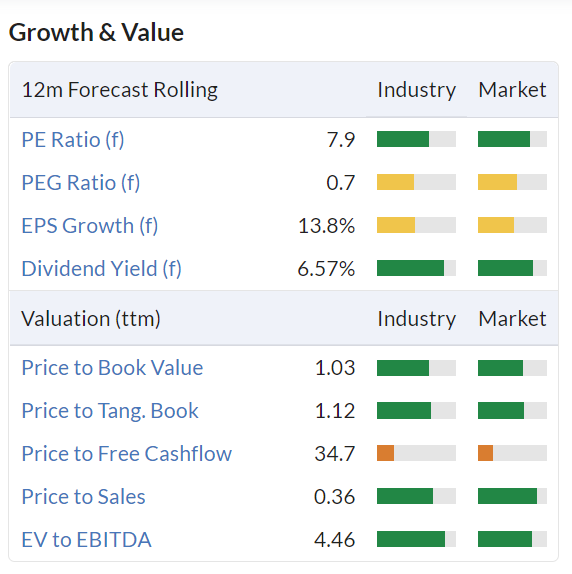
Smashing value metrics -
.
Roland's Section:
James Fisher And Sons (LON:FSJ)
280p (-9% at 08.10)
Market cap £142m
Long-term investors who’ve continued to back this family-controlled offshore services and engineering group have had their patience severely tested over the last three years.
Unfortunately, today’s half-year results appear to include a further (mild) profit warning. The shares are down nearly 10% in early trading.
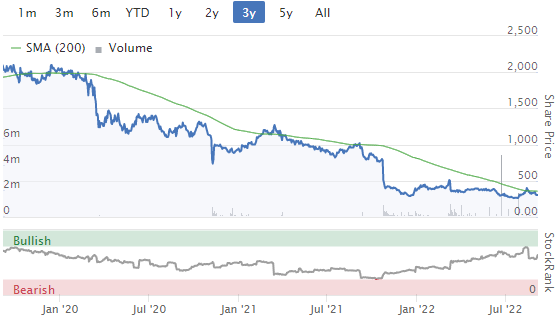
Updated guidance: Today’s share price drop appears to have been triggered by guidance that “full-year operating underlying operating profit is now expected to be broadly in line with 2021”.
Checking back to last year, underlying operating profit was £28m.
There are no broker notes on Research Tree. The only forecasts I can find for FY22 operating profit suggest a figure of £29m. So today’s cut to guidance appears fairly mild, but unwelcome nevertheless.
Financial highlights: a recovery is not yet visible in the numbers. Fisher’s half-year results show continued decline compared to the same period last year:
- Revenue +2% to £238.4m
- Underlying pre-tax profit -47.8% to £4.8m
- Statutory pre-tax profit -60.5% to £3.2m
- Underlying earnings per share -48% to 6.7p
- Dividend suspended
- Net debt £172m (June 2021: £189m)
- Leverage: 2.9x EBITDA
Despite the suspension of the dividend, leverage does not seem to be falling very quickly.
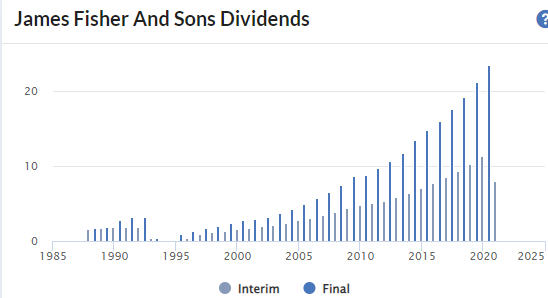
As a side note, suspending the dividend after more than 20 years of unbroken growth is a tough blow, especially for a family firm. As Jack commented in March, it does suggest something has gone seriously wrong here.
Profitability: I’m always encouraged when companies report return on capital employed. Even if it’s poor, it shows that the board recognises the importance (in my view) of this profitability metric.
Fisher reports both operating margin and ROCE. Unfortunately the figures are poor:

Operational highlights: This group is made up of a number of operating companies, each with their own brands.
Trading during the first half was strong in the group’s offshore oil (well services) and tankships (ship chartering) businesses. Marine contracting (subsea services for offshore energy) is said to have continued to improve.
The weak spots seem to have been Fendercare – which supplies ship mooring products and ship-to-ship oil transfer services – and ‘Specialist Technical’. This includes diving, defence and nuclear decommissioning (an odd fit?).
Management warns that Specialist Technical projects are cyclical and budgets are under pressure. So I’m not sure about the near-term recovery prospects here.
Outlook: Fisher’s business does have some seasonal weighting and management expects the second half of the year “to be materially stronger than H1”. Seasonal cash flows should cut net debt and leverage by the year end. Further disposals are also a possibility.
However, with full-year profit now apparently expected to disappoint, the tone of the outlook is cautious.
The commentary in today’s results was provided by chairman Angus Cockburn, who was appointed last year. There was no comment from new CEO Jean Vernet, who only started work on 5 September.
Fisher normally issues a trading update in late October – perhaps we’ll hear from the new CEO then.
My view: There are a lot of moving parts in this situation and I’m not sure a turnaround will be quick or easy.
However, Fisher does seem to have some strong, specialist franchises. With a new CEO and chairman now on board, my hope is that historic issues can gradually be resolved.
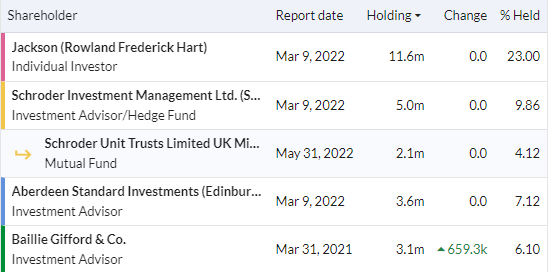
The Fisher family continues to control 23% of FSJ stock, with fund house Schroders in second place, with around 10%. That suggests to me that Schroders (also family controlled) sees value in this business.
Broadly speaking, I see this as an interesting turnaround situation that could deliver attractive returns over time.
However, if I was thinking about investing, I’d want to do more research into the history of the group’s operating divisions and its record of acquisitions and disposals. This would hopefully help me to understand when things started to go wrong, and what the solution might be.
Definitely a DYOR situation – but with a 175-year history and family ownership, I think James Fisher is definitely worth further research.
Somero Enterprises (LON:SOM) (I hold)
406p (-6% at 08.45)
Market cap £229m
“Record H1 revenue translated efficiently to strong profits and operating cash flow”
Today’s interim results from this concrete floor-levelling specialist report record revenue and are in line with expectations for the full year. But that hasn’t stopped the share price falling this morning!
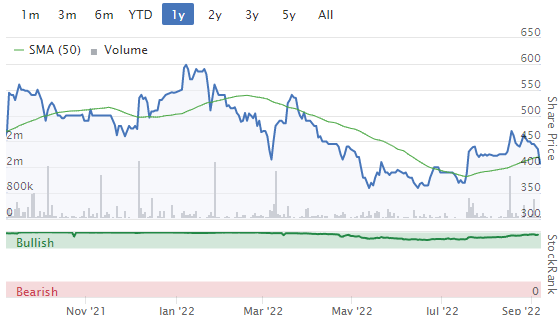
Trading commentary: Investors appear determined to price in a bearish outlook, and perhaps that’s appropriate at the moment.
But Somero says it’s seeing a “strong, active non-residential construction market” in the USA, together with encouraging growth in Australia and Latin America.
Financial highlights: Revenue hit record levels during the six months to 30 June, but there was some slight margin weakness, causing profits to slip slightly. This was attributed to cost inflation and increased headcount. Even so, today’s half-year figures look very respectable to me.
- Revenue +6% to $68.5m
- Pre-tax profit -5% to $22.4m
- Adjusted earnings -3% to $0.31per share
- Cash flow from operations -20% to $12.8m
- Net cash -17% to $27.2m
- Interim dividend +11% to $0.10 per share
Outlook: The momentum seen during the first half of the year is said to be carrying over into the second half. This is supported by a strong non-residential construction market in the US, with “extended customer project backlogs” and opportunities for international growth.
The board recognises the risk that supply chain shortages could “slow our ability to fulfil customer orders”. This could impact 2023 trading if unabated.
However, based on the strength of H1 trading, Somero feels able to confirm that 2022 results should be in line with market expectations. Helpfully, the company specifies what these are:
- Revenue: $138.8m
- EBITDA: $47.7m
- Year-end net cash of $39.9m
These numbers translate into some very attractive forecast valuation metrics:
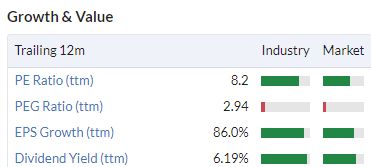
My view: As a shareholder, I don’t see any reason to change my view on Somero following today’s results. Cyclical risks will always be a factor and I do expect a slowdown at some point. Succession is also a potential concern, as CEO John Cooney is in his mid-70s and chair Larry Horsch is nearly 90.
However, the balance sheet looks bulletproof to me and the company appears to be continuing to execute well. Somero shares don’t look expensive to me at current levels and offer an attractive yield. I remain happy to hold (and buy) this stock.
Disclaimer
This is not financial advice. Our content is intended to be used and must be used for information and education purposes only. Please read our disclaimer and terms and conditions to understand our obligations.

79 comments
Somero Enterprises (LON:SOM)
For any fellow holders out there, below is a table showing unit prices (in $k) over the last few years.
Note the significant price increases over the last 6 month.
It was also interesting to see gross margins essentially flat YOY (and up sequentially from 2021 H2), and Sky Screed revenues of £1.3m for H1, which was higher than any of the 3 prior full years.
Cash generation still looks excellent and I remain a happy holder.
Cheers
A
Interesting Abtan, thanks.
Where did you find that? Is it your own using a couple of bits out of the report?
Somero Enterprises (LON:SOM)
Hi Doug
Yes, I collate data from the reports.
I love spreadsheets. Probably a little too much....
A
Somero Enterprises (LON:SOM)
But surely that means their actual volumes are falling if screed prices are rising significantly?
Which is the cyclical argument.
FinnCap also fixed their revenue for 2023 at the same level as 2022 guidance implying further volume loss.
Not sure I agree with that but it all adds to the 2021 was the peak argument.
Phil
(No holding)
Somero Enterprises (LON:SOM)
Hi Phil
That's exactly right - Boom Screed prices increased 16%, and this was offset by volumes falling 11% - the result was still a 2% year-on-year increase in revenues.
I was okay with this as gross margins, at least at a top level, were flat vs the prior year (and up sequentially.)
As for next year, I have no expectations about what will happen with product volumes and I don't recall seeing anything concerning today; some product volumes went up, some went down. That doesn't look unusual even when looking back over the last few years.
Many thanks for your comments on £HEAD Paul. Here's Chris Payne, CEO giving a presentation of H1 results, followed by all the investor questions yesterday. Video & podcast.
Thanks Tamzin! I listened to the podcast version of your webinar with Headlam (LON:HEAD) whilst trying out the new Elizabeth line in London today! A couple of points jumped out at me -
The gross margin up 100 bps was referred to twice, as being "temporary" - I'm not clear why that would be. Do you know?
Energy costs - if I heard correctly, it sounds like HEAD spends about £1m p.a. on utilities for its distribution centres & trade counters, which doesn't sound much. This is expected to go up as much as 5-fold (assuming no Govt help), so quite a headwind there potentially.
Demand reduced from households, but commercial floorcoverings is picking up, so something of an offset there.
I think he said all their distribution centres are owned freehold, which reinforces my focus on this key point.
Thanks as always for arranging, much appreciated. I thought the listener questions were superb! Very well presented, as ever, by your good self! I found the sound quality for the CFO rather a strain - sounded like he was on a bad phone signal, whereas the CEO was crystal clear. Both sound safe pairs of hands, and nicely grounded.
Regards, Paul.
Re £Head and "gross margin up 100 bps was referred to twice, as being "temporary".. why"
FWIW, my notes imply a gain on inventory build bought at lower prices when Manuf put their prices up, allowing Headlam to do the same but I cant tell if I inferred this or it was stated!
On energy costs, the CEO said in answer to Qs that solar was being in put in to distribution centres but it would take time for approvals (up to 1-2yrs I think). Since their energy usage in a is relatively light, I think this will provide a lot of cover quite quickly so it is a one winter issue with Govt support somehow provided for at least the next 6 months as well, according to the Govt.
(I hold)
RM (LON:RM.) SP down 41% today (at 28p its joined the 90% club!). I wonder if bad news (placing) is on the horizon?
Glad, for a welcome change, that I sold RM (LON:RM.) back in January at around £1.95 even though that was a loss of c. 20%. Sadly can't say the same about a few others where I could have done with escaping and are now at or close to the 90% club!
I also spotted that deep plunge in RM (LON:RM.) this afternoon, with no news released. It's on very high volume, and there's a late print of 9.35m shares sold early afternoon at 26p which might have triggered the price crash maybe? Looking at the big holders, my guess would be it could be the Buffetology fund dumping, as it had already recently sold 3.0m, and had 9.5m left, which would roughly tie in.
Graham covered the recent poor update from RM. I've just checked its last interim results, and don't like the balance sheet one bit. When you take off intangibles and a supposed pension surplus, then NTAV is negative. Net debt shot up. So it looks a possible candidate for an emergency refinancing, although that would be inside information, so if a major shareholder was aware of a fundraising, then they wouldn't be able to sell.
If my guess is right about the seller being the Buffetology fund, then they did something similar during the pandemic with their Revolution Bars (LON:RBG) (I hold) holding - ditching in the market, and smashing down the share price. The share price then more than doubled in the short term once they finished selling, but longer term came back down again. So maybe there could be a trade here, for a bounce with RM, but the balance sheet looks too weak for me to want to risk getting involved.
I've added it to my watchlist, so I can report back on any newsflow.
Regards, Paul.
Excellent trading update from iEnergizer (LON:IBPO) this afternoon
My gut feeling is that the FTSE 100 is still a long way from hitting lows which reflect the current state of the economy. Just look at it historically.
Is it possible to have a small cap rebound with the FTSE 100 dropping? I am unsure of that. More likely the small caps tread water while the FTSE 100 falls.
The bulls need to leave the FTSE100 IMO. 6500 would be a good starting point for a full market rally.
FTSE100 - (I'm Short)
Halfords (LON:HFD)
Chatting to friends over beers (expensive drowning of sorrows), we all determined to move annual car service from main agents to independents.
General feeling was that independents just as good as main agents and a lot cheaper. If others taking same view then good for the likes of Halfords but maybe set backs for likes of Vertu (I hold).
Mark
Would that not impact guarantees and possible resale value and therefore end up costing more in the long term?
Regards
Michael
I think there are two approaches here - if outside of the (assumed) 3 year warranty period then its a no-brainer to move to a much cheaper option - any decent garage will have the IT/software to interrogate a cars system to see what is wrong.
If within the 3-yr warranty period it is an economic decision to take the risk that the warranty isn't needed vs the savings that can be made - I also believe that there was a test case some years back that main-dealers couldn't refuse the warranty claim if the car was serviced outside of its dealership - on the proviso that certain parameters were met.
Having just had a BMW oil change for £335 vs my normal £110 on my old non-BMW car at a local unbranded garage I can see the attraction of going outside of the main dealer.
Halfords (LON:HFD) was on my watch-list and I think still seems a good option in the future, but I am not yet ready to invest my watch-list money yet as I am not convinced we have seen the bottom of the market.
I have used an independent for about 30 years. Touch wood never had a breakdown in all that time and I am a high mileage driver (sorry Greta ).
There was a time when manufacturers kept their computer codes secret but now independents have access. Support your local garage I say.
Only anecdontal. Last week rang five garages and all with good reviews for quotes to replace clutch, two replied and warned would be two to three weeks. Halfords might do well in the cost of living crisis as owners hold onto older vehicles and need to pay higher maintenance costs. Not holding but if falls back after rise today, tempted to do so.
Thanks Paul on Govererment support for energy.To me it takes the pressure of a potential catastrophe,that desen't mean oil & gas will stop rising,in the meantime that difference between capped & real cost has to be paid back by consumers via their suppliers in the future,"so in affect it's kicking the can down the road",it will basically be a mortgage on your energy.On our prospects v Europe it's a toss up who are worse off",you can argue we are less productive than Europe,either way we are both in a big mess.I admire your optimism but don't share it.
Repayment of the energy loan over decades will mean that today's pensioners are borrowing money from their children. That may be OK for families rich enough to be leaving their children a legacy but it hurts the rest. How much longer will a younger generation tolerate this?
I think most don't even realise its happening to them.
On QE - can this even be in the toolkit still?
I get that historically, we didn't have to worry about runaway rise in Gilt yields, because QE will just be used to drive the yield back down. But if gilt yields are rising due to soaring inflation, wouldn't additional QE just cause more inflation (or the expectation of more inflation) and therefore drive Gilt yields higher (based on expectations that the Base Rate will have to increase to tame inflation), thus negating any QE?
Is QE still a valid potential tool in the box in an inflationary environment?
If the answer is no... then we have this issue for shares now, that as gilt yield rises, money will flow from shares to bonds, and the PE ratio that investors will be willing to pay will continue to decline. The FTSE 100 is currently at a 12-13x TTM PE. I'd argue that looking historically, there's scope for that to fall to lows of 8-10x, which means a further 20-30% drop in share prices potentially still to come. Potentially.
Indeed the BoE has indicated that not only has it stopped QE i.e. no longer reinvesting the proceeds of bonds that have matured into new bonds, but it is contemplating QT (quantitative tightening) i.e. selling existing bond holdings.
https://www.bankofengland.co.u...
I think it's a question of sequencing: the BoE's (and other central banks') first priority currently is to bring inflation back down which will probably require further potentially substantial rate rises, which could result in a slower/shrinking economy. This is the big balancing act that central banks and governments are having to perform.
It seems likely that it's only once inflation expectations have been sufficiently lowered, and the unemployment rate has increased sufficiently so as to prevent a wage-inflation spiral, that central banks will consider switching tack and potentially pausing rate hikes or even cutting rates and/or moving back into QE to cushion the economic impact. The outlook/timing for lower inflation seems even more uncertain in the UK than say in the US given the upcoming fiscal package and the tensions between the new PM and the BoE regarding the latter's mandate, on top of global and potentially structural factors such as the energy crisis and China lockdowns / de-globalisation.
Yes BOE can't really do more QE when inflation is this high - markets simply would not accept this and you'd probably have a run on the pound. On the contrary, right now they are being forced to tighten policy (increasing rates and reversing QE through quantitative tightening)
I agree Boon part of the inflation problem was money being put into people pockets directly by the 400 billion covid qe response gilt yields rising means anyone holding gilts will be losing money on the capital value if your holding long duration in a rising interest rate environment you will get slaughtered. The status quo is B of E have stopped QE whether there will be some slight of hand to buy the 200 billion of gilts that will be issued to pay for everything we will have to wait and see.
I also can't see a scenario where if bond yields are going higher interest rates won't follow suit which is going to be bad news for anyone/business/government with large debt to service.
Paul, re Headlam (LON:HEAD) - when you wrote "Balance sheet - is fantastic. It’s not almost £200m of NTAV", did you mean "it's NOW almost £200m ..."?
Well done FREng! I was wondering who'd be the first to spot this !! ;-)
Paul, re Headlam (LON:HEAD) - when you wrote "Balance sheet - is fantastic. It’s not almost £200m of NTAV", did you mean "it's NOW almost £200m ..."?
I'll fix that now.
Best wishes, Paul.
Paul - have a look at K A-L's comments on RM (LON:RM.) in the September Buffettology fund review (of August) published yesterday:
"Of the 23 fallers, six were double -digit with only one reporting during the month. That was RM (-52.6%) whose delayed interim results were quite simply a horror show. We had commented only last month that the business had struggled to regain its mojo post Covid. August’s update revealed a plethora of challenges relating to an ERP roll-out at the same time as school budgets are coming under pressure from energy cost and salary inflation. Sadly, this shows little sign of abating in the short term. Damage to the portfolio was somewhat limited by its low weighting of 1.2% of net asset value at the start of the month. Our original investment was made in July 2019 at a time when the business appeared to be emerging from a big restructuring. Growth had returned, operating margins were moving up, returns to equity were over 30%, cash conversion looked to be moving in the right direction and gearing was about 10%. Thebig opportunity was the digitisation of education. Then Covid struck with its devastating impact on schools. Observant followers will have noted that we have been selling down our holding since April; being concerned about the revolving door of management changes and deteriorating investment metrics. However, having a large position in a relatively small company meant that we have been unable to exit as fast as we would have liked. Therein lies a lesson".
Quixant (LON:QXT) interim results seemed ok yesterday, with good growth in revenue and profit. Any chance of casting an eye over please Paul?
Surely that much of Somero's earnings are in dollars, and translating into pounds is going to give them a significant tail wind in the next year ? I recall first reading Pauls recommendation of SOM when the pound was low previously, sounds like much the same logic stands now, although as paul mentioned last week, it's currently more a matter of dollar strength than pound weakness. sounds to me like a pe of 8 is modest for such a company, I hear what you're saying re succession, but surely there are people being groomed internally ? (not in a bad way !)
Hi Kenobi, personally I don't tend to worry too much about currency headwinds. They tend to even out over time, in my experience. And they don't (usually) reflect on the company's operating performance.
Larger companies tend to be quite adept at managing FX exposure, too -- certainly more skillfully than I would be able to.
Roland
Interesting discussion to be had on a thoughful board like this re the Energy Price Freeze - (difficult to assign to "Trussonomics" as first the Lib Dems, then Labour having been calling for one for ages!).
The surprise for me is talk of a relatively low level 2 year cap on the 'price promise' – a cap potentially not needed in 12M time or set at the wrong level. I guess they can always change it.
Unless I missed it, the bigger big problem for investors was the almost complete lack of mention of long term structural reform of the energy market.
On supply side: the need to decouple gas and electricity prices, reducing cost of new supply through more onshore wind and renewables, a view on nuclear etc. On the demand side : insulation programmes to address fuel poverty permanently (as well as New Zero), variable pricing through the day to encourage demand shifting.
In short, the plans floated will address the short-term problem (good news, we faced crisis) but shows little sign of long term thinking – when the start of a reign is the best time to set a vision involving change.
For investors in UK Inc – which we see in things like the X-rate, interest rates and stock market prices over time, not today - the new regime does not seem to be materially different in its willingness to face up to tough choices. This does not bode well for the longer term. Frankly, I am thinking about moving my focus to shares abroad long term if this is the next couple of years.
Tax cuts and price freezes for rich grandparents to be paid for in 20 years by other people’s grandchildren does not strike me as a fair or good recipe for long term success.
Let’s hope I am wrong.
I wonder why the energy suppliers haven't hedged with options or something, does anyone know?
Utterly agree but has always been thus as someone said when asked your argument about grandchildren paying up for todays give aways "the unborn can't vote"
The solution for high prices is high prices, Economics 101. High prices encourage house insulation, alternative renewable energy and more efficient arrangements.
A socialist style subsidy to keep prices at the same level will keep consumption at the same level. This means the subsidy will have to be indefinite.
Better to protect incomes by uprating pensions / benefits in line with inflation. Employers will need to pay more to keep their workers. Successful firms will raise their prices, unsuccessful ones will get smaller or shut.
It amazes me that the current Conservative government are so against free markets. We will very shortly see if Liz Truss is the natural heir of Margaret Thatcher or a fake, i am guessing the latter.
Hi Epitychia,
I understand your point of view, but bear in mind that the proposed cap of about £2,500 per average household, is about double what we were paying last year, so a big increase, especially for poorer households.
For that reason, and fear of prices rising, I think most people are already cutting down on gas & electric usage. So for that reason, I don't think a new hard cap on bills is in conflict with people reducing demand.
Your proposal would result in widespread deaths over the winter, which is just not acceptable in a civilised country. When markets become dysfunctional, then Govts have to act boldly, and stuff the political or economic dogma!
The other major flaw in your proposal, is that inflation would then run rampant due to uncontrolled energy prices, which would trigger huge increases in Govt spending through salary rises (most Govt spending is salaries & pensions remember), and we'd then end up in a hyperinflationary spiral.
By nipping energy prices in the bud, PLUS supply side reforms, then this should enable inflation to be rapidly brought under control. Doing nothing would mean we end up in a disastrous economic depression, which would mean tax revenues drying up & spending going through the roof.
So it seems to me, the lesser of the 2 evils is what the Govt is planning. And a free market solution (in what are not actually free markets!) is a terrible idea in my opinion! So we'll have to agree to disagree on this, I think :-) But interesting to get your view nevertheless!
Regards, Paul.
agreed, I do hope that the government is addressing supply too, the idea of a windfall tax is fine, but I'd rather they be encouraged to invest that money in new green supply rather than hand it to the government. companies generating electricity from non gas sources are getting a huge bonanza, there should be some cap to the price they get, and we need to get massive investment in other sources. There has been talk of Rolls Royce creating mass produced micro nuclear generators based on the ones they build for nuclear submarines, but obviously without the restrictions those devices have, given the billions being lost here I would suggest big grants to rolls royce to get this technology up and running asap would be appropriate. I would rather that than pay billions to edf to build a nuclear reactor with a guaranteed min price of 43p per unit, as I think we have done. I would have thought a mass training and subsidised installation of solar would be a good idea too, The war may be in ukraine, and perhaps we're not fighting on the front line, although we are arming and training one side, but the effects are being felt far and wide.
They should impose a price cap on gas production / wholesale prices in the UK - perhaps average plus 20%. This still gives a good profit to producers and wholesalers whilst restricting excess profits.
UK only imports about 20% of gas so this 20% import would have to be at world / European market prices.
We should stop exporting gas (as we are currently doing) and put any excess UK production into the Rough storage facility.
Truss' proposals just pay hundreds of billions to producers / wholesalers / traders in gas which we then have to pay back over 10 - 20 years. Plus interest of course.
I thought Rough had been shut down ? which is what's causing us a big problem as we now have know where to store excess supply so end up selling it to Europe.
Ah, the ol' Austrian vs Keynesian economist showdown. ;)
I'm pessimistic about everything at the moment. I believe that the scenario of high inflation and recession will likely happen.
I think that a lot depends on whether you think that high energy prices is a short-term blip or long-term. If it's short-term then government intervention may help. I'm always suspicious of government intervention, though.
If you think high energy prices will be a long-term problem, then we're basically all hosed. There is, after all, no such thing as a free lunch. It all has to be paid for one way or another. It has to be paid for via taxation or borrowing. Countries can only sustain so much borrowing.
Prices will come down if one can increase supply. That's not an easy thing to do as it requires technology and availability of resources. We're past peak petroleum production, so what we're going to do about that is a major dilemma with no easy resolution. I saw a demo where a plane flew using batteries. I sincerely doubt that this is a feasible solution, though.
Alternative tech is expensive. I get the impression that wind farms have low returns on investment. They have a limited life, too. Be prepared to cough up dough if you're banking on wind farms. Solar seems pretty rubbish, too. Nuclear (fission) and hydro seem to be our best bets at the moment.
Clean coal? Virtually no-one mentions this, but perhaps they should. I don't know what the economics of it are. The way I figure it, we can process petroleum, why not coal waste? I'm just talking through my hat here, you understand.
In summary: it ain't easy. To quote Woody Allen: “Mankind is facing a crossroad - one road leads to despair and utter hopelessness and the other to total extinction - Let us pray we have the wisdom to choose correctly."
With respect I dont agree.
The GBP have had the scare of an horrendous increase in their utility bills and the prices HAVE gone up already , the cap or freeze is just stopping them go up further.
From my circle of friends etc many have already put in place measures to reduce consumption.
R
Excellent results from Coral Products (LON:CRU) this morning. Revenue £14,391k, up 34%, pre-tax profit £1,330k (2021: -£316k), gross margin up to 36.7% (2021: 35.5%).
And a very important point: "[We have] review[ed] all group energy contractual relationships to confirm all group energy needs are of a fixed long-term nature agreed prior to the current energy crisis". And "all [group] operations will remain relatively unaffected by the current turmoil in energy prices".
Revenue next year will explode due to acquisitions - I am expecting £34m+. It's not in the forecasts and the market seems clueless about the huge short to medium-term potential here.
Coral Products (LON:CRU)
Update - Cenkos have initiated coverage this morning. They are forecasting revenue of £32.1m for 2023.
Yes, excellent news from Coral Products (LON:CRU) (I hold ) and even in these strange times I don't understand why this is so cheap. Current yield 6.67% and things likely to be better still next year. Or am I missing something?!
I agree with you Paul if the energy crisis is a one winter issue, but what if it continues over several with Russia grinding it out? Hopefully the challenges would diminish a bit with nuclear plant restarts, efficiency measures and alternatives increasing but such energy infrastructure challenges tend to take many years to fully plug with new generation and supply.
Hi Dogon,
Yes, good points. I'm no expert on the energy sector, and am sure you're right that long-term fixes could take a long time. But my main focus today was on the impending collapse in consumer spending, and widespread insolvencies of businesses, which would have happened if Govt did nothing to prevent household energy bills rising to est.£6k p.a. by early 2023. So a hard fix at nearer £2.5k, is a huge change in what was expected. Hence bullish for bombed out consumer-related shares, I think.
I'll leave it to the experts to work out how the longer-term energy problems get fixed.
Regards, Paul.
"I'll leave it to the experts to work out how the longer-term energy problems get fixed."
Paul - The experts work on the problems they are set by the leaders. That's why I'm long term concerned. Short term, a small cap bounce is possibly, likely even - the mood was so dire. But I thought our focus on this board was about being long term investors.
The West's (UK, EU, USA) relationship with Russia is going to be bad for many years now - this means shortages in gas in EU (and knock on to the UK) for 2 - 3 years minimum IMHO.
Even if Ukraine win the war in their country this issue does not go away in 12 months.
Worth watching the video from UNIPER CEO
Worst is yet to come for gas/power prices this year wholesale prices 20 times 2 years ago
https://www.cnbc.com/2022/09/0...
Yes they are multiple times two years ago but the current surge is primarily due to Russia's invasion of Ukraine. However, perhaps the threat of recession in Europe and the efforts to source gas from other sources might now be having a negative impact on gas prices. European gas prices based on the Natural Gas EU Dutch TTF (EUR/MWh) which was 208.00, down 31.84 (-13.28%) today is also down by 40% since August 26th The main index in the US (Henry Hub) has also been falling. Add to this the oil price has been falling and Brent Oil today is below $90/bbl (Source: FT). Consequently if these trends continue and the UK government introduces the price cap the Goldman Sachs revised forecast of 10% (on the basis of the expected Government action) might actually be a bit high. However, I do think that even at a level below 10% the BoE will still have to raise interest rates to try and control inflation and possibly stop a run on the pound. This will see Gilt yields increase and might actually make government bonds investable for income seekers provided of course the UK government stays solvent!
Interesting comments Paul re support and markets. You took me a little by surprise especially as you think the proposal limits inflation. I don’t want to be overly negative at the moment although I still think the US market has a forecast risk problem. And no sign the fed will pivot yet.
My view would be the Covid response has pushed the economy to some sort of capacity threshold. This is alleviated through time through investment. The energy crisis is clearly severe but for me means policy makers have nothing to lose by accepting a recession ( curtailing demand ) and keeping policy tight. At least short term. How long all this lasts remains to be seen. Anyway if anything whilst the cap and policy might limit headline inflation - the transfer of wealth and rise in borrowing (spending ) must also be inflationary. That all sounds confusing I know.
I’ll try again - policy responses will likely result in higher bond yields - potential sovereign debt issues - all at a time the Fed is tightening. Liquidity in markets likely to remain dire and bond spreads widen. In the short term I’d be a little more cautious…. BUT I agree I major opp is on the horizon. At the moment we are in the second leg down - traditionally the worst part of the bear - I’d like to see where we bottom and take it from there. The Least liquid parts of the market i’d continue to be very careful in. Anyway that’s what makes a market - good luck everyone.
I agree RDHOWARTH, you write like a fellow FT reader?
Hi RDHOWARTH
Sorry, this message is very late and completely out of context with anything you've written today.
I meant to send my thanks for sharing your podcast interview a few weeks ago. I found it really interesting and thoroughly enjoyable. It certainly got me thinking about what my 'number' is.
Cheers
A
Thank you Abtan - that's very kind.
Good morning Paul
Great article but I think a typo in paragraph 5 should be 100% not 10% of GDP?
Agree with your sentiments though!
J
Hi jamieswain,
Great article but I think a typo in paragraph 5 should be 100% not 10% of GDP?
No typo. It says 10% p.a. - i.e. the annual over-spend by Govt (deficit). Are you confusing it with total debt maybe? (which is nearer 100% o GDP, if we ignore the reality that over a third of that debt is actually owned by the Bank of England, so isn't actually debt owed to external parties).
My point was that in recessions previously, the annual Govt deficit tends to peak at around 10% of GDP. It looks to me as if the latest support measures about to be announced, but trailed in the press, would take the deficit up to that sort of level, maybe even beyond, who knows.
So it's difficult to see how tax cuts could be afforded, on top of this huge package of spending on controlling energy prices. Although that depends on how much progress they can make on supply arrangements - e.g. forcing UK producers of electricity to accept new contracts that reflect their actual costs, plus a reasonable profit margin, rather than being linked to the cost of wholesale gas. That link clearly needs to be broken for electricity generated from other sources, not gas.
Regards, Paul.
> e.g. forcing UK producers of electricity to accept new contracts that
reflect their actual costs, plus a reasonable profit margin, rather than
being linked to the cost of wholesale gas.
Yes, but won't the producers then cut supply to domestic customers so that they can service more profitable sectors?
The problem with interventionism is that you end up micromanaging everything. It's like herding cats. You want the cats to go one way, but they tend to veer off in uncontrollable ways.
As mentioned by others, Somero Enterprises (LON:SOM) once again delivers impressive results, which the company flagged at the trading update on 19th July. Somero Enterprises (LON:SOM) continues to trade line for the full year while its cash generation enables it to invest in people and product development and pay a handsome dividend that has been increased by 11% at the interim stage.
I appreciate the cyclicality of company's operations but it is difficult to deny the medium/long term opportunity that the current grudging share price significantly fails to reflect.
I hold and added at the update so have a natural bias.
Over to you Paul/Graham/Roland for any thoughts you may have.
Hello Jonno, and all reporting, and much of the growth, in big fat $US too!
I wonder if the outlook comments have worried some people? Especially....'While these shortages can carry over and negatively impact 2023 trading if continuing unimproved, based on the strong H1 2022 results, confidence in the health of the non-residential
construction market, and with the benefit of unfilled orders carried over from H1 2022, the Board is pleased to confirm 2022 results are anticipated to fall in line with market expectations for revenues of approximately US$ 138.8m, EBITDA of approximately US$ 47.7m, and year-end cash of approximately US$ 39.9m.
fall in line or fall in line = fall or = in line! I wouldnt have chosen to use the word fall at that point!
Hi ridavies
Insofar as 2023 trading is concerned and potential supply shortages, I have no idea how this will play out. I try to stick to the facts and avoid if possible being drawn into predictions or speculation. Somero Enterprises (LON:SOM) is a cyclical business but is well managed, in my view. It continues to invest for the future and to paraphrase Roland has a seemingly bulletproof balance sheet, so insolvency is not a concern
Recessions come and go and for what it is worth it appears the US economy has the best chance of avoiding one at present. Regarding the use of the phrase 'fall in line' I don't see any sinister connotations as management has always played fair with investors. I shall watch the PI webinar with the company on 13 September, when no doubt the reference to potential supply shortages will raised.
All the best
Re the Somero Enterprises (LON:SOM) report I wasn't implying anything sinister; rather that this was slack and inappropriate wording, given the twitchiness of the market at the moment.. There was no need for the word 'fall' at all; just 'in line', which is what it is.
They have applied price increases to match cost increases, and these always have a bit of a lag.
They are investing, and this has been flagged if not flogged for some time in a succession of reports.
As you indicate the US as usual is likely to get off mst likely from all this, and although cyclical, supporting big box building for customers which need precise which I guess is one of their strengths, is likely to be less cyclical than most sectors.
Yes would agree about the wording on the Somero Enterprises (LON:SOM) update but of course one can look on the bright side, it gives true believers like me (I hold) an opportunity to top up!
Regards
Michael
Paul I agree with your sentiment that the energy intervention might be the equivalent of the vaccine announcement - particularly if other nations follow and markets realise that governments aren't going to let energy prices get out of control. It's important to note that among what's being suggested is Liz Truss' government intervenes in the wholesale market to set maximum prices for UK produced gas and electric. How long before the EU/US/other nations say to their producers you can only set prices at X amount?
ps now might be a good time to bank profits on any energy producers!
Halfords TS looks surprisingly strong today, it's on my watch list as possibly oversold but the debt worries me, I wonder if we have any strong holders on Stockopedia with more insight into the company?
what is worrying about the debt ? they have net cash, the rest is made up of leases...
Rising interest rates and customers squeezed. I'm sorely tempted but have caught too many falling knives in the last few months. I note Paul's positive comments.
M&C Saatchi (LON:SAA)
Interims out this morning, meanwhile the takeover situation seems to drag on.
https://www.londonstockexchang...
Interesting thoughts Paul. I'm not a fan of QE to put it mildly but a big response was needed here.
Many shares are priced for Armageddon right now, some below Covid lows!
But what if inflation has peaked in the UK? Shipping costs dropping every week, commodity prices falling. With a cap on energy prices this could completely change the outlook for many businesses. The negative fog will at least be partially lifted.
Id recommend anyone to view £LUC latest presentation - https://stream.brrmedia.co.uk/... An excellent insight into inflation pressures.
Hi Gringo,
do you have a link for £LUC latest presentation on IMC.
https://www.investormeetcompan...
Video may not be up until later, will be on Youtube today or tomorrow also Id imagine
This one is available now- https://stream.brrmedia.co.uk/...
Luceco (LON:LUCE) looks compelling value at the moment...
Please elaborate. I see that the broker forecasts have recently reduced.
There is also Edwards excellent article here on Stocko : https://www.stockopedia.com/co...
Somero Enterprises (LON:SOM) H1 22 results today, in line for the full year. Amazing results after a record year last year.
Webinar Tuesday 13 September, 3pm.
Register here https://bit.ly/SOM_H1_22_Results
Plus interim dividend increased 10%, yielding 9.7%, finncapp have TP of 808p, 86% above current trading price.
thats just bonkers !
Yet it's still opened 5% down... Ah the joys of a bear market.
Somero Enterprises (LON:SOM) mostly all metrics down on last year, plus only in line
Somero Enterprises (LON:SOM)
JohnDoe2378
"mostly all metrics down on last year, plus only in line"
You have to factor in the significant investment they are making this year - its known they have upped costs to invest for future gain - this was fully flagged up and expected - so market will have fully expected metrics to be where they are i dont see h1 2% ebitda drop as being material when we factor in that they have confirmed they are on track to match last years year end EBITDA number ignoring 100k difference which i see as being non material. There is nothing in these numbers that looks sketchy or unexpected to me. Perhaps market was hoping for a beat i certainly wasnt expecting a beat.
I suspect worries here are ref recession and perhaps thoughs that company may be investing at wrong point in the cycle - i for one though happy that management are paying then long game game they have played as that should increase their range products and potential sales even if there may be blips just over thr horizon - being honest 5% swing eitehr way on thjis share is to be expected on results day probably depending on where the sheep go.
per update at start of the year
Regarding newproducts, and taking a longer-term view, the Board recognizes the significant long-term value creation opportunity that comes from increasing the Company's
addressable market by developing innovative solutions for new applications and marketsegments. As such, the Company remains committed to investment inproduct development, sales, and support resources to drive this effort, anecessary near-term investment and cost with longer-term benefit. With acombined view of these factors, the Board expects 2022 will be a highlyprofitable year with healthy cash generation, modest revenue growth, andEBITDA comparable to 2021 that reflects the planned investment in resources for future growth and the full-year impact of 2021 staffing additions required to support the growth of the business.