Sosander: ditching the discount powers profits as customers return

When I write a Stock Pitch, I usually choose companies where I’m already reasonably bullish. This week I’ve flipped that around to choose a stock where the StockRanks are bullish, but I’m less sure.
Women’s fashion brand Sosandar (LON:SOS) may be a fine business with exciting potential. But its record since listing is mixed and as a marginally-profitable startup, it falls outside my personal investing universe.
For this week’s Stock Pitch I’ve decided to venture outside my comfort zone and take a closer look at Sosander, which is one of the latest StockRank Jumpers highlighted by Ed’s exciting new research.
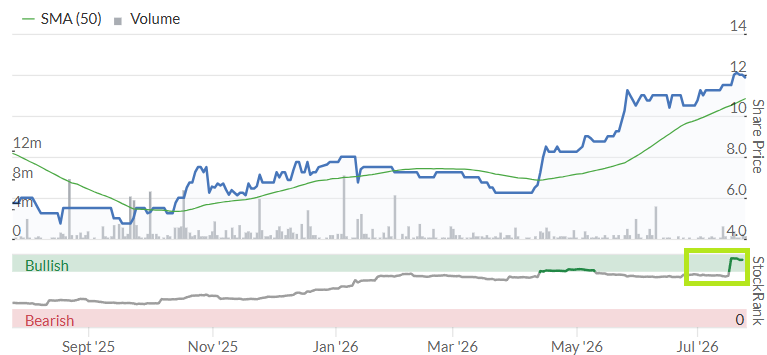
Sosander’s share price has also doubled over the last year as investors have backed the founders’ revised strategy, perhaps suggesting that there really is new momentum in the business:
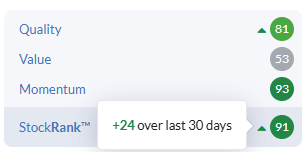
What’s more, July’s StockRank Jump has left the shares with strong Quality and Momentum scores. That could be a nice setup for further growth:
Share price at the time of publication: 12p
Market cap: £26m
Disclosure: at the time of publication, Roland has no position in SOS.
The Pitch
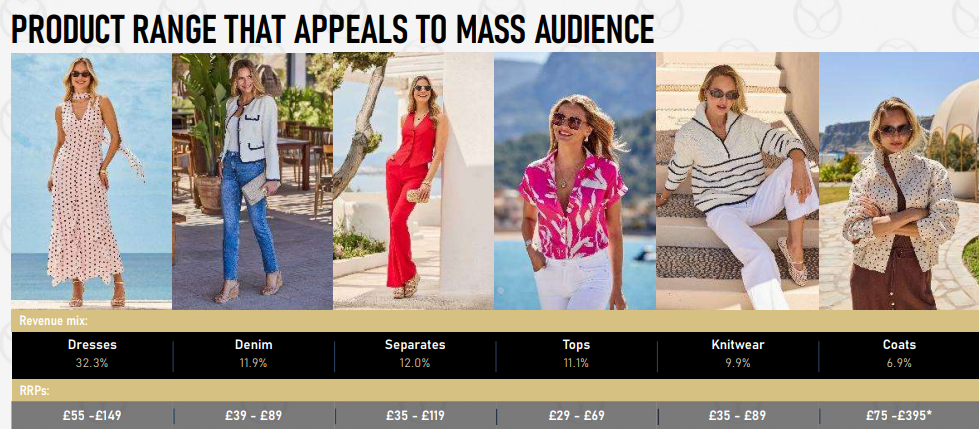
Sosander was founded in 2015 by former fashion journalists Julie Lavington and Ali Hall, who run the company as co-CEOs. Launched as an online-only business, it’s a mid-priced fashion brand targeting “underserved 35-65 year old women”.
Source: Sosander FY26 presentation
Sosander listed on AIM in November 2017 through a reverse takeover. The business initially reported rapid sales growth and improving profitability:
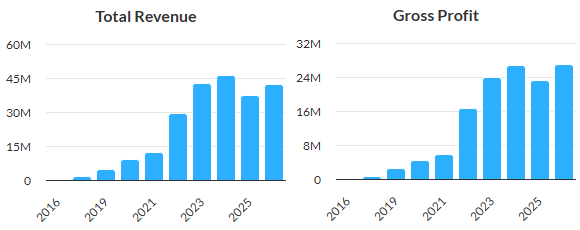
However, progress was put on hold in 2024 when the company decided to open some physical stores and move away from regular discounting towards a full price strategy.
The result of these decisions has been two years of sales below previous highs. However, I believe the benefits of this approach are starting to show. If recent momentum can be maintained, this business could be well on the way to becoming a larger and more profitable retailer than it’s been previously.
In the sections below, I’ll explain why this strategy could work and offer some thoughts on valuation.
The Big Picture
Sosander’s recent FY26 full-year results suggest to me that its full-price strategy is working. Margins improved and sales momentum looks solid:
FY26 revenue +14% to £42.3m, with adjusted pre-tax profit doubling to £0.4m. Q1 FY27 sales rose by 22%, helped by a weak comparative last year. Full year expectations were unchanged.
Active website customers rose by 15% to 205k in FY26, with improved order frequency and conversion rate. Sosander is starting to reverse the 30% decline in active customers it suffered after the switch to full price sales in FY25. This suggests to me that the company's target customers have accepted this new pricing strategy.
Most customers are repeat shoppers: 75% of its sales are to repeat customers, who shop an average of four times per year. Marketing spend to acquire new customers is now paid back on the first order.
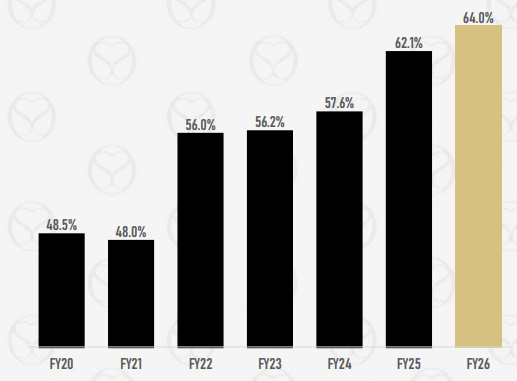
Rising gross margin signals opportunity: for consumer goods, a high gross margin is often a sign of a brand with pricing power. Sosander’s gross margin rose to a very respectable 64% last year, putting it at a similar level to Dr Martens (66%) and Burberry (68%). If Sosander can maintain this performance, continued sales growth could drive a rapid improvement in operating profit as revenue outpaces costs.
Source: Sosander FY26 presentation
Going Deeper
Drilling down further highlights a number of other factors that could support profit growth and which do – perhaps – add credibility to the investment case:
Physical stores: it’s easy to scoff at Sosander’s decision to open physical stores. These shops may yet prove to be a white elephant. But founders Hall and Lavington make the point that 60% of the c.£60bn clothing market in the UK is still transacted in stores. They believe Sosander’s shops will help to build brand awareness, support customer loyalty and drive more traffic to the company’s website. In fairness, this is consistent with the strategy used by many other mid-market and premium brands.
Third-party sales growth: Sosander also sells through a number of third parties, including Next, Marks & Spencer and John Lewis. These now account for c.50% of sales – up from zero five years ago. This provides a capital-light way to expand, including internationally.
M&S tailwind: according to the latest note from Singer Capital Markets, last year’s M&S cyber attack translated into c.£0.7m of lost profit for Sosander. Sales have now returned to normal, so I assume the profit contribution from M&S should recover. Sosander’s adjusted pre-tax profit is expected to rise by £0.7m to £1.1m in FY27. I would guess that some of this should already be underpinned by normalised M&S sales.
Positive cash generation: I am always more favourably disposed to companies generating positive free cash flow. That’s true here. My sums estimate underlying free cash flow of 0.6p per share last year, or around £1.2m. That’s comfortably ahead of Sosander’s FY26 adjusted net profit of £0.7m and gives the stock a free cash flow yield of c.5% – reasonable value.
Ownership: each of the two co-founders has a c.2.4% holding, while serial entrepreneur Nigel Wray owns 11.5%. Schroders is the largest shareholder at just over 20%, providing solid institutional backing. Collectively, I think the major shareholders are likely to be aligned on creating a more valuable business, even if some patience is required.
What The Brokers Say
Broker consensus estimates on Stockopedia present a mixed picture:
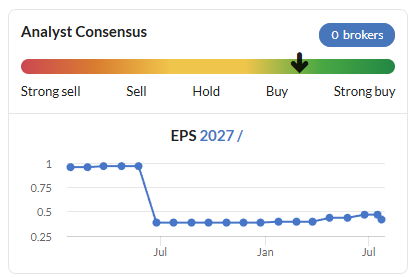
Checking individual forecasts from Zeus Capital and Singer Capital Markets on Research Tree confirms this consensus estimate remains valid – both brokers have a FY27 adjusted EPS estimate of 0.4p.
There are no FY28 forecasts available yet.
Zeus has a fair value estimate of 16p, while Singer’s target price (pending an update) was 11p on 14 July. Averaging these gives a figure of 13.5p, about 12% above the recent share price of 12p.
The Bear Case
Building a successful fashion brand is a tough challenge. I can see a number of risks here that could limit future share price growth:
Retail store risk: store sales only rose by 13% on a like-for-like basis last year, compared to a 24% increase in website sales. To make matters worse, Sosander’s stores are still losing money. The company says that the stores placed a £0.9m drag on pre-tax profit last year. Despite being in their second year of operation, management say the shops are still “maturing”. I’m not sure how long it’s expected to take for them to become profitable. They may not do.
Lack of fundamental momentum? Sosander’s share price has almost doubled from its March 2026 lows, but as we’ve seen above there hasn’t been a corresponding increase in broker forecasts. This lack of fundamental momentum is a risk – as we’ve seen elsewhere recently, fast-rising share prices can quickly reverse if momentum isn’t supported by rising expectations.
Fully-priced already? As things stand, Sosander trades on a FY27E P/E of 29. That’s not cheap unless sales and profits continue to rise, ideally at 10%+ per year. With no forecasts for FY28, earnings visibility is limited.
It’s a tough market: the track record of small fashion brands building durable growth businesses in the UK is mixed. Many enjoy a short period of success before fading. Maintaining volume growth without a return to discounting will require strong brand-building and consistently good product.
Trustpilot: Sosander has nearly 2,500 reviews with an average 4.6-star rating. That’s pretty good, but I was struck by a small but meaningful minority of reviews complaining about product quality issues. If that’s a representative sample then it could be at odds with the company’s brand positioning.
The Bottom Line
Sosander has established a clear niche and benefits from founder-led clarity and strong distribution through major retailers, as well as direct channels.
There’s growing evidence the company’s full-price sales strategy has been accepted by shoppers: the number of active customers rose by 15% last year and 75% of website buyers are repeat customers.
Implementation of this strategy has improved the economics of the business. The group’s gross margin rose by 1.9% to 64% last year, a level that’s close to other respected mid/up-market brands.
Risks remain, of course. Sosander’s foray into physical retail stores is still loss-making and could remain so. This year’s forecast sales growth of 11% is adequate rather than inspiring and there are no forecasts for FY28 yet.
If sales growth or margins falter, the current valuation could lack support. But if the company’s recent trajectory can be maintained, I think there’s a good case to argue that Sosander could become a larger and more valuable business.
Disclaimer
This is not financial advice. Our content is intended to be used and must be used for information and education purposes only. Please read our disclaimer and terms and conditions to understand our obligations.

9 comments
Excellent analysis!
All the best
Rowland, Excellent write-up on Sosandar (LON:SOS) — A stock I've recently taken a opening position in.
The most noticeable Jump for me was not the Stockrank which is up +24, but the substantial Q Rank Jump which is up +43 in the last 30 days. This is because Quality Rank led jumps carry roughly 5x the forward-return edge of Momentum or Value led ones. This differnece is most likely because the market is slower to price a change in Quality, than a change in price momentum or value. The open question now is whether Sosandar (LON:SOS) is an underpriced Quality Jump arrival, or one where price had already run ahead of it?
A downside with the likes of Sosandar (LON:SOS) is the extreme illiquidity and lack of active broker research, which is where review articles like yours become soo useful.
That +43 Q rank jump was actually within 7 days between 16th and 23rd July, and suggests that a high weighting is being given for just one set of results on 14th July.
Yes, its only results days that will signifigantly rescore the Q Rank.
Ive been trying to think of reasons why the market is slower to price in a change in quality for small caps. Is it because calculating a change in the quality of a business is difficult? Or because the company is small and it's stock is hard to buy in great quantity there is a lack of broker/analyst interest in it- Peter Lynch actually thought this was an advantage to the individual investor. Does that also explain why the stock rank jump is less reliable for companies whose market cap is greater than £350m? Does anyone else have any other theories?
I suspect they simply dont trust small companies - can a small amount of individuals in a smaller company more easily destroy the company than a large compay ? probably - can insiders more easily hold back info or do stuff for purposes that suit them rather than shareholders - probably.
I get the skepticism - thats is sometyimes an opportunity - i would say trusting managment is key ref transparency and ability.
Perhaps its lack of liquidity and lack of coverage that doesnt help?
Perhaps it takes less to take down a small company compared to a big un.
i am prettty sure if Northern Bear (LON:NTBR) had everything 4 times the size it has now with consisent metrics it would be on p/e higher than 3.9. Recent results were perhaps as good as could have been expected - stock rank is on thne up and still its a miserly rating - albeit slight blip up on the day
Maybe no one really cares.
does that give us opportunity to add on the drift.
If i had one main danger its that if there is bad news out there that is likley to be filtering down to us shareolders last - the money that matters may know at same time or ahead of directors. That danger is perhaps minimised by taking action only after a thorough update from the company.
Welcome aboard the Sosandar (LON:SOS) ship :)
IMO the best companies to buy are those where top line revenue is growing nicely (10%+ YoY), there's margin expansion, and also the PE is low. Sosandar ticked two out of the three boxes for me, and the PE test I waived as it was a company around break-even, and around that level, PE test isn't a good test of that metric.
I have been on the Sosandar ship before (2021-2022) and bought back in at 5.8p in Feb 2025. Its getting close to becoming a 2-bagger for me now. Finally, as the numbers are coming in 2026, the rising revenue and margins are proving themselves.
The big question I have now is.... where does future growth, margin or sales, come from?
The strategic shift to full price is already complete, with no further margin initiatives announced.
No new third party platform partnerships announced for the UK. Nor for international.
No major growth initiatives for their DTC online website.
Physical stores have not proven to be a profitable new channel.
The fashion market is not double-digit growth a year in the UK.
I suspect their DTC website probably still has another 15-25% of growth still left to squeeze over the next 2-3 years, which is not bad. Partners probably another 10-20%. But the cupboard is somewhat bare 24m+ IMO.
Sosandar would also make a very nice bolt-on acquisition for a PE fashion portfolio or a trade buyer; squeeze out the overlapping costs, leverage wider distribution capabilities of the acquirer, crack Europe and the USA markets.
(I hold in the Boon Fund)
TBF.....I think there should be quite a bit to come from the third party sales as the brand increases recognition and we know it was doing amazingly well within the M&S platform and stores but then their cyber attack closed that tap off completely....it is now returning and will probably surpass sales from that channel this year.
Losses from non profitable stores will be removed as they close them and I think they will be incredibly careful if considering new ones to open. Profits could easily surprise us going forward
Putting the Jump data aside — FY26 adjusted PBT was £0.4m, and FY27 consensus sits at £1.1m, a £0.7m gap that matches Singer's estimate of the M&S drag almost to the pound. So M&S normalising looks like it accounts for most of the expected broker FY27 PBT improvement on its own. Any further upside — from the Bath etc store closure, or from Sosander's remaining profitable sites — would be genuinely incremental.