Stock in Focus commodity special - Rio Tinto

The recent commodity slump has added some red ink to a lot of private investor portfolios, including mine. Yet now could be a good time to buy for contrarian value investors. After such severe declines, surely there are some bargains on offer?

In my view, the only way to acceptably offset this risk is to ensure that a company has top quality assets that can be operated at very low cost. A modest valuation, strong balance sheet and decent dividend history are also essential, in order to improve the odds of above-average long-term returns.
The company also needs to be large enough to ensure good access to funds at attractive rates, in all foreseeable market conditions.
My view is that a company ticking all of these boxes ought to have a high QV (Quality & Value) Rank and could be provide an attractive entry point. To put this to the test, I hunted through the top-ranked stocks in the Energy and Basic Materials sectors on Stockopedia.
Enter Rio
Unsurprisingly, there were not many companies which matched my criteria. One of the few that did was Australian iron ore giant Rio Tinto, which is a holding in my long-term income portfolio.
Rio’s iron ore reserves are amongst the largest and cheapest to mine in the world. As an indicator of scale, the firm’s Pilbara iron ore operations include 190 locomotives, 1,700km of rail and three ports, along with 15 mines. Rio expects to move 1 billion tonnes of rock and to ship 340m tonnes of iron ore in 2015.
Operating costs are impressive, too. During the second half of last year, the Rio’s cash unit cost for iron ore fell to just $18.70/tonne. With iron ore prices currently at about $50/t, there’s no risk of Rio losing money on iron ore.
Rio has pushed ahead with production growth on the basis that higher-cost producers should withdraw if demand is insufficient. That’s the same argument used by OPEC oil producers like Saudi Arabia and Iraq, and makes good sense to me.
I intend to add to my holding in the near future. In my opinion, Rio meets all of the criteria I listed above. I’m only human, however, and am at risk of behavioural biases such as anchoring and confirmation bias. Is it too soon to buy into commodities?
To see if I can justify adding more Rio shares to my portfolio, I’m going to subject the company to the cold and dispassionate eye of Stockopedia’s algorithms. If Rio still ticks all my value boxes at the end of this article, then I’ll hit the buy button.
First indications are good. Rio sports a QV Rank of 97, thanks to a ValueRank of 90 and a QualityRank of 85. The momentum score is predictably poor at just 14, but that’s the profile I’d expect from a contrarian stock -- fundamentally attractive, but seriously out of favour.
Mining value?
Rio’s ValueRank of 90 is built on a solid set of numbers. The shares trade on a trailing P/E of 8.5 and a price-to-free-cash-flow ratio of 11.2.
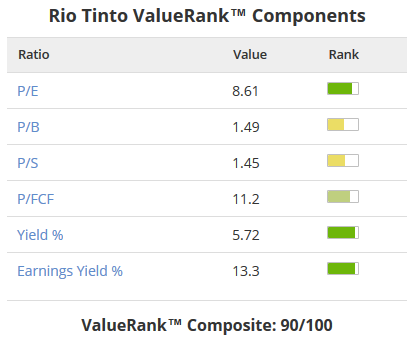
The earnings yield (EBIT/EV) of 13.3% is impressive, while the miner’s trailing dividend yield of 5.7% is very tempting. This payout is expected to keep pace with inflation over the next two years, resulting in Rio’s inclusion in both the Dividend Dogs and Dividend Dogs (Forecast) screens. The latter of these has risen by 16.4% over the last two years, while the FTSE 100 has remained flat over the same period
Rio’s large cap, high-yield dividend credentials also qualify it for the James O’Shaugnessy Cornerstone Value screen, in which it has appeared since March 2013.
Overall, there’s little to dislike about Rio’s value credentials. The only problem is that they are largely dependent on selling iron ore for nearly twice as much as it’s worth today.
Feel the quality
This valuation risk highlights the need for quality. A big miner with a strong balance sheet, low costs and sensible management can weather most storms. After all, Rio has been in business since 1873.
Rio’s balance sheet improved considerably in 2014. The miner reduced net debt by $5.6bn and and cut costs by $1.5bn. These actions helped to bring net gearing down to just 26% and improve interest cover to 5.8.
Free cash flow rose to $3.29 per share last year, almost matching reported earnings of $3.51 per share. Meanwhile an operating margin of 25% highlighted the money which can be made from Rio’s iron ore assets.
Rio’s Piotroski F-score of 6 reflects these strengths, but flags up the firm’s falling pricing power.
It’s worth noting that Rio’s other divisions, coal, aluminium, copper and diamonds, all place a significant drag on the firm’s profit margins. Rio’s net profit margin from iron ore was 35% in 2014. The figures for other divisions ranged from 14.5% to -5%.
In the short term, this adds to risk and dilutes return on capital. Over the long run, however, I’d expect Rio’s multi-commodity portfolio to help smooth returns and maintain growth.
Negative momentum
Rio shares are down by 20% so far in 2015, and are 32% below their 52-week high.
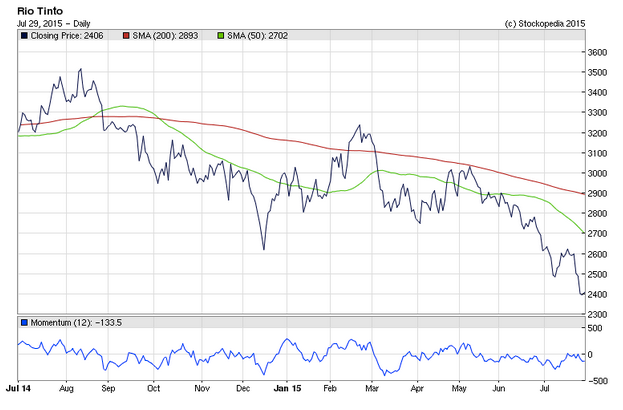
There’s no doubt that price momentum is weak, with the firm’s 50-day moving average falling further away from the 200dMA and momentum negative on a 1-year timeframe.
Yet on a 5- or 10-year timescale, Rio’s moving averages present a different picture, suggesting possible support at around 2,300p, with potential upside towards 3,000p.
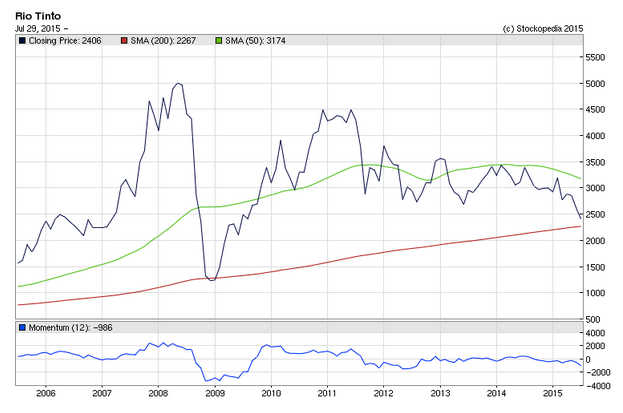
This more bullish interpretation is far from certain, however. Momentum remains negative on almost any timeframe, while earnings downgrades add to the pressure on the firm’s share price.
Rio trades on a rolling forecast P/E of 14.4, but earnings forecasts have been consistently downgraded in recent months. Over the last month alone, 2016 forecast earnings per share have been cut by 10%. This year’s EPS forecasts have dropped by almost 13% over the last three months.
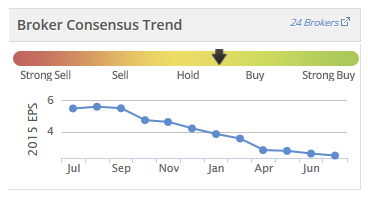
These consistent downgrades mean that Rio also qualifies for the Earnings Downgrade Momentum Screen, a short-selling screen that’s delivered a return of 23% over the last year.
My decision
I should say that although I personally believe that Rio is an attractive long-term investment (I hold), I think that there is a good chance the firm’s shares will fall further before they start to recover.
I also accept that big miners are currently unpopular, boring and appear to have problems. That’s the nature of contrarian value investing.
I intend to go ahead and add to my holding in Rio, but as always, this article is my view only and is intended to stimulate discussion for investors willing to DYOR. It is no substitute for personal research, and is certainly not advice.
Disclosure: Roland owns shares in Rio Tinto
Disclaimer
This is not financial advice. Our content is intended to be used and must be used for information and education purposes only. Please read our disclaimer and terms and conditions to understand our obligations.

No comments yet
No one has commented here yet! Why not be the first one?