Stock in Focus: H&T Group

Pawnbrokers protect their profit margins by only offering customers a fraction of what their items are worth and by lending cash at eye-watering rates of interest.
Does this pragmatic approach to operating at the distressed end of the credit market make them a good investment?
Investors might expect so, but pawnbrokers have been through the mill over the last few years, thanks to the gold price slump and to tighter restrictions on payday lending and short-term loans.
AIM-listed pawnbroker H&T has emerged from this downturn with a strong balance sheet, falling net debt and a positive outlook.
The firm is also the second-highest ranked UK stock in Stockopedia, with a StockRank of 99 and Value, Quality and Momentum ranks of 87, 91 and 97 respectively.
The question for investors is whether the strong fundamentals implied by these ranks can be maintained, or whether H&T will fall prey to a new set of problems in a few years time.
A complex mix of parts

H&T’s history can be traced back to a business founded in London in 1897, and the firm floated on the AIM market in 2006.
The group had 190 trading units at the end of June. Of these, around 150 are H&T branded pawnbrokers, while the remainder are second-hand jewellery stores, trading under the Est 1897 brand.
For investors who are not overly familiar with how modern pawnbrokers make money, it’s worth explaining that in H&T’s case, there are four main strands of activity.
The largest single source of profits is traditional pawnbroking, which contributed £28.4m to H&T’s gross profits of £45.7m in 2014.
H&T also operates a ‘we buy gold’ service, as do most of its peers. Gross profit from this unit halved from £4.8m to £2.4m last year, due to the weaker gold market and a shift in focus towards retail.
H&T’s retail sales, which are mainly of second-hand jewellery and watches, rose by 24% to £30.9m in 2014 and contributed £10.7m to gross profit.
The final area of the business is unsecured lending. Formerly a payday loan operation, this division was repositioned as a personal loan service last year in-line with changing regulations. H&T offers loans of £50-£1,000 for up to two years. The group sees this as “a key medium term opportunity”, although gross profit from lending fell from £2.9m to £1.8m in 2014.
In total, H&T reported revenue of £87.7m and a net profit of £4.3m in 2014. It’s a far cry from the gold market peak of 2011, when net profit reached £18.1m.
Investors need to ask if the firm’s new focus provides for a return to this level of profitability. Is H&T a genuine Super Stock?
Cash-backed value
H&T’s ValueRank of 87 suggests that the stock is currently amongst the 13% least expensive stocks in the market on a blended basis.
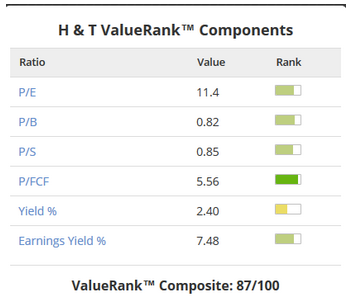
The group trades on a trailing P/E of 11.4 and a mouthwatering price-to-free cash flow ratio of 5.6.
That’s a remarkably moderate valuation versus cashflow and explains why H&T qualified for the Free Cash Flow Cows Screen earlier this year. This screen has delivered an annualised return of 16.5% per year since its inception.
Traditional value investors will also take comfort from H&T’s price-to-book ratio of 0.82. When goodwill and intangibles are stripped out, the shares currently trade at their tangible book value. This asset backing may help provide downside protection.
(Although the value of the firm’s inventories of gold and jewellery could fall if market conditions change, I think it’s fair to assume we’ve now seen the worst of the gold bear market.)
H&T paid a dividend of 4.8p last year, giving a reasonable yield of 2.4%. This is expected to rise steadily, but it’s worth remembering that the payout was cut from 11.9p in 2013, when the gold crash left the firm with big losses on its gold inventories.
Defensive quality?
Measures of investment quality have to capture both financial strength and intangibles such as a defensive moat. H&T has a QualityRank of 91, suggesting it scores highly on both of these fronts.
The firm’s strong balance sheet and cash-generative profitability is reflected in a Piotroski F-Score of 7, out of a possible 9. The only real weak point are that profits, measured as return on assets, fell last year.
This highlights a wider trend. Although H&T’s long-term average return on capital employed is a healthy 18.1%, what this metric doesn’t show is that ROCE has fallen steadily since 2010, when it peaked at 30.7%. In 2014, ROCE was just 5.8%, which is almost certainly below the firm’s cost of capital.
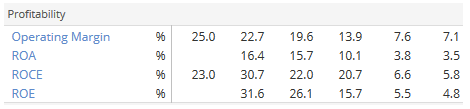
These figures suggest that H&T’s advantages of scale aren’t as effective as they once were.
In fairness, the firm’s turnaround plans may address this decline. I expect ROCE and operating margins to rise gradually over the next few years, but I don’t expect a return to the levels seen during the gold bull market.
Strong momentum
The key ingredient in the H&T pie is undoubtedly momentum. The company’s MomentumRank of 97 highlights solid outperformance against earnings forecasts and good technical momentum.
H&T qualifies for both the Josef Lakonishok Momentum Screen and the Bold Earnings Revisions Screen, which have outperformed the FTSE 100 by 35% and 45% respectively over the last two years.
Looking at the two aspects of momentum in turn, it’s clear that H&T’s earnings have been improving faster than analysts’ forecasts. Earnings per share were 9.4% ahead of consensus forecasts at the time of its most recent results. Analysts’ forecasts for 2016 have also inched higher over the last month.
Despite a 25% price gain already this year, price momentum also continues to look strong. The firm’s shares are just 5% below their 52-week high, while the 50-day moving average is 111% of the 200-day figure.
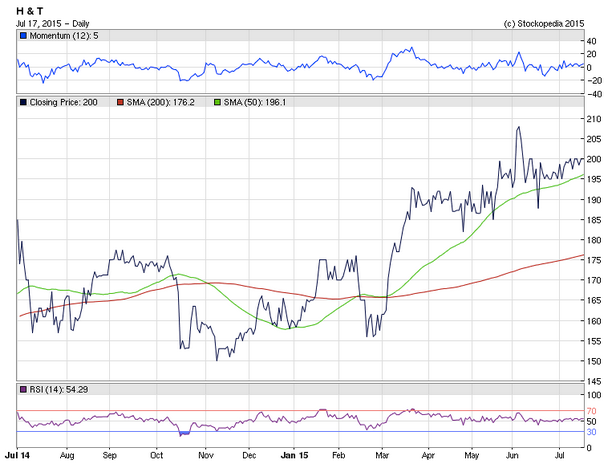
Relative strength is encouraging at 55, although momentum seems uncertain, at just 1.25.
Outlook
Trading on a forecast P/E of 12.0 and a forecast yield of 3.2%, H&T shares look reasonably valued with decent upside potential, in my own personal view.
Free cash flow generation is deeply impressive. I believe that if H&T can deliver incremental growth and a modest increase in profit margins, the dividend could rise substantially without the payout becoming too risky.
Ethically, this stock might not be everyone’s choice, especially given its personal loan business. Fundamentally, however, given its exposure to sound fundamental and valuation drivers, H&T continues to look like it could become a solid small-cap outperformer. As always, this is just a personal opinion and it’s essential to DYOR.
Disclaimer
This is not financial advice. Our content is intended to be used and must be used for information and education purposes only. Please read our disclaimer and terms and conditions to understand our obligations.

12 comments
Another poster mentioned the decline in share price was due to Artemis fund management selling a significant number of shares.
More weakness today. Surprising really given gold has had a few good days (when priced in GBP). Retail side of this business didn't grow as fast as it has before, but it is still growth. Maybe the loan book provisions are light?
When the economic woes of brexit start to manifest more GBP weakness will mean a higher gold price and more activity. This stock could have a transformational 3-5 years.
Hmmm.....nice entry point I think.
Any ideas why this has sold off from near 300p? Director selling? Can't see any RNS.
Maybe a good entry point as I was kicking myself for not getting in at 200p
I was wondering the same, I thought it maybe gold related as a few gold mining shares have fallen recently even though gold price has not. Directors selling was just options so I don't think that's it. Maybe just some profit taking after a good run?
No obvious reason at the moment that I can see.
Share price down 50p in the two trading sessions of 8&9 September on only slightly larger reported volume than usual. Quite thinly traded, so it wouldn't take much buying or selling in a particular direction to move it up or down. Could be the market makers working a buy order (tree shake to trigger any stop losses in place) or perhaps market whisper that a possible big buyer that took it up recently is either filled or gone elsewhere bringing the price back down again. Perhaps an RNS on a seller might be forthcoming in next few days?
Either way, may well be a good entry point/chance for a top up as fundamentals look pretty good.
Best,
Gus.
Not sure whether this is simply the re-rating of an established pawnbroking business with a pledge book backed by a rising gold price or some possible corporate action going on in the background but H & T (LON:HAT) shares are up by more than 20% this week (another 8% today). Any views on what might be driving the recent strong rise?
Gus.
There was an in-line trading statement a week ago, and presumably the gold price rise will be good for the company. Maybe also the market is waking up to the story here, that the debt has been being paid down fast and the company is very cash generative.
It's top of the NAPS this year... up more than 50% year to date now.
slartybartfast,
I don't know the detail of how pawnbrokers trade gold either, but H&T were not alone in being hit hard when gold prices crashed.
My suspicion is that firms like H&T were using the rising market to leverage their returns. By buying gold from punters at a discount and then selling it (later) into a rising market, profits were amplified. Similarly, lending against gold when the price of gold was rising appeared low risk and generated a profit when forfeited items were sold.
Hedging might have limited these gains.
On the other hand, when gold started falling, this leveraged effect rapidly reversed. Stocks of gold were carried or sold at a loss.
Customers who had pledged gold items at higher prices suddenly had little incentive to redeem them, even if they could. This left H&T to take the loss when it was eventually able to sell the forfeited items.
In last year's results, H&T says it made a loss from pawnbroking scrap (selling forfeited gold items) due to "the relatively higher rate per gram on forfeited items against the gold price."
That's my understanding anyway, happy to be corrected if their are any pawn experts out there!
Roland
Would a company such as this not hedge their gold position? I have no idea how the business works in practice but on a group basis would it not be prudent to hedge the net intrinsic value of their stock? If so there would be no exposure to the price of gold.
This is my guess:
The problem is that hedging, in practice, would be very difficult - because the pawnbroker's exposure to the gold price isn't constant. It fluctuates with the price itself in a sort of reflexive relationship.
It's easy for airlines to hedge jet fuel, for instance, because they know how many routes they're going to fly. There's very little variance in route plans because of the fuel price - it's not like they have planes sitting around doing nothing all day and all of a sudden they decide to start flying them because the jet price has dropped a few percent. Hence, your usage is relatively easy to predict, both if jet fuel prices go up or down.
With pawnbrokers, your exposure to gold changes a lot depending on the price. Normally, redemption rates (people who come back in to pick up the goods) are very high. If the price of gold is going up very quickly, redemption rates will be extremely high. But if the price of gold is going down, redemption rates will crater and you'll be left with the stock as the punters just renege on their loan. That asymmetric pattern would (and this is my guess - I am not a pawnbroker, just an analyst!) make it difficult to hedge. If you were to hedge your entire gold stock pile you'd be protected in a downturn but if gold prices go up and everyone redeems their loan, you're paying out your hedge and not getting any benefit from a rising gold price. If you hedge none, you have the opposite problem. If you hedge your expected non-redeemer percentage you take some of your exposure off the table, but you have the same problem that that very percentage moves with fluctuations in the gold price...
Of course, the more cynical explanation might just be that they loved it when the price of gold was going up and they printed money - hedging would've been a real bore! (as Roland is contemplating)
For me the thing that stands out is retail growth as you point out
H&T’s retail sales, which are mainly of second-hand jewellery and watches, rose by 24% to £30.9m in 2014 and contributed £10.7m to gross profit.
This was however at the expense of margin on retail. If they can continue to grow retail at this rate without too much margin erosion theRe seems to be good potential here. Interestingly though the company has stated results in line with expectation, so maybe no surprise on the upside.
Presumably now all the debt almost gone this leaves more FCF to grow the business as well.
I wouldn't worry too much on gold, business diversifying away and basically it is a free embedded option for when the metal rallies again (it will for sure).