Stock in Focus: Is Anexo Group the next Burford Capital?

Unfortunately I’m not able to make it to Mello this week, but I did attend the Mello event in May. One of the more intriguing presentations I saw was from credit hire and legal services firm Anexo Group (LON: ANX).
This AIM-listed firm only floated in June 2018, but was pointed out to me by a very experienced investor, who noted that it had a vast backlog of trade receivables and was - potentially - undervalued.
Mello is a great place to meet up with investors who are smarter than you are and to learn from them. So I attended the Anexo presentation at Mello to find out more. It was an odd experience. The presentation itself was clear enough. But I was one of several investors in the room who couldn’t understand how such a bizarre business model could ever be so successful.
I’ll come back to the group’s business model in a moment. But first I should point out that Anexo shares have done pretty well since last year’s IPO, delivering a tidy 70% gain to date:

Perhaps I was wrong to be sceptical? Could this business be a mini-Burford Capital in the making?
Happily, I’ve now got the perfect opportunity to find out more, as Anexo Group has qualified for my Stock in Focus screen. So this week I’m going to take a closer look and decide whether to add the shares to the SIF folio.
(For newer subscribers - welcome. The SIF Folio is a Stockopedia fantasy fund which I also mirror with my own cash in a real money account. At present, the Fantasy Fund system is only available on the old version of the Stocko website.)
What does Anexo do?
Anexo is a legal services and credit hire firm that provides replacement vehicles to non-fault motorists who are classified as impecunious. The company previously operated under the name Direct Accident Management, but has now rebranded as Edge. It also has a legal business, Bond Turner.
The non-fault element is important so that Anexo can claim hire costs back from the at-fault party’s insurer. Recovery of credit hire and repair costs for Edge is handled by Bond Turner, which also handles personal injury cases.
Unlike some rivals, Anexo doesn’t take referrals from insurers. It recruits claimants directly via a nationwide network of body shops and garages who promote its services. Here’s how the company compares its process to a standard insurance claim:
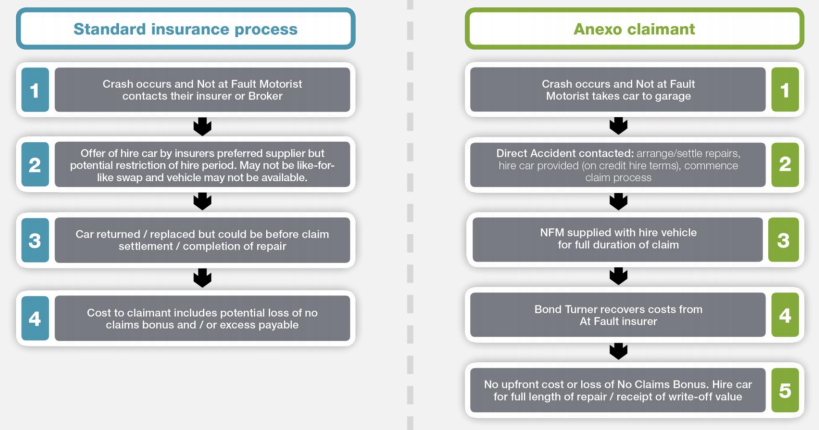
You might ask why a non-fault claimant would go direct to a garage rather than claiming on their insurance. One reason is that they might only have third-party cover. Another is that impecunious clients won’t be able to afford the upfront costs of a contested claim, such as excess payments and loss of no-claims bonus. These may be later recovered, but I know from experience you can be out of pocket for months.
Anexo’s secret sauce
Credit hire has a reputation for being expensive and this appears to remain true. This 2018 case study involving Direct Accident (Anexo) seems revealing to me.
In short, it appears that the claimant was provided with a replacement vehicle for her Ford Ka (valued at £775) at hire cost of £20,109.60 for 132 days. This works out at about £152 per day. To put this in context, my local Enterprise branch is quoting £130 per week for a comparable car. That’s £19 per day.
The credit hire business model appears to include a very fat margin for credit and legal costs.
This conclusion is supported by this snapshot of the firm’s operational metrics for the six months to 30 June 2019:
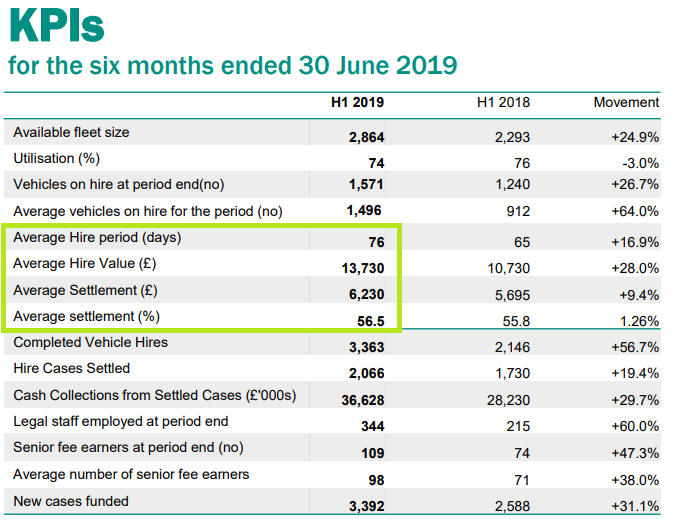
The average hire period during H1 was 76 days. How many cars take 76 days to be repaired? Very few, I suspect. But many claims take this long.
I think this is why Anexo focuses on impecunious claimants. Broadly speaking, these are viewed by the courts as being unable to fund any upfront expenditure on credit hire or repairs. I’m guessing that Anexo uses this as an excuse to hire them a car for the entire duration of the claim, rather than expediting the repair of their vehicles and minimising the costly credit hire period.
The firm then claims this credit hire cost back from the at-fault insurer. The average hire value of £13,730 works out at £180 per day. That seems quite high to me.
Unsurprisingly, most insurers refuse to pay and negotiate a settlement. During H1, this was 56.5% of the claimed amount - or about £102 per day.
At the Mello presentation in May, Anexo’s Head of IR was asked why the company didn’t just charge a more reasonable rate to begin with. He couldn’t really answer the question.
I suspect that the answer relates to the strange cocktail of in-built inefficiency, outsourcing, vested interests, regulatory opportunity and (arguably mis-aligned) financial incentives that seem to exist in the motor insurance industry. But I’m no expert.
I think we’ve now got a flavour of how Anexo operates. Now we need to understand more about its profitability, cash flow and valuation.
Value - warning flags?
Anexo’s ValueRank of 35 is not encouraging. When we look at the ValueRank components we can see why this score might be so low:
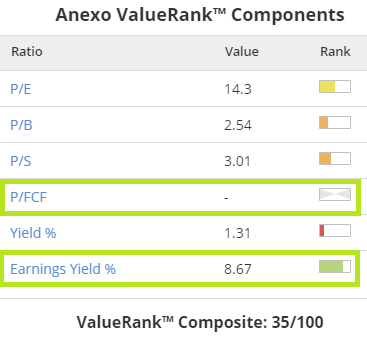
Although the trailing P/E ratio of 14 is acceptable, Anexo doesn’t appear to have generated any free cash flow over the last 12 months. That’s an odd contrast with its earnings yield (EBIT/EV) of 8.7%, which I see as an attractive figure.
What’s happening? There seems to be a strong similarity with Burford Capital here. Anexo’s profits are growing at a decent rate:
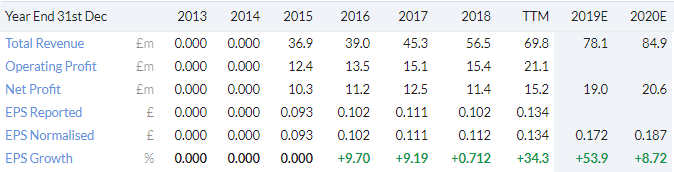

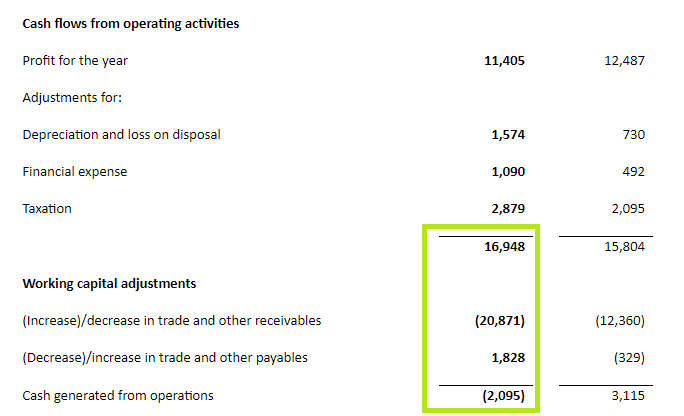
The cash shortfall is being made up with extra borrowing. Here’s how reported net debt has changed over the last two years:
Year-end 2017 (pre-IPO): £15m
June 2018 (post-IPO): £2.4m - looks like cash from the IPO was used to repay debt
Year-end 2018: £17.3m - borrowings are rising again
30 June 2019: £23.4m - still rising
In addition to this, at the end of 2018, the company reported £2.5m of hire purchase obligations on its motorbike fleet and £7.7m of lease obligations on various buildings and on its car and van fleet.
Finally, the accounting notes reveal that Anexo uses an invoice discounting facility to bring forward payment of receivables. This appears to be secured over pretty much all of the group’s assets:

In terms of value, I think Stockopedia’s algorithms are right to score Anexo poorly.
The company trades at 2.5 times its net asset value. Although reported profits look impressive, they are paper profits only. There is no matching free cash generation, debt levels are rising and the firm’s assets appear to be encumbered.
Overall, I don’t think it’s an attractive picture.
Shallow quality
Anexo has attractive profitability metrics, according to the StockReport:

You’d expect numbers like these to be matched with a high QualityRank. But they’re not:
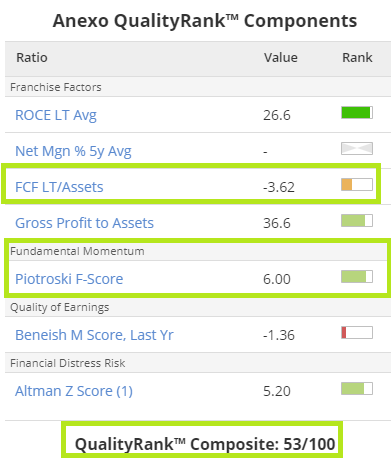
I think that the reason for this very average score is is that Stockopedia’s computers have come to the same conclusion as me — Anexo isn’t generating any cash. This is reflected in the Piotroski F-Score result of 6/9 and in the FCF LT/Assets ratio.
I don’t see this as a high quality business, regardless of its reported profitability.
Strong momentum?
Anexo scores highly for momentum, which calculated based on earnings estimates and share price action:
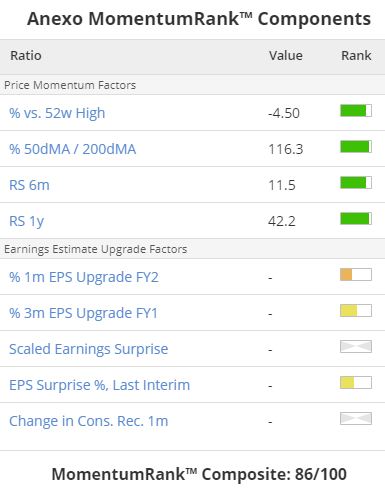
These forward-looking metrics don’t (yet) take into account the group’s lack of free cash flow. But history suggests that they will do eventually.
This situation probably isn’t helped by limited broker coverage. Only one broker is listed as covering Anexo, presumably its house broker.
My view
When I looked at Burford Capital in March, I identified the high price/book value and negative free cash flow as risks. But with hindsight I took a fairly charitable view of this. Perhaps too charitable.
Anexo shows very similar characteristics. Rapid profit growth, negative free cash flow and rising debt. Although both Anexo and Burford do generate cash from their claims, the debt-fuelled growth of their caseloads doesn’t appeal to me.
As with Burford, Anexo could be a star. But I think that the risks to equity holders are growing. Although the shares look reasonably priced on 11 times forecast earnings, history suggests these earnings won’t be backed by free cash flow. So I’d argue that they’re not worth all that much.
I’m not comfortable with this stock and won’t be adding it to the SIF folio, despite my screen’s approval.
As always, I’d love to hear what you think. I know that litigation financing has become popular with small cap investors, so please let me know what you think. All the above is only my opinion, I may be missing something.
Disclaimer
This is not financial advice. Our content is intended to be used and must be used for information and education purposes only. Please read our disclaimer and terms and conditions to understand our obligations.

16 comments
I have vast experience of this sector having worked in it for 12 years and counting. I am new to investing and only have a smallish portfolio. However, my previous company, worked with insurers to help reduce the size of the credit hire claims presented by Anexo and the like.
My main points would be:
1. Government intervention will come but could be 2 years or more likely 5 years. Once the new whiplash reforms are in then I think focus will turn to credit hire. Looking at the costs from an objective view point and when compared to the likes of Enterprise; then its easy to understand why the spotlight will fall on the sector.
2. Insurers are getting more and more efficient with “intervention” i.e. the insurer gets the Non-Fault Claimant into a hire car, say, from Enterprise and can then control the cost of hire and hopefully the repairs.
For me, it is a matter of when, not if, this share and the sector falls. The only guaranteed winners of the husband and wife owners.
https://www.lawgazette.co.uk/n...
Credit hire is mentioned here if only to note it needs to be looked at in light of whiplash reforms
Hi AngTig, thanks for your insight, it's much appreciated and very helpful.
Good luck with your portfolio.
Thanks,
Roland
Hi Roland. Glad I could help a little (if at all). Stockopedia is a great tool and the discussions/commentaries from people like yourself are invaluable to me!
Roland
I saw Anexo present at the recent Sharesoc event in Manchester. As others have commented, I think you're right to be sceptical. (I have some experience in the sector. )
Our blended average hire period was around 16-17 days when I was in the industry. Compare that to the 76 days quoted by Anexo. It just seems way out of quilter with my own experience.
Whilst the company is in growth mode as it presently is, it can hide a myriad of ills; the better quality debt tends to collect first, leaving a rump of debt that often proves impossible to collect. The business will carry on consuming cash.
It's a really tough sector to make money in, yet they quote a net profit margin of 20%.
Other things didn't strike true. There is always the threat of further legislation in the background as well. I could go on - but you get the picture. It's not for me - I'm out.
phoenixnight,
Thanks for sharing your sector knowledge, it's invaluable insight for a generalist investor like me.
I'm pleased you suggest a typical hire period of 16-17 days - that was my thinking too, that about two weeks would be enough for most repairs.
Regards,
Roland
I have seen Anexo present and it's certainly an interesting business model but I came to the conclusion that it was too vulnerable to regulatory risk and insurers taking steps to undermine them in some way.
This ruse may become less popular after many Daily newspapers (2 days ago) issued warnings for people not to use schemes like as. This was after a motorist was landed with a £400,000 bill for car hire after a judge found that the accident was her fault.
Very good summary of Anexo's "charms" thanks Roland. I too saw management present back in May and was thoroughly unimpressed. One reason for this was the company's prodigious appetite for cash with no sign of this abating. The other was their whole business model of hugely over-charging for hire cars in the sure knowledge that they'd settle for about half of this without needing to take the insurance company to court.
Frankly the whole thing stinks and I expect the business to fold at some point in the future when it can no longer pay its bills. However I certainly wouldn't short this share until their back really is against the wall - and maybe not even then given the potential for a short squeeze.
Would this be a good stock to short?
I had a look but there isn't enough liquidity to get a short on it for me.
Interesting company.
Some of those figures are quite eye-watering. Having had an car accident in the past, I can't say my experience tallies with what they say, this didn't affect no-claims but it did affect the premium for the next year, but then the same thing would have happened on Anexo.
I didn't get a like-for-like car, but then again the same thing surely would also be possible with Anexo unless they keep a multiple models of every car on the market. Car was also delivered and picked up door-to-door.
The hire period is long, but for those clients whose car is written off there may be a long delay before compensation is reached due to the insurers arguing it out.
It does seem quite odd that insurers would agree to use Anexo's service (the cost of which must surely be known up-front) and then refuse to pay when the bill comes in.... is that standard practice for the industry?
Business model seems precarious to me. What would happen if an insurance company simply got together with a hire car company and negotiated a bulk rate? Some sort of capping of costs would reduce insurance premiums for all, it is a hugely inefficient market.
Not a bad deal for the husband and wife team who own 70% of shares and may pull the best part of £1m in remuneration a year.... not convinced smaller shareholders will be the same.
Nice work, and a husband and wife team at the top too......
Hi Snoo,
Thanks for your comments.
Re. no claims: you're right that with a a non-fault claim your no claims shouldn't be affected. But as I know from personal experience, insurers will suspend your no claims while a disputed claim is in progress. I once had to renew my insurance at a zero no claims rate because of an ongoing claim. The extra premium was then refunded when the claim was settled in my favour. When added to the excess (also refunded) I was out of pocket by about £1,000 for several months.
I don't think insurers agree to use Anexos - it's the claimant who uses Anexos's service. Insurers don't have any choice/involvement - they're on the receiving end of the claim. In a non-fault scenario, motorists don't have to go through their insurer. It's a poorly understood area, I think.
Cheers,
Roland
Thank you for the analysis of this quite fascinating business model.
For those of us who don't have the skills or time to do the analysis, it's reassuring to know we can still short cut to the Stockopedia's ranks & scores.
I agree - best avoided. Exploiting the insurance system to hire out cars at crazy rates seems to be an unsustainable business model. Sooner or later the Government or insurance companies will put a stop to it.
Jim