Stock in Focus portfolio: Can BAE Systems deliver a defensive profit?

Before I get to this week’s new stock, I’d like to take a brief look at Monday’s trading update from SIF portfolio member Somero Enterprises.
In short, the update confirmed that the firm’s core US market remains strong, with mixed trading elsewhere. Results are expected to be “comfortably in-line with market expectations” for the full year. My reading of this is that earnings could even come in slightly ahead of forecasts, a view small cap editor Paul Scott shares.
SIF portfolio update
One of the apparent shortfalls of my screen is that it isn’t throwing up many defensive stocks. This is making diversification more difficult than I expected. It’s also causing me to wonder whether I’m filtering out desirable stocks.
I’m planning to look at these questions in more depth in next week’s column. What kind of defensive stocks am I missing out on? Is there a good reason to avoid them at the moment?
That’s for next week. The stock I’m going to add to the SIF portfolio this week is FTSE 100 defence giant BAE Systems. This is, I believe, a relatively defensive addition to the portfolio, despite officially being classed as a cyclical stock.
Although BAE’s StockRank of 74 is lower than the majority of the other stocks which qualify for the screen, I do believe it will add some useful diversity to the portfolio. As with GlaxoSmithKline, I’m buying BAE in the expectation of steady long-term returns.
Surprising diversity
It’s tempting to say that BAE needs no introduction, but in fact I suspect many investors underestimate the diversity of the group’s businesses. Although BAE is best known for aircraft and shipbuilding, around one third of profit comes from its Electronics and Cyber Security divisions:
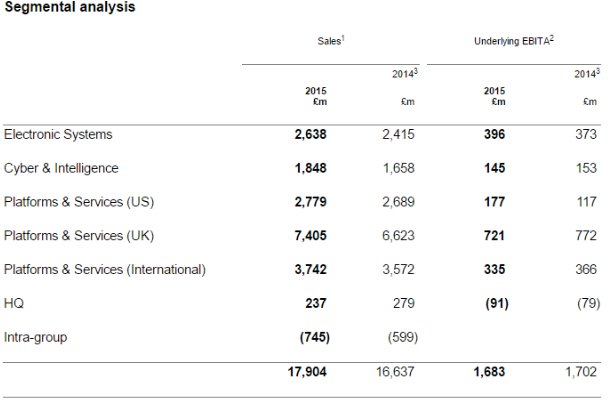 Source: BAE Systems 2015 results
There seems little doubt that state use of cyber warfare will be a growing issue over the coming decades. I suspect it is already a more widespread problem than we realise. So I’m happy to see that the UK’s biggest defence firm is already a significant player in this market.
Is BAE cheap enough?
BAE’s strongest suits at the moment are quality and momentum. The stock’s ValueRank of 51 is decidedly middling. There seem to be two main reasons for this, last year’s poor cash flow and the high price/book ratio:
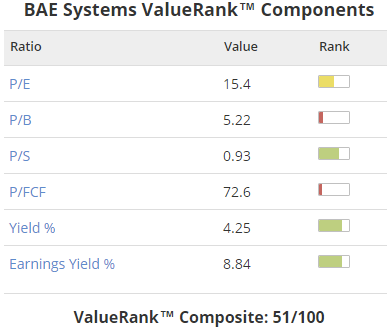
It’s worth noting that while Stockopedia’s value algorithms don’t (yet) explicitly factor in pension deficits, BAE’s ValueRank is clearly influenced by this factor. The firm’s P/B of 5.2 is the result of the group’s £4.7bn pension deficit weighing on its equity value. Strip this out and the P/B would fall to about 2, a much more reasonable figure.
I do sometimes rule out companies with big pension deficits, but for several reasons I’m fairly relaxed about this. Firstly, BAE has agreed a deficit recovery plan for its UK schemes until 2026. This information is in the market and there shouldn’t be any nasty surprises.
A second factor is that debt is low. Net debt at the end of last year was £1,422m, according to the group. That’s only 1.5 times last year’s net profit of £943m. The absence of any debt pressures makes the pension deficit less of a risk, in my view.
My final point is slightly more controversial. In my opinion, BAE is large enough and politically important enough to be able to prevent its pension deficit ever becoming a critical issue.
Looking elsewhere, BAE looks reasonable value, if not a bargain. Last year’s trailing P/E of 15 is below the FTSE 100 average of 18.5 and is backed by an attractive 4.3% trailing yield. Free cash flow was poor, but the group’s cash flow does tend to be lumpy and inconsistent, due to factors such as contract advances. This is a weakness to watch, however, as using the Stockopedia figures, only 67% of BAE’s dividend payments since 2010 have been covered by free cash flow. I’d like to see this trend improve.
Quality is improving
Interestingly, BAE’s QualityRank has risen from 38 to 64 since March. I’m not entirely sure why, given that the 2015 results were already included in March. But it’s a welcome improvement anyway!
As you can see from the figures, there are no big concerns here:
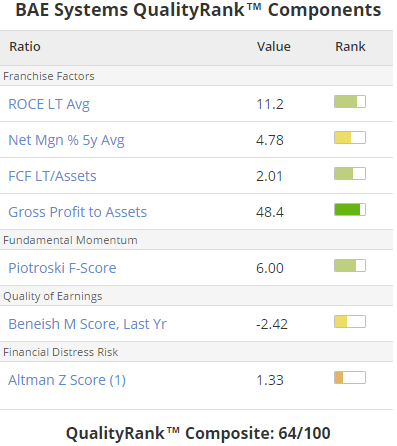
BAE’s profit margins have been fairly stable over the last six years. The stock’s poor Altman Z Score is the only obvious weak point. Looking more closely, it appears to be a reflection of the firm’s pension deficit and historic losses. I’ve annotated the image below to provide more detail on the main cause of each fail:
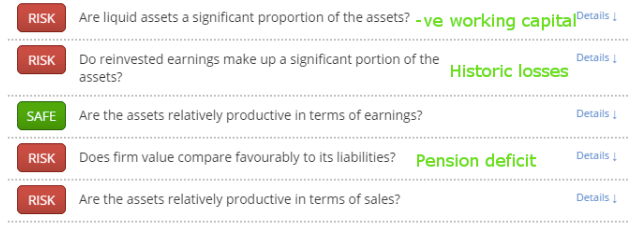
BAE’s negative working capital doesn’t concern me. It’s just the result of the firm receiving advance deposits on big contracts. The historic losses and pension deficit aren’t ideal, but in the context of a large and profitable firm, I don’t think they are deal breakers.
Is the outlook improving?
BAE’s ValueRank and QualityRank have both risen since March. But its MomentumRank has fallen slightly, from 88 to 78. This doesn’t seem to be the result of share price movement, as there hasn’t been much. I think a more likely explanation is that earnings estimates have been trending lower:
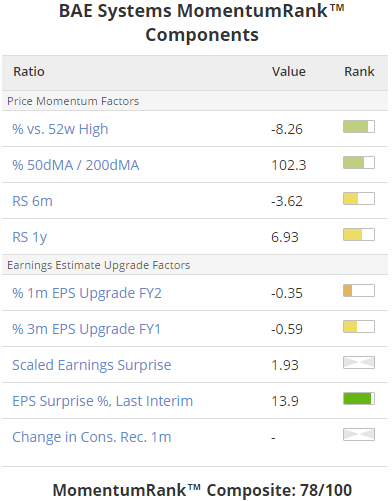
These figures present a mixed picture. The positives are clear. BAE’s last earnings came in 13.9% ahead of expectations. In that context, the -0.6% cut to earnings forecasts over the last three months doesn’t seem a big concern. Earnings per share are still expected to rise by 21% this year.
Price momentum also looks reasonable. BAE shares are less than 10% from their 52-week high. The 50-day moving average is comfortably above the 200-day moving average, which seems to have provided a reasonable level of support since December:
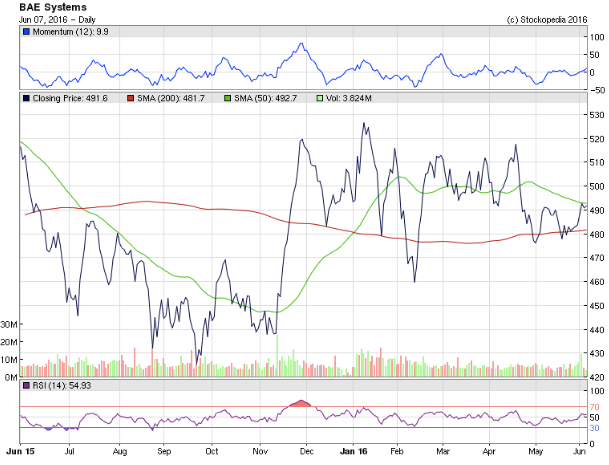
Relative strength and momentum are both improving. In my view, the momentum picture is benign at worse, and more likely to be positive.
Final thoughts
I’m aware that I’ve presented a more mixed picture than usual, for a share I plan to add to the SIF portfolio. This is because I believe constructing a portfolio isn’t solely about maximising potential gains. A degree of stability and diversification is also needed in most cases.
I believe BAE is reasonably priced to deliver positive returns and a useful income. The stock’s rolling forecast P/E of about 12 and forecast yield of 4.4% look undemanding enough to me. I’d be happy to add to my own long-standing holding at this price. For these reasons, I’m adding BAE Systems to the SIF portfolio.
As always, please DYOR and share your views in the comments. I have my tin hat ready!
Disclosure: Roland owns shares of BAE Systems.
Disclaimer
This is not financial advice. Our content is intended to be used and must be used for information and education purposes only. Please read our disclaimer and terms and conditions to understand our obligations.

1 comment
Good Analysis