Stock in Focus: Will NWF deliver more for investors?

As a value investor, I find it very hard to buy fully-valued successful companies, even when they seem very likely to deliver further gains. It’s a problem Ed discussed recently in his article about High Flyers such as Domino’s Pizza. Domino’s has never really been cheap, but has 14-bagged over 11 years. Am I missing out by avoiding such stocks?
Well perhaps. But I think it’s important to have a reasonable level of conviction when buying shares. That means investing based on a set of criteria you feel comfortable with, such as value and quality. It’s hard to hold on to a stock through market corrections if you never really wanted to buy it in the first place.

By way of a compromise, I’ve been screening for shares which appear to offer attractive quality, a reasonable valuation and evidence of decent momentum.
Luckily, Stockopedia makes it easy to track down stocks that fit a given profile. A blog post from earlier this year, Towards a taxonomy of stock market winners, makes it clear that the kind of company I’m looking for is a Super Stock. A company that continues to outperform without looking overly expensive.
Does NWF fit the bill?
This week’s choice is AIM-listed NWF, which describes itself as The Feed, Food and Fuel Group. It’s not exactly rock ‘n’ roll, but it is a consistent high performer that’s been in business since 1871, and ticks all the boxes as a potential super stock:
NWF shares have risen by 78% over the last three years, during which shareholders have also enjoyed 15.3p per share in dividends. That gives a total return of 94% in three years, making NWF a conspicuous outlier in the battered FTSE Oil & Gas sector.
The firm’s business has three core divisions, Boughey Distribution, NWF Agriculture and NWF Fuels. Respectively, these handle grocery, animal feed and fuel distribution. Although I’m not an expert on the company’s business, I can immediately see two likely structural advantages.
Firstly, a business like this can grow by generating efficiencies of scale and perhaps consolidating smaller businesses. Secondly, NWF has the potential to become a ‘sticky’ supplier to its customers, by providing a combination of price and service without which it would be hard to manage.
The first advantage appears to apply to NWF Fuels and the firm’s original business, NWF Agriculture. The second seems to apply especially to NWF’s food division, Boughey Distribution.
Delivering value
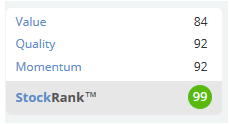
So how is NWF valued? A ValueRank of 84 suggests there are no major concerns. NWF trades on a trailing P/E of 14.1, with a trailing yield of 3.2%.
NWF’s dividend has risen by an average of 4.7% per year since 2010, earning it a place in Stockopedia’s Winning Growth & Income screen. This looks for companies generating attractive returns and rising earnings, with a focus on sustainable dividend growth.
A price to sales ratio of 0.17 reflects the firm’s low profit margins. NWF’s operating margin was just 1.8% last year, but this doesn’t seem to inhibit cash generation. Free cash flow was £7.7m in 2014/15. This puts NWF on an appealing price to free cash flow ratio of 10.6.
It’s worth pointing out that while the group’s operating margin is very low, which is typical of the transport sector, NWF’s earnings yield is much higher. In my view this is often a more meaningful way to look at a firm’s profitability and valuation.
Earnings yield is calculated as operating profit (EBIT) divided by enterprise value. NWF’s earnings yield is 10%. This tends to support my view that NWF’s valuation is full, but not demanding.
Quality is essential
Low-margin businesses in competitive sectors can fail dramatically if faced with an unexpected headwind. This doesn’t necessarily make them unacceptably risky, as long as they are good quality businesses.
I’ve already discussed NWF’s possible competitive advantages. What about financial strength? NWF scores well in this regard too, with a QualityRank of 92. Its strong balance sheet and good cash generation give rise to a Piotroski F-Score of 7 out of a possible 9, which is reassuringly high and is the main reason for the firm’s high QualityRank.
It’s also worth noting that over the last five years, NWF’s dividend payments have been covered 2.6 times by free cash flow, while net debt has fallen from £11.3m to £5.9m. Not many companies can boast of equivalent performances.
Don’t forget momentum
Without strong momentum, the company I’ve been describing above would be a contrarian play. Cheap enough, but out of favour.
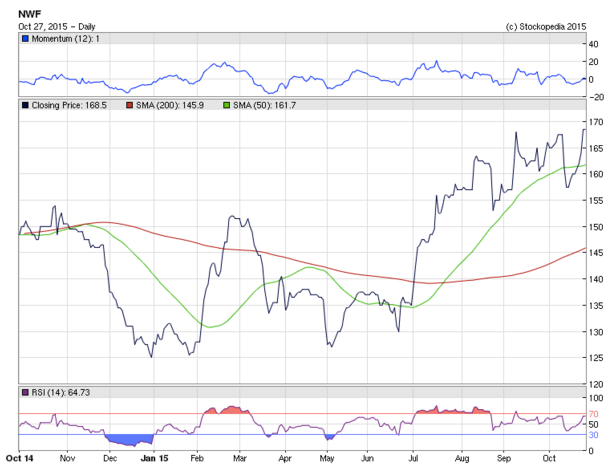
The difference with NWF is that it has a MomentumRank of 92 and a share price that (at the time of writing) is within a couple of pence of its 52-week high of 170p.
Other momentum factors are also strong. The 50-day moving average is more than twice the 200-day moving average. The relative strength index (RSI) is high, but not overbought, at 63.
Momentum has weakened recently, and is close to zero, but unless a profit warning is on the horizon, there’s no obvious reason for the shares to fall.
Brokers covering the stock appear confident, in any case. Earnings momentum has been given a boost by modest increases to both 2016 and 2017 forecast earnings per share over the last month.
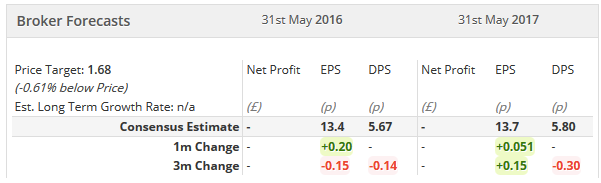
Looking at the valuation implied by the latest broker forecasts, there does seem to room for further upside.
Broker forecasts for NWF place the shares on a 2016 forecast P/E of 12.5, falling to 12.3 in 2017. The yield is expected to rise from 3.4% to 3.5% over the same period.
Would I buy?
NWF is probably quite fairly priced at the moment, given its low margins. However, the business has a proven ability to make smart acquisitions that help drive growth, while keeping debt levels under control. On this basis the shares could deliver further gains.
The main risk seems to be the possibility of dislocations caused by commodity price movements. NWF is heavily exposed to a range of commodity prices through both its sales and its input costs. This could have an unpredictable effect on profits, although I suspect that in most cases the moves will offset each other across the firm’s three divisions, as happened last year.
I’m still struggling with my bias towards out-of-favour stocks, but I can see NWF as possibly attractive. As always, please DYOR and share your thoughts below.
Disclaimer
This is not financial advice. Our content is intended to be used and must be used for information and education purposes only. Please read our disclaimer and terms and conditions to understand our obligations.

10 comments
It is probably falling because at their forthcoming update they will have to report the impact of the very mild (up to their reporting date) winter, which will have knocked their heating oil business, let alone whether they will have been able to sustain cash gross profit there in the face of a tumbling oil price. I tried to short it at £2 but couldn't....
does anyone know why the sudden drop in NWF today?
Can't find any reason, maybe oil prices going up will increase their costs?
i would have thought the opposite that it would have helped their distribution
Well part of it is transport, it is also very low margin so any sudden increase in costs could have a large effect on profits. As Roland said "As it happens this drop was offset by improved profits in the fuels business. These were driven by lower oil prices and improved sales of premium products".
Here's an example of how NWF may be able to continue to grow, at relatively low risk -- another small fuel supplier acquisition:
http://www.investegate.co.uk/nwf-group-plc--nwf-/rns/acquisition/201511020700070870E/
The thing that put me of buying them was a sizeable director sale.
Hi Roland
When dairy prices are low dairy herds decrease in size and some farmers exit the sector altogether, both reduce feed volumes
Roland,
My concern with NWF is their close link to the Dairy sector at a time when Dairy is having a really tough time. I have worked in this industry and when the milk price is low farmers resist spending. Wafer thin profitability doesn't leave room for error. Care needed with this one. Ian
Ian,
You're right -- NWF did say that low milk prices put pressure on margins in their Agri business last year and profits were down sharply.
As it happens this drop was offset by improved profits in the fuels business. These were driven by lower oil prices and improved sales of premium products (now I know why my heating oil supplier wants to sell me premium kerosene...).
I don't know if we can always expect commodity price effects to offset each other like this, although I suspect they often will.
You may know better than me, but I had also assumed that while farmers will reduce spending when dairy prices are low, there is presumably a practical limit as to how much they can cut back on feed?
Regards,
Roland