Stock in Focus: Will Plus500 sink or swim?

A new chapter in the Plus500 saga began this week. Would-be acquirer Playtech announced that the Financial Conduct Authority (FCA) had “concerns” and was unlikely to approve Playtech’s application to take control of Plus500 before the end of the year.
Playtech’s attempt to buy Plus500 has now been abandoned, leaving Plus500 back in play. Another lucky takeover offer seems unlikely, so Plus500 now needs to prove that its own brush with the FCA earlier this year has not been too damaging.
To start the ball rolling, Plus500 reported strong Q4 trading and promised shareholders a generous dividend and share buyback package. But what will it take to restore investor confidence, and how well is the firm really doing?
A closer look
Plus500 shares remain down by around 55% from the all-time highs seen early in May. The fall was triggered when the firm was forced to freeze the accounts of its UK customers and retrospectively implement more thorough anti-money laundering procedures.
Trading updates since then have shown that while revenue and user growth remains strong, profit margins have been severely compressed. UK customers also still appear to be required to register with Plus500’s Cyprus subsidiary, rather than its UK operating company.
Average revenue per user fell by 14% to $1,362 during the first half. Moving in the other direction, the firm’s average user acquisition cost has risen sharply and averaged $1,142 during the nine months to September 30. That’s a 38% increase on the same period in 2014.
Of course, user revenue should be ongoing, while user acquisition cost is a one-off. Yet it’s no secret that many retail CFD and spread betting customers lose all of their money and abandon their accounts quite rapidly. Leveraged short-term trading is extremely risky.
Plus500’s first-half net profit was $40.6m, 25% lower than last year. Despite a 38% increase in the number of active users during the first nine months of this year, profit margins are expected to be lower this year, according to the firm:

StockRank high flyer?
Stockopedia doesn’t measure sentiment or discount the risk of operating in different sectors of the market. It doesn’t ask whether AIM-listed Israeli companies are riskier than UK companies with main market listings.
Yet Plus500 was a StockRank favourite before it ran into trouble earlier this year. The stock remains highly ranked:
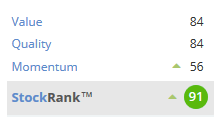
High Value and Quality ranks suggest the profile of a contrarian stock. Is this a fair assessment?
Value stacks up on paper
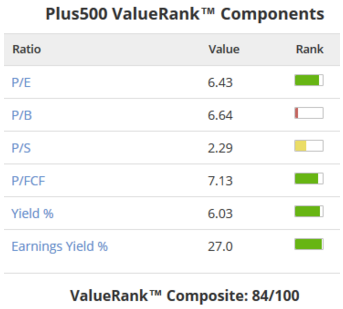
Plus500’s ValueRank of 84 makes it clear that the firm’s shares are very cheap relative to their historic performance. Note the price/free cash flow and earnings yield ratios in particular. These are very cheap:
We don’t yet have a complete picture of how this year’s operational disruptions have affected the firm, although we do have some clues.
In Monday’s update, Plus500 said that net cash was $95m at the end of June and that the business remained cash generative. That seems to imply that net cash might currently be higher than $95m.
Last year, Plus500 paid a total dividend of $0.31, giving a 6% trailing yield at today’s price. This was paid wholly from free cash flow. The only weakness is that Plus500 was only founded in 2008 and didn’t pay a dividend until 2013. That’s not much of a dividend track record.
I’m also concerned at Plus500’s lack of assets. The shares currently trade at 6.6 times book value, most of which is the $95m net cash. Net fixed assets are negligible, at just $2.3m. Intangible assets are just $86,000.
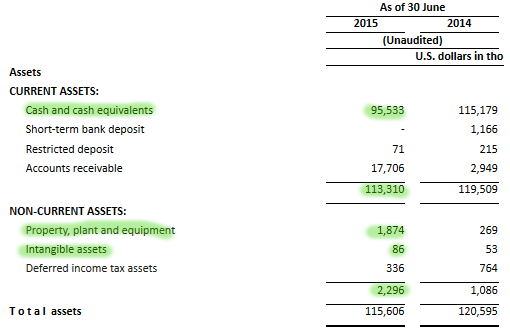
Clearly Plus500 attaches very little value to its systems or its brand. This suggests to me that Plus500 is basically a marketing business, with very little intrinsic value.
As such, my view is that Plus500 deserves a lower valuation than high-end peers such as IG Group.
Quality figures
A QualityRank of 84 is to be expected for a company that generates bucketloads of cash, as a 51% operating margin. It’s worth understanding why Plus500’s QualityRank isn’t higher, though.
A heavily-weighted element of the QualityRank is a stock’s Piotroski F-Score. The F-score tests nine measures of financial health and profitability. Although one of Plus500’s three fails is simply down to a reporting anomaly -- Plus500 doesn’t report gross profit -- others are not.
Plus500’s trailing twelve month (TTM) return on assets (ROA) is 74.1%. The ROA over the prior TTM period was 238%.
Similarly, Plus500’s TTM free cash flow per share is less than its reported earnings per share for the first time since 2009:
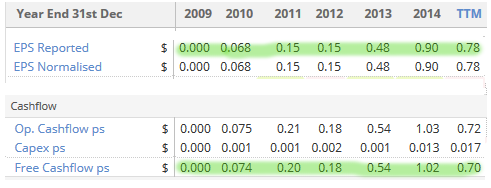
This shortfall may be due to the exceptional costs of its compliance operations this year, but it could also represent higher ongoing costs and lower profit margins. We won’t know until the 2015 results are published in spring 2016.
Dodgy momentum?
In the meantime, investors hoping for a quick return will be reliant on Plus500’s questionable momentum. Following Monday’s deal failure, Paul Scott suggested that the stock could face a renewed shorting attack.
Another risk is that analyst coverage has dropped almost to nil. Although Stockopedia does show earnings per share and dividend forecasts for Plus500, these forecasts don’t appear complete. Broker coverage appears to have been more or less discontinued following the Playtech offer.
Investors are therefore without even the limited benefit of a house broker forecast. However, I expect this to change now that the firm is planning an independent future. Earlier forecasts may be revised, so Plus500’s current forecast P/E of 7 should perhaps be treated with caution.
That said, we do have more certainty about near-term yield prospects. Plus500 declared an interim dividend of $0.2121 per share this week, along with a $20m share buyback. The interim dividend provides a prospective yield of about 3.9%. I expect a final dividend to follow with the final results, suggesting a full-year yield of 6-7% might be possible.
In terms of price momentum, investors have very little to work on. Plus500 has been under offer since soon after its share price crashed in May. I suspect we’ll see more short-term volatility, such as Tuesday’s 11% gain.
Final thoughts
Plus500 remains highly ranked by Stockopedia. The firm’s interim results and Q3 trading update suggest that although dented, its performance remains strong.
On this basis the shares could be attractive at today’s prices. Plus500’s StockRank appears to support this conclusion. However, as Ed stressed recently, the StockRanks are intended to help investors build portfolios with the potential outperform, not to pick individual winning stocks.
There’s a big difference. Plus500 qualifies for a diversified and systematically-selected high StockRank portfolio. I believe it could outperform the wider market, but it may not. Less diversified investors may need to pay more attention to the specific risk factors attached to this business.
As always, please DYOR and share your thoughts in the comments below.
Disclaimer
This is not financial advice. Our content is intended to be used and must be used for information and education purposes only. Please read our disclaimer and terms and conditions to understand our obligations.

2 comments
Just seen this on Twitter. Not a follower of Plus500 but thought it worth sharing.
http://plus500.giambronelaw.com/
No axe to grind (never had anything to do withPlus500 (LON:PLUS) as either a shareholder or customer and don't intend to) but before anyone who has had problems with Plus500 sign up to a class action, worth doing a bit of due diligence on the law firm involved, Giambone. They seem to have previous form chasing financial ambulances, for example take a peruse of the attached thread on a similar FX situation.
http://www.forexpeacearmy.com/community/threads/please-stop-recommending-giambrone-it-is-just-another-scam.50719/
As I say, no axe to grind. Just wary of anyone already burnt jumping out of a frying pan into a fire.
Gus.