Stock Pitch - Raspberry Pi - is this tech star the next ARM?


Image credit: Raspberry Pi
Welcome back to our Stock Pitch series. Graham recently highlighted a small cap with a distinctive niche offering and a network of more than 3m registered users.
Today I want to look at another company that also has a strong franchise and an enthusiast community with over 3m members.
Shares in small, cheap computer specialist Raspberry PI Holdings (LON:RPI) rocketed 67% higher last week after the company reported a 63% rise in pre-tax profit for 2025.
If recent 20%+ sales growth can be maintained, I reckon this business could be generating £1bn in annual sales within six years.
In this Stock Pitch I’m going to consider whether the numbers stack up for an investment today and explain why I think Raspberry Pi could be a true tech compounder - like ARM.
Disclosure: at the time of publication, Roland has no position in Raspberry Pi.
Share price at the time of publication: 465p
Market cap: £891m
The Pitch
Cambridge-based Raspberry Pi has its roots in an educational charity founded in 2008 to encourage kids to learn coding. The listed business whose shares we can buy was created by the charity in 2012 to produce ultra-cheap, single board computers built around ARM chips for educational use.
Raspberry Pi has since expanded to have a global reach and a much broader customer base. Revenue reached $323m last year and sales to industrial customers now outweigh those to education and hobbyist customers by three-to-one:

The product range is both broader and a little more expensive than it used to be. But the core DNA hasn’t changed all that much: Raspberry Pi blends expertise in hardware and software to produce affordable devices that can be used to address thousands of potential applications.
Demand could receive a further structural boost by the rapid growth of local AI services. Rather than relying on cloud-based behemoths for all services, there’s a growing trend towards hosting specialist AI tools on local ‘edge’ devices. This avoids cloud costs and dependencies and can address potential data security concerns.
Raspberry Pi’s new AI HAT+ 2 product is designed for exactly this purpose:
Post year-end launch of AI HAT+ 2 enables customers to run advanced AI applications including LLMs and VLMs
So far, it’s been a rollercoaster ride for shareholders who took part in the company’s 2024 IPO:
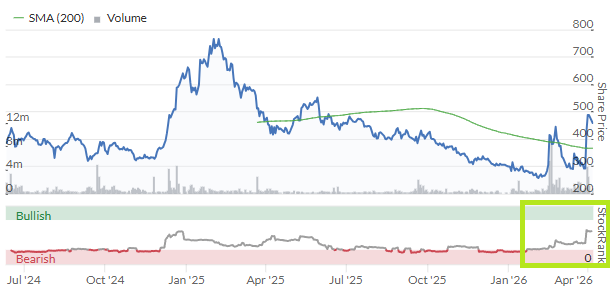
However, the company’s rising StockRank and High Flyer styling suggests to me that there may be an opportunity here for investors.
If this business can maintain recent strong quality and momentum metrics, I think the current valuation could offer more value than the stock’s 50+ forward P/E might suggest:
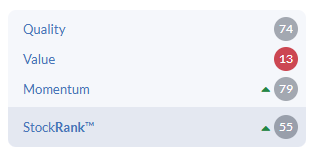
The Big Picture
Raspberry Pi shipped 7.6m hardware units last year, a 9% increase from 2024. Revenue rose by 25% to $323m, while the group’s pre-tax profit climbed 63% to $26.5m.
The company released 13 new products and now has 113 approved resellers, supporting product availability in 80 countries.
I believe this distinctive business has some quality characteristics that support the view it could be a long-term compounder:
Deep expertise: Raspberry Pi combines expertise in hardware, software and small systems, with 51% of staff working in engineering roles. This end-to-end business model provides a barrier to entry. Last year’s results show revenue of $2.3m for each member of staff – I see this high figure as a sign of quality business.
Strong franchise; embedded in many industries: the company’s products are deeply embedded in many industries and sectors and it has a loyal OEM customer base, built over a decade. Recent product launches in the microcontroller market seems likely to expand the group’s already large opportunity set. Sales of this new range rose by 47% to 8.4m units last year.
Big consumer fanbase: Raspberry Pi’s Reddit community has more than 3m members, highlighting the massive appeal of its products to hobbyists and educational users. That would be hard for a rival to replicate.
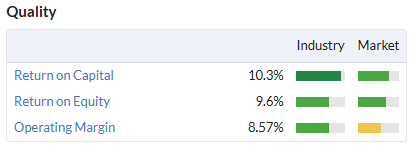
Improving quality metrics: Raspberry Pi only floated in 2024, so quality metrics for the years before then reflect the company’s previous corporate structure. PLC-era quality metrics are a little average, but are moving in the right direction.
Long-term ownership
Digging into the ownership of this business gives me additional confidence that its long-term strategy is likely to remain consistent and focused:
Committed, purpose-driven ownership: Raspberry Pi Holdings was founded by the Raspberry Pi Foundation charity, which retains a 46% stake that should give it a big say in future strategy. The company’s second-largest shareholder is ARM, the British tech company that supplies many of Raspberry’s chips. Sony is also on the shareholder register.
Management shareholding: CEO Eben Upton has a £15m shareholding and has spent £250k on stock since November, according to Stockopedia data.
Employee shares: 84% of staff own stock or have share options.
What The Brokers Say
The company’s latest outlook statement suggested rising costs will be passed onto customers, leaving 2026 profit expectations unchanged.
Earnings forecasts have trended lower over the last year as City analysts have priced in a more cautious outlook, but this trend may now be starting to reverse:
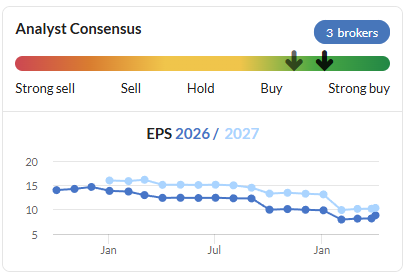
As a result of past downgrades, brokers have cut their average price target for Raspberry Pi from 535p to 395p since April 2025:
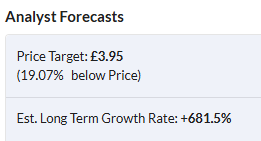
Recent explosive share price momentum has left the stock trading nearly 20% ahead of this target price. I think there’s some risk of a short-term consolidation towards the previous trend line.
At the same time, I’d argue that the reactive nature of most analysts’ forecasts means that trading ahead of target price isn’t necessarily a bearish signal. It could simply mean that the market is starting to price in long-term growth that’s not yet reflected in consensus estimates.
The Bear Case
While I’m optimistic about Raspberry Pi’s long-term prospects, I can see some reasons to be cautious about the valuation and growth outlook.
Cyclical & AI exposure: a number of the company’s industrial end markets are cyclical and the business also has some growing exposure to AI. Rising memory costs (due to the AI boom) are also putting pressure on margins, especially as the company seeks to be a “cost-effective” supplier.
High inventories: the 2025 accounts show $145m of inventory at the end of last year – equivalent to seven months’ cost of sales. Just $31m of this relates to finished goods, with the remainder tied up in component stocks to support manufacturing and maintain availability of products such as DRAM memory, where supplies are currently constrained. There’s quite a lot of cash tied up here, perhaps reflecting the group’s growing product range; inventories have risen by 200% since 2022, but sales have only risen by 70% over the same period.
Profitability is only average: a forward P/E of 55 for a business generating a 10% return on capital employed means that a lot of future growth is already priced in.
Negative free cash flow: Raspberry Pi’s net cash position has fallen as working capital requirements have grown and the company has invested in new product development. Much of this “pipe development” spending is capitalised on the balance sheet, flattering profits. While it’s great to invest in growth, the business also needs to demonstrate that it can generate positive free cash flow from this spending.
The Bottom Line
Raspberry Pi has a distinctive product offering and a strong franchise with both industrial and retail customers. Developments in connected devices and ‘edge’ AI mean that the addressable market for the company’s products is continuing to expand.
Deep in-house expertise provides differentiation from peers, while an unusual ownership structure should support long-term growth and a continued focus on cost-effective computing.
Although it might be possible for Chinese firms to create cheap clone devices, I think they could struggle to gain the market share and loyal customer base enjoyed by this educational spin-out.
The main risk for me is that the premium P/E rating and somewhat average profitability point to some risk of a near-term share price correction after recent explosive gains.
On a longer-term view, however, I think the stock could prove to be more reasonably priced. In my view, Raspberry Pi looks worthy of further research as a growth investment with the potential to deliver attractive long-term returns.
Disclaimer
This is not financial advice. Our content is intended to be used and must be used for information and education purposes only. Please read our disclaimer and terms and conditions to understand our obligations.

6 comments
I've heard in the past that Raspberry Pi's technology is being used in the manufacture of Drones by Iran and probably other nations. Discovered by downed drones used by Russia attacking Ukraine. Is this one of their key sources of growth!
im a software dev and do most of my tinkering projects on ESP32 chips as they are a lot cheaper than the PI currently... trying to develop that killer app but not there yet. I've developed some financial apps on an esp32 which render prices and charts onto a in built screen via a wifi shield (stock/crypto prices from an api ive developed so i can see my fave shares during the trading day on a seperate screen). its a lot easier to develop on the PI though and has a big software dev community for support.
thanks for this Roland - All too tech for me - but I can appreciate that there are geeks out there who will start their interest in computing on one of these kits (remember the Sinclair ZX Spectrum?) and maybe would follow the Raspberry brand just as there are geeks who spend huge amounts in Games Workshop (LON:GAW) or indeed Apple products
One thing does concern me - circa 80% is tied up - leaving just 20% in the open market - but maybe in this unusual case it may not be a negative.
WRT clones, I unwittingly bought two Pi Pico clones (eBay) for a hobby project. One had a defective flash chip and couldn’t be used. My next two were genuine and still inexpensive. I think there may be a lot of clones about but perhaps they are not attractive versus genuine if you know what you are buying.
I've just got into using the pi and found plenty of resources to help a beginner make fun projects. Especially as they are pretty user friendly .I also know plenty of people will buy the equivalent version of the raspberry pi from cheaper sources abroad. Interesting discussion Roland , one I hadn't considered investing in but may do now
Buy from a reputable dealer, like Pimoroni or Pihut.
Given the prices of SBCs at the moment, Picos are looking increasingly attractive. You can buy GPIO/IC2/SPI chips that plug into your PC so that you can control hardware from it. This would be a great project for a Pico. I've never seen anyone take up the idea. Maybe one could communicate through the serial port, or create a USB protocol. The Pico SDK has an ability to do that fairly readily, although setting up USB devices is somewhat fiddly.
I'm thinking that, for the most part, MicroPython solves 90% of peoples' needs as opposed to the SDK.
Have fun!
RPI aims to be an innovator. Upton has said that he is not really interested in being a copycat.