The Superinvestors of Graham-and-Doddsville: Rick Guerin

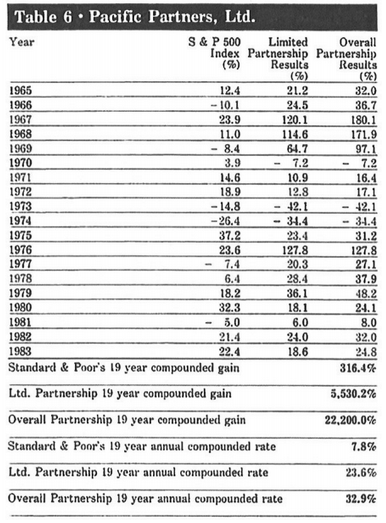
“Table 6 is the record of a fellow who was a pal of Charlie Munger's -- another non-business school type -- who was a math major at USC. He went to work for IBM after graduation and was an IBM salesman for a while. After I got to Charlie, Charlie got to him. This happens to be the record of Rick Guerin…" -- Warren Buffett's introduction to Rick Guerin in his essay: The Superinvestors of Graham-and-Doddsville.
This is part five of a six part series on Warren Buffett's essay, The Superinvestors of Graham-and-Doddsville. You can find parts one to four of the series below.
- The Superinvestors of Graham-and-Doddsville: Walter Schloss
- The Superinvestors of Graham-and-Doddsville: Tweedy, Browne
- The Superinvestors of Graham-and-Doddsville: Bill Ruane
- The Superinvestors of Graham-and-Doddsville: Charlie Munger
Buffett wrote The Superinvestors of Graham-and-Doddsville with a rebellious tone. The whole essay is written to show that value investing is not some complicated science or complex set of formulas. It is a simple process with only two variables: price and value. This simplicity means that all the various formulas loved by highly paid Wall Street analysts are, well, useless:
“The common intellectual theme of the investors from Graham-and-Doddsville is this: they search for discrepancies between the value of a business and the price of small pieces of that business in the market. Our Graham & Dodd investors, needless to say, do not discuss beta, the capital asset pricing model, or covariance in returns among securities. These are not subjects of any interest to them. In fact, most of them would have difficulty defining those terms. The investors simply focus on two variables: price and value."
Rick Guerin: One of the best in the world
Like many of the 'Superinvestors' Rick Guerin never went to business school but that didn't stop him from managing money. He turned out to be rather good at it and his results speak for themselves. Between 1965 and 1983, against a compounded gain of 316% for the S&P 500 Guerin achieved a return of 22,200% -- that's not a typo. Warren Buffett was quite convinced that Guerin's education, or lack of it, helped him achieve such lofty returns:
“[The] idea of buying dollar bills for 40 cents takes immediately to people or it doesn't take at all... A fellow like Rick Guerin, who had no formal education in business, understands immediately the value approach to investing and he's applying it five minutes later. I've never seen anyone who became a gradual convert over a ten-year period to this approach. It doesn't seem to be a matter of IQ or academic training. It's instant recognition, or it is nothing."
What happened to Rick?
Little is known about Rick Guerin and his style of investing, but after 1983 he virtually disappeared and readers of the 'Superinvestors' essay started to ask, “What happened to Rick?" Even Buffett was once asked and he attempted to answer this question by saying that Rick wanted to get too rich too fast. As a result, he used margin to leverage his funds excessively, magnifying both profits and losses. This increased volatility could have been a reason for pushing him out of the money management business.
You can see in the chart above how volatile Guerin's returns became over the years. Indeed, he suffered a 62% cumulative loss in the period 1973 to 1974 due to high levels of leverage and as a result of these two disastrous years, Guerin's CAGR collapsed to 3.7% between 1972 and 1977 -- that's a compound return of 19.97% over five years, hardly 'Superinvestor' performance.
There's no doubt that these poor returns were a direct result of Guerin's excessive leverage, not bad stock picks. Many of the shares he held during his time as a money manager were also found in the portfolios of Buffett and Munger.
As fate would have it, Guerin and Munger are now working together as board members of US media company Daily Journal Corp., where they manage the group's share portfolio. They have helped to more than quadruple the Daily Journal's stock price since 2008 by reallocating investments into equities. If you want to know more about the Daily Journal's portfolio, check out part four of this series: The Superinvestors of Graham-and-Doddsville: Charlie Munger.
If you would like to find out more about value investing strategies, why not download Stockopedia's free guide, called How to Make Money in Value Stocks. You can click here to see our library of investing ebooks and see our Subscription Plans to take a two-week free trial.
Disclaimer
This is not financial advice. Our content is intended to be used and must be used for information and education purposes only. Please read our disclaimer and terms and conditions to understand our obligations.
No comments yet
No one has commented here yet! Why not be the first one?