Trifast shares fall after 22% cut to profit guidance, softer outlook

Analyst’s view:
The company says the outlook has worsened over the last month, with continuing softness in automotive, Middle East disruption and tougher Chinese competition. Broker EPS forecasts for FY27 and FY28 have both been cut by more than 30%. While the stock might be cheap, I think it's probably fair that it should be. I'm going to move to a more cautious view until there are signs that the outlook is stabilising.
Down 15% to 75p (£104m) - Half-Year Results (profit warning)
Commiserations to shareholders in this fastenings manufacturer this morning - this is a fairly big profit warning. Frustratingly, today's downgrade comes less than a month after the company issued an in-line trading statement on 20 October.
Let's unpack what's gone wrong.
Half-year results summary
This morning's interim results cover the six months to 30 September and immediately flag up some concerns for me, as they imply a fairly heavy H2 weighting:
Revenue down 4.3% to £101.3m (47% of previous FY27 forecasts)
Underlying pre-tax profit up 10.2% to £5.4m
Reported pre-tax loss of £3.0m
Underlying earnings per share down 35.8% to 1.7p (versus previous FY27 forecast of 7.96p)
Interim dividend held at 0.6p
Adjusted net debt reduced by £1.6m to £15.8m (vs H1 26)
Revenue: lower sales are said to reflect softer automotive demand in North America and Asia. The company also reports disruption to its planned Saudi operations, due to the Middle East conflict.
Perhaps more worryingly, management reports "lower volumes from customers, losing market share to Chinese competitors". To me, this sounds a) inevitable and b) likely to get worse.
Underlying Profit: while the improvement in underlying pre-tax profit and margins sounds positive, it all falls apart at the bottom line. Earnings per share (after tax) fell sharply due to an increase in the underlying effective tax rate to 57.1% (H1 26): 27.2%).
The explanation for this seems a little complex and the company doesn't make clear how much of it will reverse in the full-year figures:
The increase was primarily driven by the non-recognition of current period UK tax losses and higher withholding taxes arising on cash repatriation to the Group's central entities. If deferred tax assets were recognised in respect of current period UK tax losses, the ETR would reduce to 37.5% (HY2026: 29.6%). Excluding withholding taxes on cash repatriation, the ETR would reduce further to 22.6%. The tax rate was also influenced by the geographic mix of profits, with approximately 98% of profits generated in jurisdictions with statutory tax rates of 19%-25% during the current half year, compared with 85% in the prior half year.
Fortunately, broker Zeus has published an updated note this morning. They expect to see a full-year effective tax rate of 30% for FY27. This suggests some of the earnings 'lost' to excess tax in H1 may be recovered during the second half, but not all of them.
Reported profits: at a statutory level, Trifast generated a net loss of £5.4m in H1. The main reason for this appears to be continuing restructuring and IT upgrade costs. Project Ignite (ERP upgrade) cost £4.2m in H1, while "Rebuild and Resilience strategic capability initiatives" cost a further £1.6m.
I'm not sure how much further these initiatives have to run, nor what the total cost will be.
Cash & Debt: a modest reduction in net debt (exc. leases) to £15.8m leaves leverage at 0.8x EBITDA, which should be manageable.
However, Trifast's cash generation fell sharply during the first half of the year due to the exceptional costs mentioned above and a significant increase in cash tax payments:
Operating cash flow down 24% to £4,664m
Cash tax paid of £2.04m (H1 26: £1.38m)
Outlook & Revised Guidance
The company says that current trading and the outlook for the full year have weakened since October's trading update for three reasons:
Previously-highlighted softer automotive demand in North America and Asia is being made worse by supply chain challenges. These are also now affecting some of Trifast's non-automotive customers in North America.
Revenue from planned operations in Saudi Arabia is expected to be lower than forecast due to the Middle East conflict
"Softer demand for household appliances" due to low-cost Chinese competition.
From an outside perspective, it's not clear to me why some of these factors would only have become apparent over the last month.
What does seem clear is that Trifast expects to suffer negative operating leverage due to the reduction in revenue expectations. While the cut to revenue guidance is relatively small today, profit guidance has been slashed:
FY27 revenue now expected between £200m and £205m (-5% vs previous consensus of £214m)
FY27 EBIT now expected between £14m and £14.5m (-22% vs previous consensus of £18.2m)
For a manufacturer of relatively low priced widgets like Trifast, volume is key. Any shortfall means that fixed costs eat into margins quite quickly, as seems to be expected here.
With thanks to Zeus for publishing its forecasts on Research Tree today, we can see how this cut may affect earnings expectations. I think it's worth noting that Zeus has made big cuts through to FY29, suggesting it doesn't see today's warning as solely a short-term issue:
FY27E adj EPS: 5.3p (-34.1% vs 8.1p previously)
FY28E adj EPS: 6.2p (-39.7% vs 10.3p previously)
FY29E adj EPS: 9.0p (-17.2% vs 10.8p previously)
These revised forecasts put Trifast on a FY27 forward P/E of 14, falling to a multiple of 12x in FY28 and 8x in FY29.
Roland's view
I was hopeful that Trifast could be an interesting recovery play earlier this year, but I'm less confident now. The expected recovery in earnings seems to have been pushed back by several years and I'm concerned about the commentary on softer demand and tougher Chinese competition.
While the situation in the Middle East may improve, I can't see that Chinese competition will get any easier. I think it's fair to move to a more cautious view until there's evidence that the outlook has stabilised.
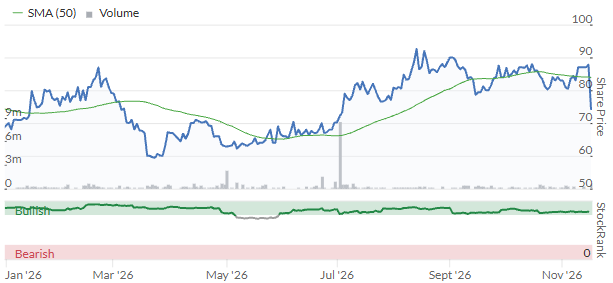
Our last look at Trifast was in July, when Graham took a neutral view and suggested that a business of this type didn't deserve a higher rating.
With hindsight this conservative approach has proved wise. The shares subsequently rose above July levels, but have given back those gains today:
Today's revised earnings forecasts imply an adjusted return on equity of 7% in FY27, rising to 8% in FY28. At a statutory level, the figures are likely to be much worse.
For capital-intensive industrial business generating this level of profitability, I'd be reluctant to pay more than book value.
Today's accounts show net asset of £109m, slightly above the latest market cap of £103m, so the shares are now trading slightly below their book value. That could be fair value, but today's profit warning means I'm inclined to take a more cautious view.
A special situation? It's probably worth pointing out that not all investors share mine and Grahams' caution: the shareholder register is led by Harwood Capital (20%) and Slater Investments (11%).
These well-known investors are likely to have more insight into Trifast's problems than we do and may now press the company to take more drastic action to deliver value for shareholders. With the stock now trading below book value, I also wouldn't rule out the possibility of a takeover approach.
Disclaimer
This is not financial advice. Our content is intended to be used and must be used for information and education purposes only. Please read our disclaimer and terms and conditions to understand our obligations.
Discussion on Trifast (0)
Comments here are also visible in the Daily Stock Market Report
No one has commented here yet! Why not be the first one?