
Statistics convince the mind, but stories bring them to life. So let me walk you through five real companies the rule flagged - four that worked and one that didn't. The loser is here on purpose, as we care about the honest downside.
Rolls-Royce: the credible re-rating
In February 2023, Rolls-Royce (RR.L) posted a +27 jump to a StockRank of 88. At the time, plenty of investors still saw a wounded, pandemic-battered engine maker with a wrecked balance sheet. The rank was saying something different - that the quality and momentum of the business had inflected, hard and a new chief executive started pulling costs out.

Over the following 12 months the stock returned +147%. The jump flagged the turn in real time, before the headlines caught up and well before the consensus admitted the recovery was real. This is the jump effect at its most satisfying: the rank reacting to a genuine change in the numbers while the crowd was still arguing about the narrative.
One honest caveat, in keeping with the last chapter. Rolls is a large-cap, and the tradeable edge - which is really a neglect premium - is weakest at the top of the market, where every analyst in the City already has a model open. So the lesson here is about the mechanism, the rank catching an inflection early.
Yü Group: the star exhibit
If I could keep only one chart from this entire study, it would be this one. Yü Group (YU.L) is the jump effect's full anatomy captured in a single stock - the jump, the drift and the exit, all in a row.
Yü is a small-cap supplier of gas and electricity to UK businesses. Note the sector: this is a Utilities name, not an Energy one - the very top row of the last chapter's sector table. In October 2022 it posted a +24 jump to a StockRank of 99 - not just into the top decile, but to its very ceiling. Then, instead of spiking and fading, it climbed. And climbed.
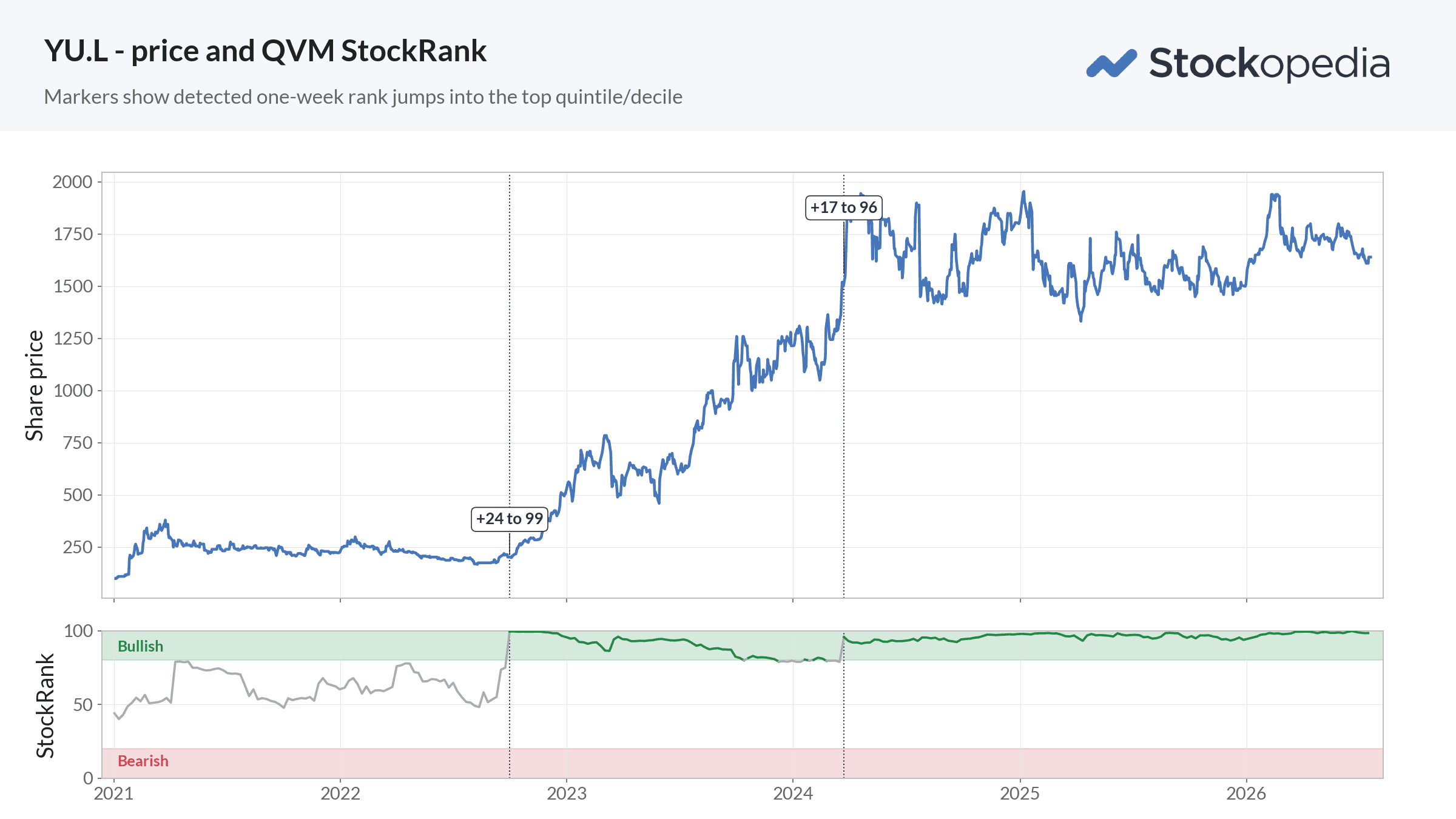
Over the following 12 months the stock returned +490% - from around £2 to roughly £12, close to a six-bagger. But the shape of that move is the lesson, not the size. It didn't gap up on one press release and stop. It went up in steps, over a year, because Yü kept doing the same thing: telling the market it was "significantly ahead of expectations," again, and then again. Every trading update was another upgrade.
This is where the three forces from the anatomy chapter show up in the flesh. Post-earnings drift: the price moved on each update, but never far enough, because nobody could quite believe the run-rate would hold. Analyst anchoring: the one or two brokers covering a company this small were anchored to their carefully-built models and revised their forecasts up only part of the way each time, trailing reality by months - which is exactly how a business ends up "significantly ahead" over and over. The disposition effect: early holders who had doubled their money sold to bank the win, while new buyers stayed anchored to the old, lower price. Too much selling, too little buying, expectations reset one notch at a time. That is what turns a single jump into a long, smooth staircase instead of a one-day pop.
And the rank held the top decile the entire way up. As long as it did, the thesis was intact and the rule said hold. Then, in October 2023 - a year and nearly a six-bagger after the signal - the composite rank finally slipped below 80. Nothing had gone wrong with the business; the price had simply grown rich, and the Value side of the QVM composite dragged the score out of the zone. That was the sell. The 90/80 Rule ringing the till in the fat part of the move - not at the top, nobody sells the top, but with most of the gain banked.
I'll be personal about this one. I bought Yü for the family above £6, with genuine vertigo entirely due to its VM Rank - it had already doubled and every instinct said I was late. I wasn't clear about StockRank jumps back then, if I was, I'd have bought it earlier.
Kromek: the small-cap front-run
Kromek (KMK.L) is the sweet spot in the flesh, and it's recent. In September 2025, this small radiation-detection technology company leapt +78 points to a rank of 98 - a violent, decisive move into the very top of the decile, in exactly the kind of neglected small-cap where almost nobody was looking.

The stock went on to gain +40% over the following six months. A big quality step-change in an under-researched small-cap is precisely the pattern the study says to favour: small enough to be neglected, in a technology niche, with a jump powered by improving fundamentals rather than a dead-cat bounce off a distressed floor. It's the un-glamorous middle of the strategy - not a 490% moonshot, just a clean, tradeable move of the sort that, repeated across a basket, does the quiet compounding.
Of course, this was a big jump, more than 40 points, which is often an unreliable cohort. The jury is still out on whether it's sustainable.
Sopheon: the neglect premium in one name
Now the biggest winner in the entire study - and a cautionary label attached to it.
In March 2016, Sopheon (SPHN.L), a tiny technology company, posted a +34 jump to a StockRank of 99.9 - the top of the top. Held to the point its rank finally broke, it returned +1,150%. An 11.5-bagger. One position, from one jump, doing more than a whole book of ordinary winners combined. This is the long right tail from the distribution chapter made real: the handful of multi-baggers that pull the mean of the strategy far above its median.

But I'm putting an asterisk on it, because honesty cuts both ways. At the time of its jump, Sopheon was worth about £6.5m - a nano-cap, sitting below the £10m tradeability floor the strategy uses to screen out names whose bid-offer spreads you could never realistically buy. So Sopheon is an illustration. The tradeable portfolio would not have held it. I show it to you because it makes the mechanism vivid - the neglect premium is strongest exactly where nobody with larger portfolios can go. The single best result in the study is one a disciplined strategy should probably walk straight past.
Carillion: the honest loser
Now the one that matters most.
In January 2017, our backtest dutifully bought Carillion (CLLN.L) on a +12 jump to a rank of 81 (in the 80+ tests). It looked, on the day, like a perfectly ordinary signal. What followed was a -94% collapse and delisting as the construction and outsourcing giant unravelled into one of the most infamous corporate failures of the decade.

Carillion is in this chapter, and in our sample, for three reasons.
First, honesty. This is what "the dead stayed in" means in practice. Carillion's 94% loss is sitting inside every average return I've quoted you across this entire series.
Second, the rule is a base rate, not a guarantee. With hit rates of 53% to 61%, roughly four in ten signals go nowhere or worse. Carillion is what the wrong four in ten can look like on a bad day.
Third, this is why the sell rule exists. A buy signal without an exit is how you ride a Carillion all the way down. Look at the entry itself: a +12 jump to a rank of 81, into the top quintile but not the top decile - the weaker end of the signal, and a reminder that the real edge lives in the 90+ club, not the low 80s. The 90/80 Rule's "sell on the first weekly close below 80" is built precisely for names like this, to get you out when the rank breaks, before the worst of the damage is done.
And Carillion has company. The rogues' gallery is systematic: Afren -98%, Morses Club -98%, Flybe -98%, Staffline -96%, Kier -88%, Ted Baker -88%. Read the list and a pattern leaps out - lenders and levered resource and construction names. It's the Financials-and-Energy left tail from the last chapter, in named and bloodied form. The losers aren't random. They cluster exactly where the data told us to be wary, which is why a simple "lean away from Financials and Energy" filter, though not part of the core rules, quietly removes a disproportionate share of the disasters.
What five stories tell you
Put them side by side and the strategy's personality is on the table.
Four winners and a disaster, and the disaster is the most instructive of the five. You will hold Carillions. You will also, if you keep at it, hold a Yü. The edge was never in dodging every loser; it's in owning the whole basket, capping the losers with a sell rule, and letting the winners run for as long as the rank says they can. Which brings us to the one question that matters - how do you actually run this, as a real human being, with real money and real nerves?
Next: Chapter 7 - Building a jumpers' portfolio. The practical playbook: the basket, the hit rate you should expect, the temperament it takes, and why this is education, not tips.