3 dividend shares for a sustainable income

My recent article describing a sustainable income screen generated some interesting ideas for dividend shares to buy now. This week I’m going to take a closer look at three of these to see why they really might have what it takes to deliver a reliable, growing income.
While big cap stocks are commonly seen as the safest choice for income seekers, my screen results include a much wider range of sizes. I’ve chosen a representative mix for this piece, with market caps from £125m through to £85bn.
I tend to focus on a company’s financial track record and dividend metrics when I’m assessing a stock. But it’s also worth checking what the company’s stated dividend policy actually is – there are two main types:
A progressive payout, where the company targets a small increase each year.
A payout ratio-based dividend, where a proportion of earnings is paid out. The payout may fall if earnings decline.
I think that both strategies have their place, but it’s important to understand which one you’re buying into. The first stock I’m going to look at pays dividends as a proportion of earnings. But I think it still has attractions as an income stock.
You can see and duplicate my sustainable dividend screen here.
Rio Tinto
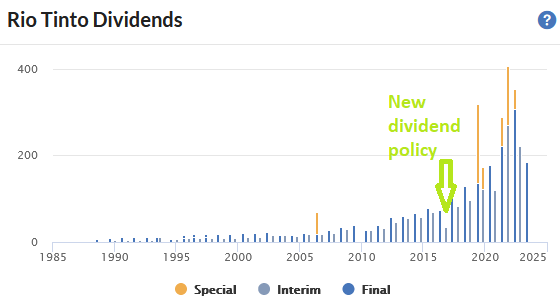
FTSE 100 mining giant Rio Tinto (LON:RIO) scrapped its previous progressive dividend policy during the mining crash of 2016. In its place, the company adopted a payout-based dividend policy:
“to return 40-60% of underlying earnings, on average through the cycle to shareholders as dividends”
Ironically, commodity markets rebounded more quickly than anyone expected in 2016. Rio’s dividends since then have been higher than any others in the group’s history:
At the heart of this business are its giant, low-cost iron ore mines in Western Australia. When iron ore prices are high – driven by steel-making demand in China – these large-scale assets are simply cash machines.
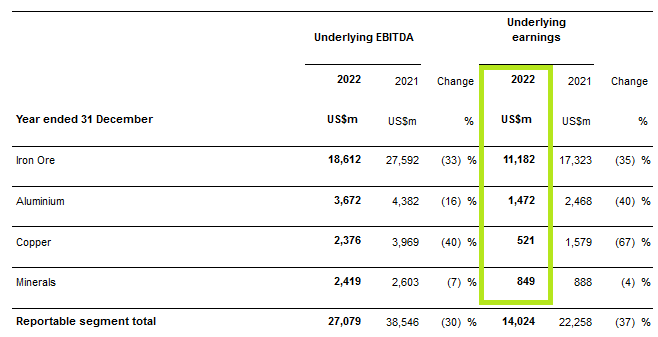
Iron ore generates about 80% of Rio’s profits. Aluminium and copper come in a distant second and third. Other minerals, including lithium – essential for EV batteries – barely register on the scale.
Looking ahead, the company hopes to expand its copper output through its giant Oyu Tolgoi mine in Mongolia. So far, this project has proven more expensive and troublesome than expected, but I think it’s probably still an attractive asset.
CEO Jakob Stausholm has also expressed an interest in expanding the group’s lithium output. But he’s said he will remain disciplined rather than pursuing expensive mega deals.
That should be good news for Rio’s income-hungry shareholders, especially if the Chinese economy stabilises this year as the company expects. But what about the next cyclical downturn? After all, iron ore prices are still quite high by recent historical standards.

Source: tradingeconomics.com
Broker forecasts suggest Rio’s payout may fall slightly over the next couple of years, but could continue to offer a 6%-7% yield. Earnings cover is expected to be around 1.6x, which looks reasonable to me given the group’s lack of debt.

My view: There’s obviously potential for Rio Tinto’s earnings to fall well below current levels. That could make current payout levels hard to afford. However, the company does have a history of prioritising shareholder dividends – and its balance sheet is currently almost debt free.
I don’t know how the global economy will perform over the next few years. But I do know that Rio shares currently trade at around 10 times 10-year average earnings (CAPE10) and offer a well-supported 7% dividend yield. That seems a reasonable valuation to me.
I think this mining heavyweight could be worth considering for income today, as long as investors understand the potential for the payout to rise and fall over the coming years.
Britvic
Demand for soft drinks should be a bit more predictable than iron ore, shouldn’t it? FTSE 250 member Britvic (LON:BVIC) – which owns brands including Robinsons, J2O and Fruit Shoot has certainly been a reliable dividend performer over the years:

Steady cash flows and a prudent payout in good years has allowed the company to maintain its dividend, even through periods of heavy investment and other headwinds:

However, the payout was cut in the pandemic and has taken a couple of years to recover. That means the five-year compound average growth rate for Britvic’s defensive dividend is just 2%.
Britvic shares have performed well over the last year and the drinks firm isn’t the cheapest stock out there right now.

However, the secret to its attraction as an income stock lies in its quality metrics, rather than purely in valuation.

This isn’t such a high-margin business as Diageo (LON:DGE), for example, but Britvic’s profit margins and returns on capital employed (ROCE) are still above average.
Use of leverage means that the group’s return on equity (ROE) is also high. Although borrowing levels have started to be a little high for my liking in recent years, these are now falling and are expected to continue doing so.
High returns and stable demand have resulted in operating cash flows that have been able to support periods of investment (capex ps), while still providing enough free cash flow to support the dividend.
My view: Britvic’s attraction as a defensive investment lies in the probability that the firm’s brands and incremental innovation will support a similar performance for many years to come.
Admittedly, this business doesn’t have the balance sheet strength and financial discipline of family-led rivals A G Barr (LON:BAG) and Nichols (LON:NICL). But Britvic’s mass-market brands and substantial market share look attractive to me. The company’s performance also now seems to be improving, after a more difficult period.

The stock’s High Flyer status is a clue that it might not be cheap at the moment. But the forecast valuation doesn’t look unreasonable to me for a decent quality defensive business:

On balance, I think Britvic shares have the potential to deliver steady, reliable income for the foreseeable future. I’d consider buying them at this level, on a long-term view.
NWF
Distribution specialist NWF (LON:NWF) boasts a market cap of just £125m, but has an unblemished dividend record stretching back 25 years. During that time, the payout has grown by an average of 5% every year:

This is a remarkable record, in my view, especially for a low-margin business operating in sectors with cyclical exposure.
One secret to this success is that NWF has maintained an attractive level of dividend cover, allowing for consistent growth even in down years for profit. I think this is a great example of a well-managed progressive dividend.

So what does this business do – and how does it make money?
NWF has three clearly-defined operating divisions, which are largely independent businesses:
Fuels (68% of TTM profit): supplies diesel, other industrial fuels, and heating oil from regional bases in England and Wales. Growth through bolt-on acquisitions in a fragmented market.
Food (14% of TTM profit): Boughey Distribution consolidates ambient goods from multiple suppliers in its warehouses in north-west England for delivery to supermarkets, food service customers and cash and carries.
Feed (18% of TTM profit): animal feed, primarily for the dairy industry. The company says it feeds one in six dairy cows in Britain.
One factor that’s common to all of these businesses is that they have low profit margins and rely on volume for their profitability. In general, the company passes through the costs of the goods or commodities it handles, applying a small mark-up or service fee on top.

However, NWF is still able to generate high returns on the capital employed in the business:

The contrast between these two charts might seem surprising at first. High margins and high returns on capital employed are often linked, but it doesn’t necessarily have to be so.
NWF is able to generate high ROCE because it doesn’t need too many expensive assets and carries minimal inventories (c.£10m at year end). It’s probably also fair to say that the company uses its assets very effectively.
However, the company’s segmental results make it clear that there’s only really one star of this show, in terms of profitability:

Source: NWF FY22 presentation slides
ROCE from the fuels business is clearly quite variable. But without it, the profitability of the group as a whole would be very average and much less likely to support such an attractive dividend growth record, in my view.
NWF reported record profits last year and recently upgraded its profit guidance for the current year, which ends on 31 May.
However, this level of profitability isn’t expected to be sustainable. Broker forecasts suggest profits will move back towards historic levels over the next couple of years:

Current broker forecasts suggest the coming year will be the low point, before a return to growth. But the group is exposed to commodity prices in fuels and feed. Demand for these products can also vary, due to weather conditions and other factors.
I don’t think it’s possible to predict the near-term path of profits with much accuracy. But I do think we can say that NWF has been well managed and achieved sustainable growth over more than two decades. I don’t see any reason why this longer-term trend can’t be maintained.
In terms of valuation, I think a cautious scenario would be to value the business based on a net profit of c.£9m per year. Before the war in Ukraine, this was the maximum ever achieved.
On this basis, the shares trade on about 14 times earnings, with a 3% yield that I estimate would still be covered twice by earnings.

My feeling is that NWF shares are reasonably priced at the moment. If market conditions remain favourable, the business could continue to outperform, as it has been doing recently.
I’d be comfortable opening a position at this level, but would hope for an opportunity to top up at a lower price in the future during a period of adverse market conditions.
Disclaimer
This is not financial advice. Our content is intended to be used and must be used for information and education purposes only. Please read our disclaimer and terms and conditions to understand our obligations.

10 comments
On the old Stockopedia website there used to be a “top dividend payers” and a separate “top dividend payers and forecast” list. It wasn’t always accurate but even so was a very useful feature.
I’ve not been able to find those two columns on the new websites. Are they still available and if so where please?
I’ve never known there being so many quality big dividend paying Companies as there are now. In the past dividends above about 6% were seen as a warning sign with high risk of it being unsustainable. Now even Companies like Aviva (LON:AV.) and Legal & General (LON:LGEN) are paying 7% and more and are confident of increasing those dividends too.
And plenty of Investment Trusts are paying sustainable 7%+ dividends and riskier Trusts like Amedeo Air Four Plus (LON:AA4) are paying as much as 15%. And Commercial Property Investment Trust sector includes several here and in Europe paying over 7% AND they are on huge discounts up to 40% or more, sometimes too. E.gTritax EuroBox (LON:EBOX) on 40% plus discount and Schroder European Real Estate Investment Trust (LON:SERE).
Other big dividend payers include Polar Capital Holdings (LON:POLR) and M&G (LON:MNG) and M&G is being touted as a bid target too.
Already have a position in NWF - good company which takes long-term view.
I will cover your Rio Tinto (LON:RIO) and raise you Glencore (LON:GLEN). Better stock rank and higher dividend.
But subject to Swiss witholding tax.
Glencore (LON:GLEN) dividends are not currently subject to Swiss WT.
"The cash distribution is to be effected as a reduction of the capital contribution reserves of the Company. As such, this distribution
would be exempt from Swiss withholding tax. As at 31 December 2022, Glencore plc had CHF 18 billion of such capital contribution
reserves in its statutory accounts. The distribution is subject to shareholders’ approval at Glencore’s AGM on 26 May 2023."
Interesting, Roland, but the dividends other than those of Rio Tinto (LON:RIO) are unappealing. What it boils down to for me is the price at which the shares were bought at, I mean, the Sylvania Platinum (LON:SLP) I paid 43 pence for each share of now pays me a dividend of more than 20 percent. This what the investment of savings in equities is all about.
Very good timing of this article, thanks. I did have Britvic on my list as well !!!, Cant go wrong with food , energy and protein energy ( feed) and mix of it all and a bit of alcohol.
Thanks for the mining pick.
Games Workshop (LON:GAW) has a trailing div yield of c. 4.4% and i think a very good chance of growing that at very decent rates in the medium term .. i own to be clear but worth considering for durable ability to pay (and grow)..
Thanks for this.
If inflation falls as forecast and interest rates head back down to 2-3%, bond prices will surely rise and so, I assume, will the SP of shares with sustainable higher yields.
Two of the shares you have analysed have yields little higher that where bond yields may settle, so on these assumptions they wouldn't benefit from the SP gains as interest rates fall and they wouldn't be very attractive as longg-term income shares.
What am I getting wrong?