A checklist for finding reliable dividend stocks

This is the final piece in my mini series of checklists highlighting the characteristics I look for in different types of shares. I’ve previously published pieces looking at quality stocks and growth stocks.
In this piece I’ve focused on the approach I’d use to find reliable dividend shares.
Checklist for reliable income
If I’m screening for new dividend stocks, I will probably restrict my search to companies with a market cap of at least £100m.
There are a few good, small companies that pay dividends, but in general I find most suitable opportunities are above £100m market cap. I don’t use an upper limit, as the FTSE 100 and FTSE 250 are home to many reliable income stocks.
Dividend history
Past performance is not a guide to future returns. But in general, I have found that companies with a long history of shareholder payouts are likely to have an established dividend culture and will try to maintain this record.
The pandemic led to a one-off break in many companies’ dividend histories. I tend to ignore this, if payouts have resumed at more or less constant levels following a brief pause. This does make screening for long dividend streaks more difficult, though.
A visual check of the StockReport helps to tell the story – remember you can click on the last-paid date for a full dividend history:

For screening, there are a range of useful metrics we can use:
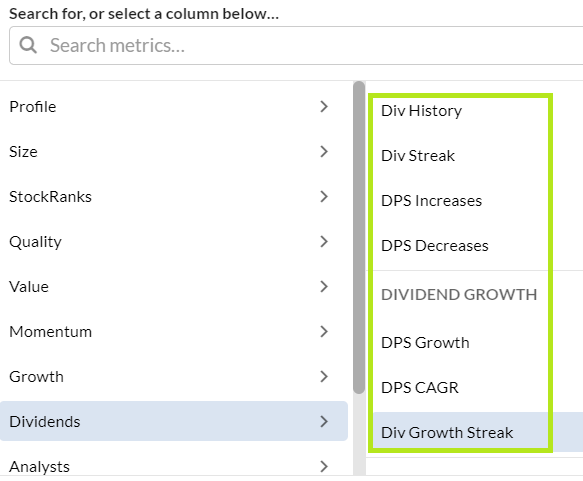
A full explanation of each measure is provided in the right-hand panel of the screener dialogue. But in short they allow us to score a company’s dividend history against various standards.
Least demanding is Dividend History. This is a binary measure that simply indicates whether a company has paid a dividend in the last five years.
At the other end of the scale is Div Growth Streak which counts how many years of consecutive dividend growth a company has achieved in the last 10 years.
I tend to take a middle route at this early stage and use Div Streak to count how many consecutive years a company has paid dividends, regardless of any cuts.
Dividend cover
The standard measure of dividend affordability is to compare the payout with earnings per share. In general, most companies cannot sustainably distribute dividends greater than their earnings for too long without running into problems.
Dividend cover of 2.0x indicates that the payout is 50% of earnings per share. That leaves a further 50% of earnings available for reinvestment or debt reduction.
Earnings cover is certainly a useful measure and I use it in my screening. It’s shown on the StockReport, directly below dividend yield:

One problem with measuring dividend cover by earnings is that dividends are a cash payout. Reported earnings do not always reflect cash generation. That’s why I am always keen to ensure that dividends are also covered by free cash flow.
Without good cash conversion from earnings, there’s a risk that dividends are being funded from cash reserves or debt. Such payouts may be sustainable for short periods, but the additional risk is certainly something I want to be aware of.
The StockReports include free cash flow per share, so we can compare this figure with dividend payments visually.
In this example, dividends paid have been covered amply by free cash flow:

These tests can also be included in a screen, using an advanced rule to compare free cash flow per share to dividend per share.

I’ve specified a cover level of 1x for this example. In reality I would usually look for a higher level of cover, but I don’t want to be too restrictive in an initial screen.
Profitability & fundamental health
When a company pays a dividend, its equity value falls. Cash that could previously have been reinvested in the business or used to repay debt is lost forever.
Excluding special situations such as liquidation, I want a company to be sufficiently profitable that it can pay dividends, service its debts and maintain capital expenditure to support future growth.
Achieving this requires a certain level of profitability, by which I mean return on capital employed. Ed’s ROCE guide is a must-read if you’re not familiar with the mechanics of this key ratio.
What’s appropriate may vary widely between businesses, depending on their capital expenditure requirements, growth outlook and profit margins.
In general I look for a return on capital employed of at least 8%, ideally over 10%. This range is often used as a rule-of-thumb estimate for a company’s cost of capital – the blended cost of debt and equity funding.
I would say it’s unlikely that a business can support growth and an attractive dividend if ROCE is consistently below this level, especially if it carries significant levels of debt.
BT (LON:BT.A) and Vodafone (LON:VOD) have been notorious examples of this problem in recent years. Both had returns on capital below 8% in most years between 2018 and 2023. Their debt ballooned to cover the cost of big capex programmes and unaffordable dividends.
Both companies ended up cutting their payouts.
In contrast, the business pictured below continued to create value for its shareholders during this period.
A rising dividend and a rising book value imply that the business was able to invest in its assets while still returning cash to shareholders.


A rising book value should support higher profits, assuming profitability remains stable.
A look at ROCE for the same company confirms that returns on capital were consistently above my 8% preferred minimum during this period, even during the pandemic.

Sure enough, profits rose as well:
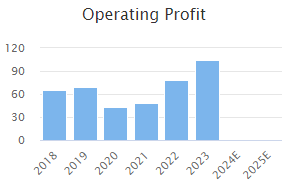
Of course, I’d need to do further research to understand the moving parts behind these numbers. Have new assets been added, acquisitions made, or debt repaid? Have revenue and profits grown?
Debt levels need particular attention.
As a rule of thumb, I prefer to see net debt of less than four times trailing net profit.
I choose net profit rather than EBITDA because I feel this measure gives me more of an understanding of a company’s ability to repay debt, rather than just making interest payments.
However, using net profit as the denominator for leverage does require some interpretation and flexibility.
Reported profits can fluctuate from year to year due to exceptional items. Reported net debt can also be inflated by large property lease liabilities, which I tend to view as less onerous than bank debt.
It’s sometimes necessary to look at the accounts directly to understand a company’s debt position.
Valuation & dividend yield
Assuming a stock has already satisfied my tests for dividend cover, profitability and fundamental health, my next priority is valuation.
When I’m investing for income, my view on valuation is generally driven by two factors:
Dividend yield
Expected dividend growth rate
The mix of upfront yield and dividend growth potential available varies widely between companies.
Tobacco stocks are quintessential high yielders. They generate high returns but reinvest very little due to their limited growth prospects. The majority of earnings are returned to shareholders each year through dividends and buybacks.
In contrast, a high-quality consumer goods or industrial firm might offer a lower payout ratio with greater long-term growth potential.
Summing the dividend yield and growth rate allows me to estimate the expected total return (share price growth plus yield) from a stock, stripping out any valuation gains or losses.
The long-term average return from the UK stock market is around 7%-8%. I typically target a 10% annual return from a new investment, although again there’s some flexibility in this.
As an investor who is still working, I typically aim for a mix of high yield and dividend growth stocks in my portfolio. My aim is to generate a portfolio yield that’s modestly above the market average, together with above-inflation income growth.
However, an older investor generating a retirement income from their portfolio might logically choose to focus on higher-yielding shares, in order to maximise near-term income.
There’s no right and wrong choice. What’s suitable for an individual investor depends on their individual circumstances.
However, I believe it’s important to understand what kind of business you’re investing in, and what you may be able to expect in terms of upfront income and future dividend growth.
Looking at the big picture
The checklist above helps me to identify companies that have been cash generative and profitable enough to support attractive dividends. But these historic numbers do not necessarily tell me very much about the business or its future prospects.
To understand this, I need to dig a little deeper.
What does the business do and is it in good health?
This may seem obvious, but my starting point is usually to ensure that I understand the company’s commercial activities and its business model.
What does it sell, who are the customers and why is the business able to generate above-average returns and strong free cash flow (assuming that it does)?
Does it have durable competitive advantages, such as brands, unique assets, scale or network effects?
Does the business operate in a cyclical sector or have exposure to commodity prices? These factors can lead to big swings in working capital and free cash generation. I need to try and understand how these might affect future profits and support for the dividend.
Finally, I need to know if the balance sheet is in good health, with evidence of NAV growth and a sensible level of debt. The F-Score (shown on the StockReport) provides a useful indicator of whether a company’s fundamental health is worsening or improving.

What mix of income and growth do I expect?
To take two extreme examples, is this a tobacco business (high yield, low growth) or a successful tech company (low yield, high growth)?
I need to think about the mix of yield and growth I can expect over the next 5-10 years. Does it suit my requirements?
The analyst forecasts shown in the StockReport are a good starting point for near-term dividend expectations. They show expected dividends for the next two years, together with recent upgrades or downgrades:

Beyond this, useful sources of information include broker notes and the company’s own dividend policy, which is usually mentioned in its annual results.
I always check whether a company has a progressive policy or a percentage payout and am alert for any changes to the dividend policy.
Progressive payouts should rise every year, but can sometimes become unaffordable over time;
A percentage payout is more sustainable, but can rise and fall unpredictably if the company’s profits are volatile;
Changes to the dividend policy can be a sign of an underlying change in strategy, profitability, or growth potential. I try to consider the underlying implication of any change.
What can go wrong?
A dividend cut is usually (not always) a sign that management has failed to plan sufficiently far ahead. The dividend payout may have become unaffordable. In general, I find either that cash inflows have fallen short of expectations, or that outflows are proving greater than expected.
It’s impossible to avoid suffering a dividend cut periodically. But as I’ve mentioned throughout this piece, there are plenty of warning signs that may hint at increasing pressure on the payout.
For example:
Falling profit margins or return on capital employed
Rising net debt and higher leverage (relative to assets or market cap)
Flat or declining revenue
Lower levels of dividend cover, or weaker cash conversion from earnings
Changes to dividend policy
A change to the business model or a large acquisition/disposal
These factors do not necessarily mean a dividend cut is likely. But I tend to use them as a prompt to look more closely and understand what may be happening.
Next steps
To wrap up, I’ve included some links to income stock screens available on Stockopedia and some of those included in previous articles.
Screening results should not be seen as a list of stocks to buy, but I hope that the screening criteria used (and the results they generate) may provide ideas for further research and inspiration for your own screening activities.
Remember – there is always more than one way to approach stock selection. Finding a system that works for you is more important than trying to emulate anyone else.
Stockopedia’s Guru Screens contain a selection of income screens based on strategies used by famous investors
Disclaimer
This is not financial advice. Our content is intended to be used and must be used for information and education purposes only. Please read our disclaimer and terms and conditions to understand our obligations.

6 comments
Thanks for the article Roland, funnily enough the checklist you describe is I think a good one & funnily enough pretty much the one I have used with some success for a number of years now. Indeed I found when researching shares and investigating stocks that came up in screens that I was always looking at these same financial metrics on each individual stock to see if they appealed and if they were likely to help me meet my objectives.
As a result of this I set out to create a bespoke Scoring system that would point me towards and highlight the stocks that provided the best mix of characteristic that I am looking for. These characteristics are based on fundamental factors such as value, quality, financial security, dividends and momentum which have been found to help in identify outperforming shares.
The Compound Income Scores I created have been used in my own portfolios and in a model portfolio based on them to produce the performance shown in the chart below.
I do make these Scores and the Portfolio available to people via a Google Sheet. If that is of any interest to readers here, then you can find more details about them and how to gain access to them at this link.
Cheers
Jamie
You omitted: “at a price”.
Oh yes, it works out at around 20p a day or less for an annual subscription.
Very helpful. Thank you, Roland.
I would also like to thank you Roland for the informative articles. I keep finding new things to try out on my stock screens based on your informative articles.
Thanks, Roland - another fab article. Have learnt a lot from this mini series.