Are the StockRanks highlighting opportunities in fund managers?

For much of the last few years, anyone betting on a recovery in fund manager stocks has been long and wrong, as the saying goes. That has included me at times.
For years, active managers have faced steady pressure on fees due to competition from cheap passive funds. More recently, most UK fund managers have also faced sustained outflows as investors have jumped ship to US equities or simply withdrawn from a lacklustre UK equity market.
However, the StockRanks are pointing to a number of potential opportunities in this sector, notably in two of the most unloved fund managers of all – Abrdn (LON:ABDN) and Jupiter Fund Management (LON:JUP).
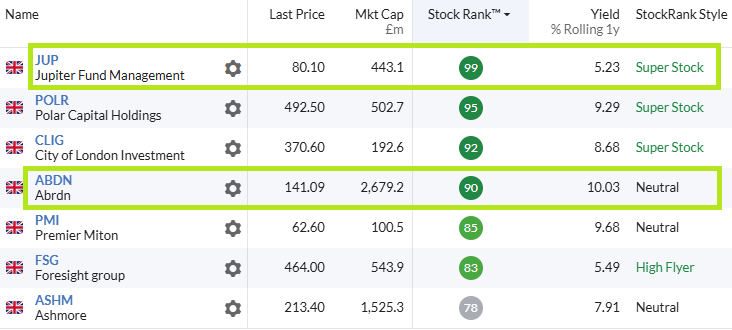
I’ve been taking a closer look at both of these firms. I think this could be a case where the objective metrics powering the StockRanks are highlighting an opportunity that’s not yet being recognised by the wider market.
Despite the (many) good reasons to be cautious about these businesses, I think the investment case for each is worth exploring.
Abrdn (LON:ABDN)
Fund manager Abrdn is a traditional fund manager, but the group also has an Adviser platform (providing services for financial advisers) and owns the interactive investor retail investment platform.
In other words, Abrdn aims to serve the full spectrum of investment clients, from institutions such as pension funds through to DIY investors.
While I was planning this article, the company issued a Q3 trading update revealing net outflows of £3.1bn during the third quarter. These were driven by outflows from the funds and adviser divisions, offset by inflows to interactive investor.
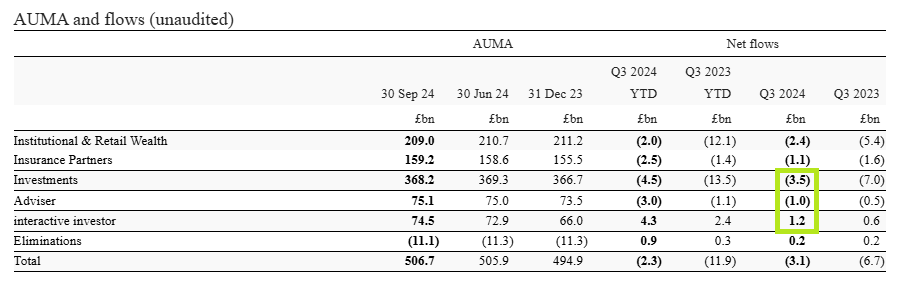
While this was an improvement on the net outflows of £6.7bn seen during Q3 2023, it wasn’t what the market was hoping to hear:
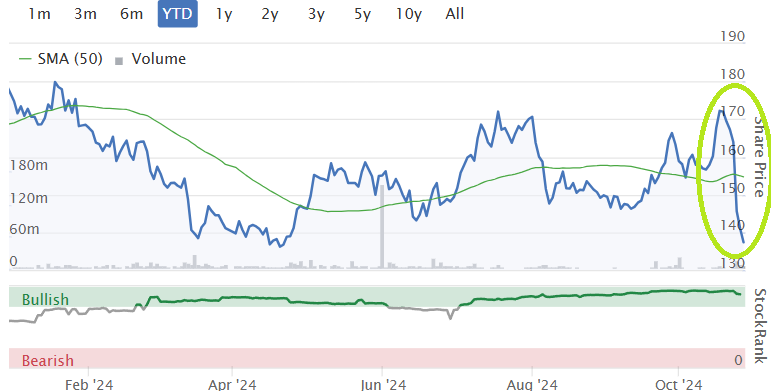
Continued outflows are obviously a potential concern. But Abrdn is hardly alone in this regard. I don’t see it as a dealbreaker at the current valuation.
Despite the structural headwinds to their business, my working assumption is that the cycle will turn for active managers at some point. On this basis, I think there are some good reasons to think that Abrdn could be attractively priced at current levels. Let’s take a closer look.
Abrdn StockRank breakdown
I’ll start with a look at the numbers behind the current StockRank and then take a look at the valuation from a sum-of-the-parts perspective.
Abrdn scores highly for value and momentum, less so for quality:

These scores suggest that the potential opportunity here may be a Value-Momentum play – also known as a Turnaround in the Stockopedia Style classifications.
This seems logical to me, given the stock’s multi-year decline and the potential for an operationally-geared recovery in profits, if the business can achieve a return to net inflows.

QualityRank: this score is driven by metrics that aim to capture the franchise quality of a business and its fundamental (financial) health.
The QualityRank is calculated using a combination of profitability metrics and the Piotroski F-Score. You can read more here.
While Abrdn has sometimes generated high operating margins, the return on equity generated by the business has been average at best in recent years. Without a sustained improvement in profitability, my guess is that this stock is unlikely to earn a high QualityRank:

ValueRank: it’s a different situation entirely for value. Abrdn’s ValueRank of 93 reflects its modest valuation metrics across a range of measures (read more about the ValueRank here):

There’s also a very tempting 10.7% dividend yield at the time of writing, although note that the payout isn’t expected to be covered by earnings this year.

Due to the strength of the group’s balance sheet (see below), I think there’s a chance that Abrdn’s current dividend will be sustainable. However, another cut is certainly a risk if profits don’t start to recover soon.
MomentumRank: this score captures price momentum (technical analysis) and earnings momentum, which is driven by broker estimates and recent results. (There’s a detailed explanation of the MomentumRank here.)
Abrdn’s MomentumRank has fallen sharply since the company’s trading update earlier on 24 October. We can see this by checking historical StockReports for the shares – just click on the arrow on the Print button to do this:

I’ve compared the StockRanks for 22 October and 28 October to get a feel for the impact of the Q3 trading statement on 24 October:

We can see that the share price slump had a sharp impact on Abrdn’s MomentumRank. This score is often the most volatile of the three factor ranks, as it’s heavily weighted to share price action.
In contrast, the QualityRank is unchanged and ValueRank has increased slightly to reflect the stock’s reduced valuation.
Of course, there may be some risk to earnings if Abrdn continues to suffer net outflows. Broker forecasts – another key element of the MomentumRank – have sent mixed signals recently, with the outlook for 2025 seemingly weakening:

Sum of the parts: too cheap to ignore?
Viewing Abrdn through the lens of the StockRanks makes me feel that it’s probably cheap.
But the investment case becomes more compelling for me when I consider the value that seems to be embedded in the business through its operating divisions and on-balance sheet assets.
The company divides its operating businesses into three groups. This screenshot from the 2023 annual report provides a handy overview:

We can see that the Adviser and interactive businesses generate the majority of profit. The Investments (funds) business appears to be somewhat burdened with high costs.
A quick look at the 2023 accounts for interactive investor at Companies House confirms that this business has the same high-margin appeal as its listed rivals Hargreaves Lansdown (LON:HL.) and AJ Bell (LON:AJB).
ii’s revenue grew by 30% to £236m last year. This translated into a reported operating profit of £104.7m – an operating margin of 44%.
At the end of the third quarter, ii had 430k direct-to-consumer (D2C) customers. This places it second in the UK market, behind sector behemoth Hargreaves (1.9m customers), but ahead of AJ Bell (371k D2C customers).
Abrdn’s adviser platform is also the second-largest in the UK (by AUM), according to this table from Integrafin Holdings (LON:IHP) half-year presentation:

Valuation: we can use the listed rivals to Abrdn’s D2C and adviser platforms to make some relative valuation comparisons.
I’ve used the ratio of market cap to AUM as a simple valuation metric for this purpose:
Company | Business type | Mkt cap/AUM | Mkt cap/AUM % |
AJ Bell | Adviser + D2C platforms | £1.9bn / £86.5bn | 2.2% |
Hargreaves Lansdown | D2C platform | £5.2bn / £157.3bn | 3.3% |
IntegraFin | Adviser platform | £1.2bn / £64.1bn | 2.0% |
Adviser and D2C clients tend to generate slightly different levels of profit, so aren’t exactly equal in value (to a potential acquirer). Equally, Hargreaves’ current valuation includes some takeover premium.
However, ultimately these businesses are all competing against each other. I don’t see any obvious reason why Abrdn’s adviser and ii units should not be valued at similar levels to those of IntegraFin and AJ Bell.
Applying a valuation of 2% of AUM gives me the following estimates for Abrdn’s Adviser and ii units:
Abrdn Adviser: £1.5bn (£75bn AUM)
Interactive investor: £1.5bn (£75bn AUM)
Adviser + ii: £3.0bn
Abrdn current market cap: £2.5bn
Abrdn paid £1.5bn for ii in 2022, so this valuation surely isn't too far fetched. The potential value of these two units alone appears to support the group's current market cap in my view. I would argue that Abrdn’s moribund fund management business could be distracting the market from the potential value of its capital-light consumer operations.
I think it's possible that continued growth for ii and a return to positive net inflows for Adviser could provide a catalyst for a re-rating, assuming margins hold up.
There’s also a second potential catalyst I can see within this business – substantial net assets on the balance sheet.
Balance sheet: what’s under the hood?
I should point out that Abrdn has a large and complex balance sheet. What follows is not a detailed analysis, just a snapshot of some highlights I think are interesting.
The StockReport provides our first clue that there might be some asset-backed value on offer here. Stockopedia’s data suggests the stock may be trading at a 30% discount to tangible book value:

Taking a closer look, the latest balance sheet shows equity attributable to shareholders of £4,931m, including intangibles.

Stripping out intangible assets of c.£1.5bn gives me a tangible net asset value of £3,417m. This suggests that the company’s £2.5bn market cap may represent a discount of about 26% to TNAV.
Abrdn is a large and complex financial group, so calculating net asset value is not as simple as for some non-financial businesses. However, the group does carry substantial investment assets and cash on its balance sheet, in excess of regulatory requirements. I think these are worth a look.
The most notable (and easiest to value) is Abrdn’s 10.7% stake in FTSE 100 insurer Phoenix group (LON:PHNX). My sums suggest this holding could be worth around £535m at current prices. It should also be generating around £57m of dividend income each year.

Looking beyond this, I’ve attempted to estimate Abrdn’s total net cash and net financial investments, in excess of regulatory requirements.
Please note I am not an expert and my estimates may include errors. But my reading of the June 2024 balance sheet and footnotes suggests the following:
Net financial investments carried on balance sheet*: £1,109m
plus Cash & equivalents: £1,397m
minus Regulatory capital requirement: £1,054m
Net free cash & investments: £1,452m
*excluding unit-linked assets/liabilities
Given Abrdn’s current £2.5bn market cap, this seems to imply that the ongoing business is being valued at little more than £1bn.
That seems cheap to me, given that Abrdn is expected to report net profits of c.£250m in 2024 and 2025.
In reality, I suspect the true realisable value of net cash and investments is probably lower than I’m suggesting. The group might also need more working capital to operate than my sums suggest.
Even so, I think it’s reasonable to suggest that there could be further value here, in addition to the potential breakup value of the Adviser and ii units.
Outlook
Abrdn’s third-quarter statement reiterated guidance for operating expenses of less than £1,075m in 2024. If I subtract this from Stockopedia’s consensus estimate for revenue of £1,321m, I get an operating profit estimate of £246m for the current year.
With a market cap of £2.5bn, this values Abrdn shares at five ten times forecast operating profit, which seems undemanding to me. (corrected 12:00 31/10/24)
For contrast, AJ Bell is currently trading at about 17 times FY24 forecast operating profit.
My view
Although I have some reservations about the broader outlook for general fund managers, Abrdn is one of the larger players in the UK, with over £500bn of AUM. I think this business should be able to generate value for shareholders if it’s well managed.
As I’ve discussed above, I think the group’s current market cap is comfortably covered by the value of the high margin, capital-light Adviser and ii units.
In addition to this, the group still appears to have a fairly strong balance sheet, with further investment assets that might be realised over time.
Perhaps my biggest concern is that the fund management business will continue to struggle, distracting management from maximising the potential of Adviser and ii. These consumer-facing businesses are expected to benefit from continued structural growth in the UK. But competition is intense, so focused leadership will be needed.
Long running cost-cutting and restructuring efforts must surely be wearing thin with Abrdn’s staff by now. However, with a new CEO in charge who appears to be closely focused on execution, I wonder if there’s light at the end of the tunnel.
On balance, I think Abrdn could be worth further research.
Jupiter Fund Management (LON:JUP)
I’m only going to make a few brief points on Jupiter Fund Management, as Graham has regularly covered this stock in the SCVR. I share his view on the business, as summarised in his comments in July.
However, given that Jupiter is now the top-ranked stock in this sector, I’d like to highlight a couple of other points that have struck me about this business.

Like Abrdn, Jupiter appears to have a fairly well-endowed balance sheet.
Capital surplus: In its half-year results, Jupiter reported a capital surplus of £198.5m, equivalent to 3.75 times its required regulatory surplus of £72m.
This suggests the group could have perhaps £100m of capital that’s truly surplus to operational requirements – more than 20% of the current market cap.
The current dividend is covered twice by forecast earnings, suggesting to me that this surplus could be lifted further by future retained earnings in the absence of any major capital expenditure (e.g. M&A).
Indeed, Jupiter confirms that “further returns of additional capital” will be considered at the appropriate time.
Net cash & investment assets: as I did with Abrdn, I’ve also attempted to get an idea of the net cash and investment assets carried on Jupiter’s balance sheet.
Net financial investments carried on balance sheet: £140m
plus net cash & equivalents: £157m
minus Regulatory capital requirement: £72m
Net free cash & investments: £225m
Again, this is very much an estimate, not an exact measurement. I imagine the realisable figure would probably be lower than this.
Even so, this figure is roughly half Jupiter’s current market cap of £440m.
Stockopedia’s consensus forecasts suggest Jupiter is expected to generate a net profit of about £59m this year, falling to £45m in 2025.
The risk here is that the earnings decline cannot be arrested despite the CEO’s efforts to simplify the business and focus on a smaller number of more differentiated products.
However, the group’s balance sheet suggests to me that the current operating business might only be valued at five or six times forecast earnings. With a well-supported 5%+ dividend yield, I think Jupiter could also be worth a closer look.
Disclaimer
This is not financial advice. Our content is intended to be used and must be used for information and education purposes only. Please read our disclaimer and terms and conditions to understand our obligations.
8 comments
Am using the helpful free regular investing facility offered by Interactive Investor to buy a small amount of ABRDN each month with a view to benefitting from pound cost benefits over a mid term perspective.
Thanks Roland great job as always. I have JUP and also LIO unfortunately, this has absolutely tanked recently same issue declining AUM. The gyrations of yesterday wont help sentiment one bit ie to reinvest in UK.
Any thoughts on LIO ?
You really would think things wou;ld turn for these companies, just look back 5 plus yrs
Thanks for that superb article Roland. I hold both Abrdn (LON:ABDN) and Jupiter Fund Management (LON:JUP) so yours was a very helpful update.
Years ago I held Abrdn (LON:ABDN) but sold around £4 several years ago as the share dropped ever lower despite ABDN buying back quite heavily for over 5 years. I bought again around £1.40 as that seemed such a bargain price, with the varying parts of Abrdn (LON:ABDN) worth a lot more than the current market cap. I.e break up potential or a bid?
Those buybacks were an awful waste of money as the share fell 70% but with the one plus that there are now far fewer shares in issue. I feel that around the current £1.30 nearly all the past bad news is priced in, but recovery potential isn’t. And there’s a good chance the big 10% dividend can be maintained.
Thanks Roland
Very comprehensive and well researched / written article. I bought in recently - I have been watching for ages and when the sp dipped to an all time low (and lower than the lowest intraday of 2009) I hit the buy button. Unloved at present but even if a moderate cut to divi it will still leave an appreciable income. There's so much value / history / customer base here that I'm happy to hold.
I'm not sure what the catalyst would be to switch from passives/etfs back to using active fund managers?
The fees these managers charge are too high, and not many of them ever beat the indexes on a consistent basis (or even match the index).
Hi Roland,
Thanks for taking the time to share this analysis.
I've been patiently waiting and watching both companies for a while now and have the same view that there may be opportunities here over the mid to longer term timeframe. Collecting good divi's along the way is a plus and will definitely help.
Just now I have a small starter position in Jupiter Fund Management (LON:JUP) and am looking to add to it when possible. It was good to see the price was reasonably stable after reporting the last AuM outflows and I'm starting to wonder if the market is beginning to look past them now ...
Abrdn (LON:ABDN) isn't too far off it's 2009 lows and it seems like you're getting a lot of company for that money. I guess I'm thinking like a weighing machine here and am looking forward to seeing what the voting machine thinks.
Thanks again, this was very helpful.
Thanks Roland, great article! I also think a reversal of the popularity of passive funds is inevitable at some point, driving money back towards differentiated strategies and stock picking funds.
One question - below suggests ABRDN trades at 10x op rather than 5x? Unless you’re looking at a half year perhaps?
‘third-quarter statement reiterated guidance for operating expenses of less than £1,075m in 2024. If I subtract this from Stockopedia’s consensus estimate for revenue of £1,321m, I get an operating profit estimate of £246m for the current year.
With a market cap of £2.5bn, this values Abrdn shares at five times forecast operating profit, which seems undemanding to me.’
Hi Jon, many thanks for your comment and for pointing out my typo, it's now corrected.
Regards,
Roland