Are UK housebuilder stocks still cheap?

Mortgage rates are starting to fall. The new government is promising a housebuilding boom.
Is it time to consider buying shares in UK housebuilders ahead of a sector recovery?
In this piece I’ve taken a look at the issues affecting the sector and the current state of the UK’s main listed housebuilders. Read on to see why I think these companies could be worth a closer look at current levels.
Politics or business?
It’s hard to separate the UK’s housing market from politics.
In the aftermath of the 2008 financial crisis, the Help to Buy Scheme helped to prevent a logical market correction. Instead, it unleashed a decade-long surge of house price inflation. Prices were driven even higher by the rocket fuel of ultra-low interest rates – unprecedented at any point in modern UK history.
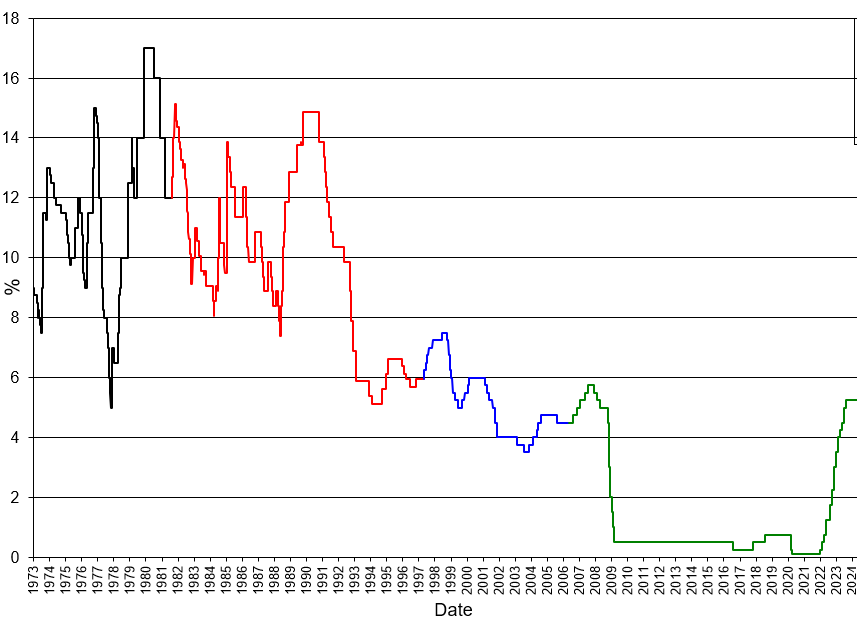
Source: Bank of England (July 2024)
Big housebuilders were prime beneficiaries of this policy. They enjoyed what I would describe as abnormal profit margins for many of these years.
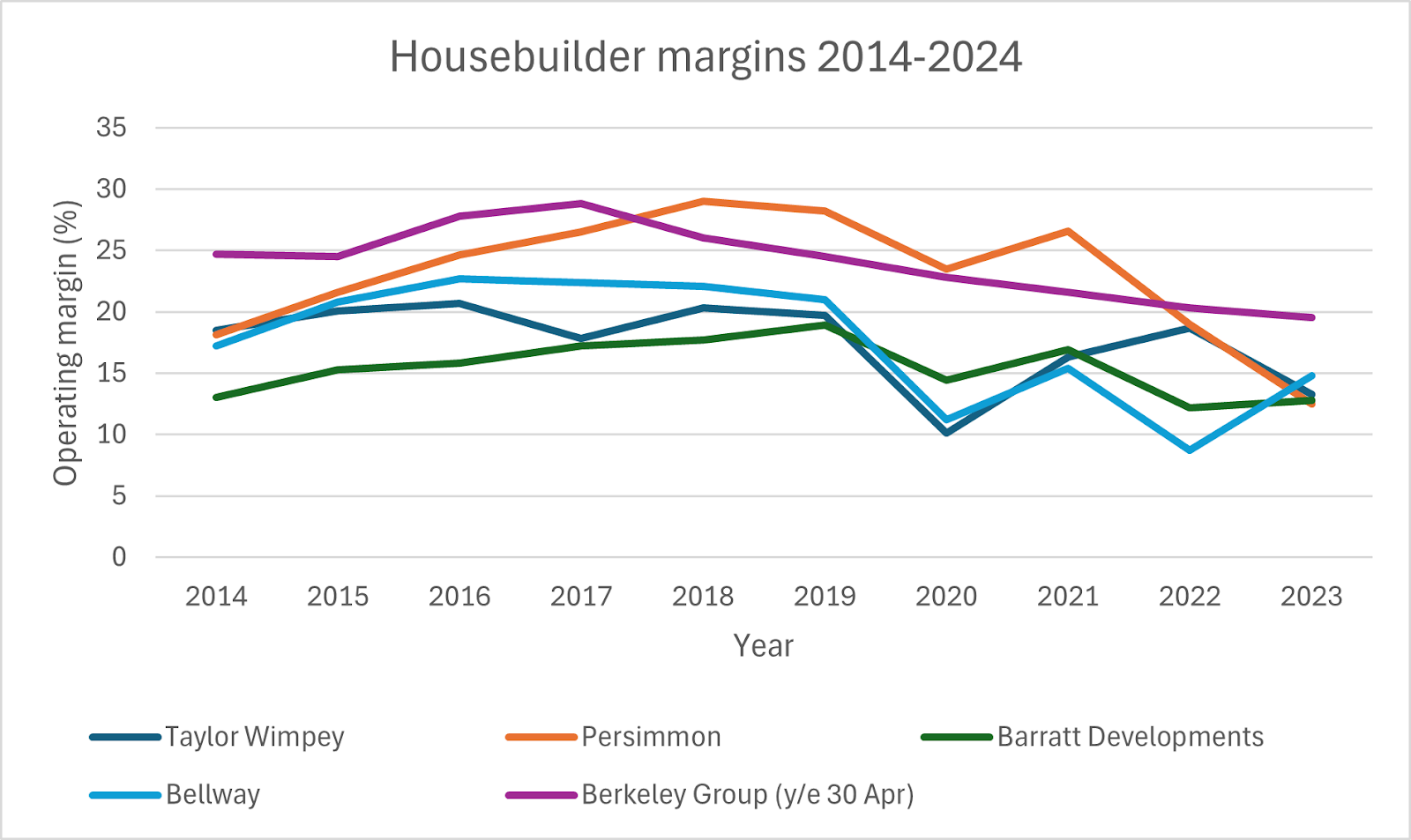
However, when interest rates started rising in 2022, the cycle started to turn. Higher borrowing costs had a predictable impact on affordability.
UK-wide sales completions are reported to have fallen by 19% in 2023. This drop has also been reflected in the output of most of the big housebuilders.
For example, mid-market builder Barratt Developments (LON:BDEV) saw its output fall by nearly 20%, to 14,004 homes, during the 12 months to 30 June 2024.
Has the market bottomed out?
In the recent election, planning bottlenecks, high land costs and a shortage of new housebuilding were key campaigning issues for Labour.
The party has promised to unblock the system and build 1.5m new homes before the next election, equivalent to 300,000 per year.
The new government’s plans have not yet been fleshed out in any detail. But I think it’s fair to assume that if interest rates fall and the economy strengthens, housebuilding activity could increase regardless of government action.
Barratt’s latest guidance is for a further fall in output to between 13,000 and 13,500 completions in 2024/25. A recovery is expected from the following year.
It will certainly take time for demand to recover and for the construction pipeline to refill. But I wonder if Barratt’s latest guidance may also be a little conservative, leaving scope for upgrades if macroeconomic conditions improve over the next six months.
Inflation is coming down and mortgage rates are already falling, with best-buy rates now closing in on 4%. The consensus seems to be that the Bank of England may cut interest rates later this year, albeit possibly a little later than expected. That could prompt a further reduction in mortgage rates.
Government policies to accelerate housebuilding could also have an impact. The big housebuilders are the only people who have the ability to build housing efficiently at large scale – any increase in volumes will surely have to be driven through them.
One caveat to this is that an increase in volumes will not necessarily result in higher profitability. Depending on the mechanisms the government uses to accelerate building and improve affordability, house prices (and builders’ margins) could potentially be under pressure for a while.
We’ll have to see. But even with this risk, I think it’s reasonable to expect that an increase in housebuilding volume is likely to boost the collective profits of UK housebuilders.
Sector review: is it too late to buy?
Have investors already missed the chance to pick up housebuilding stocks at bargain prices? I think it’s a fair question.
Average share prices in this sector have moved up by more than 30% over the last year:

Based on a portfolio of UK housebuilders with market caps >£100m
However, as I’ll discuss below, I think valuations remain fairly undemanding on a cyclical view. In my view, there are opportunities for further gains – and perhaps still a few clear value opportunities for investors.
For the purposes of this review, I’ve defined UK housebuilders as the listed firms with a market cap of £100m or above. Here they are, listed in size order:

(Note: Barratt is trying to acquire Redrow, while Bellway has made an offer for Crest Nicholson. Neither deal has completed at the time of writing and both still need regulatory approval from the CMA.)
Valuation: looking through the cycle
What about valuation? Big cyclical swings in earnings mean that simply relying on P/E and yield metrics can be misleading.
Right now, the big dividend yields of recent years have largely disappeared and price-to-earnings metrics don't seem obviously cheap:

However, the cyclical nature of housebuilding profits means that this may actually be a good time to buy. As with miners and oil stocks, a high P/E and a low yield can be a sign that profits are close to cyclical lows, assuming there are no fundamental problems with the business.
For example, in May 2021, Stockopedia’s history tool allows us to see that Persimmon (LON:PSN) was trading on a FY21 P/E of 13, with a 7.5% dividend yield (just click on the arrow next to the PRINT button for history).
Persimmon’s earnings have fallen by nearly 70% since then, while its share price has dropped around 50%. As a result, the shares now trade on a FY24 P/E of 19 and a yield of 3.9%:

Housebuilders’ profits may not readily recover to the peak levels seen during the Help to Buy boom. But with volumes down by 20%-30% at most of the big firms, I think it’s reasonable to expect some recovery.
Thoughts on valuing housebuilders
In simple terms, housebuilders' business model is to buy land and then flip it for a profit by building homes on it. In most of the UK, land costs account for the majority of the cost of building a new home.
For this reason, my first check when considering whether a housebuilding stock might be cheap is to see if it's trading at a discount to book value. If it is, then my default assumption is that there could be some value on offer, assuming there are no balance sheet problems or other glaring issues.
Although discounts have narrowed sharply over the last year, there are still a few housebuilders trading below book value, according to Stockopedia data:

If the stock isn’t trading below book value (and even if it is), I then make an attempt to estimate how profits could vary through the cycle.
How I estimate potential profitability: book value reflects the net value of a housebuilder's land and unsold inventory. Comparing net profits with book value gives us a company’s return on equity, or ROE.
My approach is to look at the latest book value and then calculate notional after-tax profits based on different levels of ROE.
As a general rule of thumb, I’d expect a well-run housebuilder to generate a return on equity of 10%-15% through most of the cycle, with peaks and troughs outside this range.
This gives me a rough framework to gauge the possible valuation of a housebuilding stock, in a cyclical context.
Here’s a worked example using Persimmon. These numbers suggest to me that the shares may not be expensive at the moment, despite trading at a premium to book value.
Step 1: Persimmon’s company’s book value can be found easily on the StockReport, listed both as a total and a per-share value:

We can see Persimmon’s last reported book value was £3,419m.
Step 2: I use this book value to calculate possible net profit figures, based on different levels of return on equity.
(e.g. 5% ROE = book value * 0.05)
Return on Equity | Net profit |
5% | £171m |
10% | £342m |
15% | £513m |
For this example I’ve used Book Value and estimated net profits. But you could perform the same calculation using book value per share to estimate earnings per share.
Step 3: Next, I compare these estimated numbers with current consensus forecasts for the stock.
Current broker forecasts for Persimmon suggest to me that the company’s return on equity is expected to be at the lower end of this range in 2024 and 2025:

Based on these numbers, I would guess that Persimmon’s profits are close to cyclical lows, barring any black swan events.
Step 4: Return on equity is a useful quality metric, but it doesn’t tell us anything about the valuation of the shares.
The final step in the process is to pair my profit estimates with the stock’s current market value. This helps me to gauge how cheap or expensive the stock might be.
My 15% ROE profit estimate of £513m for Persimmon is equivalent to a P/E of 9.5, based on the current market cap of £4.9bn.
Consensus forecasts suggest a dividend payout ratio of roughly two thirds for 2024 and 2025.
On this basis, my 15% ROE profit might support a dividend of £342m (107p per share). That would give a 7% yield, at the current share price of £15.
You’ll notice these figures are less extreme than the profits and dividends achieved during the Help to Buy era. Although this past level of profitability might be repeated, I think it’s prudent to expect a more modest level of profitability for the foreseeable future.
Conclusion: based on these numbers, I would probably conclude that Persimmon is likely to be modestly undervalued at current levels, with the potential to provide positive returns over the next few years.
However, I'm not sure the shares are at bargain levels anymore.
For comparison, repeating the process above one year ago for Persimmon would have suggested a P/E of 7.2 based on a 15% ROE, with a corresponding dividend yield of 9.2%.
Caution: the process I’ve outlined above is only a crude estimate of potential profitability. There are many ways in which it might be refined to reflect companies' varying business models. It's also fair to say that some housebuilders (notably Berkeley group (LON:BKG)) have historically been more profitable than others.
Another factor worth emphasising is the risk of one-off problems that could skew profitability. Most of the major firms have booked sizeable provisions relating to fire safety remediation.
However, Crest Nicholson Holdings (LON:CRST) has suffered additional problems relating to its past developments over the last year, culminating in a recent profit warning.
This may be why Bellway (LON:BWY) believes it can acquire Crest with a bid whose implied value of 273p is well below Crest’s last-reported book value of 313p per share (H1 2024).
What do the StockRanks say?
Of course, we don’t have to own any housebuilding stocks at all… Perhaps there are simply better opportunities elsewhere.
One of the useful things about the StockRanks is that they allow us to quickly gauge the relative attraction of individual stocks in the context of the wider market.
Returning to my portfolio of housebuilders, we can see that the StockRanks have a mostly positive view of these firms, with four of the 10 styled as Super Stocks:

The StockRanks focus on a blend of quality, value and momentum that’s statistically more likely to deliver market-beating results. Past performance is no guarantee of future returns, but higher-ranked stocks have collectively outperformed lower-ranked stocks over the last decade.
The highest-ranked stock above is also the smallest firm, Springfield Properties (LON:SPR). This Scottish firm produces a mix of private and affordable housing and saw its sale fall by 20% last year, to £266m.

I don’t have the space for a detailed analysis here, but I can see a few points worth noting:
Valuation and earnings growth look appealing relative to the wider industry and the market:

Net debt looked high on the last-reported accounts, and this figure is shown on the StockReport:

However, a subsequent trading update has confirmed that proceeds from land sales have been used to reduce bank debt to a far more comfortable level of £40m, as guided in February’s half-year results.
Trading commentary: the company says it has re-entered the affordable housing market as economic conditions have improved. Management says Springfield has one of the largest land banks in Scotland and could be well positioned to benefit from a potential increase in build-to-rent activity.
SCVR: Paul and Graham have commented on the business several times this year, most recently suggesting that the stock “continues to look attractive value” (12 July 24):
19 Feb 24: Land sale update
20 Feb 24: Interim results
12 Jul 24: Trading update
I also think that Springfield could be worth further research at current levels, despite the recent share price bounce.
Sector M&A: should we care?
One thing I haven’t mentioned much in this piece is the consolidation that’s taking place in this sector, assuming the CMA allows the proposed deals to complete. The CMA is said to have some concerns over consolidation in this sector, so this isn’t yet certain.
As things stand, Barratt hopes to swallow up Redrow, while Bellway is targeting Crest Nicholson.
I don’t really have a strong view on these deals, because I don’t think they will make much long-term difference, assuming they are executed successfully.
Both are all-share deals between companies with decent balance sheets, so I don’t have any concerns relating to debt.
Both seem reasonably priced in the circumstances, and both will give the acquiring company access to a bigger land bank (until it’s developed and sold).
Looking at how the combined companies might perform, I assume there will be some modest cost savings in central functions.
However, I can’t see any major economies of scale when it comes to building houses. Each development will require the same number of skilled labourers, and the same amount of land, infrastructure and materials.
For these reasons, I don’t think these acquisitions will make a huge difference to the future performance of either business.
Final thoughts
Profits and dividend payouts are depressed in the housebuilding sector at the moment, thanks to a sharp slump in volumes since interest rates rose.
Although share prices have recovered somewhat, I don’t think a full recovery is priced into the stocks yet. I’d expect to see a decent recovery in earnings and shareholder returns when sales volumes pick up. On balance, I believe most stocks still remain somewhat undervalued, on a cyclical view.
I intend to continue holding my own housebuilder shares for a little longer yet, at least until the shape and likely impact of the government’s plans becomes clearer.
Disclosure: Roland owned shares in Bellway at the time of publication.
Disclaimer
This is not financial advice. Our content is intended to be used and must be used for information and education purposes only. Please read our disclaimer and terms and conditions to understand our obligations.

9 comments
I find it mystifying that the main reason for the rise in house prices is never given the attention it deserves
That being imagration if you look at sites below we have added 10 million to the population since 1997 mostly through migration legal and illegal
https://www.ons.gov.uk/peoplep...
https://migrationobservatory.o...
The population of London alone has increased by 2 million
https://www.macrotrends.net/gl...
At the same time house building has not kept up especially affordable housing
https://www.gov.uk/government/....
https://www.statista.com/stati...
Which barely keeps pace with asylum cases
https://www.gov.uk/government/...
https://www.gov.uk/government/...(relating%20to%2084%2C425%20people)%20in,in%202002%20(84%2C132%20applications).
Labour have said they wish to move people out of hotels who are seeking asylum which will only increase pressure on affordable housing
Over all
Every prediction from government says population will keep rising from migration and births 3 in 10 births are to mothers who where not born in UK.
So due to the basic principle of supply and demand it will be hard for house prices to fall much and house builders should continue to do well there will be booms and busts but overall over time
The relationship between supply and demand will win out
A word of caution on Springfield Properties (LON:SPR) . Operating in Scotland where there is a hard left SNP administration means builders are at continual risk of political meddling. Scotland already is further advanced in it's rental controls than the rest of the UK and Springfield have previously canned social housing projects as a result. Personally this political risk puts me off.
Springfield Properties (LON:SPR) has a lot of debt as well.
MJ GLEESON (LON:GLE) is looking better value after a recent pullback, not well rated on Stockopedia though.
MJ GLEESON (LON:GLE) is looking better value after a recent pullback, not well rated on Stockopedia though.
If you follow Roland’s profitability model outlined in the article, even a mid-cycle RoE returns a more than doubling of earnings from here. I’m not a slave to the Stocko ratings - in fact I ignore them because they don’t really suit my investing style. More than that, however, the ratings aren’t nuanced enough to recognise the different drivers within the sector. I’m hoping that Gleason is in the sweet spot of government incentives - though it could turn out otherwise, of course.
Over the years I’ve found the housebuilders easier to play than anything else using my favoured buy the big dips tactic and top slice or sell on clear signs the sector has peaked.
It does mean buying when most commentators are saying sell or stay away. So in the most recent dip it meant buying as the sector bounced from the lows late last October and early November. (Previous sell near the peak decision was made easier when it became clear interest rate rises were on the way).
I bought back Persimmon (LON:PSN) at the beginning of November at just over £10 and that £10 was almost 70% lower than the £33 peak, and also bought Barratt Developments (LON:BDEV) near to £4 then too, when it was down over 50% from the peak. Hose were some falls……especially so for Persimmon.
Buying then means that even though sector dividends have been slashed, the yield on Persimmon (LON:PSN) and Barratt Developments (LON:BDEV) at those lows is a starting 6%. Even if in the next up cycle dividend yields are well below the peaks of the last housing bull market (e.g £2.35 a year for Persimmon) the yields should still be well in to double figures.
As to the question “is now the time to buy housebuilders” the buy case is not as strong now the sector has bounced and Persimmon (LON:PSN) is up 50% from the lows last October. Barratt Developments (LON:BDEV) gai from the low is only 20%.
The easy gains are those first ones and buying now means investors have missed those. But for reasons well argued by Roland in his great article today, there could well be further significant gains ahead. Buy the dip if there is another one. Failing that buy after a couple of bad days for the sector. Beware if any housebuilder sees share price falls while most in the sector are going up, and this applies to other sectors too.
As for which housebuilder to go for, investors are spoilt for choice. I opted for Persimmon (LON:PSN) and Barratt Developments (LON:BDEV) simply because they proved to be great investments when I held them last time. But most of them will do well in a housing bull market.
I've had good success over the last year building a portfolio out of;
The whole lot is up 50% over the year and comprises stocks that are well covered in the SCVR. I've taken profits on some, but still retain over 50% of my original investment. I think most companies are discounting a reasonable recovery in turnover and profits hence the PE's have pushed up. However, its early days, and I will sit tight and see what the new government comes up with. After all, a relaxation in planning regulations can hardly be a bad thing for the sector.
Jim
Here's the whole mini portfolio including the stocks that were sold;
BTW Springfield looks good - great spot!
Great article Roland I hold Redrow (LON:RDW) pre bid have top sliced 20% of my stake and will see what happens re the rest.
I just wondered if you (or anyone else) reading this thread have any thoughts on Breedon (LON:BREE) off a bit today on lower profit forecasts but again is a firm that should benefit if the predicted building boom happens it looks a reasonable company to me and comes up on one of my Naked Trader (light) screens but I haven't done a deep dive yet to see if any major negatives.
Andy
Roland, thank you for your excellent write-up. Have you given much thought to Vistry (LON:VTY)‘s prospects given its partnerships strategy, which differentiates it from other housebuilders?
From what I can see, it is cloning NVR (NYQ:NVR) (indeed, there is now an NVR board director on board) which runs a capital light model that has much superior unit economics than the standard model - ROE in the region of 40% and an aggressive buyback programme.
Obviously it all depends on execution but if it has even half the success of NVR it could do very nicely indeed. Take a look at the NVR track record…