Harbour Energy: bumper cash flows promise 15% shareholder return in 2026

The FTSE 250 Index (FTSE:MCX) is one of my favoured hunting grounds for UK stocks. In my experience it’s one of the best places to find good quality businesses at reasonable prices.
As a result, I needed little persuasion to follow up Ed’s recent article on the resurgent performance of the mid-cap index with a FTSE 250 Stock Pitch.
I often try to target stocks offering a tempting mix of quality and value, but I see this week’s choice, Harbour Energy (LON:HBR), as more of a pure value play. As an oil and gas producer, this business is also directly exposed to underlying commodity prices. That adds a speculative element to the mix.
I recently upgraded my view on Harbour Energy to AMBER/GREEN in the DSMR. This company is also a holding in my rules-based SIF portfolio.
In this article, I’ll expand on my recent DSMR update with a broader look at why I think Harbour is worth considering right now.
Share price at the time of publication: 253p
Market cap: £4.0bn
Disclosure: at the time of publication, Roland had a long position in Harbour Energy.
The Pitch
Harbour’s business model is based on buying up portfolios of producing assets in attractive regions, ideally with development potential. It’s not an explorer and doesn’t own downstream assets such as refineries or filling stations.
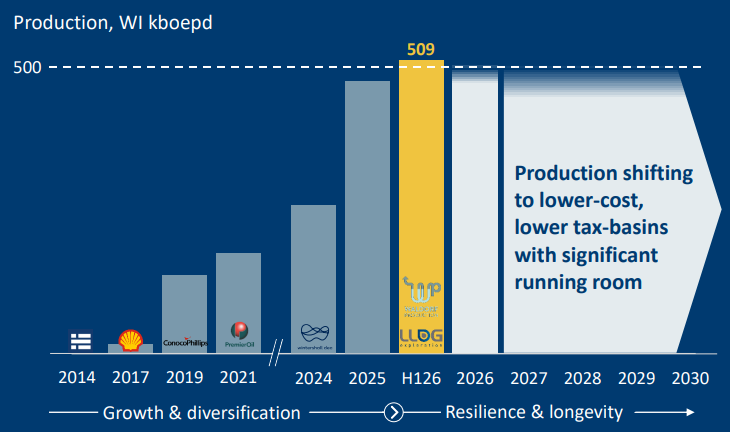
A mix of acquisitions, growing scale and relatively high energy prices has turned Harbour into something of a cash machine, with production topping 500,000 boepd (barrels of oil equivalent per day) during the first half of this year:
Source: Harbour Energy H1 2026 presentation
Prior to this year, the company already had a minimum dividend policy of $300m per year (equivalent to a 6+% yield at current prices).
However, cash flow guidance was upgraded with the half-year results. Management now expects shareholder returns to total $800m in 2026. That’s equivalent to around 15% of the current market cap, paid through a mix of share buybacks and dividends.
While it’s true that this level of largesse won’t necessarily be sustainable, broker forecasts for future years suggest Harbour will continue to generate enough surplus cash to provide an above-average dividend income.
Recent acquisitions have also extended the lifespan of the company’s reserves, providing relatively good visibility for this sector.
On the other hand, volatile commodity prices and a hefty debt pile add some risk to this situation.
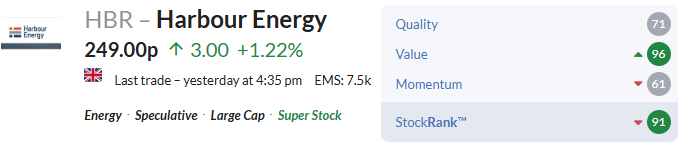
Despite this, I think much of the risk is priced in and believe Harbour Energy could be an interesting value play at current levels. This is a view that’s also shared by the StockRanks:
The Big Picture
Harbour Energy was formed in 2021 through the reverse merger of private equity-backed Chrysaor with FTSE-listed Premier Oil. The resulting group is one of a handful of independent firms that has been acting as a consolidator in the North Sea in recent years, buying assets from companies including Shell (disc: I hold) and ConocoPhillips, as well as rival independent operators.
One challenge for North Sea operators is that many fields are now mature, with limited remaining production lifespans. To address this limitation and diversify its portfolio, Harbour Energy has been expanding further afield into lower cost and longer-life regions including Norway, Argentina, the US and Mexico.
Source: Harbour Energy H1 2026 presentation
I believe there are several good reasons to expect that Harbour could remain a high-yielding cash cow over the coming years:
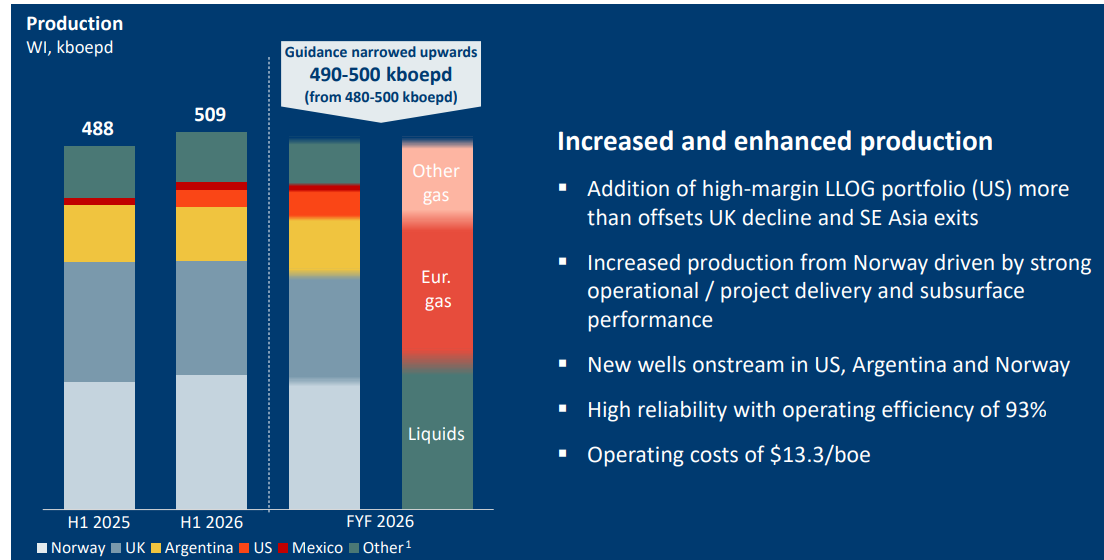
Improved production visibility: following the acquisition of Gulf of Mexico producer LLOG, Harbour Energy has a 2P reserves life of 8 years, based on H1 25 production of 488k boepd. In plain English, this means the company can carry on producing oil and gas at a similar level to current production for the next eight years.
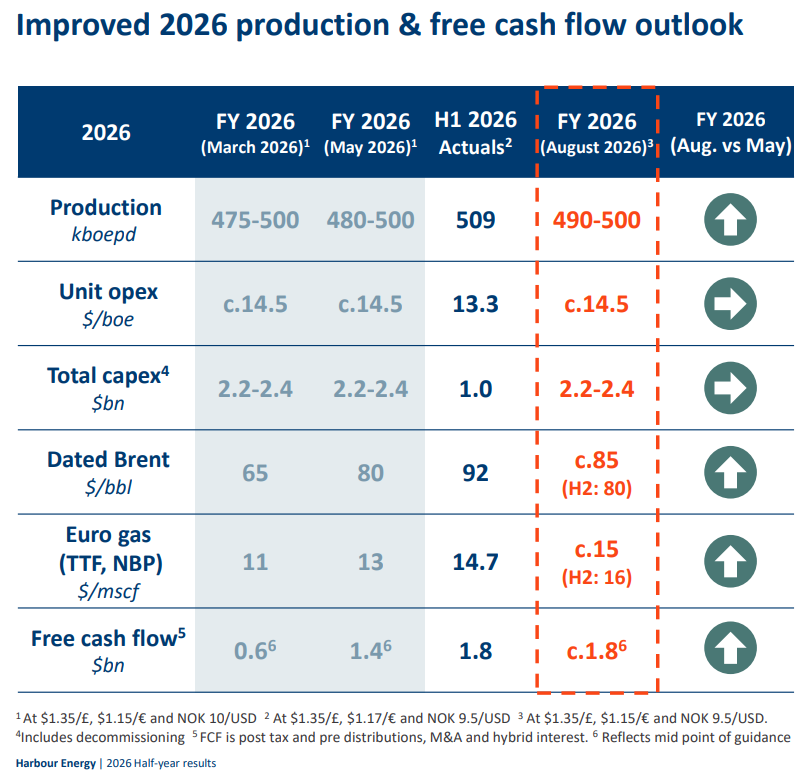
Low costs: average production costs of around $14.5/boe mean the business should remain profitable and cash generative even at lower oil prices. If (when?) oil and gas markets ease, Harbour’s management can also choose to cut back on growth capex and run assets for cash.
Uprated guidance signals cash boost: higher commodity prices and a modest boost to H1 production mean Harbour is expected to generate $1.8bn of free cash flow this year. That’s an increase from previous guidance of $1.4bn in May. Hitting this guidance would give the shares a free cash flow yield of more than 30%, comfortably underpinning the 6.4% dividend yield, share buybacks and debt repayments.
Source: Harbour Energy H1 2026 presentation
Going Deeper
Drilling down into Harbour’s asset base suggests to me that current production volumes could be sustainable for longer than might be expected:
18 year pipeline: even without further acquisitions, Harbour has around 18 years of development opportunities within its existing asset base. For example, US production is expected to double by 2028, while near-term projects in Mexico could add reserves “equal to two years of Harbour’s production”.
Brent + European gas: the group’s asset base provides broad exposure to Brent oil and European Gas, two deep markets where pricing and demand are expected to remain relatively strong.
Further acquisitions? Harbour has built a diversified asset base through a series of increasingly large acquisitions. The company’s management has shown it can navigate successfully through a range of political, regulatory and commercial regimes while delivering shareholder returns. I wouldn’t bet against further deals.
Carbon Capture & Storage: CCS is somewhat controversial and not yet proven as an effective, large-scale decarbonisation technology. However, there is increasing commercial and political momentum behind this approach. Harbour is involved in a number of CCS projects in the UK and Denmark. If successful, they could help establish the company as a leading player in this sector.
What The Brokers Say
Broker consensus estimates on Stockopedia are broadly positive and earnings forecast have been upgraded this year, largely reflecting higher oil and gas prices since the start of the Middle East conflict:
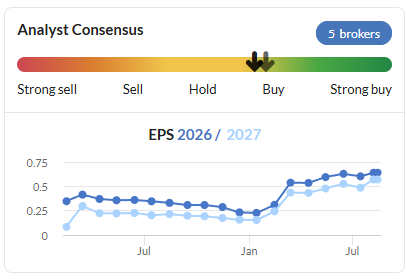
The average analyst price target is around 320p, suggesting that sector specialists believe the intrinsic value of the business is comfortably above the current share price:

Digging a little deeper into broker forecasts highlights the cash-generative appeal of the business. Current forecasts suggest Harbour Energy could average a c.15% free cash flow return on equity over the next two or three years.
Assuming the oil market doesn’t suffer any major weakness, I think this should underpin the combination of 6%+ dividend yield, debt repayments and buybacks. If Harbour can deliver on this potential, then I’d expect the share price to benefit.
The Bear Case
Sceptics may dismiss Harbour and other consolidators as run-off specialists who will eventually be left with dwindling production, a hollowed-out balance sheet and potentially unaffordable decommissioning liabilities.
I think there’s probably some truth in this more cynical appraisal of the business model, but I wouldn’t put Harbour at the top of my list of suspects. In my view, the group’s increasing scale, geographic diversity and focus on longer-lived assets give it credibility as a genuine independent operator for the foreseeable future.
Even so, I can see several reasons for caution – it’s definitely possible that Harbour is cheap for a good reason:
Commodity price risk: Harbour’s cash generation is directly related to oil and gas prices. The latest guidance from the company indicates that 2026 free cash flow will rise or fall by $170m for each $5 variation in Brent crude prices. There’s clearly a real risk of missing full-year guidance if oil prices weaken in Q4.
Hedging efforts may backfire: energy producers often seek to lock in predictable pricing through a hedging strategy. Harbour hedges some of its production, but this appears to have backfired in H1: the average realised oil price after hedging was $84 per barrel, compared to an average pre-hedge price of $90!
H2 performance could disappoint: Harbour maximised its production in H1 to take advantage of higher oil and gas prices following the start of the Middle East conflict. Higher capital expenditure and tax costs are expected to result in neutral cash flow in H2, while delayed maintenance downtime may dampen production. In my view, there’s still a risk the company will miss full-year cash flow guidance.
Significant debt burden: Harbour’s last-reported leverage of 0.7x EBITDAX sounds modest, but this multiple is based on above-average profits from strong oil and gas prices. If market conditions ease (and profits fall), the leverage multiple (debt divided by profit) could surge higher. Actual net debt was a chunky $5.4bn at the end of June, with annualised interest costs of c.$250m. If oil and gas prices dropped sharply, I suspect shareholder returns could come under pressure.
Too much change? The final risk is harder to measure and highly subjective: it’s simply that so much has changed in Harbour’s business, so quickly. Investors must hope the company has correctly understood the quality and economics of the assets it’s acquired over the last few years.
The Bottom Line
Harbour Energy has benefited from decisive acquisitions and rising commodity prices to become a large, diversified and highly cash-generative oil and gas producer.
The group’s current portfolio has the potential to underpin production and cash generation until the end of the decade and beyond. However, Harbour’s profitability is extremely sensitive to oil and gas prices and the group’s leverage could rise rapidly in less favourable market conditions.
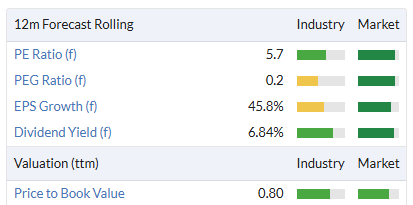
Right now, I believe that a modest valuation and front-loaded shareholder returns have the potential to support an attractive gain. But this is a holding I plan to monitor carefully and ditch quickly if my thesis goes awry.
Disclaimer
This is not financial advice. Our content is intended to be used and must be used for information and education purposes only. Please read our disclaimer and terms and conditions to understand our obligations.

8 comments
I’m a personal shareholder in Harbour, but the US acquisition made me wobble because of the valuation. Further, you ought to consider decommissioning liabilities in your analysis, where Harbour is particularly exposed.
There's a school of thought that says those decommissioning liabilities are in fact hidden value:
https://theoakbloke.substack.c...
I haven't researched myself, but a case can be made... I don't hold Harbour Energy (LON:HBR)
Capricorn Energy (CNE) is an obvious target for Harbour to diversify its production geographically and add reserves: CNE is currently subject to a bid from Genel but that is destabilised by the fact that Genel is itself the subject of a bid and the offer price was not particularly generous in the light of continued elevated crude prices. anyone else have any thoughts on this?
Hi Roland - would be good to read your response to the comments below. I too am concerned now about Harbour. Seplat has made remarkable progress this year and now stands at PE of circa 17 - (HL shows a PE of 30 ??) is this sustainable ?
I looked at Seplat Energy (LON:SEPL) (pricey) and Serica Energy (LON:SQZ), but ended up buying Capricorn (LON: CNE) and Hunting (LON: HTG) as the Energy stock for my 2026 portfolio.
I was put off Harbour by the share dilution (57.89% last year!), high gearing (115.4%) and low Z score (1.17): also note negative CAGR over last five years... and I'm always rather put off by such high director sales (81.7% in trhe last 3 months!)
Serica Energy (LON:SQZ) a possible pitch if and when it moves to main market? less debt
Thanks Roland for highlighting this one Harbour Energy (LON:HBR) , I do like these Stock Pitches.
Does look an interesting one and might do quite well, Id be keen if I didn't already have any oil in my folio.
However I have to say Im not keen on its debt levels, nor how its increased substantially the number of shares in issue for a few years now. At this point in the commodity cycle I'm looking for lower debt.
Personally I have a holding in Seplat Energy (LON:SEPL) so for me its a comparison between the two I have focused on. Albeit Seplat is more exploration of oil and in Africa . But it hasn't increased its shares over many years, has much lower debt and always profitable (apart from the covid year 2020) which looks much better than Harbour thats had a checkered past in net profit this last number of years. Both give a good yield , both super stocks, and are about the same market cap. One could argue Seplat being Nigerian based has a greater political risk profile but Id counter that by saying it has greater organic growth possibilities and so far stronger growth is forecasted.
Have to say I see Shell (LON:SHEL) and BP (LON:BP.) as very interesting at the moment (but again will probably keep with Seplat).
Anyway thanks again for this one, keep up the great work.
Shell (LON:SHEL) are selling North Sea assets I think. Taxation is also a risk.