NAPS Portfolio gains 22% in 6 months - is this a straight up year?

When the NAPS Portfolio started, way back in 2015, I had no idea that by the end of the year 19 out or 20 stocks would be winners, and the portfolio would have risen 42%.
2015 turned out to be one of the best ever years for the NAPS, but I’m starting to wonder whether 2025 might match it.
The first half of the year has been nothing short of stunning.
- 22% return before dividends.
- 17 out of 20 winners.
- One takeover. One doubler.
- A new all-time portfolio high.
- No individual stock picking (the NAPS is a passive approach).
- Lots of fun watching them go up.
There’s a long way to go, of course, and anything can happen, but I have had good feelings for 2025.
A year ago, in a webinar (and in the half-year NAPS article) I offered five positive reasons why I felt the UK stock market might be in a good place. I’m rarely one for predictions, but the signals felt right at the time.
There have been wobbles of course, but despite the FTSE All Share rising 8% over the last 12 months, it’s actually now on an even lower valuation (by P/E ratio) than it was then. It still trades at a significant discount to international indices. If the UK stops shooting itself in the foot economically, then perhaps there’s plenty of room left to run.
Quick primer - if you are new or want a refresher
Long-time subscribers will know the NAPS Portfolio well — it’s built on the StockRanks, incredibly simple to run, and has outperformed every UK fund manager over the past decade.
- If you’re new to Stockopedia, start with this 10-year review - it’s a good overview of how the strategy works and how it's fared for 10 years.
- But if you prefer a visual walkthrough, don’t miss this brilliant explainer video by the Financial Wisdom YouTube channel. It’s short, sharp, and nails the essence of the NAPS.
- And if you want a bit more background, I ran this 40-minute webinar recently covering the core principles and logic behind this style of portfolio approach.
What’s worked in 2025
At the start of the year, I said the portfolio would need to rise 40% just to reach the average UK market valuation - from a starting P/E of 8.7 to 12.2.
Well, it’s now at a forward P/E of 10.2, so we’re halfway there.
That’s value investing for you. Eventually, Mr Market does his magic.
Here are some charts year to date and since inception.
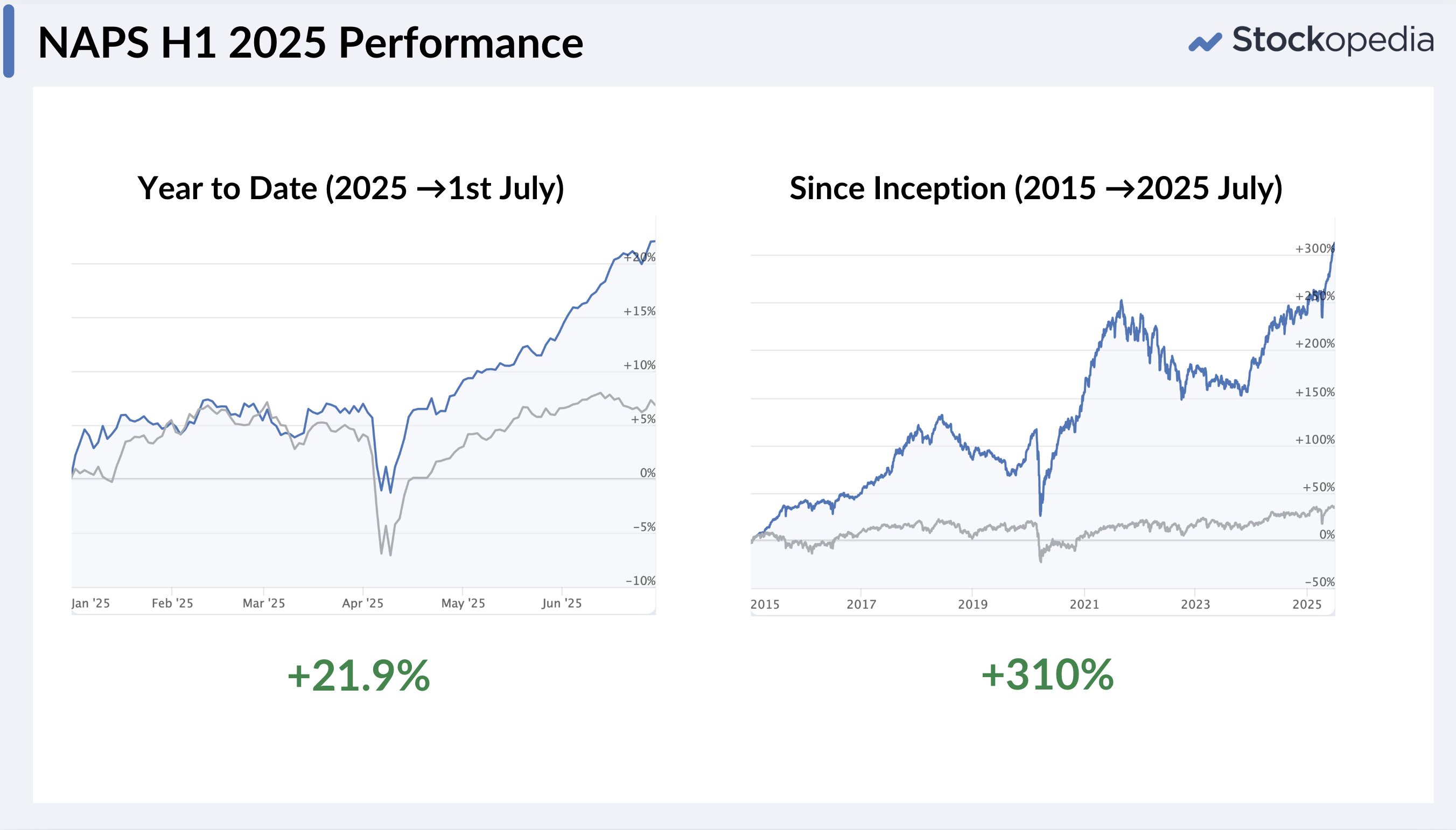
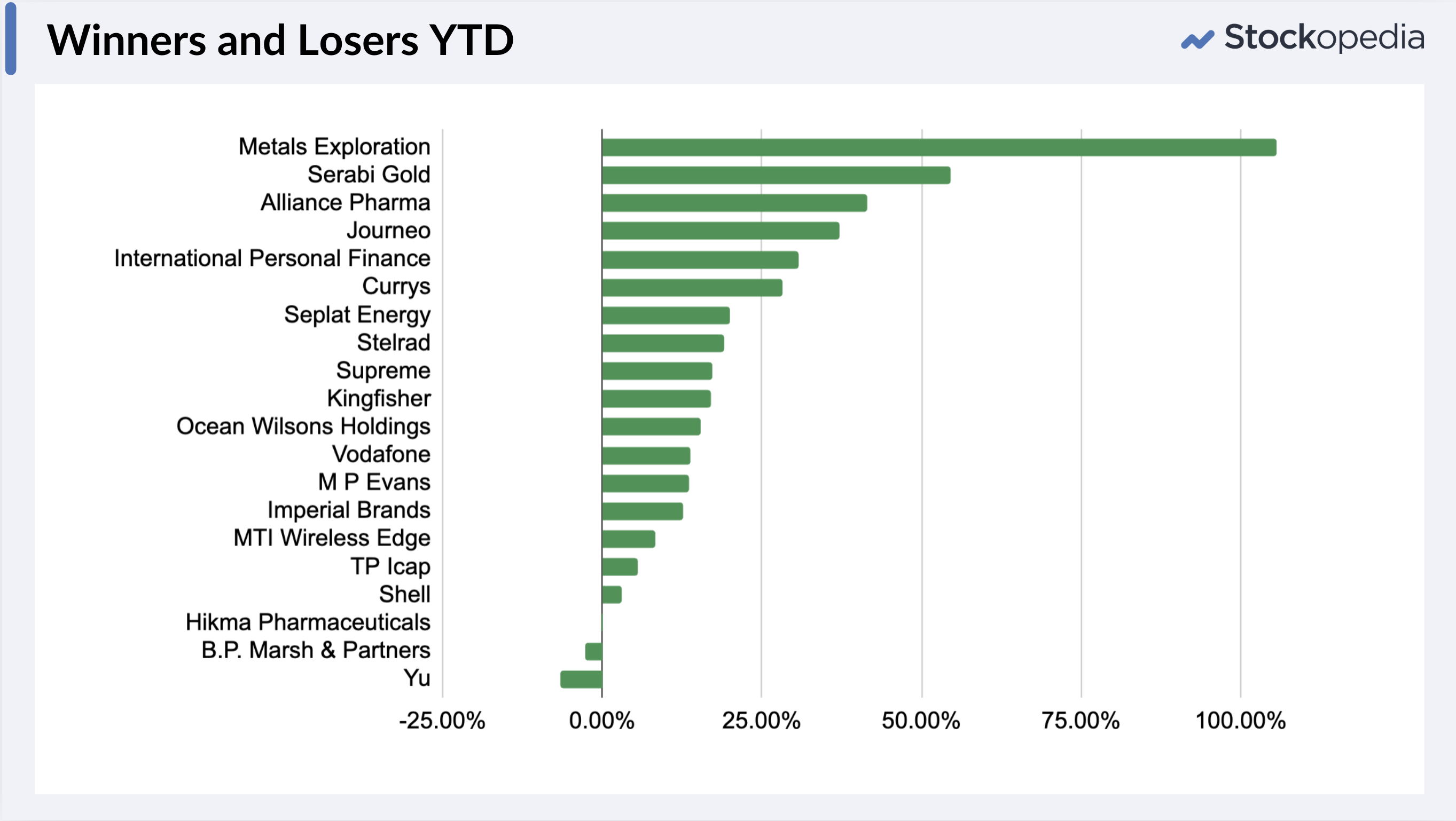
Some of the winners this year have been notable:
- The junior gold miners have taken off - Metals Exploration (LON:MTL) (also in last year’s NAPS) has more than doubled, while Serabi Gold (LON:SRB) is up over 50%. Other gold names like Thor Explorations (LON:THX) and Altyngold (LON:ALTN) didn’t make the cut, but they’re flying too.
- Currys (LON:CURY) and Kingfisher (LON:KGF) were both shunned at the start of the year due to fears over National Insurance hikes. The baked in contrarianism of the NAPS has done its work. Often the market really is right, but I do regularly find that when the media is all whipped up in fear about something, beaten down shares serve opportunity.
- Journeo (LON:JNEO) was one of the portfolios worst performers during the Trump Tariff Tumble in April - but I'm delighted to see it has since clawed its way back with a 37% gain.
What to do on a takeover bid?
There have been so many takeover bids in the UK this year and last. UK shares are just too cheap, and many fund managers are forced sellers due to outflows. If Rachel Reeves doesn’t give the UK pension and savings environment an overhaul to encourage local investment, there may be no shares in the UK left in a few years. Is cutting cash ISAs really enough?
Nonethless, in January, Alliance Pharma received a takeover bid and popped 41%. In the passive NAPS, there’s no reinvestment on bids - so it’s been sitting on 6% cash since. That’s not ideal.
So in my slightly more active QVM Portfolio version, I rotated the APH proceeds into SDI (LON:SDI) - another healthcare name. That stock’s since rocketed 62%.
That switch, from APH’s 41% into SDI’s 62%, has delivered a combined 128% return on the position’s starting capital. It’s the reason the QVM is outperforming the NAPS so far this year - 25.5% vs 21.9%.
One lucky move doesn’t make a strategy. But if you're investing for the long term, it pays to stay fully invested. Cash drag rarely helps you beat your best years.
The SNAPS Portfolio 2025
As per tradition, I’m back mid-year with the July variant of the NAPS - which I call the SNAPS - because why not?
Same rules as the start of the year, but this time organised according to the 3D framework to reinforce the principles:
Drivers
- Sort by StockRank descending
- No micro caps (< £20m market cap)
- No wide bid-ask spreads (> 7.5%)
⠀Diversity
- 20-stock portfolio
- 2 stocks per sector (only 1 from Telecoms and Utilities)
- Top up with best-ranked from 2 of the other 8 sectors
⠀Discipline
- Hold for one year. No tinkering.
My personal view is 1-year holding periods are best for these kinds of passive NAPS portfolios. I prefer shorter holding periods for more active stock selection approaches, that are aiming to profit from shorter term trend phenomenon like the Drift. Longer-term quality and value investing portfolios need more time for the market to do its work.
I always get asked how last year’s SNAPS Portfolio did. Well from July 15th 2024 to now, the SNAPS returned 18.3% (before dividends). It’s lagged the New Year NAPS (which is up 27% over the same period), but still not a result to sniff at - especially given it’s turned out to offer 15/20 winners.
Here’s this year’s half year list:
Name |
Cap £m |
P / E |
Yield % |
SR |
Sector |
Serabi Gold (LON:SRB) |
131 |
5.5 |
0.0 |
99 |
Basic Materials |
Kenmare Resources (LON:KMR) |
287 |
6.2 |
6.8 |
95 |
Basic Materials |
Kingfisher (LON:KGF) |
5091 |
12.3 |
4.3 |
99 |
Consumer Cyclicals |
Halfords (LON:HFD) |
349 |
6.8 |
8.7 |
99 |
Consumer Cyclicals |
Virgin Wines UK (LON:VINO) |
29 |
22.5 |
0.0 |
99 |
Consumer Defensives |
McBride (LON:MCB) |
259 |
6.1 |
0.0 |
99 |
Consumer Defensives |
M P Evans (LON:MPE) |
571 |
9.2 |
4.4 |
99 |
Consumer Defensives |
Gulf Marine Services (LON:GMS) |
226 |
10.1 |
0.0 |
98 |
Energy |
Drax (LON:DRX) |
2369 |
5.0 |
3.9 |
99 |
Energy |
Jupiter Fund Management (LON:JUP) |
536 |
7.9 |
5.4 |
99 |
Financials |
Ramsdens Holdings (LON:RFX) |
111 |
11.3 |
3.5 |
99 |
Financials |
TP Icap (LON:TCAP) |
2096 |
10.1 |
5.8 |
99 |
Financials |
Hikma Pharmaceuticals (LON:HIK) |
4495 |
14.6 |
2.8 |
90 |
Healthcare |
SDI (LON:SDI) |
93 |
22.1 |
0.0 |
89 |
Healthcare |
Mears (LON:MER) |
343 |
7.9 |
4.0 |
99 |
Industrials |
Supreme (LON:SUP) |
235 |
10.0 |
2.5 |
98 |
Industrials |
Frontier Developments (LON:FDEV) |
124 |
8.0 |
0.0 |
98 |
Technology |
Journeo (LON:JNEO) |
65 |
14.5 |
0.0 |
94 |
Technology |
BT (LON:BT.A) |
19306 |
8.7 |
4.2 |
93 |
Telecoms |
Yu (LON:YU.) |
277 |
8.6 |
3.6 |
97 |
Utilities |
Average |
1849 |
10.4 |
3.0 |
97.1 |
|
Median |
282 |
9.0 |
3.6 |
99 |
I hope you are having a good first half to the year.
Please do share your results with the community below.
Safe Investing for the second half !
Disclaimer
This is not financial advice. Our content is intended to be used and must be used for information and education purposes only. Please read our disclaimer and terms and conditions to understand our obligations.
62 comments
need to do more homework on it
One aspect I would be very interested to see modelled, is if doing a quarterly NAPS, whilst still holding for a year, would be worthwhile. There would obviously be greater dealing costs, but I think there might be two advantages:
The last couple of posts asking about different strategies highlights one of my frustrations with stockopedia that has lead me to cancel my subscription before. There's a huge amount of information behind the (very good) user interface we see and use, but we're not allowed to access even the basic historical data.
I appreciate it probably goes against the vision of what stockopedia wants to be and there may be licencing issues, but imagine if the stockopedia community could do some research and backtesting of ideas rather than just throw ideas at the limited resources that stockopedia have.
Don't get me started on unfinished research ideas :)
Moan over, and will finish with the comment that I really value the service provided and the community we have here. Worth every penny of the subscription, just that I think we could do more collectively if we had the tools
I’m looking at whether introducing the 90/70 rule to the NAPs would add value, so sell if Stockrank falls below 70 and reload. Any thoughts or has anyone done this?
It has been discussed before. The only issue is sometimes, there are glitches in the system or information goes missing, for a while. Would be annoying if you sold a load of shares just because of that.
I've been investing since March 2023 after years of allowing others to take an income from my savings. I was unimpressed with returns. My advisor informed me that "betting on the stock market is like putting money on a horse". I accept that starting when I did was lucky. My capital remains at risk.
Since 2023 using NAPS as my model (imperfectly applied as I sold once or twice without profit warnings last year because the Stock Rank dropped) and buying and selling only in March and September, I'm up 52% as of today which I consider a very good return indeed. If it is of interest I'm happy to share holdings, strategy etc. but it is pretty much NAPS with a 6 month twitch. So far this outstrips the FTSE 100, say, by lots and lots. No complaints.
This return includes dividends, which are "incidental" (I use the NAPS technique to choose all the stocks and if they have dividends, well, then they do) and this figure includes trading costs and a monthly subscription to ii but excludes the (remarkable value) Stockopedia subscription. Since I had a fair whack to invest, the trading costs and subscription are not a large percentage. The dividends represented 24% of my returns over this 2.5 year period.
I have never had much time for the horse betting analogy. When one places a bet on a horse you either win (and how much depends on the odds) or you lose your stake. Of course you can lose all of your money if a company goes bust suddenly or turns out to be a fraud, but generally investing is nothing like that. Imagine buying a diversified portfolio of 20 companies and expecting most of those to go bust and lose all of your money, and hoping that there are some winners that make up for it. I'm not sure that would be for me.
Well done on proving that advisor wrong.
Is there any chance of Stockopedia outlining, and perhaps backtesting, a set of NAPS rules for US stock (only) suscribers, please?
Is it now too late to start investing in NAPS portfolio 2025 ?
You can do it anytime, but l would pick a new portfolio, not the one selected here.
This is the NAPS as it stands if you start it today afresh. I've set the spread to max 500bps rather than 700bps. Don't shoot the messenger if you get different results
Yeah it's been a bit crazy this year - up 36% by my tracking (plus more in divis).
It's now running at 15% annualised since inception before divis.
It's looking more and more like a "straight up year" to me. Though surely there's some October/November wobbles pending!!!
I started 1st June 2025. Some of the portfolio remained the same, but also a few different ones. Up 15% since then, and more including dividends.
Does anyone have any idea why SDI is down 8.58% this morning? Their earnings release is not due until 30th July.
Probably because Judges Scientific (LON:JDG) are down 15%.
Hi Ed, enjoyed the Stockopedia overview presentation the other day where I learnt about the mighty NAPS! I'm wondering, do you keep track of the dividends? Be interesting to know what percentage they add, and more complicatedly (is that even a word), be good to know how NAPS would have grown if the dividends were re-invested across the NAPS piste.
BTW ... is there a way to search the page content on the Android app? On the web browser I can use, find-in-page but I can't work out how to, e.g. search 'dividend' in this post, when using the app?
Many thanks,
Linden
Linden - the NAPS 2025 list currently yield about 3.5% on average. In UK stocks this has been pretty typical for a NAPS list over the last 10 years.
Ultimately, when implementing a NAPS strategy, you will have to pay transaction costs. These include commission, platform fees, stamp duty and the spread. I don't have my last numbers to hand as I'm on my mobile but at the start of the year I calculated these to be a maximum of 1.2-1.5%.
The dividends are a significant proportion of the return and when compounded, if reinvested, would have added to the returns.
Ultimately, though I have excluded them from all performance tracking. I think this is conservative given the above.
Thanks Ed for getting back and for the detailed and useful information. In my case within a zero-fees, Trading 212 Stocks ISA, I just have stamp duty and spread costs so a significant boost above your already highly successful NAPS strategy.
First hiccup in the NAPS portfolio I have started at the beginning of June. McBride (LON:MCB) currently down 14% showing signs of weakness.
Yes Mcbride an ok update, but a little concern on supermarket cost control and market share. It's in the SNAPS rather than NAPS.
Always best to judge these things after 12 months. I'm often surprised that early droppers end up recovering significantly. MCB has a P/E of under 7 - there's value there.
Does anyone have a full list of every NAPS selection going back to the first one in 2015? I want to do some testing on impact with regular rebalancing and/or volativity based weighting. If not I'll have to go through each years posts. Appreciate it goes against the "leave it alone" principles of NAPS (and possible increased costs).
Dear Ed, love the Snaps Portfolio for its simplicity and results. Have you back dated a V/M or Q/M snaps list only? If not, is it worth looking at this as the Stock Rank for V/M has a superior record on your Stock Ranks since inception.
TJ - there was a 3 year period where instead of using the QVM Rank (StockRank) i used a 50:50 split where half the positions were crafted using the QM Rank, and half from the VM Rank. I believe it started in 2020 (read here) with the last year in 2022 (read here).
It worked very well in 2020 +27% and 2021 +28%, but 2022 saw a nasty reversal (-15%). Being so fully loaded on momentum at the top of a bull market hurt the portfolio.
Nonetheless, I'm personally rather biased towards a stronger VM loading. I see value and momentum as the strongest rank pairing and strongest anomalies. I haven't a study at hand other than this one , but you are right that the VM has a very good record and I'm sure, especially in more value oriented markets like the UK, it would do very well in a NAPS setting.
Thank you
The only issue l found with VM, is getting enough stocks to qualify, in each sector, VM was often around 40% Financials, hardly any Tech. stocks. Energy also was fairly thin at times. Trying to find 20 would be difficult. At the moment VM has a fair selection, l did a VM NAPS on 1/7/25, only one Tech. stock though. QM had 3 Tech. stocks. So VM is heavyweight in Financials.
QM it was never an issue to find 10 stocks but some sectors were a bit light.
Yes - this is one reason why I like to blend VM and QM. QM brings in the healthcare and tech stocks that are often absent in VM, while VM bring in the financials and energy/materials stocks.
Just a thought on the SNAPS list. I hold Draegerwerk AG & Co KGaA (ETR:DRW3) in Healthcare, Television Francaise 1 SA (EPA:TFI) in Consumer Cyclicals and Orange SA (EPA:ORA) for Telecoms which might be nice alternatives for anyone wanting to dabble into adding European exposure.
I began my NAPS portfolio in 2023 by deploying my ISA allowance in three tranches over nine months. I replace each share on its anniversary date, and because I’ve had a couple of take-overs, the anniversary dates are even more dispersed.
My YTD is 20%, but because of the differing ages of each member of the portfolio, it probably makes more sense to look back over the last 12 months. The portfolio has risen 18% over that time.
My NAPS portfolio performance started to diverge from the market in mid November, but it has rebounded strongly since the Trump Tumble on Tariff Day.
In the portfolio today, the biggest winner on a total return basis is Journeo (LON:JNEO) [+80%] followed by Morgan Sindall (LON:MGNS) [+70%] and International Personal Finance (LON:IPF) [67%]. Remarkably, I only bought the last two in May. That's a fantastic return in 7 weeks, I just hope it holds.
There are just three losers in the portfolio as of today: Polar Capital Holdings (LON:POLR) [-16%], Shell (LON:SHEL) [-3%], and AstraZeneca (LON:AZN) [-2%]
Well done Ed, congratulations on an exemplary performance over the 10-year (and continuing) NAPS selections.
- Simply, astonishing!
Hope the attached Jpeg opens satisfactorily, but thought it would be useful to display a what-if 10 year (well 10.5 years to the SNAPS reveal) compounding result, in pounds and pence rather than grapple with total return metrics etc.,
So in the spreadsheet shown I’ve used a starting capital investment of £40,000 (20 stocks x £2K each, because that’s the test-capital I experimented with in my own NAPS portfolio, from late autumn 2021 to run for 12 months) which performed well to that year end, and then the calendar clicked over to 2022 - and down went the market - the year of Russia’s invasion of Ukraine, and down went my NAPS portfolio too. Since then, for all my portfolios, I run a disciplined month-end performance log, with print-off’s and binder-filed away every month end - religiously.
Not quite what Ed intends but in previous NAPS years he did suggest eyeballing quarterly or bi annually, (can’t recall if he mentioned monthly). However, that will induce tinkering before the year is up, however hard one denies it.pounding growth in £££’s in the spreadsheet - if the funds raised in selling the old year was immediately invested straight into the next new year and left to run .
Anyway, just look and drool, at the astonishing compounding growth performance - if the funds raised in selling the old year were immediately re-invested straight into the next new year and left to run.
Simply astonishing, defines your compounding analysis. Not quite clear how deeply you participated?
Metals Exploration (LON:MTL) absolutely flying today up 15% - I can't see any reason new material news - anyone have any intel?
In the absence of any concrete news, is there a quantitative way of looking at this? It was up today on > 3x normal volume, and the chart and momentum rank both indicate strong momentum. Over the years on Stockopedia I've read a lot of commentary about the predictive efficacy of the ranks and some about the importance of eyeballing charts but have seen less about the relevance of the size of volume on share price moves. Is there any research either in academic or professional studies on this? Have any of the team looked at this internally? Perhaps it could make for an interesting study if not?
Free float is only 20% Like anything, scarcity breeds excitement
David - great to see you here and to have met at Mello!
Do share the template - I'd love to see it.
Currys (LON:CURY) continues to truck along with this morning's results - profits up 37%. NAPS up another 1.3% this morning led by Currys.
I am a longtime subscriber who started using Stockranks way back in 2013, even before the NAPs were a thing. I did so well in those inital years that in 2018 I gave up my job and moved to Spain.
But then I hit a psychological barrier. I realised that it is much easier to deal with market pullbacks when you have job security. The first pullback was in October 2018 and I reduced my exposure considerably. The Covid crash was another test where I reduced my exposure further and then missed the subsequent recovery - I had definitely lost my way.
About 18 months ago I finally settled on an all weather investment approach - 60% in equities with only half of those actively managed using Stockopedia metrics. The method involves selecting the highest Stockranks with a price trend filter. I sell when either the SR drops below 80 or the longterm trend breaks. That chunk of my portfolio has returned about 30% in that time.
This works seems to work for me as I survived the Trump tariff shennanigans without flinching. As things stand, my net worth is now higher than when I stopped working.
As for 2025, my actively managed UK portfolio is up 18% this year, so not far behind the NAPs. My actively managed European portfolio has done even better, up 25%.
I agree with whoever said investing in stocks is simple but not easy. Stockopedia gives us the tools to make it simple but is up to us as individuals to develop the mindset to make it as easy as possible.
Mechanical Bull - I remember your portfolios and posts very well from those early years. Do you still have your blogspot? It was a great track record I seem to remember.
Hi Ed - I stopped blogging years ago and the whole blog has since disappeared into the ether. Simple works best and once you've established a method there is only so much you can say about it. Also, I think it is quite healthy not to think about things too much as it can be tempting to tweak your strategy in response to short term events. As you well know it is all about what works over the long term.
MB
Perfect name for your strategy and an approach we could all follow!
I can remember you from the early days of Stocko Mechanical, you have achieved what most here who are (pre-retirement) dream of be interested to hear more on your story if your happy to share.
What you found has worked well for you and what big mistakes you have learned from over the years.
Regards
Andy
Hi Andy,
Apart from what I've already mentioned, I don't think that I have made any really huge mistakes. However, I have done some things that have made life more complicated for no real benefit. At different points I expanded into Australasian and European stocks (and briefly into US stocks) which at times resulted in a sprawling, unmanageable portfolio and it was difficult settle into a coherent strategy.
There can other drawbacks investing in foreign stocks, such as, fx fees, witholding tax and capital gains (if you are trading outside an ISA or SIPP). I shifted quite a lot of cash from the UK to a trading platform in New Zealand. Really, I would have been better off putting it all into my SIPP. I also have a Degiro trading account in Spain, but that makes a bit more sense because I currently live there.
For UK investors wanting general exposure to other markets, I would recommend low cost tracker funds but then run a factor based strategy solely on the UK market.
The second thing I would emphasise is the importance of sell rules. I dont have a timebound rebalancing strategy. I like to let winners run, sometimes for years and especially if the SR holds up. If a position doubles I always sell half - this locks down profit, serves to rebalance your portfolio while still giving you continued exposure.
I also have firm stop loss rules. This is not a fixed % but is determined by eyeballing recent support levels. Occasionally, I have had to abandon a position within days. It always hurts but it usually pays off. I should probably say that my stop loss rules are 'fairly firm' as I will suspend those rules during a sharp pullback to avoid simply being shaken out by the overall market. This is a tricky balance that is difficult to distill into clear rules.
The NAPs idea of holding 20 stocks for 12 months and rotating the entire portfolio would probably be much simpler, but for me it is just too much of a psychological barrier to liquidate my entire portfolio.
The final thing I would emphasise is the importance of not trying to anticipate how the overall market is going to react to macro events (I find this very difficult!). You are much better off mentally preparing yourself for when these events occur and then having a strategy to deal with it. In most cases the best strategy is to do nothing, at least initially. If a downturn is very sharp and/or sustained then a diversified asset allocation strategy will naturally shift more of your assets into equities so that you are positioned for the eventual upturn. It is an extension of the mechanical mindset by having a system that determines action and not emotions or gut feel.
This all relates to portfolio and risk mangement which is perhaps a bit beyond the focus of Stockopedia. However, I think it is really important to be thinking about this especially if you are in, or approaching retirement. You can't just think that a strategy that has delivered 14% annualised returns over the last 12 years means that you are set for life. Those returns are going to be lumpy and sometimes negative and you don't want to be the position of having to sell stocks in a bear market to buy your groceries. I have a cushion of cash, pension, dividend and fixed income that will last me at least 4 years.
Good luck
MB
Thanks for the reply Mechanical , I have 60% of my portfolio in equities and the other 40% in money market funds and a gold etf.
I agree hopeless trying to predict macro but gold generally holds up when markets tank and money market funds pay roughly 5% at the moment.
If markets tank again at some point in the future like April I just rebalance some of the money market funds when ETF'S I use to invest in S&P, 500, EURO 600 and FTSE 100 are down 10% plus from the start of the crash. If they fall further to 20% I will invest more of the money market reserves rinse and repeat.
The idea being when it all starts to fall apart central banks will print as per 2020 causing inflation which 8/10 pushes up risk assets at the expense of the currency falling even more in value.
I only need to achieve roughly 5% per annum as I'm getting closer to retirement hence relaxed having 40% in defensive assets.
Out of interest how many positions do you hold open roughly at one time ?
Regards
Andy
Hi Andy,
In terms of my active portfolio the current number of positions are as follows:
Uk - 20
Europe - 10
Australasia - 7
Australasia used to have about 15 but for a bunch of reasons I am in the process of winding up those positions. My goal is to get to just the 30 in UK/Europe.
Overall, your asset allocation looks similar to mine. I also have a gold ETF, which is up 150% since I bought it - I recently trimmed that back as part of my portfolio rebalancing.
You look well set. Enjoy retirement!
MB
Thanks Mechanical always like to hear from the few who have made it into trading full time pre-retirement very hard to do mainly due to fact so many traders fall victim to self saboutage.
With the run year to date - the annualised capital-only return is now 14.4%.
What is the annual return over the last 10 years?
In the 10 year review article published at the start of this year the annualised return was given as 13%. I've been following this from the start and have been consistently impressed with it.
I've been following and investing in the NAPS portfolio for 3 and a half years now (following Ed's recommendations very closely), using my ISA annual allowance to build the fund up each year. Success was mixed in the first two years, but its certainly been a good year this year so far.
Conscious of not wanting to sit on cash, after Alliance Pharma was bought over, I also reinvested the cash in SDI (LON:SDI) which has been good.
I wondered if anyone else who holds Ocean Wilsons Holdings (LON:OCN) will be participating in the recently-announced tender offer, which would give a choice again - sit on the cash or reinvest?
The NAPS portfolio is the purest and strongest advert for Stockopedia and its ranks that exists - the least time spent for any outcome would be good, let alone the impressive outcomes it has had.
My only problem with the idea of going fully NAPS is... what would I do with my subscription for the rest of the year?! ;-)
Watching the portfolio is a full time job of course!
Hi Ed. Excellent returns! Just as well you changed your mind about ending the NAPS Portfolio as mentioned in your post 1/01/2025! Clearly your instincts and those of your subscribers that opposed this were justified.
Well done Ed. My own NAPS, which runs August to August, is similarly up after treading water until February, hitting a new high in March, crashing in April - and then surging ever since. Talk about a roller coaster. My pension, of which the NAPS is the major component, is up 30% since the tariff lows. Selling on profit warnings has also served me well again. Things went badly wrong for IG Design (LON:IGR) in January - to the extent that forecasts were suspended. I managed to get out at the bell, down about 40%. Looking for a replacement in the Basic Materials sector, Metals Exploration (LON:MTL) and Altyngold (LON:ALTN) were neck and neck so I put 50% into each. They are up 82% and 114% respectively, meaning that IG Design (LON:IGR) turned out to be a “good” disaster. Coupled with Serabi Gold (LON:SRB) (+156%), the miners have made it a very good year.
My new portfolio will come into force mid August. Interestingly, if it was today - and per your SNAPS list - half of the portfolio would make it through for another year. I think the most rollovers I’ve had previously is four. For Gulf Marine Services (LON:GMS) and Hikma Pharmaceuticals (LON:HIK), it will be three years in a row. In fairness, Hikma Pharmaceuticals (LON:HIK) has been rangebound for the entire period. It will be interesting to see how long the momentum can continue.
Not so much the miners making it good year, but the orange coloured fool in charge of the Oval office destroying confidence in the US dollar and ultimately the economy on the far side of the pond, who has prompted the huge demand for gold and silver as a store for wealth until he is replaced and common sense is restored and cryptocurrency seen for the disaster it is.
Great performance. I run a value portfolio on similar lines (with more discretion - I whittle the list down from those that pass using my 'discretion') but across UK, Germany and France (plus some others) so the stock selections are quite different and I am slightly more active. +25.5% including dividends YTD. Big winners are Serabi Gold (LON:SRB) Lion Finance (LON:BGEO) TBC Bank (LON:TBCG) Television Francaise 1 SA (EPA:TFI) Renold (LON:RNO) Coface SA (EPA:COFA) Multitude AG (ETR:MULT) Orange SA (EPA:ORA) and the big losers have been Billington Holdings (LON:BILN) and XP Power (LON:XPP) .
I started to run my own version of the NAPS portfolio with some little tweaks:
The original list on 1st January showed almost the same companies as the original NAPS screen, unfortunately not all of them are available in my broker, so I missed on Serabi Gold (LON:SRB) or Metals Exploration (LON:MTL). I took a loose rule on the sector allocation, making the decision to rule out on buying a second company from sectors that had low StockRanks overall and overloading on others with higher Ranks.
My biggest winner so far is Altyngold (LON:ALTN), more than doubling the price in the past six months. From the 20 companies, only 4 are losers, 2 of them very big ones with Thungela Resources (LON:TGA) down almost 40% and Gamma Communications (LON:GAMA) down 26%.
I'm up 15.38% YTD so it's a decent performance and at the moment 2% of the portfolio value is cash from the dividends received on H1.
I'm not surprised, those who copied are in luck. Well done Ed!
I’m very lucky to be 26.4% YTD up using a strategy based on Ed’s thinking.
Ed did a series of talks last year on ‘properties of multibaggers’ and there was an accompanying list where you could look at 5 year % ROCEs.
I took the contemporaneous notes I’d made from Ed’s seminars and tried to replicate them in a ‘analogue’ manner for the last 6-9 months.
A close friend who has a senior role in financial markets suggested use of Chat GPT.
It then made them into a checklist for inclusion and exclusion based on these criteria. I’m now porting my stocks over away from broker based opinions to quant based analysis after checklist/broker suggestion.
It surmised :
‘The key is identifying scalable, capital-disciplined businesses with strong fundamentals, improving margins, and reinvestment capacity — then holding them long enough for value and quality to converge. This approach is not speculative. It’s asymmetric, thesis-driven investing — and it’s central to a dual-engine portfolio strategy.
On the basis of this I’ve purchased/consolidated/capital reallocated Wise (LON:WISE) ,Finseta (LON:FIN) Gaming Realms (LON:GMR) Morgan Sindall (LON:MGNS) Journeo (LON:JNEO) Alumasc (LON:ALU) .
I exited Transense Technologies (LON:TRT), MPAC (LON:MPAC) (
Sorry it/I cut the end of the message off!
I also exited Synectics (LON:SNX) .
It’s dual engine refers to:
1) high quality, excellent ROCE, LT compounders with moat and scale effects (such as Wise (LON:WISE)
2) Undercovered/unloved small caps that are early in their potential but are already cash generative, have great ROCEs and a great runway for potential expansion (e.g. Finseta (LON:FIN) . I note it’s not even loved by the Stockopedia community and I don’t think has been covered for a year or so? (This isn’t a criticism!)
I’m happy to share the template if anyone’s interested, if Ed gives his blessing (it’s basically his work), and when Chat GPT gives me enough juice to do so!
I’m also aware of the risk of concentration bias, but fortunately this isn’t a problem for my longer term financial planning!
i'VE SEEN Finseta (LON:FIN) but the spread puts me off
It’s horses for courses, OFC. It does have a 5 year CAGR of 55%.