SIF Folio: Jim Slater tip puts Michelmersh Brick Holdings in focus

My Stock in Focus screen has not provided any new candidates for the SIF fund for four weeks. The good news is that despite this, I do have a new stock to consider this week.
For some time, I’ve believed that brickmakers could be a better way to profit from strong demand for UK housing than politically-exposed housebuilders. So I’m interested to learn more about one of the smaller listed players in this sector, AIM-listed firm Michelmersh Brick Holdings (LON:MBH).
But before I get started on this, I should explain how I’ve come to consider a stock that doesn’t qualify for the SIF fund’s stock screen.
A Jim Slater technique
When my main screen hasn’t provided any new stocks for at least four weeks, my rules allow me to switch to a ‘relaxed’ version of this screen.
My inspiration for doing this came from the late Jim Slater, who was known to relax his valuation criteria in strong markets in order to avoid missing out on good buying opportunities. You can my original discussion of this here.
The short version is that I relax my screening requirements by easing two of my valuation criteria, earnings yield and the price/earnings growth (PEG) ratio:

You can see the full relaxed screen here.
I’m sure you’ll agree that these aren’t massive changes. But in the current market, they’re enough to increase my screen’s results from three stocks to seven. Better still, this expanded selection includes two stocks which are eligible for the fund.
The higher-ranked of these two is brickmaker Michelmersh, so this is the business I’m going to consider this week.
This stock actually passes all but one of my standard screening rules. The only near miss is that the firm’s earnings yield is currently 7.4%, just below my 8% minimum.

Bricks are in short supply
Michelmersh’s corporate tag line is “Britain’s Brick Specialists”. The firm operates at the upper end of the market, with a range of premium brands including Charnwood, Carlton and Blockleys.
These distinctive bricks are used on residential, commercial and public sector developments, but the company’s 2018 output of 106m bricks means its market share is less than 5%. So it’s something of a niche business.
Interestingly, the UK brick market remains in deficit despite recent expansion. Figures provided by FTSE 250 brickmaker Ibstock said recently that of the 2.5bn bricks sold in the UK last year, 400m were imported. In 2017, imports totalled 500m.
I don’t know where imported bricks fit in the quality spectrum, or how they compare on price. But I’d hazard a guess that if the market tightened, UK brickmakers would try to squeeze imports out of the market in order to maintain market share and activity levels. So perhaps there’s some margin of safety here if the wider construction market slows.
In terms of diversification, I’m comfortable with this business. The portfolio doesn’t contain any housebuilders following last week’s sale of Bovis Homes Group. Although SIF does have some consumer cyclical exposure through companies such as car dealer Lookers and packaging group Macfarlane, I don’t think these overlap too closely.
Stockopedia ranks Michelmersh highly, with a StockRank of 95 and Super Stock styling. Let’s find out more.
Fair value?
Michelmersh’s ValueRank is the lowest of its three factor scores, at just 67/100. Why is this?
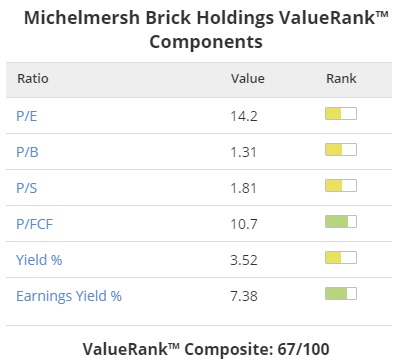
These figures don’t seem to suggest any serious concerns, but they do suggest to me that the shares are fully priced based on recent performance.
Despite this, I’m attracted to the low price/free cash flow ratio, which suggests that this firm’s operations generate plenty of cash. The Stockopedia stats seem to confirm this. Free cash flow has totalled 26.9p per share over the last six years, compared to reported earnings of 19.9p per share.
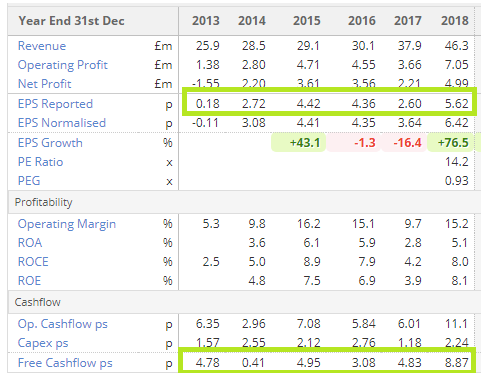
You may be wondering about last year’s surge in profits. This was due in part to the contribution from Carlton brickworks, which Michelmersh acquired for £31m in 2017. This was a big acquisition for an £84m firm, but it seems to be working well so far. A modest equity raise and good cash generation has kept debt levels low - net debt fell from £17.5m to £12m last year.
The firm’s acquisitive streak has continued this year. In February, Michelmersh acquired Belgian brickmaker Floren for €9.4m. Again, this was partly funded with a placing to keep debt levels down. Although some shareholders might regret the dilution, I don’t have a problem with this, assuming the deal stacks up in other regards.
The 2018 results include a comment from chairman Martin Warner, who says that these acquisitions have demonstrated the group’s “ambition to expand” while staying within “strict parameters to preserve the character and position of Michelmersh in its sector”.
I certainly hope the second part of this statement is true. It would be a shame if repeat acquisitions started to threaten the group’s excellent cash generation and solid balance sheet.
On balance, I don’t think Michelmersh looks especially cheap on historic numbers. But the prospect of continued strong growth suggests that the price may be fair.
Stable quality
Michelmersh specialises in upmarket bricks. But do the numbers reflect this focus on quality?
A QualityRank of 94 looks promising:
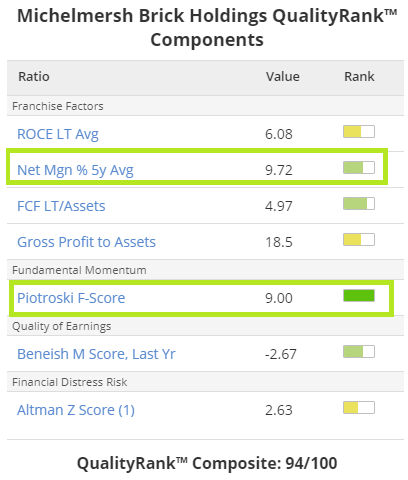
The five-year average net profit margin (after-tax margin) of 9.7% seems pretty good. I’m also happy to see the Piotroski F-Score of 9/9. This fundamental health score covers areas such as profit growth, cash generation and balance sheet strength. I view it as a good indicator of overall health.
What’s less impressive is Michelmersh’s long-term average return on capital employed (ROCE) of just 6.1%. Sometimes this average can mask a trend, so here are the year-by-year figures:

Stockopedia uses reported operating profit to calculate operating margin and ROCE, not adjusted operating profit.
In 2017, the company recorded various one-off costs and gains relating to the Carlton acquisition. The aggregate effect was to reduce reported operating profit by £1.6m. Adding these back in gives an operating margin of 17% and ROCE of 7.4%.
On this basis, I think it’s fair to say that the increase in profitability seen in 2015 has been consistently sustained. Another solid year in 2019 should see the firm’s long-term average ROCE improve as 2013 drops out of the figures.
We’ve already seen that cash generation is good, so I’m happy to give Michelmersh a clean bill of health in terms of quality.
Mixed momentum
A look at the Michelmersh share price chart since 2004 suggests that buying at this point carries some cyclical risk:
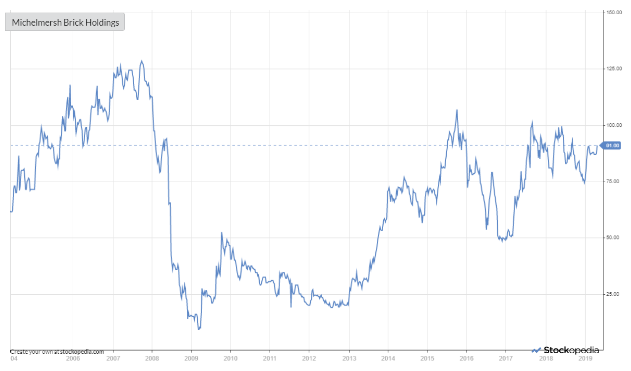
Cyclical risk aside, the momentum picture seems mixed:
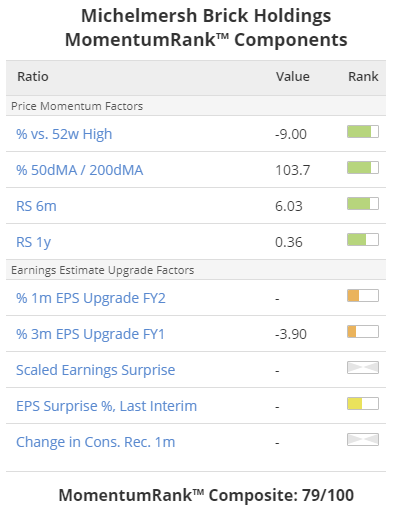
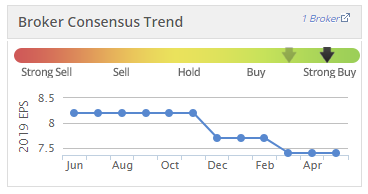
The stock’s price momentum looks good but earnings estimates have been falling. This is more clearly shown by the broker forecast trend, which I find very useful:
Looking at Michelmersh from a neutral perspective, I think it’s fair to say that the shares aren’t intrinsically undervalued. The investment case depends on continued growth.
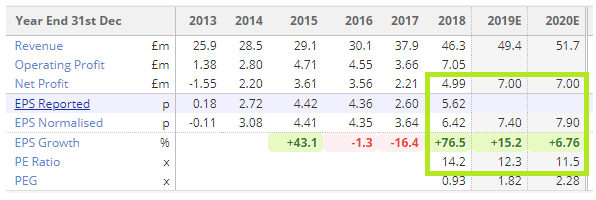
The firm’s house broker appears to be getting nervous about this and has cut forecasts over the last 12 months. But earnings are still expected to climb by about 15% this year, thanks to strong UK demand and the contribution from the Floren acquisition:
My decision: I feel that investing in a brickmaker is probably less risky than buying housebuilding stocks at the moment. Michelmersh passes all of my screening rules and appears reasonably valued with a positive outlook.
I’ll add the shares to the SIF and to my own portfolio this week, after this article has been published.
Disclosure: Roland owns shares of Lookers and Macfarlane.
Disclaimer
This is not financial advice. Our content is intended to be used and must be used for information and education purposes only. Please read our disclaimer and terms and conditions to understand our obligations.

3 comments
There has been a very uninspiring AGM update from Ibstock (LON:IBST) this morning - they have made a "solid" start, there is an "H2 weighting", and their expectations "overall" for the full year are unchanged; all of the italics quotes are things I dread to hear in an update.
I had thought of buying Breedon (LON:BREE) after their results, though doing a comparison with Michelmersh Brick Holdings (LON:MBH) indicates that Michelmersh Brick Holdings (LON:MBH) is the stand out winner on many metrics.
The only thing that bothered me was in the AGM statement where they say that "the overall capacity of the five plants within the Group is fixed" - perhaps this just means that the plants are operating at maximum capacity, I don't know, but if there is no capacity growth possible then the only possibility of increased turnover seems to then be either an increase in the price of product unit price or by acquisition.
Hi Andrea,
That's a good point - acquisitions are one route to capacity growth, and this is what Michelmersh Brick Holdings (LON:MBH) has been doing.
The only other way to deliver significant capacity growth is to build a new factory, something market leader Ibstock (LON:IBST) has done recently (it's new 100m brick factory can nearly match the entire annual output of all Michelmersh Brick Holdings (LON:MBH) factories).
There's clearly a risk here - capital investment at the wrong point in the cycle could result in a big drop in financial returns for years to come.
I'm not sure how much pricing power producers have. There are segments in the brick market -- Michelmersh claims to offer premium products -- but clearly bricks are commoditised to a certain extent.
I would not expect above-inflation unit price growth to be a sustainable strategy, although it probably works during times of strong demand (the UK market is currently in deficit and importing bricks).
Ibstock reported "price and volume growth" last year but didn't split these factors out.
Regards,
Roland