SIF Portfolio: Can small Miton Group deliver big returns?

A couple of weeks ago, I mentioned that I would be keen to add small cap fund manager Miton Group to the SIF Portfolio. On that occasion, Miton was outranked by XLMedia in my screen results. But things have changed. At the time of writing, Miton is now the highest-ranked stock in my screen which isn’t already in the portfolio.
This gives me a welcome opportunity to look more closely at this promising stock. While fund manager Gervais Williams is a key attraction, does it make sense to invest in a small fund manager at this point in time? Is the group in a position to deliver rising returns?
Has Trump hit the portfolio?
Before I look at Miton, I want to take a brief look at last week’s biggest story. I have to admit that I wasn’t really surprised that Donald Trump won the election. I was on vacation in the US in October, and the support I saw for Trump in small towns and rural areas of the north east was overwhelming.
Watching the US television coverage of the campaign felt very much like a rerun of Brexit. The issues and characterisations on both sides of the debate were much the same, just scaled up!
Getting back to the markets, the initial impact on the portfolio has been marginally positive. Trump’s pledge to boost infrastructure and defence spending lifted the portfolio’s holdings in Somero Enterprises, BAE Systems and John Laing. After a flying start, gold ended the week lower. Pan African Resources fell slightly as a result. The remainder of the portfolio was pretty much flat.
I remain happy with most of the portfolio, but it’s not always easy to measure whether a portfolio has the characteristics you’re targeting. Luckily, Stockopedia’s Folio system provides some excellent tools to help with this. One example is this snapshot, comparing key portfolio ratios with the market averages:
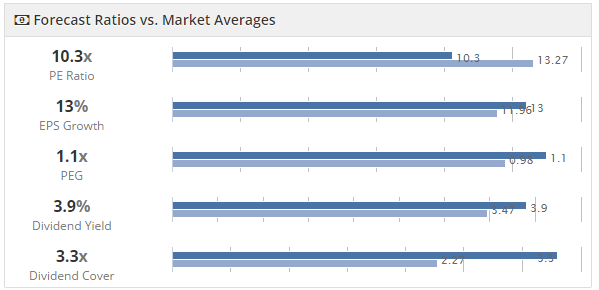
The dark blue lines represent the SIF Portfolio, the light blue is the market average. I think it’s fair to say that the portfolio is meeting its brief of “Affordable Growth. A blend of value, growth, quality and momentum.” The only area where I’m falling short slightly is the PEG ratio, which at 1.1 is slightly higher than the market average.
Let’s move on and take a look at Miton Group.
Is the future small?
Fans of Gervais Williams, Miton’s managing director, will recognise the title of his latest book, The Future Is Small. For an introduction to Mr Williams' investing style, I’d recommend both the book and his interview with Ben Hobson earlier this year. In a nutshell, Mr Williams is a specialist small-cap investor.
Gervais Williams isn’t the only fund manager at Miton, but he is jointly responsible for managing almost 50% of the group’s assets. In my view there’s a degree of key person risk here, although it’s not a critical issue.
Miton had £2.7bn of assets under management (AUM) and £18.4m of net cash at the end of August. Adjusted pre-tax profit rose by 35% to £3.1m during the first half, while net revenue also rose by 35% to £9.6m, suggesting that underlying profitability remained unchanged.
The firm’s reported results have been mixed since the financial crisis. Judging from the 2014 results slides, this is probably because the group has shifted its focus heavily towards equity during this period, and undergone some restructuring. There have been significant shifts in AUM, but growth is expected to become more progressive.
Miton appears to have quite decent income potential, too. The dividend has risen by an average of 11% per year, since being reinstated in 2011.
Overall, my impression is that this is a well-run specialist firm that could make a good long-term investment. But what does Stockopedia think?
Improving quality
Miton’s StockRank of 95 is encouraging. The highest of this stock’s QVM ranks is its QualityRank, which was 84 at the time of writing.
A look at the QualityRank breakdown suggests that historic profitability (highlighted in green) has been poor, but that otherwise Miton is a quality concern:
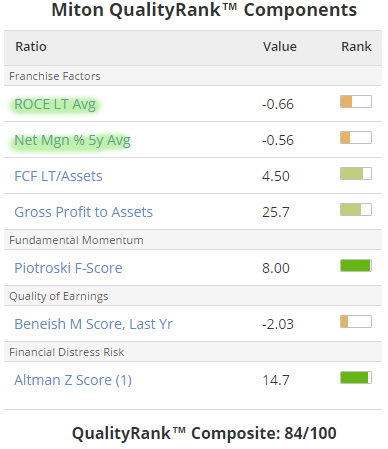
(Remember that the Beneish M Score doesn’t apply to financials).
Miton’s F-Score is 8/9, highlighting the group’s strong cash generation, lack of debt and stable profitability. I’ve no concerns here. What we do need to understand is whether returns are likely to improve. A negative long-term return on capital employed (ROCE) is not really desirable. Fortunately, it looks like returns have started to rise since the changes I mentioned were made in 2014:
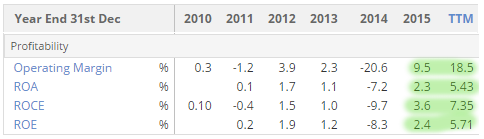
On this basis, I’m happy that the quality of Miton’s financial performance appears to be improving. Cash generation also remains strong, with net cash having risen from £8.4m in 2010 to £18.4m at the end of August. That’s quite significant, given the group’s market cap is just £51m. So does Miton offer good value?
Deceptively cheap
A ValueRank of 74 suggests that Miton is attractively priced, but not massively cheap. The group’s trailing P/E of 14.7 backs up this view. However, I believe some of the stock’s other ratios paint a more compelling picture of value:
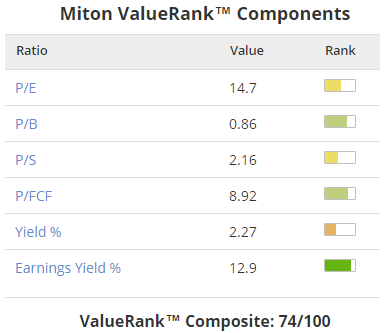
Regular readers will know how much I like Earnings Yield and P/FCF as measures of value. I think earnings yield (EBIT/EV) is a fantastic measure, because it offers a view on valuation and profitability that includes net debt or cash. Here, we see that Miton has an earnings yield of 12.9%. That’s well above my screen’s 8% threshold. Coupled with a P/FCF of just 9, these figures suggest to me that Miton has the potential to generate above-average returns for shareholders.
Improving outlook
After a year during which earnings forecasts have remained unchanged, Miton’s house broker has just increased its earnings forecasts for 2016 by 10%, to 2.1p per share. Given that this forecast comes from the firm’s house broker and is so close to the end of the year, I expect it to be reliable.
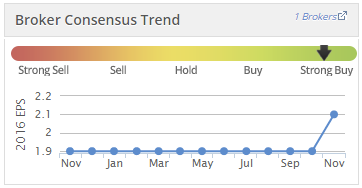
The upgrade puts Miton shares on a 2016 forecast P/E of 14, with a prospective yield of 2.7%. Further gains are expected in 2017, pushing down the P/E of 12.3 and lifting the yield to 3.05%. This guidance isn’t cast in stone, but certainly seems positive. Remember that the house broker for a small cap generally receives ‘guidance’ directly from the company being covered.
Should I add Miton to the portfolio?
One word of warning is that the spread on Miton stock can be quite wide at times. However, liquidity seems reasonable. About £55,000 of shares trade on an average day, according to Google Finance. That’s probably enough for most private investors.
The overall outlook is positive, in my view. Both Miton’s recent performance and its Stockopedia stats seem encouraging. I believe further gains are possible and have added Miton to my personal watch list. I will add Miton to the SIF Portfolio this week.
Disclosure: Roland owns shares of BAE Systems.
Disclaimer
This is not financial advice. Our content is intended to be used and must be used for information and education purposes only. Please read our disclaimer and terms and conditions to understand our obligations.

6 comments
Hi Roland,
Thanks for the interesting article. Miton (LON:MGR) is one that i have followed for a while, without ever holding. I like Gervais Williams as a fund manager and he is well respected amongst many Private Investors due to his past performance, affability and common sense. I looked at Polar Capital Holdings (LON:POLR) because George Godber and Georgina Hamilton were poached by them from Miton. They are both well regarded and possible future star fund managers? Which leads me onto the question of whether you also looked at Polar Capital Holdings (LON:POLR) for the SIF Portfolio? It's much larger than Miton, has a very high quality rank of 97.7 and value rank of 76.7. ROCE is high at 30% and it doesn't have any net debt. The yield (9%) is very high and the cover is low, which points to difficulties. Their biggest exposure historically has been Japan, but this has recently been overtaken by the US. I have recently purchased a few.
Best Regards,
Ben
"Gervais Williams isn’t the only fund manager at Miton, but he is jointly responsible for managing almost 50% of the group’s assets. In my view there’s a degree of key person risk here, although it’s not a critical issue."
It will be a critical issue if Mr Williams ever loses his stock-picking touch, retires, resigns or dies.
For some context, Liontrust Asset Management had about 80% of its AUM managed by two ace fund managers... who suddenly in early 2009 decided to quit.
Liontrust'sAUM was £3bn-plus at the time, and one year later -- even with a market rebound to boot -- AUM had dropped to just over £1bn as clients raced for the exits.
The over-riding trouble I have found with fund managers as investments for outside shareholders is that the businesses appear very much run for the benefit of the staff.
They enjoy pay rises and higher bonuses in good times of course... but even during times when AUM flatlines, employees can still take a greater slice of earnings to ensure 'motivation' is maintained.
Only in bad times do the staff take a hit (via redundancies), but those times are usually bad for shareholders, too.
Hi Maynard,
Thanks for your comments. I agree that the potential impact of investors running for the exits is quite serious. Neil Woodford at Investec is another recent example. Even if the manager's successors are equally able, the cult of personality can be very difficult to overcome.
Interestingly, Miton (LON:MGR) is in the process of switching over to a new remuneration structure. This will be "based upon a share of net revenues and adjusted for high investment performance". I haven't investigated the details but obviously net revenue is a synonym for fees in this context. So the situation you describe could potentially arise.
However, as always with my articles, this trade is made within the semi-mechanical framework of the SIF portfolio (a virtual fund). Although I have the discretion to turn down qualifying stocks, I wouldn't normally do this unless I there is something that about the firm which makes me uncomfortable or is demonstrably high risk. In Miton's case I don't think this applies.
Regards,
Roland
Roland (and adding to TMFMayn's point #1)
What has struck me most about the Miton (LON:MGR) pick is risk, i.e, picking up on your point above with regard to 'high risk'. I wonder if Miton (LON:MGR), whilst admirable on several factor scores, might not be a rather risky consideration with regard to its contextual risk profile?
In its own right it is a small cap equity (£51.1m Market cap) and thus somewhat risky. To compound on this, its success depends on it attracting an increasingly large base of customers (investors) who are interested in small-caps, but customers who will only be attracted if Miton (LON:MGR) demonstrates that its funds offer an advantage over competitors or less expensive options such as ETFs or trackers. Finally irrespective of its own performance as a business, its own share price will be influenced by the volatility of the small-cap market over which Miton (LON:MGR) has no control.
It wonder therefore if this particular addition to the SIF might not be a rather binary diversification choice: if the small caps perform it is likely to do well, but if they do not, I cannot see an upside, only a downside, as everything about the company hinges on one thing, the UKs small-cap index?
A reason these thoughts occur to me is that I got hit when Aberdeen Asset Management (LON:ADN) took a tumble post April 2015. They had respected managers and funds and were a good company, but concentrated into a particular market, their markets got hit and their share price took a big hit and has not yet recovered.
Regards
Howard
Hi Howard,
You make a good point about Miton's performance being inextricably linked to that of the wider stockmarket. But that could cut both ways. Your judgement that the stock offers "only a downside" seems to imply that the market is destined to crash. This isn't necessarily the case in the near future (although it will obviously happen at some point down the line).
I understand that your view may be coloured by your recent experience with Aberdeen Asset Management (LON:ADN). The SIF Portfolio is designed to avoid that sort of subjectivity and focus only on the numbers. Based on current fundamentals and recent trends, I think that Miton (LON:MGR) looks quite attractive. It also meets the criteria for inclusion in the portfolio, hence my decision to add it to the portfolio.
One final note -- it's worth pointing out that SIF portfolio stocks, aren't necessarily long-term holdings. Stocks are reviewed after six months and may be sold at that time. So what works for the portfolio (hopefully!) may not work for longer-term investors.
As always, please DYOR. My articles reflect my opinions and the progress of my SIF Portfolio experiement. They are not advice!
Regards,
Roland
Roland
Thanks for the rapid response. Ok, the six month review aspect of the SIF methodology does resolve my points about Miton (LON:MGR) as a pick. Thanks for the clarification, I had forgotten that part of the process and I can now see how complimentary it is to a 'focus only on the numbers' approach.
Regards
Howard